

Home Blog Page 446

Student inspires others in fight against climate change

0
Joseph Quigley

Amidst honking horns, cheering allies and occasional jeering, Jürgen Shantz remained steadfast in his protest against climate change inaction.

The crowd alongside him has dwindled over the course of his protest on four-consecutive Fridays, from more than 40 strong to approximately 10 by his final demonstration April 12. His fellow Haliburton Highlands Secondary School students had not joined him consistently. Although elementary students and adult activists have come, the protests have also attracted negative attention from skeptics.

Despite the challenges of losing out on class time and balancing a schedule with school sports, Shantz said he did not want to stop coming.

“I didn’t want to disappoint people,” Shantz said. “I really want to grow up in a world where I don’t have to worry about this kind of stuff anymore.”

Shantz was inspired to start demonstrating by Swedish student Greta Thunberg, who has become internationally-acclaimed for not attending high school to protest climate change inaction.

He made his mind up to follow in her footsteps and began protesting outside the Dysart et al municipal building March 22.

“I’m not that much of an outward person, so starting this was pretty difficult for me,” he said. “It was also difficult getting the word out there. But I had to do it.”

The support came quickly, with adults and activist groups spreading the word.

“It means a lot to me,” Shantz said. “I was just really scared of nobody being here, but at least 40 people showed up (to the first protest).”

Bonnie Roe joined in the protests each week and said the youth attending would learn a lot from the experience.

“They’ve received tons of support and I think it’s going to help them realize we can have a voice,” Roe said.

Not everyone has supported the effort. The protest has attracted negative attention on social media. One driver passing by on the final day of protest called it crazy and said not to “use the kids.”

“I thought that specific case was hilarious,” Shantz said. “I was the one who started this, so they’re not using me.”

“There will always be a few naysayers,” Roe said. “We should admire the depth and insight they have about such a serious issue as climate change, not undermine them as not understanding or following adults.”

Shantz said government action on climate change at all levels is critical.

“They’re the people who have the power to do things,” he said. “We really need governments to get on board with this.”

Although Shantz’s weekly protests are ending, he plans to co-ordinate local demonstrations in solidarity with international ones. The next one is planned for May 24.

He said he hopes that he can attract more of his peers to attend.

“I accomplished about half of what I was hoping. I was hoping a lot more students would show up which didn’t happen,” Shantz said. “But a lot more people seemed to be paying attention to the subject.”

Job board overflowing at Fleming Crew Employment Centre

0
Joseph Quigley

Job seekers can expect to find a wide array of openings ahead of the busy summer season in Haliburton at Fleming Crew Employment Centre’s job fair April 25.

The fair seeks to connect people with a range of employers, including municipalities, hospitality and trades sectors. A total of 20 employers have registered.

Information and reception assistant Sarah Adams said the fair comes in response to high demand from employers. She noted the Fleming Crew job board is overflowing, with more than 150 postings.

“It seems like we have a lot of job postings so we’re trying to get more people out to connect with employers,” Adams said.

“There’s a labour shortage,” employment and training consultant Kim Quigley said. “Any employers locally, you’ll hear them say they have issues finding staff. It’s a real challenge.”

Quigley said the difficulties have been year-round, citing a lack of housing and transportation as issues in the local job market.

Fleming is looking to address some of the gaps in the local job market. Fleming College’s Academic Upgrading program is running a computer course from May to June to help people get the skills employers are demanding.

“There’s still a bit of a gap, especially here in Haliburton. The internet is not readily accessible so people, they’re just not selfteaching themselves,” program co-ordinator Marion Willemsen said.

Prospective employees attending the job fair should come prepared, Adams said.

“They should definitely bring multiple copies of their resume,” she said. “Make a good first impression, that’s important. They should do some research ahead of time.”

Willemsen said job seekers looking to break into the market can come to Fleming Crew for help with resumes, interviews and more.

“We have this awesome service hub here with lots of resources,” she said. “We can even help people get here if they are challenged in reaching out to us here. The resources to make themselves more employable are here.”

The job fair takes place at the Pinestone Resort from 11 a.m. to 3 p.m. Transportation can be arranged by contacting Fleming Crew at 705-457-2020 or flemingcrew@flemingcollege.ca.

Alberta gas and oil CAO pleads for Ontarian’s help

0
Lisa Gervais

The CAO of Alberta-based NuVista Energy was in Haliburton Monday, talking about the energy crisis in Alberta and how it relates to business in Ontario.

Jonathon Wright was joined by Haliburton-Kawartha Lakes-Brock Member of Parliament Jamie Schmale and Haliburton Highlands Chamber of Commerce manager Jennifer Locke at the Bonnie View Inn in front of a handful of guests for a discussion and lunch.

Wright said he’d come to “just have a good fireside chat about energy, about Canada and about oil and gas.”
In addition to being the CAO of NuVista, Wright sits on the board of the Canadian Association of Petroleum Producers (CAPP).

Most of NuVista’s operations are based near Grand Prairie.

Wright said there are “a lot of misconceptions about what is happening these days” around greenhouse gas emissions and climate change as it pertains to Canada’s natural gas and oil industry. He said it is driving anti-industry rhetoric despite Canada being “the cleanest, most ethical producer [with] the highest standards in the world.”

He said it’s projected the world will need 27 per cent more energy by 2040. While he lauds the phasing out of coal, only two per cent of the world’s energy is now being supplied by renewables, such as wind and solar. That number is projected to be only six per cent by 2040 “after trillions are spent,” according to Wright.

Consequently, he said consumers still need other forms of energy, such as natural gas, oil, nuclear and hydroelectricity.

He noted Canada is the fifth largest producer of natural gas, and the sixth of oil, but is lacking investment and support. It’s gone from $81B invested in 2014 to $41B last year.

Wright emphasized that Canada needs to connect to the rest of the world via pipelines but the challenges are coming from within our country.

He attributes that to large federal government deficits; the national carbon tax; failure to expand pipeline capacity; two federal bills that are anti-pipeline and anti-marine tanker (Bill-C-69 and Bill C-48) and red tape.
He emphasized it’s not just an Alberta problem since Ontario benefits from 63,000 oil and gas sector jobs and the oil sands spend $1.9B in Ontario on supplies and services. And, yet, “entire provinces seem to think it’s okay to hold up nationally-important infrastructure projects that are critical for another province’s structure.”
He went on to say marine tanker oil shipments have doubled since 1970, yet the number of spills over seven tonnes has dropped dramatically.

He showed a slide with pipelines running all across the USA and into Canada and commented, “explain to me why we are worried about the next pipeline … the next pipeline will be the safest pipeline ever built.” He conceded there are spills from time to time, and while “terrible,” they are minor, quickly cleaned up and the faulty pipes taken out of service.

He said while there have been strides to reduce consumption, there remains a demand for gas and oil so, “we need all Canadians’ help to get pipelines built … all we want to do is go to work … we’re all part of the solution … we’re all part of the problem … we’re all using the stuff.”

School board preparing to cut teachers

0
File

The Trillium Lakelands District School Board (TLDSB) and its teachers are bracing for job losses due to provincial government cutbacks.

The province has indicated it will be raising the funded average high school class size from 22 to 28, as well as an increase at the Grade 4 to 8 level from 23.84 to 24.5. It has also said boards cannot count on the continuation of local priorities funding, which provided more special education staffing to support children in need, “at-risk” students and adult education.

TLDSB director of education Larry Hope said the board has not finalized what the cuts will amount to but estimates $7.4 million in reduced funding. Board wide, Hope estimated a reduction of approximately 23.5 high school teaching positions and 15 elementary teaching positions.

“We are very, very concerned about being able to provide the excellent support that we have all become quite accustomed to and frankly have become very proud of,” Hope said. “We always want to ensure we can have the greatest support possible for all our learners.”

Minister of Education Lisa Thompson said April 11 school boards have been left in a bad position due to poorly negotiated collective agreements with staff.

“I appreciate the fact that there are some school boards experiencing financial pressures of teacher salaries and benefits due to proposed changes in class size,” Thompson said. “We’re going to be working with school boards as we go forward. We’re going to be investing in education and we’re going to help school boards get it right.”

Ontario’s 2019 budget plans for a $1 billion increase in education spending over the next three years, less than the rate of inflation.

Minister of Finance Victor Fedeli said balancing the budget was crucial to protecting core services.

“Do we really think our public education system will flourish when the government continues to pile on more and more debt? The answer to both questions is a resounding no,” Fedeli said.

Ontario Secondary School Teachers’ Federation local district 15 president Colin Matthew said the cuts will harm specialized programming in schools.

“These cuts will drive up class sizes in the core credits – bigger math and English classes, some of which are already at 33 students, meaning far less individual time for students,” Matthew said in a press release. “And will be the death knell for specialized programming like arts, technology and senior elective classes.”

Hope said the board will have a clearer idea of its staffing picture in May, as teachers declare retirements.

“We’re watching very closely to see what the (provincial) budget brings us,” Hope said. “And what we’re going to be able to do, and what we’re going to have to do, to protect the excellence in programming.”

No charges in dog welfare case

0
Submitted

The OPP and OSPCA are not laying charges in a case involving a group of dogs in poor condition on a Haliburton-Bancroft border property.

The case involved a group of more than 20 dogs, whose alleged images went viral in a Facebook post Feb. 22. The dogs were taken in by the Siberian Husky Assistance and Rescue Program (SHARP) in Peterborough as officials investigated the situation.

Bancroft OPP Const. Philippe Regamey said the investigating officer had finished and no charges would be laid. He noted the owner had already been getting assistance from SHARP before police involvement.

“The owner was already in contact with them and getting support as he was unable to care for them, Regamey said. “Once we were involved, we expedited that process and the dogs were removed and cared for.”

The dogs attracted attention in a Facebook post from Jennifer Martin, who attended the scene with OPP. She described the dogs as being too weak to stand, with no food or water to be found.

Martin said she suspects the investigation may have been impacted by the transition of animal welfare investigations between OPP and Ontario Society for the Prevention of Cruelty to Animals (OSPCA). The OSPCA announced March 4 it would no longer investigate and enforce animal cruelty law once its contract expired April 1.

“I sympathize with the OPP and OSPCA,” Martin said. “It was just really bad timing to get this situation properly investigated by cruelty experts.”

Both OPP and OSPCA told The Highlander the other organization was the lead on the investigation.

“We as the OPP were waiting to hear back from the OSPCA, who were taking the lead,” Regamey said.

“Our role was one of support, as police have the same jurisdiction as Ontario SPCA officers,” OSPCA
associate director of communications Melissa Kosowan said.

In an email March 28, SHARP board member Sally Kirkby said the dogs were still under its care.

However, Martin said she and other animal welfare advocates have become concerned by the lack of status updates on the dogs.

“We just want to make sure these dogs have been cared for and rehabilitated,” Martin said.

SHARP did not respond to a follow-up request for comment for more details about the status of the dogs and what happened around Feb. 22.

“We will not be doing any follow-up stories with any media/publication regarding these or any other dogs through our rescue,” Kirkby said. “We would just like to get on with our rescue work.”

Province over-promotes alcohol

0

The NHL playoff season is in full swing and so, too are its accompanying beer commercials.

From a young age, these ads tell us alcohol is synonymous with good times. A right of passage. This is all despite the serious health risks the substance poses.

Three million people died because of harmful use of alcohol – representing one in 20 global deaths – in 2016, according to the World Health Organization (WHO).

“It’s time to step up action to prevent this serious threat to the development of healthy societies,” the director general of WHO said.

Which brings us to our provincial government’s obsession with promoting alcohol use.

Less than a year into office, our government has already brought a lot forward on alcohol, even appointing a new special advisor to review it. The infamous buck-a-beer has been followed up in the 2019 budget with plans to legalize tailgating as well as allow municipalities to legalize drinking in public spaces. Legal serving hours are also being extended.

Referring to the booze-friendly measures in the budget, finance minister Vic Fedeli called it treating “adults like adults.”

But goodness knows we cannot trust all adults to make healthy decisions when it comes to alcohol. MADD Canada shows 55.4 per cent of lives lost in fatal road crashes in 2014 tested positive for alcohol and/or other drugs, representing 1,273 people. Statistics Canada found in 2016, 19 per cent of Canadians aged 12 and over reported alcohol consumption which would classify them as heavy drinkers.

These dangers are why so much health awareness campaigning happens around alcohol and impaired driving. But these pro-alcohol measures the province is introducing undermine those.

It is bizarre that the government is spending so much effort promoting a substance that is a net negative to public health at a time it is trying to find cost savings in its health system. How did this make the list with all the different things Ontario Conservatives are trying to do with their first mandate in over a decade?

This also comes at a time when our country and province are still trying to figure out cannabis legalization. Although its woes may have been overblown in the short-term, navigating it in the long-term will have its challenges. If there is a right time to be trying to work on alcohol deregulation in isolation, this is not it.

These moves are flashy and might prove popular “for the people.” Our culture associates alcohol with good times and partying, something I am sure the government would like to piggyback onto. We are strangely permissive when it comes to alcohol compared to other drugs, which helps these kinds of changes pass with little pushback compared to something like cannabis.

This might also be a roundabout way of generating more revenue from alcohol taxes, even though a Liberal-planned alcohol tax increase was paused at the start of its term. Ontario generated over $1 billion in sales taxes off alcohol in 2016-17 according to Statistics Canada. More people drinking is more money for the province.

None of this is to say alcohol cannot be enjoyed responsibly. Like most things, there is nothing wrong with it in moderation. Alcohol can be part of a good time and that is fine.

But we should not turn a blind eye to the severity of its health risks. Our government is as guilty of that as our culture is. If the province does not want to limit people’s unhealthy choices, it becomes incumbent on all of us to try and do so.

Budget: VDO says seniors dental plan has gaps

0
Joseph Quigley

Haliburton’s Volunteer Dental Outreach (VDO) is expressing concern about the requirements for a new low-income senior dental program introduced in the 2019 provincial budget.

The program was revealed with the budget April 11. It would offer dental services for low-income seniors at community health centres across the province. It is expected to begin this summer.

“At least two-thirds of low-income seniors do not have access to dental care,” Haliburton-Kawartha Lakes-Brock MPP Laurie Scott said in a press release. “There are over 3,000 low-income seniors (in the riding) … who could potentially benefit from this program.”

However, VDO director Lisa Kerr noted the Ontario Dental Association has expressed opposition to the program due to the requirement for seniors to travel to government-run centres to get treatment from dental teams they may not know.

“If that’s the case, I would expect that Haliburton seniors would be expected to travel to the public health dental offices in Lindsay and Port Hope,” Kerr said. “Which would be impossible for most who cannot afford the gas or travel expenses to these clinics.”

Kerr said the board would wait for full details of the plan to make any adjustments to VDO.

“Our board will discuss if and how our financial screening process will be modified to best serve the needs of the community,” she said.

Scott praises budget

Scott praises a number of measures in this year’s provincial budget impacting the riding. The budget lays out a plan to achieve fiscal balance in five years.

The budget offers measures aimed at helping the skilled-trade sector, including a new flexible framework to allow for training and certification between different trades.

“Budget measures aimed at job creation and a modernized framework for skilled trade apprenticeships will benefit workers and small businesses across Haliburton – Kawartha Lakes – Brock,” she said.

The province also announced it intends to create a Housing Supply Action Plan to address barriers that prevent people from getting housing and reduce “red tape” around housing development.

Scott also spoke about the new Childcare Access and Relief from Expenses (CARE) tax credit, offered to families to help with childcare expenses.

“The CARE credit will provide much needed relief for local families who are struggling with the cost of child-care,” she said.

Mixed review from county warden

County warden Liz Danielsen offered both commendation and criticism over different aspects of the budget impacting municipalities.

“The province’s commitment to reducing the deficit is commendable as long as that isn’t at the expense of our environment,” she said.

Danielsen said she supported the province investing $315 million over the next five years toward projects to expand cellular and broadband coverage.

“This has been a priority for County Council and will contribute considerably to improving the ability to do business in the County and beyond,” Danielsen said.

She also praised measures to increase long-term care beds, increase the stock of low-income housing and reduce the cost of policing on municipalities.

However, Danielsen said she was concerned by news of the government’s plans to reduce the number of paramedic operators, merging 59 municipal paramedic operators into 10 regional ones.

“(That) could create a serious reduction of services in rural Ontario and an unknown financial loss to the county,” Danielsen said.

Minister of Health spokesperson Hayley Chazan said no paramedics will lose jobs as a result of changes to the system.

“As we move our modernization agenda forward, we are working directly alongside frontline paramedics and our municipal partners to ensure emergency health services can better meet the needs of Ontario’s communities,” she said.

The province is also not increasing the provincial gas tax share to municipalities which the Association of Municipalities of Ontario said was unexpected.

“The plan to reduce the province’s gas tax program will likely create greater challenges for municipalities that run, or are considering the establishment of public transit services,” Danielsen said.

Minden transformer station to be expanded

0
Lisa Gervais

Hydro One held an open house in Minden Tuesday night to talk about its planned expansion of the Minden Transformer Station starting mid-June.

Manager of projects Gianni DiFilippo told The Highlander it’s a $33-million investment. He added it would both improve reliability to existing customers and support future growth.

In a community notice sent out to affected residents, Hydro One’s community relations officer said that much of their transmission system was built in the 1950s and is in need of investment.

Melissa Raby said that in Minden, once complete, the Hydro One expansion will provide much-needed electrical capacity for the Minden and Haliburton areas.

The station is located on Haliburton County Rd 21 in Minden Hills.

“Investments in the system today will help protect the public, ensure reliability and offset far more costly work in the future,” Raby said.

Included in the work is: Installation of the new T1 transformer in its permanent location on the northwest side of the station; tree removal on Hydro One’s property and extension of the station’s fence by approximately 0.28 hectare; installation of the new T2 transformer and associated equipment; installation of two new buildings which will house critical electrical communication equipment and removal of the old T2 transformer and associated equipment.

The utility also announced that the trees they have to remove will be going to Heat Bank Haliburton County. Spokeswoman Tina Jackson said it would represent about one-quarter of what they need for a year.

Work will be done primarily with equipment such as bucket trucks, all-terrain vehicles and heavy machinery.

“We understand construction can be disruptive and we appreciate your patience while we complete this important work,” Raby said. DiFilippo added residents would get a lot of notice before any planned disruptions.

The transformer was the site of a major fire on July 26, 2018 that knocked out power to 20,000 homes. The blaze caused significant damage to the station’s T1 transformer, which is a critical piece of infrastructure. Throughout the remaining months of 2018, staff worked to safely remove the damaged equipment and install a temporary replacement transformer.

Work is expected to be completed by March 2021.

They do it for love, not money

0
Lisa gervais

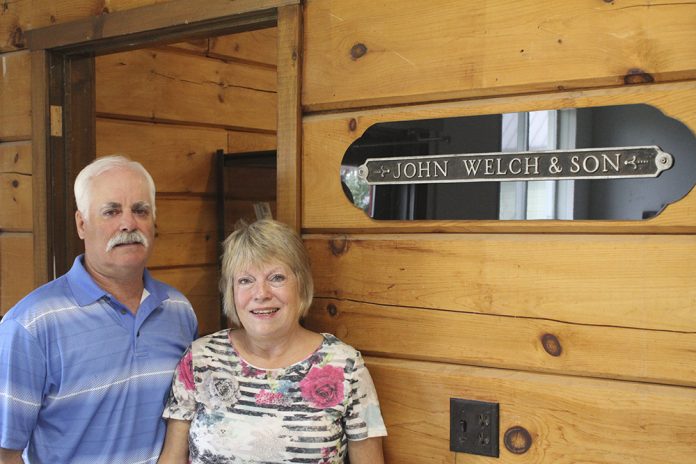
It’s for love, not money, that Judy Davis visits hospice clients while her husband Charlie plays music for HHHS patients and residents and puts in time at the fish hatchery.

The pair are a lot like numerous Haliburton County volunteers. They came from the city and were looking for something to do as well as give back to the community.

They’ve been doing just that for about 15 years.

“You need something to do when you’ve been so busy,” says Charlie. “You can’t just stop.” J

Judy volunteers for the Haliburton Highlands Health Services (HHHS). Charlie also helps out with HHHS, playing music at the hospitals or long-term care homes. He also does hours for the Haliburton Highlands Outdoors Association’s fish hatchery.

Judy is originally from the UK. She came to Canada in 1979. Charlie is a Dubliner by birth, leaving Ireland in the early 70’s. The couple lived and worked in Mississauga and then Brooklin. Judy was an executive assistant with a mapping company while Charlie worked for Enbridge for 37 years.

“We came up here one day and loved the area and decided this is someplace we’d like to retire to,” said Judy during a chat at the Haliburton Hospital café last week. Charlie came first and Judy joined him permanently
four years later.

Charlie started volunteering right away at the hatchery and later was persuaded to play music for HHHS.

“I was a fly fisherman,” says Charlie of his volunteer gig of choice. “It was something I was interested in and I’ve learned a lot there.

“I think the stuff that we are doing at the fish hatchery is vital to bringing tourism to Haliburton. We are stocking the lakes for people to come fish here and spend money to keep our economy going.”

He also plays the harmonica during his hospital and long-term care visits and says patients relate to it as an instrument from their era. With a high percentage of Alzheimer’s patients, who may seem catatonic most of the day, Charlie said the music moves them. He is thrilled when he sees them tapping their feet and bobbing their heads.

“So, obviously, it means a lot when you go there and you see the reaction of those people to the music.”

For Judy, she says that deep down, she’s always wanted to be a nurse. She added that her 93-year-old mother is back in the UK. Her brother helps to care for her but she can’t help but feel a little guilty.

“I always kind of think when I’m doing something here, I’m giving back to somebody doing something there.”

Judy visits with clients who are at, or near, end of life. She says sometimes clients feel as if they are taking her
time but “I do this because I choose to do this.” She said she has experienced death and end-of-life scenarios and “it’s having that empathy for other families and wanting to help them go through that.”

She said a lot of people have asked her: how she can sit with someone when they’re dying?

“But what you have to remember is, it’s not my mother, father, brother, sister. I’ve got a little bit of space. It’s very different. Somebody else will be better at it when it’s my mother or father.”

The couple said when it comes to volunteering, they get as much or more back than they give.

“I think it’s a win-win to be honest,” says Judy.

She said being one of the poorest counties in Ontario means there is a need for volunteers as well as donating money.

“I think Haliburton is fantastic because it really is a community. It’s got the most amazing people. They just keep giving and it never ceases to amaze me. It really makes you want to do your bit, too, because you’ve seen that wonderful community spirit.”

Charlie advises would-be volunteers to look for something that piques their interest. His love of fishing and music makes his volunteerism a natural fit.

“It is rewarding, when you find the right fit, and it might take you a couple of tries,” Judy agrees.

Gardens Retirement provides ‘road map’ for seniors project

0
Submitted

Gardens Retirement Development Inc. and their consultant, Greg Bishop, came to the Dysart et al March 26 council meeting to update councillors on their plans for 1 Sunnyside St. in Haliburton.

Bill Mardimae provided a handout to council outlining what he termed a “roadmap” of the project to date and going forward.

He noted one request is that they ensure the large development does not affect the quantity and quality of drinking water for its neighbours. They are awaiting a permit to drill a well and will have Cambium Inc. do appropriate testing.

The Mardimaes and Dysart et al are also digesting correspondence from the Ministry of Transportation and town planner Sue Harrison suggested a meeting as soon as possible with the MTO about items, including highway access to the site.

Harrison also publicly told the Mardimaes the property now has a “Holding” provision.

It emanates from an appeal to the Ontario Municipal Board from a different proposal on the site.

She told The Highlander, the OMB decision articulated site-specific zoning for the property which would allow the proposed development.

“The zoning included a list of specific conditions to be met and studies to be completed before the zoning could be actually put in place. Some of these items also required approval from the Ministry of Transportation and the Ministry of Environment, Conservation and Parks.

When all of these conditions have been met, the property owner may apply to the municipality to ask council to lift the “Holding” provision which would mean the site-specific zoning which is Residential Type 3 – Exception 8 Zone, will come into effect,” Harrison said.

Deputy Mayor Pat Kennedy asked about the aesthetics of the building and if it could be made to better reflect “Haliburton values and cosmetics.” Mardimae said the drawings to date are preliminary and changes would depend on practicality and cost of maintenance. The Mardimaes are hoping to come back to an April council meeting. They’d like to get shovels in the ground as soon as possible.