

Home Blog Page 372

HE proceeds on over-budget Cardiff pool repair

0
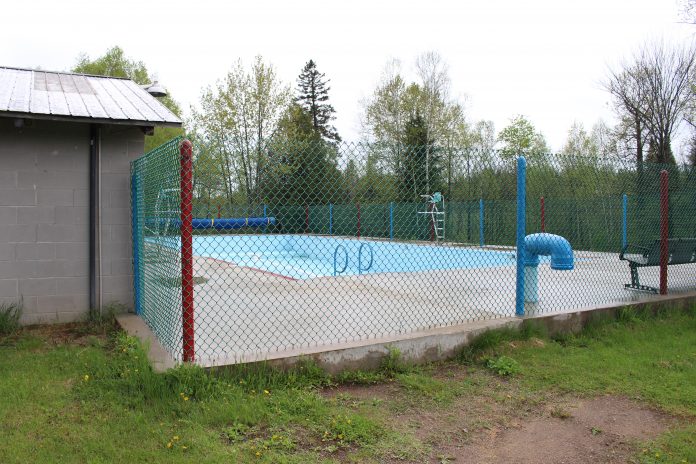
Highlands East council voted to go ahead with repairs at the Cardiff pool, despite the project going over budget. File photo.

Highlands East council is forging ahead with repairs to the Cardiff pool despite costs ballooning by $177,000 over budget.

CAO Shannon Hunter reported to council Nov. 10 that there was a lack of bids for the project, which includes repairs in the pool and mechanical room, as well as a replacement for the changeroom.

Originally budgeted at $200,000 this year, the only bids received were $130,788 + HST for the changeroom and $246,739 + HST for pool and mechanical room repairs.

Coun. Cam McKenzie read a prepared statement and said the municipality should go ahead with the repairs despite the costs, citing the important social aspect of the facility.

“It is difficult to put a value on a facility that’s taught hundreds of kids to swim over the past 50 years,” McKenzie said. “What is the value of getting our youth out of your home, away from computer screens, video games to enjoy sunshine, fresh air, and exercise?

“We are presented with a choice to continue with these opportunities for another 50 years. Let’s make it happen.”

McKenzie suggested the value looks better than what consultant WalterFedy put forward in a facility review December 2019. It recommended a replaced changeroom and mechanical room structure at a cost of $600,000. The consultant said ideally the pool would get replaced for $2.5 million but recognized that as a steep cost. McKenzie also noted a commercial-grade pool liner is included in the bid, something not considered in WalterFedy’s report.

Deputy Mayor Cec Ryall said he agreed with repairing the pool but questioned if the costs could be broken down.

“We should have a pool there. That’s not the issue here. Is there a way to separate some of the stuff, like the changeroom?” Ryall said. “Or are we faced with an all or none situation?”

Hunter said all three parts are needed – the mechanical room as a safety concern and the changeroom as an accessibility issue.

McKenzie suggested delaying the changeroom for another year. Ryall said it is worth considering if it could save $10,000-$15,000, given inflated material costs this year.

Coun. Suzanne Partridge said the project should move forward and disagreed with delaying.

“I’m not in favour of waiting and going out for tender again. It would be a gamble,” she said. “We have firm figures in front of us right now. If we’re going to do it, I think we really need to do it all next spring.”

Hunter reported contractors were advised the work must be completed by May 21, 2021. To pay for the added cost, council voted to budget the extra $177,527 plus HST in 2021.
Learning to continue on snow days

0
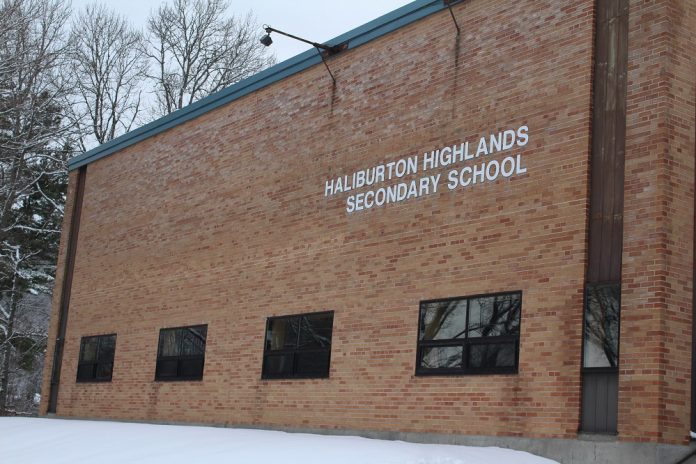
Trillium Lakelands District School Board is no longer allowing extra-curricular activities during the school day in the wake of ongoing teacher job action.

By Kirk Winter

When there are snow days this year, the Trillium Lakelands District School Board has decided it will close schools and students taught online.

In the past, when the bus was cancelled due to bad weather, parents had the option of driving their children to school for in-class learning. That won’t happen this year, the board determined at its Nov. 10 meeting.

Director of Education, Wes Hahn, outlined the new protocols.

Prior to this year, schools remained open on snow days. Every school had some students still come who would be combined together into makeshift classrooms so that some learning could occur. However, the health unit has told the board that the mixing of cohorts on snow days is not allowed.

Now, if buses don’t run, all schools will be closed to students. Custodians and staff that can safely make it to school will be present in the building.

Staff, whether stranded at home or at school, will be expected to deliver online learning from their location.

“Learning will be occurring on snow days and this may be a permanent change moving forward,” Hahn said.

Hahn cited the limited number of instructional days available, particularly in a secondary school octoblock, and said that even a couple of non-instructional days lost to inclement weather could have significant educational impact on student learning. Octoblocks are when students study one subject at a time.

Board discusses graduation pictures

Bobcaygeon area trustee John Byrne said parent councils have expressed concern about students not getting their graduation pictures taken.

Outside individuals, such as photographers, have been restricted from school property to help contain the COVID-19 virus.

“Families want these pictures and I wonder if they can be taken virtually,” Byrne asked.

“I understand that families want to have them because they are part of their memories,” Hahn said.

“Public health is working on a provincial protocol for photographers in schools and if one can’t be safely worked out, the board locally will try to figure something out regarding graduation pictures,” Hahn said.

Provincial money welcome

The province of Ontario has promised $700 million in school infrastructure funding that must be spent in 2021.

“I see our share of this money being spent on small projects that can get done easily this year,” Hahn said.

“I can see projects like HVAC improvements and water stations being the kind of project we would spend our money on,” he added.

The announcement of funding for broadband Ontario-wide was also greeted very positively by the board as a whole.

“We are thrilled,” Hahn said.

“There is a rumour that there is more money coming for technology,” Hahn shared, “and we are hopeful because we have spent every penny that we have up to this point.”

The board hopes spending like this will help improve equity and access to technology.

County welcomes year of staycation funding

0
Participants in a past tourism summit. File photo.

Warden Liz Danielsen said she welcomes a provincial tax credit for tourists aimed at making 2021 the “year of the staycation.”

The provincial government announced the credit in its budget Nov. 5. Although details have yet to be released, it will provide Ontarians with up to 20 per cent of eligible tourism expenses within the province. Ontario also announced a $100 million community building fund to support tourism, culture and sports organizations facing significant pressures in the pandemic.

Danielsen said the support is a positive development given the County’s dependence on tourism.

“The province’s commitment to invest in tourism, culture and sport is extremely welcome,” she said. “While we still await funding promised by the province for (Ontario Highlands Tourism Organization) to assist tourism operators with the losses they have seen this year, further investment will be welcomed and is needed to assist them through this ongoing crisis.”

OHTO expected the province to make a funding announcement for the region in July, but that was suddenly postponed and has yet to be announced.

The Tourism Industry Association of Ontario (TIAO) welcomed the provincial budget, noting the tax credit was a key pillar in its budget consultation process recommendations.

“This will (help) businesses stay competitive in the most dynamic industry in the world and safeguard the livelihoods of hundreds of thousands of Ontarians. This is an important first step to ensuring tourism is an integral part of our province’s economic recovery,” TIAO president and CEO Beth Potter said.

The provincial budget is also allotting business support.

Municipalities will now be allowed to cut property tax for small businesses, with the province to consider matching those reductions. But Danielsen said that is a “double-edged sword.”

“Allowing a property tax reduction to support small business during these difficult times sounds wonderful,” she said. “But the rest of the tax base (being all ratepayers) would have the burden of covering the shortfall.” She also offered praise for education tax rate reductions.

The province has committed to reducing business education tax rates for 94 per cent of all business properties in Ontario, to a rate of 0.88 per cent.

“We have been fortunate that the percentages for our education tax rates have remained stable over the last few years, but a reduction will definitely help municipalities and our ratepayers,” she said.

Danielsen said budgeting is challenging at all levels of government this year, but many aspects of the provincial budget work in the municipality’s favour.

“I am pleased to see so much emphasis placed on municipalities to help meet the challenges coming from the pandemic and assist in our collective recovery.”

YWCA receives $50K donation

0

Peterborough-based philanthropists, David and Patricia Morton of the Morton Foundation, have made a $50,000 donation to the YWCA Haliburton County.

The YWCA made the announcement Nov. 5.

In a press release, Patricia Morton said, “we are inspired by the courage of isolated and vulnerable women who are struggling to survive and escape from abuse and violence, and to build a better life for themselves and their children.”

She added, “we greatly hope that our donation will encourage others to help to support them and the dedicated and great work of the Peterborough Haliburton YWCA.”

The YWCA’s Ria Nicholson said the support comes at a critical time and they are “incredibly” thankful. She said the need for safety and specialized supports that address violence against women has increased steadily since the initial lockdown this past spring, particularly in rural areas.

“YWCA Peterborough Haliburton’s clinical therapist and transition support workers, who continue to work remotely by phone, text and email, are seeing between five and 10 new women per week reaching out for support,” Nicholson said.

YWCA executive director, Kim Dolan, added “recent trends in the County, with more cottagers opting to stay in the area, have resulted in an increase in calls to our Haliburton County services for information, support, and safety planning. We expect this to continue as the reports of abuse are more serious and complex given the heightened stressors brought on by the pandemic.”

YWCA outreach programming in Haliburton County offers clinical therapy and counselling, risk assessment and safety planning, systems navigation and referral, emergency client transportation, court accompaniment, and more.

The YWCA Women’s Centre of Haliburton County provides a home base for three part-time transition support workers, one full-time clinical therapist, an office coordinator, and an independent family law lawyer.

Members of the community who wish to donate, or find ways of supporting YWCA crisis and support services, are encouraged to contact Nicholson directly at 705-743-3526 x113 or rnicholson@ ywcapeterborough.org.

If you, or someone you know, needs support, contact the 24-hour support and crisis line: toll free 1-800-461-7656; phone 705-286-6442 or text 705-991-0110. YWCA receives $50K donation YWCA is Haliburton County’s only shelter for women and children.

Cottagers with ties to County relieved at election result

0

Two Haliburton County cottagers, who live in the United States, say they’re relieved Joe Biden is set to be sworn in as the 46th president of the United States on Jan. 20 next year.

Like many Americans with ties to Haliburton County, Scott Shriver and Christine Jurusik were stressed and waiting anxiously as the Nov. 3 vote results stretched until Nov. 7 before a winner was declared.

“I had been scared to death of the possibility of four more years like the last four,” Shriver said. “Even one year of continuing to do nothing to contain COVID-19 was frightening to contemplate.”

US president Donald Trump has been criticized for not doing enough to fight the pandemic while President-elect Biden’s transition team has already announced a COVID-19 task force.

Jurusik said, “the democratic process took its time providing us with a new president as it was a very close race in many states.” She added she was impressed with the high voter turnout.

Shriver said while Biden wasn’t his first Democratic choice, he supported him over Trump. Jurusik is a Biden supporter but knows many people who supported Trump and said she can understand their position.

“I think his intentions were good at first and he initially wanted to do, what he thought, was best for the country. Many people believed that he did a good job,” she said.

However, as a U.S. immigration lawyer and an immigrant to the U.S., she has a different opinion since she sees first hand how some of Trump’s policies and executive orders “destroyed the lives and opportunities of good people. Hopefully, we will see a reversal of those policies before long.”

Shriver said he’s saddened the outcome “was not more of a total repudiation of the current presidency.”

The Associated Press said Trump has garnered 47.5 per cent of the vote as of press time.

Both Shriver and Jurusik said the sad legacy is a country divided.

“Trying to discuss issues such as racism, anti-feminism, anti-science, the value of truth, etc. is almost impossible when many people don’t think those kinds of issues matter,” Shriver said.

Even more disturbing is “we’ve lost our ability to solve problems through open debate and compromise. The debate is shut down in the halls of Congress before it begins and compromise is seen as weakness,” Shriver added.

Jurusik conceded, “the divisions are there, just like they are in Canada. The Liberal-Conservative dichotomy is not just a U.S. construct. We should not kid ourselves that we as Canadians are immune. “I see many of my Canadian friends and family criticizing the U.S. for how divided we are and yet these are some of the same people that hold strong political opinions either for or against the current Canadian leaders and express them frequently on social media.”

Ultimately, Jurusik thinks Biden will be more invested in improving the relationship between Canada and the U.S. than the Trump administration was. “That is a good thing. My sense is that he is a much more diplomatic leader who will be interested in uniting people and not dividing them.”

Library services return to smaller branches

0
The Haliburton County Public Library is bringing curbside pickup to Cardiff, Highland Grove and Gooderham. File photo.

The Haliburton County Public Library (HCPL) is bringing curbside pickup to its smaller branches in Highlands East.

HCPL announced Nov. 2 it would begin bringing books to patrons in Cardiff, Highland Grove and Gooderham for the first time since the pandemic began. People can place a hold on books for a once-per-week pickup day. The pickups will begin next week.

Branch services librarian Erin Kernohan-Berning said the small size of those branches makes opening them difficult due to the enclosed spaces, but they worked out a plan to at least provide curbside.

“Opening those branches wasn’t really an option,” Kernohan-Berning said. “Curbside, because it was successful in our larger branches, could be an option.”

HCPL has run pickup at its larger branches since June 25, including Dysart, Minden and Wilberforce. The three branches have also been open with limited hours since Sept. 8.

Kernohan-Berning said while navigating running libraries in a pandemic, staff have tried to be careful not to add too much at once. Getting service to smaller branches waited while HCPL worked through reopening larger ones. But with that going well, she said the time was right to expand services again.

“Needed to be able to find our feet each time we did something new,” she said. “I can definitely understand and definitely feel the frustration with some of the patrons in Cardiff and Highland Grove and Gooderham. They haven’t had library service in their community since March and that’s tough.”

Holds at the three branches can now be made through haliburtonlibrary.ca, or by contacting info@haliburtonlibrary.ca or your local library branch.

Kernohan-Berning said she expects a fair amount of demand for the three locations. She added although the library has a substantive online collection, people still want physical books.

“The library is more than just books, but this is definitely a reminder books are certainly an important part of the service,” she said.

Man drowns in Lake Kash

0

A 23-year-old Mississauga man drowned Nov. 7 in Haliburton County.

OPP say that on Saturday, at approximately 4:55 p.m., they, along with the Minden Hills Fire Department and Haliburton County Paramedic Services responded to reports of a drowning on Kashagawigamog Lake in the Township of Minden Hills.

They said Nov. 9 that Mohamed Amar Mukthar failed to resurface from the water while swimming.

They said the deceased was located by the OPP Underwater Search and Recovery Unit. A post mortem examination is scheduled to take place at the Centre of Forensic Sciences in Toronto.

County surrenders fight for health unit funding

0
The Haliburton-Kawartha-Pine Ridge District board of health is joining a new push for universal basic income. File photo.

The County of Haliburton is acquiescing to the province and local health unit over demands to increase its share of funding by 10 per cent.

County council agreed to pay the full $463,508 requisition to the Haliburton, Kawartha, Pine Ridge District Health Unit (HKPR), with only Warden Liz Danielsen opposed. The amount increased by $42,371 over 2019 levels as part of a provincial push to have municipalities foot more of the bill for health unit programming.

The County and City of Kawartha Lakes initially declined to pay the increase, protesting the sudden additional cost without any input. But after months of effort, the province and health unit did not budge on the ask.

“This continues to challenge me, where we pay for things that we have no direct supervision or control over,” Coun. Brent Devolin said. “Fundamentally, systemically, I just have a challenge with these sorts of things that fall on municipal taxpayers.”

CAO Mike Rutter said staff already budgeted for the amount in anticipation the County might have to pay it. He added the levy is expected to continue to rise, by about $46,000 in 2021 and $51,000 in 2022.

In a letter to Rutter, HKPR director of corporate services, Angela Vickery, said the province is reducing money allotted to programs it previously funded at 100 or 75 per cent, reducing it down to a uniform 70 per cent. The goal is to have municipalities uniformly paying 30 per cent for all programs.

For the HKPR health unit this year, that amounted to $1.216 million less from the province, but with the Ministry of Health (MOH) expecting it to provide the same mandated programs and services. Vickery said there was $773,300 in funding from the province to mitigate the impact this year. That funding is expected again in 2021, but not in 2022.

Deputy warden Andrea Roberts, the County’s representative on the board of health, said HKPR has worked to find cost-saving efficiencies. Rutter said many of those cost-saving methods were discussed in closed session as they involved identifiable individuals.

“They have made significant changes,” Roberts said. “But these are programs that are mandated.”

The province is undergoing a modernization of health units. The County had representatives at a regional consultation session in Peterborough December 2019. MOH spokesperson David Jensen said that process is still on pause due to the pandemic.

“Once the COVID-19 pandemic is contained and risks are mitigated for the people of Ontario, we will consider how to move forward with the modernization process,” he said.

Rutter said the goal of the County in withholding the funding was to get more information and send a message to the province about downloading concerns.

“In many ways, those goals have been accomplished,” Rutter said. “I know many members of council have discussed this informally with provincial representatives as well. And I really am confident the modernization process will address some of your concerns.”

Ford announces $680M in broadband funding

0

Premier Doug Ford announced $680 million for broadband and cellular connectivity across the province when he visited Minden Nov. 4. But it is not clear how many of those dollars will come locally.

Ford, joined by other officials including MPP Laurie Scott and Minden Hills Mayor Brent Devolin, announced the new funding at the Minden library. He said it’s part of the 2020 budget being introduced Nov. 5 and will go towards “shovel-ready projects” to connect underserved communities.

The new financing is not tied to any specific projects. But Devolin said he is hopeful the dollars could further the Eastern Ontario Regional Network’s proposed $1.2- $1.6 billion gig project, which could bring gigabyte-per-second internet speeds across the region but still needs funding.

“We’ve fully developed a business plan and are ready to go when the commitment from provincial and federal governments make this possible,” Devolin said. “I’m hopeful that this announcement by Premier Ford and his cabinet ministers today will be a piece of a part of a solution moving forward.”

The new funding will be rolled out over six years and is in addition to the $315 million the province has already allotted for its broadband and cellular action plan.

The new funding will also double the existing pool for the Improving Connectivity in Ontario (ICON) program to $300 million. The County is already applying for an ICON grant to bring more fibre connectivity to the area with private partners.

Ford said reliable broadband is critical for everyday life and noted the challenges of 1.4 million people in the province who lack broadband or cellular access. He referred to Algonquin Highlands resident Elaine Cole, who struggles to get consistent connectivity to contact her family. The Highlander wrote about Cole’s plight earlier this year.

The premier added praise for partners like EORN, citing the $213 million project underway to improve cellular service in eastern Ontario, which the province is investing $71 million in.

The funding “will help communities like Minden and Kawartha Lakes get access to their internet and cell service we all rely on,” Ford said. “We will continue to grow and expand our investments with our telecom and municipal partners to make every dollar count. Partners like (EORN), that have incredible track records.”

Scott said the day was a “watershed moment” for broadband and said they hope the federal government will release its universal broadband fund, aimed at supporting broadband projects across the country.

“Ontario has stepped up,” Scott said. “Ontario isn’t waiting any longer. That is why we are taking action today. There is no more important infrastructure project than broadband.”

“COVID-19 has highlighted the necessity for access to reliable, high-speed internet services for all Ontarians,” Devolin said. “More needs to be done. EORN looks forward to continuing to work with the Government of Ontario to help our community.”

What is Frost Centre’s future?

0

For years now, I have regularly driven Highway 35 N on my way to Dorset, Algonquin Provincial Park or Huntsville. I have also spent a great deal of time on the trails in and around the Frost Centre.

Every single time I drive by, or visit, I lament the emptiness of the centre and grounds and comment on its continuing deterioration. I can’t count the number of times I’ve said ‘if only someone would buy that and fix it up.’

For the first time in my years living in Haliburton County that may now be a possibility as the Province of Ontario recently put the property up for sale.

News broke late last week that a for sale sign had finally been installed outside the centre. Infrastructure Ontario, which is the Crown agency responsible for managing provincially-owned infrastructure and real estate, put it up for sale. CBRE Limited Real Estate Brokerage has it posted and the listing can also be found at Realtor.ca

For a lot of people, the sale came as no surprise. For some, it tug at a bandage that has been placed over a 16-year-old wound. Many locals worked at the Frost Centre for years until it was abruptly closed by the Liberals in 2004.

That closure still leaves a bitter taste in many local mouths. Some see the sale as the final blow to Leslie M. Frost’s declaration in 1944 that the school “may be the forerunner of other such establishments in Ontario.”

The closing was difficult. There were protests at the MNR building in Minden and at Queen’s Park. Former MPP Chris Hodgson is credited with doing a lot of heavy lifting to keep it open. But despite the best efforts of him, the Friends of the Frost Centre (which submitted an unsuccessful plan to take it over) and the Frost Centre Institute, which wound up in 2010, it was shuttered.

Algonquin Highlands Mayor Carol Moffatt said the province put the sale into effect as far back as 2012, sending a provincial surplus property notification to the County and AH, and in 2013 the province applied to sever the land now up for sale.

In its day, the Frost Centre was a fixture in the community. It linked the community to eco-education long before we worried about things such as Climate Change. Its history is deeply entrenched in the story of Dorset, Algonquin Highlands and Haliburton County.

I often run into people who worked there and have heard about the amazing work that was done. The Highlander has to agree with both Barrie Martin, a former Frost Centre employee and now tourism expert, as well as Moffatt. Martin envisions the Frost Centre continuing as a place of education about natural resources, ecology and climate change. Moffatt wants to ensure that the history is somehow honoured in whatever it becomes.

The buyer will have to be visionary. He, she or them will have to honour the trail system that runs through the land, and the launch to St. Nora’s Island. They will have to embrace the Haliburton Highlands Water Trails office and its hub of activity. They will have to love the land as much as we all do.

We will all be watching anxiously to see how this historic piece of Haliburton County can live on long into the future.