
Who would have thought the revolution would begin on Maple Avenue in Haliburton village?
Hats off to SIRCH, whose repair café is shining a light on consumption run amok and providing a counterpoint that’s 100 per cent in tune with who we are as Highlanders.
Back after a pandemic-enforced break, the repair café is an opportunity for people to get their broken stuff fixed; volunteers skilled with screwdrivers and Super Glue will resuscitate our dead consumer goods.
Big business won’t be happy. Over the decades, manufacturers have baked in obsolescence with products that are hard to fix.
The results, as we reported last week, are showing up in our landfills. The amount of construction and demolition waste in Dysart, for example, has gone up 38 per cent in a year, helping to double our costs to haul it away to the lucky place, out of sight and mind, with a big enough hole to put it in.
Meanwhile, we run down to Costco or log in to Amazon and get the shiny new thing. Perhaps we like it that way. Buying new makes us smile; ripping out and building back bigger makes us feel we’ve accomplished something.
But what if we know deep down it doesn’t work like that, and so we have a sensation in our stomachs that something’s amiss?
The “right to repair” movement is gaining traction. Legislators in the United States have passed laws requiring manufacturers to make things fixable. Attempts at similar laws have been proposed at provincial and federal levels in Canada, but nothing significant has passed yet.
The movement is having an impact, however. The latest incarnation, for example, of Microsoft’s Surface Pro computer allows you to replace the battery – that’s one less laptop in the electronics bin and more money left in our pockets. Last month, John Deere relented to allow farmers in the U.S. to fix their own tractors.
The repair café is part of this movement.
But this is more than just a bunch of folks pushing a rock up the vertical mountain of materialism. Instead, it’s reframing what a good life means. It’s telling us a new story about what makes us happy.
And that’s where the Highlands can be a seed of revolution.
Haliburton County is a place where what we do for the community counts for more than the size of our house, where GoFundMe requests get met within days, where saying hello to friends on main street is more valuable than the latest iPhone.
Our future will be secured only when we realize a thriving community and environment is what makes us happy. That hanging out for 30 minutes while we learn to fix our broken reading glasses is more fun than adding a new pair to our shopping cart.
The Highlands gets it right. We can be a beacon for how a community could be. And we can begin to repair our broken world.
Zoomed Out is a new column that looks at the big picture – the stories behind the stories.
Repairing our stories of happiness
A bridge to nowhere… for some
While constructing their new home on Koshlong Lake, Frances and Ken Hill figured if there were any problems, they’d cross that bridge when they came to it.
Unfortunately for them, it turns out the bridge is the problem.
As reported in today’s front-page story, many residents surrounding Koshlong Lake have been left stranded, quite literally, after a recent Dysart et al bylaw change implemented weight limits on the Koshlong Lake Road bridge. This comes after an engineering firm carried out a bi-annual study of the site in October, finding it’s not up to par with modern safety standards.
The bridge was built in 1960 and wasn’t designed to carry the kind of weight loads it was seeing, according to Rob Camelon, the township’s public works director. He went on to tell council at a Dec. 13 meeting that he believes this is more an issue of liability than safety.
Since then, the bridge has seen new posted weight limits of 16 tons for single-unit vehicles, 29 tons for two-unit vehicles, and 42 tons for three-unit vehicles. These limits are in place for the next five years.
This restricts the type of vehicles that can now cross the bridge. Think the kind of heavy-duty trucks used by the likes of Hydro One, propane suppliers, contractors, and moving companies. Camelon said the township had secured an exemption that would allow the local fire department’s pumper trucks to cross the bridge in the event of an emergency.
That’s all well and good, but what about people such as the Hills, who have seen construction on their new home come to a grinding halt? What of the people who rely on propane to heat their home? What are they to do right now if they run out?
Likely more of a coincidence than a concerted, two-hour effort, but Dysart council was quick to offer a solution. By the end of Tuesday’s meeting, they had arranged to purchase a new temporary bridge that they plan to install over the existing structure. The caveat – mayor Murray Fearrey thinks it will take about a month to install.
Considering Dysart has known about this for at least a couple of months, there should have been a better plan in place. This new temporary bridge should have been secured prior to reducing the weight limits, so that people such as the Hills weren’t affected.
One of the main gripes the Hills and Laurie Bruce, speaking on behalf of the Koshlong Lake Association, had, though, was they only learned about these changes through third parties. They claim there was zero communication from the township. This is an oddity considering the impact this was always going to have.
Camelon told council in December that he would be seeking to replace the bridge in 2024. He also warned that this kind of situation is likely to come up again, since the township has several 60-plus-year-old bridges within its borders.
We encourage council to start planning for these now to avoid further complications down the road.
Oceans – and global warming
In 2022, oceans were the hottest ever recorded. More than 90 per cent of the heat that greenhouse gases trap ends up absorbed in the oceans. Because sea surface temperatures significantly influence global weather, the warming of the oceans is “supercharging” extreme weather. More moisture in the air from hurricanes and typhoons causes intense rains and flooding, but also larger and more rapid intensification of hurricanes. Until recently, colder water from deeper ocean layers would have tempered a hurricane’s escalation.
Research released by the US National Oceanic and Atmospheric Administration this month show that the extreme weather events of 2022 were intensified by global warming and climate change. This international team of scientists said, “The Earth’s energy and water cycles have been profoundly altered due to the emission of greenhouse gases by human activities, driving pervasive changes in Earth’s climate system.” They added, “Measuring the oceans is the most accurate way of determining how out of balance our planet is.”
And they conclude that this warming of oceans, with its effects on weather and ocean life, will continue to increase unless we manage to reach net zero emissions.
WHAT CAN YOU DO?
• Keep waste out of the water system. All water on Earth is connected. Water down the drain or run-off from the yard ends up in rivers and eventually into the ocean. Pesticides, fertilizers, cleaning products and other chemicals reduce oxygen in the oceans, killing sea life. Even manure in the garden contributes to algae blooms in water systems that disrupt the natural balance.
• Reduce pollutants by choosing non-toxic chemicals and disposing of chemicals properly.
• Use as little fertilizer as possible.
• Reduce waste by cutting down on packaging and what is thrown away. What ends up in the landfill contributes to global warming and leaches into groundwater. Garbage is also a hazard for marine animals that try to eat or become entangled in it.
• Be informed about seafood options. Choose from sustainable seafood guides and eco-friendly fisheries.
• Boat responsibly, adhering to speed limits and “no wake” zones. Anchor away from animal habitat and endangered vegetation.
• Strictly follow catch limits when fishing. Practice catch and release.
• Choose low-phosphate detergents and non-toxic cleaning products. See Consumer Reports’ Greener Choices. Baking soda and vinegar are options.
• Avoid souvenirs and jewellery made from marine animals or animal parts, including shells and especially coral.
• If you have a salt-water aquarium, ask where and how the animals you buy were collected. Look for evidence of aquatic stewardship in pet stores and ask for animals that were carefully harvested and well cared for. And never release an unwanted pet into the ocean or any waterway. Organisms that don’t belong can crowd out the locals and disrupt the ecosystem.
• Reduce your carbon footprint. All fossil fuels burned (oil, gas, coal) add carbon dioxide to the air and contribute to warming oceans, also increasing acidification that makes it hard for corals and clams to build skeletons and shells.
• Power down. Try drying laundry on a clothesline or rack. Walk, bike, carpool to work or school. Replace light bulbs and older appliances with newer, more efficient models.
• Switch sources from burning fossil fuels, whenever possible. There are subsidized alternative energy programs that may work for you.
• Teach your children about climate change. A fun, informative and interactive resource is found at: climatekids.nasa.gov.
• Preparation for climate change includes readying for heavy rains and potential floods. What are some things you can do to reduce property damage from high winds and heavy rains? What about planting trees to support soil and reduce mudslides?
Time for a CT scanner
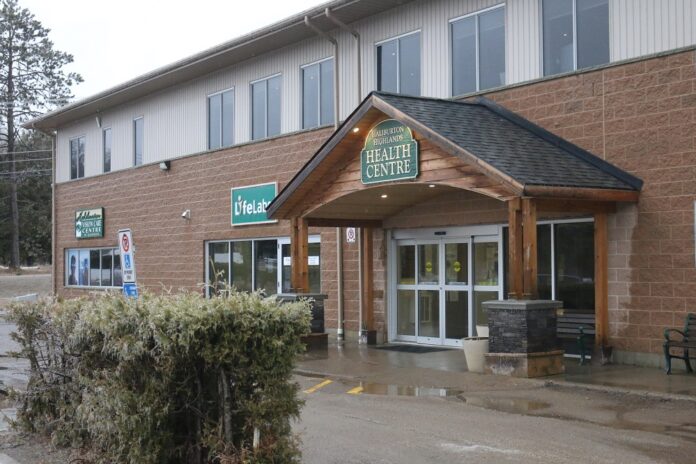
The push is on for a CT scanner for Haliburton County.
County of Haliburton staff and councillors have been talking about it for a few months. And, on Monday, Haliburton Highlands Health Services (HHHS) waded into the conversation.
HHHS said it had planned to include the addition of a CT scan machine as part of its master planning process.
CAO Carolyn Plummer said HHHS knows the diagnostic tool would make a positive impact in the community, and is something Highlanders have wanted for some time.
HHHS said it’s taken steps to do a feasibility study, to determine if it’s possible to proceed now, rather than waiting for the master planning process to be completed.
We think the answer to that question is start now. Do the study to demonstrate whether a CT scan machine is feasible and put a full application in to the Ministry of Health.
The County’s director of emergency services, Tim Waite, and CAO Mike Rutter, would be more than happy to sit down with HHHS staff to work on a feasibility study and application.
For months, they have been telling council the same story. County ambulances are driving south daily to take patients for CT scans. While in other jurisdictions, such as the City of Kawartha Lakes and Peterborough, they are being called to 911 emergencies. In some cases, they are sitting outside Ross Memorial Hospital in Lindsay and Peterborough Regional Hospital waiting to discharge their patients due to long off-loading times.
Having a machine here would also mean people who have to take HHHS transportation or private vehicles for scans would not have to take half a day to do that – spending money out of County in the process.
It would hopefully mean quicker diagnoses, allow us to be a healthier community with screening and preventative medicine, and attract the health care workers we so desperately need.
County officials talked about how their recruitment efforts are being hampered by the lack of a CT scanner. New doctors, in particular, don’t want to come to areas where there isn’t one. The machine is akin to a blood test in today’s diagnostic world.
Plummer said it would be a long journey requiring strong community support.
We don’t doubt the community’s willingness to help out. After all, it raised the money to build two hospitals. It supports the HHHS Foundation.
We can’t express the same confidence in the ministry of health or Ontario government – which have landed Haliburton County and other rural and regional hospitals in the mess they are in.
For example, we find it unfathomable that the provincial government allows private agency nursing companies. Having them in our hospitals to cover for nursing shortages is costing HHHS an exorbitant amount of money every month. Further, it is creating tensions between HHHS nurses and agency nurses since the agency nurses are making at least double the money of permanent staff.
The provincial government should instead have a pool of its own nurses that it can make available to rural and regional hospitals – and urban ones if needed – when they go through staffing shortages to ensure wage equity.
But that is another battle for another day. For now, we encourage HHHS and the County of Haliburton to work together on finding out if we can get a CT scan machine, estimated to cost $2.5-3 million, figure out how to raise the money, and get going.
Oceans – and global warming
PROBLEM:
The ocean is the Earth’s largest carbon dioxide reservoir. As CO2 levels increase in the atmosphere, they increase in the ocean, critically changing the pH and affecting marine life through ocean acidification. This process is increasing at an accelerated rate, now 10 times faster than at any other time in the past 300 million years.
At the same time, the vast majority (90 per cent) of heat from global warming ends up in the ocean. The top few metres of the ocean store as much heat as the Earth’s entire atmosphere. And since more than 70 per cent of Earth’s surface is ocean, the effects of ocean warming are extensive.
Heat stored in the ocean causes expansion, responsible for nearly one-half of global sea level rise. Record ocean temperatures were measured in 2021, followed by record sea water levels in 2022. According to the World Bank, there will be 143 million climate refugees by 2050 due to rising seas.
Coral reefs are especially vulnerable to ocean acidification and warming. They are projected to shrink 70-90 per cent at 1.5°C of warming and over 99 per cent at 2°C. The Status of Coral Reefs of the World 2020 report states 14 per cent of the world’s corals were lost between 2009 and 2018.
With the loss of Arctic Sea ice, the jet streams are slowing down and becoming erratic, greatly increasing the frequency, severity, and duration of extreme weather.
The Pacific Ocean is expected to become the biggest heat reservoir because of its large volume. Water currents will carry this ocean’s heat to the far reaches of the planet, further distressing the balance of weather patterns.
Lobster on Nova Scotia’s sea coast are migrating north to follow the colder temperatures. A Canadian study published in July 2022 showed 41 per cent of 90 fish stocks were at serious risk.
SOLUTIONS:
A recent global study calculated the speed of ocean warming. Using temperature sensors placed on boats, buoys, and in the ocean, thousands of measurements from around the world calculated the global ocean heat content back to 1950. With no action taken to reduce greenhouse emissions, the rate of ocean warming is projected to quadruple by 2090. By limiting global surface temperature to 2°C above the pre-industrial level, the acceleration of ocean warming will stop around 2030 (Nature Reviews Earth & Environment).
Dr. Ruth Musgrave, physicist and oceanographer at Dalhousie University, is researching ways to capitalize on the ocean’s ability to remove CO2 from the atmosphere. By adding alkalinity to seawater it enhances the ability to absorb and dissolve carbon dioxide. They hope to remove one gigaton of carbon from the atmosphere annually.
Daniel Boyce, a marine ecologist at Fisheries and Oceans Canada (DFO) is lead author of the climate risk scorecard for marine life (August 2022, Nature Climate Change). The scorecard will triage the most vulnerable fish, providing a picture of how marine life will fare in a warmer ocean. Cold-water species such as lobster are projected to lose much of their habitat. They are preparing the first-ever Climate Adaptation Framework for Fisheries, encouraging climate-smart infrastructure such as wharf designs that withstand sea-level rise.
Memorial University engineer, Dr. Baiyu (Helen) Zhang, is developing new technologies for the capture and conversion of carbon using marine algae. Based in St. John’s, her team is examining the deep North Atlantic and its essential role in the ocean carbon cycle.
Efforts to recover and protect coral reefs are paramount to ocean health. United Nations Environmental Program (UNEP) lists coral reefs as a priority ecosystem. There are numerous initiatives to support marine life and ecosystem health: Regional Seas Programme, Glowing Gone, Clean Seas, Global Fund for Coral Reefs.
A changing winter season
I recognize that Haliburton County Snowmobile Association president John Enright was joking when he said people should put white crayons in their freezers, wear their pyjamas inside out, and put spoons under their pillows, to bring snow to the Highlands.
And I respect that Sir Sam’s Ski/Ride owner Doug Wilkinson says the winter-yet-to-come is part of his industry, that he takes it in stride because there’s nothing he can do about it, and that it’s not all doom and gloom. He is staying optimistic.
I think Yours Outdoors owner Barrie Martin is the one hitting the proverbial nail on the head, when he says that in the longer-term, winter tourism is going to be an endangered species in Haliburton County due to climate change. He anticipates that, one day, we will have five months of November-like weather. He’s worried about the impact of climate change on winter tourism in the future.
And, from what County climate change co-ordinator Korey McKay has had to say in her reports over the past couple of years, he is right to be worried. All of us should be.
Let’s look at some excerpts for McKay’s report on our greenhouse gas inventory and climate projections.
• As the global average temperature increases, the County of Haliburton will see higher average temperatures and more extreme heat. The average annual temperature could increase by over 4°C toward the end of the century. Higher average temperatures will result in warmer summers and milder winters.
• Climate projections for our region from the Climate Atlas of Canada, based on a business-as-usual scenario where global greenhouse gas emissions continue to rise, would see the average winter temperature increase by 5.2°C toward the end of the century. We may see an additional 45 mm of winter precipitation toward the end of the century.
• The County is also predicted to see more variable weather conditions and extreme weather due to increased energy in the atmosphere from higher temperatures. This results in more storms, including ice storms, snowstorms, and thunderstorms.
While McKay’s report speaks to the end of the century, we are already seeing evidence of this climate change trend. We had the big dump at Christmas, followed by the big freeze in the early new year. As I sit to write this column, on Jan. 9 at 5:15 p.m., it is 0 C outside. There is a freezing rain warning.
When we further look at excerpts from McKay’s Corporate Climate Change Adaptation Plan, she comments that the impacts of increased temperatures will mean more mild winters that may lead to winter melts causing disruption to outdoor events and programming for winter-based recreation.
To this end, she suggests continuing to communicate weather dependency when planning for events that depend on snowpack and consider developing alternative programming for low snowpack conditions.
In other words, we are past putting crayons in freezers, wearing our pyjamas backwards and putting spoons under our pillows.
McKay says the impacts we will experience in the future depend on global action to reduce greenhouse gas emissions. So, we are at the mercy of forces outside of our County. But, locally, it means those who plan traditional winter tourism activities in the Highlands have to plan ahead and pivot in future.
New year’s wishes for the Highlands
A lot can happen in a year. As I sit down to write my first column of 2023, I think about what I would like our County to accomplish over the next year.
I have been unwavering in my support of a shoreline preservation bylaw. Contrary to what opponents would have us believe, the bylaw isn’t as complicated as it seems. I encourage everyone to look at the final draft and read the pages upon pages that we have written about it. The Highlander prepared a Coles Notes from the last council meeting on the topic that appeared in the Dec. 22 issue.
It appears Dysart et al isn’t going to play ball with the rest of the County on the bylaw. If you live there and disagree, drop a line to mayor Murray Fearrey (mfearrey@dysartetal.ca) or deputy mayor Walt McKechnie (wmckechnie@dysartetal.ca), who believe many Dysart residents don’t support it.
Our lakes are our most precious asset. We cannot continue to put them at risk.
In the same vein, we do need to finally regulate short-term rentals. Those who believe the industry is not impacting our environment – including our social environment – have their heads in the sand.
At the County level, I am also looking forward to the economic development strategy that a consultant is expected to hand over to director of economic development, Scott Ovell, soon. I am excited to see how the County plans to expand our economy beyond our traditional reliance on tourism.
I also look forward to the continuation of the service delivery review. I am anxious to see who will bid to do a waste management services review to see how landfills can be better managed.
I would like all of our local councillors to make working better together a priority for 2023. As Minden Hills County coun. Bob Carter commented at the first real working meeting of council Dec. 14, united they stand, divided they fall. I agree.
Maybe 2023 will also be the year when we decide as a community whether or not we need to seriously consider amalgamation. At every single County council meeting, we see examples of how the current system is not working.
Aside from local government, I hope the staffing situation at Haliburton Highlands Health Services can stabilize so we aren’t constantly threatened with the prospect of emergency department closures. Some tough decisions have to be made about health care moving forward in this County.
I would like to see inroads in tackling our housing crisis. County CAO Mike Rutter alluded to a housing summit in the new year and I look forward to more information on that.
After years of trading off with Manitoulin Island as the poorest counties in Ontario, I would love to see real solutions start to emerge on the poverty front. We can no longer expect Haliburton County residents to prop up our social services’ sector with donations. The Canadian and Ontario governments need to help.
And, finally, I would like to see Highlanders be kinder to each other in 2023. When I scroll through comments on our Facebook feed, I would like to see people stop attacking each other. I hope to see more comments such as, “I respect your opinion, but we have to agree to disagree.” When I look back upon 2023, I’d like to be able to see civility returned to our County.
A nice way to break up the winter blues
Minden Hills sees the return of its popular Fire and Ice event, Feb. 19 with a few twists.
The town’s Cultural Centre Foundation is organizing the night out after being shelved since 2020 due to COVID-19.
Foundation member, Emily Stonehouse, recalled that event was “a sold-out success.” She said at the time, she was working for the cultural centre, and was looking forward to running it again.
In addition to being paused due to the pandemic, she said, “during that time, there was a shuffle-around with the foundation. There are now new foundation members, myself included, and we bring a unique variety of skills to the table, so I believe this event will be successful once again.”
One of the shifts, she added, was taking a step back from it being an exclusive Scotch tasting.
“We are opening up some opportunities for cocktails and mocktails, created and provided by Ommmh boutique.”
She added there will also be representatives from local restaurants providing “yummy” food. There will be food and drinks through the gallery, as well as bonfires outside.
“The whole event is designed to allow people to taste-test some local foods, and mix and mingle with good company,” Stonehouse said.
It is a 19-plus event, and a fundraiser for programming at the Cultural Centre. It is also done in collaboration with local businesses, “so that we can showcase the talent and variety that we have available in our community. It’s always been a great event, and a nice way to break up the winter blues a bit.”
The event goes 7 to 10 p.m. Tickets are $40, at the Minden Hills Cultural Centre, Up River (in Minden and Haliburton), Ommmh Boutique, Beauty Basics and Castle Antiques. For more information, email mindenhillsccfoundation@gmail.com.
Dorset Snowball
The Dorset Snowball winter carnival returns Feb. 17-18. $5 for a button gets the public in (children two and under do not pay). Festivities kick off Friday at 6 p.m. with a skating party at the Dorset ice palace with music, hot chocolate and a campfire. Saturday gets underway at 10 a.m. with the parade at 10:30 a.m., a lumber jack show, junk yard symphony, wildlife caller, archery, cardboard toboggan and snoe show races. See more at dorsetsnowball.com.
Huskies split weekend games in Minden
The Haliburton County Huskies bounced back from an overtime loss to the Stoufville Spirit Feb. 11 to beat the Collingwood Blues 3-1 Feb. 12 at the S.G. Nesbitt Memorial Arena in Minden.
Zack Terry opened the scoring Sunday afternoon from Leo Serlin and Lucas Stevenson at the 9:50 mark.
After a scoreless second period, Luca Rea bulged the twine on a powerplay at 3:53 to put the Dogs up 2-0, with helpers from Alex Cunningham and Will Gourgouvelis.
The Colts made it a 2-1 game at 17:40 with their goalie pulled, but Lucas Marshall found the empty net a little over a minute later, at 18:52, to seal the deal and a 3-1 victory.
Head coach Ryan Ramsay said he thought it was their most complete game of the season as a team.
“Everyone bought into the game plan. It was like a playoff hockey game. Their team’s fifth in the country, so we played really well. Guys stepped up and guys played their part and are buying in, so it’s really nice to see.”
Huskies lose in OT
On Saturday, the Dogs came up against brick wall goaltending, as the Spirit’s Ayden Bulmer turned aside 43 of 44 shots.
In this game, the Huskies opened the scoring late in the first, as Isaac Sooklal buried the puck at 19:53 from Terry.
But Stouffville scored late in the third, at 16:55, to send the game into overtime. And the Spirit buried the puck at 3:28 of the extra frame to put the game away.
“It could have been 5-1, 5-2, 6-2 but sometimes that happens,” Ramsay said. “We ran into a good goalie. We had a couple of good chances to score. We hit a couple of posts. I think we outplayed them pretty good. I think they had a lot of perimeter shots. Spoons (Aidan Spooner) played well when he needed to but we couldn’t score.”
With tight weekend scorelines of 2-1 and 3-1, Ramsay said they had been working on their defensive game.
“Last year in the playoffs, I don’t think we did a good enough job as a team. I think there were individuals that bought in and played really well in playoffs, because it’s stingy hockey.
“It’s something we’re really trying to stress and get into the guy’s heads now, rather than in another three weeks. It’s something we’ve stressed in the last two to three weeks and pretty much all season. Our message from training camp was ‘this is the way you have to play in playoffs and there’s no switch once you enter playoffs, so get it into your head now and your habits’.
“Last year, we had a better team than Cobourg, but they just played a better playoff style – something we’re trying not to do again this year.”
Next up: The Huskies are on the road against Georgetown Feb. 18 before hosting Lindsay for a Family Day tilt Feb. 20. They will be at home again on Feb. 25 versus the Toronto Junior Canadiens. Puck drop is 4 p.m. at the S.G. Nesbitt Memorial Arena.
Cunningham has earned big role with squad

After enduring a “frustrating” debut season in the Ontario Junior Hockey League last year, power forward Alex Cunningham is enjoying a stellar breakout campaign with the Haliburton County Huskies.
The 20-year-old native of Windsor, ON moved north to the Highlands in the summer after splitting time last season playing for the Pickering Panthers and Brantford 99ers. He’s scored 17 goals and tallied 25 assists across 48 games in blue and white this season, becoming an increasingly influential presence for the Huskies at both ends of the ice.
“I was so excited to get the call in the summer – I had a good start to the season last year in Pickering, I had 13 points in 10 games with them, but things dropped off after moving to Brantford… I knew I wanted to play on a winning team that could go far in the playoffs, so I jumped at the opportunity to move up here,” Cunningham told The Highlander.
It’s been a slow burn for the 6-foot-2, 200-pound wing, who had to play his way into prominence in Haliburton County. He started the season on the fourth line, but as he became more familiar with his teammates and coach Ryan Ramsay’s system, he’s flourished.
Now operating as a middle-six winger who also sees time on the powerplay and penalty kill, Cunningham has been a regular feature on the scoresheet. He’s put up 10 points over his last four games, including a team-record six points Feb. 7 in an 8-3 win over the Markham Royals.
“On the way to the rink for that game, I just felt so locked in. I knew we needed to get the win, so I was laser focused. Once I got out there on the ice, everything seemed to go right – every shot I took went in,” Cunningham said. “It was my first ever hattrick, so definitely an exciting moment.”
With playoffs right around the corner, Cunningham said he’s excited to get his first taste of OJHL post-season action.
“Hockey playoffs is the best playoffs in pro sports. I can’t wait to experience it,” Cunningham said. “I think it’s going to suit my game well – I’m a big body that likes to hit, but I also thrive in those pressure situations. Whether it’s going forward and trying to score or being defensively responsible. I’m ready to go in all situations.”
With one more year of junior eligibility, Cunningham said he’d love to return to Haliburton County for his final season – preferably with an OJHL championship under his belt.
“We have the oldest, most experienced team in the league – we can roll any of our lines out and know they can make a difference. If we play as I know we can, with confidence, we should be able to beat any team in this league,” he said.
Alex Cunningham has become a key contributor for the Haliburton County Huskies.