
Home Blog Page 326

County ‘begs’ while ‘Muskoka millions’ flow

0

Haliburton County has to “beg and scrape” for provincial money to support its watershed projects while ‘the Muskoka millions’ continue to flow, Algonquin Highlands Mayor Carol Moffatt told a township council meeting Oct. 7. 

During a Muskoka River Watershed communications committee meeting in late September, Moffatt, who sits on the committee because the watershed partly falls in Algonquin Highlands, said she learned about provincial government funding for work in the Muskoka watershed.

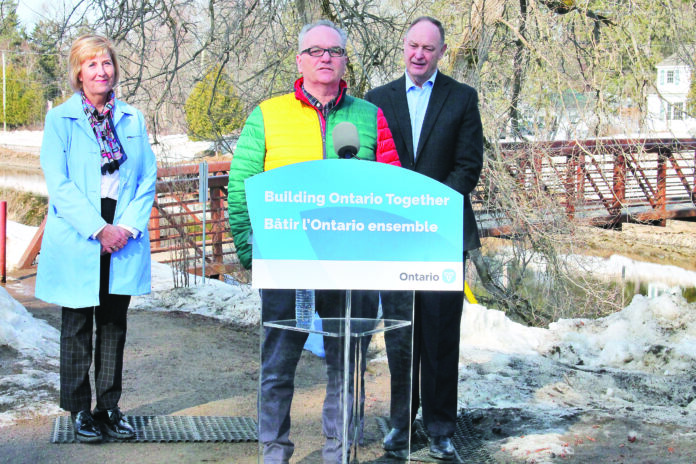
 She was referring to an April announcement in Gravenhurst that the Ontario government is investing more than $4.25 million on 16 projects to further protect that watershed. According to a Ministry of Environment, Conservation and Parks press release, the funding would help safeguard the region from environmental pressures, such as severe weather and flooding, while also improving the health of the watershed.

 Moffatt said one of the projects is a hydrology model for Muskoka. “I’ve been waving the angry flag for some time that Haliburton County is miles ahead in its integrated watershed management process and relationships and modelling, and we’ve had to beg and scrape for every cent and this is just some more money … the Muskoka millions,” she said.

 Moffatt added, “It’s frustrating that a neighbouring municipality continues to receive tremendous amounts of money to address problems that neighbouring communities and other jurisdictions across the province are facing.” 

Coun. Jennifer Dailloux commented, “I wonder if now is another moment to write a letter and say there are equity issues here. Cottage country across Ontario is vast and it isn’t just one region. We all have these same questions and we’ve said it before, but we’d like to say it again now.” In August 2018, Ontario announced a $5 million Muskoka Watershed Conservation and Management initiative.

 In August 2019, the MECP established the Muskoka Watershed Advisory Group. The Ministry of Natural Resources and Forestry did release its Protecting People and Property: Ontario’s Flooding Strategy in March 2020 in Minden. However, there was no money specifically announced for Haliburton County.

 And while the County of Haliburton received $175,000 from the National Disaster Mitigation program to assist with flood prevention planning in 2017, that was federal money for LiDAR mapping of the Burnt and Gull River watersheds following significant flooding.

Moffatt, and Minden Hills Mayor Brent Devolin are County representatives on the Upper Trent Water Management Partnership.

 Moffatt said municipalities within the local watershed have forged relationships, including with the Coalition for Equitable Water Flow and the Trent Severn Waterway, and have expertise, yet she feels the County has been slighted. “In some ways [the two watersheds] have different battles, different hills to climb, but when they [the province] issue a press release that says, ‘The Muskoka region is one of Ontario’s crown jewels, and we want to ensure that we continue to protect its environment which is so important to the local economy and the great people who live there, said Premier Doug Ford … well I think there are a lot of other jurisdictions in Ontario that would like to receive that same largesse over and over.” 

Moffatt indicated it is a County of Haliburton issue and she would be talking to deputy mayor and County warden Liz Danielsen about raising it there in future.

 Haliburton-Kawartha Lakes-Brock MPP Laurie Scott said that in April 2021, the Ontario government announced an initial investment of over $4.25 million to fund 16 projects to address flooding and the watershed health of the Muskoka River Watershed as previously announced in 2018.

 However, she said, “our municipalities have been working hard to protect local waterways including a successful application through the Great Lakes Local Action Fund to create a sustainable, citizenbased model of benthos biomonitoring in the Haliburton, Peterborough and Kawartha Lakes areas to identify early indicators of lake issues. “This was one of the 44 community-based projects to receive $1.9 million in funding through the Great Lakes Local Action Fund. This fund supports local projects that protect and restore coastal, shoreline and near shore areas of the Great Lakes.” 

Scott added, “our government is committed to protecting and conserving our environment and we want to ensure that Ontario’s natural beauty can be enjoyed for generations to come. That is why we created the Made-in-Ontario Environment Plan outlining practical, sensible, and affordable solutions to some of our province’s most pressing environmental concerns.” 
Minden Lions celebrate Octoberfest

0

The kegs won’t be flowing, but bratwursts, potato salad and coleslaw will all be on
offer at the Minden Lions Club’s first family-friendly Octoberfest celebration.

On Oct. 16, the Lions will be serving up German-style fare in their clubhouse. Guests can book one of two seatings, at 5
p.m. or 6:30 p.m. “We’re trying something new,” said Lions Dan Bingham, who is organizing the event.

“We thought October would be a good time to do it.” To comply with COVID-19 protocols,
everyone attending must be vaccinated, since the event falls under the same classification as a restaurant. They’re
also offering takeout. “The reason we’re doing the takeout we know some aren’t comfortable with the dine-in experience
yet,” he said.

All diners must book their table or takeout order by Oct. 14.

The dinner is the Lions’ first large-scale in-person fundraising event for over a year
and a half. “It’s been very frustrating,” Bingham said. He mentions other cornerstone events on
the Lions’ calendar such as Music on the Gull, which was canceled this year.

Funds from the Lions Club go towards multiple community initiatives, as well as helping out in times of need such as the town’s 2017 flood.
For Bingham, this event could act as a kick-start for fundraising as pandemic restrictions continue to allow more
in-person events.
“Because it’s been so long since we’ve done any fundraising, we wanted to get back in the groove,” he said.
To book a table or takeout order email mindenlions@lionsa16.com or call
705-286-6476

Planners launch second shoreline bylaw survey

0
A shoreline in Haliburton County

In partnership with the County of Haliburton, planners have released a second survey polling residents on options for a draft shoreline protection bylaw. 

The survey focuses on specific aspects of the previous draft that consultants J.L Richards and Hutchinson Environmental Services Ltd. have identified as areas to clarify or improve in a new draft bylaw.

One element of the bylaw which has stirred debate is the previously proposed 30-metre setback. 

In the survey, JLR asks residents what elements of a property, including topography, existing site conditions and developments, should be considered when applying the bylaw. 

As well, the survey asks how people view a protection plan meshing with existing planning requirements such as the County’s official plan which states “the 30-meter shoreline preservation setback shall apply from the high watermark of a ‘body of water’ including lakes, rivers and streams.”

From Oct. 6-19, the eight-question survey can be accessed through the County of Haliburton’s website. 

Another survey, completed in August, focused on general feelings towards lake health and waterfront development. Among the 286 respondents, all indicated lake health was either extremely important, very important or somewhat important. 

The surveys are one part of a wider consultation strategy from JLR and HES. Ahead of presenting a draft bylaw to County Council at the end of October, the consultants met with stakeholders and received input from private residents through two virtual town hall meetings, also attended by County councillors.

You can complete the survey here.

Thanksgiving drive to support Food Centre

0

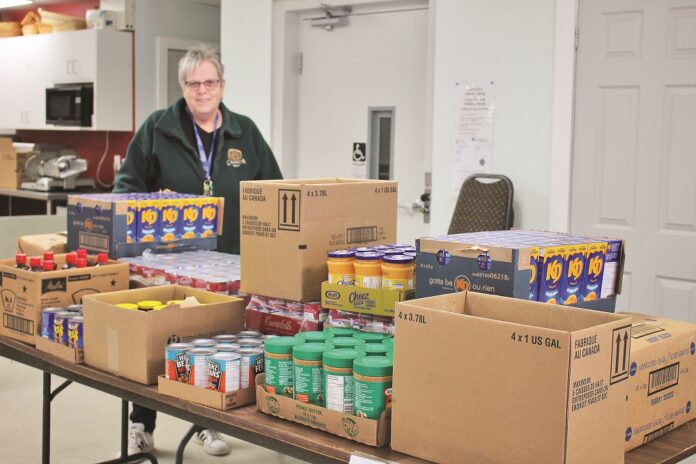
With Thanksgiving right around the corner, one local lake association is once again putting out the call to raise money in support of the Minden Community Food Centre.

For the past 10 years, the Maple, Beech and Cameron Lakes Area Property Owners’ Association has been donating food and money to the food bank in Minden as a way of “giving back” during a time when, typically, demand for support and assistance in the Highlands is on the rise.

“The idea was a simple one – we are all fortunate to be able to cottage or live in this community, and not all the people that make the community what it is are equally fortunate,” said Andy Muirhead, president of the MBC lake association. “So, we decided let’s do something to make it just a bit easier for those in need of some help.”

Originally, the group encouraged its members to donate food items that could be delivered to the food bank. Muirhead said many seasonal residents would close their cottage up in the fall, and clear out their larders. Rather than transport all of that leftover food home, many decided to donate it.

When the pandemic hit in March 2020, Muirhead realized it wouldn’t be possible to host a traditional food drive – so he turned his focus to cash donations instead. Last year, the association raised around $1,500.

“Then we added an additional $1,000 onto that amount,” Muirhead said. “We decided early that we would match any donations coming in, up to a maximum of $1,000.”

The association will be doing a similar thing again this year. While Muirhead said he would be grateful for whatever donations his group receives, he would really like to push on and break the $3,000 mark this year.

All money received will go towards supporting programming at the Minden Community Food Centre. According to Joanne Barnes, manager of the facility, the food bank serves over 250 families annually.

Since the onset of the pandemic, the food bank has also distributed more than 1,150 emergency boxes to individuals that have never visited the facility before.

“Thanksgiving is not just a symbolically good time for helping out, it is also the beginning of the slower times here in the County,” Muirhead said. “With the tourists and cottagers heading off, jobs are scarcer, and times get a bit harder.”

He noted that while cash donations are being encouraged during this drive, the food bank is able to accept food donations directly at their facility.

Cash donations are being collected at St. Peter’s Church on Maple Lake. Muirhead said the association will be hosting an appreciation raffle for donations over $25.

To learn more about the Minden Community Food Centre, visit mindenfoodbank.org.

Huskies seek to improve on the road

0

It was a weekend of mixed emotions for the Haliburton County Huskies as they kicked off their inaugural OJHL season, recording an opening night victory over the Lindsay Muskies on the road on Friday, before a sobering shutout defeat against the same opponents on home ice the very next night.

In what head coach and general manager Ryan Ramsay described as a monumental effort on Friday, the Huskies upset the hometown Muskies 3-2 in their season opener, imposing their will right from the first whistle and controlling large portions of the game. Forward Sam Solarino got the Huskies off to a perfect start, stabbing home at 11:40 in the opening period after a nice pass from Jack Staniland to score the organization’s very first goal.

The Muskies responded well, drawing a penalty from Joe Boice and levelling the score at 15:08 through Duncan Scullion. With the hometown crowd still celebrating, Huskies star forward Oliver Tarr took centre stage. Just 21 seconds after the Muskies tied the game, he ripped a shot past goaltender Fraser Ethan to restore the Huskies’ lead. Against the balance of play, Noah Pardy would again tie the game, scoring at 17:27 of the opening period.

In what was a more tentative second period, devoid of many real scoring chances, the eventual game winner came from the unlikeliest of sources, with Huskies defenseman Will Gourgouvelis following up on a rebound at 13:59 to score his very first junior goal. “I saw Steve Li start bustling down the wing and I saw a bit of an opening, so I just turned on the jets and got to the net,” Gourgouvelis said of his goal. “It was pretty exciting for me to get that first goal, but even better that we got the win.”

A frantic, yet scoreless third period meant the Huskies were able to celebrate a win in what was their first ever OJHL game. Gourgouvelis said it was a special night for many of the Huskies players, many of whom were hitting the ice in an official game for the first time in 18 months. “Hockey is kind of our escape, and when COVID hit it prevented us from connecting with others, so getting back on the ice felt unreal tonight,” Gourgouvelis said.

Ramsay commended his team for the way they fought throughout the contest, not giving the older Muskies an inch during an enthralling game. “It was a tight fought battle out there on the ice, and the boys worked really hard from the first minute to the last. I’ve been preaching all along that we need to have a level of competitiveness, and we need to play with speed – I thought we did both of those things well [on Friday],” Ramsay said.

As impressed as he was with his team’s effort on Friday, Ramsay pulled no punches when breaking down the team’s performance the following night. In front of a packed crowd at the SG Nesbitt Memorial Arena on Saturday, with more than 200 area residents in attendance, the Huskies fell to a 4-0 defeat. After a scoreless opening period, the Muskies Killian Rowlee broke the deadlock at 13:22 of the second period.

The away side would go on to add three more goals in the third period without reply, leaving the Huskies, and coach Ramsay, to reflect on a hefty loss. “I think we got outworked, we got outplayed. There’s no beating around the bush, we didn’t play a very good hockey game,” Ramsay said of his team’s performance on Saturday. “You’re going to lose hockey games at this level, and we’re fine with losing hockey games when you run into a good goalie, or you get some bad bounces, but it’s just not acceptable to lose when the effort level isn’t there.” Following that game, the Huskies made a move to improve their forward corps, signing 18-year-old left winger Nicholas Athanasakos.

The forward was most recently signed with the Prince George Spruce Kings out of the British Columbia Hockey League. The team has a couple of road games coming up, against the Wellington Dukes this coming Friday, and the North York Rangers on Sunday. The Huskies are next at home at SG Nesbitt Memorial Arena on Oct. 16 when they take on the Cobourg Cougars.

This reporter was hurtin’ in Haliburton

0

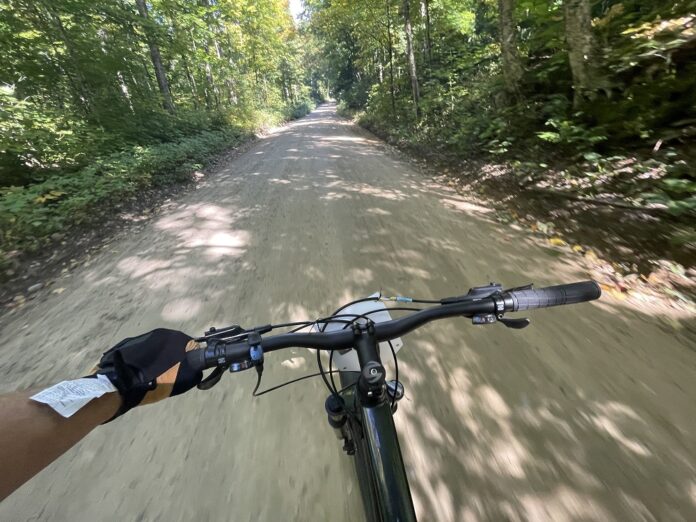
Two days before the annual 8 Hours of Hurtin’ in Haliburton race, I realized I had made some grave miscalculations.

The first was agreeing to organizer Marc Sinclair’s generous offer of a complimentary press entry to the now infamous gravel race around a section of Haliburton Forest trail.

The second? I had no clue what gravel racing was. There’s also the small fact I had never been in a cycling race, let alone one as long as my usual workday.

After frantically buying the bike shorts with the most posterior padding I could find, I googled “gravel racing” to find a whole world of tire specifications, carbon fiber racing cycles worth three times the price of my car and as many colour options of skin-tight lycra attire as there are Haliburton residents.

But as a reporter, my job is to find out the facts. Chase the story. Pursue truth, no matter the obstacles.

So I showed up with running shoes, a second-hand skateboarding helmet, a mountain bike and a hastily-bought bottle of Gatorade.

Bike racers drink Gatorade, right?

Under the sunny skies and swaying trees of The Haliburton Forest, I chatted with a couple of racers who were tinkering with their cycles or fuelling up on some strange sort of edible energy gel I had presumed only could exist in Star Trek.

As my solo men’s class rolled off the starting gate, I took up last place as the sunglasses and smooth-helmeted crowd sped off upfront. The trail, I soon found out, is beautiful. It curves around still lakes, flowing rivers, imposing pines and firs, steep rock faces and rustic cottages. There are also hills. Near the end of the first lap, my journalistic training had alerted me to the fact that yes, the event was aptly named. I was indeed … hurtin’.

Near the end of the second, my thighs made me feel incredibly empathetic for the experience of a tenderized T-bone steak.

Eight hours pass quickly.

Whether gulping down electrolyte powder, pedaling backwards to get help for a downed cyclist, reciting the entirety of U2’s discography or expanding my curse word vocabulary on each hill climb, I kept myself occupied.

Despite passing me so fast I appeared to be pedaling in place, nearly every rider offered encouragement as vibrant lycra-clad bottoms disappeared up the trail.

It was a race, but also a community event, and one that felt incredibly open to a newbie like myself. One kind racer, after a chat about leg cramps, tossed me two Gatorades and a bag of candy. “Electrolytes are the key,” he said.

It felt competitive, sure, but also like everyone was riding their own race; just doing it together. “That’s the thing,” said Sinclair before the race. “You make [the race] what you want it to be.”

Strategic gravel grinding

Some riders completed seven or eight laps. Adam Hill cruised to first place in the men’s division, riding 216 kilometres.

For Hill or Haliburton local Nick Emsley, who placed second, this race was small potatoes: both are friendly competitors on marathon rides that can stretch up to 24 hours or intense short cycles jostling neck and neck with other riders.

“Shorter distance stuff, sometimes it’s more competitive but you go home and you find you didn’t do as well as you thought,” Hill said, after he crossed the finish, hardly breaking a sweat. He pointed to the field of riders packing up next to the finish line.

“But everyone who’s here right now has ridden their bike for eight hours. That’s a huge accomplishment.”

For Emsley, “when you get to the strategic part of it, the racing, it’s completely different,” than short races or mountain biking, which is his forte.

Emsley talked about drafting other riders, overtaking competitors and measuring your speed.

“You have to learn yourself and learn your body. When you train, all the hours you put in, you have to learn about yourself.” That’s what he’s spent years doing, as he pursues a mountain bike career that’s taken him to races across Canada and beyond.

For me? I finished off the day with more than one carbonated beverage and what must have been the most delicious hamburger in all of history.

I’ll spare you the details about my postrace condition but a basic understanding of human anatomy and bike seat ergonomics might give you a hint.

But will I be signing up for next year’s race?

In a heartbeat.

Naturalizing death in Agnes Jamieson exhibit

0

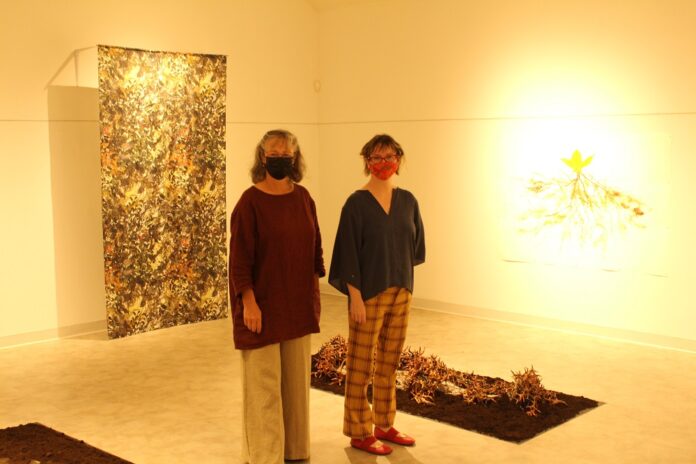
“We live in a culture that is not very comfortable with death,” said Barbara Brown, standing in a small room tucked inside the Agnes Jamieson Art Gallery in Minden.

Beside the photographer stands her collaborator, sculptor Cynthia O’Brien: around them the white walls are covered with small square photos and molded shapes, each representing a patient of longterm care homes who has passed away. Visitors are invited to write the names of their own deceased loved ones on scraps of paper and then slot them into niches around the room.

It’s just one part of their exhibit, Returning, a show in which both artists explore the beauty and sadness in death as they process their time working in longterm care homes.

“We worked in large facilities, 450 beds,” Brown said. “People died every day, but there was no conversation about it. There’s a taboo to dying.”

Returning plants that conversation in the natural world with photographs, clay sculptures; even dirt mounds shaped and hollowed out. In one three-dimensional work, So Below As Above, bone-coloured roots suspend a photo of a forest floor spread with dead leaves, clay shoots of new growth break the surface: death and life intermingled.

Many of the pieces, said O’Brien, are “imbued” with the memories of the people she got to know while working in long-term care. Aside from her work as a caregiver, her clay sculptures have been collected internationally.

“I think they’d be very happy that they’re there. They’re living on through me and through the pieces. I think that’s a good thing,” she said.

The show was first exhibited in 2018 at the Karsh-Masson Gallery in Ottawa. The two artists were co-workers when they realized the possibility of artistic collaboration. “We were talking about the projects we were working on artistically and found there were a lot of overlaps and what we were doing was based on our experience in long-term care,” said Brown. She has exhibited widely across Canada and taken multiple artist residencies as far afield as India.

“We were also interested in flowers, growing things, and how that nature-based idea is in both our work,” added O’Brien.

In the main room of the gallery, photos capturing the deep browns and rich greens contrast jagged roots of red, black and white. It’s a discussion of decay and growth, said Brown, as well as how memories of lost loved ones stay with us.

“There is beauty in all things. and even though we see something as sad, there is peace in that as well,” she said.

O’Brien worked in a care home during the COVID-19 pandemic. For her, it’s been encouraging to see people finally valuing, and noticing, the work and issues of care in the industry.

“The people I worked with are mothers and fathers. and we’re all going there too. They deserve respect and I think everyone should be directing their energies towards that,” she said. “There is a beautiful thing engaging in someone’s life to that degree, to be a part of their community.”

That sense of beauty, in all its pain and complexity, is what Returning explores. The show runs until November 27.

New protocols for school sports and clubs

0

By Lisa Gervais and Kirk Winter

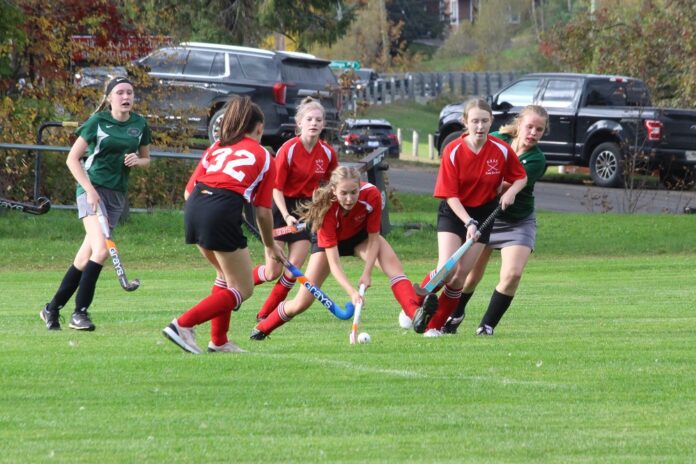
When the Red Hawks girls’ field hockey team took to the pitch at Haliburton Highlands Secondary School Oct. 5 it was a rare inter-school match for this fall in Haliburton.

The girls will host another game Oct. 12 but that’s about it for school matchups, other than cross-country runners who are also entering competitions this year.

There’ll be no boys junior or senior football and girls’ rugby has also been sidelined for the autumn.

Principal Chris Boulay said the school’s athletics department is, however, easing back into fall extracurricular opportunities by offering a number of sport and fitness programs to engage students in physical activity and to help promote wellness.

“In addition to girls’ field hockey, the Red Hawk Running Club (x-country running team), the Hawk’s Nest fitness centre, and boys volleyball are underway,” Boulay said.

He added, “currently, volleyball is happening as an after-school skills development/activity, along with the fitness centre in the Hawk’s Nest.”

The Trillium Lakelands District School Board discussed sports during its Sept. 28 meeting and specifically how it plans to deal with transportation with a critical shortage of buses and what the protocol will be for spectators.

“Extracurriculars are back,” director of education Wes Hahn said. “We are glad they are back but they are voluntary. Not all coaches and teams are going to be running. We will respect if staff feel uneasy or anxious about running teams again.”

Participants will have to be driven by parents to competitions because “buses simply are not available because the driver shortage remains a serious issue,” Hahn said.

Before someone will be allowed to drive they will have to have a criminal reference check; a license search; and a check for liability insurance. Drivers will not be considered if they have not been double vaccinated at least 14 days before the event. If they are driving children besides their own, everyone in the vehicle will need to be masked. Drivers will be allowed to watch the event.

All coaches and referees will need to be double vaccinated.

Haliburton area trustee Gary Brohman asked if volunteer drivers would be reimbursed for gas. Superintendent Kim Williams said each school would make that decision based on their budgetary realities.

Brohman said parents are saving the board the cost of a bus, and “strongly encouraged schools to pay.”

As for spectators, Williams said “only players, coaches and officials will be in attendance.”

Williams said student participation is the priority for extra-curriculars this fall, and coaches should be devoting their attention to the competition and student safety without worrying about whether parents, friends and siblings in the stands are masked, properly distanced and behaving appropriately.

Hahn is also hopeful that some kind of inter-school sporting activities will be made available for Grade 7 and 8 students, possibly focused around soccer. Superintendant Jay MacJanet is working on that activity, in addition to encouraging intramural competitions within each school.

School board director urges COVID-19 vigilance

0

The local school board’s director of education says he’s looking forward to a time when COVID updates are unnecessary at school board meetings.

Wes Hahn told the latest meeting, on Sept. 28, that there were currently almost 40 cases of COVID in the communities that send their children to Trillium Lakelands District School Board schools, including one new community case with five high risk contacts as of Oct. 5 in Haliburton.

“There have been no real spikes or real rises since school began and that is good,” Hahn said. He added there are currently no active cases within the TLDSB but there have been five since schools opened.

Hahn said the board continues to strongly encourage students over the age of 12 and members of their extended families to get vaccinated. As of the Sept. 28 board meeting, he said 30-35 per cent of that student cohort is still unvaccinated.

“If we have a case in the high schools,” Hahn said, “students who are double vaccinated can return to school immediately. Unvaccinated students cannot return unless you are cleared by public health, typically after 10 days of isolation. That is a lot of school missed.

“It is paramount for the protection of students that we have as many vaccinated as can be,” Hahn said. “Vaccinations allow extra-curriculars to operate. Vaccinations allow more interactions between students to occur safely and vaccinations allow students to stay in school.”

Haliburton area trustee Gary Brohman wanted to know when lockers are going to become available for students.

“They aren’t,” Hahn said. “We are concerned about unvaccinated kids congregating at lockers where a lot of contact will occur. This is to be avoided. So, for now we are saying no to lockers.”

Hahn added that 86 per cent of board staff were fully vaccinated, with 14 per cent medically exempt or performing the vaccine education program which includes testing twice a week for COVID.

Trustee Colleen Wilcox asked for an update of the health unit vaccination drives that had used board sites to host their events in September. Wilcox was told that four mass vaccination clinics had been held with “only 20-50” getting vaccinated at each school.

The Ministry of Health said that between Sept. 13 and Oct. 5, 12 to 17-year-olds were responsible for 13.11 per cent of all cases in Ontario. In the HKPR district health unit, that age group had 31.26 per cent still not vaccinated as of Oct. 5


Pandemic sparked property care business

0

Clare and Jordan Kadlosvki had wanted to work for themselves for a while. It was the pandemic and accompanying shutdowns that gave the couple the extra incentive to start up KADS Home and Cottage Services, a full-service home care company, last fall.

“We thought, well there’s uncertainty in every job, we might as well give it a go,” Jordan said.

It also gave them a chance to dream about how they could use their skills to create something new.

“For a while it was back of mind. We wanted to do our own thing and create our own schedule,” added Clare.

Now they’re on the road every day, offering everything from lawn care to cottage checks to stocking up kitchens with a weekend’s worth of groceries.

“We try to incorporate as many things as possible. We offer to a broad range of clients,” Clare said.

And they’re doing it as a family. Their two young sons, Carter and Harper, often come along to jobs, especially since COVID-19 meant schools were closed.

“We’ve also been trying to juggle and manage that as well,” explained Jordan.

The Kadlovskis said demand for their services has sometimes been “overwhelming.”

“Now to think we have a steady clientele base already, it’s unbelievable,” Clare said.

They said much of that could be because of the increase in tourism and interest in real estate in the County. Construction activity in the area is reaching all-time highs: in each municipality build values are nearly, if not more than, double amounts seen in 2020. That’s mirrored in a steady uptick in tourism and many people finding short-term escapes from urban centres in the Highlands.

Their services cater to those markets: whether preparing cottages for short-term rentals, or maintaining and keeping a careful eye on properties while their owners might be elsewhere. The majority of their clients, Jordan said, reside outside the County.

With a brisk start to business right out of the gate, Jordan said KADS’ top challenge has been the logistics of running a mobile business. He and Clare, as well as another full-time employee and a couple of parttime workers, spend each day driving from place to place performing different jobs for property owners. That means balancing long-term jobs such as seasonal deep cleaning and short order tasks such as emergency checks and small repairs.

“It’s just trying to manage that time and access the properties at different times,” he said.

Jordan said they’re proud to be a sort of “one-stop shop” for homeowners. “People really like the idea of going to one person, one company and getting a high quality of service.”