

Home Blog Page 310

Help wanted: Highlands’ staff shortages part of ‘complex’ regional issue

0

With capacity restrictions eased, The Mill Pond Restaurant in Carnarvon is having no problem finding customers to enjoy homecooked comfort food. The issue is getting staff. “Nobody’s applying, every restaurant you talk to is looking for servers too. It’s crazy right now,” said owner Brad Archer. “I need to have four servers on staff. Right now, I have two full-timers and one part-timer.” During the fall, Archer couldn’t find anyone to take the shifts so he and his servers often worked 50-hour weeks. In industries from childcare to hospitality, businesses across the Highlands are having trouble finding employees.

 “You open up the newspaper or you go to any online job platform: there’s a lot of jobs out there,” said Haliburton Chamber of Commerce executive director Amanda Conn.

 “A lot of our members are saying they’re having a really hard time filling those roles. The roles may be skilled or entry-level, they’re having a difficult time filling both types of roles.” 

The question is, why? 

Archer guesses CRB, which ended in late October, might be a major reason why it’s become more difficult to find staff. “Everybody is on CRB, nobody wants to work, and nobody’s applying for jobs,” Archer said. 

He doesn’t personally have staff who have stayed on CRB, however, he’s spoken to customers who have said they took the summer off. Federal MP Jamie Schmale agrees: “I do believe, with CRB gone, our businesses may start to see more people coming through their door [looking for work],” Schmale told The Highlander. 

While the federal opposition has linked CRB to the current labour shortage, economists such as Karl Skogstad from Lakehead University are slower to jump to that conclusion. Skogstad pointed to Canada’s workforce participation rate, which fell from 65 per cent to 59 percent at the start of the pandemic. “If this CRB story was true, we’d expect to see that this participation rate has fallen.” 

However, labour force participation has risen back to the 65 per cent level. “The data shows people are participating just as much, if not more, than they were pre-pandemic,” said Skogstad. While individual stories of people defrauding the CRB and the old CERB system — choosing to stay home rather than work — abound, Skogstad said it would have to be extremely widespread in order to distort job participation numbers. “My gut tells me there’s more going on than just that,” he said. 

Skogstad, Lakehead’s Robert Petrunia, University of Winnipeg’s James Townsend and Lakehead Master’s student Derek Patterson have been studying the economic impact of the pandemic in Northern Ontario since early 2021. 

In a community such as Haliburton, where heavy summer traffic increases the need for hospitality workers, Skogstad reckons there can also be a “mismatch” of skills to what’s actually needed.

 He and Archer both say it’s likely the number of people qualified or equipped to handle jobs such as being a line cook don’t match the demand for their services. “There are 40 restaurants in the area, and there’s probably 40 cooks,” Archer said. “There’s a very small pool of people who do that sort of thing up here, it’s been going on for years.” Sean Dooley, a labour market information analyst with the Workforce Development Board, said the employee shortage could be reframed: “It’s important to recognize the difference between a labour shortage and a skills shortage,” said Dooley.

 He said programs such as the Trillium Lakelands District School Board’s Start Me Up initiative is focused on equipping youth with skills and knowledge about the trades. It could be a good first step in addressing this skills gap in growing industries, he added. 

Gena Robertson, SIRCH Community services regional director, wrote in an email there are routes employers and trainers could take to eliminate barriers to this kind of training. 

“Typically trades and other post-secondary training requires local residents to go for extended periods to another city,” wrote Robertson. “…even when registration fees are waived or subsidized, there are still costs involved, which many people may not have. Could the training be brought locally?”

Robertson said employers also could refer potential hires to soft skill training programs, such as one SIRCH offers, to get prepared for new roles. “But we have yet to receive a referral from an employer,” added Robertson. Living in the Highlands “It’s hard for people to come work here when they can’t find a place to live,” said Conn.

 That’s a reality Archer knows all too well: he said staff in the hospitality industry especially struggle to find affordable places to live. “All the rentals are so expensive and they’re so hard to find, and you don’t get any new people coming into town,” he said. 

A quick search on Facebook Marketplace or Kijiji turns up few rentals. While certain developments in Haliburton County have been approved as “affordable,” this classification means they are priced at market rent: in Haliburton it means $979 for a one-bedroom apartment, nearly half of a minimum wage worker’s pre-tax monthly income. 

The generally accepted rent to salary equation is 30 per cent.

 Even workers in established roles such as Lisa Paterson, a cook at Extendicare Haliburton, are having difficulty calling Haliburton home. “I spent months looking for something,” said Paterson, who commuted for six months from the GTA while looking for an apartment. When she found a place, “it was just a room. I had a roommate, it wasn’t even my own place.” 

Now, about to re-start her job after maternity leave, Paterson said she’s unsure how she’ll handle the drive. SIRCH Community Services has also experienced potential hires declining positions partially due to rental prices. “The person offered the job would have loved to have taken it, but the person’s partner had little chance of getting employment in her profession and they couldn’t live on one income,” wrote, Robertson.

 Rental scarcity is paired with one of the highest costs of living in Ontario, with a living wage estimated to be $19.47 in 2019; undoubtedly higher now, with an updated figure expected this year. Add high transportation costs due to a disperse rural community and the Highlands could look like a difficult place to make a go of it to many lower wage workers.

 In an Oct. 22 regional small business summit, Business Development Bank of Canada (BDC) accounts manager, Heather Halihand, told business owners from Haliburton and surrounding areas that the issue “doesn’t look like it will be solved anytime soon.” 

According to BDC research, the aging baby boomer population will be a major contributing factor to decreasing labour force participation until 2036. Sixty-three percent of Haliburton’s population is over 50.

 In 2016, Haliburton’s average age was 52, over 10 years higher than the Ontario average: as a population ages, the workforce can shrink. 

While the reasons for a labour shortage are multi-dimensional, with COVID-19, inflation, housing, and demographics all taking a toll, Dooley of the WDB said the phenomenon has precedent in Haliburton County: “It’s a very complex topic with a lot of regional factors at play. 
Commemorating a true Canadian hero

0
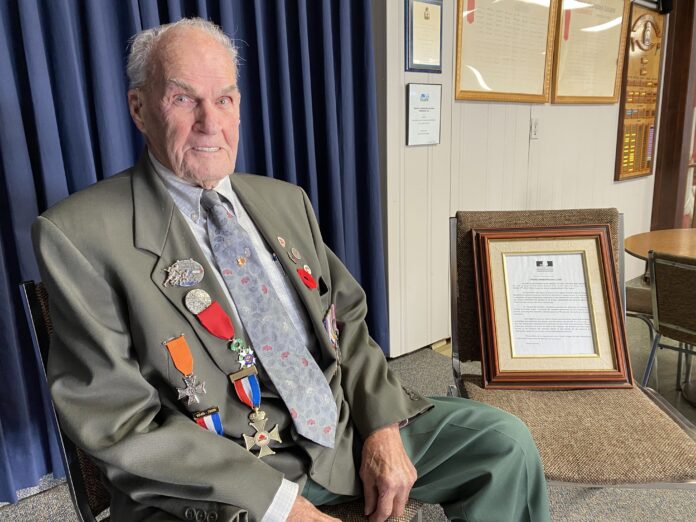
Haliburton resident and veteran of the Second World War, Harold Rowden, says Remembrance Day is a special time for him. Photo by Mike Baker

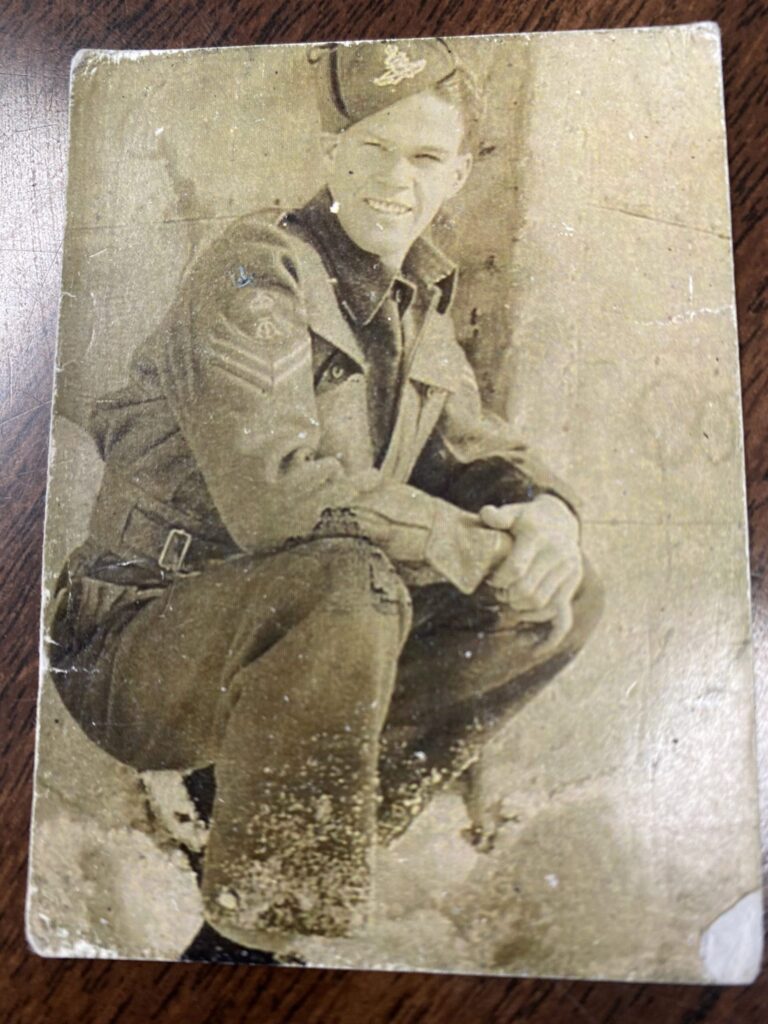
While he will never tell you this, Haliburton resident Harold ‘Rowdy’ Rowden is the very definition of a war hero. 

Serving with the 3rd Division of the 13th Field Regiment during the Second World War, Rowden was there the day members of the Canadian military went where no Allied soldiers had gone before, pushing the Nazis out of their beach-front strongholds and sending them into retreat. 

The Normandy landings, and in particular the Canadian affront on Juno Beach, have long been considered the catalyst for the Allies’ eventual victory. The sacrifices of the men who stormed the beach on June 6, 1944 will be honoured Nov. 11 as part of our Remembrance Day rituals. Rowden was 19 when he stepped on the ship in Portsmouth, England bound for France. 

Harold Rowden was a member of the 3rd Division of the 13th Field Regiment during the Second World War. 

He remembers that daunting journey – the eerie silence among usually rambunctious troops, the sickening sway of the boat, the dread that set in as soon as land came into view. “Everything was on fire,” Rowden said of the scene that greeted him when the landing ramp dropped. Within seconds, he lost dozens of comrades, friends he had come to know and love during his years of deployment in the UK.

 As a dispatch rider, Rowden’s orders were to collect messages from one point and deliver them to another. Equipped with a Norton motorcycle, he was one of the lucky few to escape Juno Beach unscathed. 

D-Day was Rowden’s first overseas mission. He had spent years training at various sites across Canada and the UK since signing up for the war effort at 15. Still, nothing could have prepared him for the horrors he would face that day, and the many that followed. “If anybody says they weren’t scared, then they weren’t there,” Rowden said. “It wasn’t nice. I had never seen anything like that before. The Germans were up there picking us off. The beach was covered [with dead bodies].”

 After safely getting out of the water, Rowden found a tank he could strap his bike to and crawl on top of. He was carried away from the action. Once settled he got to work on delivering messages between command and gunners. 

His orders were often top secret. Just days after the landings, Rowden’s regiment came under direct attack. His unit was bombed while stationed in a small town called Courseulles-sur-Mer. Four of his comrades were killed, while his commanding officer was badly wounded.

 Knocked unconscious, Rowden eventually came to and, noticing a gaping laceration in the officer’s neck, did what he could to patch him up. Equipped with only a field dressing he had stuffed into his helmet, Rowden covered the wound and applied pressure until medics arrived. “I guess they told me that I saved his life,” Rowden said. 

Years later, once the war was over and having returned home, Rowden and his then wife bumped into the officer again on the main street in Orillia. His wife knew the man from school so went over to say hello. “She gave him a bit of a hug, and then he turned to me and said ‘you look familiar.’ I thought ‘it can’t be,’ but it turned out it was. I said ‘you old fart, you’re still alive!’ At the time, I didn’t know if he had lived or not.” 

After recovering from a serious concussion sustained at Courseulles-surMer, Rowden participated in the Battle for Caen. During intense enemy shelling, he was hit by a blast that threw him into the air and against a truck. His left leg was damaged so badly doctors initially wanted to amputate. 

He also injured his back and right leg. He was transported back to England where he spent months recovering in a hospital in Watford, near London, before being put on a ship to Canada. His service was over. Rowden spent several months recovering at a military hospital in Kingston. 

After months of rehab, he re-entered the workforce, became a truck driver, married and had nine children, including three sets of twins. 

Rowden has received eight medals, including France’s highest honour, the rank of Knight of the French National Order of the Legion of Honour. Consequently, Rowden should be referred to as Sir Rowden. Even when talking about his experiences, Rowden displays a tremendous amount of humility, saying that, deep down, he doesn’t believe his actions merit any special attention or recognition.

 “I am proud, but you would have done the same things as I did back then. Anyone would. You don’t have to be a hero to patch someone up when they’re hurt. The way I see it, if you see a dog down in the ditch, you help it,” Rowden said. “And the medal … I’m doing alright right now, I lived a life. That should have been given to one of the boys that lost his life.” 

Rowden said Remembrance Day is a time for careful reflection. “I’m proud, but I’m sad. I was only a kid back then, but the whole Canadian army was pretty well just kids. So many people died on both [sides]. Many times, it was kill or be killed, but I took no glory in any of that. I lost a lot of friends over there. Remembrance Day is a time I can remember them.” 

HCSA named Ontario snowmobile club of the year 

0

The Haliburton County Snowmobile Association has won Ontario’s top annual snowmobile honour. 

The Ontario Federation of Snowmobile Clubs named the association “club of the year” at its annual awards ceremony in Barrie, Nov. 9. 

Association president John Enright thanked the Haliburton community, which he said made the award possible. 

“It’s about the landowners and it’s about 49 years of previous hard work and dedication from the volunteers of the HCSA who got us into this place so we could win,” he said. 

The association is responsible for the grooming and maintaining the area’s 370 Kilometres of trails that stretch across the west and central parts of the County. 

The club boasts over 2,500 members and a reputation that draws riders from across Ontario.

“We’re in a very fortunate geographic position. We’re two and a half hours out from the most populated area in Canada,” Enright said.

The club, on Oct. 22, also won regional club of the year. 

In the past year, HCSA encouraged downtown Haliburton businesses to post “welcome snowmobilers” signs in their windows, installed a webcam showing snow conditions in real time, and also hosted a fundraiser that donated one dollar per hour groomed on its busiest trail to The Kelly Shires Breast Cancer Foundation, raising $500.

More to come in next week’s edition of The Highlander.

Schmale named shadow minister for Indigenous services

0

Local MP Jamie Schmale has been appointed as the new Shadow Minister for Indigenous Services in Canada’s 44th Parliament.

The news comes as part of a team of critics announced today by Conservative Party Leader Erin O’Toole.

Schmale said, “I’m looking forward to my new role as Shadow Minister for Indigenous Services. This presents an opportunity to expand on the experience I gained while in Crown-Indigenous Relations.”

Schmale added he looks forward to working with Indigenous leaders and communities to address issues including: clean drinking water; adequate healthcare and housing; public safety issues on reserves through increased Indigenous-led restorative justice measures and increased powers for First Nations policing services.

The House of Commons is set to begin sitting on Nov. 22

Police investigate drowing on Moose Lake

0

The Haliburton Highlands Detachment of the Ontario Provincial Police (OPP) are currently investigating a drowning that occurred on Sunday morning.

On Nov. 7, at approximately 10:26 a.m., members of the detachment responded to a report of a capsized canoe on Moose Lake in Dysart et al. It was reported that three adult males entered the water.  

Officers attended the scene with Haliburton County Emergency Services and the Dysart et al Fire Department. One of the adult males was able to safely make his way to shore and was uninjured. The other two parties were unable to make it to shore and they have since been confirmed as deceased.

This investigation is ongoing and the detachment is being assisted by the Underwater Search and Recovery Unit, as well as Technical Collision Reconstruction investigators.

The identities of the deceased will not be released until next of kin have been notified. Further information will be released as it becomes available. Investigators are asking anyone with information to call Haliburton OPP at 1-888-310-1122.

Winterdance ‘beyond excited’ for season

0

Dogsledding will return to Haliburton County next month with Winterdance Dogsled Tours announcing they plan to reopen for the season on Dec. 10.

Tanya McCready told The Highlander it will be “business as usual” for the local operation, who are set to usher in their 23rd year in the community.

“We are beyond excited to get going again – us and the dogs!” she said.

The news follows Haliburton Forest and Wild Life Reserves recent declaration that it would be shutting down its dogsledding operation effective immediately. On Oct. 21, the organization issued a letter to the community outlining its reasons for exiting the business.

“There are numerous challenges facing the dogsledding business, including unpredictable winter weather patterns, changing group experience profiles, shortages of professional animal care staff and rising health care costs for dogs,” the letter reads.

Tegan Legge, general manager of the Forest, said the organization would now be prioritizing self-guided, low-impact outdoor experiences such as hiking and fishing. She also mentioned the Forest intends to “replace” its dogsledding operations with a different portfolio of experiences in the coming winters. Haliburton Forest had maintained a dogsledding program for more than 20 years.

McCready said she and partner, Hank DeBruin, have adopted 11 of the dogs Haliburton Forest owned for its dogsledding program.

As she looks ahead to the upcoming season, McCready said Winterdance will continue to offer much of the same tour options as in past years.

“We will have half-day, two-hour, moonlight and full-day tours. The half-day is our most popular offering, while the twohour tours are great for young families or folks on tighter timelines,” McCready said. “The programs and systems we have built over the past 22 years have worked really well for us. We normally welcome over 2,000 guests from around the world every season.”

Last year was a bit of an anomaly for Winterdance and the McCreadys. Due to the COVID-19 pandemic, they had to drastically reduce their offerings, leading to a 70 per cent reduction in usual winter income. The couple helped to offset that loss through the release of Journey of 1,000 Miles, a sequel to the previously published Iditarod Dreamer. The book became an international bestseller, and helped McCready and DeBruin to establish a popular virtual speaking tour.

Over the past eight months, the couple have led dozens of presentations that have streamed virtually to audiences across Canada, the U.S., Central and South America and Europe focusing on overcoming challenges, leading through times of change, teamwork and chasing dreams. All of those stories, McCreary says, were inspired by lessons the pair have learned through their many adventures in Haliburton and beyond.

To learn more about Winterdance Dogsled Tours and their offerings, visit winterdance.com.  

Poppies about remembering our vets, says Legion

0

“They shall grow not old, as we that are left grow old. Age shall not weary them, nor the years condemn. At the going down of the sun and in the morning, we will remember them.”

The iconic words of Laurence Binyon, penned in his poem For the Fallen, are often revisited at this time of the year as people look back on and commemorate the sacrifices of our Canadian veterans.

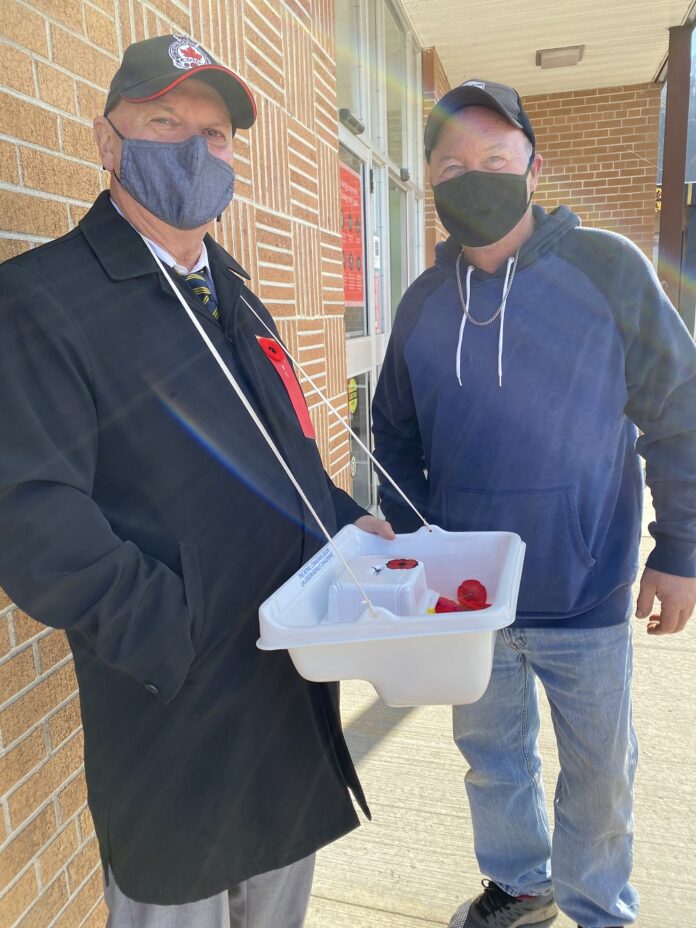
Haliburton Legion president Don Pitman recited them as he helped to kick off the annual poppy campaign in town Oct. 29.

“Why do we do this? It’s the three classic words, lest we forget,” Pitman said.

From now until Nov. 11, poppies will be available in more than 100 businesses across Haliburton. While donations are not required, Pitman said any money given goes directly towards supporting and helping veterans. In 2020, the Haliburton Legion raised around $24,000 through its poppy campaign.

All of that money was sent to the Ontario Legion’s central command and divvied up from there. Pitman says he knows of several local veterans who received money to help with one-time and ongoing costs, while the community’s cadet group and ‘Vet to Vet’ support program was also backed.

“This community has always been very, very supportive of the poppy campaign. We had one of our best years last year, and we’re definitely hoping for another strong campaign this year,” Pitman said.

Volunteers will be on hand with poppy boxes at Foodland, Todd’s Your Independent Grocer, Napa Auto Parts and Tim Hortons all day Nov. 5-7.

Remembrance Day has always been a big deal for Pitman, who had several family members involved in the First and Second World Wars.

“I had two grandfathers, my father and my uncle who all saw time in the military. My grandfathers saw action in the First World War, while my uncle served during the Second World War,” Pitman said. “But this day is as much about new veterans as it is remembering those [who served in the Great Wars]. The perfect example of that is Afghanistan and everything that went on there.”

With the Asian nation recently falling back into Taliban control, Pitman said many veterans who completed tours during Canada’s involvement in the War on Terror have been left questioning their service.

“There are a lot of veterans who lost a lot of friends over there. We lost 165 Canadians over there … Some of the people that came back, who have already been dealing with things like Post Traumatic Stress Disorder, have needed additional resources to help them get over the fact that all those lives have been lost, and yet the country fell back to where it was,” Pitman said.

He added, “Remembrance Day is important, number one so that we never forget. Because if you forget, then history will repeat itself.”  

HHHS prepares for Epic software

0

HHHS is preparing for a major shift in healthcare record keeping. In partnership with six other healthcare service centres in Ontario, the services will launch Epic, a new clinical information software system, Dec. 3.

HHHS CEO Carolyn Plummer said it will streamline patient information across the service.

It also requires new equipment such as vital sign machines and Workstations on Wheels, funded by the HHHS foundation.

“Staff are going through training and there’s a lot of work to be done,” Plummer told the HHHS board Oct. 28. “It’s a very significant change in their practice.”

First rolled out in Canada in 2015, Epic is a growing medical software system, which is now used in 134 Canadian hospitals.

The system means Haliburton patients’ medical records will be synced between all seven hospitals that have partnered together to implement the system.

“Because we are a small hospital, we rely very much on the services offered by other hospitals in our region,” Plummer said, explaining how many Haliburton residents receive care in Peterborough, for example.

“It will mean one medical record can be securely accessed by each medical provider.”

Previously, a new medical record had to be created for each medical centre they might receive service in.

“The healthcare professionals will be able to have better information at their fingertips, and patients won’t have to be asked the same questions over and over again,” Plummer said.

She also said the system will automatically prompt nurses, physicians and aides when certain care procedures are needed.

“I think it’s going to have a really positive impact on patients,” Plummer said.

Patients can also access their own records online, view and cancel appointments and communicate with healthcare providers.

Nursing Advisory Committee meets

A new committee is focused on supporting and improving the experience of HHHS nurses.

The Nursing Advisory Council had its first meeting Oct. 25.

Plummer reported that the committee is meant to “better understand the current nursing environment and determine ways to support it.”

She said the committee has already begun to review service areas such as dietary workflow on inpatient services. She said that early in October nurses conducted a walk-through exercise in the Haliburton emergency department to determine improvement opportunities such as changing supply quantity orders and improving communication processes.

New call systems at LTC

Work is set to begin on installing a new call bell system in Hyland Crest and Highland Wood long-term care homes.

Funded by the HHHS foundation, the call systems are an electronic notification system which will allow residents to call staff. It’s the same as is currently in use at the health service’s main hospital location.

It will correspond with additional display stations so that nurses and PSWs don’t have to report to a nurse’s station to see the location of the call.

“The residents won’t really notice any change,” Plummer said. “There will still be a button they use to call the nursing staff. But the nursing staff and PSWs in the team will certainly notice a difference.”

Huskies hang on for win over division rivals

0

The Haliburton County Huskies held on for a 5-4 win over division rivals, the Lindsay Muskies, in a fast and physical game at the S.G. Nesbitt Memorial Arena in Minden Oct. 30.

With some costumed fans in attendance for the Halloween weekend tilt, the Huskies endured a couple of scares. They made five consecutive trips to the sin bin from 14:53 in the first until 11:12 in the second, giving up two power play goals in the game. Then, with Muskies’ goalie, Ethan Fraser, on the bench late in the third, the fish scored at 17:29 to tighten the game. However, the Huskies held on for the win, improving their record to 7-4-0-0.

The Huskies opened the scoring at 11:28 of the first, with Bryce Richardson scoring his first goal of the season, assisted by Nathan Porter and Riley Rogers. Just a little over a minute later, they scored their second goal, an even strength marker, by Christian Stevens, his first, with helpers from Patrick Saini and Oliver Tarr. The dogs started to get into penalty trouble and late in the period, the Muskies scored on Christian Cicigoi, at 17:54, to make it Huskies 2-1 going into the second period.

Stevens scored again at the 11 second mark of the second to put the Huskies up 3-1, with Richardson and Nick Athanasaskos getting the helpers. But another Huskies’ penalty put the Muskies on another power play and they found the back of the net at 8:10 to make it a 3-2 game. The Huskies’ Tarr answered back at 17:05, assisted by Stevens, to make it 4-2 Huskies heading into the third.

The Muskies kept fighting back and made it 4-3 at the midway mark of the last frame. But the Huskies replied with a second Richardson goal from Jack Staniland to pull ahead 5-3. With Fraser watching from the bench and the Muskies with six skaters, they found the back of the net to make it a nail-biting 5-4. But the defence and Cicigoi closed the door.

Two-goal scorer, Stevens, said it was a nice win to get under their belts. “We played hard, a little sloppy in the end, but we got the job done so it doesn’t really matter.”

Commenting on a four-game win streak, he added, “streaks mean a lot in this game so if we stay hot, I think we’re going to keep going and I’m excited to be here and I think it’s going to be great.”

Richardson, who also notched two tallies, said, “It’s been a slow start for me this year so two goals tonight is definitely really nice, a couple of good bounces, a great play by Jack Staniland on the second one there. But it’s just nice to get the win.” He said the Nov. 5 game against Trenton will be a good test for the team.

The Huskies return home Nov. 6 against St. Michael’s and play in Cobourg Nov. 8.

School board reports fewer suspensions

0

In what staff are calling “a bit of an anomaly,” Trillium Lakelands District School Board (TLDSB) saw a significant decrease in the number of suspensions and expulsions dished out to students in the 2020/21 school year.

Superintendent of Learning, Paul Goldring, informed TLDSB trustees Oct. 26 that there were 780 infractions recorded last year – with 471 of those for secondary students and 309 for elementary. The main reasons listed for suspensions were conduct injurious to moral tone, fighting and/ or violence, conduct injurious to others, opposition to authority, vandalism and bullying.

When compared with statistics from the prior year, 524 for secondary and 625 for elementary, that represents a near 33 per cent drop.

“It’s important to note that we had two periods of remote learning last year for significant blocks of time. In terms of looking at the last two years of data, it’s difficult to compare year-to-year and establish any sort of trends.”

During 2018/19, the last full school year that wasn’t interrupted by the COVID-19 pandemic, there were 809 secondary suspensions and 915 elementary suspensions.

Goldring noted that this past year was the first time that elementary infractions had exceeded secondary infractions.

The board permanently expelled eight students in 2020/21. Goldring noted expulsion was a “last resort” for the board, and were only considered after failed mediations with the student and parents.

“Mediation is something we have started to use more and more. The idea is it allows students to stay in school, but receive some level of support,” Goldring said. “The key factor here is we are looking at the situation and making sure the student is not a risk to the school, and other students.”

Further explaining the process, Goldring said school principals tend to take the lead with mediations.

“They will reach out to family and then try to come to a settlement. They will look at the period when the student can return to school, what type of support is needed before they return, and, in a lot of cases, what ongoing support they will need after they’ve returned,” Goldring said. “We see mediation as a very successful tool for us to use. I really like it as it keeps kids in school and gets them the support they need. I see it as a tool we will use more often if we can.”

Property ban lifted

Director of education, Wes Hahn, said visitors would be allowed back on TLDSB premises to attend outdoor functions, but maintained a ban on indoor visits.

“We are slowly moving in that direction (to open up schools to visitors), but there are timelines from the province for when that will take place. For now, we continue to limit visitors to school buildings,” Hahn said. “Even though the different seasons are coming to an end, we have decided to allow spectators to attend sporting events, while wearing a mask and [social] distancing. This is for outdoor only.”

Hahn said the main thing holding the board back from allowing indoor visits is requirements surrounding monitoring of vaccination statuses. He said it would be impossible to have staff on hand to check each individual’s status, and that the board could not have people in the building they’re “not certain of.”

With many indoor sports and clubs set to start up heading into winter, Hahn hopes to receive direction from the province regarding reopening their facilities in the coming weeks.

“We will let parents and the community know when things change,” he said.

Vaccinations

Haliburton County trustee Gary Brohman asked Hahn if TLDSB was tracking data on vaccination rates of its staff.

“We are, and I am pleased to report our vaccination rate is at approximately 87 per cent for staff,” Hahn said. “Our process is that staff have to report being fully vaccinated, being medically exempt, or if they’re [choosing] not to be [vaccinated].”

Any member of staff who isn’t vaccinated is required to participate in an education program highlighting the benefits of the vaccine, and submit to weekly COVID-19 testing and incident screening.”