Home Blog Page 267

New software helped Heat-Line grow

0

Highlands-based company Heat-Line Freeze Protection Systems has been highlighted in a new federal study as a shining example of how investing in digital technology can help to grow a business if used efficiently.

The Business Development Bank of Canada says while 91 per cent of small and medium-sized enterprises in Canada spent money on new technology in 2021, only a fraction of those are using their new tech effectively.

Founded in 1988 by Lorne and Robin Heise, Heat-Line specializes in developing and manufacturing advanced heating cable, heat trace wire and water pipe freeze protection solutions for the residential and commercial markets. The business is located on Green Lake Road, adjacent to Stanhope airport.

After years of flirting with the idea of bringing their business into the 21st century from a backend standpoint, Heat Line recently took the plunge by spending on new enterprise resource planning software (ERP). Operations manager Matthew Roberts said the software, supplied by NetSuite has completely revolutionized how the company manages its financials, supply chain, operations, reporting and manufacturing activities.

“It really was a whole new world once we got things up and running,” Roberts said. “We went from having a dozen different people having to manually take information down and transport them from one place to another, to having a software that dealt with all of that… Something that before would have taken us 10, 15 minutes we could do now in a few seconds.”

But it wasn’t an easy transition. Roberts estimates he spent between 600 to 700 hours digging up data for NetSuite for the system build, while the company’s production manager Richard Mee put in another 200 hours.

The system eventually went online in July 2020, just a couple of months into the pandemic. The time, and money, spent developing the software paid almost immediate dividends, Roberts said. It put the company in a position to be able to handle the “incredible” growth it saw later that year.

“Without that new software there’s no way we would have got through the pandemic expansion. In the two years since we launched it, our business has pretty much doubled in size with a similar level of frontline staff,” Roberts said.

After seeing how successful the NetSuite system has been for them behind-the-scenes, Roberts said the company has this year rolled out a new e-commerce website that allows customers to purchase materials, look at previous orders and track their deliveries in real time.

“That’s been a big hit, and has been a huge help for us too. Before, half of our production manager’s job was fielding calls from customers looking for an update on their order. Now, they can check all of that out for themselves,” Roberts said.

He added, “We couldn’t live without NetSuite now… It’s almost become the heart of our company.”

County continues short-term rentals review

0

More than 1,500 people responded to a County of Haliburton survey on short-term rentals, consultants J.L. Richards and Associates Ltd. told County council May 25.

They said the first of two surveys – focused on gathering community perspectives and their interactions with short-term rentals – was “well received.” The survey ran from April 3-25.

Report authors Gursimran Saini and Tori Ruck said they would use the information to guide a second round of consultation with County-identified stakeholders.

“The second round will focus more on the different ways on how to address the issues associated with short-term rentals,” they said. In their report, they said the County has to balance advancements in the tourism industry, via websites such as Airbnb and VRBO, with the need to create a regulatory framework “to manage these new age vacation rentals.”

They also said it is largely a municipal responsibility. Currently, short-term rentals are not addressed in the County’s official plan.

In the report, the consultants reviewed what’s been written about short-term rentals and looked at what nine other Canadian municipalities are doing.

Speaking to the literature review, they concluded, “generally, the research indicates that full-time, entire homes and multi listings are the underlying cause of various issues associated with STRs such as constriction of long-term rental markets and competition to traditional hospitality industry.

“Further, Combs, Kerrigan and Wachsmuth (2019) conclude that STRs are growing faster, concentrating faster, and removing housing from the long-term market faster in rural areas and CAs (Census Agglomerations) than in CMAs (Census Metropolitan Areas). This finding is important in context of the efforts to manage STR in Haliburton County, indicating foresight and a well-rounded approach is necessary in all relevant policy decisions.”

They looked at Blue Mountains; Whistler; Huntsville; Niagara-on-the-Lake; Lake of Bays; Prince Edward County; Vancouver; Kingston and Brampton for comparators.

Closer to Haliburton County, Blue Mountains regulates short-term rentals. They have a licensing application fee of $55; and two-year licensing for approximately $2,300 plus inspection fees. They have rules about density, occupancy, parking, landscaping, amenity space, health and safety. They also have a demerit point systems for various infractions by operators and guests, with licenses revoked if too many points are issued, and fines of up to $2,500.

Huntsville regulates the industry with an application fee of $55 and licencing fees of $500 to $750 with annual renewal fees. They also regulate occupancy, parking, and apply a municipal accommodation tax of four per cent.

Lake of Bays regulates via licensing, with three categories of fees, occupancy, parking and other considerations, such as setbacks.

“The best practices … have been adopted by various municipalities based on the local context … all municipalities contain general provisions in their relevant bylaws that require conformity of the units with other applicable regulations such as waste management bylaws, building code, fire code and noise bylaw,” the report stated.

“Additionally, there is a requirement of site plan, floor plan, parking management plan and emergency exit plan, together with site inspections to get [an] STR license in many municipalities. A responsible person who can respond to concern or complaints within a pre-determined amount of time is also a noted requirement in STR legislations.”

However, the planners also noted that the municipality of Collingwood, for example, does not permit short-term rentals, except in the form of bed and breakfast establishments.

Ultimately, they said it would be up to County councillors which direction the portfolio goes.

Referring to the first survey, they said, “there are several conflicting opinions regarding this topic, and we understand it can be a controversial one. This report is merely a summary of the comments received and is not indicative of the County’s or consultants’ position on the topic.”

See more in next week’s Highlander about what was decided at the meeting.

Stop-gap dam installed on Esson Lake

0

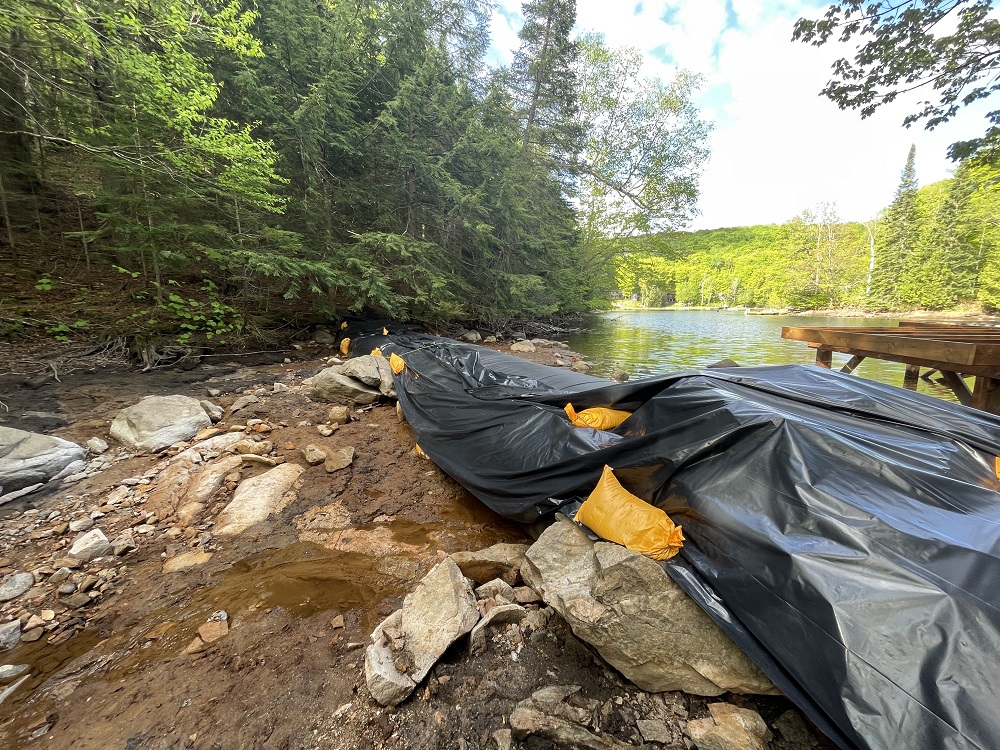
Two weeks after the erosion of a soil embankment on Esson Lake in Highlands East, Parks Canada crews have installed a temporary dam to shore up the breach.

In an update to landowners, Parks Canada said it is currently removing materials used to block a culvert dividing two sides of the lake. The dam was installed May 17.

The report estimated the lake would stay at mid-summer averages for the remainder of the spring and summer.

Currently, water levels at the lake are at a 2.5-metre average, far below historic lows for this time of year.

Below the breach, dozens of mature trees have toppled and parts of the soil hillside have eroded. On the lake, docks are sitting well out of the water.

Previously, Parks Canada estimated it will implement a long-term repair this winter when water levels decrease. “Residents and users of the lake are asked to avoid the aqua dam area in the interest of public safety,” said Parks Canada spokesperson Karen Feeley in a media release.

“Parks Canada would like to thank property owners for their patience and understanding during this time.”

Gardens of Haliburton all set to grow

0

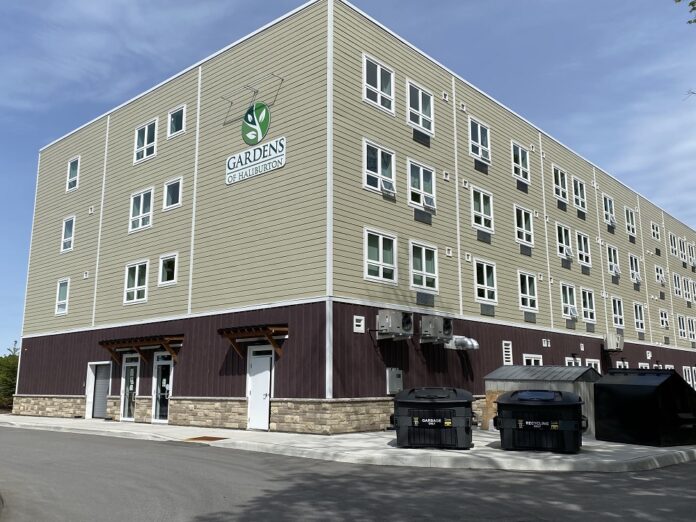
One of the owners of the Gardens of Haliburton retirement residence has said “we’re going to have [our second phase] built in a year” after the project was given the green light by Dysart council on May 24.

Bill Mardinae, who owns the facility alongside his brother Phil, said he was excited to move ahead with phase two, which will include the construction of a new four-story building containing 34 units.

The new structure will be located immediately beside the existing building, which was completed in 2021.

“Phase one was for 66 suites and they have all been leased, so we’re proposing to add another 34 suites to bring the total count to 100,” Mardinae told council.

“We’re not putting in any new services, no new roads… We’re going to have this built in a year.”

Specific timelines relating to a possible start and end date were not provided. Town planner Kris Orsan said the application, which required approval of an amendment to a previous site plan, met municipal standards and regulations. He recommended that council approve the project, pending a few minor adjustments.

He asked that Mardinae consider planting some trees on the north side of the property to create a barrier between a neighbouring property, and asked that parking lines for spaces to the east of the property be repainted, as they “are difficult to follow.” Orsan also recommended that an existing temporary rope divider installed around an outdoor patio be upgraded to fencing so as to create a greater barrier between the patio and parking lot.

Mardinae felt these issues were minor, and while he agreed to plant the trees and take care of the lines on the road, he felt installing a fence around the patio was unnecessary.

Deputy mayor Pat Kennedy agreed, saying he’d be happy to approve the application as is.

“I think this is just a fabulous project, and I really look forward to phase two getting shovels into the ground… Bill has been a good developer so far, the building looks nice and is well looked after… I think we can waive all of these points to get the project underway,” Kennedy said.

Coun. Walt McKechnie made a motion to approve phase two, seconded by Coun. Larry Clarke and it was passed unanimously by the rest of council.

Haliburton-Kawartha Lakes-Brock election candidates sound off on chamber questionnaire

0

The following is submitted by the Haliburton Highlands Chamber of Commerce

The Haliburton Highlands Chamber of Commerce membership identified five questions for provincial election candidates.

1. What strategies will you be putting forward to address the housing crisis in Haliburton County?

2. The County’s labour shortage and non-participation of many who could be upskilled to fill roles is a major concern for businesses. What will you do to address this issue?

3. Haliburton County relies heavily on our tourist economy. With inflation and the rising cost of gas, how will you ensure this industry is not negatively impacted?

4. What is your plan to improve upon high speed, affordable internet access within the County?

5. This is an exceptional time requiring exceptional measures. With this understanding are there plans to remove red tape, barriers, and reduce costs to ensure strong economic development in the County? Is there a strategy to incentivize the development of “primary home” and market rent accommodations?

Here are their edited responses for newspaper size constraints. 

Laurie Scott, Progressive Conservative Party of Ontario

1. At the end of the day, the biggest issue fueling the housing crisis is not enough homes. Our PC team introduced legislative, regulatory, and policy changes to help build new homes. We are fixing barriers to building new homes while protecting the environment, the Greenbelt, and agricultural lands. Our housing supply plan helped over 100,000 new homes start construction last year, the highest in more than 30 years. We continue to work with municipalities to reduce barriers to build different types of residential housing.

2. Encouraging apprenticeships, jobs in the skilled trades and allowing colleges to grant 3-year degrees. We are working with our local employment organizations and Fleming College to help connect more people with good jobs and upgrade their skills. In April, we announced over $1.6 million for three projects at Fleming College and Trent University to help get recent graduates into the labour market, and support local employers to fill skilled job vacancies. Fleming is also part of a $5-million dollar SkillsAdvance Ontario project to help 150 job seekers and 300 employed workers gain the skills and work experience they need to find jobs or advance their careers in wood product manufacturing and producing. We also created the Ontario Jobs Training Tax Credit to help workers retrain, improve their skills, or prepare for a career shift.

3. We are implementing a long-term plan to address the housing crisis, informed by the Housing Affordability Task Force’s recommendations and temporarily cutting the gas tax by 5.7 cents per litre and the fuel tax by 5.3 cents per litre for six months, beginning July 1, 2022. We continue to support households with the Ontario Electricity Rebate for residential customers, small businesses and farms and are proposing to provide an additional $300 in Personal Income Tax (PIT) relief, on average, to about 1.1 million taxpayers by enhancing the Low-income Individuals and Families Tax Credit. We also introduced the Ontario Staycation Tax Credit that allows residents to get back up to 20 per cent on their eligible accommodation expenses for leisure stays in the province this year.

4. As a part of the 2021 budget, our PC team is making an historic investment of $2.8 billion for broadband infrastructure, ensuring every region in our province has access to reliable broadband services by 2025. On top of previous investments, this increases our total investment to nearly $4 billion. This builds on the Cell Gap Project announced last spring with a provincial investment of $71 million to improve cellular service in Eastern Ontario with 300 new telecommunication sites to be built and over 300 existing sites upgraded across the region over the next five years.

5. Our PC team has a plan to help keep costs down by increasing housing supply, making it less expensive to drive, and providing targeted tax relief. We’re eliminating and refunding licence plate renewal fees for passenger vehicles, light-duty trucks, motorcycles and mopeds, and as mentioned temporarily cutting the gas tax and fuel tax. Also the previously referenced income tax relief; lowering child care fees for parents and securing a fair deal for Ontario by signing a $13.2 billion agreement with the federal government in an important step towards achieving an average of $10-a-day child care by September 2025.

Barbara Doyle, Ontario New Democratic Party

1. The NDP has a Homes in Ontario Program that will provide a 10 per cent stake in the homes to help buyers qualify for the down payment and reduce mortgage costs. 

This all goes along with our general affordability measures: raising minimum wage, supports for small businesses, $10/day childcare, pharmacare, dental care and mental health brought under OHIP, and bringing down the price of gasoline. Working together, it all leads to stable housing markets for homes that our community can afford. 

2. Our Green New Democratic Deal will create one million jobs, and transition the economy to an equitable, just and green future. By building on regional strengths, our innovation hub strategy will foster new skilled trades and economic opportunities in local areas. The NDP are making important investments in post-secondary education and workforce development to prepare for the in-demand jobs of the innovation economy. 

An NDP government will work with manufacturers to develop a manufacturing and labour force strategy for the province, while also supporting small and medium-sized businesses and non-profits for government procurement and our Buy Ontario program. 

An NDP government will raise the minimum wage to $20 an hour. We will remove the minimum wage exemptions that allow students to be paid less than every other worker in the province.

3. Increasing funding to these sectors is proven to increase the economic benefit to the communities around them. 

We would extend the Staycation Tax Credit but this is only helpful for those that can afford the immediate cost of the vacation. Reducing costs on everyday items such as child care, health care, and education will provide more disposable income that families can use to travel across Ontario. 

We will also address the price of gas. The NDP will give the Ontario Energy Board a mandate to monitor the price across Ontario to reduce price volatility and unfair regional price differences but will also regulate the retail price and wholesale mark-up of petroleum products. 

4. The NDP is committed to ensuring that Broadband is made available across Ontario, with priority to rural areas like ours. This is also directly linked to supporting our agriculture industry and food supply chain networks. Real time access to markets and processing is essential in today’s agri-economy. 

5. Municipalities know what types of housing they need to meet the needs of their communities while also providing room to grow. This may mean addressing current zoning to now allow for tiny homes, basement apartments, duplexes and triplexes or townhome developments. Density can be rethought, and innovation happens. Looking at how the province and local government can work together to build affordable market and non-market housing, eliminating the wait lists for subsidized housing, while at the same time providing room for growth for larger houses is not an either/or proposition. It can all be done at the same time. We can have social supports while also addressing high end needs as well. What we can’t do is build only high-end subdivisions while ignoring the local housing crisis and growing waitlists.

We must ensure larger investments in local hospitals, dedicated doctor recruitment programs, investing in local schools, taking the profit out of long-term care and ensuring more beds and new builds that are smaller, more home-like and better staffed. Looking at the core community supports, along with housing developments, create a community infrastructure to support more growth. 

Tom Regina, Green Party of Ontario

1. Green policy is to build 182,000 new permanently affordable community rental homes over the next decade, including 60,000 permanent supportive homes. Greens would mandate inclusionary zoning and require a minimum of 20 per cent affordable units in all housing projects above a certain size. Greens will create a seed fund for co-operative housing through direct funding and mortgage support.

Greens will partner with the federal government under the National Housing Strategy to renew 260,000 community rental homes over the next decade. Greens will partner with non-profits, co-ops and community land trusts to use public land for permanently affordable rental housing and attainable homeownership options through low-cost long-term leases. Greens will consult on and develop a down payment support program to help low and middle-income first-time home buyers. To help pay for these programs, Greens will implement a multiple property speculation tax on people and corporations who own more than two houses or condominium units in Ontario. The tax will begin at 20 per cent on the third home and increase with each additional property owned. Greens will work with all levels of government and housing experts to develop regulations to ease the financialization of both our affordable rental stock and single-family homes.

2. An affordable housing strategy is required to allow young families and workers to find a place in our community. Creating more, truly affordable housing will enable willing workers, professionals and entrepreneurs to find a place for themselves in our community.

3. Greens support increased staycation tax credit to include dining in restaurants. Greens will improve opportunities for small, local businesses and non-profits to win public contracts through targets and by decreasing current financial and informational barriers. Greens will allow Ontario’s craft spirits, brewers and wine producers to open independent, off-site stores; allow boutique wine, craft beer and artisan spirit retail outlets: improve the distribution network to work for small businesses; and allow access for hospitality to purchase from these suppliers at a wholesale price of up to 20 per cent.

4. The Green Party is committed to connecting people with better broadband. Greens will make broadband internet an essential service and roll out highspeed access across the province. Greens will use regulations to level the playing field for small, local internet service providers and support provincial funding for programs to study best practices for tele-working as a climate-friendly alternative to commuting.

5. Greens would like to create more pathways to home ownership, for example, allowing single family dwellings to be divided into multiple condominium units to create more attainable home ownership opportunities within existing neighbourhoods. Similarly, Greens will increase incentives and streamline the application process for first-time homeowners to add affordable rental units to their primary residence to help pay down their mortgage.

Gene Balfour, Ontario Libertarian Party

1. One dimension is the ability to pay for housing with after-tax earnings. Fact: The average Canadian pays more than 53 per cent of annual income to governments at every level; this has risen from 38 per cent since 1961. Excessive taxation clearly affects ability to pay. Excessive regulations in the housing sector are another root cause. The red tape and constraints that these burdens impose on builders and property owners adds greatly to both the cost as well as the time it takes to meet the demand for affordable housing by residents. Libertarians advocate for Less Government in order to unshackle all of the resources needed to make goals like affordable housing possible for everyone. Our approach is to pare back all unnecessary laws and regulations while ensuring the right balance for public safety. 

2. If elected, I would take great pride and satisfaction in using my expertise to help the County formulate a plan to eliminate the current labour shortages. No other political candidate can bring as much productive value to this issue as I can. However, like most issues, some of the problems arise from counterproductive government regulations. Like housing, these unnecessary constraints can only be repealed through the efforts of many appropriately-motivated and qualified MPPs in the Legislative Assembly of Ontario.

3. Take complete ownership of the issue at the County level and create your own strategy to mitigate these risks. Engage local stakeholders who have “skin in the game” so that you will have better control and buy-in of all needed resources. I recommend that the County’s tourism stakeholders employ the use of SWOT for each tourist season. This will ensure that they employ a proven and disciplined approach to make the industry more resilient to the changing circumstances that will inevitably evolve.

4. Become better informed about the existing plans for rolling out these services within the County. I am aware that the federal and provincial governments have already committed sizeable expenditures to accelerate the rollout of fibre-optic cable across Eastern Ontario where current access is poor. Addressing any problem begins with understanding its details and then becoming an informed facilitator to achieve the intended goals. Like all large projects, the schedule for this rollout has already been established.  If the implementation schedule is not satisfactory to your residents, then this is something that can be addressed through negotiations or by other means. Of course, StarNet is already available for residents who are not prepared to wait for the promised fibre-optic cable services. Prices are another matter. I do not favour government subsidies and prefer to investigate more creative ways to address these costs. I generally have little confidence in receiving timely and cost-effective ‘help’ from government institutions or promises made by Big Government politicians.

5.  I have been an Advocate for Less Government since 2007 when I first discovered Libertarianism and the Austrian ‘school’ of Economics. My commitment to reducing governments’ size, cost and scope of authority has been long-lasting and unwavering. In my view, the pendulum has swung too far in favour of concentrating power in government institutions. Our public sector is overly bureaucratic, excessively controlling, and far too expensive. Libertarians have been trying to hold back the pendulum from causing further harm. We hope to inspire our citizens to demand that it reverse direction.

Kerstin Kelly, Ontario Party

1. Simply put, the supply of homes is too low and demand for homes is too high, and, on both fronts, our current politicians are mostly to blame for this crisis.

The solution is not government funding funnelled to new homeowners. As recent history shows, when government money is made available, the market responds with proportional increases to home prices.

One of the Ontario Housing affordability Task Force objectives is to build 1.5 million new homes within the next 10 years. For the province to confirm the available land supply to accomplish this objective, we need to remove red tape and excessive legislation restricting single-family zoning in Ontario’s most housing-deprived areas. Property owners must be given more freedom to construct larger multi-unit residential buildings, and to add tiny houses to their properties, while we protect agricultural land.  It should not take six to 18 months to get building permits. We would advocate for establishing an Ontario-focused purchasing ban on foreign investors on residential homes and vacant land, as well as, striking up a money-laundering task force charged with rooting out corruption and instituting needed regulatory changes related to real estate sales and purchases. The Landlord Tenant Board of Ontario has created a crisis by making it impossible for good landlords to get rid of bad tenants, so now they are reluctant to take anyone else in.  This needs to be corrected, so people once again open up their homes to rentals. 
The most effective way to enhance building will be to get government and regulations out of the way, cut the red tape and use sound non-obstructive planning. To make it easier for first time house buyers to get into the market, allowing affordable tiny homes and multiplexes. The conversion of appropriate underused and unused commercial properties to create more homes is an excellent example of cutting the red tape and stimulating home building. We need the community to use innovative and creative solutions and get out of the way of allowing solutions to happen. 

2. We must encourage and value trades in schools. We would lower the cost of tuition for those post-secondary programs leading to careers with the most labour market demand. Ontario Student Assistance Program (OSAP) loans will also be made more easily available to students accessing those high demand programs and make it virtually free for qualified applicants to train in the skilled trades.  

Currently the Ontario government, or more precisely our province’s taxpayers, cover nearly half–about 46 per cent–of a post-secondary student’s program costs. That funding is not allocated by job market need: a student in a program proven to have few related job prospects after graduation can access the same levels of government funding as others (while their levels of funding are the same, their levels of defaulting on repayment is significantly higher). An Ontario Party Government will incentivize students to funnel into those post-secondary programs for which there is the most labour market demand and greatest opportunity for personal career success. Immigration should also be targeted to those persons bringing those in demand skills. Retraining the unemployed into skilled trades as part of the requirement to accept unemployment payments, and ODSP where possible, may also be an area to explore. 

There are 9 Essential Skills:

1. Reading

2. Writing

3. Document Use

4. Numeracy

5. Computer Use

6. Thinking

7. Oral Communication

8. Working with Others

9. Continuous Learning

These skills are not presently the primary focus in our schools, and we need school reform, where students learn times tables, printing and writing again. Library programs, Toastmasters, and creative and innovative coaching mentorship and education programs should be encouraged to provide these necessary skills.

3. We must remove all mandates, ineffective restrictions to business, lower taxes, less regulations and red tape to allow our creative entrepreneurs to innovate and to thrive. There is no sound reason that we do not have cheap energy and lower taxes. CERB, UBI etc. all have the negative impact of keeping people from working and driving prices up. Excess taxes and legislation drive prices up and this must be curtailed. 

4. Haliburton has many challenges with its highlands, rocks etc., making it difficult to promise high-speed and affordable internet access, but satellite internet is coming rapidly, and many private companies are competing to provide service. Making it profitable for them over such long distances and low density has been a barrier and high taxation, preventing them from keeping their profits has been a deterrent to providing service. Removing red tape and providing tax incentives would be some of the steps we could consider to promote rural service, to those in need. 

5. There are plans to remove red tape, barriers and reduce costs to ensure strong economic development in Haliburton. There is a strategy to enable homes and rental facilities to be built.  Removing all mandates and making a better plan is the core of the Ontario Party Platform.

Don McBey, Liberal Party of Ontario

1. The Ontario Liberals will double the pace of home building until 1.5 million residential units have been constructed, 138,000 of which will be deeply affordable. We will tax owners of empty development-ready land to create incentives for new housing starts. We will end the blind bidding process which drives up house prices.

2. We will train and hire more healthcare professionals and repeal Bill 124 to attract currently qualified professionals back into healthcare and education. We will double OSAP and eliminate interest on provincial student loans. We will double the existing skills grant for apprenticeships and skilled trades. We will increase the minimum wage to $16 dollars an hour starting in 2023 and from there we will create a structure of regional living wages across the province. All workers will receive 10 paid sick days and access to portable dental, drug, and mental healthcare benefits at an affordable cost. The Liberals will also provide $10 dollar-a-day childcare with flexibility to accommodate irregular schedules and shift work. We will raise the minimum PSW wage to $25-an-hour and cover tuition costs for medical and nursing students who will work in rural and remote communities. We will also create 25,000 green jobs and 2,000 internships for high school graduates in green sectors.

3. We will restore funding for the arts, music, and cultural sectors. We will invest $25 million a year in these sectors starting in 2023-24, and also invest $5 million for the Indigenous Culture Fund, which was scrapped by the Conservatives in 2019.  For rural Ontario, we will be making community transportation grants permanent. We will waive two years’ corporate tax for small businesses whose revenues were devastated by the Ford shutdowns, on a sliding scale up to 100 per cent. We will also be supporting restaurants by eliminating the HST on prepared food under $20.

4. The Ontario Liberal Party has committed to connecting all Ontarians with high speed, affordable wireless internet before 2025.   

5. By reintroducing rent control, we will put more money into the hands of prospective home buyers and reduce speculation in the housing market. We will work with municipalities to end exclusionary zoning policies and allow the building of homes with up to three units and three stories as well as secondary and laneway suites. We will also create an Ontario Home Building Corporation to cut red tape in the home building process and provide $300 million in incentives to municipalities to expedite the housing approval process. We will unlock more land for homes by expanding the Brownfields Tax Incentive program to provide tax relief for the conversion of underutilized commercial space into homes. We will create a digital platform for development applications.



McBey targets healthcare and housing

0
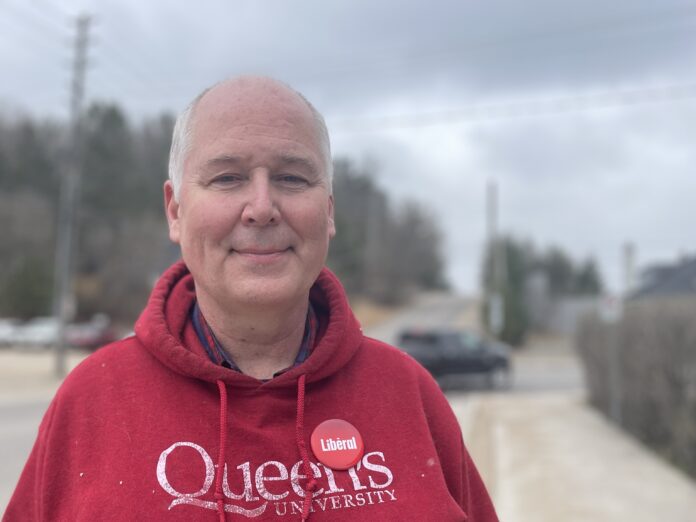
Don McBey

During his time as vice-chair of the Workplace Safety and Insurance Appeals Tribunal, Don McBey became keenly aware of the ripple effect COVID-19 is having across Ontario’s workforce.

He’s already seen cases of long-COVID and frequent instances of healthcare worker burnout.

The experience shaped his perspective as the Ontario Liberal Party’s candidate in Haliburton–Kawartha Lakes–Brock running in this year’s provincial election.

“People have to be informed about the risk, they have to be given reliable information, the tools they need so they can navigate their way in the new world, which is with COVID,” he said.

McBey said COVID-19 also exposed cracks in the province’s long-term care sector.

“What we’ve seen in the past is people were put at risk. That is something that has to change,” he said. “What we want to move towards is something that is based on providing care to people in their homes.”

McBey said he resonated with the Liberal’s plan to equip 400,000 seniors with home care in the next four years and boost spending on long-term care by $2 billion by 2026. Over the next decade, they propose building 15,000 assisted living spaces.

McBey said housing is another key concern.

“What we’ve got to do is look at the structure of housing and affordability: it’s not only a question of units, but also who can win the bidding wars,” he said.

McBey noted he wants to reduce speculative buying, or purchasing properties with the hopes of financial returns, to favour the needs of families and first-time home buyers.

He acknowledged this is especially prevalent in areas such as Haliburton County with a population exceeding housing capacity.

He said he worries Ontario is becoming a “two-tiered system of big landowners and people that can hardly afford rent, and can’t save money.”

McBey said he plans to tour communities around the riding, spreading awareness about how local issues such as hospital closures or social services gaps can be addressed provincially.

He said he recognizes many Ontarians grew frustrated with the previous Kathleen Wynne government. In 2018, the party only retained seven ridings.

“People really delivered that message to the Liberal party strongly last time around. The Liberal party is a new party,” McBey said.

He said new politicians like himself have helped change the face of the party, now led by Steven Del Duca.

“Times have moved on,” McBey said.

Too much government, says Balfour

0

Libertarian Gene Balfour will have his name on the ballot for the fourth time in Haliburton-Kawartha Lakes-Brock in next month’s provincial election, but he says his role is not to get elected.

Standing as a candidate for a fringe party, Balfour said he has long since come to terms with the fact that he won’t be elected to represent the riding in Queen’s Park. But he still believes in the importance of giving people a choice.

“When it comes to politics, people are not going to vote for a party that’s not going to be electable. So my role is not to get elected, my role is to try to influence,” Balfour said. “I run because I’ve always believed in the idea, principle and value of democracy.”

As a Libertarian, Balfour believes, fundamentally, that there is too much government in the world.

“We are the party that says that freedom of choice basically means the government plays a part, but it doesn’t have to control our lives entirely like it does today. If there’s one key model that we believe in, it would be freedom. That’s basically our party’s DNA,” Balfour said. “On top of that, there’s four principles which we call the principles for civil society. We believe in personal responsibility, individual freedom, respect and fairness.”

While he doesn’t consider himself an active campaigner, Balfour says the majority of people he has spoken to in the lead up to next month’s vote have liked what he’s had to say.

“Virtually everybody agrees that we have too much government, that our taxes are too high. I can’t think of a single person that I’ve ever spoken to in the last few years that would think we need more government intervention,” Balfour said.

With issues surrounding inflation, health care and the local housing crisis taking centre stage in Haliburton County in the lead up to the election, Balfour believes the root cause of all of those problems is mismanagement at the municipal, provincial and federal level.

One of the things he is actively advocating for is what he’s calling “non-government options”. Essentially, giving the public the choice to opt in or out of expensive programs funded through taxation.

“Take education for example, if you choose to support the government programs then I would propose you voluntarily pay your share of the costs to the public education system. But if you choose to opt out, then you would be exempt from contributing, you’d save that money and be able to redirect it paying for a private school education,” Balfour said.

He said the same concept could be used for government-led climate change programs, such as the carbon tax and gas tax.

“If you believe climate change is a serious issue, then you should personally contribute your own money and your own time to the cause… [those that don’t] should be able to opt out,” Balfour said. “That would give people so much more freedom to live their lives the way they want to, which is what Libertarianism is all about.”

Snail catchers get global recognition

0

A new program pioneered in Haliburton County in 2021 is starting to turn heads around the world.

After seeing dozens of area lakes infiltrated by invasive snails in recent years, the Coalition of Haliburton Property Owners Association (CHA) teamed up with specialists from the Ontario Federation of Angling and Hunting (OFAH) to design a program to tackle the issue.

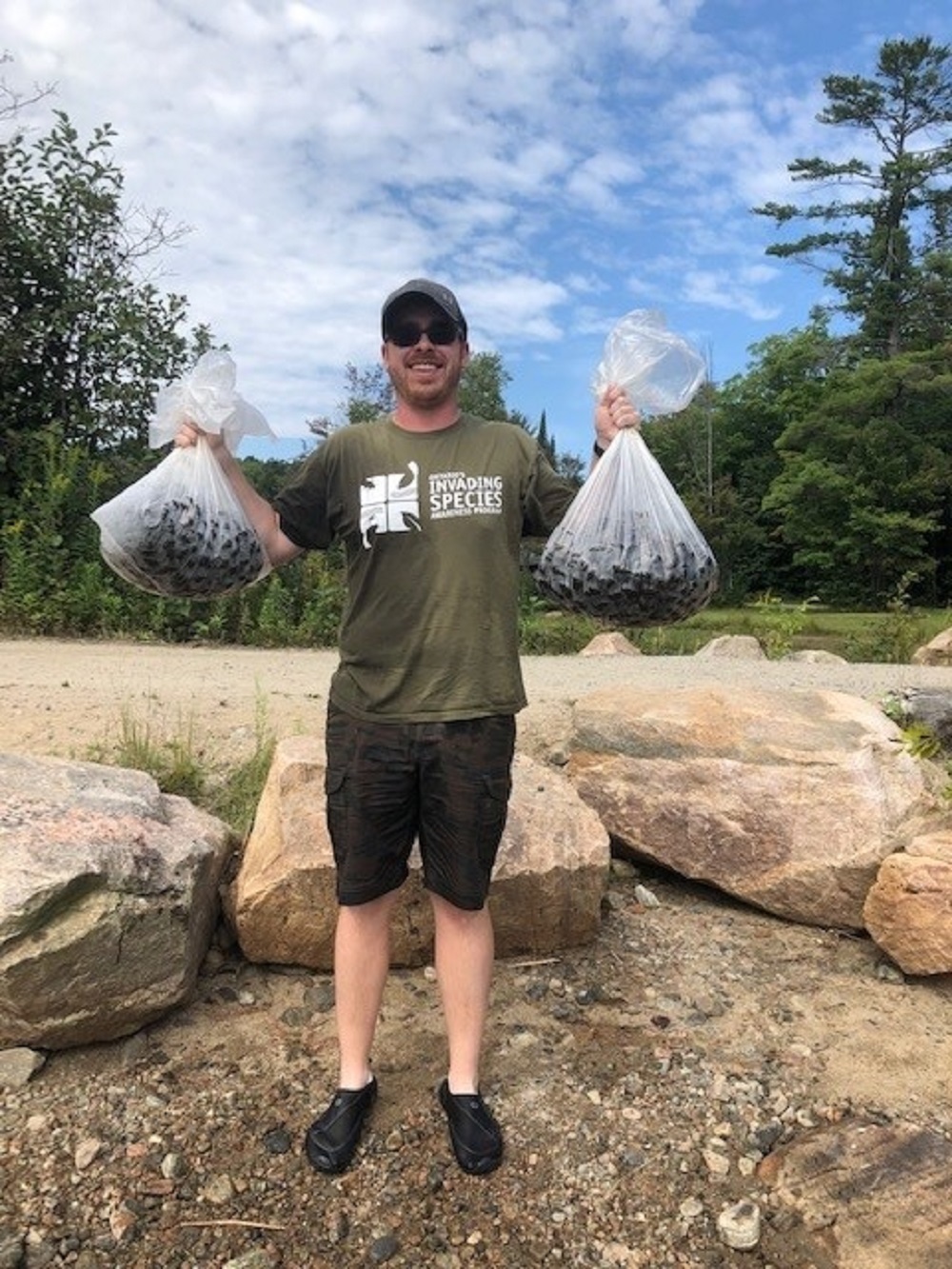
The effort saw around 300 volunteers come together to remove approximately 553,000 Chinese mystery snails and Banded mystery snails from more than 20 area waterbodies.

Brook Schryer, an aquatic program specialist with OFAH, discussed the program at the CHA’s 2022 lake stewards meeting, held at the Haliburton Legion May 14.

“Because snails are classified as fish in Ontario, we had to ensure volunteers that wanted to take part were trained and licensed to do so… Because the training is so stringent, we were successful in applying for a master license, which enabled us to host group training sessions and providing people passed, they could operate under that master license,” Schryer previously told The Highlander. “It was quite revolutionary, and hadn’t really been done before.”

Following the success of that inaugural year, Schryer started to hear from individuals all over North America seeking to establish similar programs. Lake experts from Oregon, Minnesota, Alberta and Quebec were among the first to get going. Earlier this year, Schryer presented the program at an international conference in Belgium, meaning the initiative fostered here in the Highlands is starting to take off across the globe.

The program will be running again in Haliburton County this year, with Schryer already hosting one training event in early May.

Speaking to the importance of the program, Schryer said the snails can wreak havoc on a lake’s eco-system. The snails have been known to eat largemouth bass eggs, impacting the bass population in lakes, while they have also been linked to various parasites that can be passed on to fish, waterfowl and humans, causing a myriad of issues including Swimmer’s Itch.

A single mystery snail, Schryer said, can store up to 100 embryos inside its body and can reproduce four or five times during its life. “Easy to see how they’ve become such a significant problem,” he said.

Changes to Invasive Species Act

In another presentation, Schryer noted around $3.6 billion is spent annually in Ontario managing around 440 different invasive species.

Ontario’s Invasive Species Act was created in 2015 and regulates the management and prevention of invasive species in Ontario. As of this year, Schryer says there are 22 species listed as prohibited, meaning they are illegal to transport, possess or release into the public.

There are 11 prohibited fish species, including snakeheads and grass carp, both of which Schryer listed in his top three problem species. There is one prohibited insect – the mountain pine beetle, six prohibited inverts, six prohibited plants and one prohibited mammal – wild pigs.

A further 11 species are listed as restricted, meaning they are illegal to import, and bring into provincial parks or conservation areas.

New boating regulations

Matt Robbins, also with OFAH, noted that, as of Jan. 1, the province has implemented new rules regarding the transporting of boats overland and has introduced strict cleaning measures to avoid transporting invasive aquatic species from one waterbody to another.

It is now required that drain plugs be opened or removed before a boat can be taken out of the water and transported elsewhere. As well, Robbins stated that reasonable measures should be taken to ensure all plants, animals and debris be removed from the boat before its transferred. Once cleaned, it’s recommended that owners dry or disinfect their watercraft for at least five days, leaving it exposed to sunlight, and cleaning it with hot water over 50 degrees Celsius, or a pressure washer between 2,500 and 3,000 psi.

In an update regarding baitfish, Robbins said that bait or leeches can no longer be transported outside of the BMZ zone they were purchased in. This means anglers fishing outside of their home BMZ zone must purchase their bait in the zone they’re fishing.

For more details, visit www.ofah.org/ about-us/ofah-zones.

Social cycle cruisers back on the road

0


At the Stanhope fire hall, about 30 people strap on helmets and saddle up their cycles before rolling away down North Shore Road.

Most are already chatting while they ride two-by-two into the foggy spring morning.

The Haliburton Real Easy Ryders’ first season officially back on the roads is now rolling after COVID-19 hampered the group’s cycling fun.

“There’s a real sense of community and friendship in the club I really enjoy,” said LeeAnn Cruz, club vice-president.

The club hosted its ‘Let’s get Rolling Social’ May 1 to welcome new members or anyone interested in cycling with others. More than 80 people showed up.

“The turnout was even greater than expected,” Cruz said.

While before COVID-19 membership exceeded 100, the club now sits at 84 registered members.

“Not as many people were feeling comfortable coming out and riding in a group,” Cruz said.

Now they’re back to regular programming: three rides a week at different locations across the County, along with trips to southern Ontario roads.

There’s even a planned three-day voyage to the Ottawa valley in September.

On each weekly ride, the club splits up to ride different distances, ensuring no rider gets left behind based on ability.

“There’s also safety in numbers,” Cruz said. Riders changing a flat tire or taking a break won’t be left alone, and new riders are often paired with club veterans.

Whether it’s recumbent, full-suspension, gravel-focused or a feather-weight racing bike, any type of cycle will do.

“We encourage anyone to come out,” said Cruz.

She said the club may be built on cycling, but it’s the social aspect that likely keeps members coming back.

“It makes riding that much more enjoyable when you can share it with others,” she said.

Ontario Party focusing on freedom and small government: Kelly

0

Ontario Party’s Dr. Kerstin Kelly hopes to represent Haliburton-Kawartha LakesBrock residents at the provincial legislature.

“We need someone in politics representing our people that isn’t there for the job. Someone to bring the power back to the people, and bring back their lives of opportunity. To bring back hope,” she said.

Kelly said she decided to run for office because she was “tired of the way the country has been run.”

She is a retired veterinarian and co-operator of the Lindsay Airport, also running the Crooked Lake Wilderness Lodge in Norland.

Kelly, who voted for Ford in 2018, said the Progressive Conservative party mishandled the response to COVID-19.

“I’ve never been so let down.”

She said the province should “never do mandates again” and pointed to the economic cost of shutdowns and vaccination policies.

Kelly said the Ontario party, started in 2018, stands for “truth, honesty and putting decency back in the government.”

She added that she appreciates the party encourages members to vote independently of the party, meaning she could vote against party policies without consequences.

She said she supports the party’s entire platform so far.

She said housing is a top issue in Haliburton that she has spoken to voters about. She favours looser rules on tenant evictions, which she said could give landlords the confidence to rent out apartments without fear of damage.

She advocated for allowing private healthcare to run alongside the public system.

“We intend to keep the public system going, but to improve it,” she said.

She favours a hands-off approach to rules governing businesses “so they can be allowed with their own entrepreneurship and creativity, to make the world a better place. Government has never done that and will never do that, it’s something we need to rely on the good people of this riding and Ontario to do.”

She has hosted multiple events across the region, such as a meet-and-greet at the Minden 50s diner. Kelly said if elected, she’d introduce new ways for constituents to voice their opinions, and take their feedback into account.

“It’s time that people have a candidate that actually speaks for the area,” she said.