Home Blog Page 330

‘Pandemonium’ when Haliburton won OHA Cup

0

Derrell Stamp can hardly believe it’s been 50 years since his Haliburton Junior D Huskies team hoisted the OHA Cup in front of a huge crowd at the Haliburton Community Centre.

The forward was only 16 years old for what was the highlight of his athletic career.

The team, under the leadership of owner, A.J. LaRue, coach, George Nicholls, manager Scotty LaRue, and trainers Bob Nichol and Curry “Pork” Whittaker, came back from a stunning playoff defeat the year before to beat a team from the much bigger community of Exeter to raise that cup on that fateful night – and go down in sporting lore in the Highlands.

The first Junior Huskies team was forged in 1965. According to the Haliburton Highlands Sports Hall of Fame committee, they were a “scrappy bunch.” However, thanks to a new hockey barn with artificial ice that extended practice time, and visiting National Hockey League players from Hockey Haven, the team evolved.

Stamp joined the squad as a 15-year-old for the 1969-70 season.

They made it to the OHA Cup finals.

He recalled that heartbreaking series in which the team was up three games to none against Norwich. They were leading 4-1 in what should have been the series-clinching game.

“Our goalie took a stick to the nose. It broke his nose. Our second stringer came in but he was not as good and we lost that game. Then, Norwich beat us the next three straight.”

It was a devastating loss for the team, but as often happens in sports, it brought a resiliency they would take to the 1970-71 playoffs.

“We had the makings of a group of good players, young players from a Bantam championship team mixed with the older guys, who were also very good.”

He said the team was fairly confident it would go back to the finals.

“We went to seven games the next year. It was terrific hockey as I recall. And the fan support from the community was great. They followed us in buses and cars and stayed in the same hotels when we were on the road.”

He said supporters came from as far away as Bobcaygeon, Fenelon Falls and Bancroft, culminating in game seven in Haliburton with an estimated crowd of 1,600.

According to the committee, the players were household names. Captain Bob Woodcock, assistant captains, Craig Stamp and Gerry McElwain, and a team with depth and stamina to first become Central Ontario League champs, then playoff Junior D champs and Eastern Ontario Junior D champs.

In that fateful OHA Cup series, Haliburton and the Exeter Hawks were evenlymatched. It was three-all going into the game seven decider. The Huskies held on for a 6-5 win.

Stamp said he has never experienced anything like the aftermath.

“It felt like most of the people in the stands came out on the ice. Everybody was so exuberant and happy. Parents, friends, girlfriends. It was pandemonium.”

Speaking on behalf of the team, Stamp said he’s pleased with the Hall of Fame induction.

“It’s an honour to go in. Most people don’t remember 50 years ago but at the time it was a very big deal for the town and the community.”

A new clown in town

0

Pockets the Clown twirls pieces of string in both hands. One moment, they appear to be different lengths. With a deft flick of her hand, they suddenly seem exactly the same.

That’s just one of the tricks and skills Pockets has perfected in her 30-year career as a clown, performing at birthday parties, seniors homes, assisted living centres and hospitals around the GTA.

Now, she’s bringing the magic to Haliburton. She and her husband recently retired to Wilberforce.

“I’m just restarting the business up in this area,” said Pockets the Clown, whose alter ego is Colleen Smith.

“While I’m here I maybe will only do one or two shows. I’m not going to do the full schedule I had there. I’m going to do what I can so that I can still enjoy this beautiful country.”

For Smith, the joy of clowning is focused on the smiles and giggles of her audience. She’s soft spoken, and said being gentle is as central to Pockets’ persona as her frizzy wig or face paint.

“The most enjoyment I get out of this is the smile on the children’s faces and the laughter I hear from them,” she said.

Her specialty is birthdays, where she creates elaborate balloon creations, performs magic and, before COVID19, showcased her artistic skills through elaborate face painting.

While Pockets can twirl princesses, puppies and a bouquet of flowers from balloons in seconds, she wears a “No Swords” badge: she believes clowning, like the rest of life, should be about peace and kindness.

It’s also hard work.

While employed as an accountant, Smith approached her father, Twinkletoes the Clown, to see if she could use clowning to supplement her income.

“I said ‘can you show me how to be a clown?’ And I’ve been clowning around every weekend ever since.”

She’s been to conventions for clowning around the GTA, as well as travelling to the famed Red Skelton Clown school, Mooseburger Clown Arts camp in Minnesota and even multiple weeklong worldwide clown conventions in Washington D.C. Now she’s started passing on her skills: Smith’s daughter has been learning the ropes as well.

 A caring clown

Throughout Pockets the Clown’s career, North America’s relationship with clowning has gone through a rough patch. Fictional depictions of clowns like that of Pennywise, from IT, meant Pockets faced threats and cruel messages online.

“It was a difficult time to get through to make sure that the person that’s hiring you knows you’re not the Stephen King clown. That’s a movie. This is a happy go lucky clown and my job is to entertain and make children laugh, not make them scared,” said Pockets.

She doesn’t use horns, and said she’s extremely careful to not startle kids and other attendees when she performs. Usually, the ones who might be timid around her experience a change of heart, she said with a smile.

“Usually if there’s a child who is scared of me, they’re my best friend by the time I go, and they don’t want me to leave.”

Pockets the Clown said that’s the highlight of clowning: seeing how her work can make even one child smile or giggle. She often performs for children with autism.

“When they see me or they will let me paint their face, or interact with me when I’m giving them a balloon, or laugh while I’m doing my magic show, and the mom comes up to me and says ‘my kid doesn’t do that’,” she said. “That says I’ve done my job.”

Landowners urged to support Highlands Corridor

0

The Haliburton Highlands Land Trust is reaching out to landowners in hopes of enticing them to join the Trust in protecting an important wildlife corridor.

The Highlands Corridor in southern Haliburton County has been identified as important and a few private landowners live within the corridor.

The Trust has received a grant of more than $60,000 from Environment and Climate Change Canada’s Habitat Stewardship Program and about $7,500 has been allotted to produce land management plans for a few of the landowners, said Shelley Hunt, chair of the Trust.

“Private landowners are an important piece of the puzzle, and we hope that offering a few free management plans (that will go towards enrolment in MFTIP – managed forest tax incentive program – and property tax savings) will reward and encourage good stewardship as well as raise awareness of the Highlands Corridor,” Hunt said.

She added the rest of the grant is for activities that will help them to understand more about the habitats within the corridor, for example, more wetland mapping and evaluation, and to raise the profile of the corridor as an area that needs good stewardship and protection.

The Trust doesn’t yet know the identities of the landowners who will receive the plans. They have sent letters to landowners whose properties have been identified through mapping as high-priority, asking if they would be interested in the offer.

“In return, we are asking to be able to visit the property and do an on-the-ground assessment of its ecosystems and habitats. This helps us gather more information about the corridor, as well as going towards the development of the management plans,” she said.

She said they hope to do the work this fall and the grant will help efforts to build climate change resilience and improve habitat connectivity for wildlife.

The Highlands Corridor is a broad swath of land that connects three provincial parks: Queen Elizabeth II Wildlands; Kawartha Highlands; and Silent Lake.

The area is rich in natural forests, rock barrens, wetlands and lakes, and home to a diverse community of wildlife including species-at-risk such as Blanding’s Turtle and Whip-poor-will. “Wildlife needs to be able to move safely across the landscape in order to thrive, and so it’s critical not only to protect these habitats, but also to maintain their connectivity,” Hunt said.

She added that climate change adaptation also relies on nature-based solutions such as protecting forests, wetlands, large natural areas and natural corridors. She said it helps to build the resilience that is an important part of Canada’s climate plan.

“Natural solutions can help to mitigate impacts like flooding and drought, conserve biodiversity, protect ecosystem services, connect landscapes and capture and store carbon. Canada has committed to protecting 30 per cent of our landscape by 2030. In Ontario, only 10.7 per cent of our landscape is currently protected.”

HHLT and partners such as Ontario Nature have been working to study and document the ecological values of the corridor. This has included the evaluation of 3,300 ha of wetland, mapping and classifying wetlands in the townships of Snowdon, Lutterworth and Glamorgan, modeling wildlife movement between the provincial parks, and building a database of species-at-risk observations.

Much of the land within the corridor is unceded Crown land that is in need of greater protection, but private landowners have an important role to play through good stewardship of their own land, Hunt said.

The MFTIP program reduces property tax rates in exchange for managing private, forested land with the environment in mind. This can include sustainable harvesting, or managing for wildlife or recreation, or a combination of land uses.

HHLT can offer up to five management plans to eligible landowners. “If you are contacted by HHLT, be sure to respond quickly if interested,” Hunt said.

For more information contact Hunt at chair@haliburtonlandtrust.ca or Christel Furniss, office administrator at admin@ haliburtonlandtrust.ca or 705-457-3700.

Algonquin Outfitters paddles to new milestone

0

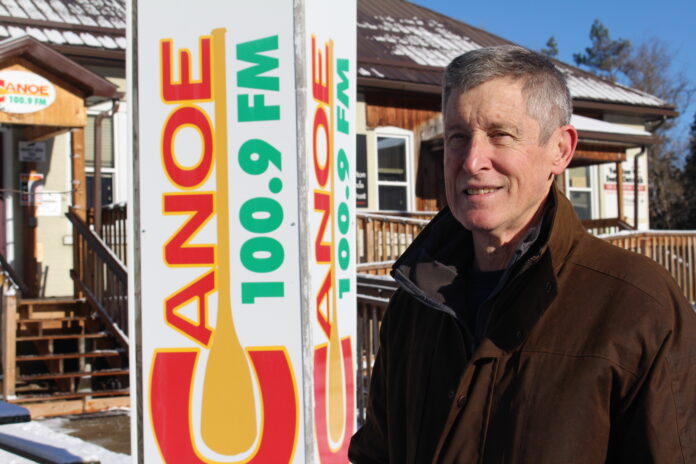
In 1961, 40 cedar canoes arrived at Algonquin Highlands’ Oxtongue Lake.

Shipped all the way from New Brunswick, they kickstarted Bill Swift Sr and forester Dave Wainman’s first Algonquin Outfitters location on the edge of Algonquin Park.

Now, 60 years later, the outdoor company has 12 locations spread out over Haliburton and Muskoka, serving backwoods campers, wakeboarders, cyclists, paddlers, climbers and just about anyone who enjoys the outdoors.

Rich, Bill’s son, and his partner Sue run the company now. Swift said the store still honours his dad’s original vision.

“I think my dad would be proud to see us maintain our traditional roots in what we offer,” Swift said.

“We do it right, we do it properly, with respect to nature. And we try and teach that to customers who are coming up,” said Swift.

They don’t only do that through conversations at the cash register. Algonquin Outfitters has a storied history of overnight canoe trips, a paddling school at the Gull River or even at their cafe and grill nestled in Algonquin Park.

That expansion started in 1980, largely prompted by Rich Swift and his brother Bill Swift Jr.

Now, Bill Jr. runs Swift Canoe and Kayak, which produces high-quality Canadianmade boats.

Throughout the store’s 60-year, multigeneration history, many have worked at the company for decades.

“It’s family,” said Randy Mitson, marketing director.

“We see that a lot, we see people who are with the company for 10 years and then they get the bug to go do something else, and they’re like ‘I miss the family’.”

Mitson himself left the company but quickly came back, working his way up the ranks. Now, he oversees marketing the company to an ever-expanding range of customers eager to explore Ontario in new ways.

“I always say we’re ambassadors to people’s leisure time,” Mitson said. “And that leisure time is getting shorter and shorter and shorter.”

Each store offers something slightly different, ensuring each branch has a different “flavour.”

“People tend to gravitate towards stores that they find serve them,” he said. If for example, you’re an avid paddler, AO Boatwerks could be the place to go while mountain bikers might voyage to Huntsville for an expanded selection. Though, adds Mitson, the Haliburton store services bikes.

Along the way, Algonquin Outfitters has developed a special relationship with artists through its yearly paddle contest. In 2019, 182 paddles were auctioned off, raising $32,575 for local charities. This year artist Jerry Lantaigne painted seven canoes for the auction as well, in celebration of the Group of Seven’s 100th anniversary. This year’s paddles will be auctioned off online from Sept. 13-27.

Mitson also said the store wants to showcase its history and future. They’re hosting a quiz on the store’s history (spoiler alert: all the answers are on their website), with the winner getting $1,000 to spend at the store.

Haliburton store expanded

Algonquin Outfitters’ Haliburton location got a refresh this spring.

“It’s got a lot more variety than what we had available in the old space,” said Mitson. The store moved from the corner of Maple Avenue and Highland Street to the former Source for Sports location.

“We wanted to showcase more of the products we offer at some of our larger locations – it was an opportunity to do that,” Mitson said.

It’s a lineup of products that are in hot demand. Biking, camping, canoeing: all activities which have exploded in popularity during the COVID-19 pandemic. “Because of COVID we’ve seen this huge boom in tourism,” Mitson said.

It’s a boom all 12 locations are ready for as they cater to a wide array of outdoor enthusiasts in a way that Mitson said is “quintessentially Canadian.”

“We’ve always embraced that but now we have a need to get away from the Zoom calls and chats and get outdoors.”

COVID vaccine focus shifts to mobile clinics

0

By Lisa Gervais and Sam Gillett

The local health unit and the Ontario government are teaming up to have the GO-VAXX bus come to the County Sept. 19.

A pair of GO buses have been temporarily retrofitted to serve as mobile COVID-19 vaccine clinics as part of the province’s efforts to target those who have yet to receive a first or second dose.

Since hitting the road in August, the buses have visited Canada’s Wonderland, Rogers Centre, BMO Field, select shopping malls, various universities and colleges, farmers markets, festivals and more to provide COVID-19 vaccines.

Now, the GO-VAXX bus is coming to the Highlands to provide COVID-19 vaccines on Sunday, Sept. 19, from 1-4 p.m. at Abbey Gardens (1012 Garden Gate Dr.) in Haliburton County. The site is located 10 minutes from Haliburton Village, towards Carnarvon, just off Highway 118.

“We’re pleased to be working with the province and Metrolinx to bring the GO-VAXX bus to our communities,” said Doreen Boville, a health promoter with the HKPR District Health Unit.

“We encourage anyone who still needs COVID-19 vaccine to get aboard the bus and get a first or second dose so they are fully protected against COVID-19, especially as we head into a fourth wave.”

Anyone wishing to take advantage of the GO-VAXX bus to receive a vaccine is reminded to:

• Bring your health card. If you do not have a health card or your health card is expired, bring another form of government-issued photo identification such as a driver’s license, passport, Status card, or birth certificate.

• Eat and drink something before you arrive to prevent feeling faint or dizzy while being vaccinated.

• Dress for the weather in case there is a line-up.

• Wear clothing that allows for easy access to the upper arm such as a loose-fitting top or T-shirt.

• Wear a mask that covers your nose, mouth, and chin.

• Do not visit the GO-VAXX bus if you have symptoms of COVID-19. The mobile clinics have come about after all mass vaccination clinics in the health unit area, such as the S.G. Nesbitt Memorial Arena in Minden, have closed.

As of Sept. 3, mobile pop-up clinics are being scheduled around the County for those who haven’t received two shots of a COVID-19 vaccine.

“While we did see large numbers of people come through our mass immunization clinics, we know that there are some areas of our region in which the vaccination rates are still lower,” said Dr. Natalie Bocking, HKPR medical officer of health in a press release.

“Mobile clinics are now being offered in some of our smaller communities making it easier for people to get vaccinated without having to worry about transportation issues or taking time off work to travel to a clinic,” she added.

Currently, mobile clinics will also visit the South Algonquin Country Store in Harcourt on Sept. 18 from noon until 3 p.m. Appointments aren’t required for mobile clinics.

The health unit also had clinics at the high school on Sept. 14 and 15.

The health unit reports 71 per cent of COVID-19 cases in the region since June were among unvaccinated people while 10.8 per cent were fully vaccinated.

“These numbers demonstrate to me that at a community level the vaccine is making a difference,” said Bocking.

As of Sept. 13, 83.3 per cent of the region has received their first dose of a COVID-19 vaccine, and 78.3 per cent have received two doses

AH middle of the road for council pay

0

Algonquin Highlands taxpayers have gotten some insight into how much they are spending on council as compared to similarsized townships.

Gallagher Benefit Services (Canada) Group Inc. presented an elected officials’ remuneration review final report to council during a Sept. 2 meeting.

The firm’s Jane Mizanski said the report was aimed at assessing the competitiveness of compensation. It also informs the township about attracting municipal candidates and whether their compensation reflects the responsibilities, time commitment and accountability of the positions.

The consultants looked at base pay, per diems, eligible expenses and other things such as benefits and pensions.

A comparison was made to North Frontenac, Perry, North Kawartha, Lake of Bays, Highlands East, Hastings Highlands, Trent Lakes, Minden Hills and Bracebridge.

They found the mayor’s remuneration is competitive to the market average, while the deputy mayor and councillors are a bit above.

They noted at .45 per kilometre, the township falls short of most others which compensate mileage at .55 per kilometre. It noted the council gets health and dental benefits. As for technology, the mayor and deputy mayor get cell phones.

The report concluded, “Overall the Township practices for benefits and other expenses is aligned to most of the market comparators, with the exception of per kilometre rates and technology supports where the Township is below the comparator group offerings. In terms of base remuneration for each of the three positions [mayor, deputy mayor and councillors] the Township is competitive with the market median.”

It suggested annual pay adjustments equal to staff positions; increasing mileage reimbursement to .55 per kilometre for the first 5,000 km then .45; and exploring cost effective options to provide all elected officials with technology support either through direct purchase (and return of laptop or buy out at end of term) or a once per term stipend for newly-elected members (returning members receive the stipend only once).

Mayor Carol Moffatt noted that with the pandemic, councillors are not driving a lot and some are using landlines, but the suggestions are good going forward.

Coun. Jennifer Dailloux said she was “delighted” to see Algonquin Highlands was “right smack in the middle. It’s a good space to be in and provides confidence for us.” She said she would prefer a stipend to put towards technology, such as internet and software costs since how council business is being conducted has changed.

Deputy mayor Liz Danielsen agreed it was good to see that the council was in the middle of what people are paying. She agreed with taking a look at mileage reimbursement and stipends for technology.

Coun. Julia Shortreed said members of the committee of adjustment are doing a lot of driving and supported examining a mileage increase.

A staff report will come back to a future council meeting.

Fines issued for Illegal moose hunting in Forest

0

Three County residents have been fined for illegal moose hunting in Haliburton Forest during the 2019 moose hunt.

According to Northern Development, Mines, Natural Resources and Forestry, five men – the other two from out of the County – have been fined a total of $17,900 for illegal moose hunting activities involving a bull and a cow moose in the Forest in October of 2019.

The case was heard on June 15, 2021 and a press release issued Aug. 20.

In the press release, the ministry said “The Ontario government wants to remind hunters that when party hunting to follow all requirements and not make false statements to conservation officers.”

Patrick Morrison of Haliburton pleaded guilty to unlawfully hunting a bull moose without a licence and unlawfully hunting a cow moose without a licence and was fined $6,000.

Steven Forrest of Bobcaygeon pleaded guilty to unlawfully hunting a bull moose without a licence and unlawfully hunting a cow moose without a licence and was fined $5,750.

Robert Robinson of Ashburn pleaded guilty and was fined $1,950 for making a false statement to a conservation officer and $1,750 for unlawfully enabling someone else to use a licence or component of a licence issued to oneself.

Colin Morrison of Haliburton pleaded guilty and was fined $1,750 for unlawfully using a licence, or component of a licence issued to someone else.

Craig Stamp of West Guilford pleaded guilty and was fined $700 for unlawfully transporting wildlife that was unlawfully killed.

The court heard that on Wednesday, October 23, 2019, a conservation officer conducted an inspection of a hunt camp in the Forest and found a dead cow and calf moose that had been shot. The cow moose had a cow tag attached that was issued to Robinson and notched for that morning at 8 a.m. The officer spoke with Robinson over the phone who claimed he had been there and left at lunch that day.

The investigation revealed that three moose – a bull, a cow, and a calf – were all harvested on Oct. 23, 2019 by Forrest. There were no individuals with a bull moose tag or cow moose tag actively participating in the hunt when the moose were shot. Robinson had left his cow moose tag behind with Colin Morrison who notched and affixed the tag. Stamp had assisted in transporting the moose out of the bush. Patrick Morrison had informed the hunting group that they had more moose tags than they did. The bull moose was left in the bush but then later brought out and identified to officers so it wouldn’t spoil. Justice of the Peace Ronald Prestage heard the case remotely in the Ontario Court of Justice.

The release said “conservation officers continue to patrol and protect our natural resources during the current COVID19 pandemic and would like to remind everyone that by respecting seasons, sanctuaries, bag and possession limits, we all help ensure our natural resources stay healthy.”

To report a natural resource violation or provide information about an unsolved case, members of the public can call the ministry TIPS line toll free at 1-877-847-7667. You can also call Crime Stoppers anonymously at 1-800-222-TIPS. For more information about unsolved cases, visit ontario.ca/ mnrftip

Another bump in the road for Wallings Road development

0

By Mike Baker

Dysart et al Mayor Andrea Roberts says she and her council are still “very much committed” to moving ahead with a new affordable housing development on Wallings Road, but admitted this week that the planning process has been more difficult than anyone anticipated.

Municipal officials spent close to two hours on Tuesday (Sept. 14) discussing the proposed project during a closed session of council. Jeff Iles, Dysart’s director of planning and land information, presented an official draft letter of intent, which outlined the expectations of both the municipality and Places for People – the local non-profit that is partnering with the township on the development.

In that letter, it was revealed that the near 2.7 acre plot of land on Wallings Road, located directly beside the school bus terminal, would be transferred from Dysart to Places for People for a cost of $2 once the site has been rezoned.

It was noted that the location, once complete, would consist of up to 48 affordable rental units for low and moderate income households.

Township staff and representatives from Places for People have been collaborating on the proposal since November 2020. It was originally hoped that the land could be rezoned by Oct. 31 of this year – a deadline that Iles, on Tuesday, recommended that staff remove.

“Timelines associated with the zoning process depend on many factors, and I’m of the opinion that the [Oct. 31] timeline does not appear to be achievable,” Iles said. “The intent is certainly not to delay the process. However, before the process can proceed, certain items need to be addressed.”

While Iles did not disclose specific details surrounding those items, Ward 4 Coun. John Smith said he had a problem with some of the financial details outlined in the letter.

Places for People is requesting that Dysart waive $374,000 in fees to help push the project over the line. Having agreed to donate the land in question, Smith feels that amount is excessive.

“They are not going to get the land and all of the other concessions we would normally make for an affordable housing development… It’s always been my own perspective that the land was a generous donation on our part. But to layer on top of that another [near] $400,000 worth of waiving fees is, I feel, excessive,” Smith said.

Roberts agreed, highlighting a need for further discussions with Places for People before an official letter of intent can be signed. One sticking point she referenced was a request to waive the municipality’s sewer connection fee, which for this project is slated to be $225,600.

“Sometimes these things take longer than one would hope, but that is the way the planning process goes. It’s not to delay anything whatsoever, or hold anybody up. We want to see this project go forward,” Roberts stated. “Not signing the letter of intent today does not mean [we won’t]. The intention is still to go forward with this project. We’re all wanting the same thing. It’s just not as easy to get there as we originally thought.”

Iles said he would confer with Places for People and the County of Haliburton over the coming weeks on some of the financials, as well as a plan to install a flashing light at the corner of County Road 21 and Wallings Road to help with traffic flow once the development is complete. Iles said he would bring a revised letter back to council “as soon as possible,” but held off on committing to an actual date.

Protesters urge action on climate change

0

People gathered to hold signs reading “climate change is real” and “there is no planet B” in Haliburton Sept. 8 to urge political action on climate change in the upcoming election.

Organized by Environment Haliburton! and Concerned Citizens of Haliburton County, the march drew more than 23 people to Head Lake Park before they walked to the side of Highland Street, passing cars and trucks honking their support.

It was part of 50 marches planned across Canada by 350, a U.S.-based non-profit dedicated to ending the reliance on fossil fuels and advocating for climate change action.

“When you look out west, when you look at Europe, Australia, those are ways you can tell the climate crisis is almost past a crisis. there has to be action now,” said Bonnie Roe, of Concerned Citizens of Haliburton County. “We believe our politicians need to start listening.”

Carolynn Coburn, a director with Environment Haliburton! said she’s been frustrated with a perceived lack of action from federal and provincial representatives in the County. “I don’t hear Jamie Schmale, I don’t hear Laurie Scott talking about climate and their party’s policies,” she said.

Schmale’s Conservative Party has proposed multiple climate change goals such as ensuring the country meets Paris climate accord emission targets, as well as making electric vehicles more affordable and introducing a low carbon savings account.

The UN Intergovernmental Panel on Climate Change predicts that unless urgent action is taken to keep temperature level increases below 1.5 degree Celsius, extreme weather events could have terrible consequences.

For many such as Coburn, that means Canada should do everything possible to limit emissions, even if it means temporarily hurting parts of the economy such as the oil and gas sector.

“You can’t have an economy on a dead planet,” she said.

Prime Minister Justin Trudeau’s climate record has attracted criticism, too. For example, in 2019, the first year of federal carbon pricing, emissions rose by 0.2 per cent. Many also regard Trudeau’s purchase of the Trans Mountain pipeline as a violation of climate action goals. “If we don’t deal with climate there’s nothing else,” said Judi Forbes, Liberal candidate for Haliburton-Kawartha Lakes-Brock. Forbes was the only candidate who attended the event. Schmale and other candidates had scheduling conflicts, said Susan Hay of Environment Haliburton!

Tom Regina and Andrea Percy, both members of the Green Party of Canada, attended the march to advocate for urgent action on the climate crisis.

“We’ve got to get started on doing something,” Percy said.

Regina noted that so far in the election race, demonstrations seem to have centred on issues surrounding COVID-19 protocols.

“It’s important to show different kinds of protests,” Regina said. “The protests that have been given media attention in the last few days are quite different from what we’re here trying to draw attention to. By having these demonstrations, we can have our voice brought out just as much. There are people thinking about the environment and various progressive platforms.”

Concerned Citizens of Haliburton County and Environment Haliburton! is holding a Fridays for Futures Global Strike on Sept. 24 at noon in Minden.

Minden waives fees for housing project

0

Minden Hills council voted to formally waive fees associated with a proposed new affordable housing project at Highway 35 and County Road 21 in Minden.

It’s part of a countywide initiative to provide incentives to prospective builders to achieve affordable housing targets under the County of Haliburton and City of Kawartha Lakes Housing and Homelessness Plan.

At its Sept. 9 meeting, CAO Trisha McKibbin said, “I know that council is very much aware that we do have within the County and Minden Hills a lack of purposebuilt rental units and rental properties are few and far between and it is a challenge for … residents to find housing.”

It means the County and township waiving just under $400,000 in application fees, site plan security and building permit.

She said the benefit is the KLH Housing Corporation is planning to build 36 new affordable housing rental units.

The County and its four lower-tier municipalities are inviting private developers, community housing providers, affordable housing providers, community agencies and residents to apply for the incentives.

Coun. Bob Carter commented, “For us, it’s really a waiving of fees and a donation of a road allowance that we weren’t using. The $360,000, which is the majority of it, 90 per cent, that’s part of the County program that really has nothing to do with us. I certainly would have no objection.”

Coun. Pam Sayne said, “our downtown is screaming for people that can find affordable housing so that they can be employed in our downtown area so I think this is going to be a big boost for our community and I’m looking forward to the shovels in the ground.”

Coun. Ron Nesbitt asked about the project timeline.

Carter, who sits on the housing task force, said there is one outstanding item before the MTO and it is also in the hands of the CMHC, so “we don’t know.”

Deputy mayor Lisa Schell said the ask was nothing new and council is supportive of the program.

A formal agreement and the passing of a bylaw will come to a future council meeting.