
Home Blog Page 335

‘It’s all about people’ for Lenny Salvatori

0

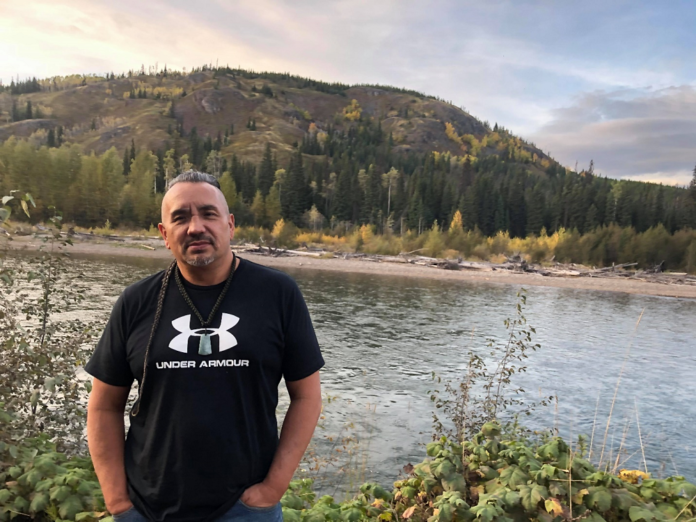
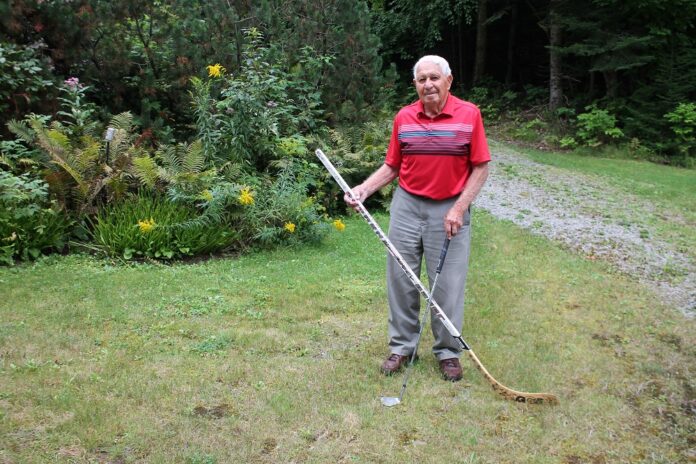
Lenny Salvatori’s man cave is a visual history of what the 91-year-old Haliburtonian has achieved in sports, youth mentorship and public service over the years.

There’s a hockey stick, golf clubs and balls, curling paraphernalia, trekking poles, and trophies and pictures lining the walls.

Someone made him a wooden framed cabinet with the names of many of the Scouts he mentored over 30 years written in calligraphy.

There are mementos from nearly 35 years as a school board trustee.

For all of this, and more, Salvatori has been named to the Haliburton Highlands Sports Hall of Fame in the builder category.

The Hall committee says, “Lenny Salvatori invested a lifetime of involvement into the sports culture of Haliburton County. From his early days as an athlete in the 1930s and 40s to his legendary success as a 90-year-old golfer, Lenny has been a player, an organizer, a promoter and a fan of local sports.”

In the downstairs room of his house just west of Haliburton, Salvatori recalled driving a 48-passenger school bus down Kennisis Lake Road for the LaRue family when he was just 17 years old and still attending high school. It was during the Second World War and they were short of men to drive.

His first foray into organized sport was at the age of 14 or so when he played softball for an Eagle Lake team. He caught and later pitched.

“I was always into sports,” he said. Although he could not play organized hockey because the family lived too far away from the Haliburton arena, he was heavily involved in management, coaching and on minor hockey executives in his adult life.

He managed the high school hockey team. After graduating, he ran the arena for a year, recalling having to hand scrape the ice. He was also somewhat of a counsellor as parents would come to him with their problems.

Going on to join Curry Motors, which he eventually co-owned, he continued to work with youth. He was a founding member and long-time organizer of the Glen Dart Hockey Tournament.

The Hall said he became known for his skills at resolving disputes and challenges among the teams.

His Scouting career spanned more than three decades as did his trusteeship.

“I was always around kids.”

He began golfing with former HHSS principal Bud Thayer when he was still in school and has played right up until this summer. He had a hole-in-one on the third hole of the Pinestone in 2006.

He said his love of the game stems from “the friendship of people you go with and the competition.”

Asked about being inducted into the Hall, Salvatori humbly said, “I have mixed emotions about that. There are a lot of good people that did a lot of work in minor hockey and never got any recognition. I think everybody should be recognized for what contribution they made. It’s unfair guys like me get recognition when guys I worked with didn’t get anything.”

At the end of the day, said Salvatori, two phrases come to mind. “It’s all about people” and “No person is bigger than the game.”  

Mandatory vaccinations fuel discussion

0

By Kirk Winter

The vaccination status of staff and students was hotly debated at the Aug. 24 Trillium Lakelands District School Board regular board meeting.

Senior staff drilled down with trustees the protocols that will be put in place with teaching staff who refuse to get vaccinated.

“Vaccinations for students and staff are not mandatory,” Director of Education, Wes Hahn, said. “Staff who remain unvaccinated must have a medical exemption and will be COVID tested on a regular basis.”

Trustee John Byrne wanted to know if staff who refuse vaccinations will have to participate in a vaccine education program. Byrne was told that board is waiting for direction from the Ministry of Education on that piece of the protocol, but he expects the answer will be yes.

Senior manager of human resources services, Tracy Hubbard, told trustees staff testing kits have already been delivered. She believes staff who refuse vaccinations will need to be tested once a week.

Trustee Steven Binstock asked Hubbard what would happen if a staff member refused to self-test. She said the board “will be ready for that contingency.”

Trustee Judy Saunders wanted to know if the board has the power to make vaccines mandatory for staff and students. Hahn was unsure and said senior staff would have to look into that.

Both local teachers’ unions are fully supportive of mandatory vaccinations in schools saying in a joint press release Aug. 18, “We believe that everyone working in, or attending a school who is eligible and can safely be vaccinated should be vaccinated.”

The unions qualified that any mandatory vaccination program must include provisions that ensure those who are unable to be vaccinated for medical or religious reasons receive the required employment accommodations and are not disadvantaged.

However, they said, “Individuals who are exempt for reasons due to statements of conscience, or are not vaccinated, must be required to take additional precautions for their own safety and that of those around them including regular testing, using additional PPE, ensuring distancing requirements are met and adhering to other safety protocols.”

Craig Horsley, president of District 15 of the OSSTF, added, “I would like to see as many layers of protection in place to keep staff and students safe … and vaccination is just one of those layers as well as proper ventilation, smaller class sizes, comprehensive cohorting and testing. The current board policy for vaccination disclosure aligns well with OSSTF on the topic.”

When asked how many teachers this new policy might affect, Horsely said due to privacy issues OSSTF does not have that information but, “generally speaking our members are no different than the public on what can be a very divisive topic, so I suspect the numbers will be similar to the general public but again I have no data to support that.”

Hahn also informed trustees that public health will be using secondary schools in TLDSB in September to host vaccine clinics.

“TLDSB is encouraging students to be vaccinated. It is clear that cases that are on the rise come from the unvaccinated,” Hahn said.”

We have to always be on guard. Cases could spike again despite the fact that we are feeling good locally. We want staff and students to be safe and kids to stay in the classroom.”

Hanh said the clinics will be run by the local health units and it will not be mandatory for unvaccinated students to attend.

“We simply want to provide students and others the opportunity for getting the vaccine,” Hahn said.

Smaller learn-at-home

The board’s Learn at Home program for 2021-2022 will be a shadow of the robust pandemic-bloated model that operated in 2020-2021.

Hahn said that as of Aug, 24, 327 elementary and 257 secondary students have registered in the virtual education program. This is a significant drop from the 2,000 who used Learn at Home as their primary vehicle for educational programming during 2020-2021.

Hahn made it clear again that due to concerns about staffing, once students have committed to Learn at Home they will likely have to finish at least the semester in that program.

“There might be some shifting in early September happening as we do our regular school reorganization, but after that the kids won’t be moving. Staffing this year will not allow it.”

EH! goes back to the land on climate

0

The relationship between climate issues resolution and Land Back – the movement to return lands to Indigenous peoples – is the focus of an upcoming Environment Haliburton! event.

“Land Back & Climate Justice” will discuss the movement, explain why it’s central to addressing the climate crisis, and provide information about how settler climate organizers can support the movement.

The discussion will feature speakers Jaydene Lavallie and Sakej Ward and moderator Dr. Jen Gobby.

Gobby is an activist-scholar and educator based on unceded Abenaki territory in rural Quebec and author of the book More Powerful Together: Conversations with Climate Activists and Indigenous Land Defenders.

Gobby said in an interview that she started out as a climate activist and in the mid2010s she “came to understand that the most powerful and transformative force towards environmental and social justice in this country is Indigenous folks defending and caring for their lands and waters, And so, I try to support Indigenous land defenders in ways that I can, though various forms of solidarity.”

Her research is focused on climate policy, climate justice, social transformation and Indigenous-settler relations in social movements in Canada, and through her research she met Lavallie and Ward.

Lavallie is a Two-Spirit Michif-Cree woman currently living in Dish with One Spoon Territory (Hamilton). She spends most of her efforts on anti-extractive and land defense struggles but has also dedicated herself to defending Hamilton against gentrification, fighting patriarchy inside and outside of organizing circles, and pushing for animal liberation.

Sakej (James) Ward belongs to the wolf clan. He is Mi’kmaw (Mi’kmaq Nation) from Esgenoopetitj (Burnt Church First Nation, New Brunswick). He holds a bachelor’s degree in Political Science and a master’s degree in Indigenous Governance. Sakej has a long history of advocating and protecting First Nations inherent responsibilities and freedoms.

Gobby holds a PhD from McGill University, is a postdoctoral fellow at Concordia University and teaches courses on environment and climate change at Bishop’s University and McGill’s Bieler School of Environment.

To highlight Indigenous perspectives Gobby pointed to a talk by Pamela Palmater (“Canada, It’s Time for Land Back”; breachmedia.ca/land-back). Palmater is a Mi’kmaw lawyer, professor, writer, member of the Eel River Bar First Nation and Chair in Indigenous Governance at Ryerson University.

“Today, Indian reserves account for just 0.2 per cent of the land,” said Palmater. “It’s worth remembering that even though Indigenous peoples make up less than five per cent of the world’s population, we protect 80 per cent of global biodiversity … First Nation jurisdiction over lands and waters would not only be a matter of justice, but a pathway for Canada to a more sustainable relationship to the natural world.”

According to Gobby, while the Land Back movement may not seem politically feasible at the moment, it actually is.

“There are a lot of great examples that we’ll talk about in the event about ways that concretely people are enacting Land Back in all kinds of really exciting ways.”

“Land Back & Climate Justice” will be held Sept. 8 at 7:30 p.m. virtually on Zoom. To register, go to environmenthaliburton. org and use the link on the home page. For more information contact Susan Hay at hayfield@tcc.on.ca or 705-457-9239.

Skin Tech expands in new location

0

It’s been an exciting 15 months for business owner Yvonne Kreuzwiesner.

During that time, the Halls Lake cottager moved to the County full-time, ran a mobile esthetic services business, launched Skin Tech Face and Body Care in Haliburton, moved it to a new location and weathered pandemic slowdowns and a closure. But it has all worked out.

“The reason for our relocation was to expand our size and our services,” said Kreuzwiesner. “We are located in a great new spot with other amenities available beside us.

We are on the ground floor, which is easier for seniors, and there is a registered massage therapist, Cathy Killoch, [nearby] and Mark [Christiano] from the Hair Lounge is two doors down from me.”

The new location features double the space to hold more equipment and provide greater client comfort, and electrolysis and laser treatments have been added to the original esthetic and medical esthetic services.

Kreuzwiesner made the move on March 1, only to be required to shut down from April 6 to June 30 under pandemic regulations.

Since the reopening, “I’m happy to say we have been very busy and we are so grateful,” said Kreuzwiesner.

“The pandemic has been challenging to our business; however, we proceed with strict hygiene procedures and clients can see how clean and professional we are … We screen and follow the health department [guidelines] closely.

“Our new location has been so good for business – bigger space, great location and great support and referrals from the businesses next door to me. I am so happy to be servicing the wonderful people of Haliburton County, what a privilege and an honour. We like our cottagers from the GTA, all are welcome.”

Skin Tech is now located at 50 York St., Unit 5 in Haliburton beside ServiceOntario. Phone 705-489-1598; text 416-806- 9682; email ykreuz@hotmail.com; visit skintechfaceandbodycare.com.

Green candidate says people want change

0

Green Party candidate Angel Godsoe said people can call her naive, but she isn’t about to concede the 2021 federal election to Haliburton-Kawartha Lakes-Brock Conservative incumbent Jamie Schmale.

Nor will she predict a percentage goal for the Greens, after 2019 candidate Elizabeth Fraser garnered 8.4 per cent of the vote.

“I’ve been speaking to people in parks and everybody’s ready for a change that I have talked to,” she said. “I’m not going to limit us by putting any numbers out there. We’re in it to win.”

While taking a lunch break at a parkette on Balsam Lake near Cambry with her children, Godsoe said she is dedicating the month of September to contesting the election.

She owns a riding stable called Heaven’s Gait in Cambry and runs summer camps for kids. She is a mother of nine and has one grandson. On the day of the interview, the kids had practised rodeo skills and tie-dyed bandanas.

She said she has had horses for about 25 years and has taken them to public events.

“It started off with ponies for my young kids and it just sort of grew.” She said she loves the feeling she gets from taking ponies or horses to public gatherings. Like when walking dogs, she said, “you immediately have something to talk about because the horse is the attraction.” She is working to open a therapy centre at her farm for people with post traumatic stress disorder.

Asked if the Green Party’s very public leadership woes are being discussed, she said some people mention it. “They ask if Annamie (Paul) is still the leader because that was really put out there. I think that was not an accurate representation of what actually was happening. I think there was an issue with her press person but it was resolved to the vast majority of the party’s satisfaction and I think the bad press that we got was really troublemaking. It was not reflective of the reality.”

As for the timing of the election, she said it is “unnecessary and ill-timed” with droughts, fires and a pandemic. “I really hope people see it for the power grab that it is.”

As for her and the party’s election platform, she speaks to climate, electoral reform and international issues.

“The climate should be in everybody’s heart. I really feel we have a pulse of it in this riding. We have a lot of farm people. I think as a farmer myself we are really in tune with what’s happening in the environment and the threat of fires and drought and flash floods and severe storms. We get it. It’s important. The Green Party has been constant and unwavering in our commitment to alleviating climate change and to sticking to our carbon goals.”

As to electoral reform, she said Liberal leader Justin Trudeau campaigned on change in 2015 and it has not come about. “Because now he is in power and he doesn’t want things to change but we do. When we get in, we will make the change.”

Godsoe added that international affairs are important to her and the party has been consistent in its stance of Canada maintaining its role as an international peacekeeper, stopping the arms trade, not supporting violent, militant groups, and being open for immigration of displaced people and people who are asylum seekers and in need of a place.”

She said she believes the crisis in Afghanistan is on people’s minds.

“I’m just really looking forward to speaking with people. If people see us out and about, putting up signs, wearing green T-shirts, I really want to be approachable and I want to hear feedback from as many people as I can about what is important to them.”

Party ‘had people’s backs’ in pandemic

0

THE HIGHLANDS VOTES

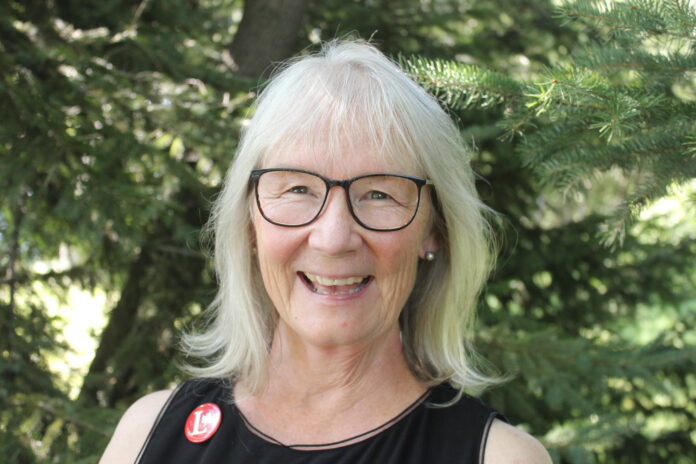
While the party she’s representing called a federal election, Liberal candidate for Haliburton-Kawartha Lakes-Brock, Judi Forbes, didn’t have much notice she’d be hitting the campaign trail.

“It’s been a bit of a whirlwind. I think it’s been that way for all the candidates,” she said.

Despite running in a riding longtime held by the Conservatives, Forbes said she feels confident. “I’ve had a great reception when I’ve been door knocking,” said Forbes, who worked for 30 years in the financial industry and currently owns a bed and breakfast in Beaverton.

She said many people she’s spoken to “know the Liberal government has had their backs through this pandemic.”

Forbes said her party is focusing on housing and rentals, a key issue in Haliburton County.

“Part of that is increasing the supply of housing,” she said. That includes doubling funding for the National Housing Co-Investment to a total of $2.7 billion over four years and a promise to spend $600 million in converting commercial spaces into residential housing.

The party also proposes an “anti-flipping tax” on residential properties to discourage buy-and-sell strategies.

As a business owner working in hospitality, an industry hit hard by COVID19, Forbes said “small businesses are a focus of mine. I am concerned about our small businesses, a lot of them were closed down during COVID. Large box stores were allowed to stay open which seemed unproductive.”

However, she said party policies such as a reopening subsidy or support program for the tourism sector, covering up to 75 per cent of rental costs until 2022, represents strong support for businesses.

“The Liberal government has been supporting small businesses all along,” she said.

One contentious aspect of the platform is CERB, a program which the Conservative party, among others, claims is partly responsible for difficulties in finding employees as they claim it “penalizes workers for picking up shifts.”

Forbes defended the CERB rollout, saying “the point of this program was to get money into people’s hands who needed it. I think it was hugely successful in doing that,” she said. “Obviously there are people who take advantage of programs, it’s a very, very small minority of folks that would do that.”

Parties such as the NDP have also criticized the Liberal government for its handling of key electoral promises such as a 2015 pledge to end first past the post voting or a commitment to ending boil water advisories in Indigenous communities.

In both cases, Forbes said the issues are far more complex than “sound bites.”

“We have brought clean water to well over 100 indigenous communities. It’s a work in progress, we haven’t finished yet.”

Support for mandatory vaccines

“We need mandatory vaccinations for health workers and education workers,” she said. For Forbes, it’s important to make sure all who work in high-risk areas protect the people they work with, whether elderly, infirm or too young to take the vaccine.

“I have confidence in Dr. Tam and her team when they say vaccinations are safe and absolutely effective.”

For Forbes, the issue is personal. Her mother is living in long-term care and she said “many, many vulnerable citizens passed away from COVID, and it broke my heart.”

The Liberal Party is proposing a new Safe Long Term Care Act and a $9 billion investment in increasing spaces available and the quality of care.

Another flashpoint of the 2021 election has been the rapid resurgence of the Taliban in Afghanistan, a country where more than 40,000 Canadians served in various military and support roles since 2001.

Many say Canada has not been proactive in helping Canadians and those who helped Canadian forces in Afghanistan escape the country.

Forbes rejects that claim: “I’ve been talking to John McKay [counsellor for Canada’s NATO Parliamentary Association] personally about this situation in Afghanistan, because I know so many people are concerned about it. He assured me his team is working incredibly hard to resolve this.”

Fighting opioid stigma to save lives

0

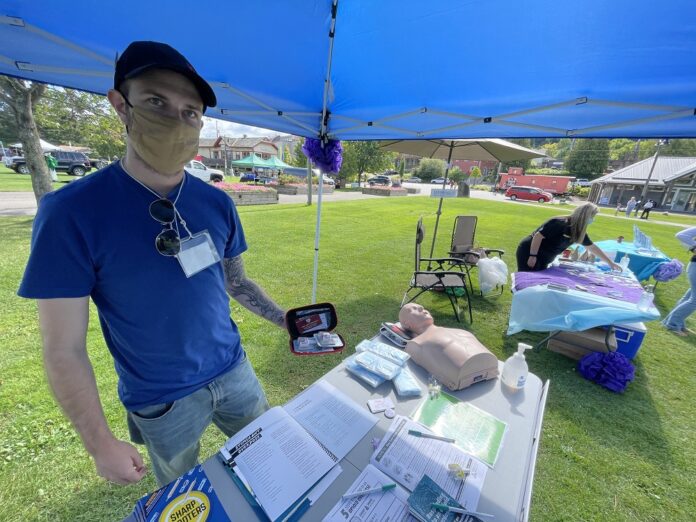
At a table in Head Lake Park, Matt Perrin shows two people how to use Naloxone kits.

The small nasal plungers are safe to have around kids, small enough to fit in a purse and could mean the difference between life or death for someone who has overdosed on opioids.

Perrin is a Harm Reduction Outreach Worker with PARN, a community AIDS Resource Network. He was set up at one of three booths in Head Lake Park on Aug. 31 at a vigil marking International Opioid Overdose Awareness Day.

It’s a somber occasion.

Between April 2020 and March 2021, the HKPR District Health Unit reported nearly double the number of opioid overdoses across the region. Across Canada, cities such as Toronto are experiencing higher than ever rates of opioid-related overdoses, with 51 calls made to 9-1-1 on July 30 alone.

At the vigil, multiple people working on the frontline of the crisis in Haliburton County said the issue is increasingly pressing.

“It’s a combination of the exacerbating of an existing problem, increased anxiety, increased mental health stresses,” said Robert Gaudette, manager of skills development and harm reduction services with the John Howard Society of Canada.

Fighting stigma

Gaudette said there are countless misconceptions around drug use, such as perceptions about who uses drugs.

“It isn’t strictly within an underserved community. It’s quite surprising how many people live successful lives, are business owners, and this just gets a hold of them.”

Many people who overdose don’t intentionally consume too much. Increasingly, the drug supply is tainted with the extremely toxic drug Fentanyl. A small amount mixed in with another substance is nearly impossible to detect.

Natasha James, a harm reduction and crisis coordinator with the John Howard Society, said Haliburton’s housing crisis also plays a role in the amount of drug use and people’s risk of overdose.

“Oftentimes that stigma gets in the way of finding proper and stable housing,” she said.

“If people don’t have proper housing they are more likely to use. We are very concerned about going into the winter months.”

Rebecca Eagleson works with the Canadian Mental Health Association as a case worker. At the vigil she and a colleague were spreading awareness about their services and support programs. She said a lack of services in Haliburton makes getting help with mental health difficult: that can be linked with drug use or serious mental health conditions such as opioid addiction.

“Up here there is almost next to nothing. I think that’s a huge contributor to what’s been going on up here recently. It’s a lot of unmanaged mental health and people unable to access resources.”

County polls residents on wellbeing ‘gaps’

0

Haliburton County is developing a Community Safety and Wellbeing Plan (CSWB) and now they want to hear from the public.

The County launched a community survey, developed by consultant StrategyCorp, on Aug. 23. The firm has been hired to help the County address Haliburton’s social challenges through collaboration between government, stakeholders and community groups.

The survey polls County residents about their perception of social issues and services. That includes housing, education, healthcare, transportation and more.

StrategyCorp has been working with the CSWB Plan Steering Committee since April 2021. At an Aug. 25 meeting, they outlined their findings so far.

They suggested three “focus areas”: issues within the County that the plan could address. Those include housing, poverty and food insecurity, and physical and mental health.

“They are the ones that are coming up over and over again as foundational problems,” said StrategyCorp manager Lauren Wyman.

Other areas Wyman suggested posed risks include: public transportation, indigenous support, mental health and substance use, elder care, service system navigation and climate change.

They detail how interconnected many of the issues Haliburton County faces. For example, the County has the second highest cost of living in Ontario after Toronto. A living wage, they estimate, is $19.47 an hour. That translates into issues of energy poverty. Sixteen per cent of homeowners in Haliburton County spend more than 15 percent of their income on energy costs, according to StrategyCorp.

The goal of the survey, steering committee talks, and upcoming public consultation in September is to pinpoint where Haliburton County’s infrastructure is failing members of the community.

“It’s about identifying the gaps between the services you have that will get you to innovative solutions,” said StrategyCorp principal John Matheson. Those solutions, suggested Matheson and his team, might aid Haliburton in decreasing issues such as crime, homelessness and poverty. Suggestions so far include streamlining access to support systems, a centralized transportation system in the County, data collection and sharing and better collaboration with community organizations.

He said the plan, when finalized, won’t necessarily mean huge spending. Instead, it will act as a guide in the ongoing process of streamlining support systems across the community. It’s also mandated by the Ontario government that all municipalities develop a CSWB plan under the 2018 Safer Ontario Act.

“As long as there are gaps in community collaboration, that’s where this can benefit,” he said.

Filling those gaps as a municipality is hard to do, remarked multiple members of council.

“It’s not an issue of political will, it’s an issue of political knowledge,” said Algonquin Highlands Mayor Carol Moffatt.

CAO Mike Rutter said he’s become more aware of how communication of County programs has been a barrier to people seeking help: “We’re doing things to help people, somehow the message just isn’t connecting.”

After the survey results are processed, the CSWB Plan Steering Committee will coordinate with StrategyCorp to develop a draft plan in October, finalizing the plan after that.

To access the survey, available until Sept. 17, visit haliburtoncounty.ca/en/news. There will also be paper copies available at Haliburton County Public Library locations and soon to be announced town hall meetings.

Highlands Cinemas Documentary: Profiling Kinmount’s ‘movie man’

0
Photo by Scott Ramsay

Matt Finlin was 11 when he first discovered Highlands Cinemas. His family had rented a cottage and his aunt and uncle took them in for a film. 

“All of a sudden we’re driving up someone’s driveway … it almost looked like someone’s house. It was like ‘oh, is this a movie theatre?’ said Finlin. “Then you walk in the doors and it’s just this magical place.” 

For the past three years, Finlin has been trying to capture some of that magic, and the magician behind it, Keith Stata, in a documentary. 

The Movie Man will likely be completed in 2022. 

He hopes to find interested investors who could help fund post-production and help bring the passion project to life. 

“This is very much a passion project. It’s something that evolved from a weekend creative outlet into something that’s become a larger feature film,” he said. 

Finlin is a partner in Door Knocker Media, a Toronto-based video production company that’s produced ads for Honda and RBC, music videos for the likes of Eddie Vedder and more. 

He said he approached Stata to do a small video piece on the theatre, mentioning his childhood attachment to the space.

“When I got there, I realized there was a larger story to be told,” Finlin said. 

That story has taken more than three years to tell. 

“The larger story is that there’s not really any place like it in the world,” he said. With ancient projectors, halls of memorabilia and 45 cats living in handmade apartment-style accommodations, it’s a one-of-a kind operation. Finlin said he was surprised by secret passageways, hidden doors and Stata’s care of his animals (including a bear which has made itself at home at the back of his property).

For Finlin, Stata is a character intertwined with his theatre. 

“Keith is the theatre as much as the theatre is Keith,” said Finlin. “They’re like this symbiotic relationship which is really interesting. Someone who’s born and raised in a town of 200 or so and decided to stay there, to create a magical place which drives the town.” 

But does it get tiring, sharing the theatre’s stories? “No,” said Stata. “It’s kind of fun sometimes.” 

That’s even after more than 40 hours of showcasing his theatre to Finlin and his team. 

“He practically lived here,” Stata said. “I said to him ‘you realize I’ve almost gone through three dogs since you started this’!” 

Uncertain ending 

Stata holds a poster for Christopher Nolan’s The Dark Knight Rises. It’s one of more than 1000 posters in storage at the Cinema.

Stata doesn’t know how the documentary will end. After all, neither does Finlin. 

That will depend on whether the theatre can open in 2022. 

Stata’s magical place is currently shuttered, closed since 2019. He and his 46 cats haven’t welcomed the usual summer crowds. The future of the cinema is a bit uncertain. 

He said it costs $75,000 to run each year. “In all reality we have to get back to some kind of normal,” he said. And that means both as far as COVID-19 and moviegoing habits. Stata said he’s seen other theatres in nearby regions suffer with mediocre ticket sales even since they were allowed to reopen with limited capacity. 

For now, Stata’s been sorting through memorabilia, neatly organized across his property in 17 shipping containers, such as a collection of more than 1000 movie posters he’s been selling. 

“It took me months to find enough time to go through this: they’re out of order, there are multiple copies,” he said, leafing through a pile of posters from the original Matrix movie, The Dark Knight; The Hulk (He recently sold a rare Revenge of the Jedi poster for $950). 

Stata compares sorting through his posters to Finlin dealing with the hours of footage from the cinema. 

“With that much footage he’s going to have a hell of a time editing it down,” Stata said. 

Over the course of hours of interviews and stories about the theatre, Finlin said he views the cinema’s proprietor as a friend. As a documentarian, that makes producing the work a personal challenge. 

“My version of the truth is becoming more awkward because I’ve gotten to know Keith very well. I have a very personal relationship with the theatre because it inspired me to make movies.” 

Finlin said in the next few months he hopes to dive back into the Highland Cinema’s documentary. The goal is to have it all completed by the spring. All, that is, except the ending. That part of the script has yet to be written. 

Shore report calls for flexibility

0

After months of consultation, firms hired to undertake a review of the County’s draft shoreline bylaw have called for more flexibility in an easier to read document.

Representatives from J.L Richards and Associates Limited (JLR) and Hutchinson Environmental Sciences Ltd. (HES) summarized 216 pages of research, feedback and early suggestions for bylaw improvement at an Aug. 25 council meeting.

Areas of the bylaw which the firms suggest could be improved include: plainer language; consistent application; flexibility depending on site conditions; consistency with local regulations; using performance-based standards to regulate site activity; streamlining application requirements and broadening the scope of lake health matters that will be referred to council; as well as an efficient transition from current to revised bylaw rules.

Many of the suggestions rely on enhanced bylaw flexibility. For instance, lakes with steep shorelines more at risk of contamination from runoff might have different regulations than lakes with flat waterfront lots. Currently, the draft bylaw is the same no matter the size, shape or orientation of a waterfront property.

“That might make things quite difficult for the people who are going to be managing this document,” said Warden Liz Danielsen, mentioning how lake-specific rules would be tricky to regulate in a County with as many waterbodies as Haliburton. “We’re all going to be very cognizant of the management of enforcement.”

That flexibility could extend to site-specific regulations. For example, currently shoreline construction work must be limited in the instance of strong winds. With performance-based rules, that would determine risk management strategies each firm could have in place.

Thinking of 30 metres

In JLR’s report of existing regulations, they reminded County council of regulations set out by the planning act: any new rules must conform to a municipality’s official plan.

That means a shoreline setback other than 30 metres would not match what’s laid out in the County’s plan. That plan directly refers to a 30 metre setback from a high water mark.

Brett Parsons, a scientist with HES, compared the County’s proposed rule with other municipalities including Gravenhurst, Lake of Bays, Huntsville and Hasting Highlands. He found setbacks between 15-30 metres are common. The province’s Lake Capacity Assessment Handbook also suggests a 30 metre setback for waterbodies on the Canadian Shield.

Coun. Cec Ryall said it appeared the report stood by the initially proposed 30 metre setback: “Would a 20 metre setback compromise anything of what we’re doing?” he asked.

Parsons explained that buffers of nondevelopment of 10 metres remove 65 per cent of sediment while 30 metres is found to remove 85 per cent.

“The length of the buffer and the effectiveness of it all depends on what you deem to be effective,” Parsons told council. He also said site conditions determine how much of a setback could limit pollutants entering the water. Most municipalities researched by the consultants required that 75 per cent of a property’s shoreline must be maintained in a natural state.

However, many of the public who addressed the planners at a July 29 special meeting of council said they were concerned a 30 metre setback was overly cautious.

Stakeholders, public have their say

All those who spoke with JLR or HES consultants have remained anonymous, however Jason Ferrigan of JLR assured council they accurately presented the full spectrum of opinions. As of Aug. 25, 783 people responded to a survey on the shoreline bylaw. The report presented to council details a list of stakeholders interviewed.

“Most important is that everyone we’ve spoken to values the lakes and waterbodies in the County,” he said.

Members of council and the public said there were other public policy objectives that were more important to address than the rules surrounding shoreline development.

“The lakes are still in pretty good shape based on the reports we have,” said Coun. Walt McKechnie. He mentioned other lake issues are similarly important: “To me I’m hearing concerns like in Head Lake with (Eurasian) Watermilfoil.”

Coun. Carol Moffatt said jurisdiction of lake activities is also a challenge: “the problem is that the jurisdiction of whatever is happening out on the lakes is not ours,” she said.

Whatever bylaw eventually is passed by council will likely be far easier to read.

For the public to accurately understand whatever rules are decided on, Ferrigan suggested revising the bylaw’s wording or including a “Coles Notes” version to summarize the rules.

“Our sort of approach is to write short bylaws that are performance based and outcome focused.”

Ferrigan said the current bylaw is quite lengthy, meaning the “average citizen” might not even read the whole thing.

After presenting their findings to council, the consultants will continue working in the community to determine clear recommendations and a final draft bylaw County council will discuss.

“We provide you with the options,” Ferrigan said. “At that meeting you decide which options you want to take.”

To read the full report of work and research completed so far, visit haliburton. civicweb.net/portal/