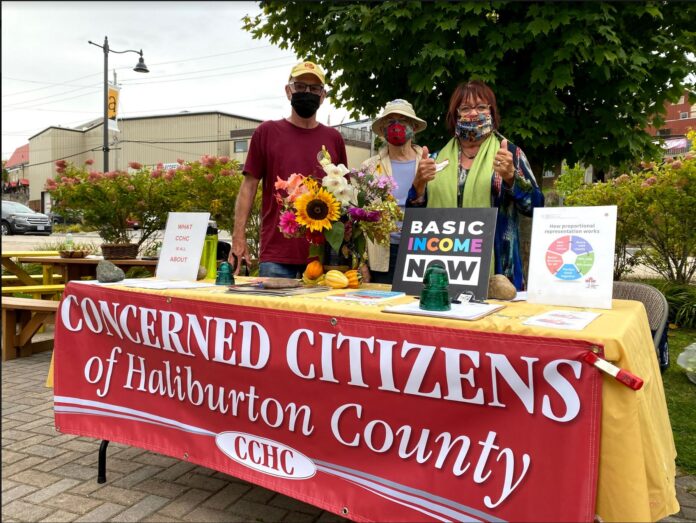
More than 40 area residents provided their thoughts and opinions on the potential implementation of a nationwide basic income program during a special day-long presentation at Head Lake Park on Sept. 21.
Organized by the Concerned Citizens of Haliburton County (CCHC), the event was designed to “get people talking, and get people thinking” according to Bonnie Roe, one of the activist group’s leading volunteers.
Since their formation in January 2019, CCHC has been one of the community’s lead advocates when it comes to social justice issues. The idea of a basic income has been prevalent, in Ontario at least, for several years. Back in March 2016, the Liberal government of the day launched a pilot project designed to test a growing view that a basic income could help to reduce poverty in a sustainable way.
The program was rolled out in Hamilton, Thunder Bay and nearby Lindsay. More than 4,000 people were signed up, with individuals receiving up to $16,989 per year, and couples slated to get $24,027. The program was intended to improve outcomes in food security, stress and anxiety, mental health, health and healthcare usage, housing stability, education and training, and employment and labour market participation.
“We believe having a basic income is vital to helping individuals who may be struggling get their lives back on track. When we saw the positive outcomes that people who were enrolled in this program were having, it was incredible,” Roe said.
The program was later discontinued in 2018 after Conservative Doug Ford assumed office.
“When it was shut down, many people’s hopes and dreams were totally destroyed. These people had started to do things such as no longer rely on the food bank for food, going back to school, or even starting their own business,” Roe said. “Once that level of support was removed, a lot of these people found themselves back at square one.”
Carolynn Coburn, another volunteer with CCHC, set up a chart at last week’s event and made a note of every specific thing an individual stated they would need to live a happy life. She said the group will be using that information to broach the issue of a basic, livable income with provincial and federal politicians in the near future.
“A lot of the responses we received related to housing, having enough food, being surrounded by family and friends. Then there was a community component too – that was important, because people felt they would be more inclined to get involved in their community, and be good, active citizens if they felt more secure financially,” Coburn said.
Given the situation that many people across Canada found themselves in last year when the pandemic first hit, Coburn feels there’s more compassion out there now for individuals who do need an extra helping hand. Approximately 8.9 million people applied for support through the Canada Emergency Response Benefit last year after being financially impacted by the onset of COVID-19.
“It was pretty interesting to see what the government thought people who lost their jobs needed to survive, to get by month-to-month – they each got $2,000 per month,” Coburn noted. “Considering the pilot project for basic income was at $16,900, that’s a big increase.”
The major stumbling block many people have difficulty with when it comes to a universal basic income is the reported costs associated with implementing such a program. According to the Office of the Parliamentary Budget Officer, a guaranteed basic income would cost $87 billion in 2022, rising to $93 billion in 2025.
Coburn says that money would be offset by a decrease in monies paid out through other social programs. Roe said she’d like to see some of the country’s richest residents dip into their pockets to help pay for the program.
“In my view, a basic income would come from our taxation system, the same way that healthcare does. If you turn around … and look at the very, very wealthy, and if you tax them even a minimal amount, you would have all the extra money needed to be able to allocate to something like this,” Roe said. “If people know they have this secure amount of money coming in every month, that could change their life. They will be able to plan and know they have enough for a comfortable life and have all of their basic needs met.”
She concluded, “It would be a win-win for all involved.”
As Hailey Alden settles into her new life up in North Bay, she does so having received a little helping hand from the Wilberforce FUNraising Group (WFG).
The recent Haliburton Highlands Secondary School graduate, and long-time Wilberforce resident, made the difficult decision to leave home earlier this year in pursuit of post-secondary education. She is currently enrolled in a two-year practical nursing program at Canadore College.
Just prior to her move to the ‘Gateway of the North’, Alden was the recipient of the 2021 WFG Bursary Award. Launched last year, the initiative was designed to assist promising students as they prepare to head off to college or university.
“This is just one of the delightful sort of Highlands East kind of things where there’s a group of people who like each other, and have got together with very little structure for years and years and years to do regular community events. Then, the money that we made [would go towards] the betterment of the community, and we have, historically, tended to focus on youth,” said WFG member Joan Barton.
The group, in the past, has raised money for projects such as the development of Herlihey Park. When COVID-19 hit, however, they were severely restricted by what they could do.
“We had money just sitting in the bank. This was money people had given to us thinking we would do good stuff with it. So, we decided we wanted to continue doing good stuff, hence the bursary,” Barton continued.
Last year, HHSS graduates Sydney Little and Chelsea Flynn each received $500 through the bursary fund.
Originally, the WFG wasn’t sure they’d have enough to match that total for this year’s bursary. Then, Barton recalls, one member received a call from Elaine Fournier, the recently retired former principal of Wilberforce and Cardiff elementary schools. Rather than receiving gifts from the community, in celebration of her retirement, Fournier asked that area residents instead donate to the WFG bursary fund.
The money, Alden says, was used to offset the cost of some “very expensive” materials that were required for her course, including two text books and an online computer program.
Aside from her “ground-breaking marks” at high school, Barton said the WFG were most impressed by Alden’s community work throughout her teenage years. She was far and away the standout candidate for this year’s bursary, Barton reiterated.
“One of the things we ask for in our application, is for students to tell us about their community service. Hailey’s service was exemplary – she assisted yearly with one of our events that we put on, the penny raffle. She had also done volunteer work with the Wilberforce Figure Skating Club and the Wilberforce Agricultural Fair,” Barton said.
While the bursary was established, in part, due to the COVID-19 pandemic, Barton says the group intends to keep it going for years to come.
After moving to Haliburton in January, artist and music producer David Partridge often strolled past Tiffany Howe, outside her studio space, How(e) Creative, in Haliburton Village.
“We’d see each other and be like ‘that looks like my kind of people,’” said Howe.
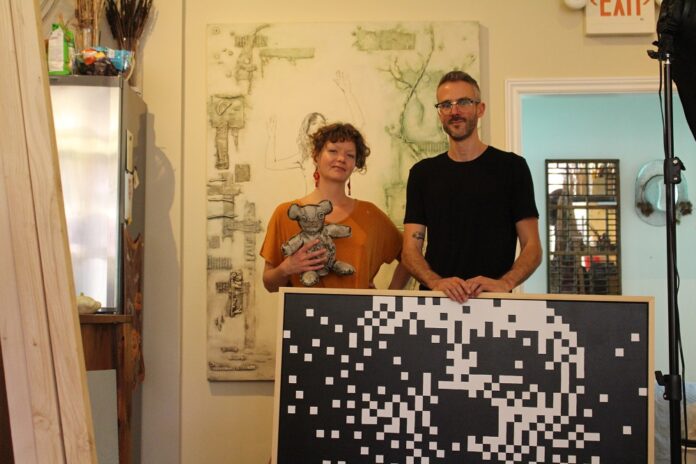
They were right. And now half a year later they’re co-hosting an art exhibit, “You Make Me Wanna Scream,” opening Oct. 2.
The exhibit is Howe’s first partnered show in the century-old former store, which she renovated in 2020 and opened in 2021.
The name of the show is mostly for fun. It’s a nod to Partridge’s paintings and Howe’s recent work which she says explores a bit of “inner turmoil.”
The “screams” in question are all silent; characters rendered onto canvases in splashy blocks of acrylic colour by Partridge, some letting loose howls. And Howe’s recent work might spook the unprepared: she’s been creating creatures in paper-mache, purposefully a bit weathered and worse-for-wear. On the table in front of her, a crumpled teddy bear stares forlornly out into the sunlit studio.
“Our art is so different. Hopefully we’ll bring in people who like different things… and who cares if they don’t!” she said.
Don’t take it too seriously though, because Partridge and Howe don’t. Even calling the show “You Make Me Want To Scream” seemed a bit too pretentious, Partridge said. Howe chimed in “It has to be ‘wanna.’ That makes it more fun!”
It’s also Partridge’s first time exhibiting in a formalized show, hanging up large-scale paintings that explore a blocky, pixelated style he began exploring when he was 17.
The show’s closing coincides with the scariest night of the year, Halloween, Oct. 31. That means there could be an impromptu block party, featuring a witches’ dance to celebrate the end of the monthlong exhibit. “It’s gotta be a ‘closing ritual,’ not a ‘closing reception,’” Partridge said. And the space might suit an art show experience tinged with a healthy dose of the unexpected. “
I have this incredible space that’s also super creepy,” Howe said with a laugh, gesturing to the high ceilings and victorianesque facade outside. “Let’s just have another event and throw some other fun things on top of it.”
It’s a space that she lives in too, so all those coming to the show after it opens must call ahead to book a viewing. “It is my space to live and work: this is my living room, dining room, office and studio.”
The gallery’s purpose might just reflect that of the upcoming partnered show: it’s a celebration of art and community.
“Without having it being a store, I wanted to make it a more easy-going space,” Howe said.
The pair are hosting an opening reception on Oct. 2 from 1-4 p.m. at How(e) Creative, located across from Haliburton United Church.
The very first day that Dawn Sudsbury stepped through the front doors of Archie Stouffer Elementary School in Minden, she knew she had landed somewhere special.
Taking over as principal from the recently departed Jane Austin, Sudsbury says she’s “incredibly excited” to join a school that is known across the region for its community spirit and academic excellence.
“First and foremost, what an opportunity,” Sudsbury said when discussing her motives for moving to ASES. “There are a lot of reasons why I’m excited to be here. First off, this is a really big school for our area. I love interacting with kids, and there are a lot of them here. I also like the fact that there’s a great staff in place here, and a vice principal that I can work with.”
She moves to Minden having most recently served as principal at Langton Public School in Fenelon Falls. In total, Sudsbury has more than 20 years of educational experience.
“I’ve heard many great things about this school during my time [as an educator]. I’ve seen already just how welcoming this community is” Sudsbury said.
A big part of that energy has been generated by the students themselves, who were happy to return to school under somewhat normal circumstances following close to two years of interrupted learning.
For Sudsbury, a return to in-person learning for the vast majority of the student body this year is being viewed as a major positive for a variety of reasons.
“I think that school is an important place for kids socially. You can feel the energy in the building – the kids are happy to be back, and the staff are happy and excited to have kids back in front of them,” Sudsbury said. “I know that I, for one, love the interpersonal piece of being in the school and having that interaction and personal connection with students.
Having students back inside the classroom will help academically too, Sudsbury said.
“I really think there’s an opportunity here, after having a couple of years totally interrupted by COVID-19, to work on academic achievement … We need to try and accelerate that – identify where our students are, and what we need to do to help and support them get to where they need to be,” Sudsbury noted. “I’m really passionate about early reading. That is, I think, a strength that I bring to the school, and is something I’m looking forward to working on.”
Expectations are high as the Haliburton County Huskies get set to kick off their inaugural season in the Ontario Junior Hockey League (OJHL), with head coach and general manager Ryan Ramsay laying down a marker and challenging his young squad to push for a playoff spot this year.
After months of behind-the-scenes planning and preparation, the Huskies are now just a day away from making their competitive debut. The team will take on the Lindsay Muskies in a home and home series this weekend, beginning Friday night on the road and culminating with a match-up at SG Nesbitt Memorial Arena in Minden on Saturday.
Ramsay was bullish when discussing his expectations for the season, noting that, having worked with most of his players throughout the summer, he knows they have what it takes to make an impact in the OJHL.
“I really like our team. I think we have a really young, exciting team,” Ramsay said, noting his roster was among the youngest in the league. “From what I’ve seen so far, we’re a team that loves to compete.
“Our goals for this season … we want to make the playoffs. I [will] judge success on at least making playoffs,” Ramsay added. Pre-season was a bit of a mixed bag for the Huskies. The team started out with a pair of wins over the Aurora Tigers, where their top scoring line – particularly Bryce Richardson and Oliver Tarr – impressed.
The pair combined for 17 points against the Tigers.
This past weekend, the Huskies went head-to-head with the Collingwood Blues – a perennial challenger for the OJHL championship. Ramsay said those games would give a good indication of where his team is at heading into the regular season. On Friday (Sept. 24) in Collingwood, the Huskies battled hard but ultimately succumbed to a 6-1 defeat.
The very next night in Minden, the team rallied and were impressive for large stretches of the game. Despite an improved performance, the Huskies gave up a 3-1 decision.
“I know the game in Collingwood, the score didn’t look too great for us, but we started off that game really well. We outchanced them the whole first period, but still found ourselves down 3-0 by the end of the first period,” Ramsay noted, saying the Blues scored on their second, third and fifth shots of the game. “By then, the game was pretty much a wash, but I was pleased with our compete level and the speed of our play. Even in that final period, when the game was obviously gone, the boys didn’t give up.
“On home ice, we were better again, but Collingwood is a top team,” Ramsay said. He also reserved special praise for the local community, who came out in droves over the past couple of weekend to support their new team. Both home exhibition games were sellouts, and Ramsay expects that trend to continue well into the regular season.
Earlier this summer, it was reported that the Huskies had sold well over 200 season tickets to excited fans – giving them access to all 27 home games during the regular season.
“We couldn’t be happier about the support we have received from the community – we’ve seen it from people wanting to buy tickets, businesses looking to sponsor, and families [volunteering to serve as billets]. The Haliburton County community has really welcomed this team,” Ramsay said.
He would go on to admit that, given the level of interest in season tickets and capacity restrictions brought on by COVID19, single game ticket availability for seats in the rink will likely be limited for the foreseeable future.
The Huskies will compete in the OJHL’s East Division, against the Muskies, the Wellington Dukes, the Trenton Golden Hawks and the Cobourg Cougars. While a playoff spot is the eventual goal, Ramsay said it was difficult to predict where his team would land given the unknowns surrounding some of the other teams.
“Looking at previous seasons, Wellington, Trenton and Cobourg tend to bring in a lot of older players. But it’s tough to predict how everyone is going to look right now – the OJHL didn’t play last year, so there’s not really much to go off. We don’t know if Cobourg is losing five players, or if they’re losing 15 players. I think it’s going to be a bit of a weird year,” Ramsay said. “I think it’s going to take the first month to really judge how we’re going to stack up against some of the other teams.
Before Chris Stephenson began studying to become a head librarian, his sister gave him a book, Riding with Rilke. In it, an English professor delves into the worlds of libraries, archives and travel via motorcycle.
Turns out it was a fitting gift.
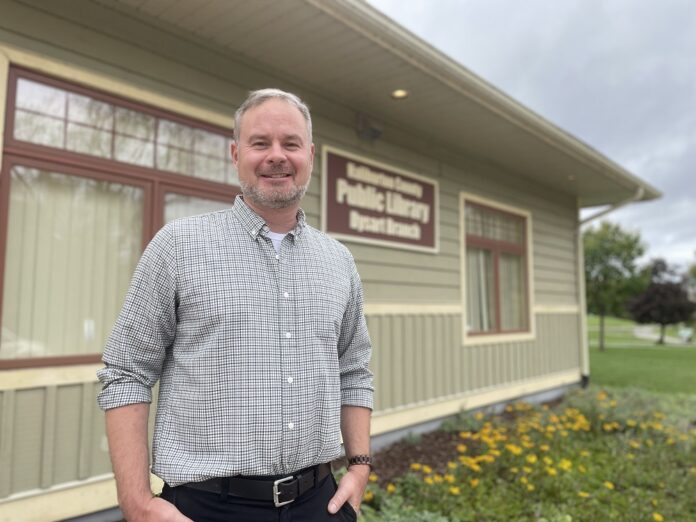
Stephenson, originally from Gravenhurst, has just been appointed as CEO of the Haliburton Public Library. Not to mention he’s an avid reader, researcher and motorcyclist as well.
“I didn’t know until after I read it that it was so appropriate for me: I became a librarian, I love motorcycling and I love books and archives,” Stephenson said in an interview at his new office.
Replacing interim CEO Anna Babluck, Stephenson said he’s had an exciting, if tiring, first week in the role.
“I don’t feel overwhelmed because I’ve received such a warm welcome,” he said.
“When the door is open and my job is to walk through and make people feel comfortable and excited about the library… half the work is done.”
He joined the field later in life, after working as a senior set carpenter in Vancouver’s film industry for 10 years.
The life of a set carpenter means long hours and physically taxing work, and Stephenson began charting a career pivot. He invested in a masters of library and information sciences degree from the University of British Columbia. Next, he gathered experience from multiple librarian roles, including a stint in Bancroft. It was a journey to get him to the point where he could jockey for the role of CEO, the most senior position within a library system.
“I was prepared it would take some time, and it has,” he said.
He was also excited to move to the community of Haliburton, where he spent much of his childhood at a family rental property in the Haliburton Forest.
“I knew there is a very strong arts community [in Haliburton] and that’s something I was looking for in a community,” he said.
Building partnerships
Libraries aren’t just places for book loans. Now, spots like Haliburton’s Public Library are vital access points to the internet, lifelong learning, community meetings, news and more.
Libraries, said Stephenson, have had to “actively advocate for themselves to stay relevant” by connecting community members with resources they enjoy, and resources they need; community being the key work.
“I’d always been good with people, caring about community and community building. One thing I noticed in libraries is that you’re well poised to be one of the community builders.”
He’s already made strides in ensuring the libraries he works in consider diversity and inclusion in their programming. In 2020, Stephenson and a colleague at the Okanagan Regional Library in Kelowna hosted a drag queen storytime, despite negative feedback online and concerns from the library’s CEO. The two librarians were awarded the B.C. Library Association’s Champion of Intellectual Freedom Award in an online ceremony for their advocacy for the program.
It’s still early days in Stephenson’s role in Haliburton; he’s moved into the office and has been setting up email, meeting with staff, and will soon discuss the library’s strategic plan with the board. But once he gets his footing, he hopes to focus on partnerships with community groups.
“The strength of the community is here, we just need to tie it to the focal point of the library to make things happen,” he said. He mentions the arts community and the teen population of the Highlands as a special focus. “I hope to make these connections; restore connections that may have fallen by the wayside.”
Maybe it’s just a bit like his former career, another type of construction. “Building sets and building houses is rewarding in a certain way, but the feedback you get from working with the public is powerful,” Stephenson said.
Up and down Water St. in Minden, climate activists participated in the Global strike for Climate. Founded in 2018 by youth climate activist Greta Thunberg, hundreds of thousands march each year across the globe to bring attention to the increasing threat of climate change.
The Minden event was organized by Concerned Citizens of Haliburton County and Environment Haliburton!
Dr. Scott Phipps, CEO of Clean Development Group, was in Minden visiting his parents. His company consults government and multinational corporations on clean energy initiatives, and he’s noticed a shift in mindset. “Now governments and policy makers are starting to get a little more on board,” said Phipps. “The one thing that’s taken me back is it’s been a very slow shift.”
For Phipps, and those at the strike, it’s important to realize how urgent the threat is.
“Some are frightened by the potential of climate issues. They’re a little apprehensive to engage,” Phipps said. “But it’s become so much of the public psyche now we’re realizing we can’t just hide away from it, we do have to address it head-on.”
Working groups tasked with researching service improvements across the Highlands are discussing uploading aspects of municipal services, such as waste management, infrastructure planning, bylaw and IT, to the County level.
In a Sept. 22 committee of the whole meeting, working groups headed up by municipal CAOs, delivered progress reports to councillors.
“We’re not asking for a final decision on some of these things,” said County CAO Mike Rutter. Instead, he said the meeting was to determine if councillors were “generally supportive” of concepts each working group is researching.
Since June, they’ve been discussing policy improvements proposed by StrategyCorp, a firm hired to review the efficiency of Haliburton’s services.
While the discussion was not about amalgamation of the four municipalities, it was a topic which emerged in council discussion after each working group presented their progress.
“The ‘A word’ was not something that was supposed to form part of the conversation but I don’t see how we can separate the two,” said Warden Liz Danielsen.
“Especially when it comes to these bigticket items, like roads and bridges and waste management and really any of these topics.
” StrategyCorp, in a report presented to council in Nov. 2020, estimated increased collaboration between municipalities could save the County up to $1,193,000 annually. The suggestions include large projects, such as a master transportation plan, which Highlands East CAO Shannon Hunter estimates would cost between $250,000 – $500,000. It would chart the course for road infrastructure, sidewalks, and even public transportation, over the next decades.
Another focus area was waste management. Council expressed interest in continuing to investigate how waste management could be more efficiently dealt with, including the possibility of centralizing the service at the County level.
However working groups aren’t just focusing on big ticket items. CAOs heading up each group outlined ideas ranging from centralized employee benefits to software procurement. Multiple councillors expressed interest in centralizing communication initiatives to ensure consistent messaging about government activities across the Highlands.
For Highlands East Deputy Mayor Cecil Ryall, the suggestions of closer collaboration reflect the challenges the County faces, and only might ease the way to amalgamation. If it happens, “…the ‘A word’ becomes a lot more compatible,” he said. “It’s a direction we’re probably going to be going in, it’s just a question of when.”
Minden Hills Mayor Brent Devolin said he will support initiatives proposed by the working groups that move towards amalgamation.
“I have been firmly convinced, and far more so in the last couple years, we need to go that direction,” he said.
Council made no formal decision on the working groups’ interim reports and will receive an update on the progress of each file in November.
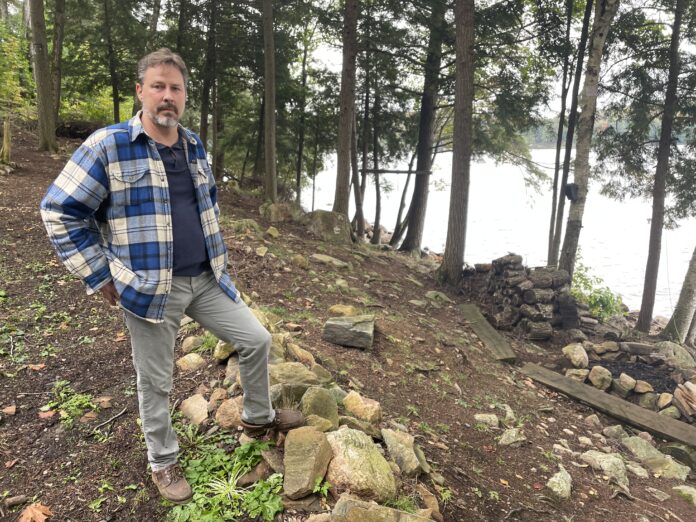
"I'm not an extremist. I care deeply about my shoreline," said Thomas Moch, a Kushog Lake Cottager who penned a letter to County Council asking for a revised approach to the draft bylaw process.
More than 100 Kushog Lake cottagers have signed a letter voicing concern over the County’s draft shoreline preservation bylaw consultation process. According to the letter sent to County councillors Sept. 22, certain cottagers and residents are “very concerned that [their] views are not being adequately represented” in the consultation process, currently facilitated by J.L Richards (JLR) and Hutchinson Environmental Sciences Ltd. (HES).
Thomas Moch, spokesperson for the group and writer of the letter, said there’s been a widespread surge of concern among cottagers across Haliburton as the consultation process enters its final stages. “Everybody on these lakes works extremely hard to have a second property. We all sacrifice a lot, to afford this,” said Moch, vice president of a Canada-wide contracting company.
“For someone to come in and say ‘we’re going to take the first 30 metres of your property and essentially expropriate it from you: everyone’s question is how can you possibly even consider that?”
“The problem right now we’re seeing is the bylaw itself and the elective and subjective input”
Brian Atkins
Moch expressed concern the process was weighted in favour of lake associations and stakeholders like BeShore Haliburton. As of press time, BeShore did not respond to three emails asking for comment. There is currently no bylaw actively being considered by County council. A previously proposed draft bylaw, being reviewed by JLR and HES, suggested restricting development and native vegetation removal within 30 metres of a shoreline’s high water mark.
It did allow property owners to clear access paths and submit permits for development projects such as the installation of docks, fire pits and decks. Brian Atkins, a Kennisis Lake cottager, has similar concerns to Moch.
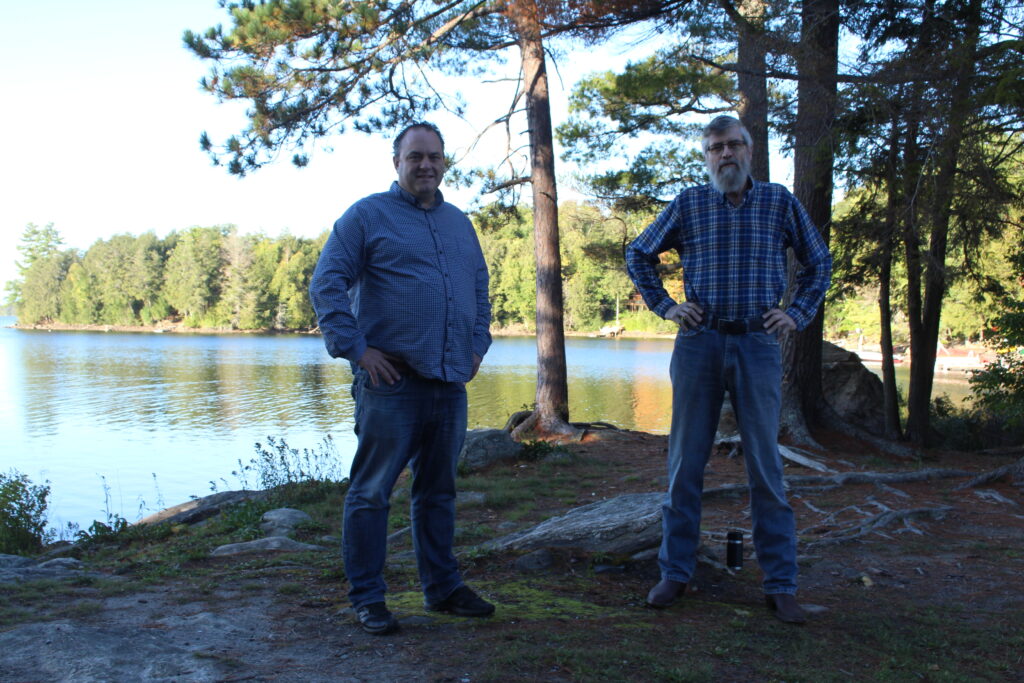
Brian Atkins, left, and Rod Dobson, a Haliburton resident who also feels the current consultation process on the draft bylaw is inadequate.
He put out a call on Facebook for property owners dissatisfied with the direction of the review process to contact him. Atkins said he’s been “slammed” with messages of people voicing their support, collecting nearly 200 email addresses and names. He’s formed an unofficial group, Concerned Haliburton Waterfront PropertyOwners. “We’re not hiding behind a media budget, we’re out there. Anyone can contact us,” he said. Atkins said neither the consultants nor County council seem to be receptive to their concerns. “Here we are with our hands up in the air going talk to us, talk to us,” he said in an interview.
Warden Liz Danielsen said while not every email councillors receive, of which there have been hundreds related to the bylaw process, is replied to, they are passed on to the consultants. In an interview before the letter was submitted to council, Jason Ferrigan of JLR said his team will receive and take seriously the Kushog residents’ letter. Ferrigan said he’s been impressed by the variety of opinions expressed by property owners and stakeholders around the county.
“It demonstrates to us how much folks in Haliburton care about the quality of their lakes,” he said.
Polling lake associations
Both Moch and Atkins, as well as signatories on Moch’s letter and those who commented on Atkins’ multiple Facebook posts, expressed concern that it seemed as though the opinions of official lake associations were valued higher than individual property owners in the consultation process. “The problem right now we’re seeing is the bylaw itself and the selective and subjective input,” Atkins said, mentioning how many lakes have 40 per cent or more cottagers not a part of lake associations.
He claims the Kennisis Lake Cottage Owners’ Association (KLCOA) has voiced support for the draft bylaw as it was stated before the consultation process began, and has not been transparent with members about interactions with consultants or its connection to BeShore, of which the Coalition of Haliburton Property Owners Associations (CHA) is named as a member. BeShore has published advertisements in local media sources which include the phrase “show your support” in regards to a shoreline protection bylaw.
Debra Wratschko, KLCOA president, said the association pays a small yearly fee to the CHA to access webinars, and online tools. Approximately 50 property owners associations are part of the CHA. Wratschko said she isn’t aware of any information about the consultation process being held back from members.
She said her group has posted on the association’s website each opportunity to get involved with the draft bylaw consultation. “We did express our support to the county for a public consultation process,” said Wratschko. “We recognize we can’t represent all opinions, so for us it was important that everyone had a chance to say their piece to the county.” She said they supported the objectives of the previous draft bylaw “in principle,” in the goal of achieving good water quality and healthy lakes, but have not spoken in favour of a final bylaw direction, such as the 30-metre vegetation buffer.
She said she urges the County to “provide a clear, concise and easy to understand version of the bylaw.” Moch and others said the Kushog Lake Property Owners Association was accused of supporting the draft bylaw without member consent. However president Norma Goodger said while she supports the drafting of a bylaw consistent with science, there’s currently no bylaw on the table to support. It’s impossible to support adocument which is not currently available, nor being considered by County Council, Goodger said.
She said she seeks to inform members about opportunities to get involved. “We have no intention of dividing the community, our role is to inform,” she said. “I believe that the council members are asking very intelligent questions that are building their ability to make the right decision.” Danielsen said council has “recognized all along that lake associations don’t necessarily represent the entirety of a lake.
She said municipal officials have “tried to offer opportunities whether it’s through email or through surveys or through the online open houses” for people to be able to have their say individually. “We’ve tried our hardest to ensure everybody has a voice,” she said, mentioning that all concerned about the draft bylaw the consultants might propose in October will have many more chances to speak up before it is passed into law.
The vegetative debate
A diagram of the protection area included in a 2020 info document from the County on its previous draft shoreline bylaw, in 2020. Photo via County of Haliburton.
While the debate surrounding shoreline preservation bylaws in the County has been ongoing for nearly four years, Moch, Atkins and other cottagers who signed the letter take particular exception to the previously proposed 30-metre vegetative buffer, a rule they expect to see in the next draft bylaw. What that buffer means, writes Moch, is unclear as it did not specify what vegetation was considered native.
The previously proposed bylaw allowed an application process for a long list of development projects within the buffer, which Moch argues would still decrease property value and overly restrict property owners. However, a scientific literature review from consultants HES states the longer the vegetative buffer, the more effectively a shoreline will keep sediment from entering a lake. Yet if the draft bylaw, to be presented to County Council Oct. 28, recommends a 30-metre setback for all lakes, Atkins said “It imposes a one-size-fits-all solution,” which unfairly targets properties with unique topography.
Varying assessment criteria is a suggestion JLR proposed to council at its progress report in September. Moch, claiming Kushog Lake is “above the 75 per cent natural shoreline level considered to be a measure of lake health,” writes that the previously-proposed bylaw will target lakes which already are protected.”
However a 2015 report from Watersheds Canada and the Canadian Wildlife Federation scores Kushog much lower, at approximately 35 per cent naturalized shorelines. The Coalition of Haliburton Property Owners Associations (CHA) of which the KLCOA and Kushog Lake Property Owners Association are members, reports that 92 per cent of lakes in Haliburton do not meet the 75 per cent threshold.
While Moch, Atkins and the many who support their views in Moch’s letter support the current shoreline tree preservation bylaw, Environment Haliburton vice-president Terry Moore said it’s not adequately protecting Haliburton’s shorelines. “It’s an after-the-fact, complaint-based way of dealing with trees only, not shoreline vegetation writ-large,” he said.”It’s been manifestly unsuccessful to begin with, [doing nothing] to stop the degradation of the trees and vegetation around Haliburton County.”
With many speaking out against the previous tenets of the draft bylaw at town halls, online and through lake associations, Moore said he’s aware of a large community that supports stricter measures on their shoreline. “People understand that there’s a relationship between what happens on the shoreline, and what happens on the lake,” he said. Moore said he’s received rude and threatening messages online due to his support of aspects of the previously proposed bylaw.
“They want to see that protected. What they don’t want to do is be subjected to ridicule and attack on social media. It’s been ruthless,” Moore said.
Both Moore and Danielsen urged caution when discussing the future of the draft bylaw. “If people think that there’s a draft bylaw that’s on the table at County council, they’re wrong,” Moore said. “I think it’s misleading for people to start from that perspective.” The Highlander will provide a full online report of the second public town hall, hosted Sept. 29 by JLR and County Council.
The term “small business” has been a fixture in Canadian news and community discussions since the COVID-19 pandemic began.
It’s for good reason: the pandemic and associated health measures only boosted the bottom lines of Amazon, Wal-Mart and Loblaws, while decimating revenues of restaurants, gyms, clothing stores, cafes, hotels and the hundreds of other small businesses that make Haliburton County a good place to live.
We can only hope that the attention small business owners have garnered from provincial and federal governments continue. Artists and creators are small businesses too. Aside from the fact many of us use art to make our houses feel more like homes or find comfort in uncertain times, the industry contributes around $25 billion to Ontario’s GDP, according to a 2019 Ontario Council of the Arts review.
It’s a sector of the economy with wide ripple effects, and the people who work within it are often those working the hardest to make communities beautiful destinations. International tourists flock to Haliburton’s Sculpture Forest and artists from around the province install sculptures on Haliburton’s main street each summer. Students and cottagers enroll in degrees and summer classes at the Haliburton School of Art + Design, and creatives host multiple crosscounty art shows each year.
That’s not to mention the vibrant performing arts organizations which perform top-class operas, plays and concerts. There’s a good chance each and every person who comes to Haliburton for any one of these experiences spends more than a couple of dollars at cafes, restaurants, shops and stores around the Highlands. A county with a healthy arts sector draws people in and can help define its character.
This weekend, artists from Minden to Carnarvon to Haliburton will open their studio doors for the 34th annual Studio Tour. They’ll showcase work that often takes many hours to make; pieces of pottery molded from clay using techniques that they’ve practiced for decades: watercolour depictions of the County’s lakes and forests and much, much more. It’s valuable work. It’s work that reflects our surroundings and encourages us to take time to observe, feel, and marvel.
I, for one, need that encouragement these days. Getting takeout or sitting down for dinner is a way to support the future of our favourite restaurants. Buying art and engaging with artists who have gone nearly two years without a normal show and sale schedule shows support for a valuable, and I’d say integral, part of the county’s cultural and economic fabric.