Home Blog Page 284

Is it time to change government?

0

When voters go to the municipal election polls Oct. 24, 2022, they’ll find not much has changed since they cast their ballots four years ago.

The names of people vying to represent them may have altered, but they will still be voting for 24 people, of which eight will automatically become County councillors, for a total of 32 elected officials for a County estimated to have 20,571 people over 4,000-square-kilometres.

By contrast, the City of Kawartha Lakes will again elect eight councillors for its population of about 75,000 people over 3,000 square kilometres.

The need for a governance review was discussed in the lead-up to the 2018 municipal election.

However, more than three years later, nothing has been done on that front. Instead, councillors have opted for a service delivery review, which will take until at least 2023 to complete. Some in the County, such as Glenn Evans of the Haliburton County Home Builders Association, Terry Moore of Environment Haliburton! and outspoken Minden resident Patrick Walshe think that isn’t good enough.

Nor do some County councillors, most notably Minden Hills mayor Brent Devolin. However, many others, including prominent political science professors and a number of councillors say the service delivery review must be completed first.

There can be no cart before the horse. They say its implementation may, or may not, lead to a look at governance. Examining the City of Kawartha Lakes’ forced amalgamation of 20 years ago offers some insight into what can be gained by becoming a single-tier municipality. It isn’t about cost savings. However, it’s greater efficiency with better customer service. Or so we’re told.

We have yet to see any studies that back that up. A majority of County councillors believe implementing recommendations in the service delivery review will result in cost savings and efficiencies.

It’s certainly been worth looking at what Strategy Corp. is suggesting and making changes. But the question becomes, is that going to be enough? The provincial government, for now, says it won’t force amalgamations in Ontario.

In fact, it’s the province that supplied the money for the service delivery review and is pleased it’s been spent and a report tabled. It doesn’t appear to have much interest beyond that.

We’re not hearing words such as amalgamation or annexation. The will for change – if the community wants it – will have to come from Haliburton County’s elected officials. The community needs to start asking some tough questions: is the service delivery review and its expected efficiencies and cost savings enough? Or is it time for one level of government or a hybrid model?

It’s been 20 years since the last local amalgamation created the four townships we now have. Is it time for a serious look into what governance will best suit us going into the future? We’ll be asking these questions in a series of stories that kicks off today. If you have strong opinions on the subject, email editor@thehighlander.ca

Is it time to discuss County governance?

0
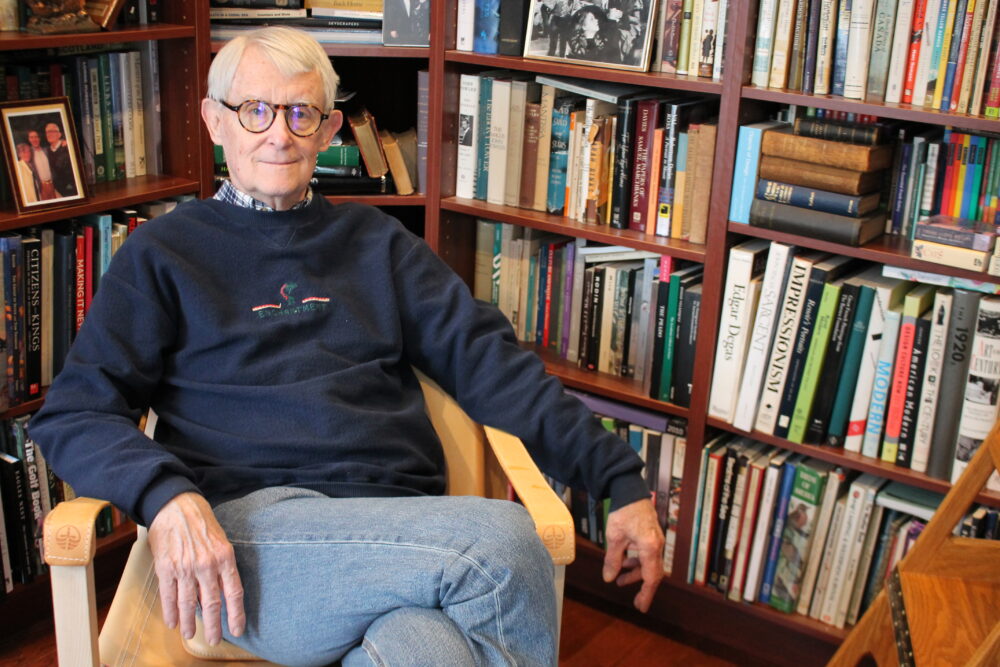
Minden resident Patrick Walshe has long called for a review of local governments. Photo by Lisa Gervais.

When campaigning to be mayors and deputy mayors in 2018, Haliburton County candidates were asked about amalgamation. 

In his opening remarks to a debate audience at Haliburton School of Art + Design, Minden Hills mayor Brent Devolin was the only candidate to address the issue.

 “Our current municipal structure of 24 persons in 32 political positions in a County of less than 20,000 permanent residents [now 20,571] is not sustainable,” he said at the time. 

He added, “A four-year term of council is enough to assess, consider, plan and execute the possible changes in time for a municipal election in 2022.” 

During question period, voter Patrick Walshe pushed the issue, saying, “I really don’t want to hear you guys say we should talk about it or we might talk about it. I think amalgamation has to be looked at.” 

More than three years after that debate, there has been no study into a governance review for Haliburton County and its four lower-tier municipalities. 

Instead, there has been a service delivery review, paid for by the province, “to understand, identify, and evaluate opportunities to achieve a more efficient and effective service delivery model across the Haliburton municipalities while maintaining adequate service levels.” Haliburton County CAO Mike Rutter said, “The focus of staff is really not on the governance question. Our focus has been on ensuring there is a process in place that will provide our councils with sufficient information to make decisions on the [service delivery review’s] recommendations.”

 Warden Liz Danielsen said they are already working to eliminate duplication and streamline the way things are done via the ongoing service delivery review – which is expected to take until 2023 to complete. 

She noted that every department at every municipality is taking part in the discussions. For example, the warden said they know contractors who work in all four townships are in some cases dealing with four different sets of rules. 

“Even if we can resolve something like that, we’ve made progress,” she said. 

Service delivery review first

She emphasized the service delivery review will have to play out before there is talk of a governance review.

Danielsen added, “Just because there’s duplication doesn’t mean that we have to amalgamate to resolve the issue.” She said amalgamation might eventually be the answer but she’s not convinced of widespread council support. 

“Obviously, all of this started with thoughts of amalgamation. It’s fine to say ‘we need to amalgamate and stamp our feet’ but that doesn’t mean we need to amalgamate. Is it the answer? Will it be cheaper? We’ve seen some examples where it’s not cheaper?”

 Devolin said it isn’t necessarily about saving money. “This is about being more efficient and getting value for money.” 

Danielsen said she’s personally come around to the point where “I am open.” She said the service delivery review process “has opened my eyes. You find yourself thinking, maybe we should be doing this, that or the other. More councillors may be coming to that conclusion. Maybe amalgamation is inevitable.” 

Devolin has never wavered. 

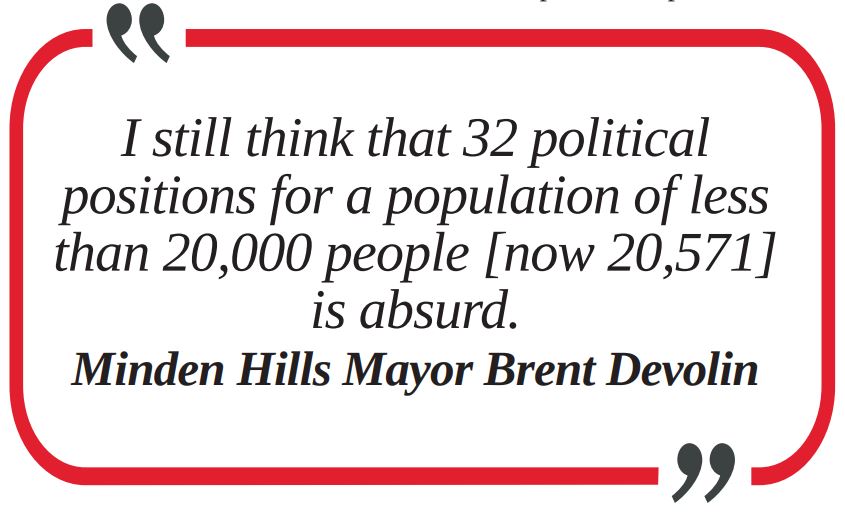
When he announced in the fall that he won’t be seeking a third term as mayor, he said one of his greatest regrets is that he was not able to push his colleagues to consolidate local government. In a lengthy interview, he elaborated “I still think that 32 political positions for a population of less than 20,000 people [now 20,571] is absurd.” 

He said COVID has caused an explosion of growth in the Highlands and highlighted labour shortages in municipal government. 

He said it’s easier to attract candidates to larger governments. With a background in forestry and cars, he added those industries had to consolidate to survive and it’s no different for local government. “I’m just a huge believer in a proactive stance rather than a reactive stance.” That being said, the current provincial government has no plans to move forward with changes to regional governments, according to a spokesperson for the Ministry of Municipal Affairs and Housing. 

Rather, “The province encourages municipalities to look for opportunities to work together and supports locally-developed solutions that are mutually beneficial,” Conrad Spezowka said. As for Walshe, he thinks the service delivery review does not go far enough.

 “If we’re doing a performance analysis and it is going to be made by cutting jobs, for example, and your job is going to be cut, how objective are you going to be? I’m not saying you’re dishonest or disloyal, but it is far from a thorough review of them managing funds, and providing the best level of government in this part of the world.” 

He thinks there would be “a whole other level of service improvements, streamlining and a gazillion other benefits” that would come from amalgamation. “This is 2022. We can’t be running things the way we were in 1982. It makes no sense. I don’t think there’s any real thirst for meaningfully improving the services government brings to this part of the world. We’re still stuck in the 1980s.” 

Next week: It isn’t about saving money

How County councillors feel about a governance review

Dysart et al mayor Andrea Roberts

 I think there is so much on County council’s plate right now what with the shoreline bylaw still not resolved and now we have started the process for a short-term rental review.

 I would say the issue of municipal governance in general will become a hot election topic. Amalgamation has been talked about before, but there has never been a review on if it would actually be better or worse for the people of Haliburton County. It will be interesting to see where things start to go once the election period begins. 

Dysart et al deputy mayor Pat Kennedy 

I do think that eventually we will move to a single tier.

 Fiscal savings as a result of such a decision? Doubt it, and in many instances operational costs and property taxes (especially for the taxpayers of Dysart) will increase. I still believe, as I did in 2018, that a confederation model is the best approach, where services are assigned to upper or lower tier. This to me is the most efficient model while still remaining responsive to local challenges. 

Minden Hills mayor Brent Devolin has always supported having a single-tier government. [See quotes in story] 

Minden Hills deputy mayor Lisa Schell

To be honest, I’ve never had a strong opinion one way or the other regarding having a one-tier governance; however, I have been a strong proponent of the [services delivery] review in order to see if it makes sense financially. I think if it is established that it is feasible financially, a governance review would definitely be warranted as well. 

Algonquin Highlands Mayor Carol Moffatt 

I believe the County needs a governance review not only because it’s our responsibility to continually assess our raison d’etre, but also because the phrase “form follows function” is part of our commitment to the service delivery review.

 I’ve done a lot of research on governance models and while there are no financial savings to be had in moving to single-tier, the public may prefer the efficiencies of one bylaw or fire department, or a countywide landfill system. However, if the upper and lower tiers reconfigure their working relationships in accordance with the recommendations of the SDR, a full-on amalgamation may not be necessary. Either way, when the time comes, there’s going to have to be a detailed analysis of potential gains and losses so that the difference is clearly understood. For me, the pandemic has brought to light myriad more reasons to have that review in order to genuinely craft this community’s future. 

Algonquin Highlands deputy mayor Liz Danielsen said she is open-minded about the possibility. [See quotes in story] 

Highlands East mayor David Burton

 My viewpoint hasn’t changed during the service delivery review. We are mid-stream going through the recommendations of the final service delivery review report and a discussion of governance would be premature at this point. I am pleasantly surprised on how many joint initiatives that are transpiring now.

 Highlands East deputy mayor Cec Ryall 

I believe that a single level government for Haliburton County will eventually happen. However, my position has been and continues to be that we need to complete the majority of the service delivery review before we consider how the County is governed. So far, we have investigated, and in some cases resolved, many challenges that were identified and those solutions will contribute to a stronger Haliburton County. Items like economic development and procurement are in progress as we speak. That still leaves important issues like waste management, fire and roads that will require revised solutions. More complex issues like the building, official planning and shoreline preservation must also be addressed. 

We know these challenges are there; they can be significantly improved; and in my mind carry a higher priority at this moment. (Lisa Gervais).


Huskies weather Rangers’ rally in big win

0

The Haliburton Huskies scored in double-overtime to break a resurgent North York team March 8. 

The 3-2 win brought the crowd at the S.G. Nesbitt Memorial Arena to their feet. 

From puck drop, the Huskies pressed against the disciplined GTA squad. First-period play was back-and-forth, with neither team claiming advantage of fast, free-flowing hockey. In the second, the Huskies bounded into action.

 A short cross from Patrick Saini in front of the Rangers’ net was converted by Lucas Stevenson, who flicked the puck into the bottom left corner. Shortly after, Stevenson slotted another with eight minutes to go in the third period. 

With the seconds trickling down, the Rangers pulled their goalie, turning the game on its head. 

The red and blue battered the Huskies with an extra attacker, crowding the Dogs’ net, slicing a shot past Christian Cicigoi to make it 2-1, and then 2-2 in quick succession. 

Coach Ryan Ramsay said he’s never seen a team score two goals with a goalie pulled. “It’s something that doesn’t happen too often in a game. Hats off to them, they hemmed us in a little bit,” Ramsay said. 

As the third period drew to a close, the Huskies’ crowd thundered into life, urging the boys up the rink. 

A taut overtime followed, with shots from Saini, Sooklal, Tarr and others coming tantalizingly close to glory. It was Simon Rose who broke the ice deep in the second period of overtime, assisted by Patrick Saini. 

The boys in blue flooded the ice to celebrate.

 “The boys are playing well, they’ve responded well. Obviously, there’s some confidence coming back into their game,” said Ramsay. 

Triumph over St. Michael’s 

The Huskies trounced St. Michael’s in a 4-1 away win March 4. 

Nicholas Athanasaskos opened the scoring in the second minute, assisted by Cameron Kosurko. That prompted a flurry of goals in the period, with Rose capitalizing on a powerplay to bulge the netting, assisted by Stevenson and Saini. 

A Payton Schaly goal followed shortly after. St. Michael’s only goal came during a powerplay during the closing seconds of the period. 

The Huskies turned on the cruise control, weathering St. Michael’s attacks until the 18th minute of the last period when Christian Stevens snuck home a shot on an empty net. 

Ramsay said the return of four-day practice weeks helps prepare the team for these late-season battles as playoffs loom. 

“You can slow things down and really teach a lot. Since then, we’ve recorded two big wins,” he said. The Dogs return to play March 11 at home against Trenton before facing fierce rivals Lindsay March 12 at 4:30 p.m. 

Province to end masking mandate

0

Highlands businesses and indoor public spaces won’t be obligated to enforce mask-wearing as of March 21. 

All remaining COVID-19 health measures will be dropped by the end of April, announced Ontario’s chief medical officer of health, Dr. Keiran Moore, at a Mar. 9 press conference.

The Highlands’ top doctor Natalie Bocking said Mar. 8 that masks are still key in preventing the spread of the virus. 

“We know that masks are an effective and easy way to slow transmission of COVID-19,” said Dr. Bocking, Haliburton Kawartha Pine Ridge’s chief medical officer of health at a media information session Mar. 9. 

“What is key is we continue to be aware COVID-19 is still in the community, there are still people who will get COVID-19,” she said. 

Dr. Moore said with increasing immunity and high vaccination rates mean Ontario “has the tools to deal with the impact of this virus” without mask enforcement. 

He said the decision to remove the mandate “does not mean the risk is gone” and that Ontarians should expect to see a case count increase as people “increasingly interact with one another.” 

Masking rules will still be in effect for congregate living settings, public transit, long-term care homes, shelters and jails. 

Bocking said “time will tell” whether the decision to remove masking rules comes too soon. 

“It does place the onus on individuals to assess risk for themselves, and assess the impact on other people,” she said. 

Bocking added that businesses and other settings have the ability to maintain masking rules, acknowledging the possibility the decision might prove contentious. 

“The pandemic has been a long pandemic and certainly has the potential to continue on: it’s very unfortunate in some settings [masks have] become divisive,” she said.

Currently, Haliburton has two lab-confirmed unresolved cases of COVID-19, with 413 lab-confirmed cases to date.

Isolation rules change 

If you’re over 18 with a booster dose or considered fully isolated, you won’t need to isolate if someone in your household tests positive for COVID-19. The isolation period for vaccinated people remains five days. For unvaccinated people who have COVID-19, as well as unvaccinated close contacts, the isolation period remains 10 days. 

As of Mar. 11, the Province also will change how it reports COVID-19 deaths. It will specify whether COVID-19 caused a death, contributed to a death or if the cause of death is unknown. 

Landscape aren’t enough

0

I’ve heard two phrases over and over again during my first year in the Highlands. The first? Haliburton’s population is exploding. The second, in the words of one restaurant owner I spoke to, “no one wants to work anymore.”
There’s clearly a disconnect.
The 2021 census proves Haliburton’s population is indeed exploding.
And clearly many people want to work.
Pollsters predict unemployment across Canada is expected to be at around pre-pandemic levels in 2022. Nevertheless, a new report outlines worrying trends in the local workforce.
The Workforce Development Board’s (WDB) 2021 labour market planning report shows multiple sectors of the Highlands’ workforce in decline, contrary to the County’s growing population. While the population has risen by nearly 14 per cent since 2016, the accommodation and food service industry has seen a 238 person decline since 2017.
The WDB predicts more restaurants will shutter than open between now and 2024. You’d think a booming population would mean more teens eager to find jobs and young adults looking for summer jobs or service industry work, but that isn’t the case.
Some restaurants and even municipalities had to adjust their hours due to staffing issues. Even in high-paying trades jobs, Highlands companies report difficulty finding anyone to work.
Beyond developing training programs or school-based initiatives for the trades, we urge the County and its four municipalities to pay attention to the job market and census results as they plan for the future.
While information from the last six years isn’t available yet, the average age of a Highlander was more than 10 years higher than the average age of a Canadian in 2016. Around 32 per cent of our population are seniors, compared to around 13 per cent in the rest of Ontario. I’d guess we’ll see similar numbers when the data is released later this year.
I’d also wager few of our County’s elderly or those contributing to jaw-dropping construction activity are going to be applying for the jobs that the WDB says are hiring, whether at restaurants, our two hospitals or long-term care homes.
Without balanced demographics, Haliburton is in danger of facing an aging population without the services and healthcare infrastructure needed to support them. The HHHS is using agency nurses to staff emergency rooms, and the list of people waiting for a family doctor was at approximately 1,000 in early 2021.
Ambulance calls in the last year were up by over 30 per cent too. As our population ages, will our medical infrastructure be able to keep up with the need?
There’s already consistent job ads in the field. The WDB reports that in 2021, there were 98 job postings for home care, support work and other healthcare jobs. The time is now for young Highlanders to enter the skilled trades or healthcare industry, but beautiful landscapes aren’t enough to lure workers north.
For young folk who do move here, it’s hard to find your footing. I speak from experience. Passionate clubs, a vibrant music scene and outdoor pursuits have fed my love of the County but don’t clear the way to homeownership or long-term accommodation.
Rent, food costs, energy prices, and constant driving, combined with a lack of social hubs, can make life in the Highlands seem daunting. In 2017, Haliburton County published an Age-Friendly Master Plan.
As the Highlands grows, and businesses struggle to meet staffing demands, perhaps it’s time for another age-specific plan: one that incentivizes young people to move to, or stay in, our community for the sake of its long-term prosperity

Haliburton’s Big Brothers, Big Sisters looks to expand

0

Big Brothers Big Sisters of Kawartha Lakes-Haliburton is looking to expand its presence in the Highlands.

Offering services in the area for several decades, the organization is actively working to engage with more families and volunteers in 2022, said executive director Janice Balfour.

“We have four active matches in Haliburton County, with another 10 youth on our waitlist,” Balfour said, noting the group needed more adult-aged volunteers to provide mentorship and guidance to young people across the Highlands.

According to the Big Brothers Big Sisters website, research suggests that young people are more likely to flourish when they are embedded in a web of relationships with supportive, caring adults. Balfour said that is the essence of the organization’s programming – to provide those relationships that young people need to succeed.

The local chapter offers traditional mentoring, in-school mentoring and summer group mentoring options to youth. Balfour hopes to introduce the Kids ‘n’ Kops program to Haliburton County this year, an initiative designed for children between the ages of nine and 12 to provide positive interactions with police officers. The usual week-long event has been a big hit in other communities, and has been described as a mini police academy with a recreational component.

Balfour said the organization is also hoping to recruit two new board members from Haliburton County.

“This will help us to be able to ensure we are providing the services the community needs,” she said.

The group is currently in the midst of its second-annual Move For Kids’ Sake fundraiser. The event was launched in 2021 during the pandemic as a replacement for the bowling-themed Bowl for Kids’ Sake, but is being kept on as a more inclusive, virtual event again this year.

The event encourages participants to get up and move, Balfour said. Participants will challenge themselves, and each other, to be active and, in doing so, raise pledges to support programming at Big Brothers Big Sisters Kawartha Lakes-Haliburton. Whether it’s walking, running, or going to the gym – any form and level of exercise is acceptable.

This year, Balfour has introduced the Bingo Challenge Board. Divided into five categories of different activity and energy levels, Balfour said it brings a fun, fresh element to the fundraiser. There will be prizes for individuals that complete an activity line and full bingo cards.

Move For Kids’ Sake raised $4,000 in 2021, and Balfour is hoping to bring in $6,000 this year. The organization is on the hook for bringing in approximately 85 per cent of its annual budget, which Balfour expects to be around $100,000 in 2022. Across the region, Big Brothers Big Sisters Kawartha Lakes-Haliburton supports 50 families and 24 volunteer mentors.

Anyone with an interest in volunteering, helping with events, joining the board of directors, or participating in this year’s Move For Kids’ Sake fundraiser can visit kawarthalakes.bigbrothersbigsisters.ca, or call 705-324-6800.

Adoption can be a ‘torturous process’ that brings the greatest gift of life to families

0

Erin Neimann and Doug Rowe were desperate when they contacted Durham Children’s Aid Society in 2006. Approaching their 40s and having exhausted all possible ways of biologically expanding their family, the couple turned to adoption.

Living in Whitby at the time – but now residents of Haliburton County since 2012 – they set out on their journey. Feeling unprepared, they hired a social worker to help them navigate the system.

“The first three months were spent just filling out paperwork. Then CAS came in and did their investigating. After that, it was months and months of training,” Neimann recalled. “At that point, we really didn’t have any idea what we were doing, or what to expect.”

Karen Kartusch, regional adoption program manager with CAS Durham, Highland Shores and Kawartha-Haliburton, said the initial vetting process is extensive. It can take up to a year. Home studies, criminal record checks, financial inspections, health check-ups – all a necessary part of the process, she said.

The Kawartha-Haliburton region approves around 20 new families per year. At any one time, the organization has around 175 children under their care. Kartusch noted only a small number of those, between 35 and 40, are considered to be in Extended Society Care, which means CAS has become their legal guardian.

The organization’s primary goal, Kartusch said, is to have children return to their birth home when possible. Only when that poses a safety risk to the child, and often after several years of going through the courts, does that transfer take place.

“We do not have many very small children. People, when they’re considering parenting, think of scenarios where they’ll adopt a baby through CAS. I can tell you, that is incredibly rare,” Kartusch said.

Based on numbers from 2019 and 2020, 78 per cent of children placed in new homes by CAS Kawartha-Haliburton were aged three and older, while almost 25 per cent were at least eight.

The search begins

When Neimann and Rowe started, they wanted an infant. As time went by, they relaxed their expectations. They attended CAS adoption resource exchange conferences in Toronto, where they made connections with social workers representing children. There were video presentations showcasing children available for adoption. Those events were difficult for Neimann.

“Some of the most emotionally draining experiences I’ve ever been through in my life,” she said. “Sitting there and watching kids talk about themselves, and almost trying to sell themselves. Talking about how all they want is a family of their own. It just broke my heart.”

They came close to adopting three sisters, but were passed up for another family. Refusing to put herself through that experience again, the pair considered alternative options.

Going private

Neimann and Rowe asked about private adoptions.

“Very difficult to find, and you can be waiting a lot longer,” Neimann said.

Families are asked to fill out a profile outlining why they would be good parents. It’s shared online and available for adoption caseworkers to share with clients.

Deciding to go domestic rather than international, Neimann submitted a profile in spring 2008. Several months went by without a word. Then, on Thanksgiving weekend, Neimann got the call she had been waiting for.

“Our worker became aware of a girl who was pregnant in Thunder Bay. The family that had agreed to adopt her baby changed their mind at the last minute, so she was looking for a new family,” Neimann said.

Neimann and Rowe flew to Thunder Bay to meet the woman and her case worker. It was agreed they would adopt the baby. Freyja Neimann-Rowe arrived on Nov. 11, 2008.

Neimann and Rowe opted for an open adoption, and have been honest with Freyja about her background.

Other avenues

Georgia Shank’s experience with CAS, while “beyond invasive” was quite straightforward, she said.

The Minden resident was contacted in 2014 after her biological nephew was taken into CAS custody. A single mother with a two-year-old daughter, she wasn’t sure she could handle another toddler while juggling a part-time job and college. She agreed to visit with one-year-old Jacob and take things from there.

“We started off with short visits, where I would travel from Haliburton to Lindsay to see him. Then they started letting me have him for weekends. We did that for two months, then I got temporary custody and he started to live with me part-time,” Shank said.

CAS remained heavily involved even after the handover had taken place.

“All in, it took two and a half years for the adoption to go through. It was a lot of paperwork, a lot of stress on me, on my friends, and it prevented me from having any privacy,” Shank said. “They basically had control of my life.

However, she added, “It was all worth it. Jacob is my son, and that’s never going to change. It was one of the best days of my life when it became official.”

Money and other considerations

Despite a misconception private adoptions are expensive, Neimann estimates they spent around $7,000. When briefly looking into international adoption, fees were in excess of $40,000. Shank says she spent around $3,000, with CAS subsidizing half of her total bill.

Kartusch said anyone interested in adopting needs to be aware of the realities before becoming too emotionally-invested.

“Adoptions are a lot of work, particularly through CAS. The main driver for us in terms of matching is the needs of the children. We’re looking for families to meet the needs of the children, not the other way around.

“Ideally, we’d like families to open their minds and hearts to what adoption from CAS looks like. Most kids are older and have relationships with biological family. Being open-minded to various possibilities greatly enhances a family’s chances of finding a successful adoption.”

Richardson: ‘We’re playing for the County’

0
MINDEN, ON - FEBRUARY 11: Bryce Richardson #11 of the Haliburton County Huskies during the pregame warm-up at the S.G. Nesbitt Memorial Arena on February 11, 2022 in Ontario, Canada (Photo by Tim Bates / OJHL Images)

Huskies forward Bryce Richardson gets goosebumps every time he steps out onto the ice at S.G. Nesbitt Memorial Arena.

The 18-year-old has taken to life as a Highlander, and while there’s much he loves about living in Haliburton County, hearing the roar of the hometown crowd on game day ranks among his favourite things.

“We have the best fans in the league,” Richardson said. “It’s great for us walking out of the dressing room. Those first steps, you’ve got kids lining up giving us high fives, and then stepping into the arena and seeing all the fans … We’ve played all over this season, and you just don’t see that. The community has really gotten behind us. When we go out there, we’re playing for the whole County.”

Richardson has tallied nine goals and 10 assists in 39 games with the Dogs this season, his first as a full-time OJHL player. While he enjoyed a nine-game audition as an affiliate with the old Whitby Fury in 2019/20, Richardson feels he’s taken his game to a whole other level this year.

The Toronto native likened himself to former Maple Leafs’ favourite Zach Hyman.

“I’m a guy who likes to get in the corners and make plays happen for my teammates. I think I’m more of a pass-first kind of guy, I try to keep my head up when I’m out there and keep the puck moving as much as possible,” he said.

Richardson started the year playing on the Huskies’ top line alongside Lucas Stevenson and Oliver Tarr. As the season developed, he’s shifted around the lineup. While also seeing third-line minutes skating alongside Cameron Kosurko and Sam Solarino, Richardson has seen the bulk of his ice time come on the second line, playing alongside close friend Patrick Saini.

“I’ve known Patrick for a long time. We played AAA together at major bantam with the North York Rangers, where we were coached by Ryan Ramsay, so we have good chemistry playing together in this system,” Richardson said.

The biggest eye-opener has come off the ice. Having never lived away from home, Richardson said it’s been an interesting few months venturing out on his own. He’s billeting with Dan Roberts on Lake Kashagawigamog alongside teammate Kolby Poulin.

Loving his new life in the Highlands, Richardson is hoping for a strong finish to the season as the Huskies vie for a playoff berth and extended post-season run.

“Everyone in that locker room is playing for each other right now. We’re a brotherhood,” Richardson said. “We’ve missed a lot of hockey the past couple of years, and being a new team in a new community, what better way to kick off a new era than to win a championship. That’s something we’re really working for right now, for ourselves and for the community.”

Author remembered as gifted storyteller

0

“The happiness of every country depends on the character of its people, rather than the form of its people,” rings out the voice of Kenneth Bagnell in a CanoeFM radio vignette.

It’s a quote from Thomas Haliburton, the County’s namesake and the focus of one of the dozens of short reflections Bagnell broadcast over the community radio airwaves for half a decade.

Bagnell, a former journalist, celebrated author and devoted United Church of Canada minister, died Feb. 15 at age 87. Bagnell was known around the County for his short recordings, written with care and recorded at CanoeFM with producer Ron Murphy.

“He was an excellent writer,” said Murphy. Bagnell would arrive at the station in the summer with stacks of written papers, some about history some about the present day, all geared towards the seasons.

“Bagnell moments,” as Murphy said they became known, were played nearly every day until a couple of years ago when Bagnell’s Alzheimer’s disease progressed.

Bagnell’s cottage on East Moore Lake was his introduction to the County, said his son Paul Bagnell. He arrived after a lengthy career at Canada’s top news outlets such as the Toronto Star and Globe and Mail, as well as editing the United Observer, the Imperial Oil Review and the Globe Magazine. He also anchored a CBC news show.

“He was a gifted storyteller, and he had a great capacity for the English language,” Paul said.

As the assistant to the editor of the United Observer, Bagnell had the chance to interview Dr. Martin Luther King Jr. who spoke on the civil rights movement sweeping across the United States in 1962.

Later in life, Bagnell penned multiple books. The Little Immigrants: The Orphans Who Came to Canada told the story of 100,000 impoverished children from the UK who were sent overseas, many to Canada. Bagnell’s investigation shone a light on a slice of Canadian history that had rarely been discussed. Paul said many of the immigrants, who at that point were elderly, found the book to be “essential reading all these years later, for Canadians interested in that part of our history.” Paul said it’s likely that book was one of Bagnell’s proudest achievements as a writer.

Family and Haliburton

Dave Bagnell said his father wasn’t much of a cottage person, coming from downtown Toronto. However soon after the family purchased their cottage, it became a fixture in their family’s life.

“We never thought dad would take to it: as soon as he got a taste for it, he really fell for it,” said Dave.

Paul agreed: “I think he understood smalltown life. He found Haliburton County a very, very relaxing place to be,” Paul said .

In 2014, Bagnell approached the station with the idea for “Ken Bagnell moments.” In the years following, Murphy helped him record dozens of vignettes, as Bagnell was diagnosed with Alzheimer’s disease. As his memory declined, Murphy continued to receive recordings.

Dave said Bagnell enjoyed researching and preparing topics for the radio stories. “Anything dad would do he would research it. He would give a lot of thought, and that was his style, very retrospective,” he said.

Many radio listeners will remember Bagnell’s contemplative views on Haliburton life, history and holidays, broadcast throughout the Highlands.

His family said they will remember a man with a strong faith and integrity, who always devoted time to family.

Bagnell’s funeral was held in Toronto Feb. 18. He is survived by his wife Barbara (nee Robar), sons Paul (Diana Cafazzo), David (Carolyn Swift) and daughter Andrea Crawford (Philip). Bagnell has three grandchildren: Sidney and Bretton Crawford and Mark Bagnell and a brother, Claude, who lives in Hawaii.

“He was the best father we could have asked for,” said Paul. “He never gave short shift to his family

Emerging pop talent ready for live return

0

Cassidy Taylor is framed by a black background and lit by flashing lights in her latest original music video, Pretty, released in 2021.

Pretty, like many of the tunes Taylor writes or covers, is full of emotion, lilting melodies and a soulful voice.

A well-known local talent, Taylor has performed across Haliburton County and was a contestant on The Shot, an emerging artist contest at the Mississauga Living Arts Centre.

Currently based in the Highlands, Taylor’s experience of the pandemic mirrors many who work in music: cancelled performances.

“It was pretty hard. I had seen a lot of other shows being cancelled that weren’t mine. Then it happens to you and it kind of hits harder,” she said.

That didn’t mean her career went on hold. She said she’s been figuring out how to elevate the experience of a live show rather than waiting for something to happen.

She’s also spent time and money crafting new ways of presenting her music online. Her YouTube channel is full of recent music and behind-the-scenes glimpses into how she crafts songs. She said live gigs performed virtually will likely be a big part of her career moving forward.

“We’re now hoping to livestream every show going forward, as well as being in-person,” she said.

Taylor said she’s been listening to many of pop’s exciting talents: Bleachers, Dizzy, Lorde and others whose music inspires her own.

The HHSS graduate said the County’s landscape has influenced her songwriting as well. “That’s what I had access to,” she said. “I think it had a huge influence on how I write: I write a lot of metaphors about nature, and it helps me make sense of the world in a new way.”

In the lyric video for Before Daylight, a song about lost connections and longing, Taylor stands in a Haliburton lake at dusk as the lyrics scroll across the page.

“In the past, it’s been really personal experiences,” she said, talking about songwriting. “I’m finding a new way to stay creative. I found ways to kind of take my experiences and what I’ve been through and turn them into fictional stories.”

She’s been writing new music too, and said she’s excited to release it.

Her first show of 2022 in the Highlands will be March 19, at the Folk Society’s Women of Song concert.

“It feels like I’m starting to perform for the first time again, but I have more experience this time. That’s very exciting,” she said.