

Bancroft OPP said April 18 they had located a woman who had gone missing in Highlands East.
Police said in a press release that they had found the 29-year-old Hope Jemimah alive and well at approximately 1:18 p.m. They said she was transported to a local hospital by emergency medical services for an assessment.
“The OPP wish to thank all the individuals who called in to support and assist in locating Hope,” Bancroft OPP said in a press release.
Jemimah had previously gone missing in Highlands East April 12 and had last been seen on Highway 118 near Cheddar Road.
The search team included the OPP Emergency Response Team, Aviation Services and a Remotely Piloted Aerial System.
Bancroft OPP find missing woman

Public regains voice on Highlands East committees

Highlands East council convened its advisory committees for the first time in more than a year after a hiatus caused by the pandemic.
Council held a joint committee meeting March 31, with almost all of its committees: recreation and culture, housing and grants, environment, trails and outdoor tourism, and economic development. The meeting was held on an online Zoom call, with each convening in turn.
The structure was approved Jan. 19. Meetings are to resume monthly going forward.
“We want everybody heard,” Mayor Dave Burton said. “We want to make everybody part of this.”
The only exception was the fire committee, which remains on hiatus.
Visitor information kits
The economic development committee plans to create a visitor information kit to help with a busy summer season. The kit was drafted and being edited before the pandemic.
It is a document focused on seasonal renters and hard-to-reach visitors, providing information about the community. Member Barbara Kraus said the kit should be a priority.
She added based on last summer, there will be a greater influx of people to the area.
“This is really our opportunity as a region to shine and present ourselves to the general public that, in the past, may not have even heard of us,” Kraus said. “This is a project we would be silly not to put in the foreground.”
Economic development coordinator Joanne Vanier said there is money in the budget to print the document. The committee agreed to make it a top priority at an April meeting.
Green burials back on the agenda
The environment committee is planning to take another look at green burials. Chair Suzanne Partridge said the committee explored it before going on hiatus. The environmentally-friendly burial practice was promoted by the local Green Burial Society, founded in 2019. No County cemetery currently offers it. Members agreed to discuss it at an April meeting and review the cemetery bylaw.
Trails projects resume
The trails committee reviewed a long list of projects after a year hiatus.
The committee’s plans include creating multi-use trail links in Gooderham, Wilberforce and Cardiff, creating a water trail map and adding more signs and markers to tourist mineral sites.
“We have lots of things on our plate, which is great. Gives us purpose,” chair Cam McKenzie said. “Because of COVID, there’s been a lot more outdoor activity going on.”
Lockdown, internet sideline concert

The Haliburton County Folk Society’s plans to bring music to people at home April 10 were dashed by a combination of the provincial lockdown and poor local internet.
The society announced it was cancelling a virtual, open-stage concert April 8 due to the provincial COVID-19 health restrictions. The province enacted a shutdown April 3, which closed facilities including live-streaming concert venues, before adding a stay-at-home order with more restrictions April 8.
Folk society treasurer Don Gage said the show may have been possible under the restrictions given performers all operate from home. But the society cancelled because hosts could not get strong enough internet connections to broadcast without using closed public facilities such as libraries or the Rails End Gallery.
“Disappointed, frustrated, confused,” Gage said, adding it has been difficult to figure out the regulations. “If everybody here had good internet, we could do it.”
However, Gage said the society has worked out alternative arrangements to put on another show April 24 with the same slate of performers – all while staying within the rules.
The folk society has put on several virtual shows throughout the pandemic using live streaming. Its latest series have been virtual open stage shows, featuring local artists performing from home with pre-recorded songs.
Gage said they have also been adding bigger-name headliners, with folk artist Rick Fines scheduled to join the stream from home. Gage said the pre-recorded performances were a workaround to accommodate poor internet speeds throughout the County. Shows did still feature live hosts and interviews, with professionals like Fines in better-connected areas able to perform live.
“Our mandate is to support local artists. Our mandate is to provide good music,” Gage said. “Especially in these days of lockdowns and restrictions, being able to do some community-minded things and being able to continue to represent local artists in unique ways is important.”
The province closing isolated live streamed shows in concert venues has earned some ire in the music world.
The Canadian Live Music Association wrote a letter April 8 asking the government to revise restrictions to allow companies to continue rehearsing, taping, and live streaming.
“In live streaming, we convene small groups of highly-trained professionals in well-managed spaces to engage in closely-controlled work,” the letter said. “We are well-equipped to implement and work within world-class safety protocols. As a sector, our number one priority is the safety of our artists, workers and patrons.”
Gage said the folk society was able to reschedule by avoiding any “concert venues” and finding alternate sites with good internet. Hosts and performers alike will be broadcasting from different places.
“We don’t want to bend the rules if we don’t have to,” Gage said. “We want to stay within them the best we can.”
Gage said the society wants to continue with open stage events that spotlight local artists, who may not have the same live streaming opportunities that professionals do.
“Open stages have that sense of community, of everybody getting together in a room,” Gage said. “We’re trying to recreate some of that atmosphere.”
Developers seek to bring condos to Cardiff

Developers are proposing a new 40-unit condominium project in Cardiff aimed at independent living seniors, at 2778 Monck Rd. using municipal property and offices.
Teska Development Corporation presented to Highlands East council April 13. Its plans includes two two-story buildings, each containing 20 units, utilizing wood-framing. The development would use municipal land, with the old township office used as a community centre but the library and post office on the property kept as is.
Corporate chairman Stephen Tunks said the project is designed to be affordable for the area – about $900 per month for a single-bedroom and $1,100 for a two-bedroom suite.
“We’ve kept the project costs really low by having a fairly simple design,” Tunks said. “It’s an attractive project, but we’ve done everything we can to design it to keep the costs down.”
It would include 16 two-bedroom units and 24 one-bedroom units. Tunks said the buildings would be fully wheelchair accessible. The rents would be all-inclusive except for satellite TV and internet, which the condominium would offer. Tunks sought to start working with the municipality to purchase the land and progress building permits.
“We’ve done an awful lot of consultation,” Tunks said. “We’ve done an awful lot of work to get to this point.” Cardiff-area
Coun. Cam McKenzie said housing is needed in the community.
“We’re looking for additional housing,” McKenzie said. “Affordable additional housing.”
But he added concerns about whether there is enough sewer capacity. He also said the services on the property, including the post office, food bank and library, need to be protected.
Tunks said they would be kept available. He also said the development could maintain the $1 annual lease for the library, which is currently paid to Highlands East.
On sewage, Tunks said they are willing to pay for any expansion needed, though it would play into land purchase negotiations.
“It’s doable, it’s just a question of what does it cost,” Tunks said. “It’s the first and primary concern we have moving forward.”
McKenzie said he has heard from constituents worried about the buildings being used for short-term rentals. Tunks replied the municipality could likely make it a building permit condition that short-term rentals are forbidden.
Other parts of the development include parking, picnic areas, an enclosed dog run and a solar power generation station. Tunks said they want to progress quickly.
Construction would take about 8.5 months. He said occupancy is possible in Spring 2022 but acknowledged COVID-19 meant it would likely take longer.
“With the circumstances, we’re just going to have to work with what we have,” Tunks said.
He further said he would like to have a public meeting to answer questions when health restrictions allow for it.
Council voted to receive the delegation as information.
Deputy mayor Cec Ryall expressed appreciation for the proposal.
“The fact that you are taking the time and effort to look at us and invest in our municipality, thank you for that,” Ryall said.
More information is available at teskadevelopment.com/Cardiff.
Province restricts outdoor gatherings, recreation

The province is extending its stay-at-home order two weeks and restricting outdoor gatherings as COVID-19 cases rise.
The Ontario Government announced new measures to curb the spread April 16. These include limiting outdoor gatherings to members of your household only, closing all outdoor recreational amenities such as golf courses, and giving law enforcement new powers to stop and question people outside their residence to enforce the order. The new rules will go into effect April 17.
“As the latest modelling confirms, without taking immediate and decisive action COVID-19 cases will spiral out of control and our hospitals will be overwhelmed,” Premier Doug Ford said.
Other new restrictions include reducing capacity to 25 per cent for all retail settings where in-store shopping is permitted, including grocery stores. All non-essential workplaces in the construction sector will also be closed. Wedding, funerals and religious services will be limited to a capacity of 10 people indoors or outdoors. People who live alone can gather with one other household.
The move comes as COVID-19 rates continue to rise across the province, with hospitalizations and ICU occupancy at the highest rates since the pandemic began.
Cases are also increasing locally. The Haliburton, Kawartha, Pine Ridge (HKPR) District Health Unit has 171 active cases as of Feb. 16, nine in Haliburton. Northumberland has 117 and Kawartha Lakes has 45.
The health unit sounded its own alarm April 16. Medical officer of health Dr. Natalie Bocking said a recent case spike has stretched district capacity to its limits. She said vaccinations are vital to addressing the pandemic but with expanded eligibility and no additional vaccine to provide locally, they are challenged to offer more clinics. The district is receiving less Pfizer vaccine than expected, down to 3,500 a week from 5,800.
“We are doing a bit of a dance right now as we continue to work through new cases while also rolling out our vaccination clinics,” Bocking said. “In the long run, the vaccinations will play a major role in changing the trajectory of the pandemic.”
The health unit announced they will email high-risk contacts with quarantine and testing requirements. It also said its call centre is facing hundreds of messages and will only address urgent ones. It will not respond to people checking on their vaccine eligibility.
“In more than half of our latest cases, there is no one point of exposure so that tells us we are clearly seeing the virus circulating in our communities,” Bocking said. “We need to stay vigilant, follow the directions and do our part to stop any further spread.”
Stay at home unless gardening
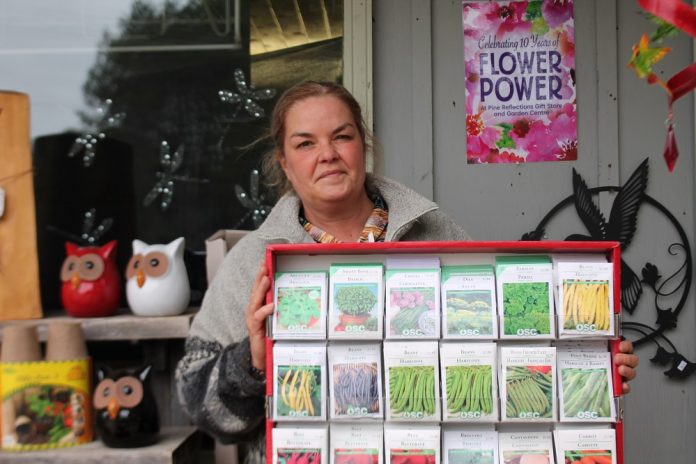
During the current stay-at-home order, one thing Haliburton County residents can do is get ready for another gardening season, says Sue King of Pine Reflections in Carnarvon.
Reopening at the beginning of April, King said “I think it’s going to be just as busy or busier” than last year when the initial COVID-19 lockdown saw a surge in vegetable and flower gardening as well as outdoor space beautification.
King said COVID helped her and her staff to achieve a pre-pandemic goal of gently getting people to garden as a de-stressor at a time when the world was getting busier, faster and embracing instant gratification.
“I’d noticed a lot of people, their stress levels were just going through the roof, especially if they were coming up from the city. So, we were gently trying to get people into gardening. There’s something very meditative about digging in dirt and we know the holistic benefits of grounding yourself.”
“And then with COVID and the lockdown, people realized how important it was,” she added.
She said staring last spring, they began to get people interested that didn’t have the opportunity in the past because they were either too busy or just did not put it high on their priority list.
“It was a very exciting time for us because although we never want to force anyone to make a change in habit, to us it was a great way to show people the dirtier your knees are, the less stress you have.”
Kind said they had people who were growing vegetables for the first time.
“And there is actually something very exciting about watching something grow. And being able to eat your own tomato from your own plant.”
She said proud clients were coming back with photographs and “wonderful” stories about the beautiful spaces they were creating. She said they were also empowered, telling her and her staff, “I can do this.”
She added the Pine Reflections staff were able to educate people.
What is different this year is the supply and demand chain has been affected by COVID, so ensuring stock will be more of challenge for garden centres, King said. She is confident in her wholesale suppliers, however, making weekly trips to restock. In her tenth year in business, she added she is resourceful.
The industry is hoping people will stretch out their buying and not horde plants in May, similar to the toilet paper hording of 2020.
However, she said the local demand is already starting after a long winter in which people have been planning their 2021 gardens.
However, she reminds people it’s a bit early to get going.
“You’ve got to watch Mother Nature up here.”
That said, it is a good time to check your soil and your growing zone. She said a foot down the soils is too cold and wet to sustain root growth and expects the dirty work will begin midMay to early June.
She implores gardeners to be patient since a Farmers’ Almanac prediction of a warm summer will mean a long and abundant growing season.
“it was a great season last year and this year is going to be even bigger and better.”
Arts council keeping stable in pandemic
The Arts Council Haliburton Highlands opted to keep its board steady for another year as it maintains programming amidst the pandemic.
Members voted at an AGM March 30 to extend chair Kate Butler and secretary Renée Woltz to serve an additional year, past the two-term, six-year maximum set out in the society’s bylaws.
The move came because of a board proposal to modify those bylaws to allow for three terms, given the difficulties of the pandemic.
Attendees balked at the bylaw modification but instead to give Butler and Woltz another year. Woltz said stability was important at this time.
“The board really feels this is not the time to be losing some experience on the board, given the challenges,” Woltz said. “And the fact with less social interaction it has been a little more difficult than usual to recruit new board members.”
Woltz said the two-year term limit was meant to keep the board fresh with new ideas and energy. But members said it did not make sense to change the bylaw or to provide an extra full term, which usually lasts three years.
“The bylaws are the backbone of the organization and you don’t go making adjustments annually,” Rails End Gallery curator Laurie Jones said. “That doesn’t mean that this has not been an exceptional period.”
Butler said she is willing to carry on for one year as an exception. She added she would be willing to provide advice beyond that.
“Hopefully, by that time, we’ll have a handle on what things are looking like as we’ve gone through this COVID-era,” Butler said. “And we’re coming out the other side and we’ll be in a better position.”
The society also voted to add Sophie Creelman and Danielle Martin to its board, joining Butler, Woltz, treasurer Pat Martin, Chris Lynd, Pat Jones and Scott Walling.
Programming carries on
The arts council reviewed its past year, how COVID-19 impacted the scene and what art programs have carried on despite that.
The organization had a 2020 deficit of $2,532, compared to a $1,642 surplus in 2019. Its general fund had $40,356 at the end of the 2020 fiscal year.
Martin said the board has worked to get more grants and donations to keep programs going.
“Your board has been working hard to ensure the financial viability of the organization,” Martin said. “While the COVID-19 pandemic has been a challenge we have been able to initiate several new programs.”
Some of those new initiatives include a promotional video, a remote reading event called 6-Minute Escape, a monthly social media feature on local artists, an online artist course and a new radio play which premiered April 7.
“The resilience and creativity of our arts community here is remarkable,” Butler said. “We always find a way to make things work … Looking forward to another great year ahead.”.
Supporting families through trying times

Haliburton’s Pregnancy Care & Family Support Centre said the pandemic is putting a strain on young mothers and families.
The Christian-based charity said pandemic isolation has taken its toll on the health of clients, both old and new to the County. Client services director, Leanne Young, said though the centre is still offering services, young families and new parents are missing group connections.
She said they are reaching out, but with new families moving into the community, they face difficulties maintaining public awareness.
“People are emotionally struggling with feeling isolated,” Young said. “As a young mom, I’ve learnt so many techniques with my kids from being – in the past – in mums’ groups.”
The pandemic has caused parents to spend more time with children, navigating home-based education and lockdown. A December 2020 study from Cambridge University found both Canadian men and women with children in their household are spending 37 per cent more time in childcare throughout the pandemic.
Centre executive director, Julie Goodwin, said they find clients often need someone outside their household they can vent with.
“It’s hard for clients to reach out for help when they’re struggling. To say, ‘I want to come and talk about this concern’,” Goodwin said. “Just a listening ear. A lot of people just don’t have that person to listen.”
The centre offers free support to struggling families, including parenting programs, supplies and pregnancy education. The pandemic has curtailed its group programming, but Goodwin said it has remained open to provide individual services.
Though its supports are not exhaustive, Goodwin said they can refer people to organizations addressing any issues they cannot cover.
“It’s not the same as mums being able to physically gather with their children and gain that peer support,” Goodwin said. “We’re just trying to look for ways to say, ‘we’re here, we care.’
“This is a great community that we live in and there are lots of good resources that we can help people navigate,” she added.
The charity is 100-per cent donor-based and has been unable to hold its usual fundraisers, Young said.
But she added they have gotten by with generosity and successfully shifting their main fundraiser – a baby-bottle drive – online.
“We’ve been overwhelmed by the support of our donors,” Goodwin said.
Young said the centre has health protocols in place and is ready to help anyone, regardless of background.
“Everyone needs support and you’re not alone,” Young said. “If you feel like, ‘I’m alone in this,’ that’s not true’.”
The centre is available at 705-457-4673 or haliburtonpregnancycentre.ca
Barbecue and brisket specialty of ‘crazy’ Hunter/Gatherer

Jason Lougheed said people have questioned him and his partner Allana Ziorjen for starting a takeout business in a pandemic.
The two launched Hunter/Gatherer, a new takeout business out of Minden’s Wintergreen Maple Products in March. The smoker-based establishment serves brisket, meatloaf, and pies made-to-order, with a clothing line to go with it.
Ziorjen said the pair have known each other for a long time and reconnected recently over a mutual love of barbecuing. The takeout idea unfolded quickly, and they got a business licence in November. The location came about because Ziorjen has worked at Wintergreen periodically for 17 years.
“Everything just kind of came together beautifully,” she said. “The beauty of this is we’ve been able to set it up in the midst of the pandemic. So, we’ve been able to tailor how we operate to the rules.”
“Everybody thinks we’re crazy,” Lougheed said. “And it makes sense. We are crazy.”
The service currently only operates one day a week on Friday, though plans to expand to lunch service on the weekends over the summer. It also planned to be out of a food truck on Easter weekend, though the provincial shutdown April 3 dashed those plans.
The business centers around the barbecue and brisket specialty, which Lougheed said requires 12 hours to cook using a smoker. They said they are looking to introduce it to the area and elevate more homely dishes such as meatloaf.
“People in this area aren’t as familiar with what brisket is because it’s more of a southern thing,” Ziorjen said. “It kind of changes barbecuing because it is such a long process.”
Wintergreen owner Tom Dawson said the relationship is a way to maximize the operation.
“We have facilities, they have skills and we’re trying to put them together,” Dawson said. “Very symbiotic relationship … In one essence, we’re trying to put wind under their wings.”
Lougheed said the Hunter/Gatherer name came from their philosophy on food and the community. He said they want to use locally-sourced products as much as possible.
“Our brand is we just kind of do what we have to do to get by. We use what’s readily available to us,” Lougheed said. “We are survivors.”
Ziorjen said they have kept a slow, but steadily increasing pace – 20 meals on a first week and more than doubling that over Easter weekend.
“I have been blown away,” Lougheed said. “It’s great. Everybody seems to be just loving it.”
The two are unsure of the long-term future, with their own building a pipedream. For now, they are taking it one summer at a time.
“The restaurant industry right now is so unstable. We’re coming in at a really interesting time where we’re able to sort of adapt,” Ziorjen said.
“We have to be realistic about what will happen in the next few years, with the restaurant industry as it is.” The service is available at huntergatherfood.com
Mobile phones and COVID control
by Dr. Nell Thomas
Vaccines are making their way through our community.
More of us are feeling that cloak of protection start to form around us after getting the shot. It sure does take the edge off the constant feeling of vulnerability and the vigilance we have all been burdened with. But until vaccination coverage helps us to reach herd immunity, nonpharmaceutical interventions remain the primary means of preventing virus spread. In some countries, such as Taiwan, for example, population behaviour has been the key to controlling spread of the virus.
Border control and compulsory mask wearing on public transit was imposed at the outset in Taiwan. Therefore, this island nation (population 23.6 million) had no locally-acquired cases of COVID-19 for the 253 days between April and December 2020. As of February 28, 2021, there had been 955 confirmed cases of COVID-19 in Taiwan, with only 77 (8.1 per cent) locally acquired.
Adherence to social distancing and face masking, plus quarantining and contact tracing. These are the techniques that have made Taiwan a country with one of the lowest per capita COVID incidence and mortality rates in the world. They have not had to close schools or use strict lockdowns.
An estimated 55 per cent of their infections occurred during the presymptomatic stage. A combination of early diagnosis of cases, plus contact tracing, plus 14-day quarantine of close contacts (regardless of symptoms) was estimated to decrease the reproduction number from 2.5 (each infected person infects 2.5 other people) to 1.5 people. (Remember, to stop spread, it is necessary to have the infection rate less than one.)
The effect of social distance and face masks reduced the reproduction number to 1.3, meaning that voluntary populationbased interventions, if used alone, were not enough to stop spread. Combining quarantining and contact tracing plus social distance and masks reduced the reproduction number to 0.85, successfully stopping spread.
Taiwan demonstrates that stopping the COVID-19 pandemic requires the collaboration of public health professionals and the general public. Either strategy alone would be insufficient.
The behaviours that are most effective at reducing spread in Taiwan are also effective in Canada. We are just not applying them strictly. But if we did, we would see the benefit. A study that tracked peoples’ movements using smartphone data from March 15, 2020 until March 6, 2021 showed that average time spent outside the home in a three-week period predicted the increased spread of COVID-19. It showed that low levels of mobility will control disease spread. (I doubt any of us is surprised at this, as we have witnessed the numbers go up when our activity is less restricted and fall again after lockdowns curb movement in our community.)
This study measured weekly growth rate – the ratio of cases in a given week compared to the previous week – and evaluated the effects of average time spent outside the home in the previous three weeks. The researchers tracked variation from week to week among regions and provinces.
Across the 51-week study period, 888,751 people were infected with SARS-CoV-2. Each 10 per cent increase in population mobility was associated with a 25 per cent increase in weekly case growth rate. Before the pandemic we had no restrictions on our movement, so mobility at pre-pandemic baseline was 100 per cent. Mobility measured during the study was highest in the summer (69 per cent) and dropped to 54 per cent in winter 2021.
The study concluded that use of smartphone data can be used to guide provincial and regional loosening and tightening of physical distancing measures. Mobility strongly and consistently predicts weekly case growth, and low levels of mobility are needed to control COVID-19.