
Home Blog Page 480

Paving roads with debt not so bad

0

Debt.

It is often viewed as an ugly word. It inspires anxiety and fear for the future. It can get viewed as failing to uphold responsibility. It is a spectre hanging in the halls of every level of government. It is a stamp political cartoonists keep on their desks at all times, when they are out of ideas.

The County of Haliburton is considering taking on $3 million in debt to improve its roads situation. Roads are a critical county responsibility, but one can argue the move is not strictly necessary. County staff argued it stands to significantly improve the road network, particularly on the worse roads to traverse in the spring.

Although some may protest, the county is well-positioned to do this. In this context, this $3 million debt could stand to be a positive thing.

Few things earn more ire than bad roads. Just about everyone in Haliburton probably experienced some of the roads which “blew up” in the spring, as director of public works Craig Douglas put it. Several roads we can recall were unsafe or felt damaging to our vehicles. Few would question our local municipalities putting an extra priority on fixing up roads.

But given how much road rural municipalities have to cover, that is always an uphill battle. Costs get high quickly and municipalities have to find money somewhere.

One option is to increase tax rates, which is never popular – big ones especially so. The tax increases needed to fund $3 million would probably make the 2020 budget deeply unpopular and more than people could bear in a one-year span.

There is always the option to make cuts, or “find efficiencies” as the province likes to say. Those certainly are not popular, either. Municipalities cannot run deficits and although there is always spending you can point to as wasteful, finding $3 million to cut out of a budget is no small task. It would probably stand to hurt other important services.

There is grant funding, which all municipalities use to make projects happen. But that is always uncertain and never seems to amount to enough. Ironically, taking on debt could attract more grant dollars, by making the county seem poorer.

So, if the county wants to do more for roads in the short-term, debt is the only other option. In the long-run, it is naturally the most expensive option with interest charges. Given that, it should be used sparingly, which the county has fortunately done. The county has only approximately $1.5 million in debt it is paying off, currently amounting to an annual payment of $157,712.

The county is well short of its annual debt repayment limit of $3.3 million. At current interest rates, taking on $3 million in debt would amount to a total interest payment of about $184,215 over five years, based on figures from a county finance report.

Some will scoff at that. But given how little the county pays to service debt currently, it is far from unreasonable.

The county is not close to a final decision on this loan. Council members will secondguess it, as they should do. Debt should not be taken lightly. Were the county more prone to taking on debt, this move would probably make little sense. Better long-term planning is a stronger alternative than debt, but more is already being mandated to help, such as asset management plans.

In the meantime, this is debt we can live with.
County plans to give roads “shot in the arm

0
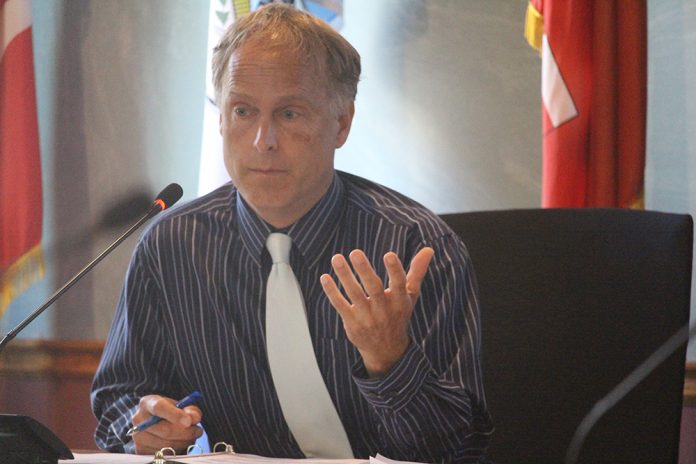
County of Haliburton director of public works Craig Douglas argued for a “shot in the arm” to the roads capital budget through a loan. Photo by Joseph Quigley.

The County of Haliburton is planning to budget a $3 million loan to give its roads a “shot in the arm” in 2020.

The Haliburton County Roads Committee voted Aug. 14 to recommend staff include a one-time, $3 million budget increase to supplement the 2020 roads capital budget.

Director of public works Craig Douglas argued for the budget increase, citing the troubles the municipality experienced with roads “blowing up” in the spring.

“Hard for me to sleep at night in that spring,” Douglas said. “Status quo isn’t necessarily going to change anything next spring … I think the roads budget needs a one-time shot-in-the-arm.”

Douglas outlined three options including: status quo; a $6 million loan and a $3 million loan. He discussed what impact each would have on roads quality in the municipality, in terms of network performance rating.

Coun. Brent Devolin said the municipality would have to make some fundamental decisions as it works on its long-term asset management.

“This is the first of a whole bunch,” Devolin said. “This is a great step forward. You’re either doing this in a big way or you stick with the status quo. I’m not a supporter of in-between.”

The motion does not represent a firm commitment, with council still able to change direction in the budgeting process. Council also directed staff to bring forward a report breaking down different approaches to the multi-million-dollar loan and how it could be repaid.

A staff report presented at a subsequent finance and correspondence committee meeting found that the municipality has an annual debt repayment limit of $3,391,370. Currently, it is only spending $157,712 across two loans. As of Oct. 31 2018, the county has $1,568,817 in outstanding debt.

“Historically, the county has minimized debt,” the report from treasurer Elaine Taylor said. “Many of our roads are in poor or fair condition and require replacement. Utilizing debt to decrease the infrastructure gap could assist the County in reaching sustainability for road and bridge infrastructure”

Douglas said the improvements may be hard to conceptualize across a massive road system, but more funding should make for a notable impact on bad roads.

“We’ll have a lot less stuff that’s blowing up,” he said.

County takes ownership of Minden daycare

0
The County of Haliburton is taking on ownership of the Ontario Early Years Centre in Minden. Photo by Joseph Quigley.

The Ontario Early Years Centre board is transferring ownership of its daycare facility in Minden to the County of Haliburton.

County council announced the move at a special meeting Aug. 14. Council authorized the purchase of the facility for $2, giving the municipality control over the building. In June 2018, the Ontario Early Years Centre (OEYC) nearly terminated daycare services there on a week’s notice.

But the City of Kawartha Lakes, which oversees daycare in Haliburton on behalf of the county, struck a last-minute deal to save it. Minden Hills Mayor Brent Devolin said the municipal control should prevent that situation from happening again.

“It remains in control of the local community,” Devolin said. “This is a good day and it ensures we never have the challenge we did over a year ago.”

Lisa Tolentino knows that challenge well. Her son attended the centre’s after school program when the closure was imminent. She said it had a significant impact on the community who used the facility.

“I’m happy to see it in the hands of the county, for sure. I think it’s a good choice,” Tolentino said. “I was just really upset about the impact it had on the staff, as well as the children of the other parents.”

The property was originally donated by the Dollo family for the community.

“We feel this aligns with the original intent,” the OEYC board said in a statement. “While also enabling the County of Haliburton to be involved in the future of licensed childcare in the community.”

Devolin said this will not change the day-to-day operations of the facility. Compass Early Learning and Care manages the daycare under the oversight of the City of Kawartha Lakes.

“It’s just strictly the asset comes into possession locally, so it guarantees in perpetuity that it couldn’t go away,” he said.

OEYC executive director Pippa Stephenson said the move has been in the works since 2017 and discussions were initiated with the county in summer 2018. The board decided it no longer wanted to operate the facility due to limited resources.

“The OEYC is not a large organization,” Stephenson said. “The board had hoped that an organization dedicated to childcare would be able to offer enhanced services to families and better support to staff.”

The facility is in line for significant improvements too. It is due to get 23 new childcare spaces, with up to $750,000 in capital funding from the province, which was announced July 2018.

The province announced Aug. 19 it would soon go ahead with funding changes for new childcare spaces, which will require municipalities supply 20 per cent of the cost. Previously, the province fully funded it, but warden Liz Danielsen said this may not impact the Minden facility.

“The timing of approvals may allow the project to move forward without encountering any issues,” she said.

Tolentino said she is optimistic for the future of the facility.

“I’m hoping whatever they do is going to make things better for everyone,” she said. “I suspect it will.”

Radiothon beats funding goal for heart equipment

0
Nancy Lowes got people in their cars involved in the fundraiser. Photo by Meagan Secord.

The 12th annual Radiothon fundraiser for the Haliburton Highlands Health Services Foundation (HHHSF) raised $30,645, $5,000 more than this year’s goal.

HHHSF executive director Lisa Tompkins said the community always comes together in support of the hospitals.

“This community is extraordinarily generous to health services and many other causes that they have throughout the county,” she said.

The Radiothon at 99.5 Moose FM took place on Aug. 16 and 17 and raised money to go towards new echo cardiographs (ECG’s) for the hospital’s emergency department.

Volunteers from both the hospital and the radio station spent two days on air, encouraging people to donate. On the ground, people outside asked people passing by to get involved.

Sue Black, a morning host for Moose FM, said on air that the radiothon helps the hospital work more efficiently.

“It would be an administrative nightmare if they had to send people out of town everytime they needed a machine,” she said.

Tompkins said the timing gives seasonal residents a chance to get involved.

“Because the equipment we’re fundraising for is for the emergency departments that might be pretty relevant to visitors,” said Tompkins. “We hope that people don’t need to use the emergency departments but we’re thankful that if they do, we’ve got great medical professionals and equipment.”

HCDC sees RED over student housing

0
People take part in the food and agricultural economic development forum on March 5 at the Minden Hills Community Centre.

Haliburton County Development Corporation (HCDC) will use up to $50,000 in provincial government money to commence studies in hopes of bringing 40 student housing units to the college.

HCDC executive director Patti Tallman told The Highlander on Tuesday, they’re working with Greg Bishop of KOB North Lake Holdings on the project. Bishop first pitched student housing to Dysart et al council last fall.

The province announced HCDC is getting up to $50,000 under its rural economic development (RED) program, while the County of Haliburton is getting up to $20,000 for food tourism initiatives.

Tallman said in their case, “the project will see the development of studies of the sewer services and property easements to enable services to be connected to the municipality’s sewer systems.”

She said it will include professional services for design drawings and municipal approval processes which will require consultants, legal and planning costs.

“The funding is available now so once costs have been incurred expenses can be reimbursed,” Tallman said.

She added that the outcome will be building design and drawings, plans and approvals to be put in place

“We are very grateful for the opportunity to work with KOB North Lake Holdings to investigate the feasibility of a student residence next to the Haliburton campus. A student residence would be an incredible asset for our community,” Tallman said.

On Nov. 27, 2018, Bishop told Dysart et al staff and councillors the project would require the severance of nearly three hectares of property from a nearly 16-hectare lot off of College Drive near Glebe Park, an easy walk or bike ride from the campus, where lack of student housing has been an ongoing issue for years.

The RED program is aimed at helping rural and indigenous communities attract investment, create and keep jobs and boost economic development.

County Warden Liz Danielsen said for their part, “The County of Haliburton has been working on the development of food tourism, in support of many local businesses for the past several years.

“With the funding from the Rural Economic Development program, we will be able to launch a number of exciting programs in the back half of 2019 and support a contract position as well. It’s an exciting and delicious time for the Haliburton Highlands.”

Harvest Haliburton hosted a food and agriculture economic development forum in Minden on March 5 to discuss a growing local industry.

Ernie Hardeman, minister of agriculture, food and rural affairs, which oversees RED, said, “our government’s priority is to create jobs and economic growth in every corner of the province. We have updated the Rural Economic Development program to better align with our commitment to supporting rural Ontario and focus on projects that will bring real benefits to communities.”

Applications to the updated program are now being accepted until Sept. 9, 2019.

It has two new project categories: an economic diversification and competitiveness stream: projects that remove barriers to business and job growth, attract investment, attract or retain a skilled workforce, or strengthen sector and regional partnerships and diversify regional economies; and strategic economic infrastructure stream: minor capital projects that advance economic development and investment opportunities.

All program details, including the program guide and application form, are available online at ontario.ca/ REDprogram.

Community loss felt at Wilberforce Agricultural Fair

0
Brixton Haywood and Camden Haywood sit atop a horse at the 36th annual Wilberforce Agricultural Fair Aug. 10. See more coverage on page 30. Photo by Joseph Quigley.

Organizers ensured the 36th annual Wilberforce Agricultural Fair went on Aug. 9-10 despite the loss of one of the community’s pillars.

The fair attracted hundreds of guests to enjoy agricultural competition, games, vendors, food, animals and more.

But Wilberforce Agricultural Society treasurer Janet Vanier said the passing of Hilda Clark, whose funeral was also on Aug. 10 in Minden, led to some extra challenge. Clark was a regular volunteer with the fair and many other community initiatives.

“Hilda was a big supporter of the fair. She would have missed being here,” Vanier said. “We know the fair has to go on. Just doing our best, and a lot of people are putting extra work in, volunteering more so that other people can get out (to the funeral).”

Clark was known for her contributions throughout the county, including founding the Wilberforce Heritage Guild and working with the Red Cross Outpost Hospital and the Wilberforce FUNraising Group, among others.

“Thanks, Hilda, for your kinda-crusty-but-ever-lovable character, your verve and your undeniable commitment,” the Stanhope Museum wrote on its Facebook page.

But the fair was still able to go off successfully thanks to the efforts of organizers and volunteers.

Wayne Quibell of Highland Creek Builders has done live demonstrations at the fair for several years, donating his creations for fair fundraising. He said he was impressed by this year’s crowd and the event’s new attractions, such as booths run by the local fire department and Canoe FM.

“It’s a great little community and you get to get out and meet all kinds of new people,” Quibell said. “No better place to spend a Saturday than the Wilberforce Fair.”

The event is also a place for competition, including horse pulls, bench exhibits and a children’s dog show. Agricultural society director Mike Alden has competed in horse pulling for five years.

“I’ve always liked it,” Alden said. “The competitors are nice to each other, they always help each other out. Everybody’s always having a good time.”

Vanier said a lot of work goes into putting the event on, with planning for next year starting shortly after the fair ends. But she said there is plenty to make it worthwhile in the end.

“The smiles on the kids’ faces and the community participating,” Vanier said. “It’s just great to see the community coming together.”

Shaking the ground for solar farms in Algonquin Highlands

0
Work has begun on a solar farm in Algonquin Highlands. It is one of two being built. Photo by Lisa Gervais

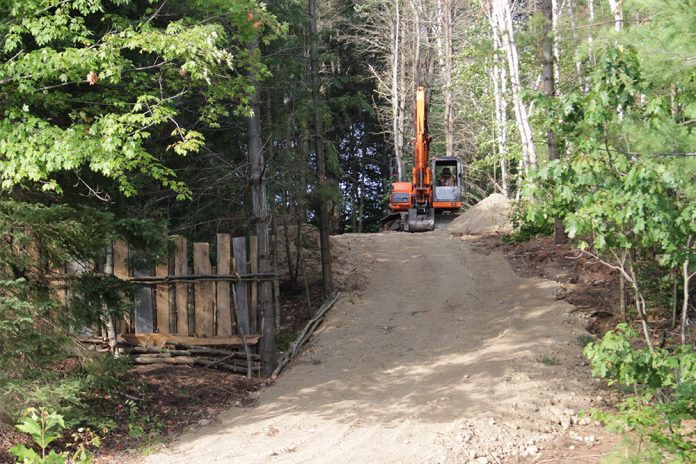
Work has begun on two small ground mounted solar generation power projects in Algonquin Highlands.

Leftovers of the former provincial Liberal government’s Fit 4 program, Soventix is commencing with two 600kW-generating projects, each on five acres of land in the township. One is just north of Carnarvon, and the other further north along Highway 35 across the highway from Boshkung Lake. Both sites are leased.

The projects first came to Algonquin Highlands council back in July 2015. The council of the day granted blanket support.

Soventix’s Canadian managing director, Michael Kendon, told The Highlander on Tuesday it has taken them more than four years to get the projects to where they are today. They applied, and were successful, under the feed-in-tarriff program. They then had stages of engineering, planning, costing and financing. They are doing other projects in Canada and across the world.

“So, it’s not like it ever went away. There’s always that kind of initial amount of information that goes out when a municipality lends it support to the project … and from a public perspective it’s been pretty much invisible until the stage where we’re at now,” he said.

Residents of Carnarvon have noted there has been blasting just north of town. Kendon said there is some blasting of rock to access the two sites and also to put in the piles that the solar panels will be attached to.

“The two projects are in construction. So, it means that the people that are working on them are doing whatever they need to get access roads in and to get the connection lines,” he said.

The managing director said they are employing local contractors to do the preliminary site preparation work. It won’t take long, either, he said.

“These things should be built and functional within the next 30 to 60 days. The whole project is comparatively very simple to put together once you have all the elements lined up.”

He said they will install piles, racks, panels, wiring and a transformer to connect to the Hydro grid. The projects have a life of 20 years. He said they will not be visible from the ground.

“The end result is two solar energy projects that are generating electricity out of sight of everybody, injecting power into the utility grid,” Kendron said. “Increasing the amount of renewable-derived energy that’s used in the area. That’s a fact and that’s a good thing to us.

“We want to do what we can to help shift energy supply and generation away from carbon sources or detrimental sources and go to renewable sources, because this planet … it’s got some challenges. And, these might be small, but you add a lot of small things together and you can make an impact.”

He lauded the province for ending its reliance on coal. He said Soventix chose Algonquin Highlands because both sites are easily accessible to transmission lines and are not on agricultural land. He said in addition to the benefit of “the energy consumed in the local area is going to be greened up a little bit more” local contractors are being used and the landowners will make some money.

“We tend to think this is a positive thing; and it might have taken a while to get to this point but here we are.”

Church “pillar” celebrates 80th birthday

0
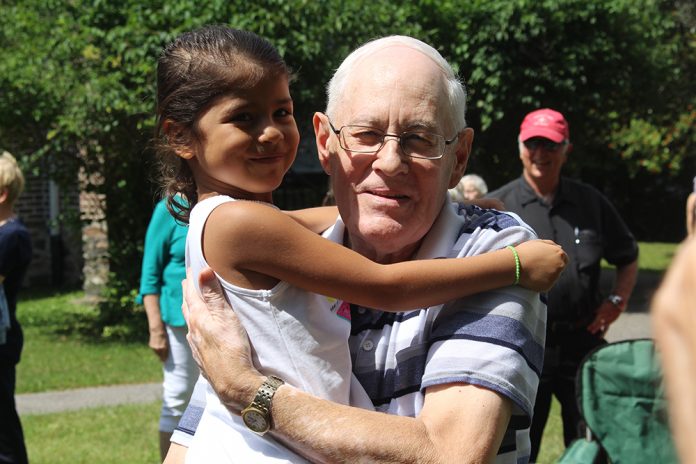
Anglican church organist Bill Gliddon holds up Rama Wiso at his 80th birthday party Aug. 11. Photo by Joseph Quigley.

Long-time Anglican church organist Bill Gliddon could hardly walk a few feet without being embraced by a well-wisher at his 80th birthday party Aug. 11.

The St. George’s and St. Margaret’s Anglican Church community hailed the choir director for his 57 years serving in the role. After a standing ovation at the end of the Sunday service, the party attracted dozens of Gliddon’s friends and family to celebrate.

It is those same people who have driven Gliddon to continue making music to fill the church’s chambers, he said.

“You become friends and the choir that I have, it just became like my second family,” Gliddon said. “I just feel very blessed.”

Gliddon was born and raised in Haliburton. After leaving to study music, he returned to teach music classes for students throughout the highlands. He said there was a pressing need for music teachers at the time.

“I really thought music is so important, in the children’s lives especially,” Gliddon said. “That’s why I came back and I’m so happy I did. I’ve always lived here ever since.”

That same drive to help his community brought him into the role of church organist. The Anglican church reached out to him when the spot opened up, with nobody else in place to take it on.

“I’ve never taken an organ lesson in my life,” Gliddon said. “But they told me the need here was really urgent.”

Through his work with the church, Gliddon has forged hundreds of connections with people. Rev. Ken McClure said Gliddon is a pillar of the church.

“If there’s somebody who’s sick, he knows about it, he visits in a heartbeat. If there’s somebody that needs to drive somewhere, Bill’s going to do it,” McClure said. “He is an example of what every one of us should be doing and being in church.”

Gliddon also practices that altruism at home. He keeps a cooler at the front of his driveway, stocked with water bottles for people passing by.

“If you really follow the Christian example, you don’t think of yourself as much as you think of other people,” Gliddon said. “If you’re helping other people, it makes you happy because you’re making them happy. I think that’s the way. If the world was like that, it would be great.”

Louise Cooper was in Gliddon’s choir from 1969-2009. She said he helps people improve. “This church, he’s the heart and soul. He never takes a holiday. He’s always here. He reaches out to people.”

There’s no heir-apparent for Gliddon for his role. Although issues like arthritis and eyesight have started creeping up, Gliddon said he is intent on doing the job as long as he is able.

“When the time comes that I feel like I can’t do an adequate job, then I’d be happy to just give it to someone else,” Gliddon said. “If someone else would only come along.”

As gifts, cards and love descended upon Gliddon for his birthday, he thanked everyone for being part of it. He said the event was not about him, but the whole community.

“This is what life is all about is being a family. And we are a wonderful family in this community,” Gliddon said. “We are so blessed to live in this beautiful spot.”

Highlands East artists centralize to draw in crowds

0
Liz Feyerabend said the Highlands East Studio Tour is “a great opportunity to get my art out there for people to see what I do. I love painting for people. I love to make them happy. I want them to have colour in their lives.” Photos by Joseph Quigley.

The 17th annual Highlands East Studio Tour attracted more than 70 people to survey a new, centralized place to see local artwork Aug. 10-11.

The tour historically invites people to drive throughout the municipality to visit local artists in their studios. Attendees can talk with local artists and look at their work, which is available for purchase.

But this year of the tour was a departure from previous, with more than half the tour’s artists concentrated at the studio of organizer Chuck Lewis. He said the effort, done to attract more guests, was successful.

“The response of the people that made the trip to the studio was it was great,” Lewis said. “Instead of travelling all over the county, they could visit just the studio and have eight artists.”

Lewis said the idea stems from his experience participating in the Tour De Forest in Dysart et al. Although they lack a central location, the artists’ studios are closer together than in Highlands East.

“We’re so remote to that group over in the west side of Haliburton. So, what we have to do now is develop the same sort of situation,” Lewis said.

Deborah Ann Morris has participated in the Highlands East tour for three years. She spoke positively about centralizing more of the event’s artists.

“It’s a wonderful thing to do to lessen our carbon footprint and to create community,” Morris said. “I do however miss the idea of people coming to my studio, but I welcome people to my studio just the same.”

Cottager Jeannette Jamieson has attended the Highlands East Studio tour for years. She praised the format change and said the artistic community is one of the best aspects of the area.

“It’s a lot of fun just to see what people are producing. To see the talent, to see the interpretations, to just feel a part of it. What we have here is a phenomenal gift,” Jamieson said. Lewis said he hopes the tour’s efforts can help the event grow with more attendees and artists.

“Up here you don’t have that many options where you can show your art,” Lewis said. “I’d like to see this expand. I’d really like this to be a hub.”

EH! Indigenous speaker talks human responsibility

0
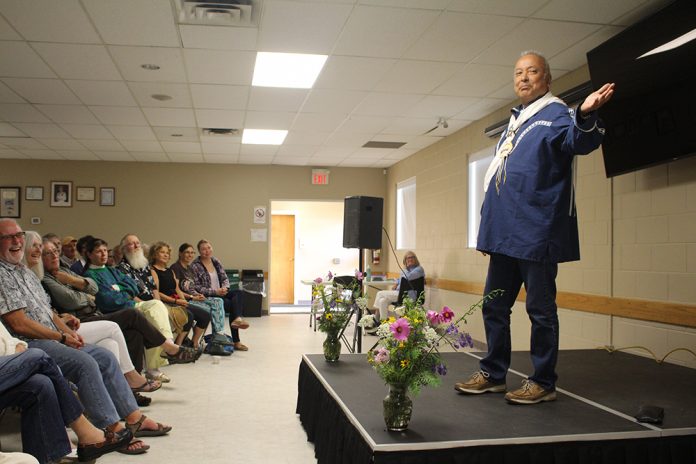
Dr. Dan Longboat cracks a joke at the start of his presentation at the Minden Community Centre Aug. 10. Photo by Joseph Quigley.

Dr. Dan Longboat shared an Indigenous understanding of man’s responsibility to nature before a crowd of more than 70 people at Environment Haliburton’s summer speaker event Aug. 10.

Trent University’s director of the Indigenous Environmental Studies and Sciences Program, as well as the acting director for the Indigenous Environmental Institute, spoke at the Minden Community Centre.

Longboat is a Turtle Clan member of the Mohawk Nation and a citizen of the Rotinonshonni. Longboat talked about Indigenous history, prophecies and creation stories, as well as what the stories say about people’s responsibility to the world.

“Our agenda in working together for the continuation of all life is now even more important than ever before in human history,” Longboat said. “No other time in human history have we had to worry about issues around water, amount, quality. We have issues around global contaminants and toxins, loss of biodiversity, extinction of species … all under the umbrella of climate change.”

Environment Haliburton president Ryan Sisson, who was once a student of Longboat, said his message and perspective are important given people’s unease with current political decision-making.

“People are looking for ways of knowing and ways of doing things differently,” Sisson said. “People are realizing, whether it’s climate change or biodiversity or water quality, we seem to be running out of time for solutions.”

“We need to think of more ways that we can talk to people,” vice president Susan Hay added. “Dr. Longboat just gives us more language, just more ideas that we can share with other people.”

Sisson spoke positively about how the event went. The summer speaker is the group’s most highly attended event each year.

“We had a great turnout,” Sisson said. “We’re just thrilled to have someone of Dr. Longboat’s stature come in.”

In a question and answer session, Longboat also addressed issues such as access to Indigenous stories, gender equality and conflict over wild rice between cottagers and Curve Lake First Nation. Longboat said with every colour of person now together for the first time in history, they must unite to care for nature.

“We’re not going to resolve those things in trying to think there’s only one way to see the world,” Longboat said. “Bring our knowledge together to work for the continuation of life. For the benefit of our children, our grandchildren, their grandchildren and all the other things in the natural world that are depending on us, as human beings, to fulfill their responsibility.”