
Home Blog Page 369

Warden election will be telling

0

I found the recently-released services delivery review for Haliburton County and its four lower-tier municipalities to be lacking.

That being said, StrategyCorp., of Toronto provided the eight County councillors with exactly what they had asked for Nov. 25. They wanted a services delivery review only. They did not want any research done on a possible amalgamation or move to a single-tier government. So, they got a document that is recommending 12 better ways of collaborating to save $1.18 million.

That document’s recommendations include hiring five additional staff. It also could take years to implement the changes.

Those of you who were around for the September 2018 mayor’s and deputy mayor’s debate would remember that some ratepayers pushed the idea of amalgamation at that meeting.

One member of the public pointed out we have one of the highest poverty rates in Ontario, lower incomes and higher unemployment than the Ontario average. Yet, at the time, there were 15 municipal employees on the sunshine list, making more than $100,000 each, adding up to more than $1.7 million.

The speaker noted the City of Kawartha Lakes had cut back to just eight councillors in a newly-amalgamated council.

We are headed into budget time at all five local councils and we will see once again that it is wages and benefits that gobble up much of our tax dollars.

It is not councillors that cost us money. They really don’t make a lot of money. It’s the staff salaries that drive the spending.

During that debate two years ago, it was only Minden Hills incumbent mayor Brent Devolin who spoke most passionately about the need for one-tier.

In his opening remarks to that debate more than two years ago, Devolin said our current municipal structure of 24 people in 32 political positions in a County of less than 20,000 permanent residents was not sustainable.

He added that a four-year term of council was enough time to assess, consider, plan and execute the possible changes in time for a municipal election in 2022.

Without a doubt, amalgamation has become a polarizing issue in Haliburton County. There are those who think one-tier will provide better value for money. There are others who argue it will lead to a loss of identity for our townships. Others say it will cost more, not less.

At this stage, even with a services delivery review, we don’t have answers to those questions. Would amalgamation be good or bad for our region?

That’s why I find the current services delivery review lacking.

It will be up to this council to decide if it wants to take the debate one step further.

Which leads me to speculate on the race for County warden. Traditionally, the post is decided upon behind closed doors, and an uncontested winner robed. They used to share it amongst the municipalities. This year is different. We have two candidates squaring off.

Some would say Devolin wants the warden’s seat back because he wants to take the governance review to the next level. Others say current warden, Liz Danielsen, isn’t as sold as Devolin on going to a single-tier.

The election by councillors and swearingin will occur Dec. 15. The decision could provide the answer as to where this term of County Council is headed for 2022.

Don’t get me wrong. Doing a services delivery review in the first place was the right thing to do. Identifying $1.18m in savings is important for ratepayers. However, those questions about amalgamation raised at the 2018 mayor’s and deputy mayor’s debate still have to be answered
Tourism gets $350,000 gift from province

0
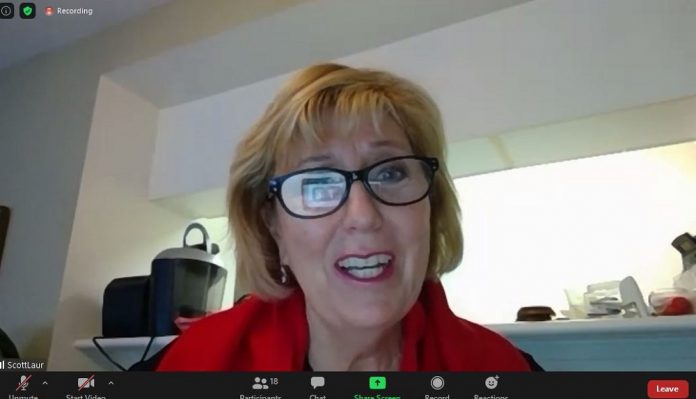
MPP Laurie Scott speaks during a tourism funding announcement Dec. 8. Photo by Lisa Gervais.

The province announced Dec. 8 it is giving the tourism organization representing the Haliburton Highlands to the Ottawa Valley region $350,000 in new funding to combat the effects of COVID-19.

Minister of Heritage, Sport, Tourism and Culture Industries, Lisa MacLeod, made the announcement for RTO 11. MPP for Haliburton-Kawartha Lakes-Brock, Laurie Scott attended the online event.

MacLeod visited the Highlands July 9 and although a funding announcement was expected then, RTO 8 received $1.4 million later in the day during a press conference in Bobcaygeon.

The new funding is in addition to $2.9 million that has already come to the region, including $734,000 for SIRCH’s bistro café and market and operating money for the Haliburton Highlands Museum, Minden Hills Museum, and the Haliburton County Public Library.

MacLeod, who lives in Ottawa, said in part, “I know that our sectors were hit first, hardest and will take the longest to recover as a result of COVID-19.”

She said the money for RTO 11 is so “they can engage and support hyper-local tourism activities within the region in order to position us for a comeback for the year of the staycation in 2021.”

She added “it’s about community. It’s about where we live. It’s about pride of place and pride of people.”

Scott said, “Tourism is so important up where we live.” She said while operators have been able to pivot well in rural areas, “we know this is an ongoing struggle.” However, she said there is hope with a vaccine on the horizon, with this funding “to help organizations bridge to that better time we know will come.” Executive director of the OHTO, Nicole Whiting, said while some operators have had their best years ever, others are struggling.

“Of course, the devastating impact this crisis has had on our sector is significant,” she said in welcoming the funding. However, she added they’re confident of coming out of the crisis stronger than ever.

Forest cancels 2021 Poker Run

0

For the first time in more than 30 years, the Haliburton Forest is cancelling its annual poker run. It had been scheduled for Saturday, Feb. 6, 2021. General manager Tegan Legge said they made the tough decision for the safety of staff, guests and community. 

The event has brought in hundreds of snowmobilers annually from all over Ontario. Last year, between the efforts of staff and volunteer, the Forest raised $15,000 for the local fire department.

They intend to continue in 2022, on Saturday, Feb. 12.

Legge said trails will remain open to those wishing to purchase day passes and for those already staying with them. The Cookhouse will be hosting outdoor BBQs on weekends all winter with bonfires and comfort foods.

All day pass fees for Saturday, Feb, 6, 2021 will be donated to Dysart et al fire department.

Social services bracing for pandemic demand

0
Central Food Network has seen an 11 per cent increase in demand for its services since the pandemic started. Highlands East Food Hub workers, left to right: Lisa Ayles, Ken Mott, Donny George. Photo submitted.

Central Food Network and other social service organizations are seeing an increased demand for services – and are rising to meet the need.

The Highlands East food bank announced Dec. 4 it was preparing to up its numbers for its annual Christmas hamper drive in response to an 11 per cent increase in food bank visits since March. Similarly, Heat Bank Haliburton County announced its plans to increase the value of the grants it provides to lower-income households by 25 per cent, from $400 to $500.

Central Food Network executive director, Tina Jackson, said the pressure of the pandemic and rising food costs are being felt. Social services have been preparing for months for higher demand come winter.

“It really underscores the need for things like a living wage, so that people that are working aren’t struggling … As well as for a guaranteed basic income,” Jackson said. “In the meantime, we will continue to be here for people who do fall through the cracks.”

Jackson said the Canada Emergency Response Benefit (CERB) flattened the curve of demand over the summer. That trend was similarly seen across the province according to Feed Ontario, though in its Nov. 30 Hunger Report, it said other factors such as new pop-up meal programs made an impact.

Regardless, Jackson said the demand started to increase again when CERB ended in October.

“We started to receive more calls,” she said. “For people now transitioned to EI (employment insurance), they’re getting less money per month.”

Still, food banks and service clubs are working to meet that demand.

“We don’t want to see anyone going hungry,” Highlands East Food Hub manager Ken Mott said. “Although our doors aren’t physically open the way they used to be, our hearts are and we want people to reach out if they need help.”

A surge in community generosity has helped, Jackson said. She highlighted a recent $6,400 donation from 100 Women Who Care and a Rhubarb Restaurant fundraiser providing more than $13,000, both to the Heat Bank.

“We are so grateful to help play a role in this very worthwhile project,” Rhubarb Restaurant owner Terri Matthews-Carl said.

“The number of people donating for us has been unprecedented,” Jackson said. “We are well prepared to weather at least the next six months and I’ve certainly heard that echoed with the other food banks within Haliburton County.”

Still, Jackson said she would like to see more pandemic support from the federal and provincial levels.

“If we think to the beginning of the food bank, we were supposed to be a Band-aid solution. It was supposed to be a short-term thing,” she said. “There’s obviously still a need for food banks, we still need to be here and people need to eat. And we need to have a social safety net.”

Police investigate armed robbery of pharmacy

0
Police established a perimeter around the Highland Pharmacy Dec. 19. Photo by Joseph Quigley.

Haliburton Highlands OPP is investigating a Dec. 9 armed robbery at the Highland Pharmacy.

In a press release Dec. 10, police said they received information about two unknown masked suspects entering a business on Highland Street with a firearm. They responded at approximately 6 p.m.

“The suspects demanded and received narcotics, then fled the scene. The employees were not injured,” the press release said.

The OPP Tactics and Rescue Unit (TRU), Canine, Emergency Response Unit (ERT) and Forensic Identification Services (FIS) were called to assist, police said. OPP central communications tweeted around 7 p.m that a large police presence was conducting an investigation in the Haliburton to Tory Hill area and asked residents stay inside. The presence cleared within the hour.

Police established a perimeter around the pharmacy shortly after 6 p.m., closing off the area, with at least three police cars on scene.

The press release said the incident is still under investigation and more information will be released when it is available.

Investigators are encouraging anyone with information regarding the incident or the suspects’ identity to contact the Haliburton Highlands Detachment at 705-286-1431 or toll-free at 1-888-310-1122. If you wish to remain anonymous, please contact Crime Stoppers at 1-800-222-TIPS (8477).

Chamber calls for County economic focus

0
File photo.

The Haliburton Highlands Chamber of Commerce is welcoming the prospect of the County taking on economic development.

The County services delivery review unveiled Nov. 25 recommended the municipality hire an economic development officer. Consultant StrategyCorp, estimated the position would cost $200,000 including $80,000 in salary, $24,000 in employee overhead and $96,000 in service expenses.

Haliburton Highlands Chamber of Commerce board president, Andrea Strano, said she is optimistic about the recommendation, adding it is something needed in the County.

“There’s a really good opportunity here for forward-thinking and forward planning,” Strano said. “We can’t always keep having the same group of 10 people in the community getting together in a bunch of groups and then talking about it, kind of like hamsters on wheels. We need to have more planning and more doing.”

Economic development is presently handled at the lower-tier level, with townships taking different approaches. StrategyCorp held a workshop about economic development with stakeholders including the chamber, Haliburton Village BIA, Algonquin Gateway Business Association and the Highlands East Economic Development Committee. The report found stakeholders wanted increased government support and coordination at the County level.

“It was a really productive process,” chamber executive director, Jennifer Locke, said. “The timing of this conversation is really key, especially with COVID.”

The report said economic development must be distinct from tourism, which already has a County position. Locke said the success of that has motivated a desire for an economic development staff.

“Easier … than having these piecemeal, silo-based activities at the lower levels,” Locke said. “The stakeholders and the business community, they are behind a centralized role.”

She added expanding the scope of the economy beyond its seasonal nature is important.

“Come winter, everybody’s on vacation. That’s the root of that,” Locke said. “There’s kind of a recognition it creates these cycles that are perhaps not ideal for our entire community … Perhaps other opportunities that would allow for a more year-round economy, diversified economy. As we’ve noted through COVID, tourism can be precious in ways that we don’t expect.”

The report said there is a community need for more economic development, citing the County’s below-average income and above-average unemployment rate (13.1 per cent in August 2020, compared to 10.6 per cent for the province). The report notes the position would likely lead to increased revenues but does not estimate that figure.

It added with provincial and federal economic programs likely coming due to the pandemic, this can take advantage of them. It recommends implementing the position starting in 2021.

There is an opportunity cost to lacking economic development, according to the report. Locke said she has received calls from businesses interested in coming to the area, but the lack of centralized resources is a difficult hurdle. She further said economic development also needs to consider environmental and social aspects, also known as a triple-bottom-line approach.

“It cannot just be about dollars and cents. It needs to be about the community, environment, everything because there are risks when we d

Ministry investigates blast

0
Construction signs near Ground Zero.

The Ministry of the Environment, Conservation and Parks (MECP) is looking into a blast Dec. 2 in Algonquin Highlands that reportedly damaged some homes and had some residents thinking there’d been an earthquake.

Residents experienced a large rumbling about 2 p.m.

MECP spokesman, Chris Johnston, said Dec. 4 there was a blast at the Francis Thomas Contracting (FTC) quarry on Highway 35 in the township. He said it wasn’t FTC that blasted but subcontractors, Fowler Construction and Austin Powder. Ltd.

He said the blast exceeded the ministry’s applicable noise limits.

“The blasting company reported the incident to the ministry,” Johnston said.

“Members of the public also contacted the ministry reporting property damage. The ministry is working to ensure the quarry owner and its contractors take appropriate action to address the public’s concerns and to ensure similar incidents do not occur in the future.”  

Johnston said the ministry is working to determine the cause of the blasting noise limit exceedance and address public concerns. He said it is too early to determine the results of the ministry’s review and assessment of the incident.

“We are requiring that the company conduct inspections of the reported damage to determine what steps are necessary to restore the property. The ministry will monitor the progress of these inspections and ensure that the parties involved take appropriate action.”

Algonquin Highlands Mayor Carol Moffatt posted to her Facebook page shortly after the blast.

She said she made some quick calls and was advised the blast occurred in the aggregate pit on North Shore Road.

“Although notifying the broader community is not required under the Act, Francis Thomas Contracting has historically notified the township and we, in turn, put out public notice. It doesn’t appear there was any notification today [Nov. 2],” she said.

She said after speaking with Francis Thomas Contracting and Fowler Construction, “we will be seeking better and more appropriate notification going forward.”

Resident Cheryl Richman wrote on the mayor’s Facebook page, “I have someone coming to check on my home as I am concerned about structural damage due to the violent shaking caused the shockwaves from the blast. There should be limits on the strength of dynamite being used near residences.”

Elaine Smith added, “we are directly across from North Shore Road, on Beech Lake. We thought the earth had moved.”

Province increases COVID restrictions in district

0
The Haliburton, Kawartha, Pine Ridge District Health Unit is shifting to Yellow under the provincial COVID-19 Response Framework. Photo via Ontario.ca.

The provincial government announced today the Haliburton, Kawartha, Pine Ridge (HKPR) District Health Unit will be moving from Green-Prevent to Yellow-Protect under the provincial COVID-19 Response Framework.

The change will be effective Dec. 7. The change brings with it enhanced enforcement, fines and education to limit spread. The health unit will apply more measures in higher-risk settings.

HKPR medical officer of health Dr. Lynn Noseworthy said in a press release the change is not surprising.

“We are seeing more COVID-19 activity in our region,” Noseworthy said. “The new measures in the Yellow level are not much different than what we currently have in place but will enhance our ability to slow the spread of COVID-19 in our communities.”

There is currently only one confirmed active case in Haliburton, but cases have spiked elsewhere in the district, with 23 cases active in Northumberland and seven in Kawartha Lakes.

According to the health unit, key changes under the new restrictions include:

  • Restaurants/bars must close at midnight.
  • Alcohol can no longer be sold or served after 11 pm.
  • A limit of six people can be seated at one table in restaurants
  • Eateries and other select businesses must keep contact information for all patrons who dine in. Currently, restaurants only had to collect contact information for one person in the party.
  • Gyms and fitness clubs must increase spacing between patrons to 3 metres (from 2 metres) in areas with weights or exercise equipment, as well as in exercise/fitness classes.
  • The volume of music in stores and businesses must be low enough so a normal conversation is possible, and shouting is not required.
  • Most businesses must now complete a COVID-19 safety plan and make it available upon request.

“Local businesses and organizations have done an excellent job following the public health measures designed to protect our residents,” Noseworthy said. “It’s important we continue to work together with our business community to ensure a smooth transition to the new restrictions coming into effect under the Yellow level.”

The local health unit will stay in Yellow for a minimum of 28 days.

“We all need to continue doing our part so we can quickly get back to Green,” Noseworthy said.

Collaboration could save towns $1.18M

0
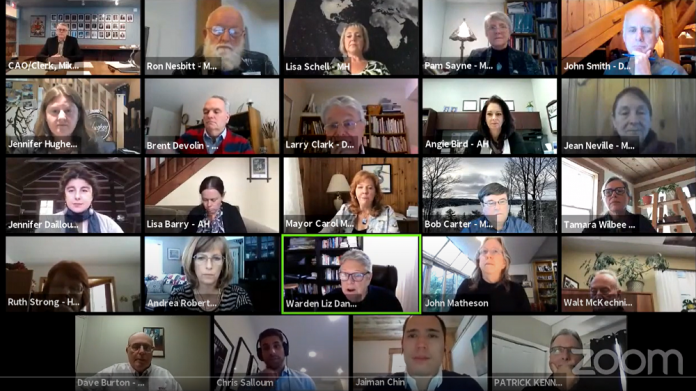
Councillors from all four townships met Nov. 25 to discuss a services delivery review. Photo by Joseph Quigley

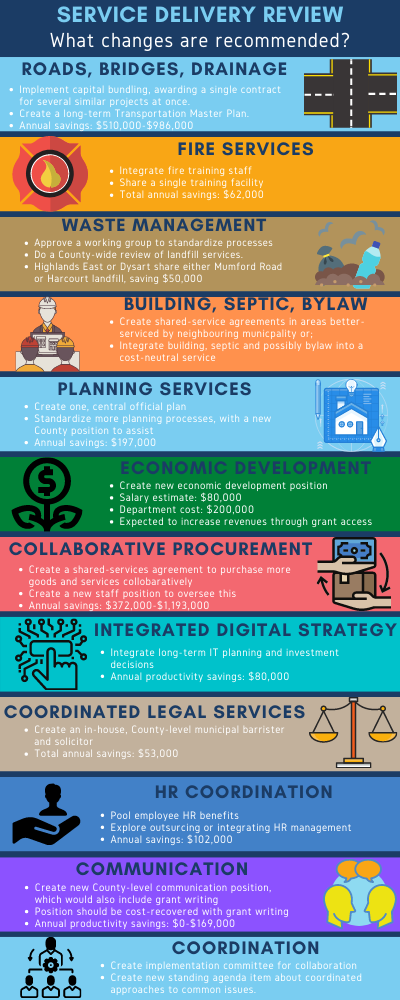
Councillors from local townships met Nov. 25 to digest a massive services delivery review with 12 recommendations for more collaboration that could save upwards of $1.18 million annually.

Toronto-based consultant, StrategyCorp., presented 12 initiatives for more intermunicipal partnerships. Their report follows months of work and more than 100 interviews/workshops with councillors and staff. The firm said between operational efficiencies, productivity gains, and $74,000 in more revenue, the implemented strategies could provide that $1.18 million.

StrategyCorp principal, John Matheson, said they did not approach the job like auditors but to work alongside staff. He said there is a clear willingness on the part of municipalities for more collaboration.

“We’re not saying we found great big problems with waste here,” Matheson said. “We’re saying we were invited to come work with the team, to try and find better ways of doing things and not surprisingly, you spend this kind of effort, that we found some.”

The recommendations do not directly address the idea of amalgamation, which was never in the terms of reference for the review. Instead, it tackles where municipalities could improve services with different levels of co-operation, including places where services could be integrated to one provider – whether the County, a special body or a lead municipality.

Matheson praised the council for being open-minded about possible improvements and being willing to do a review, as well as creating a safe space for staff to consider different ideas.

“What you’ve really done is wiped away a lot of the historical stresses that come out of the air about forced amalgamation. Where people are worried about hanging onto their right to continue providing governance for fear of being stripped away from them by a provincial government,” Matheson said. “There’s lots of different ways to achieve things to the benefit of better public administration, better value for money.”

Councillors spent four hours delving into the report and questioning each of its recommendation sections. Coun. Bob Carter of Minden Hills questioned the fire service recommendations only extending to joint training, noting common issues across the municipalities such as succession planning, increased demand and escalating costs.

“It seems to me the process for determining what was looked at was not only a quantitative process but a qualitative assessment,” Carter said.

Matheson said that is accurate, adding their recommendations focused on improvements that could achieve more for fewer or similar dollars, rather than improvements that could be more costly. He added they decided on the subjects of deeper dives after their estimate of what was most worthwhile after the first phase of the process.

“It’s not that theoretically, you couldn’t do more,” Matheson said. “We would just evaluate those opportunities as being a little less ripe in the light of the state of readiness of the organizations.”

Next steps

The review recommends implementation over several years, but divides recommendations into short, medium, and long-term. It suggests addressing some things, such as communications, economic development and collaborative procurement starting in 2021.

The review recommends the County begin implementation of other initiatives like planning, building, septic and bylaw in 2022. Warden Liz Danielsen said the review should be a standing item on the County committee of the whole. She added a special meeting should be called in January or early February to start working through it and the proposed timelines.

“We’ve got a lot to absorb and lots to talk about,” Danielsen said. “We need to start thinking about how we’re going to move forward.”

Coun. Carol Moffatt said some of the ideas in the report are not new, such as the County having an economic development position.

“To me, it seems like some of the reason why some of this collaboration isn’t already happening will be the same reasons why some of it doesn’t move ahead going forward,” she said. “We all sitting around this table today need to really, genuinely understand – that whether and how any of this moves forward depends on the will of each and all of us to conceive something for the greater good. For the benefit of the community.”

The Highlander will detail more aspects of the 138-page report in the coming weeks.

Significant changes recommended

• Roads, bridges, and drainage: Implement capital bundling, allowing contractors to secure multiple projects at once. Formalize joint planning of road maintenance.

• Fire services: Integrate fire training and explore a joint-training facility.

• Waste management: Approve a working group to standardize waste management processes across the County and/or do a Countywide review of landfills and transfer stations.

• Building, septic, bylaw: Explore either shared service agreements or integrate services.

• Planning: Create one, central official plan with secondary plans below it. Standardize more of the planning processes across the townships. Create a new County-level planning position to assist.

• Economic development: Create a new economic development staff position.

• Collaborative procurement: Approve a new staff position for the process and approve a new shared-service agreement.

• Integrated digital strategy: Integrate long-term IT planning and municipal IT investment decisions.

• Co-ordination of legal services: Hire a county-level in-house municipal barrister and solicitor and approve a shared service agreement for it.

• Human resources co-ordination: Explore the benefits of a centralizing human resource information system. Pool benefits together and create shared-service agreements for key HR functions.

• Communications: Approve a new central communications position, which would also include grant writing.

• Co-ordination: Create a new implementation committee of County council to promote effective collaboration between local municipalities.

Dysart slow on promise of change

0
Mayor Andrea Roberts speaks with Coun. John Smith at a pre-COVID meeting. File.

Change was in the air when Dysart et al’s new council was sworn-in Dec. 3, 2018.

Andrea Roberts became the municipality’s first new mayor in nearly 40 years, unseating Murray Fearrey. She was joined by three new council members: John Smith, Larry Clarke and deputy mayor Patrick Kennedy, and three incumbents. People wanted change and things to be run differently.

Two years on, the dramatic shake-up does not feel like it has necessarily manifested. Though council is setting up for a different vision of tomorrow, progress has felt slow, made worse by the pandemic.

To date, this term of council has been unable to buck the generally slow machinations of municipalities. There have not been any major things such as the Minden arena. It took the municipality one year to produce a final list of big ideas for the term: a recreation master plan, improving housing with a task force, a parks management plan, enhancing lake and shoreline health, a long-term Dysart master plan and digitizing more municipal services.

None of these are sexy, other than perhaps the intent to have a shovel-ready plan for a new recreation complex. In addition, there is nothing imminent. Though forethought is important, the list made clear the reality of this term: it was for set-up, in hopes of bringing big things in the future. A year later, in the face of a pandemic, it feels uncertain whether even these plans can come to fruition within two more years.

It is worth noting the conflict that has also been a key aspect of this council, primarily from Smith. The freshman has pushed hard for more radical, faster change and gotten a lot of pushback. Some of his ideas were intriguing, such as a more robust roads budget that has made a bit of headway. Other ideas, such as cutting funding to the museum and art gallery, have been unpopular.

Regardless, his butting heads with council, often over new ideas and slowmoving procedures, has made the progress of this council feel slow: Both because the conversation gets bogged down and because it has made it feel like this is not a table that’s open to anything dramatically new or different.

There have also been issues where the municipality has been slow to react to an obvious need for change. Short-term rentals are a pressing issue. An economic development committee seemed poised to take it on at the start of term, but council let it dissolve into nothingness. Two years on, there has been basically no progress on the file, with council only recently indicating it wants to act.

But with all that said, this council has had positive developments: the Head Lake Park master plan; the roads needs study; and the recent services review. It’s also had a good response to the pandemic. It’s been at the forefront of bringing more things online and is the only area council keeping livestreamed meetings up permanently. It’s passed noteworthy bylaws, leading the charge on fireworks limitations, and a major planning bylaw overhaul.

Despite some good, measured work, the public can be impatient. Come 2022, we will see whether voters believe in the vision this council is putting forward, or if their patience will run thin.