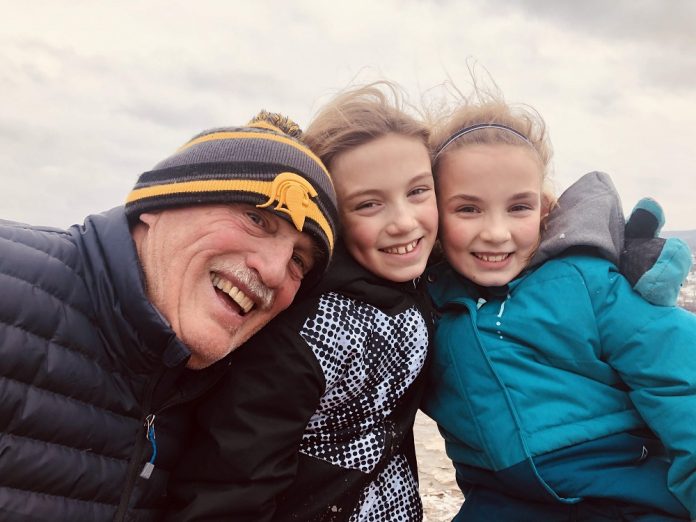
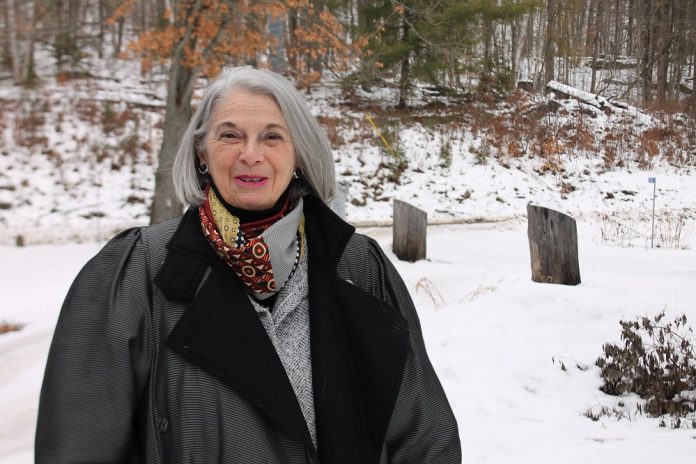
Volunteer Ron Reid with granddaughters Quinn and Avery. Reid is being remembered after his sudden passing Dec. 10. Photo submitted.
With the pandemic socially distancing and isolating people, Ron Reid set out to reconnect.
The long-time, Minden-based volunteer’s children said Reid called and emailed others throughout COVID-19. He messaged friends from across his life, even those who he had not talked to in years.
At one point, the 73-year-old could not sleep and got up at 4 a.m. to finish a letter to a former boss. That was two days before he passed suddenly due to a heart attack Dec. 10.
“He was always there for people,” Reid’s son, Simon Reid, said. “If somebody needed something, or if he saw there was a need for someone, he would always be there to volunteer and help.”
The elder Reid became a well-known figure in the community. The biologist first moved to the County for a temporary position at the Dorset Research Centre in 1976. But he would go on to spend the rest of his life in the area.
Reid’s early days in Minden came with some struggle. His farmhouse burned down – right around Christmas – just two years after he arrived. The family with two young children lost everything, but Reid’s daughter, Jody Berringer, said the community response inspired him in the years to come.
“The community just came out and gave a lot,” Berringer said. “Because of how much the community gave, I think that was a really big driver for him to continue to give back.”
He acted as a long-time chair for the Help A Village Effort (HAVE), helping them secure hundreds of thousands in grant funding. The charity helps provide clean drinking water and sanitary facilities for rural villages in India, including more than 1,200 wells since the organization was founded in 1982. Reid also volunteered and headed a variety of other causes, including the Minden Food Bank where he co-ordinated the Christmas basket program, and the Garlic Festival.
“His positive and happy attitude was really able to attract other people to want to help out,” his other son, Matt Reid, said. “He just made people feel good about helping out and that would get more people involved.”
“It wasn’t about what he could achieve. It was about what was needed and how he could help get there,” Simon Reid said.
But despite a busy volunteer life, he made time for family.
“He was always there for us,” Simon Reid said. “Playing and helping and encouraging and making us think we could do what we wanted to do, be what we wanted to be.”
Berringer described him as a passionate environmentalist, working as a research scientist for the provincial government and installing solar panels at his home. Reid also enjoyed gathering syrup from dozens of maple trees, planting gardens and farming cows and rabbits on a small scale.
“They were modern-day homesteaders,” Simon Reid said of his parents. “He always threw himself wholeheartedly into his hobbies.”
The community responded to Reid’s passing with an outpouring of support and grief. A virtual visitation was held Dec. 16, with a larger celebration of life planned once the pandemic is over.
“Basically, everybody we talked to said, ‘your dad just called me, we hadn’t talked in years, he called me up and we had a great conversation’,” Matt Reid said.
During the virtual service, the Reid children said their father’s example was one to follow.
“Dad will be forever in all our hearts, as the indomitable spirit he always was. He undoubtedly made the world a better place in so many ways, but perhaps most by being open to connection,” Simon Reid said. “Next time you think, ‘I should reach out,’ pull a Ron Reid. Just pick up the phone, jump in the car, and just show up. I’m sure you’ll make someone’s day.”
Medical students visited Haliburton in the summer of 2019 through the Rural Ontario Medical Program. The County is expanding its
doctor recruitment program. File photo.
The County is looking for ways to improve its physician recruitment program after finding some success in 2020.
Council reviewed the program Dec. 16, about a year-and-a-half since it came into being. The initiative led by recruiter, Cheryl Kennedy, saw dividends this year, with two new emergency department doctors joining Haliburton Highlands Health Services (HHHS).
But a staff report identified several gaps in the existing program – from housing to moving expenses, to the need for a better memorandum of understanding for the roles and responsibilities between the County, HHHS and the Haliburton Highlands Family Health Team.
“This program is really finding its feet now and is seeing some good success,” Coun. Carol Moffatt said. “We need to be honest and admit there’s been challenges and frustrations with the various parties … If we can really, clearly lay out who does what (and) when, so that everyone knows what their responsibility is for this program, it should smooth things out a little bit.”
Other proposed changes are expanding the recruitment efforts to include nurse practitioners and rural generalists, providing moving expenses and aiding in recruitment at out-of-County clinics if they service a significant number of County residents.
CAO Mike Rutter said a major hurdle is the lack of housing. Rutter said staff investigated purchasing a temporary residence for potential recruits but found renting to be more cost-effective, estimated at under $10,000 annually. He said staff would bring options to council in the first quarter of 2021.
“It makes sense to pursue this because it’s a constant struggle to find places. There aren’t quality places for those short-terms that come up,” Coun. Andrea Roberts said.
The report also proposes a media event for when a new physician signs a return of service agreement – a guarantee for them to work in the County for a certain number of years, which has a $25,000-per-year financial incentive.
“It’s an opportunity to celebrate the success,” Rutter said. “But also, a story, for the community to get to know new physicians that are relocating here.”
Council voted to receive the report and direct staff to incorporate changes to program documents.
“You’ve had some success and we’re fortunate to have you working for us,” Warden Liz Danielsen told Kennedy.
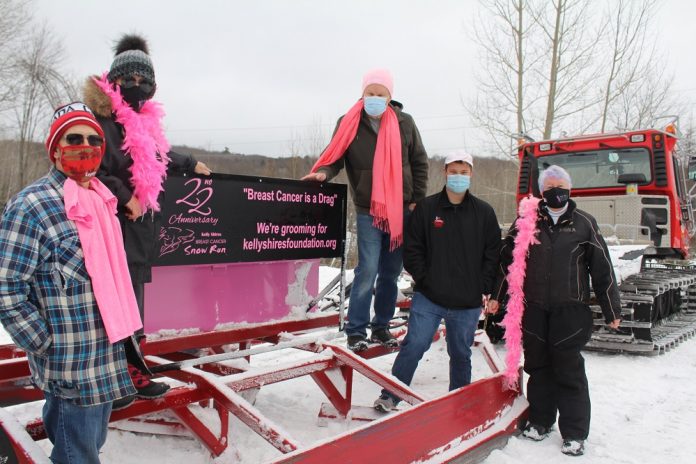
The Haliburton County Snowmobile Association is fundraising for the Kelly Shires Breast Cancer Foundation using its groomer. Left to
right: Tom Nicholson, Margo Ross, John Enright, Cole Finlay, Liz Jesseman. Photo by Joseph Quigley.
The Haliburton County Snowmobile Association (HCSA) is bringing a dash of pink to its trails with a new grooming-based fundraiser for the Kelly Shires Breast Cancer Foundation.
The HCSA is launching a new initiative to donate $1 for every hour one of its groomers is used. The machine will frequent the club’s biggest trail, the Rail Trail, with the foundation logo in tow throughout the winter.
The charity provides financial support to breast cancer patients. HCSA vice president John Enright said the donation should amount to about $500, based on historical use.
“We felt it was our time to give something back,” Enright said. “Snowmobile clubs are always sort of looking, scrounging, scraping. So, here was an opportunity that we thought up ourselves to donate to this exceptional organization.”
Charity director Suzy Stenoff said they appreciate the donation, especially given the pandemic curtailing fundraising efforts over the past year. The organization has a snowmobile focus and many clubs have done charity rides for it, but she said none have done a fundraiser like this.
“We are so thrilled to be a part of this,” Stenoff said, adding the club does a lot of work with trail maintenance over a year. “Myself, running a charity, I know how much work it is and how hard it is. So, to have this extra layer on for them, it’s spectacular they’ve been able to do this for us.”
HCSA volunteer Liz Jesseman is a breast cancer survivor who has raised money for the foundation for years. She said she knows how expenses can wrack up when receiving treatments.
“It’s just an amazing organization,” Jesseman said, adding praise for the donation. “It’s a great thing to do. For all women and snowmobilers.”
Stenoff said there is also added value in the promotional aspect of the HCSA initiative.
“Having an extra fundraiser like this benefiting our charity is very amazing and will go a long way,” she said. “Beyond that, the extra exposure, even letting people know we are here, that we are a charity.”
Enright said the HCSA plans to make this initiative a regular feature, supporting and spotlighting different small charities in the years to come. You can donate to the foundation at kellyshiresfoundation.org.
The Ontario Public Service Employees Union (OPSEU) has purchased the Frost Centre.
OPSEU/SEFPO announced
the purchase Jan. 8 and it was also confirmed by Algonquin Highlands Mayor
Carol Moffatt on her Facebook page.
In a press release,
OPSEU said it would be used as a training centre.
The union represents
170,000 front-line public sector workers.
In the press release, president Warren (Smokey) Thomas said, “this property will serve OPSEU/SEFPOs hardworking members so that they can continue to support our province, its people and its economy.”
Moffatt said on her
page that she’d spoken to Thomas and, “The revitalization
of the historic property as an educational facility will provide many
employment opportunities across a range of fields.
“President Thomas and I spoke of the many
opportunities for collaboration and partnership between the facility and the
community at large; and I look forward to helping broker some local
connections.”
Haliburton students will not return to in-person classes until Jan. 25 and will instead continue teacher-led online learning.
The province announced today that elementary students in the southern group of health units, previously scheduled to return to in-person classes Jan. 11, will not do so until Jan 25. That includes the Haliburton, Kawartha, Pine Ridge District Health Unit. This aligns with the return date for secondary school classes.
“I have and remain firmly committed to getting students back into class as soon as possible – there is nothing more important. However, the best medical and scientific experts have been clear: while schools have been safe places for kids, the sharp rise in community transmission puts that progress and Ontario families at risk,” said Minister of Education Stephen Lecce said in a press release. “During this time, students will remain engaged in live teacher-led online learning with access to enhanced mental health and technology supports.”
The province pointed to rising COVID rates amongst 12-13 year-olds. The positivity rate was approximately 5.44 per cent in late November and early December, compared to nearly 20 per cent in early January. COVID cases also continue to rise, with more than 3,500 new cases reported in the province today.
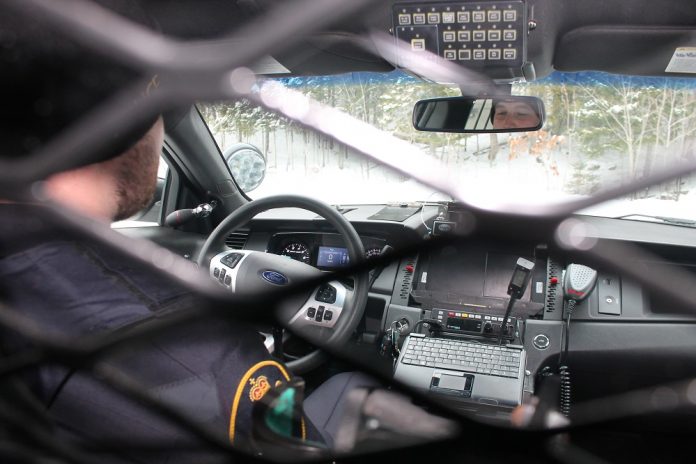
Constable Christopher Darling of the Haliburton Highlands Detachment keeps an eye out from his police cruiser. Photo by Lisa Gervais.
Minden councillor Jennifer Hughey, who used to live in Toronto, says she’s never seen anything like the drug bust she witnessed on Bobcaygeon Road the night of Nov. 12, 2020.
Hughey, who lives on the road, described the scene in a recent interview with The Highlander.
“There were three police vehicles at the end of a driveway with no lights on. One of the SUVs had a drug dog. The police marched two-by-two with the dog in the front, very covertly down the road. There was another car parked at the end of the Minden Bible Church road. They just converged on [an alleged drug house] and there was a lot of dog barking.”
Hughey said following the initial police action, which involved eight to 10 officers that she could see, police were on scene for hours and the house and adjacent garage lit up as it was searched.
“The feeling of us on the street, who have seen things going on for about two-and-a-half years, is maybe this time it’ll be done, but we don’t feel extremely confident,” Hughey said.
On that night, Haliburton Highlands and City of Kawartha Lakes drug cops executed a search warrant at the house and said they found cocaine and fentanyl. They also located cash and stolen items. They arrested and charged five Haliburton County residents as well as a suspect from Ajax and one from Toronto. The charges included possession and trafficking of drugs as well as possession of property obtained by crime. Those suspects have now begun their slow march through the court system.
The year 2020 was a busy one for drug busts in the County. Between Jan. 1 and Nov. 29, 78 people have been charged with 304 offences. By contrast, 2019 saw 23 people charged with 99 offences.
The first major bust of last year was in the wee hours of Jan. 30, 2020, when police used choppers and dogs to raid six locations in the County and GTA, seizing 400 grams of cocaine/crack cocaine, two grams of fentanyl, 13 guns and more than $12,000. They also located stolen property. Thirteen Haliburton County residents were charged at the time and three from the GTA.
Dubbed Project Imperial, the OPP said it was the culmination of a nine-month investigation into trafficking cocaine into the Haliburton area from the GTA. They said they also identified a significant property crime network directly linked to the accused.
One eye witness to a bust in Carnarvon said she was awakened before dawn to the sound of a helicopter. When she went outside to investigate, the woman said she saw a home along Highway 35, just north of the village, being swarmed by police.
The busts continued from then with major warrants executed across the County.
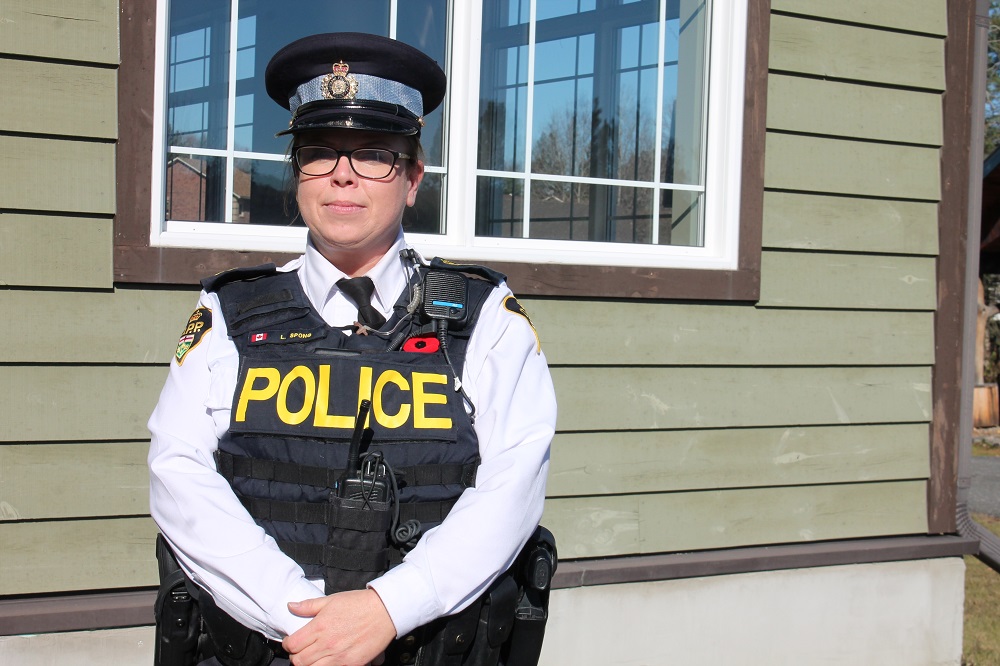
Haliburton Highlands OPP detachment commander, Liane Spong, said, “There has been an emergence of increased drug availability in Haliburton County over the recent years and to tackle that the solution required a team approach aimed at gathering intelligence and actioning projects across multijurisdictional boundaries.”
She said the community street crime units (CSCUs) that are tackling the drug trade combine the organized crime enforcement bureau, the community drug action team and the detachment-based street crime team.
“We’re actually putting a really big dent in it,” Spong said. “It’s boots-on-the-ground police work that it’s coming down to, digging out that information, spending countless hours making linkages down to the GTA in several regions.”
Based on local police statistics, the drugs of choice locally are cocaine (74 occurrences and more than 678 grams seized), followed by crack cocaine (26 instances and 704 grams). Cannabis ranks next.
The drugs are coming from the GTA with activity from Durham to the Kawartha Lakes area, Douro-Drummer, Bradford-West Gwillimbury, Essa Township and Trent Hills.
Spong said, “in the past, police agencies may not have had the same capability to work together, creating silos, however today’s advancements afford the ability to work with other police agencies across the province and beyond. And the OPP provides an integrated service delivery model whereby we work across multiple OPP detachments and OPP bureaus in developing coordinated approaches to investigations as crime knows no borders yet can have profound local impacts if not addressed in such a way. So, our local CSCU team taps into expertise across the province and works hard to pull it all together.
“Even our local members are involved in search warrants and seizures. Not just in Haliburton County, but other areas on joint projects and from there we have been executing search warrants, making huge seizures, and where the dent starts to happen, it’s hitting the distribution source much higher up in the chain.”
Police activity summary
Item
2020
2019
Occurrences
28
31
Warrants
11
18
Warrant Services
5
2
Persons Charged
78
23
Charges
304
99
Seized drug summary
Drug type
2020 Occurrences
2020 Quantity
2019 Occurrences
2019 Quantity
Amphetamine/salts/derivates/isomers/analogues
1
Cannabis (Marihuana)
24
19g; 6264 items
6
3303g
Cannabis (plants)
20
2409 items
1
9 items
Cannabis resin (hash)
1
Cocaine
74
678.17g
34
147.35g
Crack cocaine
26
704g
1
0.50g
Fentanyl
8
8
31.80g; 1 item
Hydromorphone
15
5
Methamphetamine (Crystal Meth)
4
7
512.30g
Other
14
4
42 items
Oxycodone (Percodan)
1
1 item
4
4 items
Psilocybin (mushrooms)
2
2
Totals:
191
1401.17g, 8674 items
73
3994.95, 56 items
Drugs and property crime
There is also a strong correlation between drugs and theft. Nearly every major bust finds not just drugs but stolen goods. People are stealing to sell items for drug money, or swapping stolen items for drugs.
Spong said, “They [police] do a lot of work where they are focusing on the local drug activity and related property crime and from there trying to link the distribution chain back to the source and it’s working really well.”
She added that in every investigation, they learn a little bit more about who is involved, the supply routes and distribution chains.
“Our team is incredibly busy having to connect all the dots across the County and the GTA.”
The detachment commander vows there will be more to come.
“Haliburton County is on the map. I think the messaging is loud and clear. If you’re going to engage in that type of illicit activity in the County it’s going to be found out and we’re going to take significant action to curb that.”
Spong emphasized the OPP are not alone in the war on drugs. She says justice and enforcement is just one pillar in the Haliburton, Kawartha Lakes, Northumberland Drug Strategy. The others are harm reduction, prevention and education and treatment.
“It is complex. It is deep-seated. We know it’s related to so many more things than just local people using. It has that deeper sense of being linked to overall social determinants of local health, there’s poverty, addictions, mental health. It goes across so many different facets and organizations. All these other areas play a role.”
Haliburton Highlands Detachment Commander Liane Spong. Photo by Lisa Gervais
Major OPP drug activity in 2020
• Nov. 12, 2020 – Bobcaygeon Road, Minden Hills. Five Haliburton County residents charged with possession for the purpose of trafficking cocaine and fentanyl.
• June 30, 2020 – motor vehicle stop. Three Haliburton County residents allegedly found to be in possession of cocaine and fentanyl. One was further charged with possession of proceeds of property obtained by crime.
• May 28, 2020 – Mountain Street, Dysart. Police seized more than eight ounces of cocaine and more than $7,000 in Canadian currency. Three County residents charged with possession for the purpose of trafficking cocaine. Two of them were the same people charged in a May 13 raid.
• May 13, 2020 – Mountain Street, Dysart. Four Haliburton County residents charged with trafficking cocaine.
• April 9, 2020 – Hutchings Road, Dysart. Police seized several ounces of cocaine, valued at $23,000, a small quantity of crystal meth, and $7,100 in Canadian currency. They also took four restricted firearms, and one prohibited firearm, a stolen side-by-side UTV valued at $5,500. Four County residents charged with various offences.
• Jan. 30, 2020 – Project Imperial – a nine-month investigation into trafficking cocaine into the Haliburton area from the GTA. Also identifying a significant property crime network directly linked to the accused. Police recovered stolen property taken from residential and commercial properties in the County. Major bust with helicopter and dogs. Seized 400 grams of cocaine/crack cocaine, two grams of fentanyl, 13 weapons and more than $12,000 in cash. Stolen property, including generators, power tools and solar panels. Thirteen County residents charged.
Former Algonquin Highlands resident, Carol Kilby, says it’s taken her almost a decade to write the book she’s titled Evolutionary Dancer. Out, In, and on the fringe of the Church. However, she jokes, “some might suggest, it’s taken 13.8 billion years to write.”
The reference is to the story of the Universe, which Kilby shared with visitors to the Gaia Centre for Eco-Spirituality and Sustainable Work when she and partner, Paul Irwin, lived there for 16 years. They had a labyrinth set up in the woods on the property with stations marking key moments in the universe story, from the Big Bang to present day.
Kilby and Irwin moved to Algonquin Highlands in 2004 after retiring from ministry in the United Church of Canada. In 2015, the United Nations Year of Sustainability, they opened the Gaia Centre.
The non-profit charitable organization hosted workshops, retreats, and events bringing teachers to the County.
Retiring again, the couple moved to Scarborough in May, 2020.
Kilby said the genesis of the book came from when she was invited to take part-time leadership at Kinmount United Church.
“I took the teachings from the new science and earth-based spirituality with me. The open-minded congregation and I entered into an experiment in evolutionary spirituality. We looked for daily wisdom relevant to the climate crisis, in not just one holy book, but two, the second being creation itself.
“We tackled unusual topics such as, “will we evolve for shifting times?” and “I spy with my evolutionary eye” and “becoming evolutionary elders for adventurous churches,” Kilby said.
She said the response to these gatherings was so rich, she’d go home and write them down.
“We were discovering how the old sacred story of the Hebrew-Christian Bible and the new sacred story of the Universe from modern science made for powerful dance partners. But more than being compatible, they were stronger and more relevant for our times together than apart. That was the discovery that became the book.”
She said readers can expect lots of stories.
“In the first section, stories of the teachers, artists, mystics, shamans, yogis, and others whose strange ideas challenged the beliefs, ideas, and assumptions that I’d learned in what has been basically a Christian culture, up to now.”
She added there are original stories from Grandmother Universe, her inner storyteller. Kilby said she emerged, much to her surprise, as she led folks through the woodland cosmic labyrinth at Gaia Centre telling the story of the Universe – its origins, evolutions, and becoming conscious in the human ones.
In the second section, the stories come from the Sunday conversations in Kinmount. She said there are discoveries about bible stories and “readers will see that the environmental crisis is driving not only the evolution of consciousness but the evolution of religion and the emergence of a new kind of human – one who lives in mutual relationship with Mother Earth.”
In the last section, she said readers will find samples of inter-spiritual evolutionary rituals they used.
“And many will be surprised they can be used whatever one’s path – be it out, in, or on the fringe of the church.”
Kilby anticipates the digital version will be available at Amazon.ca in late December and the print book sometime in January 2021.
In late 2015, a public health nurse told Dysart et al councillors there was a serious drug problem in the County.
She told them people who use drugs were shooting up in and around Head Lake Park and disposing of their needles in garbage bins, putting municipal staff and the general public at risk.
Shortly after her delegation, two drug needle boxes were installed in Haliburton village, so those using fentanyl, heroin and cocaine intravenously had a place to properly get rid of contaminated needles.
Our County also learned in 2016 that we had the second highest use of doctorprescribed opioids in the province.
In response, the local health unit and several other agencies joined forces as The Haliburton, Kawartha Lakes, Northumberland Drug Strategy, to develop a way to combat the misuse of opioids.
They operate on a four-pillar approach: harm reduction, prevention and education, treatment and justice and enforcement.
Has the drug strategy been successful?
The Ontario Addiction Treatment Centre on Highland Street in Haliburton has more than 50 patients being treated for opioid addictions with substitution drugs such as methadone and suboxone. There’s a needle exchange program and the drug needle boxes. Police can now administer naloxone for overdoses.
The new Youth Wellness Hub hopes to encourage young people to steer clear of drugs.
There are treatment options, although we are told there is never enough money or staff and we are hampered because we are rural and remote and people face long waiting lists for local and out-of-town treatment options.
From what we have found out, the local OPP are doing a good job of cracking down on an increasingly sophisticated drug trade but the courts are slow to prosecute with COVID-19 adding to already existing backlogs.
In other words, there have been some gains but there is more work to be done.
Also worrying is a more organized and sophisticated illicit drug ring that is operating between the GTA and Haliburton County involving not just drugs but property crime.
Some will say there has always been drug use in Haliburton County and we are no different than other counties our size across the province and country. That might be true but is simply not good enough. We should expect more of ourselves.
Drug usage is a complex and deep-seated problem. As a community, we have to move beyond judgement of users. We have to ask ourselves why this is happening, and seemingly, increasing. Rather than building a multi-milliondollar treatment centre, as one local family doctor suggests, perhaps we need a community where people can have decent paying jobs, affordable housing, and public transportation to help break cycles of isolation, poverty, despondency and addiction.
But, at the same time, how do we convince a well-off professional in the community who has used cocaine for years to stop?
It’s not a pretty issue. We wouldn’t want a drug problem to get in the way of promoting Haliburton County as both a tourist destination or a place to move during a global pandemic or as an alternative to the GTA.
However, if it takes a village to raise a child, it certainly takes a community to tackle a drug problem. The first step, as always, is admitting that we have a problem.
The Highlander has been looking into the drug problem in the County over the past year and today launches a Highlander Investigates series on the front page.
The ILR Control School has shared the Minden fairgrounds.
The owners of the car control school held at the Minden fairgrounds and community centre every winter have asked the municipal emergency control group to rethink its decision to not allow them to operate this year due to COVID-19 closures.
President and chief instructor, Ian Law, made a delegation to the Dec. 17 Minden council meeting.
He said while they understand the decision was based over safety concerns during the pandemic, “we believe the (control group) was not in full understanding of our concern for public safety and the safety protocols we have in place to minimize transmission.”
He added he was not sure they know exactly what the school does.
He said the bulk of their work is training drivers to be safer on winter roads. The course includes classroom sessions and skills building driving exercises to help students understand techniques in how to control or regain control of their vehicles in limited traction conditions.
He added the majority of their clients come from government agencies, including Health Canada and the Haliburton, Kawartha, Pine Ridge District Health Unit.
“This winter, York Regional Police had requested dates to train some of their officers at our winter driving course,” he said.
Law said they take their COVID safety protocols seriously and have run their car control courses in the GTA with strict protocols in place. He said they have reduced the number of participants to ensure social distancing in the classroom. Everyone must wear masks at all times and sanitization stations are set up and utilized often. They have hired a dedicated COVID coordinator whose sole job is to ensure everyone complies with the protocols. He added that vehicle windows must remain open at all times and they have the option of running the exercises with the instructor outside of the vehicle.
In Minden, he said, they can run courses with no direct local contacts at all.
Mayor Brent Devolin, who sits on the emergency control group with DeputyMayor Lisa Schell and some senior staff, said he knows what the school does and its COVID protocols.
However, he said with construction at the community centre and now COVID, no one has been able to use the community centre. He added the emergency control group is keeping an eye on lockdowns continuing in parts of the province, which is why they have stuck to their decision.
“But that doesn’t mean the dialogue can’t continue, that elements of this can’t be further discussed. And as circumstances change in the province, and with respect to our municipal facility, this doesn’t mean that all is lost for a season,” he said.
Devolin added he would love circumstances to change so they can open the facility in January or February. He said they also can’t pick and choose who gets to use facilities. “It’s like picking your favourite child. We can’t make decisions on one without respect for the others.
“I think that the decision that we’ve made for the moment holds.”
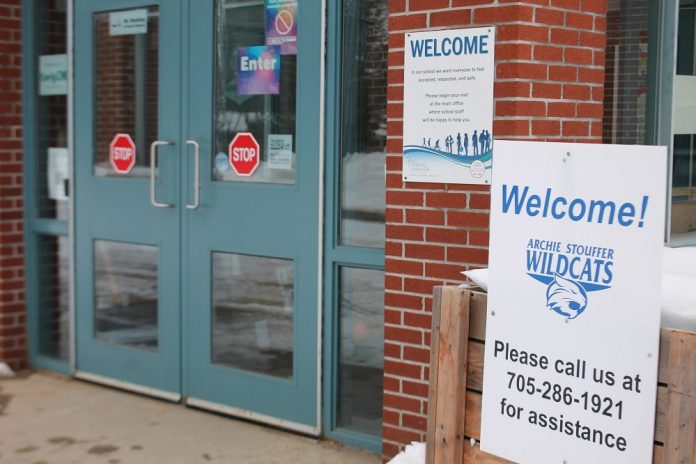
Archie Stouffer Elementary School in Minden remains shuttered after the holiday break. Photo by Lisa Gervais.
By Kirk Winter
Premier Doug Ford’s announcement of temporary closures of all publicly-funded schools in Ontario beginning January 4, 2021 has raised the ire of Ontario’s three largest teacher federations.
The Ontario English Catholic Teachers Association (OECTA), the Elementary Teachers Federation of Ontario (ETFO) and the Ontario Secondary School Teachers Federation (OSSTF) bemoaned what they considered to be a lack of consultation regarding the closings, a poorly thought-out return of elementary students to in-person learning while the province is still locked down and a lack of detail and inherent inequalities regarding virtual learning.
On December 21, Ford and Education Minister Stephen Lecce temporarily closed schools beginning January 4, 2021 with all students at all grades transitioning to virtual learning. Elementary students are scheduled to return to in-person learning on January 11, while secondary students will not return to brick-and-mortar schools until January 25.
In an open letter to parents Jan. 3, Lecce said schools are safe and COVID cases in them are minimal. “We will continue and enhance testing in schools … we will do whatever it takes to ensure our kids can continue to learn.” The province hopes that this closure will help mitigate the spread of COVID-19 which is currently spiralling ever higher, particularly in southern Ontario.
Liz Stuart, president of OECTA, which represents Catholic elementary teachers, believes the decisions to close schools “is long overdue.”
However, Stuart wonders where the consultation was between the province and the education workers in the lead-up to this decision being made.
“The province should have been engaging the education community in this decision,” Stuart said, “and there has instead been no prior consultation and few details of what this closure is going to look like.”
Sam Hammond, president of ETFO, which represents all public elementary teachers in Haliburton, was baffled by the provincial decision to bring elementary school students back to school on January 11, while secondary students are being asked to stay home until January 25.
“The plan to reopen elementary schools in the midst of a province-wide lockdown doesn’t make sense. These new provincial restrictions will not be effective unless every possible action is taken to prevent COVID19 transmission in elementary schools when they reopen. It’s time to do what is urgently needed, not what is politically convenient,” Hammond said.
Hammond agrees with Stuart that the lack of planning by the province for this closure is unfortunate.
“Had this government made its decision earlier, boards, educators, families and students could have been better prepared for the transition back to virtual learning beginning January,” Hammond said.
Harvey Bischoff, President of OSSTF, which represents all public high school teachers in Haliburton, added his voice to the other leaders who criticized the lack of consultation.
“Once again, despite this announcement’s significant impact on Ontario’s publicly funded school system, there was no prior consultation with organizations representing frontline educators,” Bischoff said. “This will lead to unnecessary flaws in implementation that could have been addressed in advance, and could have led to better decisions made in the best interests of Ontario students.”
Bischoff also reminded Ontarians of the inherent inequalities Hammond noted regarding virtual education. “Sadly, the government has not adequately mitigated the fact that many students and families do not have access to the technology or reliable internet connections that would allow access to online learning. This demonstrates a clear failure on the part of the Ford government to address the inequities created by relying solely upon online learning solutions for students.