Home Blog Page 347

Citizen calls out long-term Dysart oil spill

0
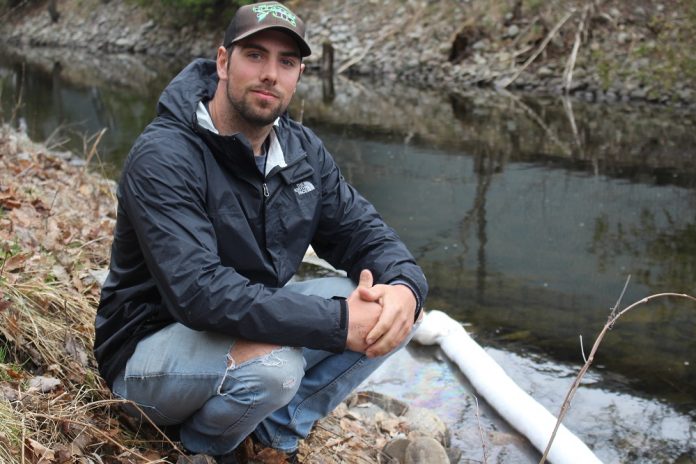
Brian Johnston sits next to an absorbent boom placed to deal with an oil seepage on the Drag River. Photo by Joseph Quigley

Brian Johnston said the sight of oil spilling into a Drag River stream where Walleye spawn is “sickening.” The avid fisher called out the decades-long problem in a viral Facebook post March 30.

Johnston said a small stream of oil, the result of an old gas station near the locale, has continually poured into the river since the 1980s. The post had been shared more than 120 times as of April 12.

Johnston said he was glad to bring the problem to light.

“It’s kind of embarrassing it’s not been cleaned up,” Johnston said. “How many times does this have to happen before this gets fixed?”

Ministry of Environment, Conservation and Parks district engineer Kelly Andreoli said the leak is coming from an underground storage tank of fuel oil, which she said the province confirmed in a 2012 drilling program. She said the oil was initially sporadic but is appearing more frequently in recent years due to fluctuations in groundwater.

Andreoli said the province plans to remove the buried oil tank and install a barrier along the shoreline to prevent any residual contamination.

She said a work plan and site investigation are likely to begin this spring.

“The Ministry of the Environment, Conservation and Parks takes all spills and threats to the environment very seriously,” Andreoli said. “The ministry anticipates that implementation of the various stages of the remediation project will require approximately five years.”

Andreoli said although there may be some localized impacts from the seepage, the environmental impact appears to be minimal. But Johnston said it is still important to get the spill fixed. He noted how area municipalities have prioritized waterway protection with laws such as septic tanks being set back from shorelines.

“It’s just as bad as littering. If I went to your property and spilled a bunch of diesel fuel on your property, how would you feel about it?” Johnston said. “A waterway is public property.”

Johnston said there is difficulty determining who bears responsibility for the underground tank, but the solution is likely to come from taxpayer dollars.

Dysart et al Mayor Andrea Roberts said the ministry cleaned the area in the past, but she does not have further information on the spill. Andreoli said the township has assisted by maintaining absorbent booms in the area to help mitigate the seepage.

Johnston said he was not out to point fingers at the municipality but would like it addressed. He noted how the section of the river can teem with Walleye at this time of year. He said the absorbent boom is not enough and more needs to be done.

“As long as we are aware and spread awareness of the issue, hopefully, the faster this will be dealt with,” he said.

Residents peck at bylaw blocking backyard chickens

0

Matt and Alex McWilliams hope Minden Hills council doesn’t chicken out on their request to have a long-standing township bylaw revisited to allow them to have backyard chickens in their residentiallyzoned neighbourhood.

The McWilliams made a virtual presentation to the April 8 council meeting.

Matt McWilliams said they grow food, tap Maple trees, pick apples and have backyard chickens – all deemed in contravention of a 15-year-old bylaw that says farming must not occur on land designated residential.

He said the delegation wanted to clarify wording in the bylaw on what exactly constitutes farm land use.

He added he had more than 50 signatures of households in his neighbourhood overwhelmingly supporting the idea.

“What we wanted to address is that according to the zoning bylaw 06-10, farm use is not permitted in a residential zone. We’re in a residential zone but the definition of a farm is land used for the growing of crops, nursery or horticultural, raising of livestock, agri-forestry or maple syrup production.”

He said they had received a complaint that their land was being used as a farm due to their homesteading on their acre.

“In the trend of green and climate action, why wouldn’t the township be encouraging the growing of backyard food production, including and not limited to eggs from chickens, rather than discouraging food security in the wake of a pandemic?” he asked. He noted Ontario farmers have forecast upcoming food shortages that will hit later this year due to COVID.

In a time of environmental pressures and food insecurity, the McWilliams think residential zones shouldn’t have such high restrictions. They noted that Harvest Haliburton had identified the benefits of having backyard chickens for improving food security, environmental and health benefits and social well-being.

Alex McWilliams said reasons given against backyard chickens in residential areas include attracting predators. However, “there is zero evidence of this potential claim.” She said they had bears and foxes long before fencing the yard and introducing hens. Nor is there a smell, she added.

Dysart et al allows backyard chickens and Algonquin Highlands is looking into it, they said. Metropolitan areas such as Kingston, Kitchener, Montreal, Toronto, and Vancouver have also recognized the benefit of this type of land use, noted the McWilliams. Matt McWiliams said it becomes an issue of discrimination.

“At the end of the day, we are two of thousands of up and comers that townships like Minden will be seeing trickle in more and more as the months progress. For people moving this far, urban farming is one of the biggest draws to such a quaint rural community. We hope we’re not forced out due to the unwillingness of recognizing the ever-changing landscape of the economy and food security rights. We hope the bylaw would be changed to allow growing of horticultural crops, agriforest, maple sap production and backyard chickens to be allowed in residential zones.”

Coun. Jean Neville, a self-described “poultry fancier,” said she had been fighting for changes during her entire time on council.

She said one of the issues cited is chickens spreading viruses to humans. “I have not yet known anybody to have caught a disease or died from a chicken.”

She added chickens, hens and the raising of chicks has proven to contribute to social well-being and decreasing anxiety during COVID. “They are the best mental therapy ever.” She added she lives in a residential area and people tap their Maple trees for home use.

Coun. Bob Carter said he was on the planning committee before becoming a councillor when the issue was put up for review, so it had been extensively reviewed in those 15 years. At the time, he said it was decided not to proceed.

“I don’t think we should just make changes because – even though it seems like the right thing to do – all changes have consequences so we should at least review the research that was done.”

Coun. Pam Sayne said she recalled the main reason a change was not made during the review was based on Ontario Ministry of Agriculture, Food and Rural Affairs (OMAFRA) input, and concern about viruses being spread to large chicken operations. She said she agreed with the McWilliams’ direction and politics, but wanted to check with OMAFRA.

Mayor Brent Devolin said the issue would be discussed along with other bylaws needing possible updating before the end of this term of council.

Family comes to terms with dog attack

0

Sadie Lester is just like any other seven-year-old Haliburton County kid, enjoying jumping on her trampoline during Spring break.

The bespectacled girl with the long blonde hair pulled pack into a ponytail briefly joins a Zoom call to say “Hi,” adding she likes going to Stuart Baker Elementary School in Haliburton with her friends, rather than virtual learning. She then runs off to play.

It’s a far cry from a year ago when she was at Sick Kids Hospital in Toronto following a vicious dog attack.

Her mom, Lindsay, also suffered non-life-threatening injuries on that fateful April 12, 2020 day. The events of a year ago have naturally affected Sadie’s father and Lindsay’s husband, AJ, as well as elder child, Addison.

“I would say that this past year, there’s been ebbs and flows,” Lindsay said in an interview. “There’s certain times when we felt like it’s been years since it happened and other weeks it just felt like it happened the day prior.”

An anniversary date is a natural trigger. Lindsay says the smell of spring brings it back. On Easter Sunday, she and Addison were out for a walk and got cornered by an off-leash dog on a public dock. That brought it back, too. Lindsay admitted to an hour in bed crying in the aftermath of that. However, overall, she said the family “is definitely in a good place.”

Physically, Lindsay has long since healed. Sadie has had several trips to Sick Kids for follow-up treatment after a week-long stay last year. There has also been physiotherapy, speech therapy and scar therapy. However, Sadie has just one more major procedure remaining.

God ‘never left us in the ditch for a second’

The Lesters said surgeons will take fat tissue from her buttocks to help rebuild her right thigh. They will also do something called revision, to lessen the scarring in 14 places on the young girl’s body, including her face. Then she’ll need laser therapy. It’s hoped the revision will make a 75 per cent improvement to the visual scarring.

AJ said his daughter is self-conscious about her scars. Tucking her into bed at night, he said she’s commented, “I wish I didn’t have these scars. She calls them the cracks on her face.”

Lindsay added that in some ways having to wear a mask due to COVID has helped ease Sadie back into normalcy.

Mentally, the work continues as well. Lindsay has had counselling and said she has tools in her toolbox to talk herself through her triggers.

Sadie has also been under the care of a child trauma counsellor, who is pleased with her progress. Lindsay explained kids like Sadie are “puddle jumpers” so they will talk about their trauma and then quickly move on to something else. That’s normal. It’s when children aren’t talking about it that counsellors are more concerned.

The family said they also want the public to know that dogs running off leash in public places are not helpful to them, or others that have experienced dog bites or similar trauma.

“We want to remind people of the importance of keeping their dogs on leashes in public places … especially the park in town as numerous times when we’ve been there with Sadie, people have let their dogs run free,” Lindsay said.

Throughout it all, AJ and Lindsay said they have been blessed with solid people in their lives, from family, to friends, to complete strangers who donated towards a $40,000-plus GoFundMe which has helped immensely with the medical expenses.

Both said they would like to thank each and every person in the Highlands who either donated money or sent cards or presents or helped welcome Sadie home April 17, 2020 upon release from hospital.

They also couldn’t say enough about Addison, from the time Sadie came home from hospital to today.

“She was great. She was an amazing older sister. She was a champ,” AJ says.

A test of faith

The Christian family admitted the ordeal has been a test of their faith.

Lindsay said, “AJ and I had to ask ourselves this question, are we going to judge God by the circumstance or are we going to judge the circumstance in light of who God says he is? Because it’s great to say God is this wonderful, loving God and then all of a sudden, your kid gets ripped apart by dogs. It’s natural to question is he really good, is he really loving?”

“I have two truths that exist,” she added. “The mother in me, if we were to rewind and he were to say, ‘this is what Sunday’s going to look like,’ no earthly mother could ever say ‘okay.’ But now being able to have experienced how he’s revealed himself through this, and that he is trustworthy and he is kind and he is gracious and never left us in the ditch for a second, I would say that I am at peace with what has happened because of the gains that we’ve experienced from God showing us who he is really is.”

AJ adds he has learned that bad things happen to good people.

“At the end of the day, you realize there is going to be purpose to all this stuff. And if you can’t bring some kind of hope through the situations you go through, then it will probably just make you a bitter person. And I could sense that very strongly and so I thought, you know, I have the tools from going to church for years. I know all the things I’m supposed to do.”

AJ said there are still ebb and flow days for him as well, and days when he is frustrated and angry.

“Our life has changed in the past 12 months. These things happen because we live in a world that isn’t perfect and it’s not meant to be perfect. If it was, then bad things wouldn’t happen. But if you allow him, he can take those bad things and bring good to it and that’s where we’re at.”

AJ said since last year, there have been more good days than bad ones and there has been progressive healing.

One thing AJ said on Facebook last year at this time was that when it was all over, the family wanted to take Sadie to Disneyland. He said a vacation remains on the cards, post-COVID.

Lindsay added, “I’m going to be a puddle when she’s there riding on the rides. I’ll be doing the ugly cry. It’s going to be just horrific to look at.”

But that’s the kind of horrific image this Haliburton County family can live with.

Historic building becomes modern art studio

0
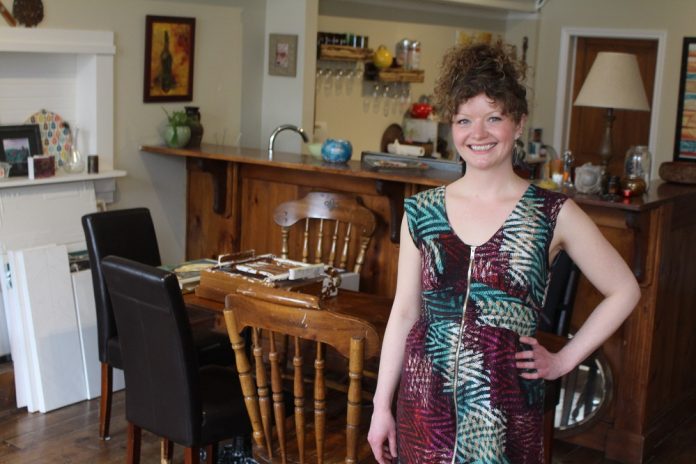
Artist Tiffany Howe is hosting an online open studio event April 17-18 at her new locale inside the former site of the Heritage House Café. Photo by Joseph Quigley.

Multidisciplinary artist Tiffany Howe said it is hard to visualize how her latest studio space was once the general store she would visit regularly as a kid.

The long-time local artist recently moved from her Redstone Lake studio into the former site of the Heritage House Café on Pine Street in Haliburton. The locale has undergone many transformations over the years – once one of Haliburton’s first general stores, before turning into different iterations of shops and cafes before Howe moved in. Now, it is her art studio. Howe, also a curator at the Ethel Curry Gallery, said she knew the house as both a store and café.

Now, she is ready to give the public limited access to the structure again through workshops and an online open studio event she is planning April 17-18.

“I feel really, really fortunate,” Howe said. “It’s a strange sort of serendipitous thing. Now, I end up getting to live here and getting to create here all the time. It’s just been part of my life since birth.”

The building has plenty of history behind it, with a store dating back to at least 1881, according to Haliburton Museum curator Kate Butler. It was owned by lumbermen and managed by Frederick Freeman, who took over the premises. It would eventually become Banks’ General Store, operated by Don and Jacquie Banks from 1978-1995, which is how Howe remembers it as a child living nearby.

“It’s really hard to visualize it,” Howe said. “Thinking about being this tiny kid, wandering up and down the aisles. It’s really hard to even picture it.”

Howe also said she knew it as the Wild Oak Café, featuring a stage with open mic nights. The stage area still exists, though is now part of her living room. But she said she hopes to bring the public in once again.

“I just feel like I really need to take advantage of how accessible this space is,” Howe said. “I also know that because so many other people have a lot of personal history in this space, they’re going to be curious about what’s going on here now.”

Howe has filled the walls with art and said she uses much of the space to create, making project such as mixed media paintings with recycled materials. Beyond the studio event, Howe said she plans to host art events and workshops in the future.

“I’d like to do life drawing sessions,” Howe said. “And art discussion and critiques. I know that’s another thing that people in the arts community have been asking for.”

The April 17-18 online open house will feature work from herself and artists Noelia Marziali, Andrew Laughlin Brown, Talitha-Litha Marie and Jennifer Seward, with everything available for sale. It will use photos and video with curbside pick-up.

“It was an essential hub of the community, especially back in the early 1900s,” Howe said. “Its importance to the community, has kind of waxed and waned, but it’s a landmark.”

Summer camps uncertain about season

0
Summer camps such as Hockey Haven are awaiting confirmation on what programming they can make available this year. File photo.

Local camps are preparing and hoping to offer more programming this summer but await word from the province about what will be allowed.

The Ontario Camps Association (OCA) submitted a plan to the province to reopen camps, including overnight ones shuttered in 2020 due to the pandemic. The proposal asks for testing support for anyone entering camps and introduces protocols to reduce traffic flow in and out.

Hockey Haven owner, Troy Binnie, said he is exploring procuring rapid testing for his facility. Registration is open for his programs, but he said he is not taking any money until there is more assurance.

“We’re planning for regular summer – or as close to regular as we’re going to get,” Binnie said. “Kids need it. I think they’ve struggled for the last year trying to get through this (pandemic).”

The province scuttled overnight programs last year, allowing only day programs to go ahead. Camps such as Haliburton’s Medeba cancelled day programs as well due to logistics.

OCA COVID task force member, Thomas Appleyard, said demand is high this year. He added day camps – as well as overnight ones in other jurisdictions – ran with success.

“We understand that it’s not definite. That there are risks involved, We’re very optimistic though,” Appleyard said.

Camexicanus co-founder, Greg Sadlier, ran a day camp last year and said they are planning for a “best-case” scenario with contingencies. Sadlier said they learned a lot going through it last year and children should be even more accustomed to behaving under health protocols.

“We’ve noticed our kids are adaptable,” Sadlier said. “Being able to be outdoors, we really are able to do a lot of our programming.”

But COVID cases are rising again are across the province. Day camps are closed for the next month as part of the provincial shutdown, though summer restrictions have yet to be decided.

Appleyard said beyond testing for anyone entering camp, the OCA hopes to limit transmission through cleanliness protocols and limiting campers to smaller groups. It is providing information and training to its members about best practices.

Losing another summer would hurt, Appleyard said, with his members unable to adapt with curbside service such as other sectors.

“There’s no question it would be a very serious financial consequence,” Appleyard said. “It would certainly jeopardize the future of the industry in Ontario.”

Binnie said he would be prepared to run at a lower capacity or just do day camp programming.

“We’ll continue to wait it out, but it’s obviously going to be tough,” Binnie said. “Going to be tough on a lot of camps and some of them may not be back.”

“We just really want to encourage families to engage as they feel safe and comfortable,” Sadlier said. “Engage with organizations that are working hard to offer positive experiences for their kids.”

Bobcaygeon finalist for Kraft Hockeyville

0

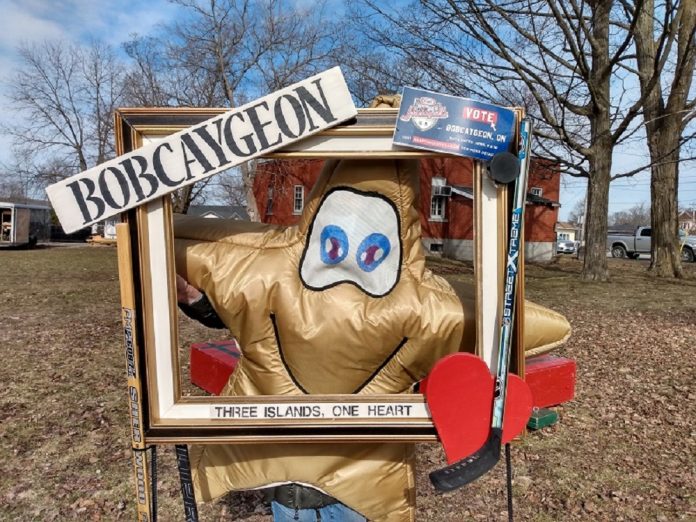
The Haliburton County community, as well as the City of Kawartha Lakes, is rallying for Bobcaygeon as it’s made the top four in this year’s Kraft Hockeyville competition.

Bobcaygeon is the only arena representing Ontario. Its competitors are in Saskatchewan, Manitoba and New Brunswick.

To help break down the barriers to community hockey and improve local arenas, Kraft Heinz, in partnership with the National Hockey League (NHL) and the National Hockey League Players’ Association (NHLPA), is awarding one community the grand prize of hosting an NHL pre-season game in their local arena, $250,000 for arena upgrades and the coveted title of Kraft Hockeyville Canada 2021.

As a finalist, Bobcaygeon is already guaranteed $25,000 in arena upgrades and $10,000 in new hockey equipment from the NHLPA Goals & Dreams Fund for deserving youth in the community.

City of Kawartha Lakes Coun. Kathleen Seymour-Fagan said, “Bobcaygeon is passionate about hockey and our local arena brings us together as fans, friends, family and ultimately as a community.

“To keep the game alive in our community, the arena needs accessibility upgrades to ensure that all players, regardless of age, gender or ability, are able to access the facility. Winning Kraft Hockeyville 2021 is a shot at opening the doors to new generations of hockey players and fans,” Seymour-Fagan said.

Local resident Mike Mudie nominated Bobcaygeon and Ann Adare has been instrumental in rallying the community to get to the final four.

“Our community is known for its heart. Even our slogan, ‘Three Islands, One Heart’ speaks to how we come together,” Adare said.

She added that in the early days of the COVID-19 pandemic, Bobcaygeon was hit hard with a devastating outbreak and the death of 28 residents at Pinecrest Nursing Home.

She said lockdowns have also meant businesses were shuttered, dealing a particularly difficult blow to a town relying on summer tourism.

Adare said Kawartha Lakes raised $190,000 that has gone back into the community to help support Bobcaygeon and area patients, families and health care workers in need of food, supplies, transportation and mental wellness counselling.

“This effort has left our community tapped out. There are no funds left to upgrade our arena which is now closed and facing an uncertain future. I’m glad this time we can come together for a happier purpose.

A Hockeyville win would ensure that the arena can reopen and upgrades would ensure that our arena can welcome everyone,” Adare said.

The existing arena was built in 1955 by volunteers after the community fundraised $100.000.

How to get involved

Register and vote for Bobcaygeon at krafthockeyville.ca. Voting opens April 9 at 9 a.m. and closes on April 10 at 5 p.m. The community that receives the most votes during the voting phase will be declared the grand prize winner. Voting is unlimited.

Change blows through Haliburton Solar and Wind

0


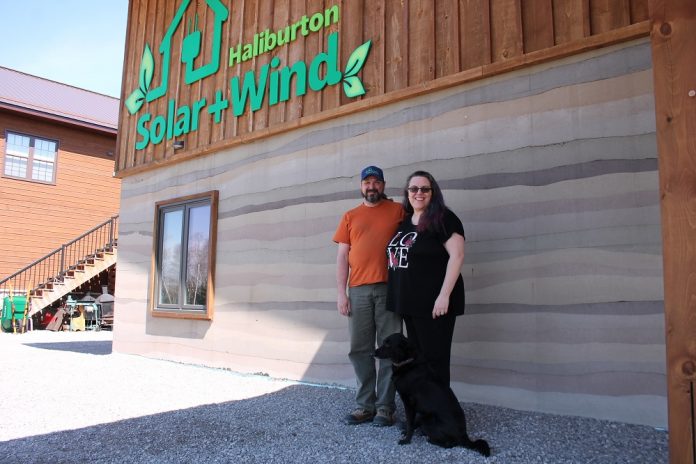
Haliburton Solar and Wind (HSW) founder, Brian Nash, has sold the business to two long-time employees.

The company announced the news in a media release March 30.

The new owners are the husband-and-wife team of Joel Ideson and Carolina Barberi.

Ideson is a master electrician who specializes in creating off-grid solutions for residential and industrial applications. Barberi will be the day-to-day operations manager.

Nash is remaining with the company in a consultant role for system design and sales.

“The Haliburton Solar and Wind brand is very strong,” Nash said. “The opportunities are significant. The new owners have all the capabilities to take the business to the next level.”

He added his business focus is also changing.

“Working with community colleges, private enterprise and professional associations, I will be providing training and education in renewable energies.”

Nash has worked with Barberi for more than 20 years. He said she’s been a senior elite project manager for complex projects globally for one of his other businesses. He said she moved over to HSW in 2016 and knows the business extremely well.

Ideson has been a controls electrician in challenging industrial environments for many years, Nash said.

“He is a master electrician that brings a wealth of knowledge and capability to Haliburton Solar and Wind.”

Nash said HSW has experienced exponential growth the last several years.

The company was established in 2013 in Haliburton to provide innovative and reliable energy alternatives. HSW pioneered Canada’s first off-grid demonstration center, on the grounds of Abbey Gardens, and went on to become a North American award-winning alternative energy company, specializing in large complex off-grid power systems.

“As our projects became significantly larger and more complex, the business garnered an excellent reputation and word of mouth has spread quickly. For example, last year we completed a large off-grid estate on the southern coast of Nova Scotia,” Nash said.

Nash said he’s confident in the future of the company and looking forward to his own sea change.

“I am really, really excited about the future of Haliburton Solar and Wind. I am also really looking forward to my new opportunities in the training and education field.”

The 100 bear pledge

Barberi said HSW wanted to create a unique initiative to coincide with their announcement.

HSW is pledging to purchase 100 ‘Humphrey’ stuffed bears from the Haliburton Highlands Health Services Foundation. They are then asking the community to nominate frontline health care workers to receive the bears.

“2020 was a rough year for many people in our community. In 2021, we want to spread thanks and kindness to our local frontline workers and HHHS (Haliburton Highlands Health Services) at the same time,” she said.

To submit a nomination, visit HSW’s social media sites and publicly share a story or anonymously submit a name via direct message.

“We want to make this as easy as possible,” Barberi said. “You tell us who deserves it, and we make sure 100 community members know just how appreciated they really are, by sending them a Humphrey the stuffed bear on your behalf. It’s that simple.”

Here’s where to nominate:

• Facebook: facebook.com/ HaliburtonSolarandWind Instagram: instagram.com/haliburton_ solar_and_wind/

• Twitter: twitter.com/YourCleanEnergy or Visit: haliburtonsolarandwind.com/ contact/


Charges after vehicle crashes into business

0
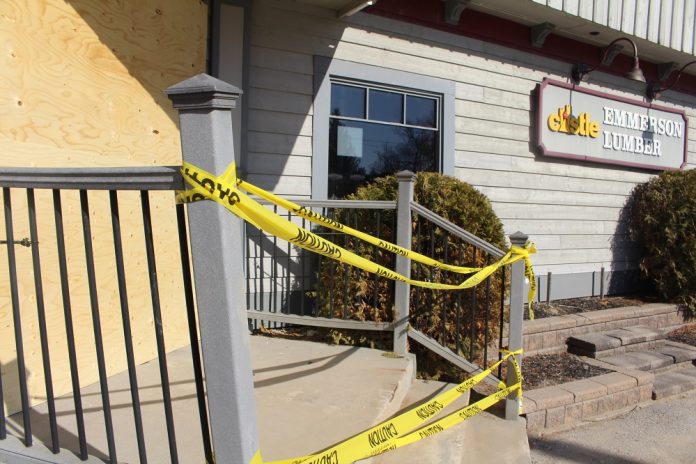
Police arrested a suspect after someone drove a vehicle into the front of Emmerson Lumber April 4. Photo by Joseph Quigley.

Haliburton Highlands OPP has arrested and charged a man after a vehicle crashed into the front entrance of Emmerson Lumber in Haliburton.

Acting Sgt. Dan Collings said police responded April 4 to the scene, which resulted in damage to the entrance door and railing. He said police also investigated vandalism to two bank machines at the nearby CIBC branch.

Collings said a Haliburton male was arrested and charged with two counts of mischief to property and one count of dangerous operation of a motor vehicle, in connection with both incidents.

Owner Kim Emmerson said the situation appears to be a “mental health issue” and declined to comment further.

The accused is scheduled to appear at court in Minden May 5.

Fatal collision

A Toronto man died in a collision on Bobcaygeon Road April 7.

Haliburton Highlands OPP said they responded to the road in Minden Hills. Police said a motorcycle travelling northbound failed to negotiate a curve and crashed into a ditch. The rider was transported by Haliburton County Paramedic Services to hospital.

The 58-year-old Bradley Benedict was identified as the rider and pronounced deceased shortly after arriving at hospital.

The road was closed for several hours while OPP investigated the scene.

Vandalism at skate park

Haliburton Highlands OPP is seeking help to find the persons who spray painted graffiti at the Dysart skate park.

OPP said they received a report of mischief March 29. It said the incident occurred over the weekend of March 27 to 29.

Anyone with information is asked to contact OPP at 1-888-310-1122, Crime Stoppers at 1-800-222-8477 or online at crimestoppers.ca.

Minden man charged with impaired driving

Peterborough County OPP charged a Minden man with impaired operation of a motor vehicle April 3.

Police said they responded to a motor vehicle collision on Drummond Line at approximately 11 a.m. A vehicle had entered the ditch and struck a culvert. They said the driver was uninjured but was found to be under the influence of drugs.

The accused is scheduled to appear in the Ontario Court of Justice in Peterborough May 4.

Impaired collision in Minden

Haliburton Highlands OPP responded to a single motor-vehicle collision on County Road 21 in Minden March 31.

After an investigation, police charged a Selby man with impaired operation of a vehicle, dangerous operation of a vehicle, possession of over 30 grams of dried cannabis or equivalent in a public place and driving a vehicle with cannabis readily available.

The accused is scheduled to appear in Minden court May 5.


Robinson’s General Store changing hands

0

Dorset’s iconic Robinson’s General Store will be under new ownership effective May 1.

The store announced the sale on its Facebook page April 5.

Brad Robinson introduced new owners, Mike and Katie Hinbest, in a short video.

During the store’s 100th year, Robinson said the family felt it was time “to move on and to bring is some new people to take over our business.”

The Hinbests said they currently live in Huntsville and are parents to toddlers, Ethan and Brie.

Mike Hinbest said, “we’re very excited to be part of the Dorset community.”

He added they wanted to let the public know that the store is “100 per cent here to stay. All of the staff are here to stay. And most importantly, the traditions Robinson’s has in the community for the last 100 years are what we look to build upon and be a part of our family for hopefully 100 years.”

He said they basically wanted to say “hi” to the community and thank it for its support as they’ve started this new venture.

“We look forward to meeting all of you. If you see us around please come grab us and say ‘hi’,” Mike Hinbest said.

In a December 2019 interview with The Highlander, Robinson said the decision to sell wasn’t easy, but “it’s time.” His daughter Joanne has been operating the store with her husband Willie Hatton and Robinson said they had decided to retire.

Robinson recalled how he made a decision to sell the store about 28 years ago. He said he was getting “played out” and rang Joanne to let her know of his decision. A few days later, he said Joanne phoned back to tell him not to sell, since they were thinking of moving back home with Robinson’s soon-to-be born grandson, Ryan.

Robinson took over the store at the age of 20 about 65 years ago. He said he and his dad were sitting around the kitchen table and his father said, “why don’t you stay here? [The business] isn’t working the way it’s going now. From now on, you’re going to be the boss and will make the final decisions.”

At that time, the store was small, only 75ft by 25ft. It’s gone through 14 additions since.

Looking back, Robinson said he feels blessed to have lived in Dorset and seen the province release Crown land so the area could be developed in the middle of last century.

“I look back and it was the Ontario government that really helped us in this area. They opened up 97 per cent of the township here for cottage lots and so consequently the country filled up quickly so that’s why we put 14 additions on the store because as the businesses grew, we grew the store to accommodate it.”

He said he’s looking forward to spending more time at the cottage, even having sleepovers.

He said he hadn’t had one in two years. But he’s not complaining. “You do in life what you want to do. If I’d wanted to go, I would have gone.”

COVID CORNER – A pep talk for the needle shy

0

by Dr. Nell Thomas

Herd immunity is when the percent of human population that is immune to an infection – either from vaccination or from having previous infection – is high enough that each infected person transmits the disease to fewer than one individual.

It’s when the virus is unable to find susceptible people to infect and so it cannot replicate and spread. Without us spreading it, the virus dies out.

The percent of the population that needs to be immune is around 80 per cent for us to have herd immunity from COVID19 (for comparison, that number is around 65 per cent for influenza). As of April 5, about 15 per cent of Canadians have been immunized, and about 2.7 per cent of Canadians have had COVID19 (difficult to tally due to unreported cases, but best guesstimate). Not close to herd immunity, but clearly a lot more realistically achievable with our current daily vaccination rate of around 200,000.

Israel continues to be ahead of the curve and closing in on herd immunity. They accomplished this because the majority of their citizens are getting the shots. As a result, the pandemic is receding and they have seen a steady decline in new infections. About 56 per cent of their population has received their first vaccine. For the over-70 age group, they have more than 90 per cent vaccinated.

What does it look like here in Ontario for the vulnerable long-term care residents and for the health care workers? These two populations were targeted early in Phase 1 of our vaccination plan. On Feb. 28, 2021 there were 71 infected residents and 162 staff reported in Ontario’s COVID statistics. On April 4 there are six infected residents and 116 infected staff (many infected staff had opted out of vaccination).

Looking at the data from the latest analysis (the six-month update) from Pfizer there is significant cause to celebrate. There are zero hospitalizations among the vaccinated subjects compared to 32 hospitalized in the placebo group (unvaccinated) in a study of 46,307 people. And from South Africa where the variant B.1.351 is dominant, again zero cases of COVID among the vaccinated versus nine in the placebo group (study size 800 people). The vaccine is 100 per cent effective against severe disease as per the CDC definition. (By the way, no serious safety concerns were reported in the trial participants up to six months after the second dose, indicating it remains highly effective and safe. Looking forward to the nine and 12-month updates).

Let’s take a stab at the variants of concern. The Pfizer data from South Africa showed that six of those nine infections were with the B.1.351 South African strain, and so these data are consistent with previous studies showing that vaccinated individuals had good protection (a strong antibody response) against this variant.

Speaking of variants. The virus that causes COVID-19 (SARS-CoV-2) mutates about half as fast as the influenza virus. To survive, a virus must spread through the human population, and to do that it must reproduce itself. It does this by telling your cells to make copies of itself. Every time the virus is copied there is an opportunity for error in the virus’ genetic code. That code, by the way, is about 30,000 letters long. Lots of room for errors. Most of the errors make no difference, but sometimes an error results in a change that makes the virus infect people more easily. When that change starts to spread, it means a new variant emerges. When you consider how many people are actively spreading COVID-19 daily around the world, the handful of mutations that are significant are very few. Reassuringly, the vaccines currently being used are preventing severe disease, even from the new variants.