
Home Blog Page 33

Ghosts and Bigfoot in Haliburton Forest

0

Haliburton Forest’s Thomas McCay stands at the gravesite of two young girls – sisters who died from diphtheria on consecutive days in 1889.

He is not in a graveyard, but the ghost town of Kennaway, a settlement that existed in what is today, Haliburton Forest, near Harcourt.

He is with members of the Ghost Hunters of the Grand River, a show that airs on APTN, as well as a crew associated with Sasquatch University, who track evidence of Bigfoot. It’s all part of new episodes on season three of Sasquatch University, now airing on Wild TV+.

“You see a place like this and it’s inherently spooky,” McCay says of the graves and the abandoned village, a result of the collapsed white pine industry and missing out on railways and highways.

The ghost and sasquatch hunters recently visited the Forest, camping out in search of paranormal and Bigfoot activity. They finished over the Thanksgiving weekend.

Ryan Willis of Sasquatch University said the ghost hunters brought their paranormal communications equipment. He added the crew recorded the entire stay and went back and listened to see if they had picked up disembodied voices.

“We had some voices come through the spirit box,” Willis said. “A voice said ‘let them breathe’.” Diphtheria affects breathing. “It was really creepy.”

Willis said the recorders picked up some Bigfoot evidence, too.

“We managed to get a very definitive tree knock on the recorder and audio of a really loud bang. It sounds like something throwing a log almost.” It’s believed Bigfoot communicates through tree knocking.

“It was just a good investigation all around and big thanks to Haliburton Forest for having us up.”

On Oct. 11, the Sasquatch team did a reveal for Tegan Legge, general manager, tourism and recreation at the Forest.

Legge said she didn’t think the ghost town of Kennaway was well known to most people, although “any ghost hunters would; anybody that’s really into the history of our County would. I didn’t really know about it until (Haliburton Forest) bought the property.”

Legge said she interviewed Willis for a job and that was when they first connected. “During the interview, he had kind of pitched ‘I do this Sasquatch University show; I think it would be really cool to do it in Haliburton Forest’.”

It piqued Legge’s curiousity. “I was a bit of a Sasquatch, alien encounters kind of nerd when I was a kid and into early adulthood.” She said she is a believer in the paranormal.

Willis reached out in the spring about a mashup with the ghost hunters and Sasquatch University. Legge said she had the perfect place for them. She thought of the ghost town of Kennaway and reached out to McCay, who was open to taking the crews there.

Legge said she was really excited to hear their findings. “It did not disappoint. I definitely had goosebumps from the voices they revealed to me and the knock. All those memories of all that reading and shows I’ve watched in the past came back to me. I had tears in my eyes and goosebumps and thought this is just crazy, but cool.”

Legge said working with the ghost and Bigfoot hunters was a really fun experience “I hope and anticipate they will be back.”

Getting ready for the thrill of ice racing in Minden

0

Do you love to race cars or drive competitively – not on the streets, of course? Or, are you a car buff that loves to drive?

Ice racing might just be your next winter thrill. The sport has been captivating Canadian motorsport enthusiasts for more than 50 years, and it’s one of the most accessible ways to enjoy racing.

Held each winter in Minden starting mid-January, the races combine skill, speed, and, of course, lots of ice. The best part? Getting started with your own car is easier and more affordable than you might think.

Ice racing is exactly what it sounds like: racing on a track made of ice. These events take place on a prepared track, where the icy run is meticulously crafted by repeatedly laying down water to create a thick, durable surface. Picture a typical racetrack but surrounded by snowbanks and sparkling with ice that tests every ounce of control a driver can muster. Drivers navigate tight turns and long straightaways, constantly adjusting their grip on the frozen surface and challenging their driving skills in ways that dry pavement could never offer.

But ice racing isn’t just about speed. It’s about control, precision, and adapting to the changing conditions of the ice. The track’s surface is constantly shifting as cars race over it, polishing the ice and making it increasingly slick with every lap. Drivers must stay focused and make realtime adjustments, offering a unique racing experience that keeps everyone on their toes.

Heat-Line looks to future

0

It’s a new era at Heat-Line Freeze Protection Systems, with the Algonquin Highlands-based business recently announcing a change in leadership.

Founders Lorne and Robin Heise, who started the company in 1988, have handed it over to the next generation. Their children, Brent Heise and Laura Roberts, have become vice presidents, while their son-in-law Matthew Roberts has succeeded Lorne as president.

Matthew Roberts told The Highlander the move is the formalization of a multi-year succession plan, which he said positions the company well for the future. Lorne and Robin are staying on in strategic positions, he said.

Heat-Line specializes in developing and manufacturing advanced heating cable, heat trace wire, and water pipe freeze protection solutions for residential and commercial markets. Roberts said the business serves four key segments – plumbing, electrical, retail, and original equipment manufacturers.

He said Heat-Line has increased its operations “double digits percentage-wise” over the past year, with a focus on expanding its business with those in the electrical sector. Roberts said the company recently completed its first strategic plan, which he said provides a roadmap for how Heat-Line will navigate the next five years. The company boasts 31 employees.

With about 32 per cent of the company’s sales in 2024 being U.S. based, and 40 per cent value-wise of HeatLine’s raw materials coming from the States, Roberts said the company is tied to the U.S. market for the foreseeable future.

Roberts said Heat-Line has been minimally impacted by the ongoing trade war between Canada and the U.S.

“Our sales have not been impacted – 95 per cent of our products are USMCA-registered products (United StatesMexico-Canada Agreement) and fortunately, those products haven’t been affected. Have there been challenges? Yes. There are certain products, things that are aluminum-based, but for the most part we’ve been passing that on to the U.S. consumer,” Roberts said, noting some products have been hit with a 50 per cent tariff.

The company has also been hindered by the U.S. scrapping its de minimis rule. Through that legislation, packages could cross into the U.S. without formal entry if they were valued at less than $800, but lawmakers got rid of it in August. That’s created a backlog across all processing, with customs required to process an extra four million parcels every day.

“There’s absolutely nothing we can do about it – it could take the standard amount of time for things to cross, which is two days, or it could take two-to-three weeks,” Roberts said. “It’s created a challenge for us because we have a lot of packages stuck at the border. We’ve been eating costs and shipping multiples of the same item, hoping one gets through and then we can try to get the others back.”

Roberts said many products are also being processed incorrectly, at higher tariff rates, saying Heat-Line typically has between 70 and 80 ongoing disputes with customs.

While Roberts said Heat-Line will never leave its home base in the Highlands, the company is looking to expand into the U.S.

“Having a U.S. location is on our radar. It may happen, it may not, but it’s always been a long-term strategic priority for us. It would be an addition to and complement what is already existing; it would never be relocating resources from here to the U.S.,” he said.

For more information on the company, visit https://heatline.com.

New-look Dahl back open after storm

0

It’s been more than six months of “painstaking” work for about 20 Countybased volunteers, but the Haliburton Highlands Land Trust (HHLT) has reopened its seven trails around Dahl Forest nature reserve.

The 500-acre site was closed to the public following the March ice storm, with HHLT’s Joan Duhaime saying hundreds of felled trees had to be cleared from the roughly five-kilometre trails system, while several “danger trees” – still standing, but at-risk of falling – also had to be cut down.

Duhaime said that’s brought on a new-look for the reserve, which reopened Oct. 9.

“The red pine plantation was very badly impacted – there were literally hundreds of trees down,” Duhaime said. “We’re leaving the limbs where they are. The forest will regenerate, which is a good thing. This all seems really bad…but this is a very natural thing. We think this might increase the diversity of the forest.

“It didn’t happen in a way that we would have chosen, but we can already see new growth in there because there’s so much more light coming in now,” Duhaime said.

The Land Trust raised $16,000 for cleanup, with about half of that spent so far. Duhaime said HHLT hired Geeza Road Mini Excavation Co. to help clear trails.

“It took them four full days with a tractor and grappler to get through everything,” Duhaime said, with limbs pushed back into the forest. She said Outram Tree Services were drafted in to deal with the danger trees – with one more felled last week.

The big stumbling block to reopening was dealing with downed hydro lines, which connected to a house Peter and Jan Dahl were using at the time of the storm. Duhaime said HHLT opted to remove the poles and wires and leave the property without a hydro connection.

Because the Dahls donated the land to HHLT, in 2009 via the federal government’s ecological gifts program, Duhaime said the Land Trust has to get approval before it makes any changes to land use.

“We’ll be talking to see what we can do with the house, if we can still use it,” Duhaime said.

The Dahls, who lived at the house for part of the year, have opted to relocate permanently to British Columbia.

Duhaime said the aftermath of the ice storm has been the most significant event the Land Trust has ever had to deal with – saying volunteers assisted with fundraising, contractor visits, project estimates and budgets, and dealing with insurance.

Work will continue, she said – there’s leftover funds to deal with any problematic trees, while a partnership with U-Links could be right around the corner.

“We’ve put in a proposal to have someone study the regeneration process of the plantation. It’ll be quite interesting noting the impacts,” Duhaime said. “I live across from Geeza Road and there was a red pine plantation beside our driveway. We’re now seeing a lot of different trees we didn’t even know were in there.”

She said public response to the reopening has been strong, with many taking to the trails over the past couple of weeks.

“We know people are keen to get out there and hike on the trails again, but we are warning folks to be cautious,” she said. “It’s not like there’s anything in there that will be toppling frequently, but the forest took a battering. As snow starts to fall, or we have a windy day, new things arise. So, we’re keeping our eye on some areas and how things develop.”

Duhaime confirmed ‘Discovery Days’ will be back in 2026, with HHLT receiving another grant from the TD Friends of the Environment Fund to run the initiative. “We’re planning a great schedule of events for next year”

Starting on time key to Huskies success

0

Haliburton County Huskies forward Julius da Silva had a big game Oct. 25 versus the rival Lindsay Muskies, but it wasn’t enough as the Fish speared the blue and white 3-2 last Saturday night at home.

Lindsay opened the scoring at 7:24 of the first period, on a Kai Williams tally at the S.G. Nesbitt Memorial Arena.

However, da Silva scored at 18:27 on a power play, his fifth of the season to that point, to tie the score, with the primary helper going to Connor Hollebek, and the other assist to Alex Rossi. The PP marker tied the game at ones going into intermission.

Then, just 2:18 into the second, da Silva notched another goal – this one short-handed to give the Huskies a 2-1 lead. Ivan Mentiukov notched the assist.

The Muskies answered the bell at 17:27 when Nole Faulkner fired one past Carter Nadon to tie it at twos.

In the third, it was Vincent Gazquez scoring at 5:13 to break the Huskies backs. Nadon turned aside 25 of 28 shots.

Da Silva told The Highlander, “Saturday’s loss was really disappointing, especially up against the Muskies.

“You never want to lose, but I thought we battled hard and we know what we need to work on to be successful.”

As for the rare man advantage goal followed by a shorty, da Silva said, “on the power play, we moved the puck around well, and I just found a good spot in front of the net, my teammates made it easy, I just had to tip it home.

“The shorty was off a read in the neutral zone, and about pressuring their D to try and create a turnover. To be honest with you, at the moment, I didn’t think too much about it, just wanted to get a bit creative and go between the legs so I went for it.”

Da Silva added, “the team’s been working hard to stay consistent all game long, which we know we have to do better at, which is what our coaches have had us focused on. Although we’ve had some disappointing losses, we’ve also had some great team wins, and the losses aren’t as one-sided as they were in September.

“I think we all see the importance of being consistent all 60 minutes and starting on time right from the get-go, and we need to find a way to execute on that because the nights we do, it pays off for us.”

Huskies win in OT

On Oct. 24, the Huskies scored just 55 seconds into overtime to defeat the Markham Royals on the road.

Defenceman Josh Hutton scored his first goal of the season to give his team the win, with assists to Kaiden Thatcher and Nic Ferrante.

In the road tilt last Friday night, the Royals got off to a fast 2-0 lead. The Huskies answered with three of their own (Kieran Raynor, Oliver Tang and Chase Del Colombo). But, in the third, the Royals pushed for the equalizer, and got it at 10:53. That set up a dramatic overtime with Hutton playing hero in the 4-3 win.

The Huskies travelled to Newmarket Oct. 28 for a tilt with the Hurricanes, winning the game 5-4. They next play Nov 5 vs Buffalo on the road.

Leafs fall to Storm winds

0

It was a brisk start to a Saturday morning, on Oct. 25, as the Curry Chevrolet U13 Rep team hosted the visiting Orono Leafs.

Halfway through the first period, Austin Cunningham opened the scoring, finding the back of the net off a set up from Grayson Park.

Shortly after, William Brown crashed the crease to bury a rebound, doubling the lead. Chase Casey made it 3–0 with a great finish following a smooth pass from James Hamilton. Park struck again later in the period, assisted by Cunningham and Jaxon Demerchant.

Orono responded with a quick power play goal, but goaltender Liam Scheffee stood tall the rest of the way, shutting the door on several quality chances.

Adding to the tally were Park, Everett Bjelis, Demerchant, and Blake Little, each netting another goal to round out a strong team performance. Final Score 8-2.

Haliburton’s Frankenstein connection

0

Hank DeBruin and Tanya McCready DeBruin got a call from California in the fall of 2023; from Birds and Animals Unlimited looking for some sled dogs for a movie.

The owners of Winterdance Dogsled Tours in Haliburton then hosted Hollywood visitor, Thomas Gunderson, who took photos and measurements of their purebred Siberian Huskies.

He never mentioned what the movie was or who was directing it. Hank figures they found out about Winterdance as he had competed in the Iditarod and Yukon Quest dogsled races.

Tanya said, “he was looking for a very specific type of sled dog and that’s all he (the animal trainer) knew.”

They didn’t hear anything after that, except for an occasional request for more information about the dogs.

But on Christmas Eve 2023, Tanya said the Hollywood handler called to say ‘okay, I think this is going to happen’ and they had a phone call Dec. 26.

In January 2024, they were told the director was Guillermo del Toro and the movie was Frankenstein – which was released Oct. 17 in theatres. Not only would they need dogs on set, but Hank as a stunt double.

Based on the iconic 1818 book by Mary Shelley, the film revolves around a brilliant but egotistical scientist who brings a monstrous creature to life in a daring experiment that ultimately leads to the undoing of both the creator and his tragic creation.

In Frankenstein, dog sleds appear in the novel’s Arctic setting where Captain Robert Walton’s ship is trapped in ice. First, Walton’s crew spots a gigantic figure on a dog sled. Shortly after, they rescue a man named Victor Frankenstein, who is barely alive on another dog sled and was chasing the monstrous figure. The story that follows is Frankenstein’s account of his life and his pursuit of the creature.

Tanya said the film studio flew up Gunderson, who worked with them in Haliburton for almost two weeks. For example, they had to train the dogs to be comfortable being near a fire. They brought their dogs to four different sets in Ontario, including a frozen lake near North Bay for the Arctic scenes, and a studio in downtown Toronto. They were on set for about three weeks over a four-to-five-month period. Their part was over in June 2024, with the cast and crew moving on to Europe.

Movie to open film festival at Highlands Cinemas

Tanya said it was an incredible experience. “The passion that went into it … the people on the set poured their heart and soul into this movie.”

Hank added it was “an amazing group of people. They became like family. There were no airs to anybody, from the director all the way down; we joked and had fun but it was hard work and serious.”

Hank found del Toro to be “an extremely down-to-earth individual. He knows exactly what he wants. We would sit there for hours and all of a sudden, he’d say ‘we’re shooting now’.”

Hank was never nervous, Tanya said, because he trusts his dogs.

An unassuming Hank said it is a “real honour. I can’t wait to see the movie. I’m very excited.”

Tanya said they had to sign a nondisclosure agreement and could not talk about their involvement in the movie until Oct. 17, so it was a big secret to keep. “It was hard. When you see your dogs do that, and know they are going to be in a film and Hank being the stunt double, you want to share that, but that’s part of the industry. You can’t give that away.”

Frankenstein at HIFF

The Haliburton International Film Festival will be screening Frankenstein at Highlands Cinemas in Kinmount Nov. 7. Hank and Tanya will be there.

“That’s where we’re meant to see it. There’s no more iconic theatre than Highlands Cinemas. Our family has loved it since we moved here 25 years ago; so, to see it in Keith’s theatre … it will be worth the wait,” Tanya said.

Festival co-organizer Tammy Rea added, “where else would you want to see the Haliburton premiere of Frankenstein that has a Haliburton connection?” Tickets can be pre-purchased at thoseothermovies.com

Summit hears about need for shelters

0

While social service agencies provide outreach from offices in Haliburton County, dedicated spaces to help people facing complex challenges, such as poverty, homelessness, and addiction, are missing, the 2025 Haliburton County Housing Summit heard last week.

Christina Alden of the John Howard Society of Kawartha Lakes and Haliburton was one of the speakers in a ‘reaching out and raising up’ panel. Alden works in the Minden office.

“I hand out sleeping bags, tents, clothing; anything else (clients) may need that we have available at the time. I offer a place to heat up the (SIRCH) meals we give out, charge their phones or tablet, and use WiFi, distribute harm reduction supplies, naloxone kits and training.”

Alden also does outreach, including to housing units. She said when people get used to workers coming on a regular basis, they are more likely to open up and ask for help. ‘Alden said people are living in tents and couch surfing. They may need help getting ID, which is crucial to accessing health care or housing to provide stability. A lot of this work is done at the Minden courthouse.

“Even with all this work, and all of the different services providing outreach … one of the biggest needs we see is for a dedicated space in each community; a place where someone can not only access our services, but also have a meal, take a shower, and do their laundry. These are basic needs that restore dignity, build trust, and make it possible for people to take the next step forward, like employment, so they can afford food, clothing and proper shelter.” Alden said.

She noted the John Howard Society is working on that in Lindsay now, “so it would be awesome if we could have that in Haliburton County, too.”

Donna Matthews is with the Eagle Lake Church ladies, who provide food to people on Highland Street in downtown Haliburton.

“Last winter was so cold; we worked outside of my car with no warming area or no washroom facilities. With the cold, there’s little or no time for them to chat and sometimes they won’t even come up because they’re just so cold. They go in for what they need, and away they go. So that is not working,” Matthews said.

She added they looked into renting a space with a small kitchen, washroom and warming area but the cost was “way above our means to support.

“Haliburton is high needs, but low resources. We could be more effective if we had a physical space where we could go in, they could be warm for an hour, use the washroom, wash your face, brush your teeth, sit and have a conversation.

They need to have a space that is warm, welcoming, friendly and safe to come to.”

David Barkley, of Coming Full Circle (CMHA HKPR), said his peer support outreach encourages people to attend dropins. “It’s important to have a safe space for people to come in and feel like it’s okay to do that and to connect.”

During her talk, Sue Tiffin, director of community outreach for the County of Haliburton, noted how the Highlands does not have a shelter for men or a shelter for homeless in general. The closest is in Lindsay.

Others speakers included: Brenda Manser with Housing First, Haliburton Highlands Health Services; Chris Parish, commander of the Haliburton County Community Paramedics; and Joel Imbeau of the Haliburton Highlands OPP mobile crisis response team.

Support staff return to work at college

0

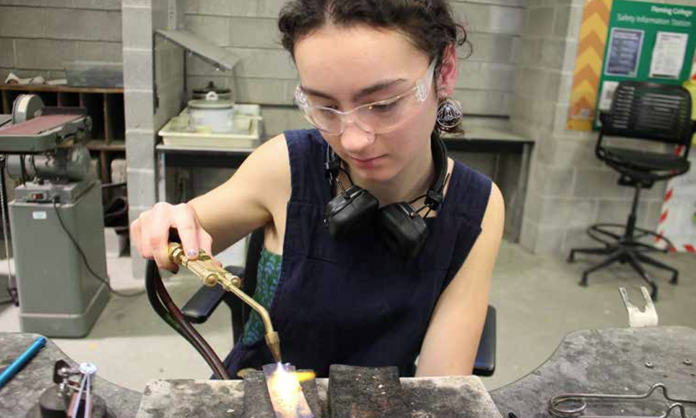
Fleming College administration has welcomed more than a dozen full-time support staff back to their roles at the Haliburton School of Art + Design after a month-long standoff between the College Employer Council (CEC) and the union OPSEU/SEFPO ended Oct. 16.

News broke last week that the two sides had reached an agreement that would send 10,000 striking employees back to work. No terms have been revealed, but the agreement that ended a five-week strike at Ontario’s 24 public colleges, which began Sept. 11, is subject to the union members’ ratification by Nov. 4.

Chris Jardine, associate vice-president of marketing and advancement at Fleming, said the college was glad to have workers back on campus.

“Yes, a tentative agreement for fulltime support staff has been reached, and picketing has ended,” Jardine said. “We’re pleased to have full-time support staff back at work and college operations returning to normal.”

About 15 workers had been picketing for weeks off the HSAD property on College Drive, after their contracts expired Aug. 31. Of Fleming’s 250 full-time support staff, 79.8 per cent were in favour of striking, said OPSEU Local 351 president Marcia Steeves. She did not elaborate on the terms of the deal.

Christine Kelsey, chair of the union’s bargaining team, celebrated the deal in an Oct. 15 statement.

“After months of intensive negotiations with an incredibly difficult employer, the gains made in this agreement would not have been possible without members holding strong these last weeks,” Kelsey said. “We had no choice but to fight back amidst a plan to privatize public education, as well as 10,000 job losses and over 650 program cuts across the system.

Fleming have been lost and more than 20 programs cut. In July, 29 Fleming workers were informed their positions were being terminated effective Oct. 9, including at least one from HSAD.

Since 2020, HSAD has lost four fulltime support staffers, dropping from seven academic support roles to three.

Part-timers vote to strike

The Ontario Labour Relations Board confirmed that only 30 per cent of approximately 13,000 unionized part-time college support staffers participated in a four-day strike vote Oct. 14-17, with 64 per cent in favour of striking.

Part-timers have been without a contract since Jan. 31, 2024, with negotiations over a new collective agreement for the past 18 months proving unsuccessful. OPSEU/ SEFPO and the CEC have agreed to three mediation dates – Nov. 20, Dec. 12 and Jan. 28, 2026 – with a proposed strike in February if a new deal isn’t agreed.

“Our proposals aren’t unreasonable, they are what we deserve,” the union said in an Oct. 17 statement.

The CEC’s Graham Lloyd said all unionized employees have been offered a two per cent annual wage increase; a six per cent jump in vacation pay; two paid sick days per year; no loss of pay for permanent employees whose shifts are cancelled within 24 hours; stronger protections in cases of workplace sexual harassment; and an internal applicant status for part-timers applying for full-time roles.

The union is calling for a six per cent annual wage increase, eight per cent in vacation pay, five paid sick days per year, and unlimited paid time off for religious and cultural reasons.

“A strike amongst our valued part-time staff is not necessary to achieve a fair agreement,” Lloyd said. “The part-time support staff are important to the colleges and have worked hard, especially during the last five weeks, to support colleges operations.”

Councillor fired up about hall closures

0

The prospect of Highlands East closing fire halls is already proving contentious, with Coun. Angela Lewis grilling fire chief Chris Baughman during a Highlands East council meeting Oct. 14.

Baughman tabled a report asking council whether they would like to stick to their vehicle replacement schedule, or come up with another approach in line with recommendations in the fire master plan.

Consultant, The Loomex Group, told council Aug. 12 they should close station 6 in Paudash and station 2 in Highland Grove as part of a consolidation plan.

Baughman noted the existing plan called for five vehicle replacements for 2025: a fire chief vehicle ($70,000), station 2 rescue pick-up ($70,000), station three rescue pick-up ($140,000), station one pumper ($600,000) and station 3 ATV/side-by-side ($25,000). He said they still need to buy the Station 3 rescue pick-up, station 1 pumper and station 3 ATV/side-by-side.

In a written report, he said, “alternatively, if council wishes to put these vehicle replacements on hold, the recommendations from the master fire plan could be further investigated.”

He said he would then bring a detailed report to a future meeting of council. He added he could report back on the reassignment of existing apparatus to different stations, eliminating the need to replace two vehicles for this budget year and in future, to save $740,000 in the current budget year.

He acknowledged, “reassignment rather than replacement purchases would result in a station operating without specific apparatus… (which) could present an opportunity to revisit the fire master plan recommendations regarding long-term service delivery planning.”

Prior to being elected in 2022, Lewis served on Highlands East’s fire committee, where she advocated against the closure of the Highland Grove fire hall.

She said the fire master plan spoke to “transparency, trust and communication,” especially when talking changes to service.

She said if they alter how they replace equipment, “there will be a fire station that is left with not enough apparatus to give the essential services that it has to a community.”

Baughman said his ask last week was “not leaving any stations short of any equipment at this time.”

Lewis asked about timeframes, and which stations would be impacted. Baughman said it would mean moving station 6’s rescue vehicle to station 3, eliminating the purchase of a rescue at station 3, and leaving station 6 short of an apparatus.

Lewis responded, “so what type of public consultation are we going to have?” She asked if they could defer the report to give the public a chance to speak.

Baughman repeated, “there’s been no recommendation to close stations, move apparatus or anything at this point. We’ve had a third-party provider give us a report with their recommendations. None of the recommendations have come from myself or council.” He said it was up to council to provide direction.

Deputy mayor Cec Ryall asked about timelines for getting new vehicles. Baughman said the average wait time is 18 months to three years, and he anticipates two years. Ryall thought it was important to make a decision by first quarter 2026.

Lewis suggested sticking with the current vehicle replacement plan and councillors agreed.

CAO Brittany McCaw said that was the intent of the report, but it gave council the opportunity to look into the fire master plan’s recommendations.