
Home Blog Page 318

Shoreline bylaw ‘prohibition by way of regulation’

0

Through their Zoom screens, County residents gave feedback on varying setbacks, a streamlined application process, and raised questions about the consultation process itself during the second draft shoreline bylaw town hall.

Hosted by J.L Richards (JLR) and Hutchinson Environmental (HES), the discussion focused on proposed changes to the bylaw rather than the restrictions of the previous draft bylaw itself.

Many of the 12 who spoke publicly, however, referred to the previous draft, which Jason Ferrigan said “represents a point in the conversation, but we are moving beyond that point in the conversation.”

Specifically, JLR and HES were tasked with reviewing and then presenting a new draft bylaw, taking into consideration the opinions of stakeholders and the public while pursuing peer-reviewed scientific research and comparative studies of other municipalities.

Conner Harris, representing Black Rock Landscaping, said the previously proposed bylaw would seriously hamper business. Its permit process, which JLR suggests streamlining to make it less onerous and expensive, would mean potential clients would be far more hesitant to proceed with building projects.

Harris said the cost of undertaking the permit process would be “disproportionate to the value of the project being pursued and in Black Rock’s view essentially amounts to prohibition by way of regulation.”

Despite those concerns, Harris said the company is encouraged by the direction they see the draft bylaw going.

“So far that process has given Black Rock cause for optimism that these concerns are being considered and will be fully incorporated into the final product when it’s considered by council.”

JLR has proposed multiple policy improvements which they suggest could improve the draft bylaw.

These include: creating a plain language bylaw; aligning the purpose of the bylaw with in-effect policies; creating a consistent area of application, harmonizing the bylaw with local requirements; recognizing variable site conditions; using performance-based standards; streamlining application requirements; broadening the matters that can be referred to council and creating a framework for transitioning to the new rules.

Disappointment with consultation process

Tayce Wakefield, a representative from a group of 150 properties on Kennisis Lake and other Haliburton lakes, said she “regrets [their] input was not sought” by consultants. Wakefield, who also addressed planners at the County’s July open house, spoke for approximately 17 minutes, outlining multiple key elements of the previous draft bylaw and raised questions which she said “remain to be answered.”

Wakefield’s group initially proposed to present a PowerPoint during the meeting. “It helps to make a clearer and more focused presentation,” she said. Their request was denied.

“It does cause us to question how interested you are” in receiving thoughtful input from property owners,” she told planners and council members. The slideshow presentation outlines multiple issues the group sees in the consultants’ report, including how the previous draft did not include renaturalization incentives.

At the beginning of the meeting, Warden Liz Danielsen said the issue of PowerPoint presentations is a “matter of equitable treatment of all presenters.”

“Those individuals making delegations at our initial meeting didn’t have that opportunity and we want to make sure we offer fair and equitable treatment for all those who have comments they wish to make,” she said.

Wakefield and subsequent speaker Thomas Moch said they support healthy lakes but were concerned by how the previous bylaw “further restricts [the] enjoyment of [their] properties.”

“No one intentionally goes out to destroy their habitat or destroy their lake in a negative context,” Moch said.

Terry Moore, of Environment Haliburton! also had suggestions for a reconfigured consultation process; one which would work towards a common understanding of facts and science apart from the “vitriolic” discourse on social media sites like Facebook.

“We need to organize, I think, public discussion forums where we can talk about where we’re coming from and why.”

Council is set to receive a new draft bylaw Oct. 27.
Cobra, the COVID-sniffing dog

0

“Sniffer dogs” are used for detection of human remains, lost persons, trafficked drugs, explosives, weapons and other illegal contraband.

Many dogs have been trained to detect diseases including Parkinson’s, various cancers, seizures, infections, low blood sugars in insulin-dependent diabetic patients. A dog’s olfactory cortex is reportedly 40 times larger than a human’s, making it capable of storing and recalling vast numbers of scents for many years.

With over 200 million scent receptors in comparison to a human’s five million, a dog’s nose can detect the odour of particular molecules and compounds that alter during disease. These odours are believed to come from Volatile Organic Compounds (VOCs) produced by biochemical changes in the body caused by malignancies, inflammations, infections, and other pathological events, including viral infections such as COVID.

The metabolic changes are detected in breath, sweat, urine and skin. Critical to our efforts to stop the rapid spread of COVID-19 is having an efficient way to identify positive cases and tracing their contacts for purposes of isolation. Nasal swabs and CT scans may be accurate in diagnosing someone with COVID, but they are relatively expensive, require medical equipment, trained staff, time to implement and obtain results. It is suggested that the use of trained dogs leads to earlier detection of infected persons at a lower cost.

Especially useful in situations when large numbers of people need to be screened quickly, a Sniffer Dog trained to detect COVID-19 helps identify asymptomatic carriers quickly. Each well-trained dog has a screening capacity of 250 samples per hour. While there are dozens of COVID-sniffing dogs in Dubai and Miami airports now, Cobra, a Belgian Malinois, is a super sniffer, able to sniff out COVID with 99 per cent accuracy.

She and her partner, One Betta, a Dutch Shepherd, work a checkpoint together at Miami International airport. They are part of a pilot program with the Global Forensic and Justice Center at Florida International University that uses detection dogs as a quick screen to identify people with COVID-19. Their detection rate is high – at more than 98 per cent – and the program has been such a success that it’s being extended for another month at the airport.

The dogs have been so accurate in their detection of COVID-19 that they and other canines with similar training could be deployed to other places that have many people coming and going at once, including other airports or even schools. COVIDsniffing dogs are being used in university classrooms now. Cobra is given passengers’ masks to sniff as the travelers make their way through a security check.

If she identifies a specific scent, she’ll let her handler know by sitting down. Sitting means Cobra has detected an olfactory signal of the coronavirus. That means the passenger will get a swab. Cobra and One Betta got their start learning to identify the presence of laurel wilt, a fungus that attacks avocado trees and kills them, costing Florida growers millions of dollars.

Once a dog learns to identify one odour, it is easily trained to identify other scents assigned to them. Cobra and One Betta were trained using mask samples from people hospitalized with COVID, and a control group of people who did not have the disease. When the dog correctly identified the virus, it got a favorite toy. From Aug. 23 to Sept. 8, the two canines screened 1,093 people during eight working days, alerting on only one case.

That person had tested positive for COVID two weeks earlier and was returning to work after quarantine. While the follow-up rapid test was negative, it highlights the exquisite sensitivity of the sniffers.

We, Highlanders

0
Highlands East will head a public consultation for the province’s disposal of Crown land on Centre lake. Photo via Granite Shores.

A couple of weeks back, as I was filling the newspaper box outside Jug City, the thought crossed my mind: what are you doing here, thousands of kilometres from home, a newspaper delivery boy in a land of lakes, forests, snow and hockey?

In one of the best places on Earth. This is the first and likely the last column I’ll write for this newspaper. Despite having my name on this page as publisher, I don’t get to decide what you read each week. That’s the job of our editor and her team.

That’s how it should be.

I get all the responsibility (I sign the cheques) and not much of the power so we can protect our product; so you know what you read here is not influenced by commercial concerns.

What Lisa, Sam and Mike put in The Highlander is what they think this community needs to read. That’s how they build an award-winning newspaper people love and tell their friends about, making it commercially viable as the go-to place for advertisers who want to reach our community.

That’s not to say I don’t have editorial input. Part of my job is to protect our mission, which you can find right above my name on this page. I keep watch to make sure what you read here is in line with who we are. The Highlander is 10 years old this week, so it’s time to reinforce that mission, to double down on encouraging Highlanders “to believe in themselves, in our community, and in their power to make our place in the world better every day.” This has never been more important.

I’m not alone in noticing how the past 18 months has put us on some kind of precipice: it feels we’re about to be pushed over the edge into something we don’t want to be. For the first time, I am hearing longtime Highlanders say it might be time to move on. It’s said people come here for the lakes and stay for the community.

This is true. Just look at the stories about our service clubs and not-for-profits, our thriving arts scene and successful businesses, and you’ll know this community has something special going for it. This is the kind of place where how you show up is more important than what you show up with, where you’re part of this place rather just in this place. We can protect all this, not by retreating into the past but by standing strong, creating our own future based on what makes the Highlands great.

All that requires is a steadfast belief in who we are and a strong resolve to ensure our future is what we want it to be. It means we have to think carefully about the decisions we make as a community. Above all, we need to know where we’re going.

Here at The Highlander, we’ll play a part in that. We’re not arrogant enough to think we have all the answers, but we do know how to ask questions. We also have you, our readers and our advertisers. We know you’ll tell us what we’re doing right and when we go wrong.

You’ll let us know what you want the Highlands to be and you’ll share your ideas about how to get there. Together, we will make the next 10 years a defining decade. We’ll emerge stronger and happier, proud of who we are and the lives we’ve built – as Highlanders.

HHHS reverses staff vaccine policy

0
Health workers are still awaiting promised pandemic pay. File photo.

Haliburton Highlands Health Services (HHHS) has reversed an earlier decision meaning all staff must now be fully vaccinated by Nov. 15 or be put on unpaid leave until they are immunized.

The move comes after HHHS CEO Carolyn Plummer told a Sept. 23 board meeting that the health provider would not be making vaccines mandatory for all staff. That decision drew some criticism in the community. The new direction, explained to staff in an Oct. 4 memo, comes after the Ontario government introduced mandatory vaccines for workers in long-term care homes. “Our organization is quite interconnected,” said Plummer.

Since HHHS staff must move between service centres, including the hospital and LTC homes, she said it would be difficult to reestablish segregation protocols and barriers which were in place during the early stages of the pandemic. “This was a difficult decision that was not made lightly,” Plummer said.

In the memo, Plummer wrote “using an ethical lens, there are a number of reasons for why this change is happening, including the interconnected nature of our organization, the services we deliver, the need for staff and physicians working in other areas to access the long-term care homes, and the importance of equity across the organization.” Staff who remain unvaccinated, less than 12 per cent, have until Oct. 10 to get their first shot. There will be multiple drop-in appointments available for staff this week, and unvaccinated staff will be offered appointments. On Sept. 23, Plummer initially said a decision had been made to not force vaccinations.

“The hospitals that have gone forward with policies that lead to termination for those who aren’t vaccinated have the capacity to fill the gaps if staff do leave the organization. We certainly don’t have that same kind of capacity.” She also previously mentioned individual choice as a factor in the decision.

However, she said the level of vaccinated individuals is much higher than when the hospital first made the decision in early September. At around 88 per cent, there’s less worry about losing staff who choose not to get vaccinated. HHHS has also increased levels of contracted agency staff working in facilities, which Plummer said decreases the risk of understaffing in some departments.

“Regardless of which direction we took, we knew there were folks who would be supportive and folks who would be questioning the direction: we’ve seen that in both scenarios,” she said.

She also insisted the decision was not made quickly: “It isn’t like we’ve started the vaccine policy discussion on Friday afternoon, we’d already talked through a lot of these issues. “If someone was concerned about walking into the hospital and a staff being vaccinated at the time, my concern would be not having the hospital available at all,” she said, without clarifying the number of staff who would have had to leave for service levels to become unstable. Plummer said she is not aware of any staff choosing to leave HHHS because of the new ruling.

The Ontario Hospital Association is calling for a unified approach to vaccinations across Ontario.

In an Oct. 1 press release, CEO Anthony Dale wrote, “there is much evidence that hospitals have used measures to encourage, persuade and educate employees and staff who are vaccine hesitant to get the vaccine voluntarily. With COVID-19 vaccination becoming mandatory in long-term care, we feel the time has come to adopt a mandatory approach for all healthcare workers, including those in hospitals, too.”

Highlands Challenge soars past fundraiser goal

0
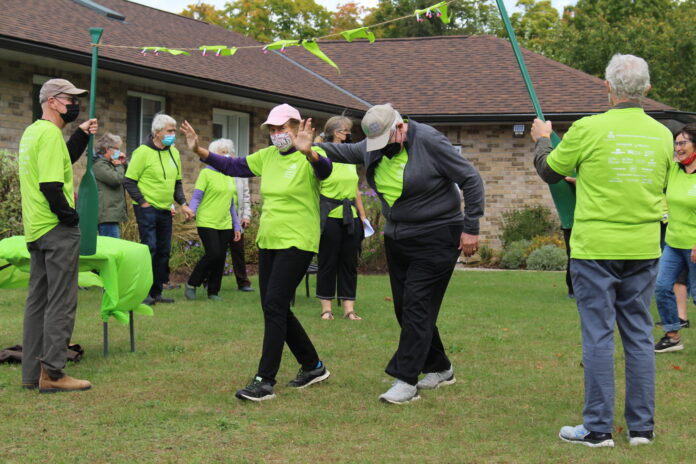
Participants celebrate the end of the fundraising challenge

The second Highlands Challenge fundraiser has raised $75,794.10 for Abbey Retreat Centre’s cancer care programming. Marianne Fenninger, a facilitator with the centre, thanked supporters for “all the possibilities that are now open to the Abbey Retreat Centre (ARC) because of the generosity of you and all our donors,” at an outdoor celebration on Sept. 26. 

The centre set a goal this year of $50,000, and for a while, they worried they might not hit it. However after a plateau in donations midsummer, the challenge gathered momentum. “I’m feeling very humbly grateful,” said executive director Barb Smith-Morrison. “I marvel that this happened and I’m so humbled by it.” The challenge was for Highlanders to get moving in return for donations, but it was open to all interpretations, skill levels and interests. 

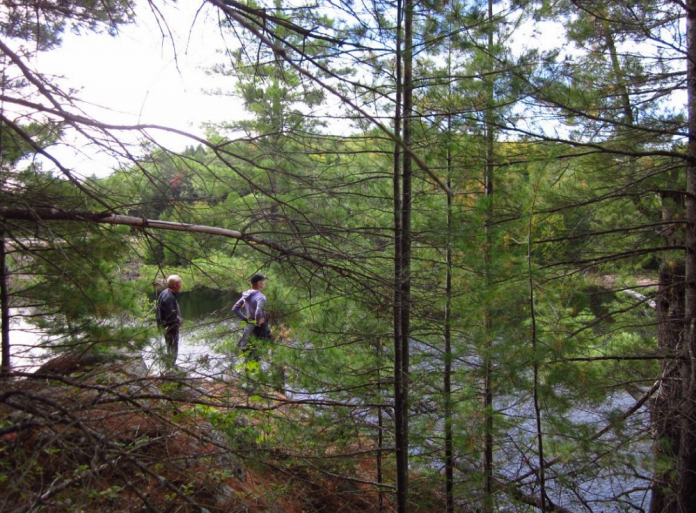
Participants ran, walked, biked and paddled in spots around the County. Bob Stiles, a past participant in the centre’s cancer retreats, set out to paddle the Kash chain of lakes and rivers with his friend Greg Roe, under the team name “Stroe Coureurs des lacs.”

 The pair paddled Roe’s 54-year-old canoe, reminiscing about spots on the lakes they remembered from their childhoods and zigzagging from shore to shore to say hello to friends. “I was a canoeist while I was young,” said Stiles.

 “There’s something elemental about it. I’m hopeful we’ll do it again.” Roe agreed, saying there is “something spiritual about canoeing, something spiritual about [this] event.”

 All together they gathered $9,224.50 in donations, more than tripling their initial goal. Stories shared about the challenge at the celebration ranged from Smith-Morrison’s parents walking 86 kilometers, nearly 10 times their goal, or the Haliburton Rotaract Club becoming keenly aware of the centre and avidly supporting the challenge. One group of friends made a goal of walking two or three times a week, all while sporting their bright green fundraiser T-shirts.

 Many who participated said passerbys would offer donations on the spot. “Our work of creating a safe, loving and healing community that supports people living with cancer and also supports their loved ones is meaningful work, it’s inspiring work and it’s even sacred work,” Smith-Morrison said to the participants. “And I believe it’s made all the richer by being part of this community together.” Each dollar raised helps the centre continue the work of providing those living with cancer a space to talk, learn, and heal, along with their support person. 

The challenge also exposed the centre to people who may benefit from its services, Smith-Morrison said. “People are wanting to come to our retreats,” she said. “Not only have we raised money, we’ve raised awareness.”

Two arrested in connection with theft of copper wire

0

The Haliburton Highlands OPP say they’ve made arrests in a theft of copper wire investigation in Minden Hills.

Between Aug. 25 and Sept. 5, 2021, officers responded to three separate incidents from Hydro One substations with an approximate combined value of $7,000.

On Sept. 14, at approximately 6:30 p.m., a suspect vehicle was located in a parking lot in Minden. Police attempted to apprehend the male but he fled in the vehicle at a high rate of speed and officers disengaged due to public safety concerns.

On Sept. 26, an officer attended a call for service under the Trespass to Property Act at a residence in Minden. Upon arrival, the officer located the male suspect with an unknown female inside a vehicle on the property. When the officer attempted to approach the suspect, he struck the police cruiser with his vehicle and fled at a high rate of speed, accompanied by the female. No further attempts to stop the vehicle were made due to public safety concerns.

On Sept. 28, as a result of the police investigation and with the assistance of the Sault Ste. Marie Police Service, the male suspect and female passenger were located in Sault Ste. Marie, and arrested without incident.

Nicolas SALLOUM, 25, of Gatineau, Que., has been charged with:

· Flight from Peace Officer, contrary to CC s.320.17 – two counts

· Assault a Peace Officer, contrary to Criminal Code (CC) s.270(1)(a)

· Dangerous operation, contrary to CC s.320.13(1) – two counts

· Failure to stop after accident, contrary to CC s.320.16(1) – two counts

· Obstruct Peace Officer, contrary to CC s.129(a)

· Mischief Endangering Life, contrary to CC s.430(2) – two counts

· Break, Enter a place, contrary to CC s.348(1)(b) – three counts

The accused is being held in custody pending a bail hearing.

The passenger, Kariann LESAGAE, 21, of no fixed address, has been charged with:

· Assault a Peace Officer, contrary to CC s.270(1)(a)

· Flight from Peace Officer, contrary to CC s.320.17

· Dangerous operation, contrary to CC s.320.13(1)

· Failure to stop after accident, contrary to CC s.320.16(1)

· Mischief Endangering Life, contrary to CC s.430(2)

The accused is scheduled to appear before the Ontario Court of Justice in Minden on Nov. 3, 2021.

Anyone with information regarding this investigation is asked to contact the Haliburton Highlands OPP at 1-888-310-1122 or Crime Stoppers to remain anonymous at 1-800-222-8477 (TIPS).

Studio Tour returns to the Highlands

0
Rose Pearson demonstrates how she takes a picture of inspiration and turns it into a large painted work of art.

By Hannah Sadlier

After a small but mighty 2020 season the Studio Tour – Haliburton Highlands is back in full force for its 34th season.

 This year 34 artists, in 23 studios across Haliburton County, will be opening their doors to visitors from far and wide. “The Studio Tour – Haliburton Highlands, welcomes returning and new visitors back to our studios,” said Peter Emmink, the tour’s co-director.

“Our 34 artists have been hard at work to bring you a huge selection of their works this year, and to make their studios as safe as possible for you to enjoy.” Not only will visitors be able to take in the fall colours that Haliburton is known for this time of year, but they will also experience an array of media. 

This year visitors will experience: fabric, pottery, painting, woodwork, glass, jewellery, mixed media, silversmithing and for the first time, photography. “Again this year, many studios will be conducting demonstrations of their craft, skill and techniques, which is not only informative but fun to watch for young and old alike,” Emmink said

. All studios will be following COVID safety protocols as outlined by the Ontario government and the HKPR health unit. “Also due to COVID we have had to forgo the snacks and treats that have been synonymous with the Studio Tour but hopefully that will all return next year,” Emmink said. The Studio Tour takes place this weekend, on Saturday, Oct. 2 and Sunday, Oct. 3, from 10 a.m. – 5 p.m.; and again Oct. 9 and 10. Copies of the 2021 Studio Tour – Haliburton Highlands, brochure are available at many local businesses; or download a digital copy online. 

For more information, visit thestudiotour. ca or find The Studio Tour on Facebook and Instagram.

‘Everyone has a right to live their life’ says CCHC

0

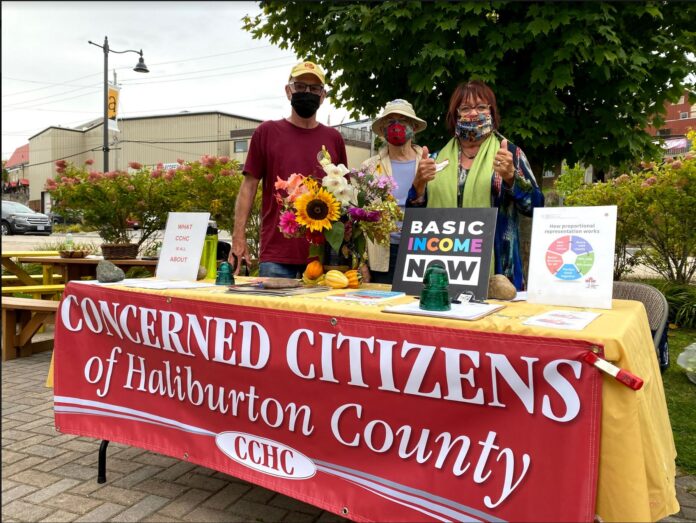
More than 40 area residents provided their thoughts and opinions on the potential implementation of a nationwide basic income program during a special day-long presentation at Head Lake Park on Sept. 21.

Organized by the Concerned Citizens of Haliburton County (CCHC), the event was designed to “get people talking, and get people thinking” according to Bonnie Roe, one of the activist group’s leading volunteers.

Since their formation in January 2019, CCHC has been one of the community’s lead advocates when it comes to social justice issues. The idea of a basic income has been prevalent, in Ontario at least, for several years. Back in March 2016, the Liberal government of the day launched a pilot project designed to test a growing view that a basic income could help to reduce poverty in a sustainable way.

The program was rolled out in Hamilton, Thunder Bay and nearby Lindsay. More than 4,000 people were signed up, with individuals receiving up to $16,989 per year, and couples slated to get $24,027. The program was intended to improve outcomes in food security, stress and anxiety, mental health, health and healthcare usage, housing stability, education and training, and employment and labour market participation.

“We believe having a basic income is vital to helping individuals who may be struggling get their lives back on track. When we saw the positive outcomes that people who were enrolled in this program were having, it was incredible,” Roe said.

The program was later discontinued in 2018 after Conservative Doug Ford assumed office.

“When it was shut down, many people’s hopes and dreams were totally destroyed. These people had started to do things such as no longer rely on the food bank for food, going back to school, or even starting their own business,” Roe said. “Once that level of support was removed, a lot of these people found themselves back at square one.”

Carolynn Coburn, another volunteer with CCHC, set up a chart at last week’s event and made a note of every specific thing an individual stated they would need to live a happy life. She said the group will be using that information to broach the issue of a basic, livable income with provincial and federal politicians in the near future.

“A lot of the responses we received related to housing, having enough food, being surrounded by family and friends. Then there was a community component too – that was important, because people felt they would be more inclined to get involved in their community, and be good, active citizens if they felt more secure financially,” Coburn said.

Given the situation that many people across Canada found themselves in last year when the pandemic first hit, Coburn feels there’s more compassion out there now for individuals who do need an extra helping hand. Approximately 8.9 million people applied for support through the Canada Emergency Response Benefit last year after being financially impacted by the onset of COVID-19.

“It was pretty interesting to see what the government thought people who lost their jobs needed to survive, to get by month-to-month – they each got $2,000 per month,” Coburn noted. “Considering the pilot project for basic income was at $16,900, that’s a big increase.”

The major stumbling block many people have difficulty with when it comes to a universal basic income is the reported costs associated with implementing such a program. According to the Office of the Parliamentary Budget Officer, a guaranteed basic income would cost $87 billion in 2022, rising to $93 billion in 2025.

Coburn says that money would be offset by a decrease in monies paid out through other social programs. Roe said she’d like to see some of the country’s richest residents dip into their pockets to help pay for the program.

“In my view, a basic income would come from our taxation system, the same way that healthcare does. If you turn around … and look at the very, very wealthy, and if you tax them even a minimal amount, you would have all the extra money needed to be able to allocate to something like this,” Roe said. “If people know they have this secure amount of money coming in every month, that could change their life. They will be able to plan and know they have enough for a comfortable life and have all of their basic needs met.”

She concluded, “It would be a win-win for all involved.”

FUNraising bursary empowers nursing student

0

As Hailey Alden settles into her new life up in North Bay, she does so having received a little helping hand from the Wilberforce FUNraising Group (WFG).

The recent Haliburton Highlands Secondary School graduate, and long-time Wilberforce resident, made the difficult decision to leave home earlier this year in pursuit of post-secondary education. She is currently enrolled in a two-year practical nursing program at Canadore College.

Just prior to her move to the ‘Gateway of the North’, Alden was the recipient of the 2021 WFG Bursary Award. Launched last year, the initiative was designed to assist promising students as they prepare to head off to college or university.

“This is just one of the delightful sort of Highlands East kind of things where there’s a group of people who like each other, and have got together with very little structure for years and years and years to do regular community events. Then, the money that we made [would go towards] the betterment of the community, and we have, historically, tended to focus on youth,” said WFG member Joan Barton.

The group, in the past, has raised money for projects such as the development of Herlihey Park. When COVID-19 hit, however, they were severely restricted by what they could do.

“We had money just sitting in the bank. This was money people had given to us thinking we would do good stuff with it. So, we decided we wanted to continue doing good stuff, hence the bursary,” Barton continued.

Last year, HHSS graduates Sydney Little and Chelsea Flynn each received $500 through the bursary fund.

Originally, the WFG wasn’t sure they’d have enough to match that total for this year’s bursary. Then, Barton recalls, one member received a call from Elaine Fournier, the recently retired former principal of Wilberforce and Cardiff elementary schools. Rather than receiving gifts from the community, in celebration of her retirement, Fournier asked that area residents instead donate to the WFG bursary fund.

The money, Alden says, was used to offset the cost of some “very expensive” materials that were required for her course, including two text books and an online computer program.

Aside from her “ground-breaking marks” at high school, Barton said the WFG were most impressed by Alden’s community work throughout her teenage years. She was far and away the standout candidate for this year’s bursary, Barton reiterated.

“One of the things we ask for in our application, is for students to tell us about their community service. Hailey’s service was exemplary – she assisted yearly with one of our events that we put on, the penny raffle. She had also done volunteer work with the Wilberforce Figure Skating Club and the Wilberforce Agricultural Fair,” Barton said.

While the bursary was established, in part, due to the COVID-19 pandemic, Barton says the group intends to keep it going for years to come.

Local pair showcase art with a scream

0

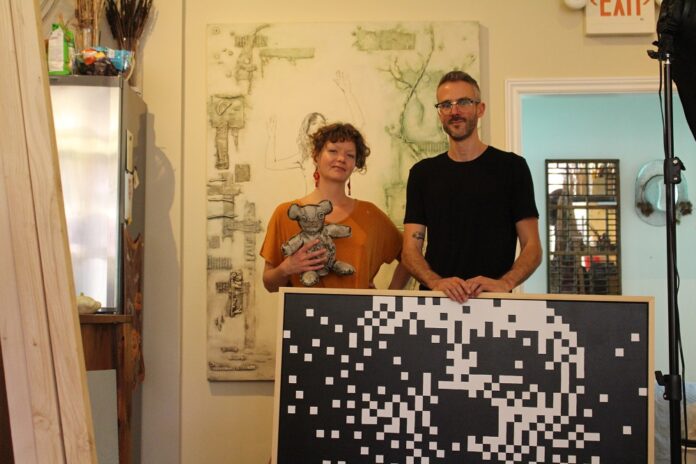
After moving to Haliburton in January, artist and music producer David Partridge often strolled past Tiffany Howe, outside her studio space, How(e) Creative, in Haliburton Village.

“We’d see each other and be like ‘that looks like my kind of people,’” said Howe.

They were right. And now half a year later they’re co-hosting an art exhibit, “You Make Me Wanna Scream,” opening Oct. 2.

The exhibit is Howe’s first partnered show in the century-old former store, which she renovated in 2020 and opened in 2021.

The name of the show is mostly for fun. It’s a nod to Partridge’s paintings and Howe’s recent work which she says explores a bit of “inner turmoil.”

The “screams” in question are all silent; characters rendered onto canvases in splashy blocks of acrylic colour by Partridge, some letting loose howls. And Howe’s recent work might spook the unprepared: she’s been creating creatures in paper-mache, purposefully a bit weathered and worse-for-wear. On the table in front of her, a crumpled teddy bear stares forlornly out into the sunlit studio.

“Our art is so different. Hopefully we’ll bring in people who like different things… and who cares if they don’t!” she said.

Don’t take it too seriously though, because Partridge and Howe don’t. Even calling the show “You Make Me Want To Scream” seemed a bit too pretentious, Partridge said. Howe chimed in “It has to be ‘wanna.’ That makes it more fun!”

It’s also Partridge’s first time exhibiting in a formalized show, hanging up large-scale paintings that explore a blocky, pixelated style he began exploring when he was 17.

The show’s closing coincides with the scariest night of the year, Halloween, Oct. 31. That means there could be an impromptu block party, featuring a witches’ dance to celebrate the end of the monthlong exhibit. “It’s gotta be a ‘closing ritual,’ not a ‘closing reception,’” Partridge said. And the space might suit an art show experience tinged with a healthy dose of the unexpected. “

I have this incredible space that’s also super creepy,” Howe said with a laugh, gesturing to the high ceilings and victorianesque facade outside. “Let’s just have another event and throw some other fun things on top of it.”

 It’s a space that she lives in too, so all those coming to the show after it opens must call ahead to book a viewing. “It is my space to live and work: this is my living room, dining room, office and studio.”

The gallery’s purpose might just reflect that of the upcoming partnered show: it’s a celebration of art and community.

“Without having it being a store, I wanted to make it a more easy-going space,” Howe said.

The pair are hosting an opening reception on Oct. 2 from 1-4 p.m. at How(e) Creative, located across from Haliburton United Church.