Ben Prentice, New Blue Party of Ontario candidate for Haliburton, Kawartha Lakes Brock. Submitted.
Ben Prentice said his decision to run for the New Blue Party of Ontario “boils down to principles.”
He said the Ford government’s fiscal record points to a shift away from traditional conservative values of keeping a balanced ledger.
“Even before COVID came in there was higher record of spending, but for a conservative government it’s always been about less oversight,” he said.
Prentice lives in Millbrook, and owns an HVAC company specializing in industrial piping and installation, which operates across Ontario and Quebec.
He was the riding president for the new party, before jumping at the chance to run in its first provincial election. The New Blues favour lower taxes and condemned Ford’s approach to the COVID19 pandemic. They said lockdowns and mask mandates disproportionally impacted small businesses.
The party, formed in 2020, said its mission is to “get our province working again by empowering individuals, strengthening our democracy, defending taxpayers, promoting small businesses, and standing up for faith and families.”
Prentice said he is concerned about aspects of Ontario’s school curriculum, which the party said shouldn’t contain information on diverse gender identities, critical race theory or in-depth sexual health topics.
He’s chatted with people who feel schools shouldn’t teach certain health or social history topics. “I want to raise my family as I want to raise them and have less government oversight,” he said. On healthcare, Prentice said, “a lot of the blanket regulations really detracted from what people need.”
He said money injected into the healthcare system throughout the pandemic should be accounted for, and he suspects rehiring unvaccinated staff would help with staff shortages. He said the pandemic has underscored “the real need for people in these positions to be well taken care of.”
Prentice said he’s not concerned over the chance new conservative parties such as the Ontario Party and New Blues might split the vote, or decrease Progressive Conservative power in Queen’s Park.
“I think governments we have now are extremely left,” Prentice said. He said the current Ontario majority isn’t pursuing conservative policies, so alternative, “principled” parties are filling the gap.
Candidates bow out
Two candidates won’t be on the ballot June 2. Grant Dewar of the None of the Above Party of Ontario and Fred Fischer of Consensus Ontario are out of the race.
Dewar said he decided not to run because he was concerned about splitting the vote.
According to party leader Brad Harness, Fischer did not acquire enough endorsement signatures to run for election.
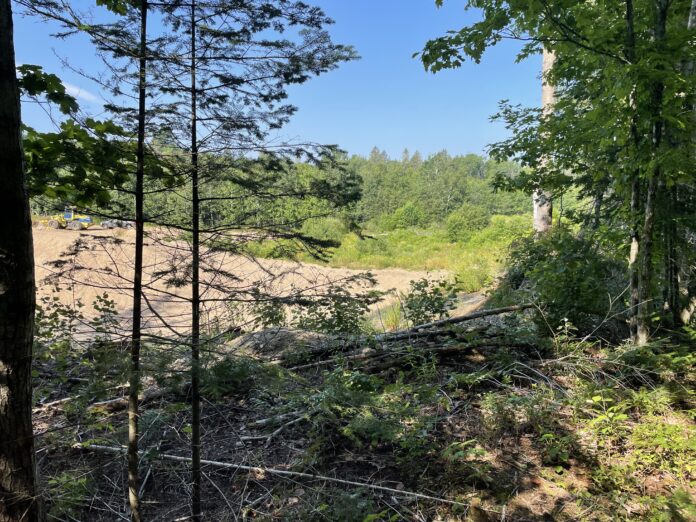
A view from a cottage road bordering the Crown land pit at Livingstone Lake.
A privately-conducted firearms safety study claims the Livingstone Lake Crown land area isn’t a safe place for firearm use.
The assessment was completed in 2020 by Mike Buss, who worked at the Ministry of Natural Resources and Forestry for 30 years, was a certified Ontario Hunter Education instructor and examiner and helped develop the provincial Hunter Safety Training Manual.
Allegedly dangerous use of uninhabited land, such as multiple Crown land areas in the County, has sparked concern among cottagers who insist the province needs to reassess whether some areas of Crown land are too close to neighbouring properties.
“In my opinion allowing or promoting shooting of firearms at this site presents a potentially dangerous situation, increases the anxiety of adjacent landowners and cottagers and would continue to foster a poor image of otherwise responsible firearms owners,” wrote Buss, in a portion of the report shared with The Highlander.
Buss provided his unofficial review of the spot after multiple Livingstone Lake residents raised concerns about firearms activities at the pit.
Wayne Parker of the Livingstone Lake Association (LLA) said he’s heard numerous complaints from residents who live at the end of the road.
Asking to remain unnamed due to safety concerns, one resident said she confronted someone shooting at a target nearby the road.
“I said that I found it very scary to walk around when shots were so close and he said that it was Crown land and he had a right to shoot there,” she wrote in a 2021 letter to the LLA. The firearms user left the area, but the resident said she found the interaction disconcerting.
Buss said in his report,“I belonged to a registered shooting club for more than 12 years and I can tell you the Provincial Firearm Office would most definitely not certify this location for the discharge of any type of firearm. I too have shot in abandoned gravel pits on Crown land, however, the berms were three to five meters high and there were no roads or dwellings downrange for many kilometers.”
He added that the many uncontrolled walking paths across the pit, along with public ATV access, means there is little control over downrange shooting conditions.
Buss insists the issue is not about disallowing firearms use on Crown land. It’s about discerning what slices of Crown land may not be suitable for target practice or hunting.
There are thousands of acres of Crown land far from residential areas.
More than 87 per cent of Ontario consists of Crown land, including numerous areas in the Highlands, primarily in Algonquin Highlands, Minden Hills and Highlands East.
The area commonly used for target practice at Livingstone Lake is boarded by a ribbon of forest approximately 40-metres thick. On two sides are cottage roads.
According to Constable Mike Melnychuck of the Haliburton Highlands OPP, police have responded to four complaints about firearms use on Crown land in the past year.
Parker agrees with Buss’ assessment of the area’s suitability for target practice. He points to Section 6 of the RCMP Canadian Firearms Safety Training Manual, which states that firearms users should consider, “is anything else in the line of fire, either
in front or beside or behind the target?… Could anything else come suddenly into the line of fire?”
The manual goes on to caution firearms users to “make sure you are welcome and permitted before you shoot anywhere. Do this whether the land belongs to the Crown, to a local club, or a private citizen.”
Parker and Buss both use firearms on Crown land often, but in areas far from residences, with high backstops and no foot or vehicle traffic behind the target.
Other firearms users in the County attend clubs such as the Haliburton County Marksmen Club.
In a letter signed by club officer Brendan Berube, the club said many join to sight rifles in preparation for hunting seasons, or compete in competitive or non-competitive events at their designated range.
“It’s a great venue to meet and share a mutual interest in sport shooting with other firearms enthusiasts. Many new friendships are forged in our community,” Berube wrote.
Widespread issues
Livingstone Lake is not the only Crown land area that residents say is being used for unsafe target practice.
In a letter presented to County council in
June 2021, Algonquin Highlands mayor Carol Moffatt outlined reports from Scotch Line, Boshkung Lake and, as previously reported in The Highlander, Koshlong Lake.
Residents from Koshlong Lake and Camp Wanakita describe firearms use in the area as disruptive and alarming.
Similar to the Livingstone Lake Crown land reserve, it’s located less than 100 metres from nearby cottages. Cottagers report gunshots disrupt parties, birthdays and lake outings, scaring boaters and kids attending the lake’s camp.
Since first bringing concerns to County council in 2021, the Koshlong Lake Assocation said there’s been no action taken by the OPP or MNRF to address the frequent shooting near residences.
The MNRF and OPP confirmed staff and officers attended the area in response to complaints of litter and the transportation of firearms over the road, which is private property.
On several websites such as Reddit, multiple posts pose questions about the suitability of Crown land areas and how to mitigate complaints from “panicked hikers.” One unverified user claims to have been stopped by a nearby landowner who asked them to refrain from shooting on the land.
“The only effective method to prevent shooting in the pit is to expressly prohibit it,” wrote Parker in a year-end LLA report. “…We also don’t believe that educational signage cautioning shooters to be mindful of their location will be helpful. In fact, the opposite can occur as it is a signal that shooting is sanctioned which can… increase activity.”
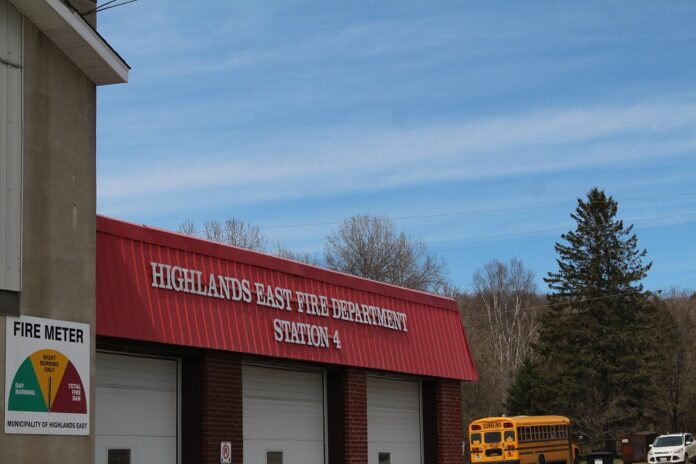
An upcoming Highland Grove and Wilberforce fire associations fundraiser is selling rain barrels to fund community initiatives.
The proceeds will go to people who have lost homes due to fire, and fund community events and education campaigns.
“By fundraising and hosting community events it not only helps promote emergency preparedness, it also brings the community together in a friendly social atmosphere, which I am sure we can all agree everyone needs after the past two years,” said Highland Grove fire captain Tom Burroughs.
Each barrel, used to trap rainwater, comes with a leaf and mosquito filter basket, spigot and an overflow adapter and hose.
Rain barrels are available for purchase online and at a May 28 truckload sale at the Highland Grove Community Centre between 8 a.m. and 4 p.m.
From 11 a.m. to 2 p.m., the stations will host a fundraising BBQ and provide refreshments.
Burroughs added the station will be recruiting volunteer firefighters. “It is a fun and rewarding way to give back to the community and help people when they are at their greatest need,” he said. Barrels can be pre-purchased at rainbarrel.ca/ highlandgrovefireassociation/.
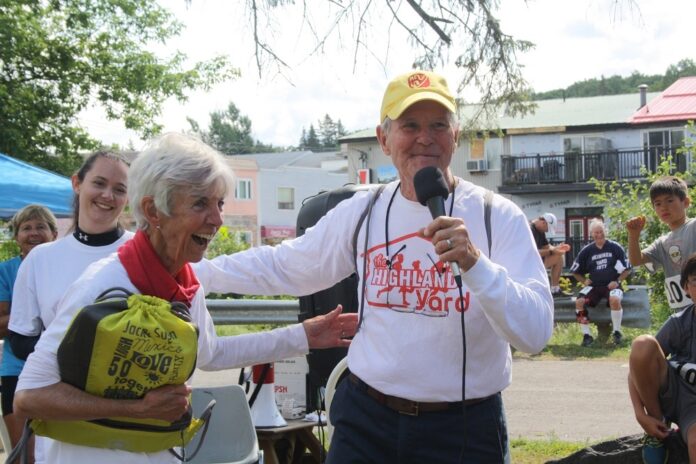
Registration for this year’s Highland Yard will open next week, and event organizers say they have something special planned to celebrate the event’s 50th anniversary.
A fundraiser in support of local nonprofit Places for People, the Highland Yard traditionally encourages participants to raise pledges ahead of gathering for a large, in-person race across the Highlands. Since the onset of the COVID-19 pandemic, the event has had to switch gears a little bit, transitioning to a more personal event.
That will continue again in 2022, with participants having the option to complete a 2k, 5k or 10k run/walk in their own time. Registration opens June 1, with people having two months to complete their circuit.
While long time organizer Jack Russel said he would have loved to stage an in-person event again after a three year absence, he said the uncertainty surrounding COVID-19 and provincial restrictions earlier this year when planning forced his team’s hand.
“We just weren’t sure how things were going to unfold. It takes a lot of time to get the planning into action for this event. We’ve been there before (planning an in-person event that had to be cancelled) so we decided to play it safe and do another virtual run,” Russel said.
Now that things have calmed and people have, for the most part, returned to normal day-to-day life, Russel said he’s been able to plan an after party of sorts in recognition of Highland Yard’s 50th birthday.
“We’ve been trying for the past three years to celebrate… The first running of the Highland Yard was 1971, so while this will be our 52nd event, we’re calling it the ‘50th year of running’. We just want to squeeze in an opportunity to celebrate and mark the occasion,” Russel said.
A celebration will be held at Abbey Gardens Sept. 10 from 1 to 3 p.m.
Following back-to-back record-breaking years, where Highland Yard has raised more than $30,000, Russel said he’s keeping his fingers crossed for another mammoth total in 2022. In the 10 years that Places for People has run the event, Russel estimated they have raised more than $150,000.
“So, what do we do with that money? Right now, Places for People is evolving and changing the way it operates. It’s moving from managing single dwelling units to larger scale multi-unit buildings… Places for People is stepping up to provide a much-needed service to the community,” Russel said.
The organization currently owns and manages seven units across Haliburton County. In recent years, management has been working closely with Dysart township on a large-scale development on Wallings Road (now affronting Halbiem Crescent), while further community projects are in the works.
Following 11 successful years at the helm of the local event, Russel will be passing along stewardship of Highland Yard to Rotaract Haliburton Highlands. All proceeds raised from future events will still benefit Places for People.
For more information on Highland Yard, or to register visit highlandyard.ca.
Celebrities are flocking back to the Haliburton Highlands.
They’re floating by docks, flitting gracefully from feeder to branch. They’re indulging in juicy worms and gossip or singing songs more renowned than anything on the top 40 lists.
The birds of Haliburton County are back for the summer.
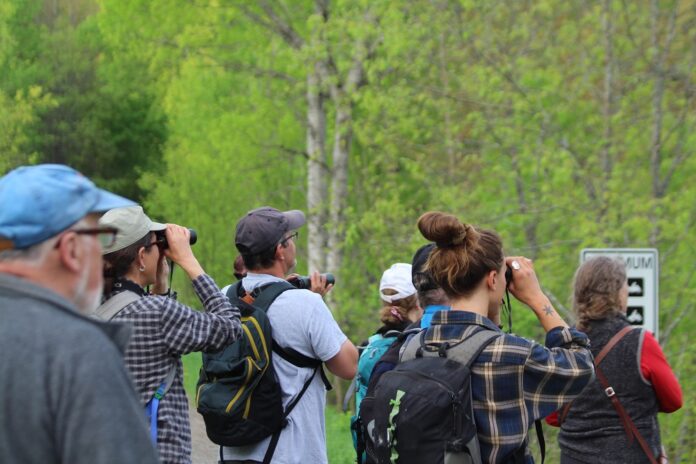
They’re the reason a group of intrepid fans arrived at 6:30 a.m. May 21 for the Don Smith Memorial Bird Walk, hosted by the Haliburton Highlands Land Trust.
As birder Ed Poropat welcomed the group to the Haliburton County Rail Trail, the birds had already begun singing.
“It’s been getting quite busy … we’re right in the peak of migration right now,” said Poropat. “We should have lots to see on our way,” he added.
With that, the group set off in the hazy late spring morning. On the path? Hushed tones and the crunch of gravel. In the trees? Thousands of conversations, tasty pine cone breakfasts and happy trills.
It was the first memorial walk, which board member Sheila Ziman said would hopefully be a yearly tradition to pay homage to Smith’s memory. Smith was a bird enthusiast, who led a Spring Warbler walk once a year for the Haliburton Field Naturalists.
“He was always keen. He was the one I learned from … he was so animated and happy to do it for us,” said Ziman.
Smith, who passed away in 2021, was a small mammal researcher, passionate about birds and creatures of all kinds.
Every few metres the group would pause and look up, glimpsing a member of the flying famous. A stork cut a dark shadow 300 metres out across Gelert Road. From behind pine needles a Bandit Warbler coyly observed awestruck fans.
A Scarlet Tanager dashed across the trail. “Hopefully we’ll get a good look at one of those up close,” Poropat said.
In a grove of evergreens, a Warbler performed its signature tune: “teacher, teacher.” Poropat explained how these tiny birds craft small nests under leaves expertly blending into their environments.
As is the case with all stars, there are copy-cats eager to emulate the greats. The Grey Catbird, calling down on the group from afar, mimics a range of birds, warbling along in a jumbled script that, for some reason, contains a “meow.”
For each bird the group hushed, lifting binoculars or squinting up at the treetops. They caught flashes of an orange belly or a grey beak turned to the sun. Poropat quickly identified each, listing its unique features. Often, he’d withdraw a book containing detailed drawings of each species. No bird too small, too common, all rendered expertly down to each gleaming talon and shiny beak.
Some were just passing through, catching a bite to eat. Others, like so many ground-dwellers this time of year, will call the Highlands home again after spending the winter down south.
As the sun rose higher, the group rambled further and the woodland gossip continued. The Highlands’ winged and famous are back.
Thirty-five thousand new fish are swimming through Haliburton lakes this spring thanks to the Haliburton Highlands Outdoors Association (HHOA).
The association raised 15,000 Lake Trout and 20,000 Rainbow Trout this year at its Gelert Road hatchery.
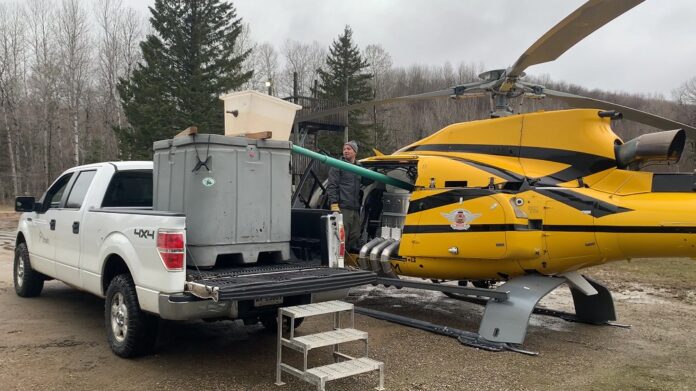
For 12 days, HHOA volunteers shipped out tanks of fish to 18 lakes around the County. Some were dropped by helicopter, others by boat.
“Stocking thousands of fish in multiple lakes is a very big job that involves a lot of moving parts and a lot of people power,” HHOA President Dan Smith said in a media release. “Timing is critical. Water temperatures have to be just right. It’s a lot of coordination and hard work but it’s well worth the effort to help maintain good fishing in our lakes.”
Hatchery manager departs
Hatchery manager Randy Charter is stepping down after seven years. Charter was the volunteer responsible for coordinating stocking efforts and completing other tasks around the hatchery.
“Randy has been a wonderful member and friend to the HHOA. His contributions have been outstanding. He will truly be missed and we wish him the best going forward,” Smith said.
Charter said the HHOA is a “wonderful organization with so many great people, with various life skills and experiences coming together to achieve a common goal.
I want to thank all our volunteers over the years for coming on board, working hard and helping to build an awesome team,” said Charter.
HHOA reports Walleye rise
The HHOA counted 2,100 Walleye at their Drag River monitoring site, exceeding 2021’s count of 1,334.
Volunteers observed the Walleye spawns nightly until April 29, counting young Walleye who hatched from eggs laid on the river’s rocky bottom.
“We think our efforts are going to have an impact,” said Tim Bahr, HHOA board member.
He said the next step is coordinating with Trent Severn Waterways staff to ensure the river gets adequate flow, to help the Walleye flourish.
“What we need to do is work really hard to make sure that water flow is maintained at the level it’s supposed to,” he said.
He encouraged anglers and fishery supporters to play the association’s 50/50 draw to help raise money for their Walleye preservation efforts.
“We’re going to keep at it,” Bahr said.
First 50/50 win reeled in
Kimberly MacDonald won the HHOA’s first 50/50 draw for 2022, totalling $2,270. Half the proceeds from the 50/50 draw fund HHOA’s walleye spawning rehabilitation efforts, stocking local lakes and other activities. Tickets can be purchased at bigcatch5050.ca.
Gooderham’s Peter Miller has just returned from Wainwright, Alberta where he worked as a vehicle technician during a Canadian Army training exercise.
A master corporal, the 57-year-old took part in Exercise Maple Resolve from May 10-22.
Miller said his shift started at 8 a.m. every day and he repaired vehicles used by the army to train soldiers.
“For the most part, when it was busy, it was a 12-hour-long day,” he said. “We removed engines and major components, anything that takes longer than two hours to repair.”
As a reservist with 32 Service Battalion in Toronto, Miller said he is still learning new things every day, despite his 30 years of experience as a civilian mechanic, and his 22-year career in the military.
“There are many things here that we don’t see as civilians, like armoured vehicles, so there’s still a lot for me to learn,” he said. “But you can bring your skills and knowledge here from civilian life. It’s a great experience.”
Exercise Maple Resolve is the Canadian Army’s largest and most complex exercise. It tests the skills of army leaders and soldiers through a force-on-force exercise. It’s planned and coordinated by the Canadian Manoeuvre Training Centre in Wainwright.
This year, the majority of participating soldiers were from 2 Canadian Mechanized Brigade Group based in Petawawa. About 2,800 soldiers, including participants from the United States and the United Kingdom, took part.
One of Haliburton’s popular outdoor eateries has found a new home.
Mega Munch food truck, now located across from the Haliburton LCBO, plans to fire up the grill and open their window in the coming weeks.
The popular food truck served hearty breakfast and lunch fare at its Hwy. 118 location for years before facing possible closure in October 2022 when they lost access to their longtime home.
“We were a little nervous we might have to leave town, said Wendy Vargas, who operates the business with her husband Adrian Vargas and their two sons Alex and Matthew.
They said they’re grateful to Adam Perecko and Chris O’Mara, owners of SolidState Computer Solutions and Prettypaws Pet Boutique, for providing space for the truck on their property.
Perecko said he and O’Mara value local business and were pleased to help the Vargas family find a new spot.
“Everybody wins,” Perecko said.
Mega Munch will soon have outdoor seating, and a stone pathway down to the river behind the truck will be a great place for picnics, Adrian said.
The food truck will now be open year-round. A winter menu will feature soups and hearty sandwiches.
Wendy said the people who frequent the truck are the best part of the job.
“Overall it’s a very positive experience. Everyone is happy with our service and our food. That’s what makes it rewarding,” Wendy said.
While inflation and supply chain issues mean Mega Munch has had to re-configure its pricing, Adrian said it prices its food “for local people.”
Many of those locals helped the family set up its new location, making time to help fill and dig the gravel base for the truck, install water lines and septic and more.
Other Mega Munch regulars have been honking their support or, most often, asking when they’ll be able to grab a bite to eat.
“A lot of people are very kind in this town,” Adrian said.
Mega Munch is aiming to open in June. Visit their Facebook page for more information.
Highlands-based company Heat-Line Freeze Protection Systems has been highlighted in a new federal study as a shining example of how investing in digital technology can help to grow a business if used efficiently.
The Business Development Bank of Canada says while 91 per cent of small and medium-sized enterprises in Canada spent money on new technology in 2021, only a fraction of those are using their new tech effectively.
Founded in 1988 by Lorne and Robin Heise, Heat-Line specializes in developing and manufacturing advanced heating cable, heat trace wire and water pipe freeze protection solutions for the residential and commercial markets. The business is located on Green Lake Road, adjacent to Stanhope airport.
After years of flirting with the idea of bringing their business into the 21st century from a backend standpoint, Heat Line recently took the plunge by spending on new enterprise resource planning software (ERP). Operations manager Matthew Roberts said the software, supplied by NetSuite has completely revolutionized how the company manages its financials, supply chain, operations, reporting and manufacturing activities.
“It really was a whole new world once we got things up and running,” Roberts said. “We went from having a dozen different people having to manually take information down and transport them from one place to another, to having a software that dealt with all of that… Something that before would have taken us 10, 15 minutes we could do now in a few seconds.”
But it wasn’t an easy transition. Roberts estimates he spent between 600 to 700 hours digging up data for NetSuite for the system build, while the company’s production manager Richard Mee put in another 200 hours.
The system eventually went online in July 2020, just a couple of months into the pandemic. The time, and money, spent developing the software paid almost immediate dividends, Roberts said. It put the company in a position to be able to handle the “incredible” growth it saw later that year.
“Without that new software there’s no way we would have got through the pandemic expansion. In the two years since we launched it, our business has pretty much doubled in size with a similar level of frontline staff,” Roberts said.
After seeing how successful the NetSuite system has been for them behind-the-scenes, Roberts said the company has this year rolled out a new e-commerce website that allows customers to purchase materials, look at previous orders and track their deliveries in real time.
“That’s been a big hit, and has been a huge help for us too. Before, half of our production manager’s job was fielding calls from customers looking for an update on their order. Now, they can check all of that out for themselves,” Roberts said.
He added, “We couldn’t live without NetSuite now… It’s almost become the heart of our company.”
More than 1,500 people responded to a County of Haliburton survey on short-term rentals, consultants J.L. Richards and Associates Ltd. told County council May 25.
They said the first of two surveys – focused on gathering community perspectives and their interactions with short-term rentals – was “well received.” The survey ran from April 3-25.
Report authors Gursimran Saini and Tori Ruck said they would use the information to guide a second round of consultation with County-identified stakeholders.
“The second round will focus more on the different ways on how to address the issues associated with short-term rentals,” they said. In their report, they said the County has to balance advancements in the tourism industry, via websites such as Airbnb and VRBO, with the need to create a regulatory framework “to manage these new age vacation rentals.”
They also said it is largely a municipal responsibility. Currently, short-term rentals are not addressed in the County’s official plan.
In the report, the consultants reviewed what’s been written about short-term rentals and looked at what nine other Canadian municipalities are doing.
Speaking to the literature review, they concluded, “generally, the research indicates that full-time, entire homes and multi listings are the underlying cause of various issues associated with STRs such as constriction of long-term rental markets and competition to traditional hospitality industry.
“Further, Combs, Kerrigan and Wachsmuth (2019) conclude that STRs are growing faster, concentrating faster, and removing housing from the long-term market faster in rural areas and CAs (Census Agglomerations) than in CMAs (Census Metropolitan Areas). This finding is important in context of the efforts to manage STR in Haliburton County, indicating foresight and a well-rounded approach is necessary in all relevant policy decisions.”
They looked at Blue Mountains; Whistler; Huntsville; Niagara-on-the-Lake; Lake of Bays; Prince Edward County; Vancouver; Kingston and Brampton for comparators.
Closer to Haliburton County, Blue Mountains regulates short-term rentals. They have a licensing application fee of $55; and two-year licensing for approximately $2,300 plus inspection fees. They have rules about density, occupancy, parking, landscaping, amenity space, health and safety. They also have a demerit point systems for various infractions by operators and guests, with licenses revoked if too many points are issued, and fines of up to $2,500.
Huntsville regulates the industry with an application fee of $55 and licencing fees of $500 to $750 with annual renewal fees. They also regulate occupancy, parking, and apply a municipal accommodation tax of four per cent.
Lake of Bays regulates via licensing, with three categories of fees, occupancy, parking and other considerations, such as setbacks.
“The best practices … have been adopted by various municipalities based on the local context … all municipalities contain general provisions in their relevant bylaws that require conformity of the units with other applicable regulations such as waste management bylaws, building code, fire code and noise bylaw,” the report stated.
“Additionally, there is a requirement of site plan, floor plan, parking management plan and emergency exit plan, together with site inspections to get [an] STR license in many municipalities. A responsible person who can respond to concern or complaints within a pre-determined amount of time is also a noted requirement in STR legislations.”
However, the planners also noted that the municipality of Collingwood, for example, does not permit short-term rentals, except in the form of bed and breakfast establishments.
Ultimately, they said it would be up to County councillors which direction the portfolio goes.
Referring to the first survey, they said, “there are several conflicting opinions regarding this topic, and we understand it can be a controversial one. This report is merely a summary of the comments received and is not indicative of the County’s or consultants’ position on the topic.”
See more in next week’s Highlander about what was decided at the meeting.