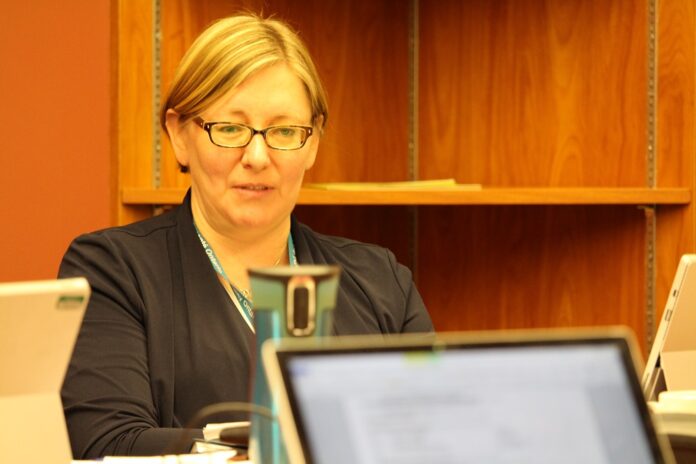
Haliburton Highlands Health Services has lifted its proof of vaccination mandate for visitors, while increasing the number of people allowed to visit its in-patient and long-term care departments.
In a slew of changes announced June 10, president and CEO Carolyn Plummer indicated the timing was right to scale back restrictions at all HHHS facilities given the low number of COVID-19 cases in Haliburton County in recent months.
It was noted, however, that essential caregivers would still be required to provide proof of vaccination. Other longstanding entry measures will also still be enforced.
“Everyone entering our facilities will continue to be actively screened for COVID19 symptoms, and visitors to long-term care and the in-patient department will be rapid tested,” Plummer said in a media release. “If the screening is failed or the test is positive, visitors will not be permitted to enter our facilities as per our current practice, with case-by-case exceptions for visitors to patients receiving end-of-life care.”
Up to four designated visitors will be allowed entry to in-patient departments, while up to four essential caregivers or visitors can visit patients in long-term care. The number of visitors allowed in the hospitals’ emergency departments will remain at one for the time being, Plummer said.
While the Ontario government lifted most remaining masking mandates June 11, Plummer said HHHS will maintain its masking protocols.
“Because our facilities serve many people who are vulnerable to infection, HHHS will continue to require masking across all of our facilities,” she said.
Communication problems
Plummer said the hospital is working alongside telecommunications company Bell to solve an issue that is preventing Bell customers from calling HHHS facilities. There have been dozens of complaints in recent days from Bell cell phone and landline customers saying they are encountering either a busy signal or a ‘customer not available’ message when attempting to call the hospitals in Minden and Haliburton.
“Work is being done with Bell to resolve the issue as quickly as possible,” Plummer said.
Calls placed through other networks such as Rogers, Telus and NFTC are connecting, Plummer noted. She said the issue has not affected incoming ambulance calls.
The Cardiff sewage lagoon is routinely nearing capacity and township staff and external consultants don’t know why.
According to studies from the Ontario Clean Water Agency (OCWA), the sewage system operates above 80 per cent of its capacity nearly a quarter of the time.
In 2021, the system averaged at 95 per cent of its rated capacity, a 22-percentage point hike in rated system load since 2018.
Based on that, OCWA suggested that the municipality “should be in the planning phase of expanding the treatment capacity” and actively investigating the issue.
Deputy mayor Cec Ryall said he thinks the situation could be “critical” if not diagnosed soon. “If we do not do that and this system collapses, we’ll be in a worse situation than ever before. I don’t think we can put it off until next year.”
If sewage influent exceeds the treatment centre’s capacity, OCWA predicts that could lead to less effective treatment of the waste, as well as algae growth due to increased phosphorus loading.
That has already happened. In 2021, algae was discovered in the sewage lagoon, prompting the township to put in place a suite of remedial measures.
“We did have a situation where the PH levels were higher than they should be for the lagoon,” said CAO Shannon Hunter, who delivered a report on the situation to council June 14.
OCWA provided six recommendations which might help remedy the issue or improve monitoring.
“One of the questions is where is this extra water and infiltration coming from?” Hunter said there’s been conversations with ratepayers and staff about why the increase of influent into the sewage system is occurring.
OCWA reported the township could study inflow and infiltration, non-sewage water entering the lagoon. A large amount of the capacity is taken up by non-sewage contents, up to 80 per cent.
“We strongly recommend that the causes of high [inflow and infiltration] be investigated and resolved in the collection system,” stated OCWA in its report.
Hunter said it appears excess water is flowing into the system from private residences, however the source of the influent isn’t confirmed.
Another suggestion is to have a lagoon sludge survey completed, which could lower the amount of solid waste taking up space in the lagoon. Hunter said she’s unaware of any prior sludging taking place in Cardiff.
According to American engineering firm Great West Engineering, sludging should take place every 20-30 years.
“Staff will be working towards all of the recommendations that are in this report, and we will be reporting back to council as we are able to,” Hunter said.
Educational assistants and custodians are on the chopping block, the union said
The union that represents non-teaching staff at schools across the region has accused Trillium Lakelands District School Board (TLDSB) of neglecting its students’ needs following a recent decision to lay off or reduce the hours of 77 educational assistants, (EAs) custodians and office staff board-wide.
Bill Campbell, president of the Canadian Union of Public Employees (CUPE) Local 997, confronted TLDSB trustees and administration at a June 14 board meeting, expressing his disgust at the decision.
“The supports these 77 employees provide to the students and schools in the system are critical to the success, safety and well-being of students and other staff,” Campbell said.
TLDSB has yet to publicly acknowledge the layoffs. Schools across Haliburton County will be impacted, with Campbell confirming Archie Stouffer Elementary School (ASES) and Haliburton Highlands Secondary School (HHSS) will lose three permanent EA positions in September. Cardiff Elementary School will also lose a permanent EA position.
Three custodians have also been served layoff notices, impacting staffing levels at ASES, Stuart Baker Elementary School and J.D. Hodgson Elementary School.
Campbell said the cuts affect roughly 10 per cent of CUPE-represented educational workers employed by TLDSB. He questioned why the board deems the cuts necessary given TLDSB reported a $2.7 million budget surplus last year, and a top concern recently outlined by the Elementary Teachers Federation is the lack of EA support in the classroom for teachers.
“The money is there,” Campbell said, also referencing several government-funded grants available to the board to support staffing levels. “The government is funding many programs to offer students the chance to regain the valuable learning lost during the pandemic… COVID shutdowns and online learning have created a learning deficit that needs to be overcome… We need our EAs now more than ever.”
Campbell expressed concern too over the board’s decision to lay off 28 custodial staff. He said, on average, CUPE-represented custodians have clocked between 40 and 80 hours of overtime this year and that with significantly fewer staff on hand come September, it will be impossible to maintain existing cleaning standards.
He said this was the fourth time since 2015 that custodial staff had been through a mass layoff at TLDSB.
“What will happen next year with fewer custodians in the schools… Custodians are a dedicated employee group that take great pride in their work, but there’s only so much they can do without the support of this school board,” Campbell said. “If the layoffs stand, make no mistake, the schools will not be as clean or as safe going forward.”
Campbell also condemned the board’s decision to close the Yearley Outdoor Education Centre, based just north of Huntsville, saying it has provided a “unique learning experience for generations of students” for the past 40 years.
In a final plea to the board, Campbell asked that they reconsider the layoffs and spend the money that’s needed to support students and teachers.
“We want to remind the board that in order to be successful in your stated goals, all students must be supported in their learning. Classrooms must be safe and welcoming environments for all. Student and staff mental well-being must be considered in every decision this board makes,” Campbell said. “These cuts are unacceptable… This is a failure on the part of TLDSB.”
Trustees did not provide a response following Campbell’s delegation and remained silent when TLDSB board chair Bruce Reain asked if there were any questions or comments.
Hydro One has issued the following corrections to its outage schedule:
Pine Springs: a planned outage for Monday June 20 from 8 a.m. to 12 p.m. is now scheduled for Wednesday, June 22 from 8 a.m. to 12 p.m.
Carnarvon and area: Tuesday, June 21 from 8 a.m. to 12 p.m.
Kennisis Lake, Fort Irwin and Maple Lake: June 26, cancelled.
Thousands of County residents are preparing for Hydro One planned power outages between June 20 and 26.
A spokesperson for the utility said it is because they are investing in improving reliability for residents and businesses by completing upgrades to infrastructure and critical forestry maintenance.
In order for crews to safely complete the work, the spokesperson said three planned power outages are required.
“Our highly-skilled arborists will be completing forestry maintenance that requires specialized equipment to safely remove two large dead trees along Hwy. 35,” the spokesperson said.
Two power outages will take place on:
• Monday, June 20 from 8 a.m. to noon, affecting approximately 460 people in the Pine Springs area.
• Tuesday, June 21 from 8 a.m. to noon, affecting approximately 1,048 customers in the Carnarvon and surrounding areas.
Further, the spokesperson said, “our highly-skilled distribution line crews will be replacing three poles and installing a smart switch; a piece of equipment that can be remotely operated to reduce the number of customers affected by a power outage. As a result, a power outage will take place on:
• Sunday, June 26 from 8 a.m. to noon, affecting approximately 3,900 customers from Maple Lake to Fort Irwin and north to Kennisis Lake
The spokesperson said they understand how difficult it is to be without power and thank customers for their patience as crews complete the important work in the area.
Some tips to help you and your family during an outage:
• Make sure your appliances, such as the stove, are in the off position.
• Make sure your cellphone and extended battery packs are fully charged.
• Keep your refrigerator and freezer doors closed as much as possible. Use a cooler with ice for items you’ll need during the planned outage.
• If your water services will be affected, consider filling jugs of water to use for drinking and cooking.
• If you plan to use a generator, remember to use it in a dry area outdoors away from any open windows, doors and vents. Visit the Electrical Safety Authority at esasafe.com for more tips.
• If your water services will be affected and you have a bathtub, consider filling it with water before the planned outage begins. You can use the water and a bucket to fill your toilet tank to be able to flush.
Affected Hydro One customers have been notified via auto-dialer and can visit Hydro One’s outage map or call 1-888-664-9376 for more information. Right: Hydro One is planning power outages to cut trees and replace equipment.
Minden Hills Cultural Centre Advisory Committee members (MHCCAC) say the township needs to revise how it conducts committee communications and implement new reporting procedures.
Committee member Jim Mitchell, who tabled the topic at a June 9 meeting, said the committee hadn’t been contacted since the pandemic started until July 2021.
“Since COVID, we’ve been totally ignored,” Mitchell said.
They received no communication on significant staffing events, such as director of community services Craig Belfry’s hiring or the departure of former curator of the Agnes Jamieson gallery Laurie Carmount.
The committee did not hold any meetings from March 2020 until November 2021. The committee has recently been chaired by Mayor Brent Devolin. It was previously chaired by Coun. Jennifer Hughey.
“It seems to me that the township is paying lip service to this committee,” Mitchell said.
Committee member Mary Hamilton said she felt “totally lost, as if there is no communication” between council and the committee.
She said while COVID-19 has made communication difficult, other groups such as the Friends of the Haliburton County Public Library continued to meet virtually.
Mitchell added that the issue began long before lockdowns. Prior to the 2018 election, the MHCCAC submitted a sixpage report with suggestions for council, including topics such as how communication could be improved. He said they heard “almost nothing” from council about their suggestions.
Committee member Erin Kernohan-Berning said recording minutes has been difficult without information from the township on how the committee’s minutes are recorded or addressed. “Lacking that framework, lacking that structure, has made us feel a little adrift. If there is a return to a … framework we can work within, that will be a great improvement,” she said.
Devolin apologized to the committee. He acknowledged “some mistakes were made” in communication efforts. He said COVID19 had an impact as well as staff turnover: Belfry’s position was vacant for more than a year. Both Belfry and CAO Trisha McKibbin began working for Minden Hills during the pandemic.
“I know that’s part of Craig’s feeling that we need to reconcile some of these things,” he said.
Belfry said the advisory committee should be expanded.
“We do need larger community input into here, more membership so we can get the voices,” he said.
A report on the MHCC from Lord Cultural Services, completed in 2020, outlines multiple improvement points for the centre, including bolstering communication with its committees and supporters.
Belfry said he is committed to improving lines of communication between council and the advisory group. The committee has restarted monthly meetings, and Belfry said the hiring of new staff at the centre will position it to restart programming, an area where, he said, the MHCC has been lacking even before the COVID-19 pandemic.
“There is work to do, there is a huge programming component that is missing,” said Belfry, mentioning how he’d like incoming staff to explore how to expand regular programming beyond arts events.
He added that “there does need to be an arts and culture master plan. That hasn’t happened.”
Murals are prepared to be mounted on the side of the A.J LaRue arena in Dysart et al, Haliburton, Ontario.
As murals of Lesley Tashlin and Taly Williams were placed on the wall of the A.J. LaRue Arena June 14 – and will be officially unveiled June 18 – one can’t help but feel a wrong has been righted.
Exactly why the two Black athletes were not added to the wall before this is unknown to us. We’ve heard stories but nothing we can substantiate. However, the lack of their inclusion does appear to represent a societal bias of the past. After all, the overlooking of Black athletic performances across Canada has been prevalent.
The fact it took elementary school students to correct this oversight is also telling. The students of Marina Thomazo’s J. Douglas Hodgson Elementary School class did what civic leaders of the past and present could not do. They recognized the slight and set out to overturn it.
Dysart’s cultural resources committee, and a subsequent sub-committee, picked up the ball and ran with it. They and the students are the ones who deserve the credit, not the politicians who may take centre stage Saturday.
The students began their quest in March 2021 when they wrote mayor Andrea Roberts – explaining how the accomplishments of the siblings merited a spot on the wall.
On June 22, 2021, council accepted a report from the sub-committee, which included two of the students. The finalized report sought to “remove any barriers to inclusion” on the wall. That included formalized criteria for athlete selection and their connection to the community.
Up to now, all athletes depicted on the arena are white males: NHLers Bernie Nicholls, Ron Stackhouse, Matt Duchene, Cody Hodgson and CFLer Mike Bradley.
JDH Principal David Waito is proud of the way students pushed for change, but believes the focus is on the future and the most important thing now is two athletic heroes are properly being recognized.
He’s right.
Tashlin is the first Haliburton resident to compete for Canada, in the 100-metre hurdles and 4 x 100 metre relay race, at the 1996 Olympics. Williams played defense for the Toronto Argonauts and Hamilton Tiger Cats from 1994-1996. They both broke multiple sporting records at HHSS. They are role models for all of us.
Across Canada, this story has made waves with athletes and athletic news outlets. Former CFL star Pinball Clemons wrote a letter in support of the students’ campaign, and in May, 2021, Athletics Canada published an article about the effort.
At the end of the day, this isn’t about pointing fingers. It is about recognizing where we as a community have failed in the past and setting out to correct that failure now and into the future. We imagine Saturday’s celebrations will be emotional for Tashlin and Williams. It should be felt by all of us.
June 18 also marks the unveiling of the Haliburton Highlands Sports Hall of Fame. The first crop of athletes includes a fair share of white males, people such as Bradley, Glen Dart, Hodgson, Joe Iles, Nicholls, Stackhouse, Jake Walker, Ab LaRue, Len Salvatori and three hockey teams.
However, there are people of colour in Tashlin and Williams, and women such as Tashlin, Marla MacNaull, Anna Tomlinson and Linda Brandon.
Wrongs are being righted. Slights are being corrected. Change is happening.
The Haliburton Highlands Health Services and multiple County municipal offices say telephone and landline connection issues affecting Bell Canada customers have been resolved.
“We appreciate the hard work of our staff team to connect and coordinate with Bell to resolve these issues,” said Carolyn Plummer, President & CEO of HHHS. “We are thankful that the issue is resolved.”
Dysart et al, Highlands East and Algonquin Highlands have posted notices stating Bell customers seem to be able to connect to their services again.
A Bell Canada spokesperson said the outages were caused by an issue with Iristel, a company used by Bell Canada to service internet-based phone connection software such as landline messaging systems.
An Iristel spokesperson said the company had temporary issues with their network in the County and “asked Bell to mitigate the potential issue for their customers by routing the traffic to one of our other interconnect points with them but they refused thus impacting clients. We didn’t have this issue with anyone else other than [Bell] customers.”
Businesses, healthcare centres and municipal offices are reporting widespread telephone issues.
All four municipal offices have issued warnings that Bell customers seem unable to connect to their office landlines.
“Bell customers calling on a mobile or landline phone are currently unable to connect. Callers may get a busy signal or a ‘customer not available message’,” states a June 14 media release from the Township of Minden Hills. “Calls placed through other networks such as Rogers, TELUS or NFTC are still connecting.”
The Haliburton Highlands Health Services released a statement regarding similar issues, which seem to be only affecting customers of Bell Canada.
“Work is being done with Bell to resolve the issue as quickly as possible, and HHHS will provide an update when the issue is resolved,” reads a June 13 media release. Calls to emergency services do not seem to be affected.
The Haliburton County Public Library also issued a statement on social media notifying callers of the issue.
The Highlander has been made aware of multiple private businesses and individuals experiencing issues connecting to landlines which use Bell services as well.
A Bell Canada spokesperson said the outages are caused by an issue with Iristel, a company used by Bell Canada to service internet-based phone connection software such as landline messaging systems. No estimated timeline for fixing the issue was given.
An Iristel spokesperson said the company had temporary issues with their network in the County and “asked bell to mitigate the potential issue for their customers by routing the traffic to one of our other interconnect points with them but they refused thus impacting clients. We didn’t have this issue with anyone else other than [Bell] customers.”
The Highlander will provide updates as more information becomes available.
We’re starting to hear the term “lame duck” in reference to municipal councils.
It refers to restricted powers during election periods.
Basically, if new councils are going to be quite different from the old ones come the Oct. 24 election, there will be a period of time where they will be restricted from making key decisions.
The thinking is, even though they’ve not been sworn in – and likely won’t be until November – a new regime is on the way and they are the ones to make key decisions.
Lame duck refers to the period after nomination day Aug. 18 when council could be restricted from appointing or removing any officer of the municipality; hiring or dismissing an employee or disposing of any property with a value of $50,000 when it was acquired, unless included in the 2022 budget passed before nomination day. They are not supposed to make any expenditure or incur any other liability which exceeds $50,000, again, unless included in the 2022 budget.
Council can delegate the authority to carry out these matters to a person or a body when in lame duck. For example, County of Haliburton CAO Mike Rutter is the delegate for that council and CAOS generally get selected.
Lame duck will likely apply to the County, for example, since four of eight incumbents are not running (Algonquin Highlands mayor Carol Moffatt; Minden Hills mayor Brent Devolin; Dysart et al mayor Andrea Roberts and deputy mayor Pat Kennedy). The other four, Highlands East mayor Dave Burton, deputy mayor Cec Ryall, Minden Hills deputy mayor Lisa Schell and Algonquin Highlands deputy mayor Liz Danielsen are all running but we don’t yet know if they will be acclaimed or if someone will run against them.
Of course, lame duck would not apply in an emergency, such as the COVID-19 pandemic. The council could still make decisions for something such as that.
The point, however, is County council still has more than two months to make decisions before nomination day and any question of being in lame duck mode. And indeed, there is nothing stopping them from making many decisions up until Oct. 24, a full four months away.
Yet, for some time now, some of them are already saying they want to defer major decisions to the incoming council. Perhaps the most notable is the shoreline preservation bylaw. Other major items are the service delivery review and short-term rentals.
In our opinion, pushing these big-ticket items to the next council in November would simply be an abdication of councillor responsibility. The council has already made decisions in its 2022 budget around the shoreline preservation bylaw, for example. There is nothing that would prevent them from moving the file forward.
After years, and tens of thousands of dollars, a decision should be made before lame duck. In the same vein, councillors must continue to push forward the service delivery review and make a decision about how they are going to manage short-term rentals in future.
Councillors need to complete the job they were elected to do.
It was third time a charm for Highlands resident Liliya Ianovskaia, who last month made history by becoming the oldest Canadian woman to conquer Mount Everest.
The 62-year-old mother of three took several weeks to scale the mountain, the highest point on earth, completing a lifelong dream to reach Everest’s summit.
Her adventure was notable too in that she shared it with one of her daughters, Dasha, the pair becoming only the second mother-daughter duo to make a successful climb. Now back in Canada, Ianovskaia said it was the experience of a lifetime. “The peak of Everest is very special.
While on final approach, it really dawned on me that there was nothing taller in the world. I felt it with every fibre of my being,” Ianovskaia said.
That final approach was years in the making. Ianovskaia dreamed of tackling the beast as far back as 2010, when she first took up mountaineering.
Having had experience rock climbing and ice climbing around the Highlands – with her favourite spots being around Kushog, Raven, Sherbourne and Oxtongue lakes – Ianovskaia found herself yearning for more.
Photo submitted by Liliya Ianovskaia
After a few months training, she set out to climb her first mountain, Kilimanjaro in Tanzania. Africa’s highest mountain, its peak sat 5,895 metres above sea level. A challenge, for sure, Ianovskaia reflects, but that only fueled her desire to chase bigger, more demanding summits. Over the next few years, she would successfully manoeuvre almost a dozen peaks in Europe, North America and South America, including the Matterhorn in Switzerland (4,478 metres), Pico de Arizaba, Mexico (5,636 metres), and Illimani, Bolivia (6,438 metres).
Having mastered the Andes and Alps mountain ranges, Ianovskaia turned her attention to the grandaddy of them all – the Himalayas.
“It took me years of training and preparation for that fleeting moment at the top of the world. For me, it was all worth it.”
Liliya Ianovskaia
In 2018, she and Dasha climbed Ama Dablam in Nepal (6,812 metres), and then, the following year, tackled their first “eight-thousander”, Cho Oyu (8,201 metres), the world’s sixth largest mountain. It was during that Cho Oyu climb that Ianovskaia realized she could conquer Everest. After returning home, she immediately went about planning her excursion. She was to leave in March 2020, but days before her departure the World Health Organization declared a global pandemic and the trip was cancelled.
She spent more than a year training, pushing her body to new limits in the hopes that, when she finally made it to Base Camp, she would have it within her to reach Everest’s summit. Ianovskaia made the trip to Nepal alone in 2021.
While waiting out the weather at Base Camp, she contracted COVID19 and had to be evacuated. She spent 10 days in quarantine before returning home disappointed. Rather than admit defeat, Ianovskaia wanted to give it one more shot. In March, she and Dasha made the trip to Base Camp.
A view from the peak. Photo submitted by Liliya Ianovskaia
On May 14, at 6:20 a.m. local time, they reached the top of the world. “We spent about half an hour at the summit, taking in the moment. There was nothing around but snow, and nothing but clouds and countless mountain peaks below.
“Everest casts a peculiar shadow that has the shape of a perfect pyramid – it was breathtakingly beautiful,” Ianovskaia said. “Somewhere down and to the left of us, there was a large storm happening. We watched it pass, hundreds of tiny lightning strikes passed down below. It was unbelievable.”
The duo flew a conjoined flag at the peak, representing Canada, their home, Belarus, their place of birth, and Ukraine, to show support for the crisis occurring in Europe.
Traversing a chasm on the ascent. Photo submitted by Liliya Ianovskaia
Having returned home May 21, one would have forgiven Ianovskaia for taking a break. Instead, she has already planned her next ascent – K2 in Pakistan.
She leaves later this month. While it took a great amount of training for Ianovskaia to get to the point where she felt comfortable challenging Everest, she firmly believes it’s a task any climber can complete.
“Be courageous and follow your passions, but be realistic about it,” Ianovskaia said, noting that on top of the physical demands, the cost to climb Everest is also substantial. The required permits alone run approximately $11,000 and once flights, equipment and guides have been paid for, it’s not unusual for a single climb to run in the region of $30,000 to $40,000.
“It took me years of training and preparation for that fleeting moment at the top of the world,” she added. “For me, it was all worth it.”