
Home Blog Page 401

Left to Tell: Part 3 – Unprepared for war

0

By Mabel Brannigan

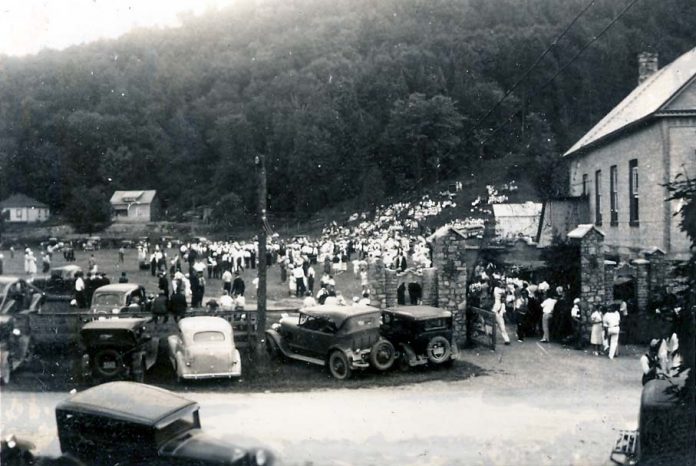
Late on Saturday night, Sept. 9, 1939, Parliament was called into session to vote whether Canada should be ranged alongside France and Britain in the war against Nazi Germany. Canada had no flag, but would fight under the Union Jack. The ‘yeas’ were said to have rocked the House, and in the morning, a stunned nation was at war.

The government appealed to everyone to be on the lookout for saboteurs, and 10 First World War veterans from No. 10 branch of the Royal Canadian Legion attended at the hydro plant at Leaside to protect it from saboteurs. Toronto Police set up a special squad to look for illegal aliens, while in Haliburton County, citizens were concerned with the Orillia Light and Power dam. Initially, Mackenzie King did not want a large army. This would mean conscription, and conscription in Quebec would be political suicide.

The reason for joining active service in Haliburton County was probably the same as in other parts of Canada. While some saw the fight against the Nazis as a crusade against evil, most enlisted to escape unemployment and poverty.

During the winter of 1940, pneumonia claimed the lives of many Haliburton County residents. Two mothers of nine small children each come to mind. Mrs. Norman Harrison, and Mrs. McKnight. With antibiotics not yet invented, the mustard poultice and prayer were the only remedies.

While Canadians were eager to fight, they were ill-equipped. It was estimated in 1940 that Canada’s ammunition supplies would be exhausted after 90 minutes of fighting. The nation had no facilities for producing rifles, machine guns or other weapons. Almost none of the R.C.A.F. aircraft were fit for combat, and the navy was so unprepared that 14 American yachts were purchased for coastal water patrol. But, on December 10, 1939, the First Canadian Army Division of 7,500 men sailed from Halifax, arriving in Britain on December 17, 1939.

Canadian servicemen had earned a reputation for courage, service and sacrifice, and at home, young and old devoted their time to the war effort, thus, it is not surprising that when the war ended, Canada had the third largest navy and army and the fourth largest air force in the Western world. In uniform were 740,000 Canadian men and women and 45,000 lay in cemeteries around the world.

Cigarettes sold for 25 cents a large pack, and smoking became the very ‘in’ thing for the ladies. Food rationing would become necessary later.

Highlands concerned about border-crossers

0
Highlands East is calling for the Canada-U.S border to remain restricted due to COVID-19. Photo via Flikr.

U.S-based immigration lawyer Christine Jurusik’s annual trip to her family cottage in Haliburton was different than usual this year due to COVID-19.

Like many incoming from the states, her family was placed into a two-week quarantine, which they stayed in for the duration of their stay. Officials also kept in regular contact with her family to ensure their well-being. But as Canadian citizens, her family was able to cross the restricted border without issue and Jurusik said it was worthwhile.

“For recreation and to take care of things that needed to be taken care of,” Jurusik said. “It was wonderful, the weather was perfect. We just enjoyed the outdoors, kept to ourselves. We didn’t interact with many people at all.”

The surge of COVID cases in the United States has generated concern about U.S. travellers to cottage country. The Eastern Ontario Warden’s Caucus (EOWC) has written a letter to the prime minister voicing support for continued border restrictions. County council also considered the issue July 22, though opted against it given the EOWC letter. Highlands East council voted July 21 to prepare a letter asking the border stay restricted until U.S. COVID cases are better controlled.

“There had been some concerns raised about the amount of traffic coming in from the states into the County,” Warden Liz Danielsen said.

Coun. Carol Moffatt said Algonquin Highlands has denied some requests for assistance – including an ask to lobby the federal government – from U.S. cottagers unable to come. Moffatt said support for border restrictions is widespread, but it is important to recognize stranded property owners.

“Quite a number of American taxpayers who have been coming here for generations,” she said.

U.S. nationals are unable to come to Canada for discretionary purposes such as tourism, according to federal rules. But exemptions exist for people crossing for work or other non-discretionary purposes, such as study and supply chains. Since June 8, people without COVID symptoms can also enter to be with a member of their immediate family who is a Canadian citizen and permanent resident.

“Going both ways, there’s a misconception the border is closed – it’s just not the case,” Jurusik said.

As an immigration lawyer, she said she has worked with some looking to cross. She said people can get in for legitimate reasons, such as for business or selling their cottage.

“Unless you really have documentation to show that you have a business purpose, they’re not going to let you in. They’re being very stringent.”

The Haliburton, Kawartha, Pine Ridge District Health Unit said it could not disclose any information about any U.S. travellers it may be aware of. It is not necessarily notified when travellers come, but may be if the traveller has questions about self-isolation or subsequently tests positive.

Jurusik said she understands the concerns of Haliburtonians and has seen negative comments directed towards U.S. cottagers.

“It’s a fear of outsiders and it’s especially highlighted in the time of COVID when people bring an unwanted virus,” she said. “People also need to understand everyone’s circumstance is different. So, if you encounter an American that is in Canada, they have been vetted at the border, they are there for a legitimate purpose.”

Storm wreaks havoc in Kinmount

0

By Lisa Gervais

Lorraine Turcotte was already in the basement of her Kinmount home when her husband shouted for her to head there in the early evening of Aug. 2

Confused, she ran upstairs as a down burst, or possible tornado, ripped through the area in about 30 seconds.

“It was horrible,” she told The Highlander on the afternoon of Aug. 3 while family helped her and her husband remove downed trees from their property.

She added it was “unbelievable.”

“We had a huge pine tree in the front yard. It was gone. It ripped all the Hydro and the Bell lines down.”

The storm left a swathe of devastation as it tore up trees, snapped Hydro poles, and damaged rooves and sheds. It closed a section of Highway 121 for several hours.

Turcotte said they also worked with Hydro One to remove downed trees as their road – Bobcaygeon Road – was blocked at both ends.

Alison Haecock lives along the highway. She recalled what it was like around 5:30 p.m. Sunday night.

“It was over so fast. There was this tremendous crashing and thumping and then this noise …  like a train going through.”

Like many, they had helpers using chainsaws and chippers to clean up the mess the next day.

“My husband belongs to the Haliburton trail riders. He put out the call, ‘hey, we need some help.’ And I’ll tell you, many hands make light work.”

Gord Domik, who also owns a home along County Road 121, said “it was a sound that I could never describe. It was the weirdest thing. You hear the normal wind and then all of sudden, you hear the tornado wind. And it was like a whole different ball game. I said to my daughter, ‘I think we should get in the basement.’ I said, ‘that doesn’t sound right.’

Domik said he was surprised houses were not completely destroyed especially since “some of these trees are actually huge, too, just ripped right out of the ground. I’ve never experienced a tornado in my life.”

Environment Canada has not confirmed that a tornado touched down. It may have been a down burst. OPP tweeted Sunday night that the road was closed due to storm damage.

Hydro crews worked to reopen Highway 121 and remained on scene to repair snapped Hydro poles and downed lines. Enormous trees were pulled from the ground and laying across roads, in yards, and in cemeteries.

The sounds of chainsaws and chippers reverberated across the village and some small fires were set to burn brush.

Deep Bay Road repaired after washout

0

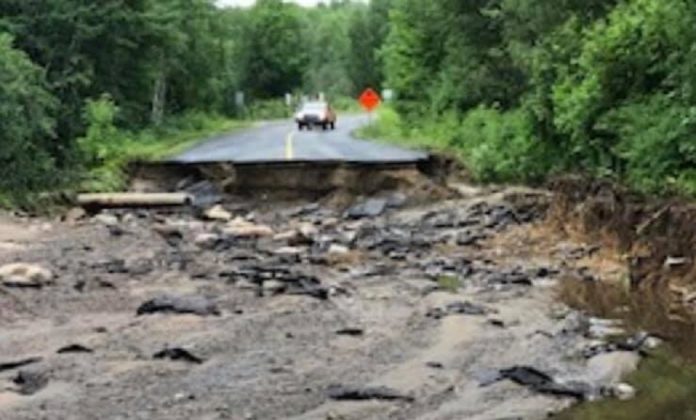
The County of Haliburton said a 400-metre section of County Road 2 washed out in a storm is open to traffic as of Aug. 12.

Deep Bay Road southwest of Minden, between Devil’s Lake Road and Forster’s Road, sustained significant damage after a storm Aug. 3. The County said it believes this may have been caused by a beaver dam that let go.

The County has worked to repair it since, detouring people to Highway 35. The County said that repair work is now finished.

County budget weathers pandemic storm

0
File photo.

County staff reported the budget is on track despite the upheaval caused by COVID-19. Council received a mid-year budget update during its July 22 meeting.

The pandemic has not yet significantly hurt the municipality’s financial position, with an estimated $743,600 in potential savings.

CAO Mike Rutter stressed that although the County’s books are not faring badly, that does not mean residents are not financially hurting. The report said that will impact the 2021 budget.

“We know there are many people in our community that are really suffering as a result of the economic fallout of COVID-19,” Rutter said. “We don’t want anything we say to be misconstrued as minimizing our genuine concern for our residents. We know that there is a lot of pain out there.”

The revenue picture was steady. Although there is a projected shortfall of investment income by $30,000, that was more than offset by unbudgeted provincial grant funding. Councillor Brent Devolin noted the County’s revenues do not have something like a transit system that would be harder hit during a pandemic.

“We’re fortunate compared to some other jurisdictions,” Devolin said. “This is not at all the snapshot that they would see.”

Council opted not reopen the 2020 budget and expressed opposition to cutting back on any more projects.

“We run a fairly tight ship. We budgeted for projects that we need to do,” Warden Liz Danielsen said. “We’re trying to aim for sustainability, and I would worry about the impacts down the road if we did cancel something.”

Council expenses at issue

But councillors were concerned by their own expenses, which are projected to be on budget at $161,028, though staff highlighted a $1,800 reduction in mileage expenses.

Deputy warden Andrea Roberts said there should be more savings given the reduced number of meetings, with committee of the whole not going ahead for several months. Rutter said staff did not remove pay for those cancelled meetings.

“There was a lot of work going on relating to COVID response,” Rutter said. “We know council members were busy with that and were, in all honesty, putting in more hours than they would have had we been having a regular committee of the whole meeting.”

Coun. Carol Moffatt said though she appreciated the intent, there could have been a council discussion about reframing pay.

“I struggle with having received money for meetings I didn’t attend,” Moffatt said. “That’s a problem for me.”

Council put the matter on the agenda for a planned committee of the whole meeting in August.

County to pursue broadband grant

0
Governments are looking to speed up projects to improve internet connectivity. File photo.

The County of Haliburton is moving ahead with a grant application for a project that could significantly improve internet connectivity.

Council voted July 22 to have staff pursue a partnership with a local telecommunications service provider (TSP) to apply for the provincial Improving Connectivity in Ontario (ICON) program. The $150 million fund offers municipalities a chance to build broadband infrastructure.

The County will pursue the grant with a consultant, utilizing $100,000 remaining in the 2020 budget earmarked for enhanced connectivity. Due to the August 21 deadline for the first intake, the municipality will sole source.

“Everybody with COVID has become extremely aware of connectivity needs,” Coun. Brent Devolin said, adding there will be a rush for consultants to take on work such as this. “The longer we wait, the shallower pond we’re going to be fishing in.”

The initiative would be separate from the Eastern Ontario Regional Network (EORN) and its ongoing $213 million cell-gap project, which the County contributes to. CAO Mike Rutter said EORN’s resources are occupied with that development, meaning the County would need to be self-reliant.

Although the exact parameters of the project are to be determined, Rutter highlighted an estimated $55 million needed to bring the CRTC standard of 50 megabytes-per-second download and 10 megabytes-per-second upload to 95 per
cent of the County. With an ICON grant, the provincial and federal governments would pay half, while the County and a private partner would have to cover the rest. Rutter said they have already been approached by two TSPs to apply.

“No idea at this point how broad those proposals will be or how broad the benefit would be,” Rutter said. “We are operating under the assumption any broadband is good broadband.”

He added the County would want any proposal to benefit all four of its townships.

Rutter said such a project could require debt financing. He noted it is a risk after the County approved debt to reduce the road infrastructure gap in 2019 and might need to go into debt to address affordable housing and unforeseen issues in coming months.

But he also said improved connectivity is important for post-pandemic recovery.

“Let’s get going, doing something for the folks out there that need it,” Coun. Carol Moffatt said.

Pride walk in Harcourt supports bullied youth

0
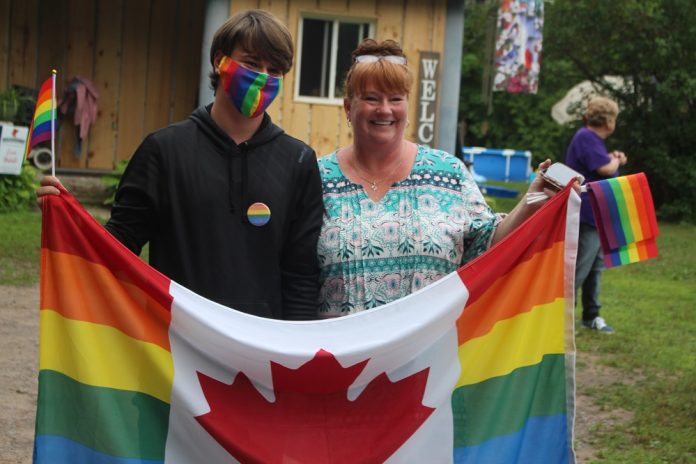
Evan and Debbie Natale hold up a flag after a Pride walk through Harcourt July 22. Above: The MacDonald family joins in a Pride walk through Harcourt. Photo by Joseph Quigley.

Harcourt’s streets were filled with Pride colours as more than 60 people gathered to spread a message of love and combat bigotry July 22.

People took part in an ad hoc march through the neighbourhood, waving Pride flags. The event was done in support of gay youth Evan Natale, after he said people at a nearby residence shouted at him about his sexuality – including slurs – during a walk around the neighbourhood.

“I was extremely upset and frustrated,” Natale said. “I just learned to ignore them, but it’s still difficult. I’m hoping this walk will help not just me, but anyone in my position.”

His mother, Debbie Natale, made a Facebook post about the incident. It quickly spread and soon, the idea came together to walk with Evan Natale through the community. She said the walk was an important show of support.

“There’s a lot of young adults out there, and even older adults, that don’t feel they have support,” Natale said. “They need to know they’re not alone and if they need support, we will be there and we will walk with them any time they need it.”

Wayne Beker pushed the event on social media, coming up with the graphic used for it. He said he felt heartbroken when he saw the post.

“Everyone feels alone in something,” Beker said. “We need to get together as a community and support each other and that’s what this kind of turned into.”

The walk attracted people from far and wide. Wayne Holmes came from Belleville to show his support and reflected on his own experience as an LGBTQ man.

“I came out at 21 (years old) in Toronto. Back then, it was a hostile time – people throwing eggs, tomatoes at you, chasing you around. I’ve been beaten many times,” Holmes said. “But all the activism work – I thought it wouldn’t be an issue now, and it still is.”

“We need to show people in rural areas that they’re not alone,” he added.

The walk went through a significant part of the hamlet, including two pointed passes by the residence that heckled Natale. Decorated Canadian curler John Epping also attended and told Evan Natale to reach out to him if he ever needed support.

He said as an openly gay athlete and LGBTQ advocate, he wanted to be there. He added LGBTQ people in Toronto are a little more privileged compared to certain rural areas, where some may not be as educated on the subject.

“I hope this is something they can continually do, and I hope that other maybe small communities, small towns, pick up on something,” Epping said. “It’s about just spreading equality, kindness and being nice to each other.”

“The love and support are absolutely amazing,” Debbie Natale said. “We delivered a good, peaceful message and it’s a good first start.”

Dumpster fire at Haliburton landfill

0
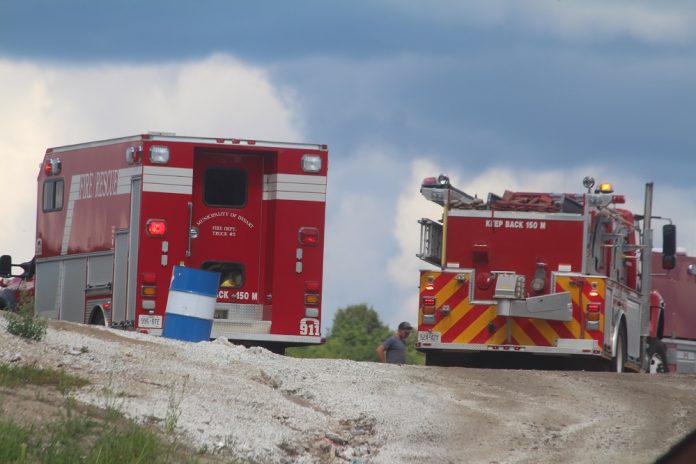
Fire trucks at the Haliburton Landfill fore a dumpster fire. Photo by Joseph Quigley.

The Dysart et al fire department responded to a dumpster fire at the Haliburton landfill July 31.

Firefighters were on scene for approximately one hour dealing with the blaze, located at the household waste section of the landfill, according to municipal staff on site. The landfill was closed throughout the response and remains so as of 4:05 p.m.

The cause of the fire is unknown. More to come.

Fire destroys cottage on Boshkung

0

By Lisa Gervais

Photo by Julia Lewis

Julia Lewis said she was awoken in the middle of the night July 30 by her daughter, who had heard sirens.

Overlooking Boshkung Lake, Lewis said, “We looked outside and the whole bay was lit up by flames.”

A cottage under renovation “was fully engulfed and the firefighters were already there.”

She said Stanhope volunteer firefighters did a great job of preventing the fire from spreading to any other buildings, but the cottage was unfortunately lost. 

Algonquin Highlands fire Chief Jonathan Wilker said on July 31 that his department got a call around 2.30 a.m. July 30.

“Someone from across the lake saw the fire,” he said. He added they didn’t know what the exact nature of the call was and paramedics were first on scene followed by volunteer firefighters.

They soon knew it was a structure fire. He said it was a cottage under renovation with no contents. He said the owners were not home and there were no injuries.

He confirmed that upon arrival, it was fully engulfed. He said volunteers were able to set up a pump on a dock on the lake to draw water and took about one hour to extinguish the blaze – but the building was a complete loss.

The cause of the fire remains under investigation.

Why has the Wigamog clock stopped?

0

The state of the Pinestone Resort and Conference Centre, and the Wigamog Inn, now owned by the Aurora Group out of Vaughan, has been a concern for Haliburton County residents for some time now.

The Auroras purchased the Pinestone in 2015 and the Wigamog in 2016.

They announced some grand plans for both sites.

To date, very little, if anything, has been done.

In defence of the Auroras, Dysart et al Mayor Andrea Roberts told The Highlander she’s sure it has been challenging times being in the hotel business these last few months.

We are certain it has. And, we applaud the Pinestone for opening its doors to frontline workers needing accommodation during the pandemic.

Aurora CEO Ravi Aurora did answer a couple of our emails, which we appreciate, since his head office has not responded to many of our queries in the past.

He said they were very busy dealing with COVID protocols and realigning business practices. They needed all the time they could get, so he couldn’t provide an update on the Pinestone, Wigamog, or County Road 21 gas station, car wash and fast food outlet they have talked about.

While we were happy to email him questions, he could answer at his leisure, or restrict a phone call to half-an-hour, he declined. However, he said he appreciated the community’s concerns, they deeply care for the community and the Pinestone and its involvement in the community. He encouraged us to reach out in September when things calm down a bit.

We certainly will, because while things have been tough for the hotel industry for the past six months or so, the Auroras have owned both properties for four to five years now. Whatever happened to opening the Moose Bar and Grill and some of the Wigamog Inn’s rooms by mid-summer 2016, for example?

In the interim, the inn has fallen into a state of disrepair such that it is highly unlikely it could be renovated. Maybe the eventual plan is to demolish it to make way for a planned housing development the Auroras are promising on their website. It’s hard to say, since the Auroras aren’t really talking.

In the meantime, those living around the former inn are faced with seeing what has become an eyesore over the past 10 years or so, since the property had been vacant for five years before the Auroras arrived on the scene.

It is strange to drive down Wigamog Road and see upscale developments such as Haliburton Heights and Silver Beach next to the Wigamog.

Some have also questioned the role of the municipality.

While the Wigamog is privately-owned, the municipality could take a more active role.

Perhaps someone there could press the Auroras for answers.

As for bylaw enforcement, it appears that has only been stepped up the past week or so because neighbours Keith and Julia Robertson are rocking the boat, and The Highlander is asking questions.

The Highlander paid a visit July 20 and observed some pretty disturbing things, including no fences, a lack of ‘no trespassing’ signs, a broken window, and a swimming pool with a busted fence, filled with stagnant water. It’s not only an eyesore, it’s dangerous. We shudder to think what would happen if there was a fire.

We encourage the Auroras to update the community in September, when they have more time. Even bad news, such as if they decided they were not proceeding with their development, is in some cases better than no news at all. And we urge Dysart Council to take a more proactive stance when it comes to developments of this nature in their domain. They shouldn’t wait for neighbour complaints or press questions to actively push for timely and good development in Dysart.