Haliburton resident Bonnie Roe has been recognized for her ongoing work in support of seniors and advocating for change in Ontario’s long-term care system.
On Nov. 16 she was presented with an award from the Toronto-based Institute for Change Leaders at the organization’s fifth anniversary celebration held in the city. Roe was acknowledged for the pivotal role she has played in raising awareness over the myriad of issues senior residents have faced while living in long-term care homes throughout the pandemic.
Back in 2020, she, along with fellow local resident Mike Perry, formed the HaliburtonKawartha Lakes Long-Term Care Coalition after being left “appalled” by reports coming out of Pinecrest Nursing Home in Bobcaygeon, where 29 people died after contracting COVID-19. Together, they vowed to take action in hopes of inspiring change in the industry.
The coalition identified six core priorities it wanted the Ontario government to address to improve conditions in the sector. High on that list was advocating for the inclusion of long-term care to the Canada Health Act. The group also called for the reinstation of annual resident quality inspections, exploration of new models of care, an increase to the number of hours of direct care residents would be entitled to each day, and a complete stop on any new for-profit long-term care or nursing homes being opened in Ontario.
Now, more than 18 months later, Roe said she’s proud to say the Haliburton-based coalition has made real ground on many of those files.
“We’ve come a long way,” Roe told The Highlander. “We’ve worked hard on our goals, formulated a campaign and a timeline, and maintained a strong voice over the past 18 months to let our provincial representatives know that we won’t just stand by while our seniors [are being neglected].”
Roe admits she was “completely blown away” when she learned she was to be honoured. She was told the Strategic Win for Change award she was set to receive was being presented in recognition of the work she had done in lobbying Haliburton Kawartha Lakes-Brock MPP Laurie Scott for greater support for seniors over the past 12 months.
“The Coalition used their resources of pressure and access to media to meet with their local MPP, ultimately calling her out in the local press for not acting. Within weeks $4 million in new funding to pay for more care in the local nursing homes was announced; great news for local seniors and workers, and a community win,” said Olivia Chow of the Insitute for Change Leaders, explaining why Roe was the perfect fit for this award.
While Roe said it was “quite an honour” to be recognized, she said the credit should be split equally among the HaliburtonKawartha LTC Coalition.
“Many of the members of our group have been involved since our inception, and it’s because of each and every one of them, who have the same passion and determination that I have to making a difference in long-term care, that we are where we are,” Roe said. “And believe me, we’re still going strong. There’s still a lot of work for us to do.”
Top of her list is pushing back against a proposed revision of the province’s LongTerm Care Act, which she says ignores calls to limit any new for-profit organizations from getting involved in long-term care. The new legislation recently received first and second reading at the Ontario Legislature.
As she reflects, again, on the award, Roe said she will use it to remember all of the seniors who have tragically passed away since the onset of the pandemic.
“I’m going to dedicate the award to all of the lives that were lost so unnecessarily due to neglect and COVID. And to all of the families who didn’t get to spend the final days with their loved ones. That’s why we’re here, that’s why we’re fighting for this,” Roe said. “Long-term care homes should be just that – a home. People should feel that the care they receive is above standards, not below. These facilities should feel like a home to our seniors. They should feel safe, and be able to live in dignity.”
To learn more about the HaliburtonKawartha LTC Coalition, visit ltcneedsyou.ca.
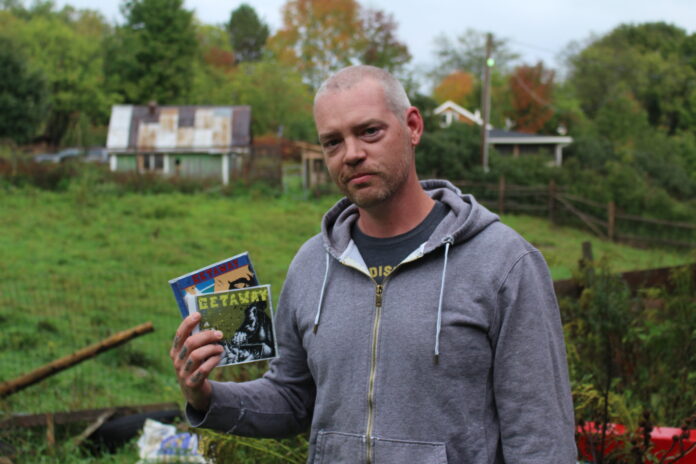
Matthew Wesley is a building inspector living amid rolling hills of trees and thick bush near Minden.
On his organic farm, he and his partner and their kids tend to goats, a few chickens, a new litter of puppies, trees tapped for spring maple syrup. In his basement, there might be a computer hard drive.
On it, guesses Wesley, might be a musical ghost. The phantom in question is a collection of digital music files.
They represent the culmination of his former life as a singer in the fast-paced world of punk rock, shredding stages from Newfoundland to Florida, sharing festival lineups with Blink182 and working with some of the biggest names in music, poised for a leap into stardom.
The 10 songs make up the final unreleased album from The Getaway, called Left for Dead.
For 15 years, it was.
Now, Wesley and his bandmates are living out a punk rock resurrection. He received word the album is being picked up by a Quebec-based record label that released it Sept. 17 across streaming platforms. “I hadn’t listened to it in a long time,” said Wesley.
He said he now dials up the tunes while driving. “I’m proud to say it really holds up!”
The Getaway arrives
Wesley was The Getaway’s lead singer, joining in 2001 when Punk was spreading like spikey-haired wildfire, connecting with a generation that felt unheard, and often let down, by the political class of the United States and Canada.
Out of Toronto, the band’s day-to-day was grinding for what could come next. “Every moment you’re like ‘how do we get to the next level. How do we book this show, who’s going to put out our next album?’” he said. Level by level, they moved up. Channeling wild energy on the stage (Wesley was known for lighting firecrackers mid-show) the band toured Canada.
They were one of the first of the genre to travel to Newfoundland, and shook the walls of high school cafeterias in Heartland, New Brunswick, parkside clubs in Halifax and downtown bars in Montreal.
The fanbase was building, their music was connecting with more and more people. They even played the Haliburton Arena, though punk rock didn’t have a huge following in Wesley’s homeland. It felt like a breakthrough was coming.
“Everyone had their own idea of how we were going to break through and make it,” said Wesley. “When you’re in a band that’s pretty much your number one, friends, family, relationships. Those all take abackseat to it. Not everyone is going to be okay with you doing that.”
Sailing through cities across the States, coming into contact with the “broken and those who’d fallen through the cracks” of the American dream, influenced Wesley’s songwriting.
With a snarling guitar, muted strumming complemented by the thumping drums, he wrote about heartbreak, growing up and coming face-to-face with injustice. The band connected with Joe Escalante, a producer with worldwide acclaim who worked with the biggest punk bands alive, including Blink-182 which many critics, including The New York Times, claim is the most influential band in punk history.
He connected them with Ocean Studio in Burbank, California, where they recorded songs and melodies.
“We really thought we were going to have an opportunity there,” he said. The producer was one of the best in the business, going on to work with the Lumineers and The Cold War Kids. “We’d seen some pretty big disappointments,” Wesley said. “It seemed that this was the next plateau and this would be a jumping-off point.”
It wasn’t.
Their record label, caught in industry drama surrounding another band, folded. But The Getaway’s record was legally bound to the label and stuck in limbo. “Everyone remembers it differently,” said Wesley. “For everyone, it was a bit of a traumatic experience.”
Wesley and his bandmates moved on. Some stayed in music, Wesley went back to school and soon embarked on a successful career in planning.
“It all stopped,” Wesley said. “There was no more gas in the tank.”
Seven hundred clicks from Minden
Anthony Grenier co-owns People of Punk Rock Records. He launched the label to support punk rock in Canada, transitioning from a Facebook page where he shared band videos and photos.
Early in 2021, Adrian Mottram, a member of the band, bought a record from People of Punk Rock’s online store.
He sent a message to Grenier and asked if he wanted to have a listen to their long-lost album. “I’m no musician,” Grenier said. “When I listen to an album it’s like I either like it or I don’t.” He listened to Left for Dead 10 times in one day.
“What we like to do is release really cool stuff. It was a good opportunity to release something which makes people go ‘wow, this is something really cool that was supposed to be released 15 years ago, but it’s out in 2021.’”
Wesley said he’s still in disbelief.
“That just never happens. We worked really hard to get record labels to notice us.
For a label out of the blue to say they really like it, they want to put it out – that’s huge. It felt like it was something that was unfinished and it was always going to stay that way,” Wesley added. Wesley said there’s been some chatter between bandmates.
Should The Getaway play some shows? Revive some of the early 2000s punk rock? He won’t rule it out, but the thought of heading on the road in a bus seems a lot less tempting when he has a family and a full-time job.
The future of the band might not be the main point, he said. ‘When I thought the only ones who remembered us were us; it’s really special.”
Jodie Langemann has spent his career mentoring young adults but now it’s his turn to receive a helping hand from Medeba, the village of West Guilford, Lakeside Church and the wider Haliburton County community.
Jodie suffered a significant stroke Oct. 19 and has been in hospital in Kingston ever since, with wife, Sarah, at his side. A GoFundMe has been established to help them with costs.
They are also accepting prayers, said Medeba executive director Steve Archibald, who has worked with Jodie for years.
From Alberta originally, Jodie “fell in love with the idea of camping as a tool to reach and train and develop young people and has spent most of his career working as a leader,” Archibald said.
At Medeba, he is the director of a Christian development leadership program known as Prosago.
Archibald said the program averages about a dozen kids a year.
He said Jodie is a big guy who seems a bit gruff at first “but he really has an incredible heart for young people and to see them develop.”
It can be a tough program, identifying wonderful things about kids but also areas where they need to grow and change. However, graduates emerge with an affection for Jodie, “because he sticks with them through that over the course of that year,” Archibald said.
“He’s willing to work with anybody. He’s got a heart that wants to see people reach their potential and is there to help them do that.”
Megan Rapley, a former student at Prosago and colleague of Langemann’s at Medeba, created the GoFundMe.
She said Jodie had been with Prosago since 2008. “In those 13 years, Jodie has impacted numerous lives, not only by his role on staff with this life-changing program, but also by making a personal investment into so many of the young people who go through Prosago and Medeba as summer staff. Before his current role as Prosago director, Jodie was involved with other programs and camps, where I am certain he had a great impact on the people that surrounded him there too.”
A lover of sports, and a gifted athlete, Jodie has a great group of friends he plays hockey and golf with, Archibald and Rapley said.
Archibald said the news came as a shock and there are a lot of unknowns about the future. Sarah declined an interview request but, via Archibald, said they welcome prayers.
“They are a family that are dependent on God for things, so they are praying and hoping for a miracle. We are looking to see what the Lord might do here, everyday giving that to God and prayer … we’ll see where that all goes for sure,” Archibald said.
“I’m hoping that people will stick around for the long-term because this could go on for months or years and what will be their needs financially or otherwise? Hopefully we’ve got people that will see the immediate needs but also will walk alongside them.”
See the GoFundMe page at gofundme. com/f/loving-the-langemanns
For more information, there is a Facebook page called “Jodie Langemann’s Journey Back.”
Haliburton County has released its roadmap for creating a community climate change action plan. In broad terms, the initiative has three stages.
The first is to develop a plan to reduce corporate emissions and next, adapt County and municipal operations for a warming world. The last stage, developing a community plan, is just getting underway.
Ads in local media encourage the public and stakeholders to sign up to join an advisory committee, focused on chatting about recommendations and next steps. “This will focus both on reducing emissions from our broader community as well as adapting,” said Climate Change Coordinator Korey McKay. “This isn’t the only group that will provide input, [but] this will give preliminary input into strategies, goals and actions.”
Apart from advisory committee meetings, she guessed online surveys might be the main way to engage the wider community. While COP26 saw global leaders discuss national climate agreements, The Highlands needs to brace for a warming world, say local groups like Environment Haliburton! and Concerned Citizens of Haliburton County.
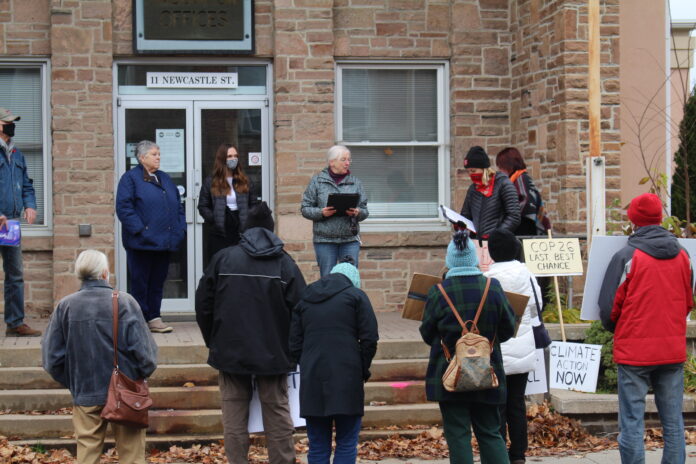
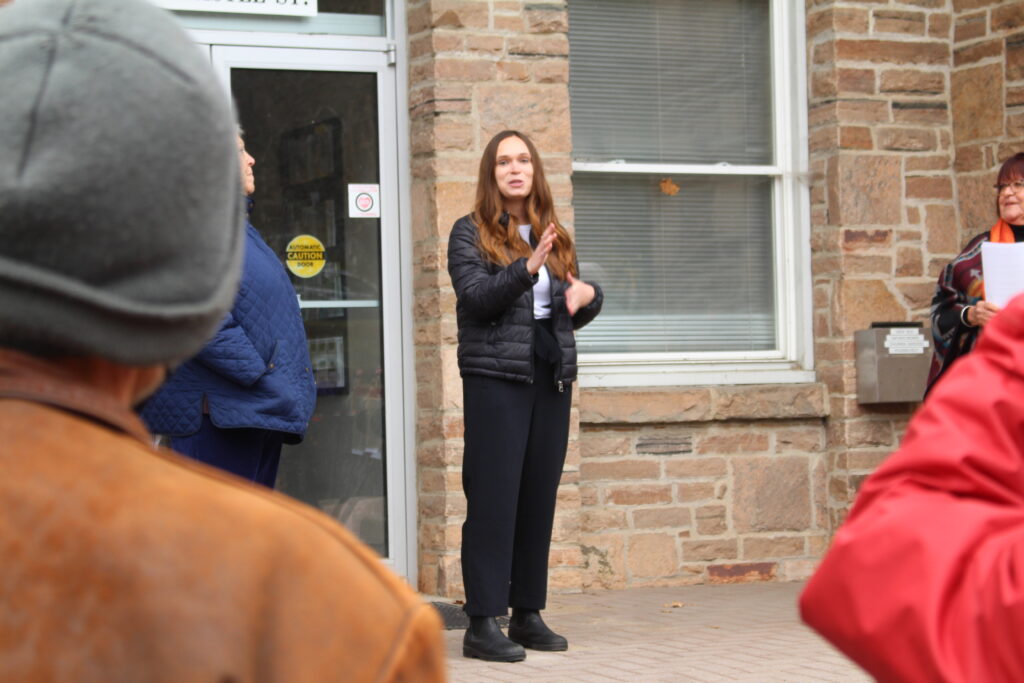
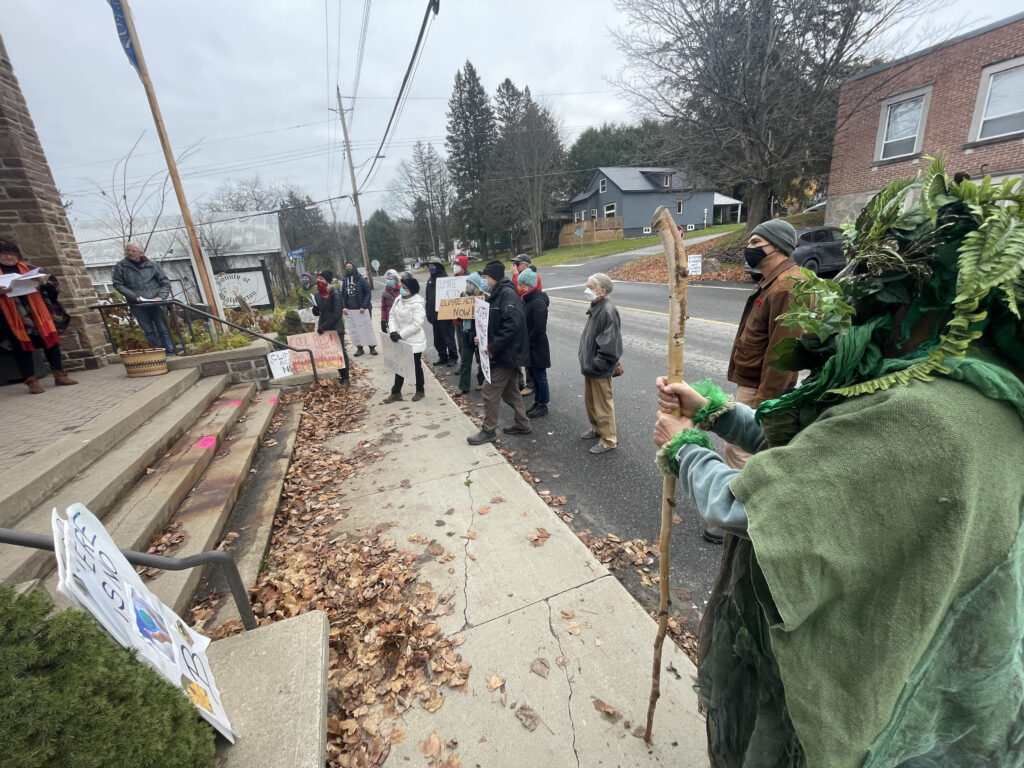
They organized a rally on Nov.5, where 15 people gathered to ask questions and raise concerns about climate change on the front steps of the County’s offices. Warden Liz Danielsen, Dysart Coun. John Smith, climate change coordinator Korey McKay and CAO Mike Rutter attended the rally. “Local leaders play a vital role in turning pledges into action,” Carolynn Coburn of EH! and CCHC said at the gathering. Danielsen, addressing the crowd, said “we really are in a bad spot when it comes to climate. We need to make a change here in Haliburton.”
The County has spent the past year and a half, with the help of McKay, educating municipal councils on how climate change will impact the Highlands, and how the Highlands’ emissions are contributing to the crisis.
Assessing the damage
County Climate Change Coordinator Korey McKay answers questions about the County’s climate strategy.
During Minden Hills’ Nov. 11 council meeting, councillors listened as McKay explained the County’s plan.
She has a lot of practice: attending Zoom meetings for all four municipalities, explaining the process of collecting greenhouse gas emissions information and outlining ways all four townships and the County could cut back. Strategies for reducing the County’sfootprint hinge on McKay’s community greenhouse gas inventory, the first of its kind to be conducted in the County.
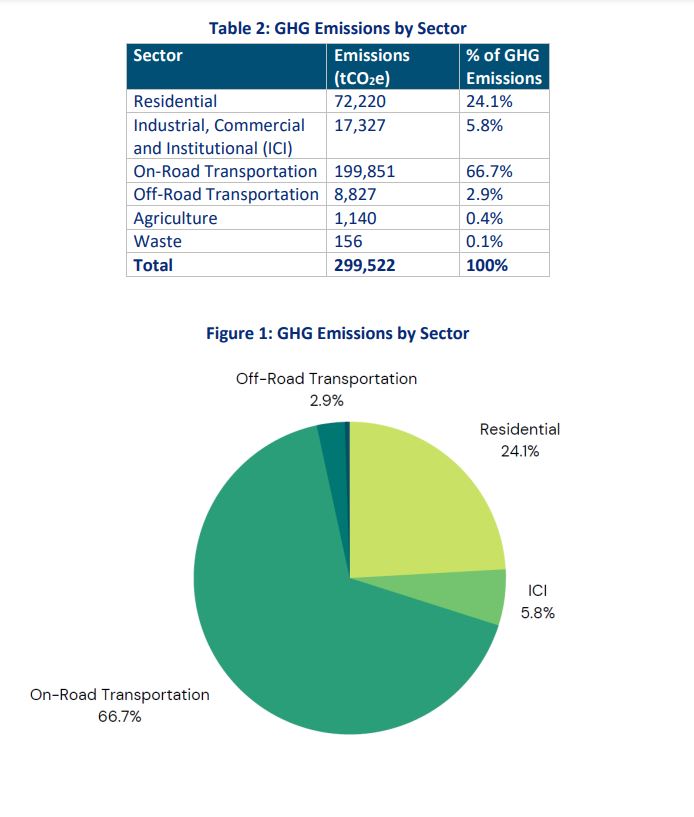
A greenhouse gas inventory is an estimation of the emissions that Haliburton produces: 299,522 tonnes of carbon dioxide in 2019, out of Canada’s total output of about 582 million. Per capita emissions in the county is 7.6 tonnes a year per person; lower than the provincial average of 11.2. Driving is the largest emitter in Haliburton, accounting for an estimated 199,851 tonnes of carbon dioxide, a figure obtained by calculating average road usage in areas around the county. All lower-tier governments, as well as the County, are on board with a plan to reduce their corporate emissions below the 2018 baseline by 30 per cent by 2030.
“My work is really to investigate the impacts locally, and what we contribute locally. Seeing those numbers really helps to localize the issue,” said McKay. “In tandem with creating a plan is also having an educational piece; why climate change is an issue and what are the co-benefits that we can realize when we implement a climate change plan.”
From the County of Haliburton’s Community Greenhouse Gas Emissions Inventory. County of Haliburton.
There’s broad scientific consensus that warming temperatures will impact life in Haliburton. As McKay’s report states, annual precipitation will increase, along with the likelihood of flooding. In 2013, floods in Minden caused an estimated $571,000 in private residential damages.
Frequent winter storms could prove disastrous in a county with many hard-to access roads and isolated communities with little or no cell phone reception.
That’s a future which many in the County fear. “There were people stranded for weeks…” in parts of Ontario and Quebec, said Coburn, talking about an ice storm in 1998 that caused 34 deaths in Quebec and Ontario. “In situations like that, we’re going to have to depend on people within walking distance, our neighbours.”
For Coburn, the issue of climate is local: if municipalities and counties don’t step up, federal initiatives will flounder.
The Europe-based Climate Alliance, a network of cities fighting climate change, said municipal action can lay the foundation of change. “Municipalities can engage their residents to contribute to the fight against climate change in their everyday lives, be it in terms of consumption patterns, lifestyle choices or ways of doing business,” they write on their home page. Municipalities can also chart development and urban expansion.
Near Haliburton, Grass Lake cottagers are rallying to protect a private stretch of wetlands that could be turned into condominiums. “We want to protect this land and, ultimately, protect Grass Lake,” organizer Carolyn Langdon said in a prior interview.
Wetlands such as the Dysart property play a vital role in fighting rising temperatures. The County is home to part of the Highlands Corridor of provincially significant wetlands, zones that act as carbon sinks and are also shown to help mitigate flooding.
While blanket wetland protections fall outside municipal jurisdiction, conservationists are taking action.
Spearheaded by the Haliburton Highlands Land Trust (HHLT), there’s a growing coalition of private property owners signing up to protect areas of wetlands on their properties.
“Natural solutions can help to mitigate impacts like flooding and drought, conserve biodiversity, protect ecosystem services, connect landscapes and capture and store carbon,” said HHLT chair Shelley Hunt in September. “Canada has committed to protecting 30 per cent of our landscape by 2030. In Ontario, only 10.7 per cent of our landscape is currently protected.”
Decision with ‘an eye to climate’
The Green Man, right is a costume created by EH! to represent animals and natural life that doesn’t have a voice in climate conversations but is disproportionately impacted by climate change.
“My question is: why the reluctance to declare a climate emergency?” EH! President Susan Hay asked Warden Liz Danielsen at the rally.
In 2019 council voted against the declaration, with some councillors saying at the time it was premature given they had no road map for handling the issue. “I really feel that the message that conveys to the community is not a good look,” Hay said.
Danielsen replied: “I can’t disagree with you, but I also cannot answer for the rest of County council. It’s a group decision and it’s not mine to make.”
Haliburton’s neighbour, Muskoka, recently declared a climate emergency in tandem with Gravenhurst and Huntsville. They also implemented a 50 per cent reduction goal by 2030. That’s a steeper climate change goal than the Highlands.
“We set targets we know we can accomplish,” said Danielsen. “I think we’re on the right track.” Coburn said she sees the County taking the issue “more seriously than in the past. However, she added, “I’d like to see more talk about it, I’d like to see them making decisions with an eye to a changing climate.”
That’s what Lauren Phillips would like to see too. The Haliburton Farmers Market coordinator moved to the County in 2020.
She said climate action “starts from the ground up.” Despite forecasts of a difficult climate future, Phillips said she wants to be able to tell future generations “I tried my best. I did my best to have a voice and make it heard.”
A rotting issue
Many tonnes of compostable waste end up in municipal landfills around Haliburton. File.
“It breaks my heart,” Oliver Zielke said loudly, his voice ringing out over the crowd facing Danielsen, Rutter, McKay and Smith. He was asking about composting. Or, specifically, why no municipality within the County offers composting services to commercial facilities, multi-residential buildings or individual residents.
While a waste audit, scheduled in Dysart and Minden Hills this year, will provide a clearer picture, a large amount of compostable waste ends up in landfills.
In Dysart alone, a 2019 staff report estimated 667 to 1,111 metric tonnes of residential food waste ended up in the dump. Townships have developed composting initiatives, like the FoodCycler indoor composting unit program that Dysart and Algonquin Highlands recently endorsed. While landfills only account for about five per cent of Haliburton’s emissions, Zielke pointed to the long distances Haliburton waste travels after it’s pitched. For example, Dysart’s garbage is sent to Orillia, then transferred to Watford, nearly 500 kilometers from Haliburton.
In an email, Dysart environmental coordinator John Watson said this is because the Dysart landfills don’t have “environmental safeguards” in place to mitigate methane gases produced by waste.
A path forward
The majority of Canadians believe climate change is a present threat, according to a Research Co. poll. The Highlands’ recent shoreline preservation bylaw exposed fractures in how the community wants to deal with it.
For Leora Berman of The Land Between, the shoreline preservation draft process was a good first step in protecting lakes and wildlife habitats as temperatures rise: what’s needed, she said, is more community involvement.
“The county has shown leadership recently with the shoreline bylaw,” she said. “The issue is they haven’t done the consultation and education necessary. If they do the consultation and education and consider the constituents partners with them, they’ll do a great job.”
While the County hosted two virtual openhouses on the shoreline bylaw, anger from the bylaw’s opponents and misinformation spread primarily on Facebook has dismayed members of council. “The divisiveness and infighting amongst friends and neighbours, I’ve never seen anything like it,” Algonquin Highlands mayor Carol Moffatt said at an Oct. 27 meeting.
Warden Liz Danielsen and Terry Moore of EH! reported they’ve received threats and verbal abuse in relation to the bylaw. Even throughout EH! And CCHC’s other events throughout the year, Coburn said many in the County seem misinformed about climate issues or quick to dismiss activists.
“We’re all regular people, there are some people who call us extremists,” Coburn told the crowd. “We care about nature and the future of humanity.”
County of Haliburton taxpayers are so far looking at a 3.53 per cent tax rate increase for 2022 after the first draft of the budget was tabled at a Nov. 10 committee of the whole meeting.
It represents a $956,952 increase on 2021, for a total levy of $20,878,587, up from $19,921,635 Director of corporate services, Andrea Bull, said the hike is largely the result of increased service delivery along with wage and insurance jumps.
Bull said the budget was being aided by a 1.01 per cent increase in assessment growth per MPAC Some of the challenges include an estimated five per cent increase in employee benefits; a 15 per cent jump in insurance costs; contributions to the health unit going up by five per cent; a decrease in Ontario Municipal Partnership Fund grants and the high price of fuel.
There will be additional staff, including, in the service delivery review, such as the new director of economic development and tourism and a procurement coordinator.
There’s more money to increase staffing at the Tory Hill ambulance station and purchase two new ambulances, a pay equity, market, job evaluation review and increased service levels at libraries.
New chief librarian Chris Stephenson wants funding to hire a new staff, as well as to offer sick pay to part-timers. The budget also includes wages for new staff if and when the County passes its draft shoreline preservation bylaw.
The estimate is $220,581 to take effect the second quarter of 2022. It would add three staff for permitting and in the field work.
However, councillors suggested that since they are not meeting until Jan. 17, 2022 to look at the draft again, that budget line item could decrease.
Overall, County council said it was pleased with the first draft. Warden Liz Danielsen said the budget was “a lot more reasonable as a starting point than I thought we would be looking at.” CAO Mike Rutter thanked staff for their hard work, saying the first draft was done during a time of employee transition, with a lot of new faces at the table, as well as new accounting software. He said it reflected a changing community, including more investment in housing, affordable housing in particular, climate change, growth, additional staffing in EMS and economic development.
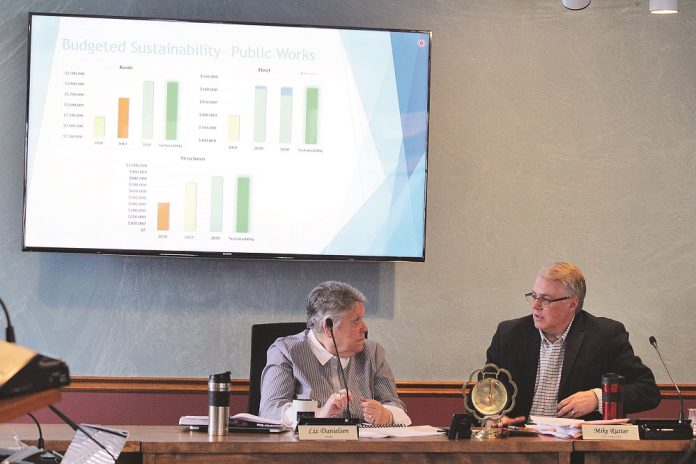
Bull said that with a goal of sustainability, the first draft would see a little over $2.4 million transferred from reserves, leaving the County with about $5.5 million at the end of 2022. Director of public works, Robert Sutton, has estimated they will need to complete $3,316,000 in roadworks to remain sustainable.
He added structure projects, or bridges and culverts, would need $5.1 million. “A loan of approximately $5.1 million is proposed in order to deliver priority projects as per the 2020 OSIM (Ontario Structure Inspection Manual). Securing a loan in 2022 would ensure taking advantage of current low interest rates,” he said.
He’s also asking for $618,000 to boost the municipal fleet.
At the end of the budget meeting, Bull said, “We worked hard to achieve sustainability in most service areas. We are almost there, just a few left to go.” Coun. Brent Devolin said, “It felt like a second or third draft. It has a mature feel to it right out of the box. It may not take so many bounces to get to the final product.”
Updates will be provided to council at December and January meetings, with adoption expected in January or February.
The temperature rose gently into a November comfort zone last Thursday as people gathered across from the Cenotaph in Haliburton.
As I walked up from the parking lot, the colour party and band were proudly marching down Highland Street to the annual community Remembrance Day ceremony. A smaller than usual crowd was on hand to pay their respects, but, considering concerns about COVID-19, it was perhaps a better than could be expected turnout.
As I glanced around I could see that most people were masked and making an effort to distance themselves from others not in their group. Before the formalities began, I noticed an unmasked man standing near the curb holding a tall piece of plywood on which he had scrawled a message.
It was an anti-mask and vaccine passport screed that riffed off the remembrance theme of the day. Initially I was upset to see the protest board. I was angry because I disagreed with the thrust of the message.
Masks and vaccinations have saved hundreds of thousands of lives and made it safer for all citizens in our community and country. These are things we do for ourselves and our community’s wellbeing.
As I have stated before in this space, I believe in the science that provides the basis for these and other measures to keep us healthy. Secondly, I thought: not here, not at this memorial for the community veterans who died for this country, in two world wars, and those who served and returned home.
I always thought of the Remembrance Day ceremonies as having the solemnity worthy of the sacrifices by the men and women of our armed services. It is but a brief moment every year when we pause to reflect, offer thanks, to remember. The occasion deserves a moment, undisturbed.
The presence of the sign was offensive to me. It reflected poor judgment and lack of respect for the day. The ceremonies, including the reading of the names of those from Haliburton County who died in the two great wars, The Last Post and the prayers, unfolded as it always does. Beyond propping up the sign, as far as I could see, the man made no other effort to inject his illinformed message on those of us who had gathered last Thursday.
Driving home I reflected on the moment and wondered what our fallen soldiers might have made of the display. I am sure, they would have been dismayed and angered by this intrusion….that the ceremony was too important and personal for this type of intrusion.
They would have trouble reconciling why they risked or lost their lives to allow the imprudent dissemination of information that could potentially result in even more casualties. I imagined them thinking, not here, not now.
Winter is coming, and with it the threat of dozens, if not hundreds of Haliburton County residents quite literally being snowed in and stranded at their homes.
In last week’s edition of the paper, I reported on one local’s concern over the lack of snowplowing options available in the Highlands. Since then, I’ve heard from several more who have been told that their regular operator will not be returning to provide snow removal services this year.
The issue boils down to insurance. Ahead of this latest season, premiums for those in the snow removal business increased exponentially. One operator, who wished to remain anonymous, told me he would have to fork out in excess of $65,000 if he wanted to get insurance for the upcoming season.
That after paying around $3,900 in 2020. Essentially, this increase has priced pretty much every small-time operator out of the game. While this in itself raises many red flags, the real issue is that there’s nobody there to pick up what’s being left behind.
Many of the large operators in the Highlands are already running at maximum capacity, and simply aren’t able to take on new clients. This is leaving many rural residents with a pretty significant problem.
There are a lot of roads sprinkled across Haliburton County that aren’t maintained by local municipalities during the winter. These seasonal thoroughfares have traditionally been tended to by private contractors hired by homeowners to ensure they are able to get in and out of their properties.
Unless something is done between now and our first significant snowfall, many of these residents are going to be trapped inside their homes. Aside from being pretty inconvenient, this also raises several safety concerns.
What happens if, say, there’s a fire at a home on one of these roads, but a fire truck can’t get down there to put it out because there’s two foot of snow on the road? What if one of these residents has a medical emergency and requires an ambulance?
It was rather disappointing last week when some members of Dysart council, after briefly discussing this issue, seemed to shrug their shoulders and absolve themselves of any responsibility over this issue.
While the municipality may not have a legal obligation to step in and try to solve this problem, surely from a moral standpoint they have to do something.
It’s their job to deal with issues like this when they come up.
Coun. John Smith says there is currently around 30 kilometres of rural roads with residences on it that don’t receive snow plowing privileges from the municipality. I’m sure there’s at least that much again spread across Algonquin Highlands, Highlands East and Minden Hills. Dysart has requested a report on this issue be brought back to council for consideration at a future meeting, but it’s unlikely that it will include any tangible solution.
It should be noted, that report is in relation to municipally-owned roads only.
There’s nothing at all being suggested or proposed for privately owned roads. Considering a significant part of our economy depends on people being able to access private roads to get to their properties over the winter, perhaps this is something council should be looking into. Because if we take away the money that these people spend in our restaurants, in our local businesses and at recreational facilities such as ski hills, then many entrepreneurs – most of whom are only just getting back on their feet after closures brought on by the pandemic – will find themselves in a precarious position.
So we find ourselves at something of a crossroads.
Yes, coming up with a plan to deal with this so late in the year will be complicated, and I’m sure the costs will be significant. There’s likely no silver bullet solution, but there have been a few ideas raised that don’t seem to be outside of the realm of possibility.
Perhaps council(s) could look into taking some of these smalltime operators on as seasonal contractors, perhaps they could offset some of the insurance costs.
There is an opportunity to be creative here, to find a solution that suits all parties. That, ultimately, should be the goal.
It’s a municipal council’s job to tackle these kind of potential economy-crippling situations when they arise.
And, honestly, when the alternative option is simply leaving people in the lurch in such a way that endangers their safety, surely there’s only one path forward. To me, it should be a clear one.
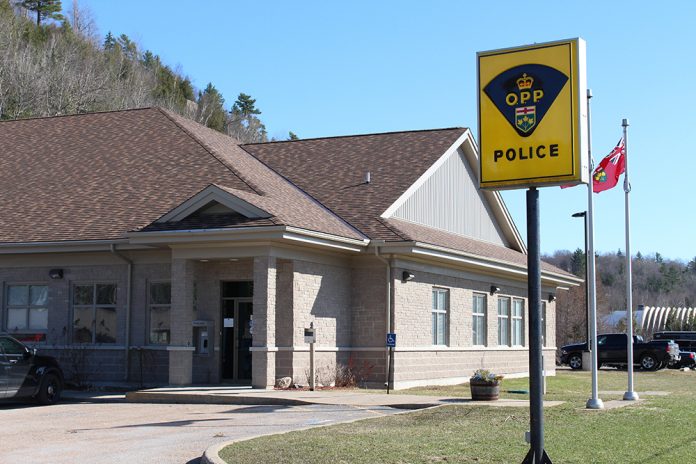
Police have arrested three people in connection with an ongoing investigation into a theft and drug ring. File photo.
Police are investigating after a fifth wheel camper trail was stolen from a Loop Road residence on Nov. 11, 2021.
Bancroft OPP officers received the report of a theft from a property on Loop Road in the Municipality of Highlands East. In a press release, Officers reported the trailer was stolen between 12:00 p.m. and 1:00 p.m.
Police request anyone with information about the theft should contact the Ontario Provincial Police at 1-888-310-1122.
Should you wish to remain anonymous, you may call Crime Stoppers at 1-800-222-8477 (TIPS), where you may be eligible to receive a cash reward of up to $2,000
HKPR District Health Unit and Ontario government are bringing the GO-VAXX bus to Wilberforce Sunday, Nov. 21, from 10 am to 4 pm at the Lloyd Watson Community Centre (2249 Loop Road).
The GO-VAXX bus is a retrofitted GO bus that serves as a mobile COVID-19 vaccination clinic.
“We’re very pleased to see the vaccination clinic on wheels roll into Haliburton County to provide vaccine and encourage anyone still needing their first, second or third dose to get on board and receive a shot,” said Doreen Boville, HKPR health promoter.
According to Boville, the mobile clinic might be back in Haliburton County in late November or early December.
The health unit issued the following reminders for anyone visiting the mobile vaccination clinic:
Bring your health card. If you do not have a health card or your health card is expired, bring another form of government photo ID such as a driver’s licence, passport, Status card, or birth certificate.
Ensure you are eligible if you are wanting to receive a third dose. Currently, people with moderately to severely compromised immune systems can get a third dose. Booster doses are also available for people 70+ (born in 1951 or earlier), Indigenous adults and adult non-Indigenous household members, health care workers or essential care providers, and individuals who received a full series of AstraZeneca/Janssen vaccines at least six months (168 days) after their second dose of vaccine. Click here for full eligibility information.
Eat and drink something before you arrive to prevent feeling faint or dizzy while being vaccinated.
dress for the weather in case there is a line-up. Be sure to wear clothing that allows for easy access to the upper arm such as a loose-fitting top or T-shirt.
Wear a mask that covers your nose, mouth, and chin.
Do not visit the GO-VAXX bus if you have symptoms of COVID-19.
Two people who drowned on Moose Lake, Nov. 7 have been identified.
On Nov. 15, an OPP press release identified a 25-year-old and 22-year-old from Toronto. The victims’ families request their names not be shared publicly.
A third person safely reached the shore.
An OPP press release said an “absence of safety equipment as a significant contributing factor in this tragedy.”
On Nov. 7, at approximately 10:26 a.m., members of the detachment responded to a report of a capsized canoe on Moose Lake in Dysart et al. It was reported that three adult males entered the water.
Officers attended the scene with Haliburton County Emergency Services and the Dysart et al Fire Department. One of the adult males was able to safely make his way to shore and was uninjured.
This investigation was assisted by the Underwater Search and Recovery Unit, as well as Technical Collision Reconstruction investigators.
The Haliburton Highlands OPP say they encourage boaters to review all safety requirements for boating before going out on the water.
Editor’s note: A previous version of this story identified both victims. After receiving a request from one victim’s family representative The Highlander has chosen to remove their names.