Home Blog Page 235

Library strategic plan won’t sit on the shelf

0

“Committed to empowering your community.”

That’s the newly-defined tagline of the Haliburton County Public Library, approved by the library board Oct. 12 and part of the library’s new strategic plan, which has been in the works for over a year. It will guide the service throughout the next five years, determining what is offered and more.

It’s set to be launched publicly late this year, including a new mission statement and actionable steps the library service will take to achieve its goals.

“A lot of work went into this and a lot of people need to be thanked for the hard work,” said CEO Chris Stephenson.

The plan is formed through interviews with staff, stakeholders and members of the public. Dozens of pages of statistics about library use helped determine, “what aspects of the library matter to our patrons and community members, and we better understood the demographics that use and enjoy our services and programs.”

That’s translated into five strategic objectives: communicating the library’s value as a community hub and safe gathering space; building and maintaining bridges to new and existing partners and patrons; advocating for the library and connecting with the community in a strategic way; developing staff careers and working to strengthen the library internally; and establishing consistency in services across all branches and exceeding expectations.

These objectives are all linked to tangible action items.

For instance, to advocate for the library, the service will begin “pop-up” programs to answer a need for more visibility and geographic flexibility.

“I’ve been involved with lots of strategic plans in my time,” said board member David O’Brien. “This document is smooth, to the point, effective and understandable about what we’re trying to do as an organization. Well done.”

Stephenson insisted the strategy will be visible throughout the HCPL.

“It shouldn’t be consigned to a binder on a dusty shelf somewhere, it’s a living document,” he said. “It should reflect the people who read it…that’s the next step, to launch it to the public.”

Hwy. 118 work continuing to fall 2023

0

Work to repair a portion of Hwy. 118 in Haliburton won’t be complete until fall 2023, according to Ministry of Transportation (MTO) officials.

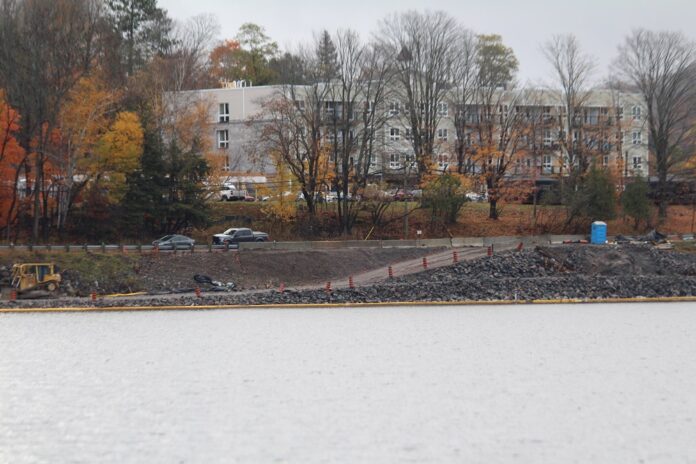
The project, which began in July, is focused on restabilizing the roadway in front of the Gardens of Haliburton residence. MTO spokesperson Dakota Brasier said work is progressing and will continue throughout winter.

“Hwy. 118 from Carnarvon to Haliburton is currently being rehabilitated. This work includes pavement rehabilitation and slope stabilization and improvements to intersections, drainage and guiderail,” Brasier said in an email. “Slope stabilization is currently underway in the Head Lake area.”

There was some concern locally when workers contracted to complete the job removed trees and installed a temporary roadway between Hwy. 118 and the Head Lake shoreline. Brasier said workers needed to create a safe access way to the slope to install a benched rock slope, which she said will ensure the future viability of the road.

“This was all necessary to stabilize the highway. The benching will become a permanent part of the final slope stabilization. The stabilized slope is constructed of rock fill, which will control erosion,” she said.

The temporary roadway will be removed once construction is complete. Brasier said trees will not be replanted in the area.

There will also be a new permanent 1.5-metre-wide extended curb installed along the highway, connecting to an existing pedestrian walkway that runs up Hwy. 118 and around to Maple Avenue.

Dysart et al deputy mayor Pat Kennedy held talks with MTO officials Oct. 14, enquiring about MTO leaving a stone thoroughfare they’ve installed along the shores of Head Lake in place.

“I think it would be really nice to have a bit of a boardwalk there around the lake,” Kennedy said. “You couldn’t walk on it right now, something else would have to be done for it to be usable. It would be a project Dysart would have to take on, something for a future council to consider… but there would be grants available [from the federal and provincial governments] that could fund the project.”

He’d like to see that strip eventually connect to the rest of Dysart’s trail system surrounding Head Lake.

Hwy. 35 construction

Anyone who has travelled south along Hwy. 35 over the past two years has had to contend with extensive roadworks at Miners Bay and Moore Falls. According to Brasier, both of those projects will be completed this year.

“The work at Miners Bay includes rehabilitation and replacement of an existing concrete culvert, together with accompanying retaining walls. The entirety of the culvert length was waterproofed and existing guiderail was replaced. New pedestrian handrails were installed on the retaining walls and permanent erosion protection is included on the downstream slopes of the creek,” she said.

Miners Bay Road, closed on one end to Hwy. 35 for the duration of the project, has been open since early September.

Construction along the bridge at Moore Falls has been extensive, and includes deck and bearing replacements, waterproofing, paving of the new bridge decks and installation of a new sidewalk, barrier walls and guiderail. Work has been ongoing since 2020.

Short-term rentals return to County table

0

Dorset cottager Peter Willmott and other neighbours of short-term rentals (STR) in the region will be watching County council Oct. 26 as talk of regulations return.

CAO Mike Rutter told The Highlander it is staff and consultant, J.R. Richards and Associates’, plan to have a final report on next Wednesday’s council agenda.

Willmott said there are seven short-term rentals on his road of 12 properties, including one next door impacting his quality of life.

He had planned to retire to Algonquin Highlands but has limited his stays in Dorset with the arrival of a next door, commercial short-term rental that can accept 10-12 guests. He said they are dealing with cars in a shared driveway, noise, lack of knowledge about fire bans and water safety, and a general dearth of cottage etiquette. He added an essentially transient population is coming for a weekend or week and not contributing to the fabric of the community.

“We have modified our cottage usage from Victoria Day until Labour Day to avoid all these hassles,” Willmott said.

The cottager, who went to college for urban planning and worked in the real estate industry for 40 years, is also worried about the impact of short-term rentals on the Highlands housing market. “It is driving up prices, which limits opportunities for local people living and working in the community, to find housing.”

Lake of Bays bylaw two years in the making

To date, he is happy the County is considering regulating the industry but thinks designating certain areas for short-term rentals, via zoning bylaws and official plans, is important. He thinks there has to be a clear definition of what a short-term rental is. He can live with a person leasing three to four weeks a year but if full-time, said they should be treated like hotels and motels, and be taxed accordingly.

“If I put a hotdog cart at the end of my driveway and started selling hotdogs, the municipality would come right away and say ‘you’re not allowed to do that commercially’ and shut me down. Meanwhile, my neighbour is running a commercial short-term rental with no regard to that,” he said.

“While the County has stepped in and started this process, there’s fine tuning to do.”

Work to date

During an Aug. 10 council meeting, the consultants recommended a phased approach to regulating, beginning with registration. They said it would provide a snapshot of the situation in the County and municipal enhancement required to implement a bylaw. They added between registering and licensing, the County and its municipalities would have time to review capacities and update applicable municipal bylaws.

The consultants looked into what a number of towns and cities are doing, including Bracebridge, Trent Lakes, Lambton Shores and Fort Erie. They also talked to Airbnb, the Haliburton Kawartha Lakes Housing Corporation, Environment Haliburton! and representatives of the local cottage rental and maintenance industry, as well as economic development and tourism. About 1,500 people responded to a survey.

Most councillors expressed interest in a phased approach, beginning with registration then licensing. Coun. Brent Devolin said he thought Lake of Bays, “has done a wonderful job. I’m ready to copy and paste what they have and tweak it so it’s relevant to our area.”

Lake of Bays regulates STRs through a bylaw, and they’re permitted in various zones identified in the zoning bylaw. The township issues three classes of STR license, based on the number of STRs operated by the same owner, total number of nights rented per year, minimum number of consecutive nights of stay, and maximum number of occupants per STR.

Licensing fees there range from $250 to $750. Occupancy allows for two people per sleeping area and one parking space per guest room.

County council discussed two people per bedroom, to ensure septic capacity. They also leaned towards one parking space per bedroom with a parking management plan.

With accessory and dwelling units, such as people renting out bunkies and garage lofts, council felt they needed more time to investigate.

When it comes to enforcement, council would like STR owners to designate someone to be on call 24/7 for issues. They so far like the idea of demerit points and fines.

To date, councillors have said “no” to shortterm rentals having to be zoned. Council said they’d license all STRs and not grandfather any.

Lake of Bays model

Lake of Bays director of building and bylaw services, Stephen Watson, said their bylaw has been two years in the making.

They hired a third-party contractor, Granicus, to help them locate advertisements for STRs in their area. He said there are more than 200. Granicus then sent letters to owners about registration and licensing.

Lake of Bays also hired a short-term rental co-ordinator. Watson said that person deals with licensing applications, answers general questions and does site visits, so bylaw staff do not have to.

When it comes to complaints, he said people can email, text or phone Granicus 24 hours a day. The company gets in touch with the person deemed contactable for the property under licensing.

“If it’s a noise complaint, Granicus will contact that person in one hour and say ‘we received a noise complaint at your short-term rental at this address. Can you please address it’.” He said the issue is usually resolved at that point with no need for bylaw.

The Dwight-based director said the cost so far is reasonable, with Granicus charging just over $15,000 annually, including a 24-hour hotline, and the co-ordinator costs under $100,000.

Watson added he’s more than happy to share Lake of Bays’ formula with the County of Haliburton.

“If they want, they can call us. We don’t like to advertise our oops (mistake). We can tell them where we think we could have done better.” He said they’ve had seven municipalities reach out to them to date.

“I think we’ve done a pretty good job.”

Study reveal to bring arts centre ‘into focus’

0
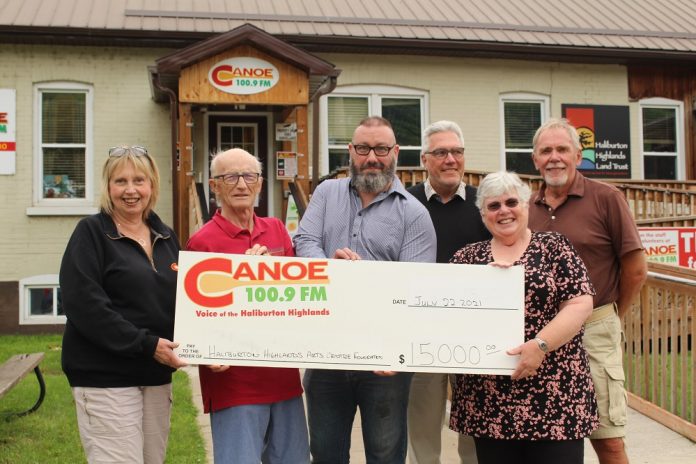
Support from local businesses and organizations such as CanoeFM funded the feasibility study.

The Haliburton Highlands’ Art Centre Foundation (HHACF) is set to unveil a feasibility study, charting the path towards a performing arts centre in Haliburton County. Janis A. Barlow and Associates, consultants who’ve spent months preparing the report, will present it at the HHACF’s AGM Oct. 27 at the Bonnie View Inn.

It will include a rundown of possible locations of a large-scale arts centre, as well as an in-depth analysis of an arts centre economic impact to the surrounding area, possible uses for the building, management models, expected customer base, community usage forecasts and more. “That brings into focus a dream that was pretty big and pretty vague,” said HHACF chairperson Daniel Manley. 

“It’s a vital step towards fundraising and further engagement with local political leaders to bring the project to life,” he added. “Government funders want to see a business plan. They want to see the thing being researched, and private donors want to see this legwork being done as well,” Manley said. 

He added the study will feed another that is set to dig into fundraising models that might get shovels in the ground. 

On Sept. 26 the HHACF announced The Dennis Group will conduct a fundraising feasibility study and campaign plan. The company recently worked for the Canadian Canoe Museum in Peterborough, managing a fundraising campaign with a target of $45 million. Not only will the feasibility study cater to more focused grant-writing and township council meeting presentations, but it will give Highlanders a glimpse into where such a centre could be located. 

HHACF board members accompanied Janis Barlow and Associates consultants to numerous spots around the Highlands that could offer potential sites. 

More than music With a large-scale indoor performing arts centre, the HHACF say the Highlands is better positioned to attract bigger performances. However it wouldn’t be reserved for concerts and plays. Board member Michael Clipperton said the feasibility study also goes into detail about technical requirements for the space and how it can be best outfitted for multiple user groups. “It’s about building the community,” Clipperton said. “This building is not just for Minden, not just Haliburton, but the community at large.” 

He said he previously joked it could be used for bingo but now, seeing the feasibility study, “it’s not unrealistic,” he said. Drew Allen, also a board member, said he was similarly inspired by how the study expands the scope of what an arts centre could provide the Highlands. “Now, listening to the consultants and talking to other members of our board and stakeholder groups, I can see probably another 10 or 15 uses I didn’t think were there,” Allen said. 

The board said an arts centre would impact all of Haliburton County, not just those involved in the arts. “Tourists who come here are a captive audience,” said Allen. “They have money to spend and time to spend it and are looking for things to do. A performing arts centre will answer that need.” 

The public can register for the in-person meeting online via hhartscentrefoundation.ca/agm

The Haliburton County Election Guide

0

Click the cover to read


The Highlander has spent the last few weeks interviewing each candidate running for election about top issues facing Haliburton County.

We’ve compiled all our profiles in this PDF document with the goal of providing you with the information you need to make an informed decision on election day or whenever you vote online or by phone.

You can listen to each interview too: check out What are we doing?, The Highlander’s new podcast. Click here.

A productive term for councils

0

It’s been a wild, four-year ride for Haliburton County’s current crop of elected officials. With this term coming to an end, I looked at some of the key decisions that have been made across the four lower-tier townships and at the County level. 

I was surprised by how much has been accomplished, especially when you factor in the pandemic and all the implications that had on municipal operations. 

Still fresh in people’s minds, the new shoreline preservation bylaw adopted by County council in August was years in the making. 

The process began during the previous term, and while discussions were delayed during the early stages of the pandemic, council was largely united in ensuring legislation protecting lands abutting our 600-plus lakes was pushed through. The final document isn’t perfect but will serve as a benchmark for future councils to improve on moving forward. 

They’re also starting to ask questions about short-term rentals, a long-term problem in the Highlands. It will be interesting to see where things land; it’s expected a new bylaw regulating their use will come forward next term. The County also made moves to protect the natural environment, adopting a new climate change action plan and hiring someone to look after the file full-time. 

Progress has been slow in Minden Hills, though the township did celebrate the unveiling of the new S.G. Nesbitt Memorial Arena. Staffing issues have plagued the municipality for years, though under new CAO Trisha McKibbin, things seem to be turning around. While there was excitement in 2020 following the announcement of a new $6.8 million affordable housing development on Hwy. 35, that project is still yet to break ground. Once completed, it will bring multiple new rental units to the community.

Development has been a key focus in Dysart et al. Council agreed to donate land on Wallings Road to local non-profit Places for People for the creation of a new affordable housing complex, while also approving a 21-unit build on the corner of Victoria Street and Maple Avenue in Haliburton village. 

The municipality also voiced its support for a proposed 88-unit development on Peninsula Road, overlooking Grass Lake. 

There was a heartwarming moment this term, too – following excellent work from a group of students from J.D. Hodgson Elementary School, council agreed to immortalize athletes Taly Williams and Lesley Tashlin with murals on the community’s sports wall of fame. The siblings lived in Haliburton in the 1980s and attended HHSS. Algonquin Highlands was able to maintain its zero-debt policy even throughout the pandemic, which is to be commended. 

The municipality also completed its septic reinspection program and agreed to draft a new bylaw allowing green burials at St. Stephen’s Cemetery. Work on that file is still ongoing. In Highlands East, a big community win has been the redevelopment of Herlihey Park. Council also resisted calls to centralize its library and fire services into one location, which, for a community of its size, is probably a shrewd decision. 

No council ever accomplishes everything it sets out to, but I think each one brought about reasonable improvements to their community over the past four years. There’s still much to be done, and the region’s next councils will have their work cut out for them finding solutions to long-standing problems surrounding housing, transportation and labour. We’ll be watching. 

Dysart et al, ward 4: Carm Sawyer

0

Listen to the full interview: click here.

Qualifications 

Carm Sawyer is a mechanic and has owned West Guilford Auto Centre for more than 20 years. He has volunteered on several community boards, including the West Guilford Community Centre and the fireworks committee. He is also a former member of Haliburton Rotary. “I know a lot of people and I talk to a lot of people – that would be helpful if I’m going to help this community.” 

Issues in Dysart et al

His main issue is the shoreline preservation bylaw, passed by County council in August. “Everybody is so misinformed, and they have no idea what this new bylaw really means. We didn’t need another bylaw. Nobody is enforcing the tree cutting bylaw we have in place now, so they’re wasting all this money to put another bylaw in, that again, won’t be enforced.” 

Amalgamation

Sawyer said he didn’t have enough information to make an informed decision over whether Haliburton County’s four lower-tier municipalities should come together to form one single-tier government. “I don’t think it’ll work, because there’s just too much geographic area, it would spread people thin… I’d need to look into it more to give a definitive answer.” 

Health 

“Maintaining two hospitals is very important. If you’re in West Guilford and need to get to the hospital, it’s a lot quicker going to Haliburton than Minden.” He doesn’t believe the township can do much to attract more healthcare workers to the community. “It’s no different than any other business… This is a huge problem across all Ontario. There just aren’t people there for the job. So, I don’t know how we’re going to fix that.” Housing “I don’t think there is a solution. It’s not just Dysart that has this problem, it’s every community Ontario-wide and Canadawide. I don’t know how we’re going to fix it. We can rally for affordable housing, but council would need to work together. This isn’t a one-man thing. We all need to put our heads together. I’m hoping that as a council we can all sit down and be rational and on the same page. Maybe then there will be something we can do.” 

Poverty

“I don’t understand, personally, why there’s poverty… Have you been to any grocery stores? Tim Hortons? Anywhere, basically? Everyone has a help wanted sign up… I think we need to look into poverty, obviously. But we need to somehow educate or inform people about the jobs that are out there. We just have to get people connected.” Shoreline preservation bylaw Acknowledging that the recently-passed shoreline preservation bylaw isn’t likely to just disappear, Sawyer said he’d like to see more in the bylaw focusing on septic tanks. “I don’t agree with what we’re doing, but we’ve got to come up with some sort of compromise.” He applauded Dysart council for not delegating authority to the County, believing that’s something that should be handled at the lower-tier level. 

Short-term rentals

“We’ve got to look into the short-term rentals and come up with a compromise everybody can live with. I think we could come up with a licensing fee and inspection fee, make sure the septic is being pumped. There are some very good policies out there… I think they need to be regulated, and with the licensing, the income would be great for the municipality.” 

Transportation

Sawyer doesn’t believe a wide-scale public transportation system will ever be feasible for Haliburton County. “Let’s say they had someone who wanted to get from Kennisis Lake to Minden, or from Dorset to Wilberforce, how are you going to schedule that? I think there’s just too much distance between everyone to have any kind of schedule.” He did say a single line connecting Haliburton and Minden, or Haliburton and Carnarvon could work. 

Vision for the future 

“The last four years, Dysart has been stagnant. We need to get over that. I hope 10 years from now it can be like it was years ago, when everybody had a job, everybody was busy. We really need to get back to that. I know the pandemic set us back a lot, but we will grow. We just need to get everybody busy and try and get everybody getting along again.” 

Focus for 2023 budget

 “Everybody is going to be upset with the budget this year, because everything has doubled in cost. So many things are costing a lot more now… Nobody wants taxes up, but everybody also wants everything done. We have to sit down and figure out what’s important and what [can wait].” He admitted the budget process would be a learning curve for him. 

Carm Sawyer the candidate

“I have lived in West Guilford my whole life. I only moved once, and that was from one side of my lake to the other… I’ve raised my family here and am a part of this community.” He said he put his name forward after hearing several members of council weren’t planning to return, feeling the need to step up for his community. “I think I’d do a great job. I’ve had a lot of people come in to see me and talk to me. I’ve had people tell me their concerns, which is important because if I don’t know them, I can’t take them to council.”

Dysart et al, ward 4: Hayden Hughes

0

Listen to the full interview: click here.

Qualifications 

After working in healthcare for several years prior to the pandemic, Hayden Hughes shifted careers when he moved to the Highlands in 2020. He’s now a contractor, specializing in framing. While he’s never run for municipal office, Hughes served as the New Blue Ontario candidate in Barrie-Springwater-Oro Medonte in June’s provincial election. 

Issues in Dysart et al

Hughes said his major concerns heading into this election are housing, transportation and health care. He’s concerned about Dysart’s senior population and wants to ensure they have the services they need to continue living independently. “The best outcome is to have people aging in their own homes, so that they’re not institutionalized, and keep them out of hospitals… the cost of living now is a problem. If the electricity price goes up, and you’re on a fixed income with most of your paycheck going to warming your house, how are you supposed to pay for those extra hours of home care, or groceries, that you need?” He believes council should be doing more to support the elder population. 

Amalgamation 

“I have mixed emotions. I know government is necessary, but I don’t like when it tries to overreach, expand or gain power. The amalgamation of things like roads [departments] would be amazing, especially for plowing… But amalgamation of the actual municipalities? I would like to get a bit more information on the area, what the people [want to do]. I’m honestly not sure how I feel about it.”

Health 

Hughes hopes Haliburton County can continue to support two hospital sites. “Staffing is the main issue. Doctors are needed everywhere. Assuming we’re not creating our own doctors here, why would they choose to come to Haliburton if their spouse can’t find a job? If there’s nowhere to live? If a doctor or a nurse is single, there’s nothing for them to do here. What it comes down to is growth. We need to build our services and grow.” 

Housing 

Prior to purchasing his home, Hughes had major issues finding a place to live in Haliburton. “Trying to find a place to rent was next to impossible… I did some couch surfing, some short-term rentals… you can’t even get started with building a life as a young person because you don’t have a place to live.” Hughes said council needs to work with developers to create more homes in Dysart. He suggested the township should consider expanding its sewage treatment facility, or building a new one, to ensure multi-unit builds can be serviced. 

Poverty 

Hughes believes council needs to work to bring more business, specifically manufacturing as those jobs tend to pay more than minimum wage. He thinks the township should be doing more to help vulnerable residents. “The amount of money people are going to be spending for heating this winter, it’s going to really pinch the pockets of a lot of our constituents… It would be nice if we were able to retrofit some houses away from propane or natural gas… to electrical baseboard heating. I think council needs to be proactive in coming up with solutions, because a lot of people are struggling.” 

Shoreline preservation bylaw

Hughes called the County’s recentlyadopted shoreline preservation bylaw a “necessary evil”. While he sympathized with property owners against the bylaw, he said it was needed to protect lake health. “I don’t like a bylaw that restricts people’s independence with their own property, but we’re just trying to figure out a way that we can protect the water, protect the native species and kind of balance out the eco-system.” He believes the document still needs some work. “There are still a lot of unanswered questions… especially with septics.” 

Short-term rentals 

Hughes believes there are bigger issues. “Our job should be to try to get a better budget to work with so we can do these great things in the future. Where we are right now, it seems like this is going to add expense to our budgets by hiring compliance officers and people to do all the paperwork. I’m not sure if we’re ready for that right now.” 

Transportation

Hughes believes Dysart needs to introduce some mode of public transportation. “There’s a lot of people who, right now, can’t get to and from work because there are next to no [transportation] options. It doesn’t have to be too extravagant; it doesn’t have to be creating a high-speed rail, just more access.” He said it was especially important to establish more options for people with accessibility issues, expanding on the Dymo bus service Dysart already offers. 

Focus for 2023 budget 

“The first thing I would do is look at what we currently have in place financially. Then look at how we can grow our income, but also save some money as well.” He would lobby to expand Dysart’s transportation service for people with accessibility issues. Hughes would like to see the township invest money into hosting more community events during the winter. 

Hayden Hughes the candidate

Hughes recently purchased a home in Dysart after relocating to the area from Barrie in 2020. “I want to make this place home for my future family, I want to see it grow in the right direction. I decided to get involved so I could help steer us in the right direction.” Hughes lives in ward 2, but said he decided to run in ward 4 because “it’s a beautiful place… it’s pretty diverse, has a lot of beautiful lakeshores we need [to protect].”  

Dysart et al, ward 4: Brian Atkins

0

Listen to the full interview: click here

Qualifications 

Brian Atkins considers himself a professional problem solver, running his own business where he “deals with toptier clients to address their needs”. He says he’d like to take what he’s learned in his work life and apply it to Dysart council. He is one of the founding members of the Haliburton Waterfront Owners group, who opposed the shoreline preservation bylaw passed by County council in August. 

Issues in Dysart et al 

“One of the cornerstones of my campaign is solving issues with connectivity. We’re past the point that cell phone and internet are nice to haves.” Atkins said a friend of his passed away earlier this year, noting that, during his time of need, he couldn’t get a cell phone signal. “We need to do everything possible to clear the roadblocks and the hurdles and get [these investments] going. If we want to attract people to the region, you must have strong cell and internet services.” 

Amalgamation

 “I think it needs to be explored. There’s too much time and energy being wasted by not having everyone on the same page.” 

Health

Atkins believes community investment is key to the long-term success of Haliburton Highlands Health Services. “If we were able to chip in a couple hundred thousand dollars for HHHS to buy a piece of equipment, so that [doctors and nurses] want to stay here, then that’s absolutely [what we should do]. To attract these people, we need to invest… If we can do that, the question of having to close a hospital site would disappear, because they will both be utilized and busy.” 

Housing

 Atkins believes County council needs to take the lead on identifying areas for large-scale housing development across the Highlands. “There is a lack of action right now. How can you solve a problem when you’re not even looking at the file?” He said the community needed some “quick wins” and promised to consult with staff, both in Dysart and at the County. “I’ll bet a lot of money that there would be solutions just by talking to our staff. We need to engage them and listen to them.” He said he sees “no reason” why tiny homes couldn’t work in Haliburton County. 

Poverty

 “We need to hang up a sign that says we’re open for business, we’re open to removing roadblocks to get things done in a fast and expedient way. If we do that, the poverty level will start to decrease because people will have jobs. The best way of getting out of poverty is, obviously, to make more money. But if the opportunity isn’t there, you can’t do it. We need to give everyone the tools to allow them to make more money.” 

Shoreline preservation bylaw 

Atkins has been one of the biggest critics of the County’s new bylaw. “In the consultant’s report, it says there’s little scientific evidence to the effectiveness of shoreline bylaws. That should have been enough for them to hit the brakes.” His main concern is with the width of the buffer zone between water and undisturbed land, currently set at 20 metres. “It should be five metres max.” He suggests there’s a lack of desire among ratepayers to have a bylaw at all. “I’ve spoken to hundreds of people. You’d be surprised at the number of people that still have no clue this bylaw has been passed… we need to open up the channels of communication so people are aware of what’s going on.” 

Short-term rentals

“You need short-term rentals. But it’s very important to separate the people that are running it as a business as opposed to someone who is renting it just to pay for a new roof. If you’re running it as a business, it needs to be treated like one, and they need to pony up some money and pay the appropriate taxes. They need to kick in their share.” 

Transportation

 Atkins said he sees the benefit in establishing a municipally-run transit system, but that he’d like it to be selfsustaining. “If it can be run in a net neutral, or even a positive financial position, then we definitely need to explore it. It would allow people to move around the County, we could market Haliburton as a place to do business. We can’t rule anything out at this point, except for running it [at a loss]. We can’t keep going back to the taxpayer and expecting them to pick up the tab over and over again. 

Vision for the future 

Atkins believes Dysart’s next council needs to do a better job of promoting the community. “We need to write the book on how to attract more people.” He believes the township needs to be more proactive in reaching out to different organizations, such as colleges and universities, to sell the area to recent graduates. “If we can do that, we can be leaders in different fields.” 

Focus for 2023 budget 

“I want to invest money into things that are going to have a high rate of return. Let’s spend some money and send road crews down for [specialized classes] and teach them so they know how to fix roads and maintain them properly. We can’t keep spending money on the same things over and over again.”

 Brian Atkins the candidate 

Atkins has been visiting Haliburton County regularly since childhood, purchasing his seasonal property in 2015. “I’m there 95 per cent of the time.” He said his number one priority would be reopening the debate at Dysart council on the shoreline preservation bylaw. “I’ve been on this file since day one. I know the ins and outs. I know all the answers.” 

Dysart et al, ward 4: Ron Evans

0

Listen to the full interview: click here

Qualifications 

Ron Evans runs an art studio, Indigo Dragonfly, on Kennisis Lake Road, with his wife, Kim. He’s lived in the community since 2009. His professional background is in journalism, live theatre and theatre management. For several years, he’s hosted a weekly show on CanoeFM, 25 O’Clock, under the pseudonym ‘Brother Bill’. He has had a lifelong interest in politics. “I caught the bug when I was 17. I was brought into a municipal campaign for the mayor of Georgina… Nearly 40 years later, this will be my eighth election cycle, either volunteering or working with different government agencies or parties. But this is the first time I’ve been a candidate.” 

Issues in Dysart et al 

Evans said his number one issue is preserving Dysart’s natural beauty, something he feels props up the local economy. “The preservation of the lakes and surrounding land is everything up here. We’ve already seen what’s happened in Muskoka, their lakes are pretty much toast, and you can’t afford to buy anything there. Kawartha Lakes is the same. If we don’t start doing something, we’re next.” 

Amalgamation

“Folks who are actually on [council] might not like it, but I think if the duplication of services is too much then it would make sense to streamline it. I wouldn’t have a problem with amalgamation as long as it’s done properly and all of our needs governmentally are still taken care of.” 

Health 

Evans would be in favour of maintaining two hospital sites in Haliburton County, though said more needed to be done to attract healthcare workers to relocate to the community. “HHHS [was asking people] to call ahead to see if the emergency department was open over the summer, and that was an astounding thing to see. I would never think you’d see something like that here.” 

Housing 

Evans believes Dysart’s next council needs to work closely with local MPP Laurie Scott to lobby for provincial money to help fund new housing developments. “We need more help in this County.” He believes working with Fleming College, or another post-secondary institution, to bring a trades school to the Highlands would also help. “We’re definitely hurting [for people] in a lot of construction areas. Something like a college brings you a built-in workforce to the community.” 

Poverty

 “It’s really hard to do anything that’s beyond short-term. There are some government programs you can go through to get help, but the results aren’t usually as great as you would hope them to be.” He believes it’s unrealistic to expect businesses in the service industry to offer a living wage to workers, pegged at $19.42 in Haliburton County prepandemic. “To me, it all comes back to human infrastructure. Invest in people and invest in the community… We need to do more brainstorming with places like the chamber of commerce to see if there’s anything we can possibly do that we haven’t thought of.” 

Shoreline preservation bylaw

Evans believes the new shoreline preservation bylaw adopted by County council in August is a good starting point. “Is it perfect? No. Did they have to give up a lot of stuff? Yes, they did. But like any bylaw, it can be changed if it needs to be.” He’s concerned about how the bylaw will be enforced in the future. “If you look at how much work [the bylaw officers] would have to do, how many applications they’re expected to have, it simply doesn’t add up. They’re going to need more people to handle this, to manage this.” 

Short-term rentals 

“There are, potentially, so many legal issues with this… There are so many questions. If you’re renting to somebody that obviously doesn’t live there full-time, who’s responsible for their conduct? And if you are renting regularly, then aren’t you technically a business? Council is going to have to look at this.” He said STRs were starting to become a problem in some areas, notably around Kennisis and Redstone lakes. 

Transportation

Evans said he would be open to exploring public transit if there was enough demand from the community. “You can run a transit system at a deficit, because, really, it’s an investment. But there has to be a certain point where you say ‘no, that’s too much’.” He thinks offering a seasonal service, operational during the busy periods in spring, summer and fall, could work. 

Vision for the future

 “To be a successful municipal government, we have to look at our infrastructure. I’m not talking just roads and internet; I’m talking about the human portion. Our housing system is in rough shape. There’s no place for people to rent. There’s no low-income housing… I’m really hoping the next council is going to take these issues and run with them.” Evans said he would also focus on bringing new business to Dysart, and improving senior services. 

Focus for 2023 budget 

Investing in roads and other municipal infrastructure would be Evans’ focus if elected, though he wants to make sure Dysart spends within its means. “We need to be cognizant of where we’re spending the big bucks. That would be, I imagine, police and something else like snow removal. Those are things we would have to look at.” 

Ron Evans the candidate 

Evans has lived in the Highlands permanently since 2009, though has been visiting the County since the 1980s. “I really want to take the politics out of the government and give it back to the community and be as transparent as possible.” If elected, he would host regular town hall meetings, or a monthly or bi-monthly basis, to hear the public’s concerns and take them back to council