
By Adam Frisk Local Journalism Initiative Reporter
As the County begins to enter the 2026 fire season, County and provincial officials are calling for a united front against the increasing threat of wildfires in the region.
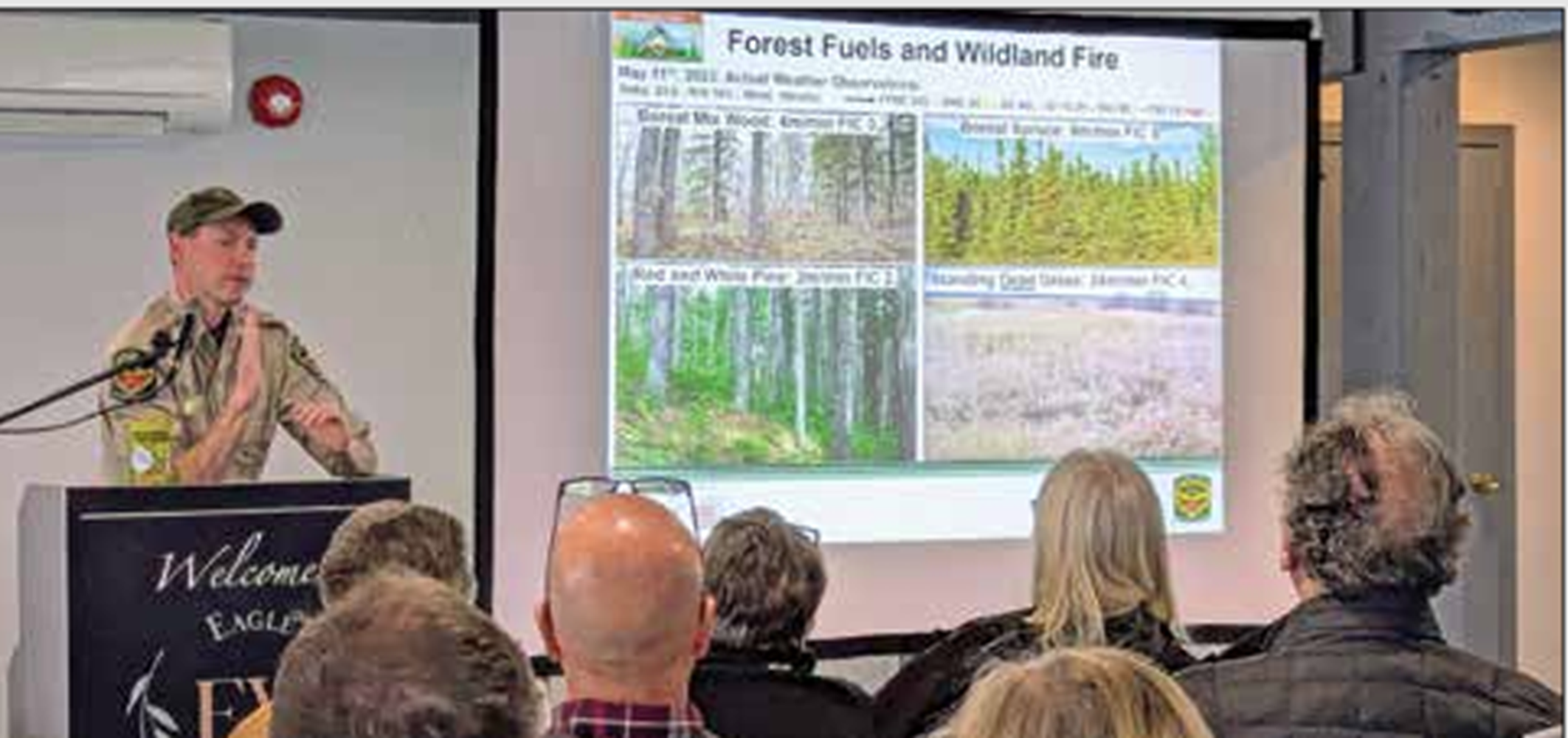
During a seminar at Sir Sam’s Ski/Ride on Saturday (May 2), the Coalition of Haliburton Property Owners Associations (CHA) and the Ministry of Natural Resources and Forestry said that protecting the landscape of the Highlands takes both individual effort and collective community action.
CHA board chair Paul MacInnes said lake and property associations play an important role when combating wildfires and climate change.
“The key for lake associations and property owners’ associations is for them to share information around the lake on what individual property owners can do to protect not only their own dwelling but their neighbours as well,” MacInnes told The Highlander. “It’s a lot of very simple things.”
During the seminar, MNRF fire advisor Ken Cox highlighted the impacts of wildfires in Ontario and how property owners can learn from the FireSmart program to protect their homes and cottages. A primary concern for Haliburton residents is the difficulty of maintaining the program’s recommended 30-metre “extended zone” of fire protection on crowded lakefront properties.
Cox said that FireSmart is a “nice to do,” but not necessarily a “have to do,” explaining that residents should focus on the immediate area around their house or cottage to help mitigate structure loss as a result of a wildfire.
“If you only do the removal of pine needles or leaves or dead grasses right adjacent to the home itself or under the decks… you’re saving yourself about 90 per cent of the time statistically,” Cox said.
The fire advisor explained that property owners should start at the structure and work outward toward the property line, removing the natural forest debris, noting that most yards already provide a natural buffer from the tree line.
Cottage association encourages good septic health
“If you have a shoreline bylaw, for example, or vegetation management, I would recommend folks just look at the intermediate zone, and not to worry about the shoreline so much because of the exact same parameters,” Cox said. “Instead of the forest being all throughout that side of the home, you’ve got a lake, and a fire is not going to come across the lake to you.”
MacInnes warned that the wildfire threat extends beyond property damage, noting the large environmental impact wildfire smoke has on our lakes and rivers.
“As climate change continues to bite harder and harder, this is going to be a bigger and bigger problem,” the CHA board chair said. “It’s pretty serious when your cottage burns down, your home burns down. But it’s also serious for the health of the lake.”
MacInnes urged the community to take action to protect the health of our lakes, with proper septic maintenance, shoreline renaturalization, and combating invasive species in the water basin.
“We need to encourage them to take the simple steps that they need to take. Keeping their septic system healthy, that’s the number one polluter of our lakes. Renaturalizing the shoreline where we’ve lost the natural shoreline. And keeping invasive species out,” he said. “It sounds simple, but it’s not.”