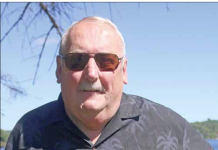


Dysart et al resident Michael Butz said he wasn’t shocked when, late last month, he found an excavator sinking into the ground at a future cell tower site at Minnicock Lake Road, saying the area is a natural wetland.
Butz, his wife Susan, and neighbours of Minnicock Lake and Glamorgan roads have opposed the tower for more than two years. It was the first location in Dysart et al selected as part of the Eastern Ontario Regional Network’s (EORN) Cell Gap Project, which aims to bridge cellular dead zones in rural areas and improve connectivity for 99 per cent of residents in the region.
Telecommunications giant Rogers is partnering with EORN on the project, responsible for sourcing tower sites and overseeing construction.
Butz said there weren’t any Rogers representatives on-site the last week in September, when issues arose. He contends workers from Quebec-based Qualnet Wireless Services first arrived about six weeks ago. Butz watched as they prepped the site, clearing trees and digging deep holes for the tower’s anchors.
While observing Sept. 27, Butz said he found workers “panicked, not sure what to do” after an excavator started to sink. “It got stuck pretty good, the water was up into the cab at one point,” Butz said. “Then the engine caught fire when they were trying to get it out. It was quite the scene.”
He contacted the Ministry of Environment, Conservation, and Parks (MECP), who sent someone to investigate Oct. 2. MECP spokesperson Gary Wheeler said officials concluded there was no spill of contaminants that would pose a risk to the natural environment or human health.
Butz contends water has been rushing to the surface any time workers dig, which he feels proves the area is a natural wetland – something he’s been preaching for years.
“It’s clear for anyone to see – there’s a spring that comes through there. The wetland is actually identified on the Haliburton County GIS map. There are bullrushes on that site too, indicating it’s a wetland,” Butz said, noting he asked Dysart council to insist on Rogers completing an environmental assessment when the application was tabled. Butz claims that didn’t happen.
Dysart mayor Murray Fearrey, who wasn’t on council when the project was approved, said the township’s hands are tied.
“We really don’t have any say. People think council can just snap their fingers and say ‘no’ and defeat this. We have to have a reason, and the reason has to contravene the federal regulations. That’s what we’re guided by,” Fearrey said.
Innovation, Science, and Economic Development Canada (ISED) is the sole approval authority for cell tower applications nationwide. Wheeler noted federal infrastructure undertakings relating to cell towers are exempt from municipal and provincial legislation, including The Planning Act, site plan control and zoning bylaws, the Ontario Building Code, The Species At-Risk Act, and provincial conservation authority legislation.
He said MECP had been in touch with ISED to relay public concern and submit observations from the Oct. 2 visit.
Aftermath
The excavator was saved, Butz confirmed, with a local firm called in to assist with its removal. He said crews laid down logs and stone so they could get something in to remove the machine and then buried it all.
Fearrey noted there’s nothing within the township’s records indicating the area is a provincial environmental protection zone, or wetland. Prod:
Elizabeth Purcell, the County’s director of planning, noted the GIS mapping does show wetland along Minnicock Lake Road – though not in the direct vicinity of the tower site. The tower will be located on Lot 24, Con 1, while the main wetland is located on Lot 26, Con 1, Purcell said. She said there is a smaller wetland feature in the southwestern area of Lot 24, but based on materials Rogers submitted to Dysart, it’s far enough away from where the tower will be built.
Jeff Iles, Dysart’s director of planning, noted in a 2022 report a “small stream” was located about 20 metres from the site, but that it appeared dry during parts of the year. He also noted the property was screened for species-at-risk, with nothing found.
Karl Korpela, who heads up Dysart’s bylaw department, said he reviewed whether the township’s site alteration bylaw may apply but since the property is not waterfront, and there’s no mapped environmental protection zone, there’s nothing the municipality can do.
While he remains staunchly opposed to the build, Butz said he knows the horse has already bolted.
“There is no resolution for me and I know that. This was the wrong place to put the tower all along. I still think the spot on Telephone Bay Road would be better – it’s higher and it serves an area that has no cell service. We have two bars here already,” Butz said.
Nilani Logeswaran, Rogers spokesperson, said construction will continue with completion expected in December.