
Home Blog Page 477

County to contract out service delivery

0
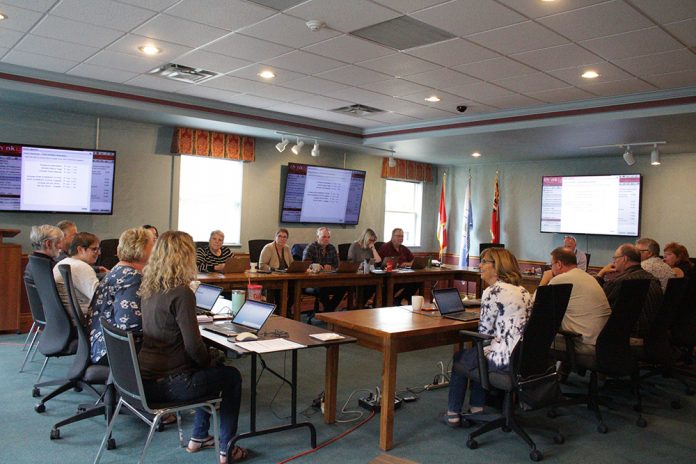
County councillors met Sept. 6 to discuss the latest in a service delivery review.

Haliburton County council has formally given the green light to proceed with a service delivery and governance review.

During a special meeting Sept. 6, councillors approved Warden Liz Danielsen and CAO Mike Rutter attending upcoming meetings at Algonquin Highlands, Dysart et al, Highlands East and Minden Hills to present their proposal and seek resolutions of support.

Rutter has also been directed to work with the local CAO’s, Angie Bird, Tamara Wilbee, Shannon Hunter and Lorrie Blanchard, to draft a request for proposal (RFP) – to tender out the work to a consultant.

The county will pay 50 per cent of the cost, with the lower tier municipalities chipping in 12.5 per cent each. The overall cost estimate is now $150,000.

“These are exciting days,” said Minden Hills mayor Brent Devolin. “I’m looking forward to the next year.”

Algonquin Highlands Mayor Carol Moffatt agreed it was exciting. She’s also “curious about where we’ll all end.”

In a report to last Friday’s meeting, Rutter said the process would be co-ordinated by the five CAO’s with some involvement from elected officials. He said they would draft the RFP, evaluate responses and recommend a consultant.

Warden Liz Danielsen suggested that short-listed candidates come before county council so they can get a feel of, and be comfortable, with them, since it’s a “very big deal and will affect everything we do.”

Rutter agreed and said CAOs and some politicians will then approve the consultant’s workplan and schedule, monitor the process and review final recommendations for presentations to county and lower-tier councils. As part of the review, Rutter said councils will be called upon to make choices.

“What services to deliver, what outcomes the municipality expects from its services, who should pay for them, whether and what citizens should pay for certain services, whether a service could be provided at a lower cost, whether all the things that go into delivering a service are really necessary, and who should deliver those services?”

Once the consultant has delivered their final report, each council would review and make comment on the recommendations. The decision-making process for any changes in how services are to be delivered would be the subject of a subsequent report to be developed as the service delivery review unfolds.

Rutter emphasized that service levels have to be determined before they can decide on governance. The county CAO added that if there are any significant changes in governance, those changes should be ready to be operationalized at the beginning of the next term of council.

“In order to provide 24 months for the substantial planning that would be necessary to implement a change of such magnitude, it is recommended that the RFP be released in late 2019, with a report back to council(s) no later than Fall 2020.”


County picks five goals for remainder of term

0
Consultant Erik Lockhart leads county councillors and staff through a visioning session on Friday, Sept 6.

County councillors and staff emerged from a six-hour meeting Sept. 6 with five clear goals for the remainder of the 2018-2022 term.

Warden Liz Danielsen said it was “an excellent session. [Consultant] Erik Lockhart has a very streamlined process that helped us focus on our mission, our vision statement and our primary goals for the term along with some objectives to help us achieve those goals.

“It was very heartening to see that council and staff were very much aligned in our goals for the county and its residents,” she added.

She said the goals are: to complete the governance and service delivery review; to consider placing a greater focus on regional economic development; to achieve financial sustainability and remain in alignment with their asset management plan; to achieve appropriate climate change adaptation and mitigation in partnership with the four member municipalities and to improve countywide broadband service.

“To ensure success in each of these goals we have established a number of steps to take as well as timelines,” Danielsen said.

She said a formal document detailing the overall plan should be available to the public in their November agenda.

“Details of our finalized vision and mission statements will be available at that time.”

Affordable housing an election issue

0

While we welcome the ribbon cutting at Whispering Pines 2 in Haliburton last Wednesday, we continue to worry about the lack of affordable housing in Haliburton County.

In case you don’t know, Whispering Pines is the housing project that is located along the road between Haliburton and Minden, just west of the Tim Hortons. The first phase was built in 2013. On Sept. 4, phase two was officially opened, with 12 townhouses.

The good news is 12 families have found affordable housing as a result of the expansion.

Whispering Pines is a partnership of the federal and provincial governments and the Kawartha Lakes-Haliburton Housing Corporation (KLH). The County of Haliburton kicked in some funding and Dysart et al waived fees.

Another project is also in the works for Minden. It, too, is a second phase. This time to Pinegrove Place, near the arena. It will see an additional 21 units. Construction tenders closed this past Tuesday and the corporation aims to have residents move in by the end of 2020 or the beginning of 2021. All up, that means 33 households will have found housing thanks to recent initiatives.

The sad part is, despite spending millions of dollars on both projects, the KLH has barely touched its ballooning waiting list. It’s CEO, Hope Lee, said that list has grown a whopping 375 per cent since 2013 and now sits at about 1,700 households. Of course, that’s not just for Haliburton, but Kawartha Lakes, too.

The problems are many. Builders are more interested in erecting family-owned homes, versus rentals. As a result, vacancy rates are low for rentals. Since new units can’t match the demand, rent costs are naturally going up.

One thing that has to happen locally is encouraging developers to build more rental housing. We are seeing that locally. Gardens Retirement Development Inc. for example looks to be going ahead with its 74-unit housing complex at 1 Sunnyside St. in Haliburton. And, Greg Bishop is planning to build 40 units of student housing next to the college. However, in both cases, the target market is well-off seniors and students, so it isn’t going to tackle the KLH waiting list.

According to a 2018 story in the Lindsay Advocate, at a municipal level, the aspirational goal for builders is to do 25 per cent rental housing. However, real estate agents say that will never happen. A more realistic goal might be five to 10 per cent. That would help the local picture.

There is some hope in Ontario’s Fair Housing Plan, with goals of increasing the housing supply, greater rent controls and better tenant protection. Minden Hills’ housing task force is lobbying for the creation of more garden suites and accessory units; clusters of tiny homes; downtown revitalization, such as housing above retail; and a made in Minden Hills seniors campus.

With the federal election looming, the question of housing is also a good one for local candidates. Where do they and their parties stand on federal government support for affordable housing in Canada? This truly is an issue that will require all three levels of government to tackle in the coming years.

School support workers hold local strike vote

0
File photo.

Members of the Canadian Union of Public Employees (CUPE) Local 997 gathered at Archie Stouffer Elementary School in Minden this past Saturday. They were there for an update on ongoing negotiations with the province and the Council of Trustees’ Associations (CTA) as well as to take part in a strike vote.

“We had a strike vote on Saturday at ASES with a great turnout,” said local chapter president William Campbell. He declined to say what the result was. Following the release of provincial vote results in mid-September, he said he’d be able to share local numbers.

Campbell did say there was a lot of interest in the meeting from the education workers the union represents: education assistants; custodians; early childhood educators; school secretaries and clerical staff; library workers; IT technicians; maintenance and tradespeople; food service workers; child and youth workers; speech language pathologists; professionals; paraprofessionals and others.

“We have not seen a turnout like that since school board amalgamation 20 years ago,” Campbell said.

Trillium Lakelands District School Board (TLDSB) chairperson Louise Clodd responded in a statement to The Highlander that, “a strike vote is part of the usual collective bargaining process. We look forward to sitting down with our local CUPE representatives to begin negotiations.”

Campbell replied, “In terms of local bargaining, we look forward to coordinating dates to meet with the employer on local issues.”

The Ontario School Board Council of Unions or OSBCU (representing CUPE) has been negotiating with the province and the CTA (representing school boards) since May. School board collective agreements expired on Aug. 31.

Campbell said OSBCU president Laura Walton and staff coordinator Darcie McEathron spoke to local members Saturday about the status of central bargaining. Campbell said other locals represented by CUPE have been, and will continue to, take strike votes across the province between Labour Day and Sept. 17. It’s all part of a CUPE job action plan launched last month. They said they’re acting amid ongoing job losses and cuts to services in school boards across the province.

Earlier this year, the TLDSB confirmed an overall reduction of 54.58 full time equivalent support staff positions.

“We believe the recommendation on job action by CUPE leaders delivers a clear message to our counterparts at the bargaining table,” Walton said in a CUPE communique dated Aug. 12. “It’s a call to restore funding so that education workers can deliver the high-quality education services that our schools rely on. And it’s saying, let’s work together to tackle the issues that threaten the quality of the services provided by education workers.”

Libraries push for eBook fairness

0
The Haliburton County Public Library wants upper governments to address high eBook costs for libraries. Photo by Joseph Quigley.

Haliburton’s municipal leaders pressed the province to help address high eBook prices for libraries across the country.

Haliburton County Library Board (HCPL) chair and Dysart Mayor Andrea Roberts, alongside other municipal officials, led a ministerial delegation at the Association of Municipalities of Ontario conference, which ran Aug. 18-21. The delegation met with the parliamentary assistant to the minister of tourism, culture and sport and focused on the issue of eBook pricing.

Roberts said the delegation went well and aimed to encourage the province to push for the problem to be addressed at the federal level.

“They were excellent, they heard our plight,” Roberts said. “It may seem in the grand scheme of things with the world the way it is, it’s not important. But we feel at the library board that it is.”

Libraries across the country have protested that Canada’s five biggest publishers – Hachette, MacMillan, Harper Collins, Penguin Random House and Simon and Schuster – are setting eBook prices too high for libraries.

For example, the HCPL said Canadian author Louise Penney’s ‘Kingdom of the Blind’ costs libraries $13 for paperback, $22 for hardcover and $60 in digital form. The digital copy is also only able to be checked out 52 times or for two years, whichever comes first, about half as long as a paper copy can last.

Roberts said the demand for eBooks in Haliburton is increasing.

“We already know our digital statistics are going up and up,” Roberts said. “We’re here to try to meet the demand of our residents.”

The county also argued the problem is only exasperated by the cuts to the interlibrary loan service, which allowed people to order books from libraries farther away.

The province cut the Southern Ontario Library Service’s budget, prompting the organization to end the interlibrary loans April 18. Roberts said the province reimbursing some costs to deliver those books via Canada Post does not work to make up the difference.

“Changes to both secondary cducation and provincial interlibrary loan services ask library systems in Ontario to increase their reliance and access to digital collections,” library CEO Bessie Sullivan said in notes prepared for the province. “This is exceedingly difficult under the current publisher’s e-content model.

The Highlander reached out to Canada’s biggest publishers for comment but did not receive a response before press time.

Roberts said advocates do not necessarily have a specific new framework in mind but want to see change through government regulation.

“We really tried to express the point the government itself is saying technology is the way to go,” she said. “If technology is the way to go, we should be able to have better access to books.”

Haliburton Lake gets new LCBO outlet

0
Maria and Brad Willing stand in front of the new shelves at their Fort Irwin Marina. Their store is one of the new LCBO Convenience Outlets opening in the province. Photo by Joseph Quigley.

Maria and Brad Willing have waited more than 12 years to be able to serve alcohol from their store on Haliburton Lake.

As of Aug. 27, they finally can. Their Fort Irwin Marina is among the first in a new wave of approximately 200 LCBO Convenience Outlets opening across Ontario in underserved communities.

“We’re very happy about it and I think it will be a huge asset to the lake,” Maria Willing said. “The lake was ecstatic.”

The pair completed renovations in their seasonal store and have built a new counter, stocked with a range of alcoholic beverages. The store will offer Haliburton Lake area residents and cottagers a closer stop to purchase than the previous nearest alcohol
store in Eagle Lake, approximately 12 kilometres away.

“It’s just convenience,” Cottager Robert Bevan said as he exited the marina. “Save me driving into Eagle Lake, so I’m happy.”

The outlet was part of a push by the provincial government to make alcohol available in more locations. It announced June 6 it would open alcohol sales to nearly 300 new locations in Ontario. Approximately 60 of the outlets opened in August, with more expected in December.

“By opening up more alcohol retail outlets across the province, we are not only making life easier for people, we are enabling growth and job creation in the province’s booming beer and wine industry,” then-Minister of Finance Vic Fedeli said at the time.

The Haliburton Lake Cottagers Association praised the marina store in an email to members.

“They (Maria and Brad Willing) did a wonderful job in the renovation side … this is a wonderful addition to our community,” the association said.

Maria Willing said it was no small undertaking. The marina has tried to get an outlet since 2007 but only made headway when the new Conservative government was elected. The store bears most of the costs to become an outlet, including renovations and purchasing stock.

“You have to plan and you have to make sure you’re capable of carrying this through because it’s a huge endeavour,” Willing said.

“There were a lot of people who helped and guided us through this. The process wasn’t always easy and just thank everybody who did help us.”

Speaker series offers tantalizing talks

0

Another season of the “Telling our Stories” speaker series gets underway Sept. 11. The series, presented by Yours Outdoors, continues to offer a wide variety of fascinating, eclectic tales of adventure travel, music, nature, politics and life, said its co-founders, Sean Pennylegion and Barrie Martin, in a press release.

The two said the series attracts large audiences to listen to stories told by Highlanders and special guests including Jim Blake, Kurt Browning, Jack Brezina, Robert Fisher, Kevin Callan, Barry Devolin and Carol Moffatt to name just a few.

“It is hard to believe we are in our fourth year,” said Pennylegion. “We have heard so many great stories – from travels in Iceland and Africa to adventures as a radio host in the 60’s to the politics of Queen’s Park. I think it is the diversity of topics that appeal to those who attend.”

The fourth series starts with a presentation by Brigitte Gall called “Piece by Piece. A Talk on How Not to Worry About How Things Should Fit.”

“What do you do when you graduate from high school with a 64 English average? Well, in Brigitte’s case, you travel the world, entertain the masses, start a family and then start a jigsaw company, of course! Brigitte will, as always, have you in stitches,” the release stated.

October’s offering (Oct. 9), “Bloodsuckers,” includes a talk by Mateus Pepinelli called “Flies We Despise” and another by Kevin Anderson called “Worms that Suck.” They will focus on two groups of bloodsuckers that are abundant across Canada: black flies and leeches, describing both their bad reputations, as well as the benefits they provide to humans.

On Nov. 13, Ted Barris returns with a new story and new book. “Rush to Danger: Medics in the Line of Fire” offers a powerful anecdotal account of how the science of saving lives in battle has evolved from the US Civil War through two world wars and into the 21st century.

“Not only has Ted retraced his father Ted Barris’ wartime experience in his new book, but he has also drawn from his library of interviews and research of military medical personnel to show stories of those who chose to rush to danger,” said Pennylegion and Martin.

“Sean and I are having great fun researching and recruiting possible speakers and we have some exciting prospects in the works for the rest of the series,” said Martin, owner/ operator of Yours Outdoors.

The Telling our Stories speaker series happens on the second Wednesday of every month at the Haliburton Highlands Outdoors Association Fish Hatchery. The cost is $10/person, a portion of which is donated to a local environmental/ conservation organization. For more information or to reserve a seat call 705-754-3436 or 705-457-7557 (cell) or visit yoursoutdoors.ca (see calendar)

Still open season on Minden Hills’ seagulls

0

When Minden Hills council declared war on the Scotch Line landfill seagulls last year, they threw more than $30,000 at the problem.

While staff say the township has seen “a significant decrease” in the Ring Billed Gull population, that isn’t the experience of the Mountain Lake Property Owners Association.

Spokeswoman Kym Hanson said there’s been an “improvement” but not as much as she would have hoped.

“Up until July 1, there were barely any seagulls on the lake, but as soon as the population increased with cottagers it seemed the landfill couldn’t keep up and more gulls started appearing at the landfill and lake,” she told The Highlander. “There are still, on some days, 300-plus seagulls on the lake. The seagulls … seem very much related to the landfill operations. I appreciate the changes they have done but I still don’t think it’s acceptable that we still have so many gulls on the lake.”

She said she was planning to make a delegation to council later this month “to see if there are any further changes they can make at the landfill.”

Minden Hills director of public works Travis Wilson presented a report on the issue to council Aug. 29, in which he said it does not appear the problem is related to seagulls at the landfill.

On Sept. 13, 2018, council single sourced Rentokil Steritech to do seagull mitigation at Scotch Line and in outlying areas. The initial proposal from Rentokil was for one year of service. Wilson said with the work starting in the early fall, Rentokil didn’t have adequate knowledge of the seagull breeding characteristics of our area, and it was believed that the seagulls were nesting near the landfill. However, he said it was determined this spring that the targeted Ring Billed Gulls do not nest in this area. He said Rentokil now believes the majority of the seagull population throughout the summer are primarily migrators with newly-fledged birds – that travel the Atlantic fly path and are mostly headed to the Niagara River for the winter.

He said they cover household waste at Scotch Line on a daily basis, which exceeds requirements under the ECA, which requires weekly cover. Staff are also recommending buying steel plates for cover in the 2020 budget. Staff are working on final cover of areas not being landfilled anymore.

Not one solution

“Any seagull mitigation program is not a one solution for every scenario. Every area is unique and requires adjustments as the service provider gathers more information regarding the bird’s behaviour,” Wilson said in a written report.

He said the plan going forward includes a major change to minimal operations in the spring, with a larger focus in late summer and early fall using falcons and hawks to ward off the gulls.

Staff recommended renewing the contract with Rentokil Steritech for another term, saying “this form of mitigation program can take up to three years before substantial change is realized.”

It’s estimated to cost about $41,000 in 2019 and just over $35,000 in 2020.

During a discussion at last Thursday’s regular council meeting, Wilson said numbers had decreased. He said a year ago, there were 1000-plus gulls and now the worst day will see about 300, with an average of 160-220.

Mayor Brent Devolin said he goes to the dump once a week and the “summer permanent population is many orders of magnitude less.”

Deputy mayor Lisa Schell said she’s also noticed a “drastic” reduction. “Council and staff are doing everything they possibly can to make strides with this.” She said she understands that residents of Mountain Lake still think there is a correlation between the seagulls at the landfill and the lake despite the contractor’s findings.

Coun. Jean Neville said seagulls aren’t just at the landfill and on Mountain Lake, but Lake Kashagawigamog, too. “I don’t think people appreciate what has gone into this project. I’m sure it adds up to quite a bit of money,” she said.

Coun. Bob Carter said they are still getting complaints from Mountain Lake cottagers and wondered if the township would have to do battle with gulls “for ever and ever, Amen” and “are we fighting a losing battle?”

Wilson reiterated there’d been a significant gain on last year and that the contractor said it can take three years to make a real difference.

Devolin said “the reality is we’re not in control over all of this. We can’t take the sole responsibility. We’re getting close to the end of our responsibility to the public.”

AH picks six priorities for term

0
Algonquin Highlands council.

Algonquin Highlands has identified six priorities following a township strategic visioning session Aug. 27.

“A lot has happened since our last visioning session in January 2018,” said CAO Angie Bird in a memo prior to the six-hour meeting. She added, “This is our opportunity to collectively imagine the future, discuss the current challenges we face and develop some priorities to ensure a successful next three to four years.”

Mayor Carol Moffatt said it was a chance to look for staff and council commonality on the major elements of their strategy for the remainder of the 2018-2020 term. She said they also wanted new councillors, Jennifer Dailloux and Julia Shortreed to have a couple of months under their belts before reconvening.

After the session, Moffatt said councillors and staff were “like cattle facing in the wind. We are all aligned. There is not a great divide as to what staff and councillors think we should be doing for our community, so it’s nice to see that.”

She said the first priority is a continued focus on a robust environmental strategy. She noted that included public education and a zoning bylaw update that considers all environment factors: including landfills; waste management; lake health; shoreline preservation; fisheries; and participating in the county’s climate change strategy.

Number two is infrastructure, which ties in with the asset management plan. She said that conversation drifted into how they manage grants. While the township has been successful in winning grants over the past eight years, it has largely fallen to one staff member. Moffatt said there was talk of possibly contracting out grant management. They’ll also be looking at the results of their energy audit and an energy management plan.

A third priority is around human resources. The mayor said they value staff but want to make concerted efforts around retention and “ensuring opportunities for people to bring their best game to the job.” For example, she said when a staff member completes a course and receives a certificate, that should be acknowledged.

The fourth plank from the session is a continuing strong communications strategy, the mayor said, including “making sure that we are communicating our work adequately and usefully.” They also want to ensure constituents can engage with the township and provide feedback.

A fifth priority is finding efficiencies. Moffatt said that involves looking at service levels and opportunities. “So, if it doesn’t need four person’s eyes on it, don’t have four person’s eyes on it.” She said the township also still has its $540,000 in “magical mystery money” the province granted it for finding efficiencies.

Moffatt said the sixth and final priority circles back to volunteers, including review of committee mandates and training. “So, volunteers have the right tools and resources to bring their best game forward.”

The mayor said the results of the session are “nothing earth shattering at all,” but there was “a whole bunch of stuff that last year came from our visioning session, and were introduced into our way of doing things.”

Moffatt said they also revisited their vision statement and she insisted they add the word “responsive” because “the landscape is continually changing, and changing quickly.”

One of the biggest challenges for local townships is that the population is growing at a greater rate than the provincial average, resulting in a greater use of infrastructure and services. In some cases, it is requiring the hiring of additional staff. Moffatt defending the hirings, saying, “no one is sitting around playing cards, waiting for the bat phone to ring.”

Federal election looming

0

If you check out electionprediction.org, you’ll find a few comments on Haliburton Kawartha Lakes-Brock (HKLB). One writer, M. Lunn, opines, “A boring rural Tory stronghold, only interest is do they get over 50 per cent or not, not whether they win this.”

Yes, folks, the summer holidays have ended, the kids are back in school and a federal election could be less than 46 days away.

As reported in our front-page story, as of press time today, there are five candidates vying for the job of representing us in Ottawa: Incumbent Conservative Jamie Schmale; Liberal candidate Judi Forbes; NDP hopeful Barbara Doyle; the Greens Elizabeth Fraser and the People’s Party of Canada’s Gene Balfour.

We’ll do our best to introduce the candidates to readers over the next six weeks via both profiles and questions and answers addressing some of the issues near and dear to the hearts of Haliburton County voters.

We’ll also be there on Wednesday, Oct. 9 for the all candidates meeting being hosted by the Haliburton Highlands Chamber of Commerce and CARP, at 7 p.m. at the Pinestone.

You may have also noticed that we have been collaborating with the Concerned Citizens of Haliburton County (CCHC) on a series of non-partisan columns on our op-ed pages.

Going back to M. Lunn above, and to provide a little history to newcomers to the riding, HKLB has indeed been a Tory stronghold. It’s been blue since 1968, with the exception of an 11-year-period when it was held by the Liberals’ John O’Reilly, between 1993-2004.

There have only been three Tory reps in all of that time, Bill Scott, Barry Devolin and Schmale.

When the country turned red in 2015, HKLB remained blue though the swing was just over 17 per cent, with Schmale still getting just over 44 per cent of support, compared to Devolin’s 60 per cent in 2011.

As the CCHC have been writing, we encourage readers to do their homework; select a candidate and party that best represents their views, and, above all else, vote. In 2015, about 68 per cent of eligible voters marked a ballot in HKLB. That was up from about 63 per cent in 2011. We were just slightly above the national average. It’s a trend we would like to see continue.