
Home Blog Page 478

Green, PPC candidates join election fray

0

A university student from Bethany has rounded out the field of Haliburton Kawartha Lakes-Brock federal election candidates as of press time Sept. 4.

Elizabeth Fraser, 21, who is in her third year of environmental studies at Carleton University, is the Green Party candidate.

She joins previously-announced candidates: incumbent Conservative Jamie Schmale; Liberal Judi Forbes and NDP hopeful Barbara Doyle. The Highlander has also learned of a fifth candidate, Gene Balfour, of the People’s Party of Canada.

It’s expected the federal election will be held Monday, Oct. 21.

Speaking from Ottawa, where she worked this summer with the Canada Revenue Agency, Fraser told The Highlander she started the Green Party Club at Carleton University in her first year of studies.

Entering her third year, she said “I didn’t really anticipate running for office this young. But I just thought given the political climate, and issues I really care about, such as the environment and employment, I can go into an election year and be upset about changes or put myself out there and be that voice for people who feel the same way.”

Fraser acknowledged it would be an uphill battle to be elected. However, “I don’t think the Green Party has had a huge presence in the riding and it’s only fair to offer those constituents an alternative and I hope to be that alternative.”

On his election page, genebalfour. ca, Balfour has a copy of the Canadian Constitution. He writes, “after reading this document, I came to realize how far Canada has drifted from the vision of our founders for a united and free Canada. This has inspired me to work with Maxime Bernier and the People’s Party of Canada to return our country to the values that have made Canada a great country over the last 150-plus years.”

Doyle won the NDP nomination on Feb. 23. She is a Lindsay-based activist. Forbes got the Liberal nod on June 26. She is the owner of Moorlands Bed and Breakfast in Beaverton and a former bank senior manager. Schmale was elected in the 2015 federal election after the retirement of Barry Devolin. He announced his candidacy in 2018.

Meanwhile, the Haliburton Highlands Chamber of Commerce and CARP will be hosting an all-candidates debate on October 9 at 7 p.m. at the Pinestone Resort.

“This is part of the Chamber’s regular service to the community and we are pleased to be able to offer the forum as a way for candidates and residents to connect before the election,” said manager Jennifer Locke.
County prepares roadmap for review

0
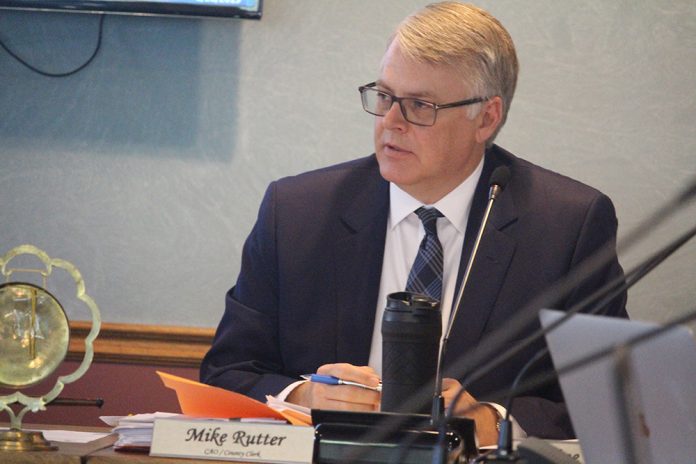
Chief administrative officer Mike Rutter presented to council Aug. 28 about a proposal to review service delivery and governance.

The County of Haliburton plans to first examine how it delivers its services before deciding whether to overhaul its governance structure.

Staff unveiled a draft review process during the Aug. 28 council meeting. The chief administrative officers for the county’s municipalities are proposing an in-depth review of municipal services across all of Haliburton’s municipalities. After that is completed, the process would then address governance and what is the best model for Haliburton, including the possibility of amalgamation.

“You’d have to figure out how you’d go about and answer a question of governance. Should it change, should it not be changed?” chief administrative officer Mike Rutter said. “This is a pretty extensive study. We know it would take a considerable amount of time.”

Council made no final decisions, deciding to defer to its September meeting.

Coun. Andrea Roberts said people have set their ideas on amalgamation based on feelings, rather than facts.

“This is the ideal time to do this,” Roberts said. “I would go forward with this. We’ve been waiting for outside, independent study to show the best and most efficient way we can operate in Haliburton County.”

“I’ve heard this over and over again. I think as councils we actually owe it to the ratepayers to get an answer one way or another,” Coun. Lisa Schell said.

The report comes after council directed staff to develop a review process June 26. Rutter said after that, staff consulted with Michael Fenn, a civil servant and consultant who is heading regional reviews in Ontario.

From that, the county CAO’s decided a service delivery would be the best place to start. The questions asked will include whether a service is necessary, what are the full costs and benefits of the service and what “tier” of government is most appropriate to deliver that service.

Staff proposed a consultant be hired to make recommendations on services. Council would also be called on to make decisions throughout the process, Rutter said. After reviewing service delivery, staff propose a separate process to address municipal structure.

Coun. Cec Ryall praised the idea to separate examinations of service delivery and governance.

“The fact that we (citizens) are using the word amalgamation as the end-all, cure-all, solve all things, doesn’t work like that. We have too many examples of amalgamation where it totally failed because not enough preliminary work was done,” Ryall said.

Staff recommended sending an RFP for a consultant in fall 2019, with a report coming back no later than fall 2020. They also recommended cost-sharing for the process, with half funded by the county and the remainder split between the four lower-tier municipalities. Staff also recommended a $150,000 budget.

Clearing the way for retirement complex

0
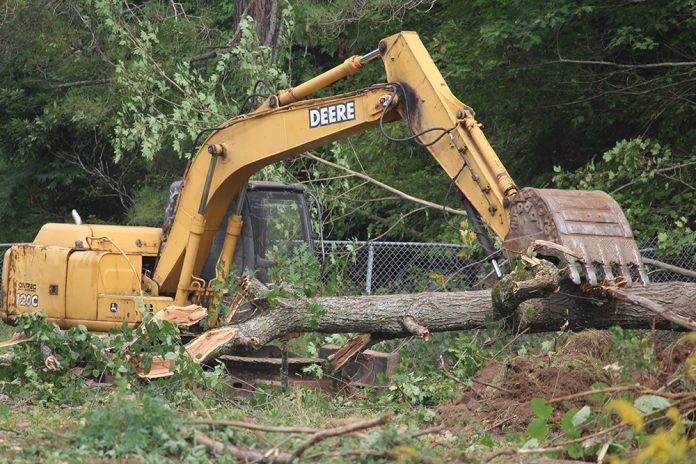
A tree is moved at the 1 Sunnyside St. property Sept. 3. Gardens Retirement Development Inc. has begun clearing the property of trees in preparation for blasting. Photo by Joseph Quigley.

Gardens Retirement Development Inc. and Dysart et al are meeting Sept. 9 about the plan for the new seniors housing complex at 1 Sunnyside St.

The municipality has scheduled a special council meeting to discuss passing a site plan agreement for the massive, 74-unit housing development.

“The municipality is continuing to work to move this project forward,” planning manager Sue Harrison said at an Aug. 27 council meeting. “This is a complex project.”

The development has faced legal hurdles due to a holding provision on the property, stemming from an Ontario Municipal Board ruling. The provision prevents rezoning of the property and the municipality can only lift it when certain conditions are met.

The site plan agreement is the next step to get the building off the ground. If accepted, it would need further approval by the Local Planning Appeal Tribunal, according to director of planning Jeff Iles. Once the tribunal issues an order, the developer can apply to remove the holding provision to get the correct zoning in place. Once that is done, the municipality can issue a building permit.

Mayor Andrea Roberts said the municipality has worked hard to get this project going.

“We are doing everything we can. Every time I go into Sue (Harrison)’s office, there’s nothing on her desk but the Gardens (Retirement Development Inc.),” Roberts said.

To that end, the municipality offered to hold a special council meeting to get the project its approvals as quickly as possible.

Meanwhile, the developer is moving ahead with clearing the site.

With the school building previously on the site now demolished, workers began clearing out trees on the property Sept. 3. After the trees are cleared, the developer plans to do blasting work on a ridge in the property.

Harrison said the municipality has received several concerns about work on the property, including about tree removal, blasting notification and pedestrian access.

Nearby residents have also received notices about the blasting from DST Consulting Engineers Inc. and general contractor Leeswood Construction, offering well-testing prior to the blasting.

“DST Consulting Engineers is performing well water testing as well as quantity analysis to ensure there is no disturbance to wells in the area,” Leeswood Construction wrote in an Aug. 15 notice. “We will do our best to limit disruption to you during this process.”

Bioheating company fires up project again

0
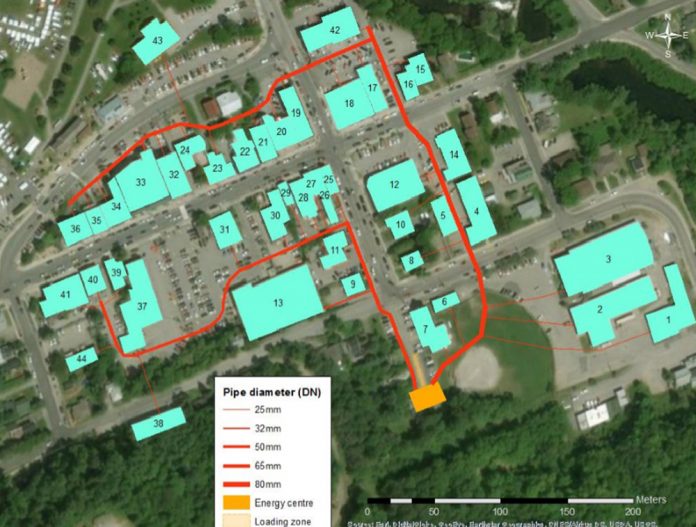
A proposed map for the configuration of the Torchlight BioResources heating project in Haliburton village. File photo.

Torchlight BioResources is trying to restart its cancelled wood-fuelled bioheating project with as many municipalities as possible.

The Haliburton Forest-based company and Dysart et al are inviting more than 20 regional municipalities to participate in a workshop about municipally-owned heat utility development Oct. 1. The aim is to revive an effort to create bio heating projects with municipalities, which was cancelled in Dysart after the new provincial government pulled back a $2.8 million grant.

Managing director Jamie Stephen said his company now hopes to get federal grant dollars by partnering with many different municipalities.

“It’s an opportunity to learn but also to talk about how the municipalities can work together,” Stephen said. “Some of them are quite small, how can they work together to develop these projects?”

Dysart et al is still partnered with Torchlight in a public-private utility corporation. Using a 50-50 split between public-private dollars, the partners planned to develop a district heating system using locally-sourced woodchips to heat 50 buildings in Haliburton village, reducing energy costs.

They were successful in getting a $2.8 million grant from the previous provincial government under the Municipal Greenhouse Gas Challenge Fund. The grant would have covered the public portion of the funding, but a change in government meant the end of the grant in July 2018.

Stephen said the project stalled after that. But with the utility corporation still in place, Torchlight has explored new grant opportunities and is now targeting federal dollars under the Investing in Canada Infrastructure Program.

“We do think there’s a very strong argument for bioheat and district energy systems from a job creation, rural economic development perspective,” Stephen said.

The company plans to create multiple bioheating projects by partnering with multiple municipalities through publiclyowned utilities. The municipal invites are going out as far as Muskoka in the west to Elgin in the East.

In a letter to municipal leaders, Dysart et al Mayor Andrea Roberts spoke to the potential of the system.

“This district heating system approach has been widely adopted in Europe as an alternative to natural gas and/or individual building fuel deliveries,” Roberts said. “We believe there could be significant value in partnering with other municipalities.”

Stephen said the initiative would create job opportunities. He added it would also be a boon to a declining forestry sector, providing a new market for Haliburton Forest to sell low-grade wood to fuel the heating systems.

Despite the approaching federal elections, Stephen said this is a project any government can get behind.

“It seems like infrastructure is something that is bipartisan. Lowering energy costs for rural residents is something that I think any party can get behind,” Stephen said.

“This is a way for communities to insulate themselves from climate-related policies, which is what the purpose of the policies is,” he added. “To shift people away from fossil fuel consumption.”

Community powers up youth sailing club

0
The Haliburton County Youth Sailing Association has successfully run for its first summer with 20 participants registered. Left to right; Director Robin Carmount, volunteer Ian Macintosh, Drey Cook, director Andrew Hodson, volunteer Cara Oleksuik, Sirena Weatherbee-McMullen. Photo by Joseph Quigley.

People of all ages, searching for fun and escape, have learned sailing for the first time on Twelve Mile Lake this summer.

The Haliburton County Youth Sailing Association is running for its first year out of the Red Umbrella Inn near Minden. Director Robin Carmount said the idea started off with a conversation in January to help improve the mental health of youth by taking them out on the water.

Seven months later, the group is doing just that. Now with 20 participants registered, the club is going at full speed.

“We’ve exceeded any expectations we had,” Carmount said. “It’s absolutely, totally amazing. The quality of the people that have stepped up and helped out. The directors, the volunteers, I can’t say enough.”

The sailing is open to anyone, but targets kids who are struggling or at risk, referred by local agencies. Participants are treated to a day out sailing under the guidance of volunteers.

Director Andrew Hodson, who also works with the Canadian Mental Health Association, said the results are strong so far.

“I can tell you they’re just chomping at the bit to come back,” Hodson said “We’ve been hearing really amazing things. We’ve been hearing things like increased self-esteem, increased self-confidence … everybody’s provided lots of good feedback. It’s been great.”

The community stepped up after a meeting with several organizations in June, Carmount said. Donations poured in, including funding, boats, equipment and shirts.

“We just sort of planted the seed and the community jumped on it and watered it from every direction,” Hodson said.

The club teaches a truncated version of a recognized sailing program, but puts a priority on getting kids out on the water quickly, Hodson said.

Cathy McMullen brought her grandchildren to attend a session Aug. 23. They were referred from the waitlist of Big Brothers Big Sisters of Canada.

“I just thought it’d be good for them to get off their tablets, come outside and enjoy some fresh air,” McMullen said. “It’s good for them to be involved with new people, mentors.”

Drey Cook has attended a couple of sessions. He said he wanted to go to as many as he could.

“It’s a good thing that I’m getting out and not playing video games everyday anymore and to get trying new things,” Cook said.

The club still wants to make improvements. Carmount said he wants to be considerate of people on the east end of the County of Haliburton and work on transportation for them.

The association plans to run during weekends through September before shutting things down until next summer, making improvements throughout the winter.

Hodson said the club is in a good position to grow, but must keep its central objectives in mind.

“This is really no barriers. It’s really open door,” Hodson said. “We want to keep it just very organic, very natural. Because the lake provides the therapy.”

Information is available at mindoverwater.org or by contacting Carmount at mindoverwater2019@gmail.com.

Abbey Gardens hopes golf tournament will grow

0
Left to right: Dave Bradley, Mike Bradley, Linda Bradley and Chris Rockingham were one of 16 teams at the inaugural Abbey Gardens Golf Tournament Aug. 23. Right: Dysart et al Coun. John Smith putts at his last hole. Photo by Joseph Quigley.

Abbey Gardens did not attract the crowds it sought at its first annual golf tournament Aug. 23 but hopes to expand it in the future.

The first try for the tournament at the Blairhampton Golf Club attracted approximately 64 participants. The event raised money for programs at the charity’s facility.

Janis Parker is an Abbey Gardens board member who also chairs the Volunteer Dental Outreach (VDO) board. She said she sought to duplicate the success of the VDO’s golf tournament, which played the day before and has gone for nine years.

“I watched how successful the Volunteer Dental Outreach has been,” Parker said. “I guess as a first time we did okay. I would have liked a few more people but I think it’s enough to grow on.”

The new tournament shared resources with the VDO’s, which attracted more than twice the number of teams. Parker said there were cost savings by running the two tournaments back-to-back.

“We only had to put up the tents once. We only had to put up the generator once,” Parker said. “It was a pretty natural partnership.”

Teams of four played the course in an 18-hole, best-ball format, with added contests throughout the day. Golfer Jackie Armet said she wanted to help support what Abbey Gardens does.

“Everything they represent, from sustainable food to their garden practices, I just believe in the kind of work that they’re doing,” she said. “We look forward to coming back next year.”

“We knew it was going to be fun and it’s for a good cause,” Dysart et al Coun. John Smith said about participating. “It went very well. Great weather, good company and it’s a beautiful golf course.”

Parker said the Abbey Gardens Golf Tournament probably raised a little less money than hoped. But she still aspires to make the event more successful.

“We just need to work harder at getting the word out there about the golf tournament,” she said.

Highland Storm navigates turbulent winds

0
The 2018 Dwayne-Simms Construction novice LL team. There will be major changes coming to novice hockey in Haliburton this year. File photo.

The Highland Storm is readying for a season of change with a massive overhaul to the novice program coming into effect.

Hockey Canada is directing a shift to novice play across the country, with players moving to half-ice games, accompanied by a host of other rule changes. The changes aim to improve young player development. Highland Storm Ontario Minor Hockey Association representative Amanda Manning said her organization is embracing the changes.

“We’re taking it on,” Manning said. “We’ve had to adapt because there’s been a lot of changes.”

Gone is the tyke category, with young players now split into minor novice and major novice. For much of the season, scores will not be kept. Other elements like face-offs and offsides are also getting removed.

According to a Hockey Canada development guide, the changes should engage players more, with half-ice resulting in twice as many puck-touches, twice as many pass attempts and six times as many shot attempts.

“Parents and coaches need to think longterm and not worry too much about children being the best player on the ice in initiation and novice hockey,” the Hockey Canada guide states.

“Putting young players into a competitive environment too early will compromise their development.”

In the middle of the year in January, major novice players will transition to full-ice and scored games. Manning said with change, there are always growing pains.

“It’s difficult for parents to understand the point of it at times,” Manning said. “A lot of parents would prefer their kids be full-ice hockey, but the research is there and it says the kids get more puck touches, they learn better stick handling. All of those things are important in hockey development.”

Arena reconstruction poses challenges

The Storm is also navigating without the S.G. Nesbitt Memorial Arena in Minden.

Workers demolished the arena May 1 and its replacement will not be ready for this hockey season. Manning said schedulers are planning the season using Haliburton and Wilberforce, but the season is going to be different.

“Everybody is, I think, understanding it’s probably going to be a trickier season and we’ll have to make some sacrifices,” Manning said. “But the ice is there so we’ll be playing.”

She also attributed a decrease in this year’s registrations so far to the lack of a Minden rink. But despite that, she expects the organization will still ice a similar number of teams across all categories.

“It’s challenging for some parents, the thought of driving,” Manning said. “Our registration numbers are a little bit lower than what they typically are. But everybody is still here, ready to play hockey so we encourage parents to come out and sign them up.”

Tryouts begin the first week of September. Registration and a full overview of novice changes are available through highlandstorm.org.

How Head Lake was saved from a “feces apocalypse”

0
A group of geese sit beneath a tree at The Pinestone Resort. The nesting geese population at Head Lake Park in Haliburton has been pushed away thanks to a years-long campaign. Photo by Joseph Quigley.

Haliburtonians have seen a dramatic decrease in the number of geese plaguing Head Lark Park thanks to ongoing efforts by the municipality to dissuade the creatures.

The geese once flocked around Head Lake in hundreds, littering the ground with droppings and creating a large mess for municipal staff to deal with. But years of dedicated work naturalizing the shoreline, strategically growing plants and putting up goose tape have seen the nesting population at Head Lake go to zero.

Recreation program co-ordinator Andrea Mueller said it has made a huge difference at the park.

“It’s made the park more enjoyable for people,” Mueller said. “There was a lot of goose feces on the ground … then people don’t really want to play around the park or have young children around the park where there’s that much of it.”

The efforts to deal with the geese began in 2010, when the Haliburton Highlands Stewardship Council and Haliburton Highlands Outdoors Association received a grant to install native garden beds at the lake to dissuade geese.

Leora Berman helped spearhead the effort, with volunteers pulling together to plant the beds. Berman said geese were an extreme nuisance back then.

“I counted 240 geese that occupied Head Lake year after year,” Berman said. “Feces apocalypse. It was just gross.”

She added the feces harm lake health, impacting the level of oxygen in and harming fish habitat. But the geese are adaptable and reducing their numbers was a yearslong process, Berman said. Geese will find whatever open space they can on shorelines, requiring solutions like goose tape.

“To totally alleviate the problem, it’s like a chess game,” Berman said. “It has to be consistent.”

But the efforts were consistent. After Berman stepped away from goose control in 2017, the municipality took it on and has continued to manage the shorelines. In that year, Berman said she saw around 10-12 nesting geese around the lake, which have since
disappeared.

“Dysart should be very proud that we are one of the few municipalities that have a good example to show landowners,” Berman said.

The efforts do not make the township or the surrounding areas goose-free. Mueller said nests have continued in places like the Haliburton Highlands Secondary School grounds. But she added those high school geese no longer cross the road to Sam Slick Park, thanks to efforts by students and the County of Haliburton Property Owners Association to naturalize the shoreline there. She added the municipality has taken similar steps elsewhere to dissuade geese, such as at Eagle Lake and Haliburton Lake.

Although foraging geese can still appear for shorter periods later in the summer, for now, people can enjoy a Head Lake mostly free of goose poop.

“Most municipalities in Southern Ontario have major goose areas,” Berman said. “The fact Dysart, at least municipal lands, are now a good example to follow is great news.”

Police call for safety after ATV collisions

0
FIle photo.

Police are calling for proper safety with all-terrain vehicles after two severe crashes in Dysart et al this past month.

OPP responded to an ATV collision on Highland Street Aug. 22, in which a lone female driver collided with a tree and was taken to hospital with serious injuries. This follows a fatality in an ATV collision on Boice Bradley Drive, north of Guilford Lake Aug. 4.

Both cases remain under investigation and police have not yet confirmed what caused either of them, OPP Sgt. Jason Folz said.

Speaking generally, Folz said the causes of ATV collisions tend to follow the four main categories of other motor vehicle collisions: driving while distracted, driving recklessly, impaired driving and not wearing proper safety equipment.

“This is more of a general comment about all ATV collisions that we seem to be investigating within the region,” Folz said. “People are utilizing these pieces of equipment as toys and they need to be certainly respected or bad things could happen. They’re high-powered machines.”

Folz said OPP members trained in collision reconstruction investigated both scenes for several hours. He added it could be several months for police to complete the investigations.

Police have not named the 31-year-old involved in the Aug. 22 crash, which occurred around 6 p.m. A press release said she was transported to a Toronto-area hospital.

Two people were on the ATV in the Aug. 4 crash, which police responded to shortly before midnight. Folz said the vehicle entered a ditch and struck a tree. Michael Bowen, 27, was pronounced dead on the scene. The other occupant was treated for minor injuries, Folz said. The investigation has not yet determined which person was driving the vehicle.

Folz said ATV safety is a concern for police, especially in the Haliburton Highlands. He said police encourage people to be alcohol and drug-free when operating them.

“They are not toys,” he said.

People not wearing proper helmets are also a concern, Folz said. The problem has garnered a moniker in law enforcement, with ball caps worn backwards on ATVs getting dubbed “Haliburton helmets.”

“We’re seeing people are a little more relaxed with those rules when it comes to being out in cottage country,” Folz said. “It’s a real issue.”

Class sizes steady for 2019-20

0
Haliburton Highlands Secondary School students rallied April 4 against classroom size increases. The province has announced it would keep those cuts small for this year. File photo.

The Trillium Lakelands District School Board (TLDSB) is reacting with cautious optimism to a pause in classroom size changes which have already had an impact on course offerings.

The province announced Aug. 22 it would provide funding to keep classroom size averages largely intact for this year. For high school, the average classroom size will rise from 22 to 22.5 students, while Grades 4 to 8 will go from 23 to 24 students, on average. But the province still plans to reduce funding to push the high school class average to 28 students over the next four years.

TLDSB director of education Larry Hope said analysis is still needed to determine how the Aug. 22 announcement will affect local schools.

“I would like to be cautiously optimistic about it. We are analyzing the details as they become available to us,” Hope said.

The province aims to implement the changes through teacher retirements and voluntary leaves as opposed to layoffs. To that end, it is providing $1.6 billion in teacher job protection for school boards from 2019-2023.

“I have made it clear that I was intent on listening to, and working with, our education sector partners,” said Minister of Education Stephen Lecce in a press release. “Our mission remains to land a deal in good faith, that puts our students first.”

But the cuts have already impacted TLDSB, Hope said. The district has approximately 24 fewer teachers than last year from not rehiring retiring staff. That means about 100 fewer courses offered across the division.

“We’ve managed this through attrition,” Hope said. “It definitely means we will have fewer teachers in our secondary schools at this point. Now, that could change depending on what the announcement today (Aug. 22) translates to.”

Minor changes to sex-ed curriculum

The province also unveiled its changes to the sex-ed curriculum Aug. 21.

The curriculum is largely similar to one instituted by the previous government in 2015. Gender identity discussion will be taught in Grade 8, pushed back from Grade 6. Sexual orientation will be taught in Grade 5, one year sooner than before. Discussions have also been added on vaping and concussions, with expanded lessons on consent and cannabis use.

“Fundamentally, important topics are covered,” Hope said. “Things that parents have advocated for are still being covered. Our teachers will use the curriculum as it’s presented to us.”

Hope added that the school district trusts its educators and that gradebased curriculums do not mean topics from other grades never come up.

“We know we are in changing times and our students access to information and access to knowledge is changing dramatically,” Hope said. “Our teachers are experts, to respond to that.”

The new curriculum is expected to be in place this year. Parents can also opt their children out of certain content blocks, a practice which was already in place in the TLDSB.