

Home Blog Page 444

Local talent featured in new HGTV show

0
The Haliburton Highlands will be spotlighted in an episode of HGTV Canada’s Scott’s Vacation House Rules premiering April 26. Designer Debra Salmoni and host Scott McGillivray are pictured.

The Haliburton Highlands will be featured in the premiere episode of a new HGTV Canada series Scott’s Vacation House Rules April 26.

The hour-long renovation show hosted by Scott McGillivray features cottages getting transformed into more appealing rental properties. The inaugural episode will feature a cottage situated outside of Minden, with local workers taking part in turning an inherited family cottage into a German-inspired guest house.

“For over 10 years I’ve been helping homeowners – advising them on income properties and renovation techniques – and now I’m taking what I’ve learned in both of these and applying them to the growing market of vacation rentals,” McGillivray told The Highlander. “With the rise of Airbnb and other booking services, vacation homes have become a hot part of the real estate market.”

The episode will feature local talent, including Minden’s Above Board Carpentry. The business declined an interview.

Professional artist and Haliburton School of Art + Design teacher Rose Pearson participated in filming back in August and painted shutters in a Bavarian-style.

“I don’t have any experience in film at all,” Pearson said. “It was interesting for me to experience all the little takes. I’m interested in seeing now what parts they harvested.”

McGillivray said the episode turned out particularly well, which is why it was chosen for the premiere of the series.

“I’m proud of all of our episodes, but we felt this one was especially great. The homeowners also have a very universal goal, which is to use the property to generate additional income in order to let them retire someday,” he said. “Shooting in Haliburton was beautiful, and the community was very welcoming.”

Pearson said some nerves come with being on television.

“I feel really sheepish. I’ll probably hold my breath and hide under a blanket when my scene comes up,” she said. “It’s not my comfort place, that’s for sure.”

The episode airs April 26 at 9 p.m. It can be streamed via watch.globaltv.com and through all major TV distributors. “If you’re interested in taking an hour to get away from our current news cycle, this is a great way to spend that hour,” McGillivray said. “If you’re interested in learning more about vacation homes or you’re a real estate/renovation junkie, you’ll find lots of good information.”

Another Minden-area cottage will get featured in the series May 10, according to Brown + Co, the local construction company who worked on that episode. Contract manager Andrew Brown said it is not their first TV production and it was fun being apart of it.

“We understand how much reach projects like this have, we always get excited about it. We enjoy the exposure,” Brown said. “We, like other people in the area, as well as cottagers, see our level of quality that we can perform and how easy we are to get along with.”

Province, high school teachers reach deal

0
After months of negotiations and several one-day strikes, the province and Ontario Secondary School Teachers’ Federation have reached a tentative deal. File photo.

After months of negotiations, the Ontario Secondary School Teachers’ Federation (OSSTF) and the province have reached a tentative collective agreement.

The two sides announced the deal April 20 after a negotiation period which saw multiple one-day strikes. Teachers protested provincial cuts and expressed concern over changes such as mandatory e-learning credits for students.

But OSSTF District 15 – Trillium Lakelands president Colin Mathew said although he is not privy to what happens at the central-bargaining table, the COVID-19 pandemic likely had an impact.

“The whole bargaining landscape, at least in the short-term, really changed with this current crisis,” Matthew said. “It’s hard to imagine it didn’t have an effect.”

The deal will be reviewed for approval by local leaders in the coming days. If approved by them, the OSSTF said it will have a ratification vote by all its members in May.

OSSTF president Harvey Bischof thanked his members for their work in their public awareness campaigning.

“As a result of our combined efforts, this government, although early in its term and holding a majority, was pushed back from some of its most egregious proposals,” Bischof said. “While this tentative agreement does not satisfy all of our concerns, we recognize the current environment we are in and the need for students to have stability once this emergency is over.”

“Our aim was to ensure our young people receive the best education we can offer, so they can develop the skills they need to succeed in the classroom and in the jobs of the future,” Minister of Education Stephen Lecce said. “We will remain focused on the government’s dual priority of keeping students safe while ensuring the continuity of education.”

The province has now reached deals with all of its teachers’ unions, including the Elementary Teachers’ Federation of Ontario, which is going through its own ratification process. A local deal still needs to be worked out between the union and Trillium Lakelands District School Board.

Matthew said negotiations have awaited completion of the central deal. If that deal is ratified as scheduled, Matthew said local bargaining should take place in May and June.

What will be discussed will depend on what is covered in the central agreement. Matthew added he is concerned about possible cuts based on deals made with other teachers’ unions. The Toronto Star reported the tentative deal with the Ontario English Catholic Teachers’ Association includes an increase in average high school class sizes from 22 to 23 students this fall.

“We know what we went out to fight for, which is no cuts to public education. I would hope when I see the terms of the deal, that will be the case,” Matthew said.

Volunteers step up during pandemic

0
Cathy McIlmurray chops vegetables while preparing meals for SIRCH. File photo.

When Alex and Barbara Kosny returned to Wilberforce March 30 after staying in Florida over the winter, they were forced into unusual circumstances.

As with all returning travellers, they had to keep themselves in isolation for two weeks due to COVID-19, meaning they could not leave the house. But they were not left in the lurch for long, as neighbours and volunteers with the Central Food Network ensured they could get the supplies they needed.

“It was a very, very big help,” Alex Kosny said. “When we sent a list of our order to Foodland, very next day volunteers came. How can it be? I am very, very happy that happened and very surprised.”

National Volunteer Week is April 19-25 and organizations across the County are showing their appreciation as volunteers continue helping even during a global pandemic.

Volunteers from groups such as the Rotary Club of Haliburton, the Central Food Network and the newly formed Neighbours Helping Neighbours are delivering groceries. SIRCH and Rotaract Haliburton Highlands are collecting cloth masks for use, woven by volunteer sewers.

Haliburton Highlands Health Services (HHHS) vice president of community programs Stephanie MacLaren said when the pandemic broke out, volunteers emerged quickly.

“Haliburton County is an embarrassment of riches when it comes to community spirit and volunteer support,” MacLaren said. “Our phones lit up with many people wanting to know how they could help.”

She said community support services has a dedicated volunteer group, which have continued to help drive people to medical appointments, deliver Meals on Wheels and make friendly visits by telephone or virtually. She added many people stepped forward who have not volunteered with HHHS in the past.

“There are a lot of people stepping up to organize responses – whether it is doing fitness classes for seniors over the internet, running errands, reaching out to neighbours. It is really impressive how we as a community have responded,” MacLaren said.

Other organizations are also honouring volunteers, including the many who help year-round. The Township of Minden Hills, which usually holds a recognition event for the week, put out a release thanking its volunteers.

“Your continued commitment and enthusiasm in helping develop our community is greatly appreciated. Minden Hills wouldn’t be the wonderful place it is without all of you,” the township said. “To all those who have been volunteering or assisting others in various ways during this uncertain time, we want to say thank you.”

However, some regular volunteers in the vulnerable population have taken a step back due to COVID-19, something MacLaren said HHHS is fully supportive of. She said she cannot predict what the “new normal” will look like moving forward during the pandemic but expects volunteers will continue to come forward.

“What is truly evident throughout all of this, is that the spirit of volunteerism and the calling to be of service to the health and well-being of the community is alive and well in Haliburton County.”

Correction: The print version of this story incorrectly identified the Central Food Network as the Central East Food Network. The Highlander apologizes for the error.

Good for you: virtual health care

0

Guest Column by Dr. Diane Duff RN PhD

Virtual health care has been around for a couple of decades in Canada, but we have struggled to make virtual visits a mainstream part of primary health care delivery (family doctor and nurse practitioner visits).

Privacy concerns, lack of digital expertise or connectivity by both patients and clinicians, and lack of approved “fee for service” funding have all delayed implementation of virtual health services.

In a recent study by the Canadian Medical Association, it was noted that less than two visits in every one thousand (1.5/1000) were done using virtual technology. This means the vast majority of visits to the doctor or nurse practitioner were conducted as face-to-face office visits or less commonly via home visits.

Virtual health care is an umbrella term that encompasses phone visits, videoconferencing visits, and email or text/chat visits that can be done synchronously (at the same time, using two-way communication); or asynchronously (at different times; more like writing and replying to an email or letter and then responding back and forth over a period of time).

So, what is wrong with just continuing face-to-face primary care office visits? Office visits require patients and practitioners to travel and coordinate times. For children and frail, elderly patients, this usually requires the support of one or more family members. Even without the COVID-19 pandemic, having sick people travel and congregate in a doctor’s office is not ideal.

Even if people were to be able to physically distance to two metres (six feet) in waiting rooms, surfaces and people may still be contaminated through touching, sneezing, and coughing.

Primary care face-to-face visits in doctor and nurse practitioner offices should be reserved for vulnerable people who must be seen and physically examined, such as babies, people who lack technology, or individuals that require hands on examination or care.

During the COVID-19 outbreak, office visits may facilitate transmission of this highly contagious virus before, during, and after overt symptoms are present and will lead to greater community spread.

Fortunately, most primary care practitioners in our counties have greatly increased the number of virtual visits they are offering and the Ministry of Health has fee-for-service codes to support virtual care.

COVID-19 may be the catalyst that helps us finally close the gap between consumer demand for virtual services and primary care provision of these services. It may also help non-attached or non-rostered people (people without access to a family doctor or other primary care clinician) have access to basic health care without having to use the Emergency Department (ED) or walk-in clinics to receive care.

While ED and walk-in care can fill an immediate need, these are expensive ways of delivering primary care and many people, especially older patients, need continuity of care in order to self-manage their ongoing or chronic illnesses.

In our counties, almost 50 per cent of people are non-rostered with a primary care provider in our community.

Kudos need to be sent to the Haliburton Highlands Family Health Team. They have not only offered their services to do COVID-19 assessment and testing but have also extended their services to many unrostered individuals in our community during the pandemic so that they do not have to visit the Emergency Department.

Other virtual primary health practices and services in Ontario have also reached out to offer virtual primary and specialist services, should we need their support.

As an unrostered patient myself, I recently decided to try out one of the virtual online options. I signed on to the virtual care site and 15 minutes later I was registered, had finished an asynchronous chat visit, and a prescription had been sent to the local pharmacy of my choice. The service was quick, efficient, and free. While virtual visits may not be for everyone, most of us at least have a phone, and they may reduce the pressure on our existing primary care services.

For more information about virtual health care, check out https://access2022.ca/ (Diane Duff is a nurse based in Haliburton County)

Pandemic notes

0

By Jack Brezina

Some thoughts and musings as the selfisolation grinds on:

• I have found that it is best to limit the amount of pandemic “news” one consumes. Initially, it was hard not to hang on every word, every pronouncement, every piece of so-called breaking news as the gathering storm unfolded. Newspapers, radio, television, and of course the internet, were tapped for the latest updates. Drawn like a moth to a flame, I sought out every bit of advice and speculation. But like that hapless moth, I learned that the flame can burn as well as illuminate. I started to forego the daily briefings from Ottawa, Toronto, and especially Washington, relying on the aggregators to give me the highlights once or twice a day. I found a calming effect was the result of limiting my exposure to the sources I trusted and leaving the rest for others to fret about.

• Hats off to the staff in our grocery stores, who soldier on under very trying conditions. Thank goodness they are there to keep the shelves stocked, calculate our purchases and deliver orders to those who can’t or shouldn’t get out to shop. It must be intimidating to work, every day, in a situation surrounded by shoppers with masks and some without, those struggling hard to maintain the six feet of separation and those unaware how breaking that rule must make others feel. There are many frontline workers who deserve our admiration and thanks, but we often overlook or take for granted those who help to keep us fed. Thank you.

• Speaking of groceries, have you noticed how shopping has all of a sudden become a highlight of the week? And what is all this fuss about toilet paper? I admit I don’t want to run out either, but I am sure I won’t be needing a closet full of rolls in the next three or four weeks. While, at least it won’t spoil, toilet paper was far down my want list. I can think of many other things to consider stock-piling.

• Have you Zoomed lately? Zoom is not the first and only multiple participant communications platform, but it seems to have become the one everybody is talking about and using. I have birthday party Zoomed and read plays on Zoom and, well, attended meetings on Zoom or similar services. I have heard of church services and book clubs and online family gatherings congregating online. Tip: go to the bathroom before starting what you suspect will be a protracted online meeting.

• While I understand the concerns about straining the limited health and infrastructure resources we have here in the Highlands, I have sympathy for those city folk who decamped to the cottage for a couple of weeks or longer. If I was sheltering in place in the city, (especially with children), the open spaces and nostalgic draw of a cottage would be irresistible, particularly if “home” is in one of those apartment or condo towers. Confronted with the same options, most of us would choose to be here rather than in the city right now.

• It is the direct interpersonal contact I miss the most. On the occasional visits to the post office or the grocery store, there is an irresistible urge to talk with people, keeping the requisite six feet or more distancing, of course. The conversations for the most part aren’t deep or consequential to anything in particular, they are just interactions, basic human contact that has been stripped from our lives by the rules of the day. There is a hunger for that contact, however fleeting, that we instinctively sense is missing from our daily lives. Even a 30 second chat about the weather seems to provide a boost to the soul.

• Now, if you’ll excuse me, I’m sure it is time to wash my hands.

No time for complacency

0

We’ve had some good news from the Ontario government – and locally – about the COVID-19 situation. Premier Doug Ford told us this week that health experts say the outbreak has likely peaked in Ontario. The modelling, released this past Monday, showed things such as staying home and physical distancing – along with the work of our frontline health care providers – is working to contain the spread of the virus and flatten the curve.

Here’s what we know. The wave of new community-spread cases appears to have peaked and Ontario is trending toward a best-case scenario rather than a worst-case scenario. We are in considerably better shape than the March modelling.

However, we also know several hundred new cases are identified daily in Ontario although the rate of growth day-over-day is declining. Hospitals have not been overwhelmed as a result of capacity planning and the public health measures currently in place.

Dr. Norm Bottum tells us in today’s Highlander that we’re somewhat lucky to have had only seven cases locally since we know people travelled during March break, have returned from wintering in Florida, and are coming to the cottage.

He attributes it to people following health protocols, and preventative measures at Haliburton Highlands Health Services.

But, he is worried about what will happen next month when cottagers traditionally return for the summer season to our County. Across the province, there also remains a real worry over outbreaks at long-term care homes and other facilities where large groups of people live.

So, rather than looking upon this week’s news as permission to ease up on handwashing, or going out to do some non-essential shopping, or over to the neighbour’s for that long overdue beer, view it as affirmation that you are on the right track.

All of us still need to stay home unless absolutely necessary for essential trips, such as accessing health care services, groceries, picking up prescriptions or supporting vulnerable community members with meeting essential needs.

If you must leave home, continue to go alone and stay at least two metres apart from others.

Yes, it’s going to get harder and harder as the temperatures warm up. And, yes, it’s going to become ever so more tempting for cottagers to return. However, we must all continue to stay the course so the good news keeps coming. The last thing we need is May modelling saying we have gone backwards, that a second peak is upon us and a worst-case scenario now looms. We’d hate to see a second wave that could ruin summer.

The public is further reminded that Ontario has made improvements to its COVID-19 self-assessment tool by expanding its symptom list, addressing the most high-risk individuals, and making it more accessible and responsive.

If you have any suspicion at all that you have been infected, get yourself tested.

Don’t be complacent at the first sign of good news. Continue to protect your health by washing your hands often with soap and water or alcohol-based hand sanitizer, sneeze and cough into your sleeves, avoid touching your eyes, nose or mouth and avoid contact with people who are sick. Stay home if you are sick.

After all, it will be slow and steady that wins this race not fast and reckless.

Food bank demand, donations up in Minden

0

The Minden Food Bank has seen about a 20 per cent increase in demand since the beginning of COVID-19 and anticipates even more people will need their services into the summer and fall.

“We’re getting a lot more calls from people we’ve never had before, and are distressed that they have to call the food bank,” Marilynne Lesperance told The Highlander April 16.

Lesperance added they have also seen a corresponding bump in donations. CanoeFM, for example, recently gave them $8,000 from bingo proceeds to buy for all area food banks. She said the lake associations have been generous, as have other clubs and associations.

However, with government regulations affecting businesses, it isn’t always easy to source food, Lesperance said. She said they had been “scrounging” at the grocery stores they usually buy from but have had to source regional wholesalers as well.

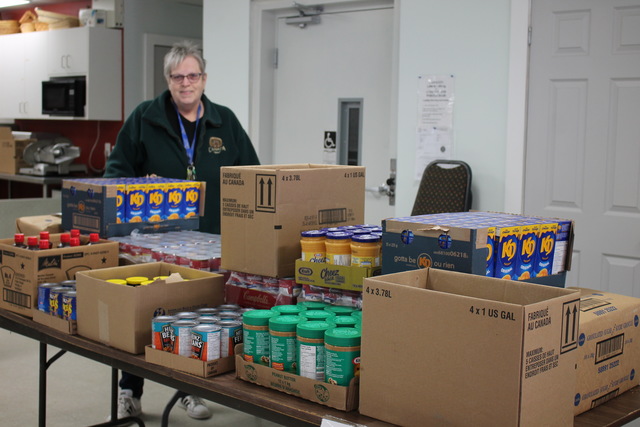
The upstairs commercial kitchen area on Newcastle Street is filled with tables containing supplies for all of the area food banks, including the 4C’s in Haliburton, Central East Food Network in Highlands East, and smaller food banks in Coboconk and Kinmount.

Joanne Barnes is there, continuing to help fill the tables for eventual distribution.

“Overall, donations are coming in fast and furious,” she said. “We are a huge way ahead of where we were a year ago, like several thousand dollars ahead.”

Like Lesperance, she said, “It’s amazing. We have the money coming in. It’s just laying hands on product.”

She is concerned about what she believes will be a lack of seasonal jobs this year and the impact that will have on families.

“We are now looking at a regular base of 150, plus 300 new families,” Barnes predicted. She added they also have limited volunteers due to the pandemic. Some of their regulars are aged or have compromised immune systems. Plus, they have to practice social distancing as best they can while at the food bank.

“I’m weary. I’m putting in long hours. I do help unload trucks but it’s more the mental exhaustion,” Barnes said.

However, Barnes said she remains buoyed by the fact, “It’s amazing how this community always pulls together.”

Due to regulations, they have one client come to the door to give their family name and size. They bring the food outside, loose in shopping carts, for clients to bag themselves. The carts are then sanitized for reuse. The food bank is also delivering to those who do not have transportation or do not want to go out.

You can contact them at: 24 Newcastle St., Minden, 705-286-6838, mindencommunityfoodcentre@gmail.com

Not all county heroes wear capes

0
Truck driver Rick English.

One manages an office, another drives a truck and a third volunteers for community radio. Collectively, they’re just some of Haliburton County’s heroes in the war against COVID-19.

The Highlander asked local health care providers to nominate one from their ranks and the majority recommended Kim Robinson, the executive director and office manager of the Haliburton Highlands Family Health Team/Haliburton Family Medical Centre.

While not on the frontlines, Dr. Nell Thomas said without Robinson “nothing would be where it is today. She keeps the clinic running, created the COVID-19 assessment centre, makes sure people get paid and coordinates the sick time and meetings. In most of our cases, if each one of us stepped away, things would carry on but if Kim stepped away, I can’t imagine what would happen.”

Robinson said she’s honoured but it’s a team effort. “Without them, none of the work that we have done around the COVID-19 pandemic would be possible.”

She said they face daily changes with ease, pick up work where they see the need and support one another and herself.

“I truly didn’t think twice about what this pandemic would mean for me. My concern was the team, physicians, patients, etc. I couldn’t have managed to do what I have done without the support of our entire healthcare community and community at large.”

Robinson said the pandemic “has consumed my time, but in a way that has actually been a blessing, so to speak. It has shown me exactly what this team can do. It has taught me to not be complacent and that we should practice such care with each other and our patients every day. I am fortunate to be able to come to work each day … I am not fearful of contracting COVID-19. I feel protected and educated thanks to our physicians.”

The trucker

Rick English lives in Carnarvon but spends the bulk of his work weeks on the road as a transport truck driver. He’s been driving for 48 years, and at 68, says he should retire but admits, “I enjoy doing it. I love the highway.”

This week, his route took him to Sault Ste. Marie, then into Michigan, Minnesota, Illinois, and back to Toronto and home.

He said his work life has not changed all that much during COVID-19, other than he cannot break up the routine by going into a restaurant for a sit-down meal. However, he has a refrigerator and microwave in the truck and says his wife always fills the fridge with leftovers. He can still get takeout and the washrooms are open and clean.

As for border crossings, he said he can’t bring his wife since only co-drivers are allowed as essential workers. Other than that, the crossings are probably faster since there are fewer cars on the roads.

Asked how he feels about truckers being treated as heroes, English said, “Everyone is waving at us when we go by, and wanting us to blow the horn. We get more respect now than we did before. But, how will they treat us after this is over? We’ll see if the tradition carries on.”

The radio guy

Mike Jaycock has been a voice of information and inspiration throughout the pandemic on Canoe FM. He has shows Mondays from 7-9 a.m. and Fridays from 3-6 p.m. as well as doing the mayor’s report Tuesdays and Thursdays. He’s conducting other COVID-19-related interviews as well.

“I’m fortunate to have a mini-studio at home with microphone, phone connection technology, mixer and computer software that allows me to record and edit phone interviews as well as record commercials and station promos,” Jaycock said. “I’m able to mix in music, if needed, and produce a finished product to send into the station via Dropbox. Between preparation for the shows I do and the interviews, I probably put in eight to 10 hours a week, from home. As a result, it sounds like I’m in station a lot more than I am.”

Jaycock said since he’s a senior with a history of asthma and some breathing problems, he’s extremely cautious and concerned around trips away from home. He goes to the station and comes home.

“The station has been very proactive in terms of setting out the protocol and providing materials (disposable microphone socks, wipes, soaps) to ensure we stay safe. It’s important for us to be at the radio station because, as a community radio station, it falls to us to provide as much current information as we can while at the same time providing friendly, neighbourly voices for members of our community. It’s in times like these that community radio excels. So, while the family is a little concerned, I am glad to do what I do, thanks to the radio station’s concern for its volunteers. I feel pretty darned safe.”

County ‘a long way from being out of the woods’

0
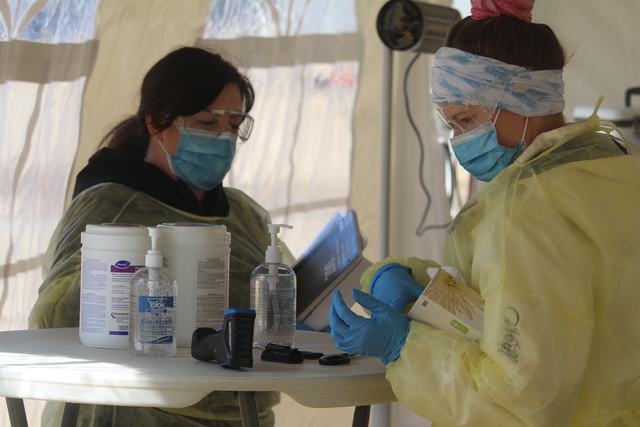
Work continues at the COVID-19 assessment centre in Haliburton.

While the province may be getting over the first peak of COVID-19, Dr. Norm Bottum of Haliburton says there could be a second, and subsequent, peaks before a safe vaccine is rolled out in possibly a year’s time.

Speaking from the Haliburton Hospital on April 21, he said, “things are nice and quiet but we are a long way from being out of the woods.”

Haliburton Highlands Health Services CEO Carolyn Plummer echoed the sentiment, telling The Highlander on April 21, it’s too soon to know for certain whether the virus has peaked in our region.

“We are in regular communication with our local public health unit and will continue to monitor the situation. In the meantime, we remain focused on ensuring we are prepared to safely manage through the COVID-19 pandemic and to continue supporting our community, particularly those who are most vulnerable.”

Dr. Bottum said it appeared Ontarians had done a great job of mitigating the initial surge. He added the County has been fortunate to have only seven confirmed cases since people travelled for March break, returned from Florida and cottagers are coming despite pleas not to.

In particular, he said we’ve been lucky it has not hit our long-term care homes.

“We have had the benefit of time to get prepared and be ready,” he said of preventative measures at Highland Wood and Hyland Crest.

He also credited non-essential businesses for shutting and following health guideless. However, he remains cautious.

“This is the first phase. The big thing is we’re in Haliburton County, cottage county, and in another month, people will want to come up. There’s a risk of still introducing the virus.”

He said it will be key to see how the provincial regulations roll out from here since “that virus is still out there.”

He personally predicts it will be a quiet summer in Haliburton County with a majority of events being cancelled.

As for HHHS, he said “we’ll probably have to carry measures right through the summer.” That means maintaining 21 COVID-19 acute care beds in Haliburton and nine non-COVID-19 beds in Minden; separating the hospital sites and ensuring long-term care homes are isolated from the hospital buildings to avoid cross-contamination. He said the assessment centre will likely remain is place as well with more people being encouraged to do self-assessments and getting swabbed. The Ministry of Health and Long-Term Care has changed the assessment to include more symptoms. It is also encouraging essential workers to be screened.

“Getting a swab is the key, especially as we start opening up the economy.”

He said he anticipates the recovery will be staged but “even at stage 3 we’ll be still social distancing, regular hand washing, and avoiding large groups.

“I think it’s going to be slow and cautious.”

In its weekly community update, HHHS said “we are implementing further measures to separate both Long-Term Cares facilities (Highland Wood and Hyland Crest) from the hospitals, and better protect the health and safety of our residents.”

How you can help HHHS

• Volunteering with the HHHS Community Response Team to help deliver groceries or offer friendly visiting by phone. Contact 705-457-2941 or infocc@hhhs.ca for more information. • SIRCH Community Services is helping to coordinate the creation of fabric face masks. Visit sirch.on.ca and look for “Can You Sew? Sewing for a Great Cause” under the ‘News’ section for more information.

• Stay informed via local media. HHHS is also keeping HaliburtonCares.ca up-to-date with new information about supports from local service providers, different levels of government (including emergency financial assistance), and more.

Clarificiation: In last Thursday’s Highlander, “HHHS responds with unprecedented action,” Plummer said, although it is true that funding specifics have not yet been detailed for COVID-19 related changes, such as new acute care beds, the actions were sanctioned by the Ministry of Health.

Cell providers get call to improve services

0
The Eastern Ontario Regional Network has issued its first request for proposals. File photo.

The Eastern Ontario Regional Network (EORN) has issued its first request for proposals to build new cellular infrastructure as part of a massive $213 million project.

The bidding process will aim to identify partners who can expand cellular coverage throughout eastern Ontario as part of a wider effort to improve mobile broadband. The initiative involves all three levels of government.

“Now more than ever, our government understands that families and businesses in Ontario need to be connected to prosper in this 21st-century digital economy,” Haliburton-Kawartha Lakes-Brock MPP Laurie Scott said in a press release, adding the project will take a number of years to complete.

Minden Hills Mayor Brent Devolin serves on the EORN board. He said the COVID-19 pandemic has not yet caused a substantial delay in the process. He further said getting proposals back from service providers would normally take about three months.

“Given the current status, I’m not sure whether that drags out. Most people are involved in technology and connectivity. We all work from a distance anyway, so that may not be such a big deal as it is for some organizations,” Devolin said.

COVID-19 shows need for connectivity

The pandemic has increased people’s reliance on cellular and internet services, with many now working remotely.

County library CEO Bessie Sullivan said the library internet hotspots are seeing use, accessed frequently from parked cars. The County has 22 hotspots in total, seven at libraries.

“It clearly points out that we are not where we need to be in terms of the digital divide,” Sullivan said. “When we have a situation like this, it just points out where our gaps are. The fact that there are options is a good thing, but I think it really does say that we really need to have a better internet infrastructure.”

Jacques Larroude is a Blairhampton area resident. As a manager for the CARE International Rapid Response Team, part of the major international humanitarian organization, he works remotely and needs reliable internet for his job. He said it has been steady during the pandemic, but he has experienced unworkable slowdowns in the past. Due to his location, he also only has access to one provider, with an alternative unwilling to extend its coverage an additional 700 metres to accommodate him for cost reasons.

Larroude further said as one of the poorest counties in Ontario, Haliburton should have some priority for new infrastructure.

“If anything happens to the particular service – I only have one choice, one option – I’m basically out of a job. That is a concern,” he said.

However, Devolin said the COVID19 situation has further emphasized how vital connectivity is and hopes that could expedite future projects.

“Accelerated connectivity will benefit us all. I’ve always believed this could never happen fast enough and in light of COVID-19, I’m more firm in my views,” Devolin said. “This needs to be perceived as kind of a basic Canadian right. That we should all have access to reasonable connectivity from coast to coast.”