
Home Blog Page 443

Stories from the frontline of the ER

0

Editors note: Dr. Ivsins is the daughter of local Merla Russell. She spent all of her summers in Haliburton County as a child as the Russell family had had a cottage here since 1954. Dr. Ivsins works in the emergency department of a hospital in North Vancouver.

The first few times I heard about it on the radio, it seemed far away. The word virus would come and go out of the media not infrequently, and especially with fear, and doomsday predictions attached. I would feel safe and warm in my tiny North Vancouver bubble. There are green trees all the time, and the ocean, and my little hospital that could. I am a doctor there, and all the nurses are my friends and I can drive my little blue electric Golf there in three radio songs up the big hill they call The Cut.

It seemed sharp and sudden when everything changed. When I look back on what day it was, I can’t seem to remember how long it’s been, or when the moment was that I realized that things were bad.

Now, when I go to work, I bring a plastic bag that I throw out, so I don’t have to bring my purse. I wear only a certain pair of shoes and don’t touch them as they sit by the front door reminding me the rest of the time of the fear, and sweaty armpits and fogged up face mask I have to try to deliver care through while I work as an emergency doctor.

So far, the hardest part has been the waiting. I feel like we are standing on the beach, and all the water has been sucked out to sea, and we are waiting for the wave to overtake us. I am standing there, with all my co-workers, only I can’t see them.

We sre all covered up with hair covers, goggles, masks, gowns, gloves. We can’t touch our patients and we can’t even see each other. Walking around in our unrecognizable ED, I have to look deeply through the semi-fogged plastic to see who it is. We have plastic sheets for walls, and ‘do not enter’ signs, and radios, and tents, and comprehensive infection protocols.

We are standing on the beach and we hear the news out of New York, out of New Orleans, out of big American cities filled with affluence and technology, but apparently not enough breathing machines or masks to keep the caregivers safe.

The first time I saw a patient who came from China, months ago, worried about the far-away virus, I giggled a little when I saw the triage note on the computer tracking screen. I remember googling the province where they had been in China, and taking my striped isolation gown off in the room in front of them and saying ‘see, you were nowhere near the place called Wuhan.’ I reassured them with a gentle arm squeeze, and my kindest doctor voice and went about my regular day.

The first time I saw a patient who was known to have the virus, I put on that gown, the goggles, the mask, the head cover and the gloves. A friend offered to go in the room for me. ‘I don’t have kids’ he said. But as someone who always likes to consider herself ‘brave,’ we went together. It felt different. Different than any other patient room I had walked into.

I froze as I felt the presence of this microscopic invader in my warm little world. I thought of my husband and daughter at home, my plastic pink shoes I go to and from work in. I thought of the moment before intubation, when the drugs are melting you into unconsciousness, and your breathing is so fast your chest aches, and your head feels like the atmosphere is blowing right through you, and you know the plastic tube will be jammed through your vocal cords, and the only sound you will hear are the ventilator beeps, and I thought, god, please, please, please not me.

And then I looked up. And I saw there something from my every day warm bubble that snapped me back to reality – a patient. A patient with big human eyes, looking right at me. Who was scared, whose chest was heaving from the fluid invading his lungs, whose heart was racing trying to keep up with his body’s metabolic demands, a human who needed me. And I thought this, this I know how to do, and I moved into action.

Not a traditional summer

0

With the Government of Ontario this week unveiling guiding principles to reopen the province, we can now speculate on a timeline for when things might get back to normal in Haliburton County.

Premier Doug Ford announced a three stage strategy April 27. With the province still virtually locked down until the end of May – schools and provincial parks for example – we can realistically predict the stages to begin in June.

In stage one, there will be some reopening of businesses ordered to close, or restrict operations. However, they’ll still be under public health guidelines. Some outdoor spaces, such as parks, will be opened. And the number of people allowed to attend some events will be increased. For those who have had non-urgent and scheduled surgeries, or other health care service needs, you may get a call.

Ontario’s Chief Medical Officer of Health and health experts will then analyze how it goes. How it goes means: a consistent two to four week decrease in the number of new daily COVID-19 cases; sufficient acute and critical care capacity, including access to ventilators and ongoing availability of personal protective equipment; approximately 90 per cent of new COVID-19 contacts being reached by local public health officials within one day, with guidance and direction to contain community spread; and ongoing testing of suspected COVID-19 cases, especially of vulnerable populations, to detect new outbreaks quickly.

Stage two will involve opening more workplaces, which may include some service industries and additional office and retail workplaces. Some larger public gatherings would be allowed, and more outdoor spaces would open.

If things are going well, the province could then open all workplaces responsibly and further relax restrictions on public gatherings in stage three.

That means a period of a minimum of six weeks to a maximum of 12 weeks to take us to the end of stage three.

Safe to say, we are not going to have a traditional summer season in Haliburton County.

Our local leaders are beginning to plan for that unfortunate economic reality. The county’s tourism department, for example, has sent out an email to stakeholders, in which director Amanda Virtanen assured them they were working on a recovery plan considering a number of factors and including a variety of partners.

In it, she wrote people need to remember that every destination in the world will be competing for tourists, but we have an advantage since people will initially opt for domestic travel and we have physical space and outdoor fresh air experiences.

We are close to major markets such as the GTA, who can drive to us. We’re hearing gas prices will remain low.

She noted our accommodations are uniquely well-positioned to take advantage of the new mindset of a more local traveller, who are likely to want their own cabins, and less-crowded accommodations.

Locals have a role to play, too. I patronized a local hardware store on the weekend and staff told me they were being run off of their feet. We must continue to shop local. We further encourage our cottagers to return in mid-summer and stay longer into the fall. Above all, we urge all residents and visitors to continue to follow current health guidelines to ensure an earlier, rather than later, recovery.

New AH treasurer gets best of both worlds

0

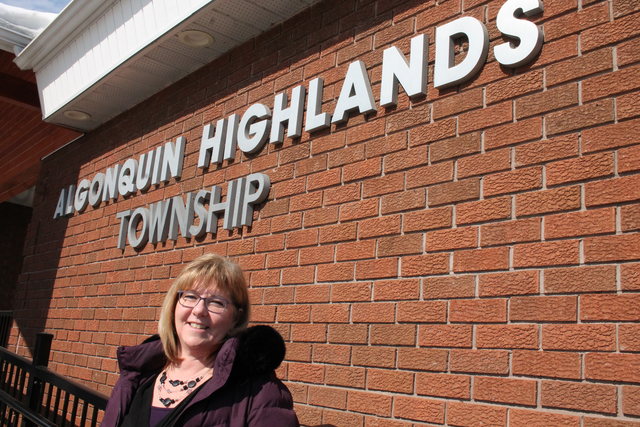
Having vacationed with her family in Haliburton County, new Algonquin Highlands treasurer Jean Hughes couldn’t pass up the opportunity when a job was advertised to replace Tammy McKelvey.

In an interview with The Highlander, Hughes said she also grew up at a cottage in the Magnetawan area so always had a passion for this area of the province. She said she and her husband set an intention to retire locally one day.

“So, this is the best of both worlds. I get to work up here and eventually retire up here,” Hughes said.

Hughes said she’s been in the municipal business for 20 years. She started in Dufferin County and worked her way up to deputy treasurer there. Four years ago, she moved to Howick, in the Huron County area, to a largely farming municipality. She was treasurer. She had been job shadowing McKelvey, who has since retired, but moved to the other side of the desk at the end of February.

“It’s very similar to what I was in before, other than that they don’t have the farmland up here,” she said. “We have lakes. Where I came from was a predominately Mennonite population. So, here we have the cottagers. Otherwise the job is very similar, although I’ve never had an airport. But, then again, I had communal well systems, so it’s just a give and take.”

She said being a municipal treasurer is a bit of a balancing act, with the province often lobbing balls.

“And, we don’t know where grants are coming from of late. They’ll say, ‘here, take some money, no obligations, and no conditions to it’ but in the back of my mind I’m thinking about the reporting. We do face challenges.”

She said as a treasurer, as her husband jokes, “I treat it like my own chequebook. I’m not going to do frivolous spending just like I wouldn’t do to my own situation. I like to make sure that we make the best decisions for our community at large.”

She said she was looking forward to officially moving into her own house over the Easter weekend and the couple beginning to set down roots. They both curl and she enjoys playing ball.

“I want to see what adventures Algonquin Highlands has for me.”

‘We’re all heroes, each and every one of us’

0

Sylvie Drouin had just started work as a nurse at the Haliburton Hospital when COVID-19 struck. She was quickly redeployed to help with the pandemic.

“This has been an incredible journey and learning opportunity, one of which I never imagined to be part of,” Drouin said.

She admits that being taken out of her normal routine was tricky and scary.

“But, logically, I felt safe knowing if we collaborated, we could keep each other safer and best utilize each other’s roles by creating a stronger team.”

She said she’s been asked to be part of many additional roles, such as: booking appointments for the COVID assessment centre, being a COVID tester, a front door screener and counselling and reassuring patients who call the clinic in fear. She’s also working the COVID unit at the hospital.

“I learned very quickly, as many did, fear can be the biggest instigator of chaos,” she said.

She said the transformation from an acute care setting to a COVID acute unit has been incredible.

“The amount of helping hands and hard effort to make this happen amazes me. All the staff collaborating to make it work. The amount of decision-making and the additional education set in place for staff and mock codes have been reassuring for me.”

She added there’s much more to it than just getting the job done.

“I can’t speak for every health care worker, but I can attest as a nurse. It has been an emotional rollercoaster. I would be lying if I reported this change as just a normal way of work. I most definitely have fears every single day, such as, “will I contaminate myself, or others? Will I be protected and for how long until we run out of PPE? Will I be asked to re-use a mask or gown already used? Will this ever end? When this is all over, what will be the outcome of the economy and the health care system? Will this be the start of many more pandemics to come? What will we have all learned from this?”

Drouin said she’s teared up before and after work, because “none of us really know how safe or unsafe we are.”

She said it’s a day-by-day process and difficult for everyone.

“I get through this by counting my blessings daily as a reminder that I am okay because I can confirm I have an effortless breath. I’m well and healthy. I have a job I can go to with an income. I work alongside a very strong group of amazing humans who support each other. This allows room to breath and carry on to do what we do best. I get through this with them.”

She said frontline health care workers aren’t the only heroes, either.

“Truth is, we’re all heroes, each and everyone of us, if we choose to be.”

Yoga going online for the frontline

0

Four days a week, Gail Holness takes to her yoga mat to help raise money for needed services in Haliburton County.

It started with her ‘online for the frontline’ initiative that raised more than $2,000 for the Haliburton Highlands Health Services, and is now switching to generate income for area food banks in May.

Holness has set up two donation buttons on her site. Initially, people’s donations went to HHHS and her online classes went to their inbox. People could either join live or receive recorded classes to do at their convenience.

“At their convenience turned out to be a very important point,” Holness said. “I learned very quickly that many people are just too stiff in the morning to be able to attempt a class but later in the day is perfect. Our frontliners are working crazy hours and there is no way a 10 a.m. class is doable, but maybe late evening is.”

Holness said it was a given she would have to go online but she did not have internet until Angie and Abby Xerri of Quantum Passivhaus offered her a space and access to their internet.

“With that in place I could move forward and help individuals through this time by giving them the much-needed routine, grounding, movement and connection with others they crave. To me it was a natural transition to open the doors wider and invite more people to help their community and at the same time help themself. I believe in times like this it is important to be able to bring your best skills to the table, for me, my skill is teaching yoga, and mindfulness. Fortunately for me, I have others that believe in me and what I do and wanted to help me.”

She said there was such a wonderful response to the online for the frontline that people wanted to know what was next.

“Overwhelmingly, the answer was direct our donations to the food bank. I couldn’t be happier. With all the cancellations and closures this summer there are going to be a never-before-seen need to help all our seasonal workers. Being able to direct cash to the food bank so they can buy what they need most and buy in bulk so they can save money makes sense. I’m hoping the momentum continues and together through my online classes we are able to raise $5,000. Why not dream big?”

How to take part: Find Gail at holnessyoga.ca. Her online schedule: Mondays – relaxing yoga Tuesdays – yoga tone Wednesdays – energizing yoga Thursdays – seniors, standing and chair & ‘on the go’ shortened version All live classes are at 10 a.m. Recorded classes are sent out shortly after the class is over. $20 donation for one live class and recording. $50 donation for all live classes and recordings for May. Classes can be purchased as a gift.

Resident skeptical over connectivity promises

0
File photo

Elaine Cole would love to facetime with her son and grandchildren, who live in Chicago, but poor internet and cell phone connectivity means she might get a second or two until the screens freeze.

The 70-year-old lives five kilometres northeast of Dorset, where she uses Bell for her landline and cell phone and Xplornet for internet.

While others are using apps such as Zoom to interface with family, friends and social groups, she is feeling more on her own than ever before as COVID-19 continues.

“It’s very isolating,” she said in an interview April 27.

She added it’s not just about service during the pandemic. She’s been a fulltime resident for six years, and before that a seasonal resident for 10. She said the service has always been poor. The landline is fine when not knocked out by weather. With the cell phone coverage, “depending on which way the wind blows, I’m lucky to get one bar.”

“It’s just so disheartening.”

She said in the recent wind storm, her landline was out and she had no cell service. While in good health, she worries what would have happened if she had needed assistance for some reason.

“It’s scary. It’s frustrating.”

Cole said she visited the Serengeti 1.5 years ago, and she got five bars there on her cell phone. Yet, 2.5 hours north of downtown Toronto, she is getting one bar if she’s lucky. She said connectivity is “not a luxury anymore. It’s a necessity.” She cannot fathom that residents of our area do not have access 24/7 and “it’s more important for people who live up north than in the cities. Not to have service is unforgiveable.”

Bell makes promise

The feisty senior says when it comes to promises – such as Bell Canada’s announcement last week of expanded Wireless Home Internet service – she remains skeptical, and will believe it when she sees it.

A Bell Canada spokesman told The Highlander this week that about 4,100 homes in Algonquin Highlands, Dysart et al, Lake of Bays, Laxton-Digby-Longford, Minden Hills, Somerville and Trent Lakes can now access Wireless Home Internet service – “a big jump from the 500 or so homes covered in these areas before last week’s expansion.”

The spokesman said the service provides Internet speeds of up to 25 Mbps, with two packages available depending on usage required. Details are available at Bell.ca/ FastInternet. He said residents can also check if the service is available at their home.

“Bell’s Wireless Home Internet program is dedicated to bringing full broadband Internet speeds to rural communities and other traditionally underserved locations. And with WHI usage growing 4 per cent over the last month, the COVID-19 crisis has clearly underscored the value of the service to customers in smaller communities,” said Mirko Bibic, president and CEO of BCE Inc. and Bell Canada, in an April 23 press release.

Bell said the rollout is for 137,000 rural households in 180 communities.

Cole will also await the results of the Eastern Ontario Regional Network’s (EORN’s) request for proposals to build new cellular infrastructure as part of a $213 million project. The bidding process will aim to identify partners who can expand cell coverage throughout Eastern Ontario as part of a wider effort to improve mobile broadband, in an initiative involving three levels of government. Haliburton-Kawartha Lakes-Brock MPP Laurie Scott has said the project will take a number of years to complete.

County businesses awaiting more federal support

0
Haliburton businesses are waiting to see more support from government. Photo by Joseph Quigley.

The federal government is providing more aid for businesses, but advocates are calling for support beyond loans.

The federal government announced a range of funding April 17, including $962 million towards regional development agencies and the community futures network. It also announced April 16 it will introduce a program to provide loans to commercial property owners to forgo the rent of businesses for April (retroactive), May and June.

But Haliburton County Development Corporation (HCDC) executive director Patti Tallman said although the additional funding is positive, groups are lobbying to get more non-repayable, or grant, support.

“There’s certainly lots of money that’s going into rural communities which is something we’ve really been advocating for,” Tallman said. “The challenging piece for us as a CFDC (Community Futures Development Corporation), we don’t want to see people go into debt and we’d like to provide them with funding.”

Tallman said they expect to get just under $1 million from the funding. Although details are limited, they assume it will be directed towards their investment fund to provide loans to businesses for the pandemic. She added the HCDC COVID19 loan program – up to $25,000 at zero per cent interest– has had lots of interest and 16 takers so far.

She said businesses are feeling pressure locally, especially given the pandemic is stretching into the tourist season.

“We’re just cutting into our tourism season which is the biggest impact of our whole year. It’s just unfortunate that the small business owner is the one that’s taking the heat,” Tallman said.

Haliburton Highlands Chamber of Commerce executive director Jennifer Locke said the latest government announcements were a win for businesses. She also highlighted the announced expansion to the Canadian Emergency Response Benefit, with seasonal workers can now more readily access, and the bigger payroll range for the Canada Emergency Business Account, which is now for businesses between $20,000 to $1.5 million.

But Locke said there is some confusion about qualifying for all the different programs. However, she added businesses are innovating quickly during the crisis.

“I find my members are just trying to wrap their heads around what they qualify for,” Locke said. “Overall, they’re just hoping the community will support them now where they can and keep them in their minds as we move forward.”

She encouraged businesses to fill out the online Canadian Survey on Business Conditions, due April 24, to ensure the rural voice is heard.

“We’re a tight-knit community and we’ve weathered hard times before,” Locke said.

Tallman said CFDCs are lobbying for more help to provide for businesses over the next two years, with non-repayable contributions.

“We just hope the federal government is going to keep pushing money towards rural communities,” she said. “We just hope we can assist our rural community to get back into the land of the living. It’s just such a horrible time for everybody.”

Community shows support for frontline workers

0
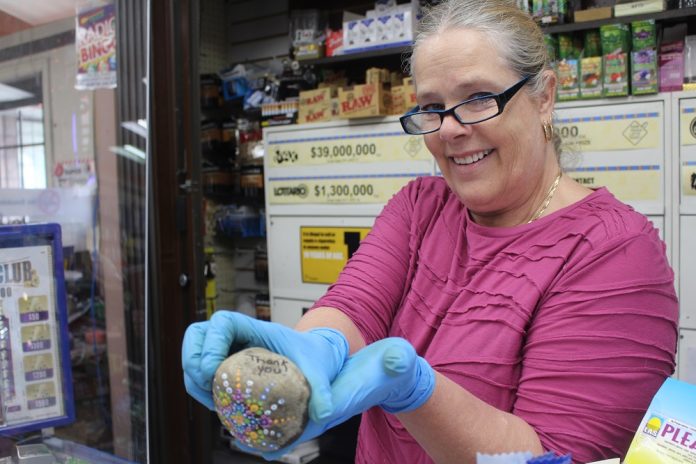
Cashier Kris Leuzinger holds up a ‘thank you’ rock mysteriously placed on the Haliburton Jug City windowsill. Photo by Joseph Quigley.

Haliburton’s Jug City cashier Kris Leuzinger described working during the COVID-19 pandemic to be a “little nervewracking,” with customers still stopping by regularly.

But she said she was pleasantly surprised April 16 when she discovered a decorated rock left on the windowsill of the store. It was emblazoned with bright colours and the words “thank you” written in black marker.

“It just made me feel really good,” Leuzinger said. “I’ve been feeling pretty down with what’s going on. I don’t know where it came from or who left it but I want to say, thank you. Put a smile on my face.”

Community members are finding a variety of ways to show their appreciation for the frontline workers providing services during the pandemic.

School communities including J. Douglas Hodgson Elementary School have held up signs of support and posted them on social media. People have put up messages in their windows. Dysart et al put up a sign on one of its community events boards thanking all essential workers.

Another location getting positive messages is haliburtoncares.ca, which offers a submission form for people to upload messages for local healthcare staff. Haliburton Highlands Health Services vice president of community programs Stephanie MacLaren said they have received a lot of support on social media.

One message submitted to haliburtoncares. ca April 3 directed towards “all health care workers in Haliburton County” said: “You are not alone – we are here, cheering you on, holding you in prayer, waiting to shake your hand, give you a hug and thank you in person when it is safe again. Thank you.”

“We are deeply grateful for the support being shown to health care and frontline workers,” MacLaren said. “These messages represent the best of Haliburton County – we all know this is a tight-knight community, that rallies together to support people when they need a helping hand, and that is exactly what is happening during this challenging situation.

“It is heart-warming to see, and it gives us the extra boost we need to keep working hard, day and night, to keep everyone healthy and safe.”

HHHS seals long-term care homes from hospitals

0

By Lisa Gervais

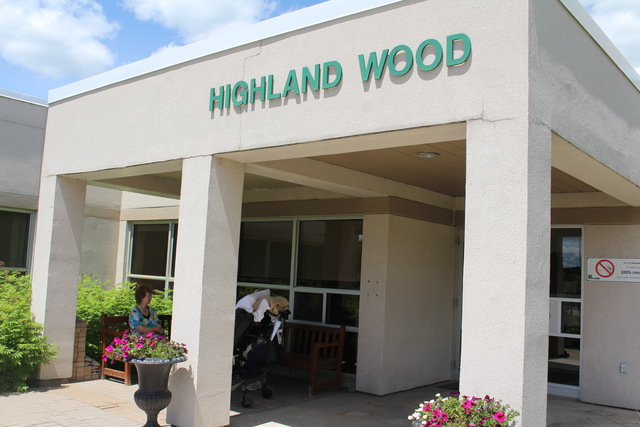
Haliburton Highlands Health Services (HHHS) said it’s now sealed off Highland Wood and Hyland Crest long-term care homes from the rest of the hospital sites in Haliburton and Minden.

In its weekly community update, released April 24, HHHS president and CEO Carolyn Plummer said they’ve  installed temporary walls between the two areas, created separate entrances for staff and essential visitors to use depending on which part of the facility they need to access, designated separate break and change rooms for staff, and re-designed work flows so that there is no cross-over between the homes and the rest of the hospital.

“All of this work, and it has been a considerable amount, has been done in an effort to reduce the risk of transmission of COVID-19 from the emergency and acute areas to our more vulnerable long-term care residents,” Plummer said.

She said HHHS is also moving forward with increased testing for every long-term care resident and staff member, as mandated last week by the Government of Ontario.

In the meantime, she added they will continue to take resident and staff temperatures twice-daily, maintain physical distancing within the homes, and have staff use the proper personal protective equipment (PPE), such as masks, in all care areas within their facilities.

Plummer said as the provincial government seeks to have more people tested for COVID-19, their online self-assessment tool has been updated to include more symptoms, such as hoarse voice, runny nose, loss of sense of taste or smell, headaches, digestive issues, and fatigue.

The self-assessment can be reached at Ontario.ca/coronavirus, or you can call Telehealth Ontario at 1-866-797-0000.

The president and CEO said while HHHS appreciates that many people have tried to stay away from hospitals and health care providers during COVID-19, “I want to encourage everyone to seek health care if and when you need it. HHHS and our local health care partners have been working diligently to ensure that we can manage the COVID-19 pandemic while still providing high-quality health care services to the community. Please do not ignore any health issues you may be having, and seek regular care when needed.”

The Haliburton, Kawartha, Pine Ridge District Health Unit now says all seven cases of COVID-19 in Haliburton County have been resolved. There have been no new cases for more than a week. So far there has only been one hospitalization and no deaths or outbreaks.

Author gives Highlander readers chance to win ebook

0

Bay of Blood, a novel set in Georgian Bay, is based on the mysterious death of renowned Canadian painter Tom Thomson.

The book’s idea came to author Andy Potter when he was watching a documentary about Thomson’s life and mysterious death called West Wind: The Vision of Tom Thomson.

“This would make a great novel,” Potter thought. Then he thought, “No, it wouldn’t. You can’t fly too close to the Tom Thomson myth. It’s sacred. He’s a Canadian icon.”

So, Potter wrote a mystery novel based on Thomson’s death.

Thomson died on July 8, 1917. The famous painter murdered in Bay of Blood died on July 8, 2017. There are other similarities, but the painter in the novel is not Thomson, and he’s not the main character.

The novel’s main character is OPP Detective Sergeant Eva Naslund.

As one of the book’s reviewers says, “Potter takes his readers on a fascinating 21st-century chase, with bells and whistles never dreamt of 100 years ago: cellphones, female detectives, Russian operatives, and shady Toronto art dealers.”

Potter won’t elaborate on the suspects; he doesn’t want to ruin the whodunit.

Ken Haigh, a Georgian Bay author, provided this short overview of the novel.

“In Eva Naslund, we discover a sleuth who is sympathetic, vulnerable, and smart. Bay of Blood is an exciting new entry in the world of Canadian detective fiction. I look forward to volume two.”

To mark the one-year anniversary of the book’s release, Potter and his publisher are offering readers of The Highlander a chance to win one of 12 free ebooks

To win, simply email your name to ampnorthnoir@outlook.com; subject Line: ‘Ebook Giveaway.’ Contest closes April 30, 2020. Winners will be selected at random.

If readers want to get a print book, Bay of Blood is available at book retailers. For more information or sales details, visit Potter’s author site at amp-northnoir@ outlook.com