
Home Blog Page 356

Addiction services seek funding

0
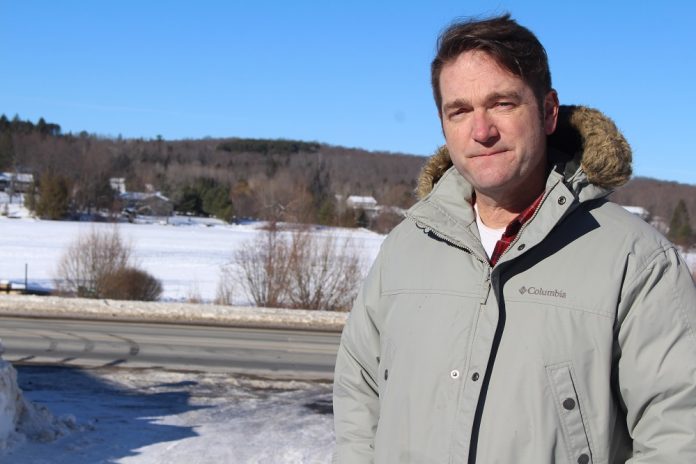
Four-County Crisis case manager, Andrew Hodson, said drugs in Haliburton are a “harrowing landscape” and he needs more help in his role. Photo by Joseph Quigley.

Four-County Crisis short-term case manager, Andrew Hodson, is busier than ever working during a pandemic.

As part of the local mental health crisis response program, his job takes him all over the region. Demand for mental health services is up across the province and Four-County Crisis is no exception, with Hodson’s caseload up more than 25 per cent.

Hodson said he helps people from all walks of life dealing with a wide range of issues, including drug addiction. He said Haliburton is not immune to the problem, with many types of hard drugs being used and becoming more readily available over the years as opposed to being imported from the city.

“It’s a harrowing landscape,” Hodson said. “I see it having tentacles into housing, into health care, into mental health, relationships … Because there are so many paths to lead into these situations, I think we need that many paths out. I think options are great – I don’t think there’s a one-stop solution.”

Hodson is one of many in the sector working to address addictions in Haliburton and beyond. But local providers say finding funding to improve their work can be challenging.

Jack Veitch is the manager of community engagement and education at the district branch of the Canadian Mental Health Association (CMHA) and works with Hodson. He said CMHA offers a range of successful programs to help those suffering from addiction but they are short-staffed.

“We need five Andrew (Hodsons). We need to have a whole, big-structured approach. We need more and more support within the community, so it’s not reliant on one, fantastic employee,” Veitch said.

Veitch highlighted the provincial government’s promise of $3.8 billion over 10 years toward mental health. But he said finances are an issue locally – with no baseline funding or cost of living adjustment for nine years. He said that $3.8 billion should go beyond just hospital settings and larger centres, adding those in positions of power might not understand how much distance can make accessing care difficult.

“Sometimes think, ‘oh well, Haliburton County, we got a support out there. They’re in Wilberforce, they can get to Minden’,” he said. “Not realizing that’s a heck of a hike if you don’t have a car.

“Let’s make sure these dollars are rolled out in community mental health care in our rural communities, where the need is clearly there,” Veitch added.

Unifying care

Minden’s Dr. Nell Thomas said the pandemic has brought increased struggle for her patients dealing with addictions. She said the impact on drug supply lines has made people turn to more dangerous substances.

She further said with rural doctors dealing with COVID, there is not as much time to address addiction.

“I know that a couple of my patients that I was holding their hand and maybe inching toward them getting to rehab, I have not seen in (months),” Thomas said. “We all know those folks with addictions are suffering and being lost.”

But Thomas does have a vision for a solution. She said current care approaches are often too siloed and collaboration can be difficult in a rural setting.

She said if the funding existed, she would like to build a new local medical centre that could bring more providers under one roof, improving ease of access. She further said a stronger, team-based method is necessary.

“I attend conferences and I see just how many different organizations and agencies exist. I’m floored at all the different acronyms,” she said. “Spits and spurts and not a truly cohesive approach. My vision would be to have a team, representing social work, counselling, crisis, medicine, nursing, public health. I have patients that are going into (emergency rooms) far too often.”

But she said the funding is not there for such a thing, particularly given Haliburton’s relatively low population. As is, she said it is difficult connecting people with different treatment options.

“Very frustrating for the doctors, in general, trying to get resources for patients because of the waitlists,” she said. “Because of the hoops you have to jump to get people connected is time-consuming and frustrating.”

Marg Cox is the executive director of Point in Time and sits on the CKL and Haliburton County Poverty Reduction Roundtable. She said there are some links to the stresses of poverty and substance abuse, though added drug abuse impacts people of all economic circumstances.

“We know that people that are experiencing poverty are experiencing huge stressors in terms of daily living and trying to pay their rent, put food on the table,” Cox said. “Throw COVID on top of it and we know folks are under a great deal of pressure. And we know that when people are under pressure, they’re more likely to turn to substances.”

She said the issues creating poverty – which the roundtable focuses on – would have downstream impacts on substance abuse as well.

“There would be a very good reduction in terms of substance use if people had adequate incomes, adequate housing, good food to eat and less stress related to poverty,” Cox said.

Help in the legal system

Thomas said she believes in a “carrot, not the stick” method when dealing with substance abuse in the justice system.

“You can lay charges around in circles. You can have a very short-term response to that, but you’re not going to have a long-term solution by using legal means. It’s really about providing alternatives and space and realistic options for people.”

Veitch and Hodson both echoed the sentiment. However, they highlighted the successful collaborations they have with police and the justice system for court diversion, intervening to help those struggling with mental health or addiction issues.

“We’re there ready in the court system,” Hodson said. “As opposed to a fine or some sort of punishment, we can encourage that person to engage with addictions support, engage with mental health support … I’ve stood in court beside people – literally – after six months of help. And speaking to the judge on behalf of their own recovery, these are powerful, powerful moments where people have recounted their gratitude for having an opportunity to turn things around.”

Veitch said punitive measures have not been an historically successful way to stop repeat offences.

“How can we still create this level of accountability and reduce recidivism?” Veitch said. “It’s creating all these fantastic court partnership programs, where there’s still a level of accountability for the offender. But there’s also a level of treatment and care and support.”

Beyond the need for increased resources, Hodson said it is vital that the community care for those suffering from addiction.

“We need to develop something for Haliburton, from Haliburton,” he said. “I ask people, ‘what on earth got you through that (addiction)?’ What I hear, it’s not what you’d expect. You hear things like, ‘my Mom never stopped loving me. My probation officer, ladies at the food bank, always treated me with dignity. Never made me feel like a second-class citizen.’

“That is everything. We can build all the buildings and develop all the medications we want to develop. If we don’t have that community that makes people feel loved – and there’s a place on the table waiting for them – I don’t know where we go.”

But he said there are plenty of people in Haliburton – from police to churches to human services to parents – ready to lend a helping hand.

“Are we perfect? Of course not, but there is an invisible army of people in this County offering their support,” he said. “I’ve seen so many remarkable cases of recovery in this community and it’s heart warming. Those stories just don’t make the headlines, but they are out there.”
T-shirt sales support local food bank

0
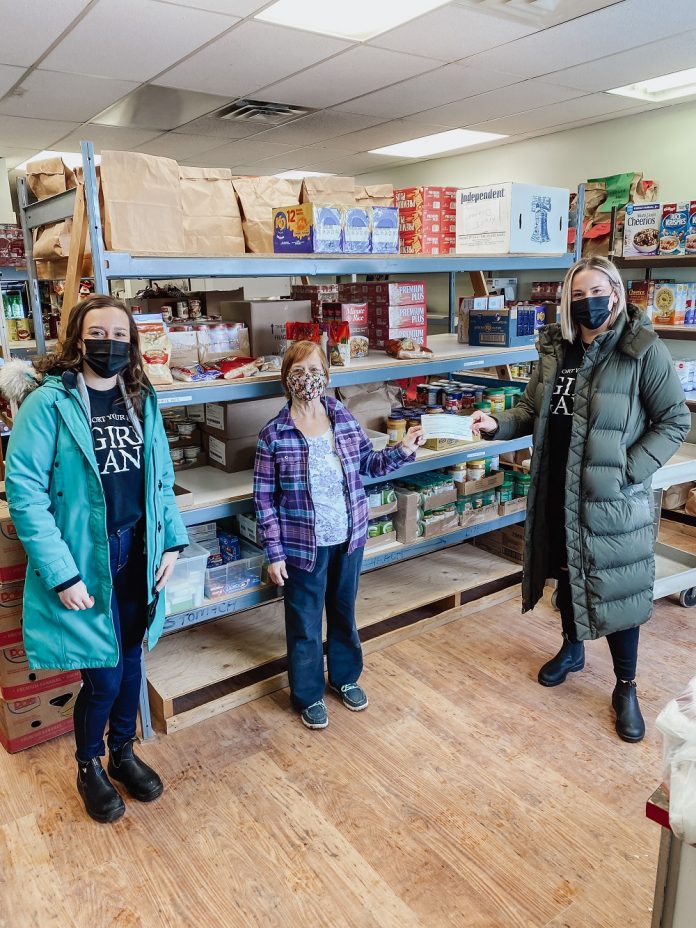
Kelly Kay, Judy MacDuff and Kirsten Rae

by Carolyn Alder

The Haliburton food bank recently received a $1,000 donation thanks to two local moms and some black T-shirts.

Kirsten Rae and Kelly Kay, the KayRae real estate team with Century 21, started selling support your local girl gang T-shirts last month with all proceeds going to the food bank.

We were thinking of ways to raise money that would be COVID safe but still effective, Rae said. We came up with T-shirts. It’s something that would be fun and people would like.

Rae said the initial response was overwhelming and the first order of the black T-shirts sold out a few days after the campaign started. More have since been made and are being shipped.

The ‘support your local girl gang’ is a fun take-off of the slogan babes supporting babes, Rae said.

T-shirts with uplifting messages are popular right now, she said, and ‘support your local girl gang’ signifies “supporting a local charity, using local realtors and supporting local businesses, Rae said.

Kay added they chose to focus on donating to the Haliburton food bank because of the local need.

With COVID we feel a lot of people may be out of work, so the food bank may have a higher number of people using it than in the past.

Rae said they plan to donate the next thousand dollars raised to the Minden food bank.

To get a shirt, go to kayraerealestate.ca

Residents reach for the Starlink

0
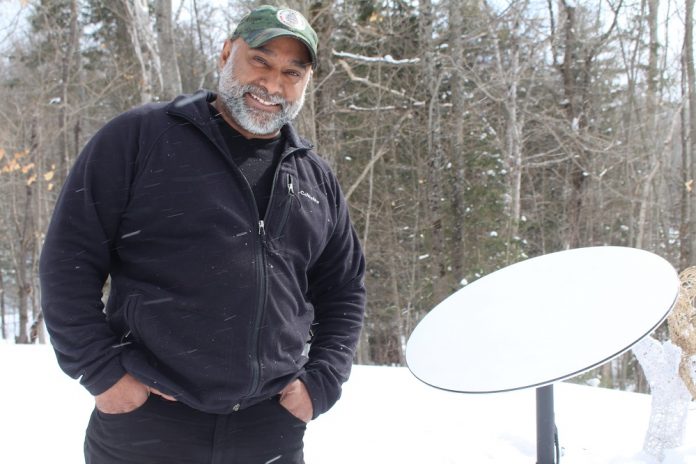
Haliburton Lake resident, Joe Mukherjee, stands next to his Starlink installation, getting high-speed internet service using the satellite-based service. Photo by Joseph Quigley.

When Joe Mukherjee got his first email that the Starlink internet service was touching down in Haliburton, he wasted no time in ordering the service.

The Haliburton Lake resident had waited for months for the opportunity. As someone doing video calls for his job, he sought better service, struggling with slow speeds using other providers. He made it work by paying for separate connections for himself and the rest of his family.

The satellite service from U.S.-based SpaceX seeks to use Starlink to deliver better speeds in remote areas across the globe. Days after receiving it, Mukherjee said it is living up to that promise, with his download speeds going from less than 0.5 megabits per second (Mbps) to 150 in one test. Starlink said users can expect between 50-150 Mbps consistently.

“Big difference, there’s no question,” Mukherjee said. “I’m really optimistic this will be a game-changer. Not just for me, but I think my community at large.”

Starlink announced it was available in Haliburton Feb. 3, but only in a limited supply. Mukherjee is one of the first in the County to receive it. SpaceX declined to respond to questions on service availability.

Starlink does have its issues, Mukherjee said. There are intermittent stoppages – about two or three times on average in every 30 minutes, lasting between three and 15 seconds. He said that will not impact most things, though does generate pauses in live video calls.

“I hope it gets better so I can do video all day, every day,” he said, adding he is optimistic with SpaceX launching more satellites in the months to come.

The service is not inexpensive. The satellite hardware is $649, in addition to a $129 per month and $65 shipping to Haliburton. There are no data caps.

But for County residents waiting years for better internet service, Starlink could be a more imminent hope. The County, both independently and through its place with the Eastern Ontario Regional Network (EORN), has been working on telecommunications infrastructure projects. EORN secured $213 million in funding last summer to improve cell coverage through Eastern Ontario. That project is going through a procurement process.

County Coun. Brent Devolin serves on the EORN board and said they are open to all technologies, including low-orbit satellites. However, he said details are still scarce on Starlink and its capacity.

“We all want connectivity. We’re like in the desert and we want a glass of water,” Devolin said. “The problem with some of the promotional stuff – there’s been a lot of bravado and not enough detail.”

Devolin told County council Nov. 25 he was excited by the proposals coming forward for EORN’s cell gap project. He said if all goes well, there would be an announcement coming in March.

But going forward, Devolin said demand for connectivity will be unlimited.

“All the available technology, going forward, we’re going to need them all.”

But Mukherjee said he could not wait any longer after reaching out to anyone he could about improving his service. He said it could be many years before projects such as EORN’s can make a difference for him.

Starlink “is for areas like us,” Mukherjee said. “Situations where it’s very difficult, very expensive for the incumbents to provide a comparable service to a metropolitan area.”

AH to set 3.89 per cent tax rate increase

0
Algonquin Highlands held two days of budget talks Feb. 22-23

Algonquin Highlands ratepayers will see a 4.98 per cent levy increase in 2021 following two days of council budget talks Feb. 22-23.

Treasurer Jean Hughes said it equated to a $273,000 increase. She added that $134,000 of that, or nearly half, is going into reserves for future projects.

On average, it amounts to about a $12.50 per $100,000 assessment increase for residential taxpayers, or a 3.89 per cent tax rate increase.

The township began budget discussions with a starting point of a 4.19 per cent levy hike.

However, deputy mayor Liz Danielsen said she would be comfortable with increasing the levy by a small amount to top up reserves.

“I would like to see us increase the levy … I think we’re in a good position to be able to add another one per cent,” she said. Hughes had earlier asked councillors to consider creating an infrastructure reserve.

She singled out adding money for the Dorset Tower ($40,000), docks and landings ($40,000) and the asset management plan (54,000) to land council where it did.

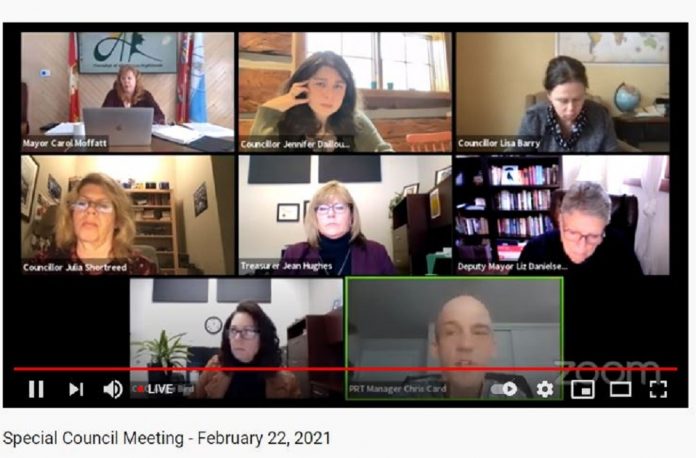
Mayor Carol Moffatt told The Highlander, “councillors chose to raise the levy rather than cut projects or services, and the increase wasn’t made or taken lightly. There’s a lot of growth in the county and AH is feeling the impact of that. The community is changing quickly and we need to stay ahead of that.”

The budget will be passed via bylaw at the March 18 meeting.

Hughes added in her budget report that during the past year, the township faced many challenges due to the pandemic, including facility closures, staff layoffs (particularly for parks, recreation and trails), program cancellations for residents and training and conference cancellations for staff, some project deferrals, and various staffing vacancies for longer than anticipated.

She said as a result, the township realized a significant operating surplus at year end and it had been transferred to the various department reserves to fund future capital projects.

Hughes said the township also received an additional $91,400 in OMPF funding for 2021 and realized reduced policing costs (two per cent) to save an additional $23,000.

She said the 2021 budget reflects new expenditures, including hiring a communications coordinator for a one-year term at an estimated $30,000. They’ll hire seasonal operators for public works and maintenance, estimated at $60,000. An added seasonal trails position to assist with increased patronage is estimated at $30,000.

Hughes said various projects planned for landfill locations, plus increased costs for haulage, have resulted in significant increases for the waste division overall, approximately $80,000.

The township also plans to spend $6,000 in improvements at Elvin Johnson park and greenspace improvements and rear entrance maintenance at Oxtongue Lake Community Centre ($7,600).

Auroras say Wigamog listing a ‘surprise’ to them

0
The Wigamog has been placed on the market but the Aurora Group says they are working to remedy that situation

The owners of the Wigamog Inn in Haliburton say they have not given up on the property despite it being put on the market.

A listing has gone up for the Kashagawigamog Lake property with an asking price of $4 million. It is being sold by agent, Rose Basir, of Royal LePage Signature Realty in Toronto. According to the listing, the property is being sold by the mortgagee in possession under power of sale.

The site is 1701 and 1741 Wigamog Rd. in Dysart et al, comprising just over 40 acres of land and 13 structures.

CEO of the Aurora Group, Ravi Aurora, told The Highlander on Feb. 23, there was not much he could say because of an ongoing legal battle.

However, “it was not listed with our approval and it was not put up for sale by us,” he said. “We’re obviously not going to take this lightly. We’ve been on it since the day we noticed that it even came up because it was a surprise to us, too.

“All I can say is that we’ll have this all fixed in a short order of time, and then we will just pursue whatever legal avenues that we decide to go with for the repair of the situation.”

Aurora said he was hopeful of updating the community as of the week of March 1.

The Auroras purchased the Wigamog on March 3, 2016 announcing big plans for it, and the Pinestone, which they had purchased the previous year. They are also working towards a gas station, fast food outlet and convenience store on County Road 21 near the entrance to the Pinestone.

Their announced plans for the resort included reopening the inn and The Moose Bar and Grill. There was also talk of a new residential development, with 180-plus units of condos, townhouses and detached homes. However, to date, nothing has been done at the site.

Aurora said those plans have not changed but he admitted they have been slowed and it’s been a challenge and “COVID hasn’t helped.”

He added that the situation at the Wigamog had no bearing on operations at the Pinestone, which he confirmed had come under the Choice Hotels brand. He said they had spent $3 million there since taking it on, including roofs, the driveway, installing LED lighting, purchasing golf carts and updating golf equipment as well as new kitchen equipment. He said they next plan to renovate rooms.

He said they’ve had no return as of yet on that investment and ultimately, they need the revenue to drive their plans.

Informed about the listing last week, Dysart et al Mayor, Andrea Roberts, said in her opinion the sale is “good news.” “

I hope it does sell and that whoever buys it doesn’t just let it sit and fall into further disrepair. We need a developer that can remove the old buildings which will be very costly, and create something for that property that is realistic for Haliburton and fits the needs for our area,” she said.

Aurora acknowledged the Aurora Group also has some work to do in regaining the community’s trust.

“I know it’s going to be a tough battle to gain that confidence again but we are very determined … Our intentions are fully to complete and move forward with everything we have planned.”

Haliburton and Minden hospitals get more money

0

Haliburton Highlands Health Services (HHHS) has received an additional investment of $607,000 through the Central East Local Health Integration Network (LHIN) to address important capital projects to improve operation and build capacity, MPP Laurie Scott’s office said.

In a news release, they said the funding will support a variety of projects including:

• $40,000 for additional repairs to the hospital roof at the Minden site;

• $142,000 for an LED lighting upgrade at the Haliburton site;

• $425,000 to support the replacement of three existing boilers with two new high-efficiency oilfired boilers as part of a facility energy assessment at the Haliburton site.

“These important upgrades and repairs will help our local hospital improve operations and support capacity building to ensure residents of Haliburton and surrounding areas have access to quality health care services,” Scott said.

She added the new funding is in addition to the $722,000 HHHS received through the Health Infrastructure Renewal Fund (HIRF) in one-time funding from the Ministry of Health for the 2020- 2021 year.

The HIRF investment was used to replace boilers and pumps at the Minden site and replace the X-Ray and cafeteria split duct air conditioning units at the Haliburton site.

HHHS President and CEO, Carolyn Plummer, thanked the LHIN and ministry for its support.

“This recent investment supports additional infrastructure upgrades that are necessary to help support the best possible environment in which to continue providing top quality care for our patients, residents, and clients,” she said.

Moylans are lords of their rings

0
Susannah and Barry Moylan built an outdoor curling rink on Drag Lake for some extra winter recreation. Photo by Joseph Quigley.

With the pandemic and lockdown shuttering local curling clubs, the Moylan family took matters into their own hands to play their most beloved sport.

They moved to Drag Lake this summer with a plan to build an outdoor, regulation-sized curling rink – with stones, rings, and all. With shovelling, flooding and food colouring, they recently achieved their goal and can now curl right behind their home.

“We’re a big curling family. That’s all we do in the winter,” Susannah Moylan said. “We wanted to put it in so we could play, as well as have our friends and family over. When they come over, we can have fun, have a little bonspiel of our own.”

Curling has otherwise been hard to come by this winter. They moved from Ajax, where their local rink permanently closed. The Haliburton Curling Club ran for about a month before the lockdown halted play. Both the Minden and Wilberforce curling clubs have opted not to open this year.

“We wanted to do it,” Moylan said. “Because of the pandemic, a lot more people are building their own rinks.”

Building and maintaining the rink is a battle against the elements. Barry Moylan, Susannah’s partner, said you must keep up with it.

“Don’t let (snow) build up, because once it’s over five inches, it’s a lot of work,” he said. “There’s been slush – and everything else on there comes through, it changes the levels.”

The couple decided to move to Haliburton as a retirement place, after visiting for a family reunion. They bought land a couple of years ago and recently finished a build.

“It’s small, but it’s big enough,” Susannah Moylan said. “We’re adjusting well to Haliburton. We really like it – I think we made a great decision to come here.”

The family said it has been nice to have a rink with curling clubs shut down. But they said they are eager to get back to the indoor rinks, with Haliburton’s due to reopen Feb. 17.

“Can’t wait,” Susannah Moylan said. “I’m really happy they decided to open because a lot of other curling clubs didn’t.”

Mixing mindfulness with martial arts

0
Point in Time is bringing back its programs that combine mindfulness with martial arts. Photo by Joseph Quigley.

Point in Time is partnering to remotely deliver a mental health martial arts program to kids and youth this month.

The charity is bringing back its Mindfulness Martial Arts and Young Warriors programs, which combine martial arts and yoga with behavioural therapy techniques. The programs, for ages 12-18 and 8-11 respectively, will be delivered online through the Youth Hub for the first time.

The courses will last 18 weeks. Point in Time Family Support’s Melanie Jones said mindfulness practices can be valuable at any time, but even more so at times such as during a pandemic.

“The program really focuses on bringing yourself to the present moment, being with uncomfortable feelings, uncomfortable thoughts and then not judging them,” Jones said. “Change how our thoughts impact us.”

The Mindfulness Martial Arts Program was adapted locally through Haliburton Highlands Secondary School in 2014 but was sidelined by the pandemic. Jones said organizers worked for months to find a way to deliver it remotely, collaborating recently with the Integra Child Development Institute for a new online model.

Kelly Outram is a martial arts instructor with K.O. Martial Arts who is teaching the course for the first time. He said the concept inspired him, as he used both mindfulness and martial arts to help overcome his mental health struggles. He added martial arts offers a good way to improve oneself and gain physical benefits as well.

“You recognize you’re able to do things you could only imagine doing when you started,” Outram said. “If you’re able to stay consistent about it, you get a lot of physical health benefits as well that also keep your mind fresh.”

The programs were previously delivered in-person, but Jones said there are some benefits to online delivery, including home comfort. Parents in the younger course will also take an active role in participation, she said.

With Point in Time also starting a campaign to address connectivity issues for youth in need, Jones said they are willing to work through internet problems.

“We’re willing to work with every family to try and eliminate all of those barriers, whatever they might be,” Jones said.

Outram said he had some reservations on the format, but there is plenty in martial arts that can be taught remotely, even without a partner. He added the mindfulness side of the program should translate well.

“Especially in this pandemic, which has given everyone a whole host of new stresses, and we need new ways to respond to these stresses,” Outram said. “Mindfulness practices is one of the best ways to do that.”

Young Warriors begins Feb. 23 while Mindfulness Martial Arts will have an information night Feb. 22. Information is available by contacting 705-457- 5345 or melaniej@pointintime.ca.

Dysart agrees to boost roads funding in 2021

0
Dysart is close to finalizing its 2021 budget, with an expected 1.16 per cent tax rate increase. File photo.

Dysart et al council opted to spend an additional $300,000 for 2021 road projects and washout contingency by drawing from reserves.

Council decided Feb. 12 to draw from a 2020 maintenance budget surplus to fund the initiative, placing $225,000 in a development reserve for 2021 road projects and $75,000 for roadside washouts. Council intends for the funding to help revert more gravel roads to hardtop, if possible. The funding is in addition to $1.52 million committed in 2021 for road capital projects.

“It’s really important we address some of these roads and start fixing them,” Coun. Walt McKechnie said. “Just delaying it doesn’t help.”

The initiative should not impact the Dysart portion of the tax rate, which stands at a 1.16 per cent increase, finalized Feb. 23.

The resurfacing issue has dominated Dysart budget talks. Council is trying to make good on a commitment to revert hardtop roads the municipality previously pulverized to gravel, with priority based on traffic counts. In a report, director of public works, Rob Camelon, said the municipality did this on 37 kilometres of roads, with an estimated cost of $3.3 million to reinstate.

The maintenance reserve from 2020 stems from relatively milder winter weather. Mayor Andrea Roberts and staff expressed some concern about not putting more into maintenance for worse seasonal weather in the future.

“We often hear about the 100-year storm,” treasurer Barbara Swannell said. “The 100-year storm is just a term. The reality is those 100-year storms are happening much quicker.”

Coun. John Smith said it made sense to put less into reserve transfers this year. He said the municipality has plenty of borrowing capacity for a “100-year storm.”

“The problem with the reserves is we’re taking that from the taxpayers,” Smith said. “Some of whom need it.”

He later noted transfers are still solid in other areas such as the working fund reserve, given a $545,660 2020 budget surplus. Roberts said the municipality would have been in a deficit position were it not for the provincial Safe Restart funding.

With budget talks nearing completion, Roberts expressed pride in the draft.

“(Roads) is our biggest expenditure that we have control over. It is where we’re really trying to put tax dollars and use them well and wisely,” Roberts said. “I feel that we’re really, really making progress here in Dysart.”

Local vaccine delivery expected this week

0

With more COVID-19 vaccine shipments expected this week, the local public health agency will be initiating vaccination clinics for the next group to be completed under the provincial vaccine distribution plan.

The Haliburton, Kawartha, Pine Ridge District Health Unit (HKPRDHU) said in a Feb. 22 media release that it is expecting to receive more than 4,500 doses of the Pfizer vaccine this week, as well as another 1,700 doses of Moderna.

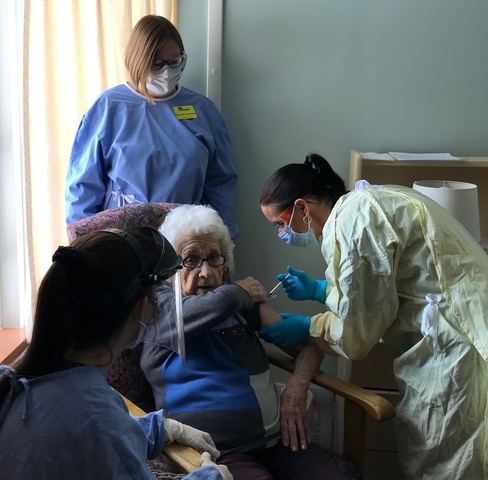
The Moderna vaccine will be used to provide the second dose to those residents of long-term care and high-risk retirement homes who had received their first dose last month.

The Pfizer vaccine will be used to vaccinate staff of long-term care and retirement homes, essential caregivers in those facilities, and health care workers in area hospitals. Persons receiving Home and Community Care, as well as other members of the community who are 80 years of age and older are scheduled to be vaccinated next, possibly beginning in March.

“We are hearing that the shipment of vaccine expected this week is the beginning of an abundance of available vaccine that will be sent out across the province,” said Dr. Ian Gemmill, acting medical officer of health for the HKPR District Health Unit. “We know that people have been anxiously awaiting their turn to be vaccinated, and I want to assure them that their turn is coming. We just all need to be patient as we receive more vaccine.”

The HKPRDHU is working with local hospitals and health care partners to vaccinate long-term care and retirement home staff, as well as the hospitals’ own staff.

Once additional amounts of vaccine are received, HKPRDHU will begin offering clinics for residents aged 80 years or older.

As soon as clinics for older adults are confirmed, and the registration process finalized, details will be provided to the community on how residents over the age of 80 years can be vaccinated, said Dr. Gemmill. 

“Our goal is to ensure that we get the vaccine into as many arms as possible, as quickly as possible,” Dr. Gemmill said. “As soon as we have the vaccine and the details for clinics, we will share that information with our residents so they can get vaccinated.”

Based on the province’s vaccine distribution plan, the next phase of vaccinations will focus on older adults living in the community under the age of 80 years and other higher risk parts of the population, and then eventually all members of the community who wish to be vaccinated.