
Home Blog Page 338

Outdoor recreation open for long weekend

0
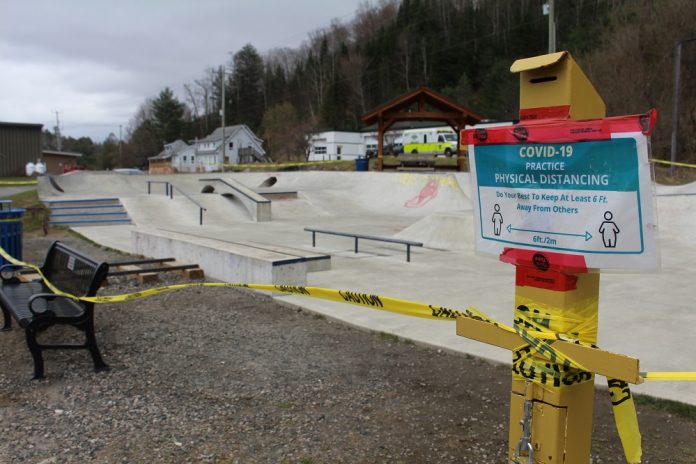
Outdoor facilities such as the Dysart et al skate park were closed April 17 due to new COVID-19 restrictions. Photo by Joseph Quigley.

The Government of Ontario is opening up outdoor recreation facilities for the weekend starting May 22.

The province announced May 20 that due to COVID-19 trends, it would allow golf courses, tennis courts, basketball courts, skate parks, soccer fields, driving ranges and more to open. Outdoor gatherings are expanded to five people. All other restrictions will remain in effect.

The move comes ahead of a new three-step reopening plan the province announced, which will enable more openings every 21 days depending on trends for COVID-19 cases and vaccinations.

“As a result of the strict public health measures we introduced to stop the spread of COVID-19 variants, we are seeing a steady improvement in our situation as ICU and hospital numbers begin to stabilize,” Premier Doug Ford said. “We can now begin the process of a slow and cautious re-opening of the province in full consultation with our public health professionals.”

Health officials have been clamouring for a loosening on restrictions for outdoor recreation, where transmission risks are lower. The Ontario Medical Association called for the move in a press release May 12. Outdoor recreation has been closed since April 17.

The government also unveiled plans to start reopening the province in 21-day intervals. If COVID-19 cases continue to trend downward and 60 per cent of Ontarian adults reach one dose of vaccination, more restrictions will lift June 12. That could include outdoor gatherings allowing 10 people, outdoor dining with four people at a table and non-essential retail opening at 15 per cent capacity.

Further restrictions could lift in each 21-day interval if trends are good enough.

“Brighter days are ahead, and we believe this roadmap represents a path out of the pandemic and will encourage Ontarians to get vaccinated and to continue following public health advice,” Minister of Health Christine Elliott said.

Step two would further expand outdoor activities, with outdoor gatherings of up to 25 people. Personal care services where face coverings can be worn would reopen and indoor religious services could resume at 15 per cent capacity. It would require 70 per cent of adults vaccinated with one dose and 20 per cent vaccinated with two doses.

Step three would expand access to indoor settings, including indoor sports and recreational fitness, dining, museums, art galleries, libraries and casinos with capacity limits. It would require 70 to 80 per cent of adults vaccinated with one dose and 25 per cent vaccinated with two doses.


Fitness experts go online to connect

0

Kathy Carey decided to shift her focus when the COVID-19 pandemic sidelined her fitness business one year ago.

She has taught classes for 36 years, most recently out of the Blue Sky Studio. But with the health restrictions limiting class sizes, she opted to halt classes and focus more on herself using a Peloton bike, an exercise company that offers online workout sessions.

Carey said she is motivated by group fitness settings – and that finding a remote option has been a boon for her in the pandemic.

“I call it my COVID saviour,” Carey said. “You don’t see people, but you feel the same sort of connection. It’s very motivating … You have to find what works for you and you need a support system.”

The pandemic and repeated shutdowns have pushed the fitness world online, with more people turning toward remote learning. Gyms have frequently been closed or limited during the province’s three shutdowns, leaving people stuck at home for fitness.

Haliburton Yoga is a provider that transitioned online – something owner Lynda Shadbolt said she intends to continue after the pandemic. She said despite the hurdles, it has been a successful venture and allowed her to attract students from a wide range of places.

“It keeps me motivated because if I didn’t have people to teach and plan for, I wouldn’t do it,” Shadbolt said. “I need the community; I need the connection.”

Carey said there are plenty of online programs out there for people to keep fit in the latest shutdown and beyond. She said fitness is important to help both mental and physical wellbeing, but it can be difficult for people to get started in the current environment.

“The biggest problem is that people that have done nothing in so far as exercise,” she said. “Fear can be paralyzing, and it can be physically so hurtful and mentally hurtful … Do things, small goals and if you don’t have a bike or a treadmill and don’t have any money to invest in fitness, go out and walk. Get out the door.”

Shadbolt said Haliburtonians benefit from all the outdoor space that exists in the area.

“We are so lucky to live where we are. We have fresh air,” Shadbolt said. “If nothing else, just get outside.”

But the yoga instructor said there are also strong health benefits to finding an online group to work with.

“That is so important to our wellbeing because I think people are feeling cut off,” Shadbolt said.

“Having a practice of learning to stay in the present moment is, I think, really essential, because our minds can take us down so many negative things right now and that’s really not helpful.”

“No one is going to do it for us, and we all have to find that motivation,” Carey said. “Whatever it is, you just try to start gradually and make it achievable.”

Virtual clinic bridges patients and doctors

0

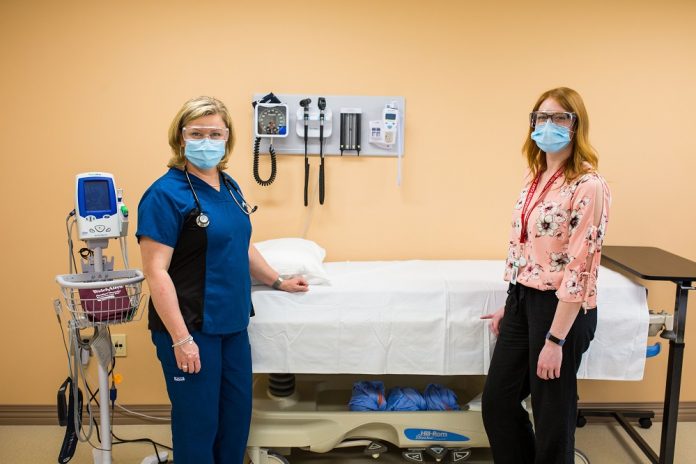
Haliburton Highlands Health Services (HHHS) opened its virtual primary care clinic May 17 to help serve people without family doctors.

The clinic provides access to a regular doctor remotely through an Ontario Telemedicine Network video session. A nurse will assist in person to monitor the patient. The clinic will open two days a week in Minden and is available to anyone who lacks a family doctor living in Haliburton County.

HHHS vice president of community programs Stephanie MacLaren said it helps address the lack of primary care available in Haliburton.

“Primary capacity, in our community, similar to other, small, rural, communities, has been challenged,” MacLaren said. “We have more of a demand for primary care than we have supply.”

Haliburton Highlands Family Health Team executive director Kimberley Robinson said their waitlist for a doctor is approximately 1,000 people. Patients are taken based on the date of their request, with the list now at people who submitted in 2017.

The model began about five years ago, according to Virtual Family Physician Network director Sam Berman. He said it has run successfully in Midland, Campbellford, Peterborough and Smiths Falls, providing a stopgap as communities recruit doctors.

He said primary care is a fundamental human right, and telemedicine was a way to provide that more widely.

It helps “communities right across central Ontario, almost all of which have shortages of family physicians,”

Berman said. “We provide a full range of services a family doctor is supposed to provide.” Berman said ideally, a municipality recruits enough doctors, so it is not needed anymore. The County of Haliburton is trying to address that, hiring a full-time physician recruiter who helped bring two new ER doctors in 2020.

But in the meantime, doctors will see the same patients regularly. Berman added they will coordinate with local health resources. Doctors are also encouraged to visit their communities for a week or two to meet patients.

“We don’t see this with other models of virtual primary care, and that is his absolute commitment to collaborating with local family physicians,” MacLaren said. “His goal is to work himself out of a job.”

There are limitations, such as not treating infants, but Berman said the accompanying nurse is there to help with most things.

“We can probably do 85 per cent of what a family doctor could do if they were there in person,” Berman said.

The clinic will be open for two half-days per week by appointment only, Monday and Wednesday, though MacLaren said that could change based on demand. Appointments can be booked by contacting 705-457-2941 ext. 2294.

Parents to decide on bricks or clicks for fall

0

by Kirk Winter

Haliburton County parents will be asked starting June 1 to select either brick and mortar learning or virtual learning for their children in the fall.

Trillium Lakelands District School Board (TLDSB) director of education, Wes Hahn, told a May 11 board meeting that those decisions will go a long way to determine staffing and structures for 2021-2022.

“The ministry [of education] has clearly stated that they want kids registered in brick and mortar schools for September,” Hahn said.

However, he added, “We believe there will be the parental demand for a Learn at Home option. Funding for Learn at Home will not be what it was this year. If parents select Learn at Home, they need to understand that kids will not be able to move back and forth like they did this year. We want to get staffing settled as soon as we can,” the director said.

Trustee John Byrne asked what would be the minimum number of students required to offer the virtual elementary and secondary experience available this year.

“We know the number of students doing Learn at Home will be lower than this year. We will do the best with the money that we have,” Hahn said.

Byrne also questioned the feasibility of parents making a decision before a possible fourth wave of COVID this summer. He asked if there would be flexibility for student movement if such a thing happens.

“We will have to take a look at that with public health come summer,” Hahn said.

Haliburton area trustee Gary Brohman wanted to know how brick and mortar schools are going to operate in the fall and how they are going to be timetabled.

Hahn said, “There will be cohorting, although not as intensively as it is being done now. PPE usage and cleaning protocols will remain. We are expecting the octoblock or quadmester models [students study just one or two subjects at a time] to receive serious consideration again next fall.”

With regards to funding, the board now has its Grant for Student Needs (GSN) numbers, or how much it is getting per pupil, which will provide the bulk of the operating budget for the next school year but Hahn said he remains cautious.

“We are still working through the GSNs. It is very detailed this year because of the intertwining of COVID funding. There are a lot of complexities and decisions won’t be made till later in May and June,” he said.

Hahn also discussed vaccines and the impact they will have on educational planning over the next four months.

He said beginning May 6, all staff that come into direct contact with students were eligible to be vaccinated. By September, the board hopes all staff will be vaccinated.

“There is now the potential for students to be vaccinated. I think late August will look very different than where we are right now.”

Crazy? Maybe a little as new restaurant opens

0

Claudette Pitre said it is “kind of crazy” to be opening a restaurant during the COVID19 pandemic.

The decision inspired her new venture’s name, Poquito Loco, meaning “a little crazy” in Spanish. The Mexican takeout restaurant is set to open May 22 on Highland Street next to the Silver Maple Hotel.

“Encapsulates us, and the idea of doing it in the middle of a pandemic,” Pitre said. “Just throwing caution to the wind.”

The establishment will serve a full slate of Mexican cuisine, from tacos to burritos to quesadillas to rice bowls and platters.

The Pitre family does not hail from Mexico, but she said her many trips to that country inspired her. She said she even considered moving there but decided not to due to her young children.

“We love Mexico, we love Mexican food,” she said. “Kind of been a thing in our house where I cook Mexican, and everybody comes over and everybody loves it.”

Pitre said she decided on the businesses as the pandemic has curtailed her career in live entertainment management. Despite the challenges in the restaurant sector during the pandemic, she said she saw a niche she could fill.

“We felt it was something that was needed. Something different, something affordable, something that’s easy. You just kind of grab it and go,” Pitre said. “My personality doesn’t allow me to sit at home. I need to be doing something. I need to be productive, and I need to be creative.”

Pitre said she will utilize both Mexican and locally-based suppliers to provide a variety of ingredients.

“We’re trying to keep it as authentic as we can,” she said. “But, also with options for people who maybe don’t want the Mexican ingredients.”

The restaurant is still readying for its opening, which was stalled from May 20 due to unforeseen delays. Still, Pitre said she is touched by the community support she has received so far and is excited to start.

“It’s going to be fun; it’s going to be good,” Pitre said. “Everything is going to be fresh and delicious and different.”

0

Covid Corner Yikes! Looking ahead …

By Dr. Nell Thomas

“Yikes!” That’s what epidemiologist Dr. Larry Brilliant said when he cited a colleague’s data for the Indian variant (B.1.617.2). 

It’s also the attitude displayed by the officials in Singapore and Taiwan as they close schools and restaurants and stand at attention. Which is what we need to be doing in North America right now. And keeping our masks firmly in place.

COVID-19 variants sequenced by the Sanger Institute in England show B.1.617.2 is rapidly increasing – now almost 30 per cent of all sequenced cases in England and anticipated to be the dominant UK strain within days. It is identified in more than 40 countries now. The Indian variant is by far the most transmissible variant yet. It is estimated to be 2.4 times faster than the original strain. Estimates are theoretical, with complex interplay of factors, but the B.1.1.7 (UK) variant is about 60 per cent faster than the original Wuhan strain, and B.1.617.2 is 50-60 per cent faster than B.1.1.7. Singapore is struggling to contain the Indian variant and Vietnam has warned there are only “48 golden hours” to stop it once detected within your borders. These are two countries that have shown impeccable control of infection. 

Epidemiologists are saying that if we rely only on vaccines and not on masks/social distancing/preventing gatherings (etc.), then even with 70 per cent of the population vaccinated, and even if vaccines are 97 per cent effective, we would only be able to stop the original slowest Wuhan strain. Remember that to stop spread, we need the rate of reproduction (R0, called “R nought,” the number of people each infected person transmits to), to be less than one. The theoretical modelling done by epidemiologists shows that all scenarios with the Variants of Concern will remain with R0 greater than one unless additional safeguards are used. 

Getting rid of the bad apples

0

With the Victoria Day long weekend looming, it’s a good time to review the province’s stay-at-home order for both seasonal residents and short-term rentals.

For those who may have missed it, the lockdown specifically states that people living outside of Haliburton County can come to their cottage to manage it for less than 24 hours or stay more than two weeks. There is nothing in the rules allowing anybody to come for the weekend. 

However, we all know that cottagers will make their way to the Highlands for the May 24 weekend. After all, there is nothing to stop them. There won’t be any OPP roadblocks or municipal bylaw officers making the rounds unless there are egregious acts, such as large gatherings.

While it is not our intention to start yet another ‘us’ versus ‘them’ war in the County, we can only implore those coming to follow COVID-19 protocols.

No doubt about it, they will be welcomed by gas stations, grocery stores, retail outlets, garden centres and eating establishments.

Economics will upstage public health. It’s not a big surprise. Here in the Highlands, health has been actively competing with economics for months now. That’s why local politicians have skated around the issue of cottagers coming during COVID.

This takes us to the short-term rental issue. 

Under the rules, cottage owners cannot rent out their spaces for recreation, only emergency housing. 

But we are hearing from cottage management companies that while they have cancelled bookings until June 2, those using online platforms such as Airbnb are breaking the rules. It is not a level playing field.

So, news that the County is considering taking on short-term rental regulations is welcome since the lower-tier municipalities have proven woefully inadequate in tackling the issue.

County councillors will go back to their respective councils to see if they’re interested.

They should be. It’s an idea that’s time is long past.

Seasonal cottager owners have a case when they come since they are paying thousands of dollars in property taxes and most of them do follow the rules They care about the County, its physical health and its economic well-being.

Short-term renters are another kettle of fish. They don’t have the long-term investment in our community and often don’t share our values. As such, some of the people who rent to them on Airbnb and other online platforms need to be regulated.

More and more seasonal properties are becoming Airbnb short-term rentals. As such, there needs to be more enforcement and municipal government have to educate better about restrictions.

It would help if municipalities implemented a licencing system and code-of-conduct for short-term rentals. 

There’s nothing wrong with fining people. If they are renting incorrectly during a stay-at-home order, fine them. If they are leasing to too many people than their septic system can support, fine them. If their guests are setting off fireworks in contravention of bylaws, fine them. 

To seriously do anything about all of this, though, the County’s politicians must ensure the support of OPP and budget for sufficient bylaw coverage on weeknights and weekends. Do this, and enforce regulations, and it will go a long way towards eliminating the few bad apples that are out there in cottage country.

Businesses waiting for end of lockdown

0

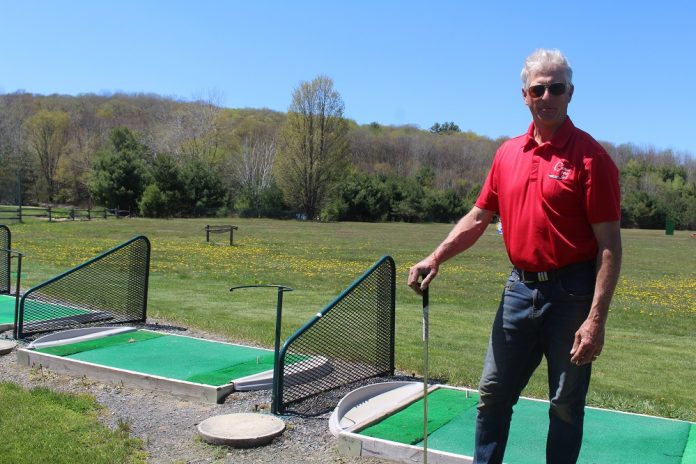
The greens at Carnarvon Family Golf remain empty of patrons, even with sunny weather and the May long weekend approaching.

The Kent family is dutifully maintaining the grass, with nobody around to enjoy the driving range, three-par course, or miniputt. His family is left to wait for the end of the stay-at-home order, set for June 2, before it can reopen to the public.

It is a contrast to last year when golf courses were able to open in May. Owner Pennie Murray said the province keeping courses closed due to the pandemic does not make sense, and the loss of the May long weekend will sting.

“Many of my friends take on three and four jobs in the summer just to be able to get through the winter, and not having the long weekend will definitely hurt,” Murray said. “It just doesn’t make any sense to me that you can’t get on a golf cart. You’ve got nothing but wilderness, and it’s going to hurt the economy.”

The stay-at-home order was scheduled to expire May 20, but the province extended it an additional two weeks past the May long weekend due to COVID-19 trends.

Golf courses across Ontario have clamoured for reopening since the province closed them April 17, along with other outdoor recreation spaces. Premier Doug Ford defended the decision May 13, citing concerns over carpooling and gatherings.

Murray said that does not make sense, and it is not something she has witnessed.

“It’s ridiculous,” Murray said. “Nobody is carpooling, and people aren’t getting together.”

The Ontario Medical Association said in a May 12 press release that although the province should extend the lockdown, outdoor recreational spaces should reopen, with rules to prevent gathering.

Haliburton, Kawartha, Pine Ridge medical officer of health Dr. Natalie Bocking agreed with that.

“We know outside activity is safer than indoor activity and the risk of transmission when you’re outside, and still socially distancing, and using masks, is much lower,” she said. “I would like to see more outdoor activities available.”

Other businesses are also feeling the impact of the lockdown and its two-week extension. But Haliburton Highlands Chamber of Commerce executive director Amanda Conn said the community is resilient. “

A lot of businesses are not having the easiest time right now. We’re all very, very aware of that,” Conn said, adding she is impressed by businesses commitment to COVID-19 safety. “No one likes to hear about another lockdown, but we do want to keep the community safe.”

Murray said she hopes she can reopen as quickly as possible.

“It’s kind of a no-brainer,” she said. “[Not being able to open], that’ll hurt.”

McKechnie remembers Leafs vs Habs

0

The last time the Toronto Maple Leafs and Montreal Canadiens squared off in the NHL playoffs, Haliburton’s Walt McKechnie was in the blue and white for the Buds.

It was the spring of 1979 – 42 years ago – but McKechnie remembers it like it was yesterday.

The powerhouse Habs, with the likes of Ken Dryden, Guy Lafleur and Larry Robinson swept the Leafs in four games, with the last two quarter-final matches going into overtime.

McKechnie’s Leafs were strong, “a tight team” coached by Roger Neilson with players such as Darryl Sittler, Lanny McDonald and Borje Salming.

“I just remember so much about it. It’s still unreal to me,” McKechnie said from his cottage May 18.

The 2021 version of the Toronto Maple Leafs play their first-round playoff match against the Montreal Canadiens, which began May 20 at Scotiabank Arena in Hogtown. The Habs won the first game 2-1.

In McKechnie’s day, they played out of Maple Leaf Gardens and in Montreal, at the famed Forum.

“The whole city was just abuzz,” McKechnie said. He said the memories still excite him and he is proud to have played in that last former original six tilt.

At the time, he said Toronto fans were crying out for a Stanley Cup. They hadn’t seen Lord Stanley’s mug hoisted since 1967 – a drought that now stands at 53 years.

“The atmosphere was incredible. I have no words to describe it,” McKecknie said.

Historic rivalry as Toronto and Montreal clash

He clearly remembers the night the Leafs were ousted 5-4 in overtime after a controversial penalty led to a Montreal power-play goal. Bob Myers made the call. Robinson scored and “Tiger [Williams] kind of lost it,” the alumni said.

McKechnie was named third star of that game. Seeing Robinson in the tunnel, he said the ‘Big Bird’ told him that if Toronto had won the last two overtime games, they likely would have won the series.

Asked about the impact of having no fans in the stands due to COVID-19 protocols, McKechnie said it will be a factor but once the national anthem is played and the puck dropped, “something kicks in.”

He was reluctant to make a prediction, saying you can’t assume anything in hockey and what a team looks like on paper means nothing as on any given night since any team can win.

“[Montreal goalie Carey] Price is coming back. He can put a wall up that is unbelievable. If Toronto plays their game, they should win. But there isn’t any series there that’s easy,” he said.

On Leafs’ sniper and fellow centreman Austin Matthews winning the Rocket Richard trophy with 41 goals this season, McKechnie said, “he’s the real day. This guy has talent. He and [Mitch] Marner, they are just so good together.”

When he settles himself in front of the television May 20 with a bowl of popcorn, McKechnie will be excited to watch the Leafs – Habs series. The memories will come back, too.

“It was a great experience. I’ve been thinking a lot about it.”

Rentals continue lockdown defiance

0

More than one year into the pandemic, AllSeason Cottage Rentals owner J.T. Lowes said he still sees problems in how some owners of short-term rentals are behaving.

Professional agencies under the umbrella of the Ontario Cottage Rental Managers Association (OCRMA) have shut down their businesses since Ontario’s most recent stay-at-home order April 8. The rules state only people in need of housing can get rentals.

But Lowes said there are plenty of property owners carrying on unabated through platforms such as Airbnb. He said he notified police of an alleged rental on an Eagle Lake property April 23.

“The fact that this was going on during the province-wide stay-at-home period really upset me,” Lowes said. “It is not fair that we had to cancel all bookings while others were still renting with impunity, not to mention the potential health and safety consequences.”

Lowes and other agencies spoke of similar issues with people defying orders during for rentals stay-at-home restrictions last year.

‘Code-of-conduct needed’

Cottage Care Rentals co-owner Cheryl McCombe said it was difficult for her to cancel bookings for those eager to escape. But she added it was necessary and professional agencies want to be distinct from online hosting platforms.

“We don’t want to bring harm to our communities,” McCombe said.

Howard Hicks uses Airbnb to rent his cottage on some weekends, when allowed. He said he is aware of other renters flouting the rules, but he disagrees with the restrictions. He said cottage owners are still attending their properties, even though rules state they can only attend a secondary residence to manage it for less than 24 hours, or if staying more than two weeks.

“People are going to their cottages, so what’s the difference?” Hicks said. “They’re isolated. It’s not an assembly.”

He said he expects traffic to come in for the May long weekend, even with the provincial stay-at-home order extended to June 2.

“Are we going to see nobody going to their cottages? I don’t think so,” Hicks said.

Haliburton Highlands OPP acting commander Sgt. Daniel Collings said the detachment receives a small number of COVID violation complaints daily but has only charged three individuals under the Reopening Ontario Act to date. One other person was charged with violating quarantine.

However, he did note Huntsville OPP responded to 20-25 ATV riders at a short-term rental facility north of Dorset earlier in May, eventually charging two organizers.

He said in absence of a complaint or other grounds, officers will not arbitrarily stop a person or check a dwelling. He said the influx of recreational property owners has posed a challenge.

“More and more seasonal properties are becoming Airbnb short-term rentals,” Collings said. Lowes said there needs to be more enforcement, and the government needs to educate better about restrictions.

He added it would help in the longterm if municipalities implemented a licencing system and code-ofconduct for short-term rentals. None of the County townships has yet to implement anything.

“Big fines need to be in place for those who break the rules,” Lowes said. “This would go a long way in helping root out the few bad apples out there.”