Home Blog Page 311

Outdoors association spawns steady year during COVID-19

0

The Haliburton Highlands Outdoors Assocation’s (HHOA) year got off to a rocky start.

In January 2021, two pumps and a well failed at the hatchery.

Without water, there’s no fish: the association has stocked Haliburton lakes with more than 700,000 since 1998.

“Local folks and the general public contributed, and we were able to get those major repairs,” said association president Dan Smith.

Twelve months later, Smith said “it’s been a good year.”

Community contributions have been a major piece of the 2021 puzzle; resulting in a $20,000 budget boost and triple the membership.

“That’s a big shot in the arm for us, the community support we got this year.”

Especially, said Smith, since much of the association’s in-person fundraising was cancelled due to COVID-19 concerns.

“We’re on tenterhooks when we can’t do fundraising,” he said.

Smith said many members, the majority being seniors, were cautious to gather due to COVID-19 safety concerns.

“We got the same work done with less people,” said Smith. An ongoing challenge is preserving the County’s fisheries, with many respondents to the association’s 2021 walleye survey reporting less than usual fish stock.

To combat that, the association stocked locations by helicopter and distributed fish to 25 lakes across the Highlands. Volunteers also spent days cleaning silt off underwater spawning grounds.

Despite a strong financial year, the association is aiming to develop guaranteed incomes over the next years to decrease the reliance on donations.

“Every year we look at our year and say we gotta’ raise this and this and this,” said Smith.

A large source of support is the association’s members themselves: the group went from 35 to 100 members in 2021. Membership chair Ken Fielding said at the HHOA AGM he hopes to attract 100 more by next year.

Smith joined the group five years ago.

“I fished all my life and hunted. I wanted to know where the fish are going, and where the good fishing spots are,” he said. “You can work as little or as much time as you want.”

Chasing the sweet treats to Carnarvon

0

It may be on a different highway, but fans of The Country Bakery are finding the business’s new home in the former Zion United Church in Carnarvon.

The bakery, coffee and lunch spot recently moved from its Hwy. 118 home of the past six years to the site along Hwy. 35.

Following their third weekend, spokesperson Jeanette Angus said, “We’re finding the local people are very happy to have us here, very thankful we’re here, and they’re happy the church is being used again. Very good reception. They’re all plugging us and telling their neighbours and strangers that we’re in here.”

The church ceased operations in May 2019 and was purchased by David and Helen Litt, who are renting part of the hall space to The Country Bakery and plan to sell antiques in future.

Angus said they’d been telling people at the other location for quite some time that they would be moving, they just didn’t know exactly when. There were a few delays in getting the building up and running. However, that reopened Nov. 19.

“So, a lot of the Hwy. 118, lovely people that have supported us all these years, they know where to find us,” she said.

Angus said the move is benefitting them in a number of ways.

“We’re right on Hwy. 35 which is nice, a little bit more convenient for those folks, when they come by, they don’t have to deviate too far.”

She added, “It’s a nice, bright, happy, larger space for us. It’s a larger kitchen to work in. The other location got a little bit small. We outgrew it. We were on top of each other. And we only had certain areas we could walk. Here, we have lots of choices to get around each other.”

She said the only con, if you can call it that, is when she arrives very early in the morning to begin baking, she is entering a nearly 130-year-old former church building.

“It feels a little spooky. It’s a big place. It’s got its creaks and groans that I’m not used to.”

Walking in, the bakery is taking up about half of the former Zion Church Hall with its various display cases. There are no tables and chairs yet but that is the plan.

“Eventually we’ll have tables and chairs for sitting and have the little café back and there’ll be more antiques. That will get better and bigger as well,” Angus said. “The two things go together quite well.”

The bakery is preparing for Christmas, working on a scone order Dec. 6 at the time of the interviw, and doggy treats were being packaged up as well.

“We’re happy. We can make Christmas things and kind of get ready.”

Their regular hours are Friday, Saturday, Sunday and Monday from 10 a.m to 4 p.m. However, those days and hours may be extended over the holidays. Find them on Facebook for days and hours of operation and products or call 705-489-2917.

U-Links calls for curious Highlanders

0

U-Links Centre for Community Based Research wants to turn questions about Haliburton County into academic studies.

The organization connects community groups and organizations with research teams from Trent University and Fleming College. They’ve completed local studies on topics from climate change to littering.

In November, they opened the call for 2022 research topics that may be picked up by winter or spring classes at each school.

Sadie Fischer, U-Links program coordinator, said she encourages anyone to come forward with an idea. Then, U-Links can help narrow a research focus or reach out to others who may be able to host research.

“We need a host organization, but that organization can be a business, it can be a volunteer group,” she said.

U-Links can help develop project ideas and “define the appropriate research questions,” a press release stated.

Fischer mentioned how many 2021 projects, such as benthic biomonitoring as well as monitoring trees in Land Trust forests, were centered on climate change.

“A major need in the community is looking at the environment and factors there,” Fischer said.

However, U-Links has facilitated a range of projects on everything from community development to healthcare outcomes to a wetlands assessment of Gull Lake.

Fischer has already received a number of project proposals this year. For example, Abbey Gardens wants to incorporate indigenous knowledge and practices into its facility, and Fischer said U-Links is developing plans to study the County’s youth employment patterns.

Ideas or questions are passed on to research groups or classes within the schools. Sometimes an idea can spawn multiple academic projects.

In 2021, Fleming College students dove into waste management practices and common themes surrounding roadside dumping.

U-Links also conducts community learning activities, such as the HaliburtonMuskoka-Kawartha Children’s Water Festival coordinated by Trent environmental science students.

Fischer said the community’s passion for learning and change is motivating.

“Because it is such a small community there are so many people who are trying to make a difference and trying to research and learn,” Fischer said. “I think that’s really inspiring.”

To contact U-Links about a research topic, email Sadie Fischer at environmental@ ulinks.ca or call 705-286-2411.

HHHS reports $613,000 deficit

0

Haliburton Highlands Health Services (HHHS) is in a precarious financial position according to board chair David O’Brien, who says the organization is waiting on nearly $3 million of COVID-19 related funding from the provincial government.

During a Dec. 2 board meeting, O’Brien said HHHS was “experiencing another very challenging year” in light of the ongoing pandemic. The organization is reporting a budget deficit of $613,000 as of Sept. 30, although O’Brien indicated that number is likely significantly higher today. He noted the third quarter financials, once in, were “not going to be pretty.”

Year to date the organization has seen lost revenues of approximately $372,000, while staffing expenses are way up, totalling more than $350,000. This is largely attributed to the use of staffing agencies to maintain services and miscellaneous recruitment costs, said Carolyn Plummer, HHHS president and CEO. A “significant” increase in housekeeping hours and security services has also impacted the budget.

O’Brien noted HHHS is experiencing cash flow issues, which is making things difficult operationally. As reported in the Nov. 25 Highlander, the organization is preparing to reduce services at its facilities in Haliburton and Minden in the near future, although that decision is being driven by staff shortages, according to Plummer.

“These challenges are particularly onerous on small rural hospitals who have very, very limited sources of external revenue that they can depend upon,” O’Brien said. “We’re going to continue to have serious issues going forward into the new year.”

The money HHHS is owed by the province is accounted for in the budget, meaning when it comes in the organization will still have a fairly substantial shortfall. In her report to the board, Plummer stated she was still waiting on reimbursements for pandemic-related expenses dating back to March 2021.

MPP Laurie Scott did not respond to questions surrounding the funding as of press time.

Emergency department closures

Plummer said an announcement on pending emergency department closures is coming, with the organization ironing out the details on a new long-term service plan.

It is unclear at this time whether those changes will impact the Minden hospital, Haliburton hospital, or both. Plummer has previously stated that HHHS will ensure at least one emergency department is available at all times.

“Work is still underway to analyze some information that we have available to us, and to seek feedback from various groups,” Plummer said.

HHHS physicians and clinicians have been involved in the process, she said. Other stakeholders such as Haliburton County Paramedic Services, Ontario Health, and community partners have also provided feedback.

Once a decision has been made, it will be shared at least 48 hours before any changes are implemented so as to give the community time to prepare.

“I don’t think any of us wanted to see this happen, but it is the reality [of our situation],” Plummer said.

Facility enhancements

HHHS has hired Thom Runciman to serve as environmental services supervisor. Plummer said he has a lot of experience in long-term care, and would be working to improve some of the organization’s cleaning and maintenance protocols post-COVID-19.

Work to bring HHHS up to standards through the Johnson Controls Energy Efficiency Initiative is close to completion, Plummer noted. Staff have recently finished upgrading LED lighting throughout all HHHS facilities, while a new building automation system has been installed.

“This system allows us to continuously monitor heating, cooling and ventilation trends in our main facilities, to help ensure our heating and air conditioning systems are functioning properly to maintain a comfortable environment for our patients, residents and staff,” Plummer said.

The planned long-term care nurse call system replacement project will be completed at Highland Wood this month, with work to begin at Hyland Crest early next year. Plummer says the old system was outdated and difficult for residents to use. The project was funded by the HHHS Foundation.

The magic of giving

The local hospital foundation reports it is off to “a very strong start” with its annual festive fundraiser. While she didn’t provide any numbers, executive director Lisa Tompkins said she was “very grateful for, and very humbled” by the generosity of the Highlands community, who has continued to support the foundation throughout the pandemic.

All money raised through the Believe in the Magic of Giving campaign is donated back to HHHS to fund equipment and facility upgrades and service enhancements.

Tickets for the foundation’s December 50/50 draw are still available, with an early bird draw taking place on Dec. 15 and grand prize draw happening Dec. 31.

Townships continue work on service review

0

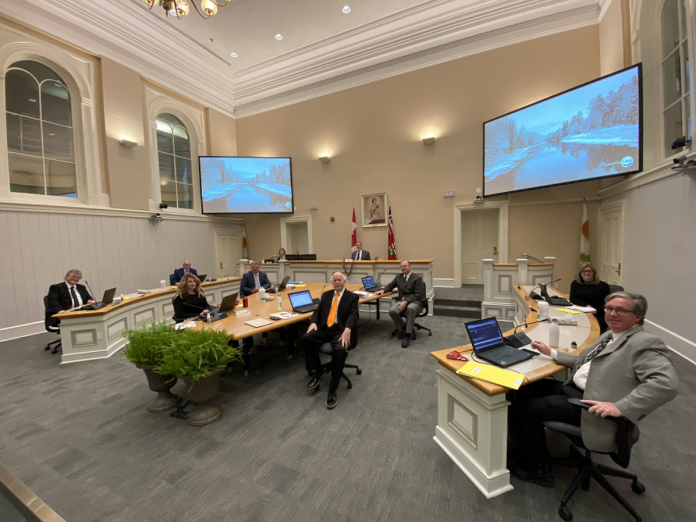
County of Haliburton CAO Mike Rutter says COVID has helped speed up the service delivery review (SDR) process and residents should see improvements and savings in the coming months.

Much of the work is being done behind the scenes by staff of the County, Algonquin Highlands, Dysart et al, Highlands East and Minden Hills. However, the Haliburton County Home Builders Association (HCHBA) has been invited to the building, bylaw and septic working group.

Working groups are meeting regularly and report back to County council on a quarterly basis.

Rutter said since the pandemic began, the five CAOs have met once a week and that is continuing via Zoom.

“We simply did not communicate as often, or as well, prior to COVID. I would actually say we have come further, faster, on the service delivery review because of that meeting format,” he said.

The most recent SDR steering committee with County councillors was on Nov. 24.

Rutter is at the helm of the review, based on the 140-page report from consultants Strategy Corp., who identified 12 broad initiatives aimed at finding more than $900,000 in operational efficiencies and about $200,000 in productivity gains by getting the five corporations to work together better.

Rutter said it’s expected to take three years to complete, or into 2023.

“While not everything will be fully implemented by then, I do think the respective councils will have made decisions on many of the recommendations in that timeframe,” Rutter said.

However, he added, “That does not mean they will support every recommendation, but I do believe they will have all been debated and direction provided in that threeyear horizon.”

Rutter said he believes some changes will be implemented in the coming months. For example, the County has created, and now successfully recruited for, a director of economic development and tourism. Scott Ovell started Nov. 8, coming from the Town of Huntsville.

“As a result, residents should see improved service delivery/savings in those areas in the near term,” Rutter said.

County councillors also gave the green light to hiring a procurement coordinator. However, they have been unable to find a candidate so that remains on hold as of now. The other suggested positions, for which there has been no movement to date, include an in-house legal position and a communications officer and grant writer.

Building bylaw and septic

Referring to the building, bylaw and septic working group, Rutter said they will be reviewing bylaw enforcement and developing a recommendation on the potential for integration of that service in the near future.

The HCHBA declined to be interviewed, saying “we are very pleased to be included in the process with the County and the municipalities.”

According to meeting notes from Oct. 20, they asked that “given the level of activity in the building industry right now, is this the time to make monumental change like this?” They added if there is change, they want assurances service levels will not decrease during the transition.

The builders wanted to know if more municipal staff would be required. The answer was the model doesn’t include more inspectors, and it’s not yet known whether bylaw enforcement would be integrated.

The HCHBA also asked if changes would help the township attract more qualified staff. The answer was it was possible and there could be other benefits.

The builders said more discussion is needed on the pros and cons of having dedicated septic inspectors versus building officials who also do septic inspections. The four municipalities provide the services in a different way.

They said “consistency is critical” and were told an integrated model would result in consistent forms, interpretations, and approach.

The builders also wanted to know about maintaining connections with planning staff they are already dealing with at each township. According to the notes, it’s an area requiring more work.

The working group also had a number of questions for the builders. They wanted to know if it is important to have a physical office in each of the local municipalities. The HCHBA said that would be preferred. They said not everyone would be willing or able to submit plans electronically.

Councillor says towns must ‘work together’

Minden Hills Coun. Bob Carter, who has been keenly watching the process, said the need for change is crucial. “We have four different criteria for the minimum size dwelling in the area.

We have different rules for setbacks and little minor things like that, that drive builders crazy.

“I recall being in the office [Minden Hills] pre-pandemic and a builder came in and was showing the building department the plans for a garage he was building and they told him, ‘well, you can’t do that, and you can’t do that,” and he said ‘but I just took these same plans to Dysart et al and got approved’. And they said, ‘oh well, that’s Dysart’.

“That’s craziness and it’s hurting us all. I think that we have to work together.”

Doc head-hunter hits the ground running

0

Wendy Welch hit the road last week, a potential doctor in tow, as she tried to entice the visitor to relocate to the Highlands.

The new physician recruitment coordinator said the female doctor and her family are considering moving to the area.

So, she and former coordinator Cheryl Kennedy drove in their car, and the doctor and her family in their car – for a tour, communicating via speaker phone.

“We made her feel very welcome,” Welch said.

She said it is just one area where pivoting and compromise has been required due to the pandemic.

Welch is into her third week as the County’s part-time physician recruitment coordinator.

A former Minden Hills area cottager, she moved to the County full-time four years ago. Her background is in nursing.

At her last job, as an external nurse assessor with Veterans Affairs Canada, she said she met with physicians regularly. She also did sales and marketing.

“So, that’s why when I saw this job posting, it kind of popped out at me and I thought ‘ok, this seems like it would fit different parts of my background’.”

She said COVID cancelled a number of in-person career fairs at Ontario medical schools, but they are starting up again. They are for residents who are graduating, looking at where they’re going to practice. They have been virtual and on Zoom, “which is awkward and challenging,” Welch said.

However, she plans to attend one at Western University Jan. 28 with others at McMaster, Queen’s and the University of Ottawa scheduled.

“I’ll be there representing Haliburton County and be able to talk to them face-toface about what we can offer, there’s a lot of value in that.”

She said the County would like to recruit four doctors.

Being relatively new to the area, she said she understands some of the concerns around practising in rural and regional Ontario and housing.

“I can relate to people saying ‘there’s nowhere to shop here, what do you do? Or what about if you need the care of a specialist? Then what? Where do you go and how does that work’?”

She said she feels like she can help them problem solve.

The County has a home it’s renting the main floor of for physicians to stay in on a temporary basis.

Welch said she has been involved in developing properties since moving to the County. While not a real estate agent, she said she has her finger on the pulse and could help people in their search.

In addition to working with regional partners, she plans to connect with interns and residents, and doctors that have already worked in the local system for short periods of time. “Talking about their goals and see if practising in Haliburton County full-time could be an option.”

Welch said she is grateful that Kennedy – who was successful in getting two doctors – is showing her the ropes.

“My hope is to be just as successful as she has been.”

COVID outbreak declared at J.D. Hodgson

0

A COVID-19 outbreak has been declared at J.D. Hodgson Elementary School after three cases of the virus were identified among students last week.

The Haliburton, Kawartha, Pine Ridge District Health Unit says two cases were detected on Dec 4, with another identified over the weekend. Letters were sent to parents Dec. 6.

“Provincial guidance requires a school outbreak be declared when two or more linked confirmed cases occur within a 14-day period, where at least one case could have reasonably acquired their infection in the school,” Bill Eekhof, HKPR spokesperson, told The Highlander.

Eekhof said one classroom at J.D. Hodgson has been affected by this outbreak.

The situation is linked to an ongoing COVID-19 outbreak declared on school bus No. 32 in Haliburton County. As reported in last week’s edition of the paper, that bus was used to transport students to multiple schools in the area, including J.D. Hodgson, Stuart Baker Elementary School and Haliburton Highlands Secondary School. All individuals who rode the bus and were identified as possible high-risk contacts were instructed to isolate and get tested.

Two positive cases from that outbreak have been confirmed to be students from Stuart Baker.

The positive cases interrupted the Highland Storm schedule this past weekend.

While 13 cases of the new Omicron variant have been identified in Ontario since its emergence last month, Eekhof was keen to contain any worry, saying “at this time, the health unit has not been notified of any local cases of Omicron variant in its region. The Delta variant remains the dominant stream of COVID-19 locally and across Ontario.”

Anyone with questions or concerned are encouraged to contact HKPR at 1-866-888- 4577 ext. 1508.

Builders say tough to meet housing ask

0

A new provincial report estimates about 1,200 new homes will have to be built in the County over the next decade to keep up with projected population changes. But officials from the Haliburton County Home Builders Association (HCHBA) say they’re not sure the target is realistic.

Canadian economist Mike Moffatt held a virtual webinar Nov. 25. He outlined a “desperate need” for more housing. He predicted by 2031 more than one million new homes will be required in Ontario.

In the Highlands, experts say the population is expected to grow by more than 10 per cent over the next decade, and with housing already in demand, it’s going to place enormous pressure on the market. Moffatt said there needs to be 1,190 new single-family homes built locally by 2031.

Aggie Tose, HCHBA executive officer, said a lack of buildable space, convoluted municipal planning and application processes, and resistance from existing property owners means the target will likely be difficult to reach.

“Like we’ve seen already [with existing proposals], nobody wants to see development in their backyard, and there’s really not a whole lot of space for us to build. Planning takes a long time to move forward. I think that’s a big number to hit over the next 10 years,” Tose said.

Local options

While the Highlands is home to some of the most expansive green spaces anywhere in the province, most of that land is untouchable, Tose says, either protected by provincial or federal authorities, privately owned, or within close enough proximity to a water source that it is already at maximum capacity.

Space for considerable developments, such as a new multi-home subdivision, is at a premium. Tose says there’s no indication that such a build is on the horizon anywhere in Haliburton County. Options within Minden and Haliburton villages are almost non-existent, too, she says.

Complex problem requires government buy-in

The responsibility, she believes, falls on the County and the four lower-tier municipalities to come up with a plan to tackle housing shortages.

“Something has to change, otherwise we’re going to be left behind,” she added.

CAO ‘shocked’ by stats

Haliburton County CAO Mike Rutter admitted he was shocked by some of the numbers presented in Moffatt’s report.

He said housing is a “complex problem” that requires buy-in from all tiers of government if it is to be addressed properly. He pointed to the County’s work with the Kawartha Lakes Haliburton Housing Corporation as proof the municipality is taking issues surrounding homelessness and housing affordability seriously

Many of the development proposals he has seen focus on multi-unit residential builds such as apartments and condos, which may not appeal to young families looking to enter the market.

Rutter says more needs to be done to encourage developers to invest in the Highlands.

“There are a lot of things we’re doing, either through the service delivery review or other avenues, that may result in people wanting to develop in the County,” Rutter said.

In a 2014 growth management strategy report adopted by County council, it was noted population increases would create a demand for 1,910 new residential units in the Highlands by 2036

Moffatt warns the projections outlined in his report Baby Needs a New Home are likely lower than the actual demand in some communities. He added many will be forced to look beyond the GTA if they want to buy a home of their own.

It’s happening in the County already, with many people relocating to the area since the onset of the COVID-19 pandemic.

“A housing shortage in Toronto is a problem for everyone in Ontario,” Moffatt said. “We’re starting to see population growth happening in smaller communities that hadn’t really experienced much population growth since the 1960s, and you’re getting higher housing prices that begin in the GTA and start to transmit all over the province.”

Housing numbers

While the County has the 2014 report, there’s real plan to bring a large supply of new units to the Highlands to sustain growth targets, Tose said.

Over the past 10 years, based on statistics provided by each of the four lower tier municipalities, there have been 1,360 new dwellings built in Haliburton County. A significant number of those involved demolition of an existing home.

While slightly different given their mandate is to support the development of affordable housing, the KLH Housing Corporation says it projects 750 new units will be needed across the County to support population growth over the next 10 years.

Manager Michelle Corley said statistics suggest if there are more apartment-type builds in the future, that could free up enough single-family homes to help offset some of the excess demand for that type of property.

“Our existing households are very small in nature. One and two person households in the County make up 77.2 per cent of the household population … however, in the County 92.8 per cent of the current dwelling type is single-detached homes,” Corley said. “This suggests that a lot of our households are ‘over housed’.”

People are leaving

Karen Morgan moved to the County with her husband and young child in 2019. At the time rental properties were already scarce, but they were able to get a place in Wilberforce.

Months later, after a separation, Morgan found herself in the unenviable position of trying to find another apartment on a fixed income. She had $800 per month for accommodation through ODSP, but that wasn’t enough. She eventually found a place in Highland Grove, where her landlord accepted significantly less than market value for a two-bedroom house.

“Things were great, then our landlord decided to sell,” Morgan said. She was given until Nov. 1 to find a new home for herself and her five-year-old daughter.

“I must have viewed more than 40 apartments, but they would go before I even had chance to get an application in,” she said.

In the end, Morgan was forced to leave the County. She is now in Orillia, though hopes to be able to move back to the community so that her daughter can be closer to her father.

What’s next?

Tose reiterated there’s a need for almost all types of development in the Highlands. She said the recent influx of new residents to the County, and an increase in the number of locals being forced away, suggests a change in approach may be required.

“Our college wants to expand, our businesses want to grow, and people are moving here, so we really don’t have any option other than to build. Where we’re going to build though, I don’t know. Looking between [Haliburton] and Minden, there’s not a lot of good land. And wherever we do build, it can’t be too far outside of the centres because of infrastructure and transportation,” Tose said. “I don’t love the idea of apartments, and I know the word subdivision is almost a foofoo here in Haliburton County … but as has been pointed out, the growth is here today. It’s very clear. It’s not going away, so we have to make a plan for the future.”

49 Greek letters and chewing gum

0

What does RNA live to do? Make copies of itself. The coronavirus genome (the genes that make up the virus), is a twisted strand of nearly 30,000 letters of RNA. (The human genome is over three billion.)

When the virus finds a cell it likes, it injects it with a strand of RNA containing its entire genome. It uses the machinery inside the host cell to replicate its 30,000 sequenced letters, copying and copying and copying. With each new infection, in each new cell, inevitable copying errors occur (mix-ups in the letter sequences).

Most of these make SARS-CoV-2 a less effective virus. But some have the opposite effect, shaping the virus to more efficiently do the only thing that RNA really wants to do – make more copies of itself.

We call this evolution. It is how variants like Omicron (B.1.1.529) – the most recent variant of concern – are born.

On Nov. 9 in Botswana a sample of the Omicron letter sequence was collected, sequenced by South African researchers, and uploaded to a central site on Nov. 23. On Nov. 24, South Africa reported to the WHO. Omicron cases have now been identified in more than a dozen countries including Germany, the UK, China, Australia, Canada, the list growing as you read this.

Omicron is scary because it has a large number of mutations in its sequence for the spike protein, which is the major target of our vaccines and is the entry point for SARS-CoV-2 to access our cells.

Omicron appears to be highly transmissible. Data from South Africa show test positive rates from Gauteng province jumped from around one per cent to 30 pe cent last week. (About 25 per cent of the population is vaccinated.)

A traveler from South Africa to Hong Kong who tested negative before his flight Nov. 11 then tested positive while quarantining in a Hong Kong hotel on Nov. 13. Someone across the hallway then tested positive for the new variant. Both individuals had high viral loads. Of 539 travelers from South Africa to the Netherlands last Friday, they identified 61 cases.

Unvaccinated individuals are more likely to become sick when exposed, have a much higher viral load, and are far more likely to transmit to others. In this way, unvaccinated people pave the way for the virus to achieve its mission: making copies of itself, leading to more mutations.

Ponder this: There are countries in Africa with two per cent vaccination rates.

How effective are vaccines against Omicron variant? Tracing the RNA sequences of the variants of concern shows Omicron to be more similar to the original Alpha than to the Delta lineage. So far, among vaccinated people, there have been no serious cases.

Viruses don’t want to become so deadly they kill off their hosts. They mutate to increase the amount of their genetic code circulating.

Mild diseases like the common cold keep hosts alive to spread more virus. But the number of spike protein mutations in Omicron is significantly more than in the other variants, including mutations that allow more efficient cell entry (increasing transmissibility), show resistance to neutralizing antibodies and evasion of innate immunity (making previous infections and vaccines less effective protection).

And then there’s gum. A new experimental chewing gum could reduce the amount of coronavirus particles in saliva and help slow transmission, according to a study in the journal Molecular Therapy.

The gum contains a protein that “traps” virus particles, reducing the spread of virus-laden droplets when infected people are talking, breathing, or coughing. The viral load in the samples fell by more than 95 per cent, the researchers said. The gum feels and tastes like conventional gum and meets FDA requirements.

Downtown tree ripe for decoration

0

Residents are once again being invited to bring a personal touch to Christmas in Haliburton this festive season, by helping to decorate the downtown tree.

Put up Nov. 21 by volunteers from the Dysart Fire Department, it’s the biggest tree the community has ever had, according to Haliburton & District Lions Club member Jim Frost, measuring in at more than 30 feet.

This is always a special time of the year for Frost, and his wife Marilyn, who often take the lead in organizing festive events across the community, most notably the annual Santa Claus parade. Last year though, with COVID-19 causing many popular events to be cancelled, the couple came up with a creative way to spread Christmas cheer around the community, asking residents to help spruce up the downtown tree. Now, they’re hoping to do it again.

“We had so much fun with this last year, and I know lots of kids did too. By Christmas we had a lot of decorations on there – the tree looked great,” Frost said. “So, even though things are getting back to normal now, we thought ‘why not make this part of what we do [in the lead up to Christmas]’.”

The Lions are partnering with the Haliburton BIA on the initiative, and BIA administrator Angelica Ingram was on hand with her two children, four-year-old Evangeline and two-year-old Abigail, to apply the tree’s first ornaments – a pair of blue reindeer.

“This is a good, nice way for us to kick off Christmas, and for the community to feel like they’re a part of the downtown celebrations,” Ingram said.

Residents can stop by the tree, located outside the Village Barn on Highland Street, anytime between now and Dec. 25 to hang a decoration. Ingram says the tree will remain in place until the first week of the new year. Residents will be required to pick up their decorations if they want them back.

12.

Give the gift of food this Christmas

Haliburton Highlands OPP is encouraging residents to get into the spirit of giving this festive season.

The local police force is hosting its annual Fill-A-Cruiser event again this year, with officers scheduled to be at several locations across the region over the next few weekends to collect food, toys and monetary donations for three area food banks.

On Dec. 4, officers will be at Foodland in Haliburton from 10 a.m. to noon, and at Todd’s Independent Grocer from 1 to 3 p.m. On the same day, police will also be at Easton’s Valu-Mart from 10 a.m. to noon and the Minden Foodland from 1 to 3 p.m. On Dec. 18, officers will be at the Wilberforce Foodland from 11 a.m. to 3 p.m.

All donations will support the Minden Community Food Centre, Haliburton 4Cs Food Bank and the Central Food Network, which offers food and supplies to residents across Highlands East.

“The Christmas season can be a really hard time for some families financially; to be able to afford to put food on the table for their family on top of [buying] toys and taking care of all the other things they’re responsible for at this time of the year, so this event is really about our community coming together to help people out during a time of real need,” said OPP Constable Michelle Scanlan.

Officers will be accepting non-perishable food items such as canned meats, soups and vegetables; cereals; meat alternatives such as peanut butter, soy and assorted nuts; sanitary items such as toilet paper and diapers; and personal hygiene products. Most participating locations, Scanlan said, have put together pre-packaged bags that residents can purchase and drop off with officers on their way out of the store.

As it has done for several years, the local force will also be collecting toys. Scanlan said they would be passed on to families that are most in-need to ensure all children across the county have something to open up on Christmas day.

All money raised will also go directly to area food banks to help purchase in-demand items such as eggs, milk and meat.

“I was a part of the event last year, and even then, during a pandemic, it was amazing to see how quickly the cruisers were filling up,” Scanlan said. “Every single person was walking out of the store with a bag in hand to give to us. We’re fortunate to live in a very giving, very generous community. I’m sure this year’s event is going to be [a] huge [success].