

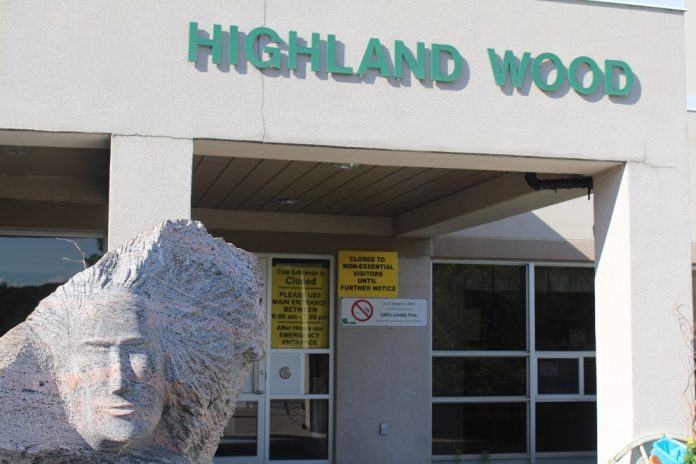
On Nov. 20, the Haliburton, Kawartha, Pine Ridge (HKPR) District Health Unit declared a COVID-19
outbreak at Highland Wood Long-Term Care. There are currently two confirmed resident cases associated
with the outbreak.
As a result, six Highland Wood residents have been isolated. The home is also now closed
to any further admissions and general visitors. All outings will be cancelled unless it is for a medical
appointment. Volunteers are also restricted from entering the home at this time. Essential caregivers
may continue to visit.
HHHS will continue to maintain important Infection Prevention and Control (IPAC) measures, including
mandatory masking in all resident care areas, mandatory vaccination, regular surveillance testing before
entry into long-term care facilities, and enhanced cleaning at Highland Wood Long-Term Care.
Services in the Haliburton Hospital remain unaffected by this outbreak and community members in need
of care should not hesitate to seek assistance.
HHHS notified of COVID-19 outbreak at Highland Wood
Santa en route to Minden Hills
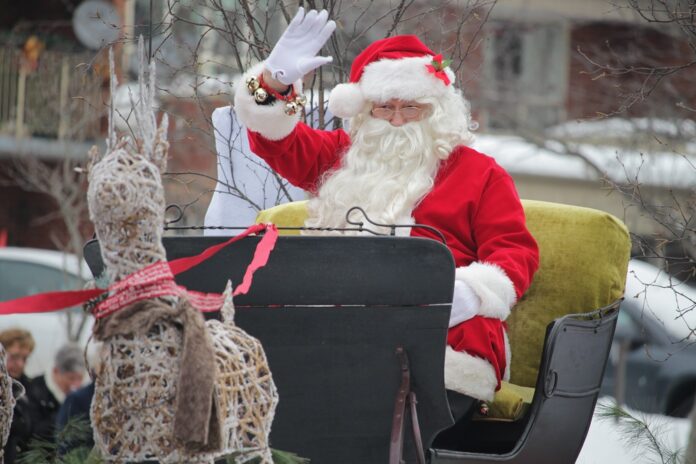
The township of Minden Hills is encouraging families to continue their holiday traditions this Saturday.
The town’s Santa Claus parade takes place Nov. 19, starting at 11 a.m. The parade will begin at the S.G Nesbitt Memorial Arena parking lot, continue along Parkside Street and head south on Bobcaygeon Road, before finishing at the municipal parking lot off St. Germaine Street. Look out for rolling road blocks.
After the parade, families are encouraged to visit with Santa Claus at the Minden Hills Cultural Centre. Christmas in the Village is back from 11 a.m. to 3 p.m.
“The whole family can enjoy the outdoor Christmas artisan market, tour the heritage village decorated for the holidays, try some delicious homemade baked goods for sale in the Bowron House, explore the Old-Fashioned Candy Shop, visit our Santa letter writing station and sip hot chocolate and apple cider,” the township said.
Admission to Christmas in the Village is by donation.
For questions regarding the parade, call the community services department at 705-286-1260 x 551. For questions regarding Christmas in the Village, contact the cultural centre at 705-286-3763 x 542. For more information, visit the Township of Minden Hills website at www.mindenhills.ca
Camaraderie and respect at Wilberforce service
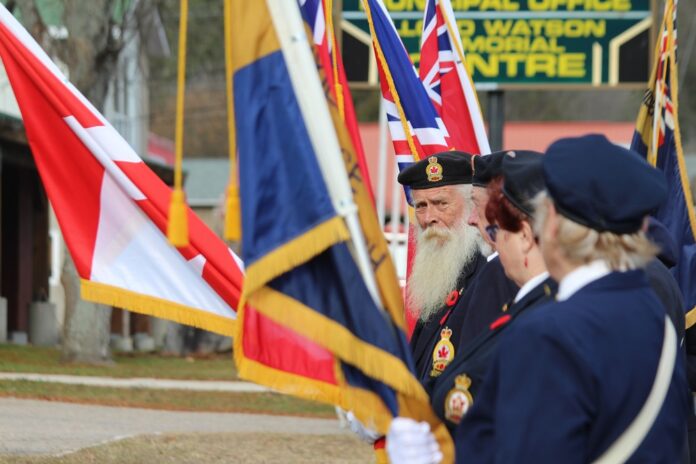
As Highland Grove resident Barb Munroe sang the hymn Abide with Me, she looked out on a crowd of approximately 100 who gathered under sunny skies to honour Canada’s fallen in front of the Wilberforce War Memorial.
“My parents, my uncles all served in the Second World War. It’s memorable for people our age to be able to come out and celebrate,” she said.
She was especially glad to see dozens of children from Wilberforce Elementary School attend the ceremony.
“For people of the younger generation, they might not have grandparents who served. It’s nice for them to see even the camaraderie that’s displayed on a day like this. These are all local people here, and it’s a show of respect.”
Since the OPP closed the road in front of the memorial for the duration of the service, only the gentle flap of a half-mast Canadian flag and the rustle of trees could be heard during the 11 a.m. moment of silence.
Ordained priest Ted Morris, who led an opening prayer and presentation, acknowledged the impact of war resonates in 2022 as the Russian invasion of Ukraine continues.
“Those who do not remember the past are condemned, and I repeat condemned, to repeat it,” he said.
Minden remembers
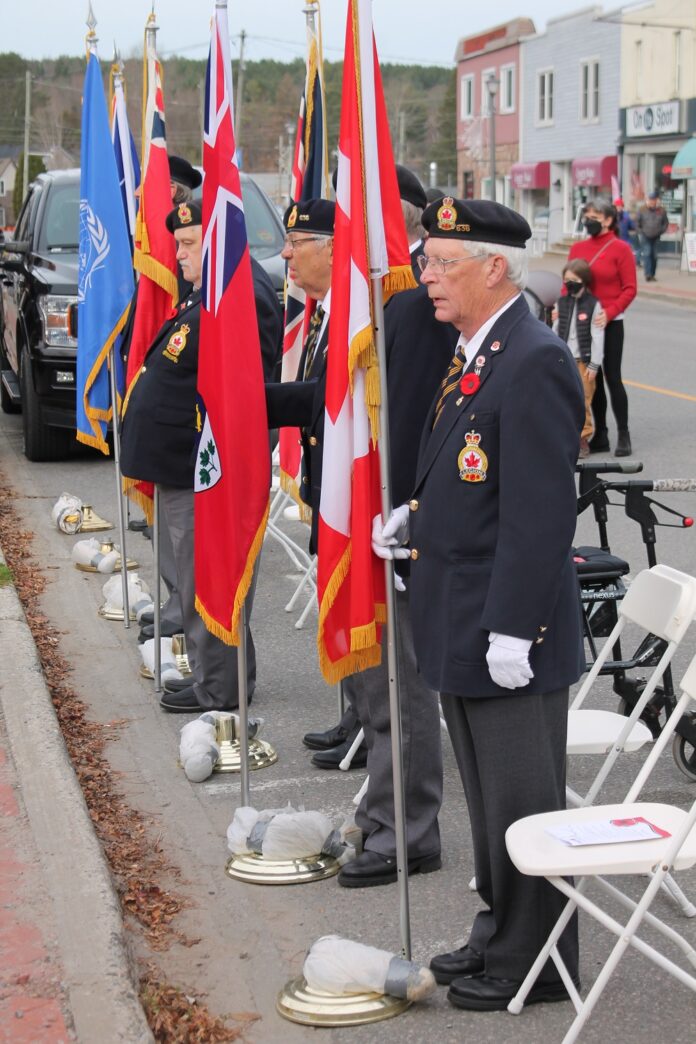
A large crowd lined Bobcaygeon Road for the annual Remembrance Day ceremony at the Cenotaph in the Village Green in Minden Nov. 11. Royal Canadian Legion Minden branch 636 members were joined by dignitaries, including mayor Bob Carter and deputy mayor Lisa Schell, former Algonquin Highlands mayor Carol Moffatt and Andrew Hodson, representing MP Jamie Schmale. Cadets, boy scouts and girl guides, police and fire were also represented. The Rev. Canon Joan Cavanaugh-Clark addressed the crowd.
Parade featured in Haliburton service

The sidewalks along Highland Street were packed Nov. 11 as community members came out to pay their respects as the Haliburton Legion held its annual Remembrance Day service at the cenotaph.
Derrick Moore, vice president of the local Legion, led a 50-person strong parade along Mountain Street and Maple Avenue, featuring the Haliburton Highlands Bagpipes and Drum Band, members of the Haliburton Army Cadets and military personnel, both active and retired.
U11 Storm show spirit in Haliburton tournament

After a successful start to the season, the Highland Storm’s U11 Car Quest team entered the Silver Stick tournament in Haliburton this past weekend.
The team first faced off against the Sturgeon Lake White. The locals dominated, spending the majority of the match in the offensive zone. The Sturgeon goalie played a great game, holding the Storm to two goals and the Highlanders hung on to win 2-1.
Bently Bull and Mackay Windover had goals. A solid effort from the defense held the opponents to one goal.
The second game, against the Kemptville Royals, saw the Storm hold their own in the first, heading into the second down by one goal. The team struggled in the second and gave up five goals. The players rallied and played hard in the third and held the Royals scoreless but were unable to start a comeback. The final score was 6-0.
The third game on Saturday was against the Campbellford Yellow team. The team drew together and came out flying. The newfound spirit was possibly due to a unique team handshake that was a rallying cry for the players. All 12 rose to the challenge. Goalie Nathian Lowe lived up to his commitment to stop the first shot.
The defense and hard back-check fulfilled their part of the bargain by clearing rebounds and turning the puck up ice. A complete team effort, led by a hat-trick from Windover, awarded the team a 6-3 victory and a semi-final game against Apsley.
The team spirit continued as the Storm faced the heavily-favoured eventual champions. The Storm came out strong again and pulled ahead by two. While the team played by far the best game of their season, they were unable to hold the lead for a final score of 3-2.
Canada’s version of the moon landing touches down in Haliburton
Just as Americans remember where they were when Apollo 11 landed on the moon, Canadians of a certain age recall where they were when Paul Henderson scored a serieswinning goal for our nation in Moscow on Sept. 28, 1972.
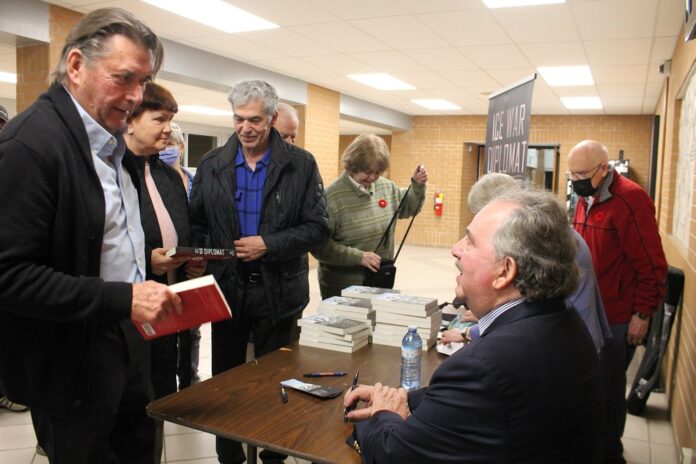
That historic piece of hockey history was present in Haliburton Nov. 10 as Those Other Movies showed the documentary, Ice Breaker: The 1972 Summit Series. They also brought Canadian ambassador to Russia at the time, Gary Smith, to the Northern Lights Performing Arts Pavilion. He talked about his involvement in the series. Local filmmaker Helen Parker also spoke as she was involved in the making of the movie.
The Russian-speaking Smith explained how the series came about. Then prime minister Pierre Trudeau visited Moscow in 1971 to try to warm the cold war. It resulted in a return visit by Soviet premier Alexei Kosygin. Although initially met with protesters, he was taken to a hockey game where he got a better reception. It sparked an idea for Kosygin that hockey could improve relations between the two nations.
Smith was involved in the negotiations to bring the series about. He told the audience it was “a great privilege to be in Haliburton.”
“I think we all know this was the greatest hockey series ever,” Smith said. “In 27 days of September of 1972, this country was fixated on a hockey series with the Russians. I was fortunate enough to be at the Canadian embassy in Moscow as a Russian speaker and playing for the Moscow Maple Leafs and got involved in all the negotiations for this series, travelled with the Soviet team across Canada, looked after Team Canada in Moscow and you’ll see there were a lot of hijinx that went on. Everyone thought Canada was going to wipe the ice with the Soviets. We didn’t and it was a last-minute thing, but I think you’re going to find this a beautiful film, a film where people cry, laugh, applaud and jump up and down,” he said.
He re-visited Moscow in 2021 with director Robbie Hart where they did some interviews with the Soviet players, finding the experience “unique.”
Parker went to Moscow in 2017 for the 45th anniversary of the summit series where she interviewed players. She said a friendship she and husband Carl Dixon struck up with Ron Maclean during Rogers Hometown Hockey in Haliburton also helped to get Maclean in the film.
Those Other Movies (TOM) is back from a COVID hiatus and celebrating its 18th year, said spokesperson Tammy Rea. She said they will be continuing the TOM series but are holding off on the Haliburton International Film Festival (HIFF) and doc(k) day for now.
She said with the growth of Netflix and Amazon Prime, they were worried about getting films but their “sleuths” found great films at the Toronto International Film Festival (TIFF) and Cinefest in Sudbury, so have some “amazing” movies on the way.
Food for the rest of us
Food for the Rest of Us, a film screening with director Caroline Cox, is happening Nov. 24 at 7 p.m. at Haliburton School of Art + Design
Organizers said it’s a feature film that presents four stories of people living life on their own terms, serving as leaders and role models, and leading a revolution to a better world, from the ground up.
Created by two Canadian filmmakers, “this film is powerful, inspiring and embodies messaging of youth empowerment by connecting them to food,” organizers said.
All viewings will have a question-andanswer session with Cox.
Cost is by donation and all proceeds will go to the re-launch of Abbey Gardens’ Sprouts to Snacks program, which provides youth with a full circle experiential opportunity to learn, appreciate and enjoy being a part of where their food comes from.
For more information, contact Irene Heaven at Irene@abbeygardens.ca or call 705-754- 4769.
Kids ‘stick it to the man’ in rocking musical
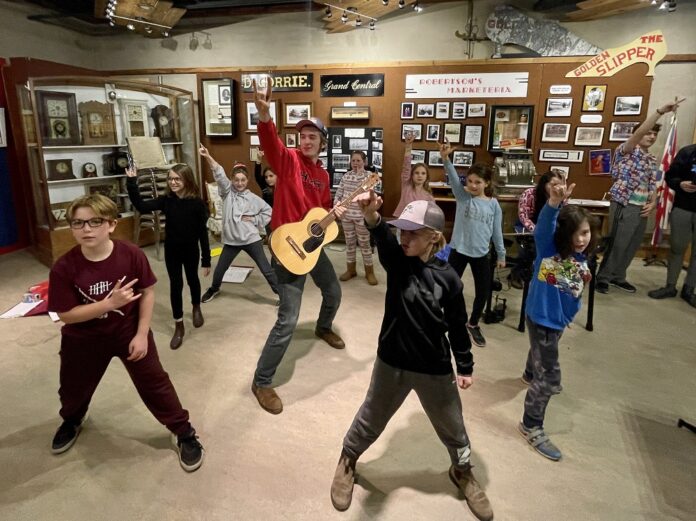
Fia Scuhr said she’s “really excited but a little bit nervous” about taking to the stage alongside more than a dozen other Haliburton County kids and teens next week in a Camexicanus production of School of Rock.
She and her castmates have spent months practicing songs and lines with director Darian Maddock and Camexicanus director Greg Sadlier at multiple practices a week at the Haliburton Highlands Museum.
The musical premieres at the Northern Lights Performing Arts Pavilion Nov. 23 at 7:30 p.m. Shows are also scheduled Nov. 24 and 27 at the same time. On Nov. 25, the musical arrives in Wilberforce for a 2 p.m. matinee at the Lloyd Watson Community Centre.
“I think it’s an amazing experience,” said Jack Walker, a Haliburton Highlands Secondary School student who is playing the intimidating Patty di Marco. He and other older teens play many of the older characters and have helped mentor the younger actors, some of whom haven’t been part of a musical or play before.
“Seeing how far they’ve come from not knowing any lines at all to knowing all these songs, it’s amazing,” he said.
School of Rock is the story of Dewy Finn (Maddock) who joins a school as a substitute teacher and exposes his students to the freewheeling world of rock and roll, culminating in a battle of the bands competition.
The production has been designed to highlight kids’ talents and develop their confidence on stage.
“It’s not a musical we put together, it’s more of a musical the kids put together,” Walker said. “They get to direct it, that’s what I love about it.”
Tickets are available at camexicanus.ca.
“All proceeds from this event will go back into this community in the form of more events and programming just like it,” reads a Camexicanus media release.
Haliburton girl gets helping hand from War Amps
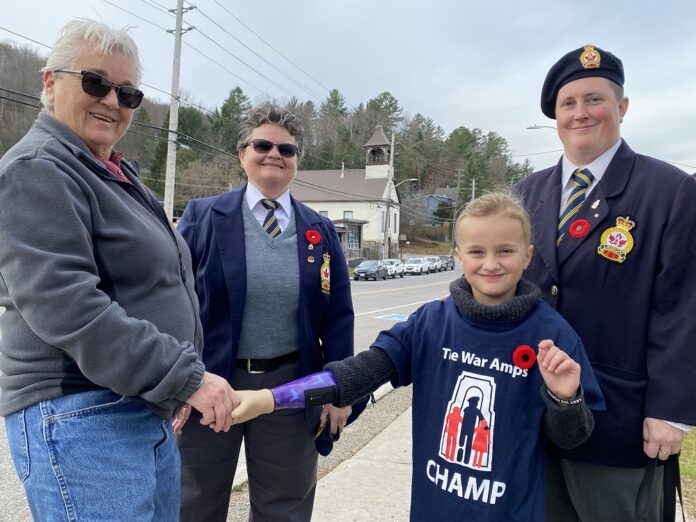
Seven-year-old Haliburton resident Valla Berry was all smiles last week as she showed off her new prosthetic arm, declaring herself “a War Amps champ.”
Born without a right hand, the youngster was presented with the prosthesis in time to wear it and march in the Nov. 11 Remembrance Day parade in Haliburton. Helped by her mom, Adrienne Clark, Valla placed a wreath at the Cenotaph on behalf of War Amps Operation Legacy. It was a fitting way for the family to recognize the “amazing” contributions of War Amps, said Clark.
“I don’t know where we’d be without them. They have been absolutely amazing with us throughout this journey, and to see the smile on Valla’s face today, it was just a special moment,” Clark said.
Through its Child Amputee Program, War Amps offers comprehensive services to child amputees and their families, including financial assistance, peer support and regional gatherings and seminars. All services are provided free of charge.
To date, Clark estimates the organization has provided more than $20,000 worth of support.
“The [Ontario] government only covers 25 per cent of the cost of a prosthetic, so it can get expensive. War Amps has covered the rest of the cost, they’ve paid for any special appointments we’ve needed, they cover the cost of our trips down to the city for appointments, so gas, food, overnight stays if we needed it. It’s such an incredible operation,” Clark said.
Clark said she and her family have supported War Amps efforts for generations, dating back to her grandfather Sydney Adamson. A tail gunner in the Royal Canadian Air Force during the Second World War, Adamson donated regularly to War Amps through its key tag service. Tags are mailed to participants annually and can be latched onto a key ring, with a number attached for people to call if they find a lost set. Since the service began in 1946, more than 1.5 million sets of lost keys have been returned to their owners.
This will be Valla’s second unit. When she was younger, she was fitted with a passive prosthesis – a hook she would use while at home or the playground. She quickly outgrew it though, with Clark saying it served as more of a hindrance.
Then, after returning home from school one afternoon in spring, Valla asked her mom a question that kickstarted this whole process.
“She came home from school one day and goes ‘I want two hands just like everyone else,’ and that was just about the most heartbreaking thing I’ve ever heard,” Clark said.
Valla said she “absolutely loves” her new hand, which she designed herself.
“It’s great. Now I get to wear it around and pick stuff up,” she said. “My favourite thing to do now is shake hands with it, because I couldn’t do that with my right hand before.”
Awards soften ‘strong Haliburtonian’ exteriors
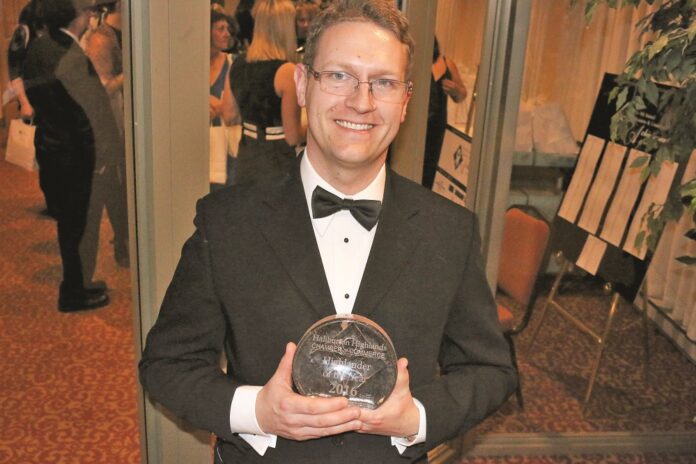
The Haliburton Highlands Chamber of Commerce awards return Nov. 19, with executive director Bob Gaudette saying it will be a time to “recognize and celebrate the quiet contributions of those in our community.”
Gaudette added when meeting people on the street, or at the grocery store, they have their “strong Haliburtonian” exteriors on.
“Strong people with strong work ethics living together in an environment that reflects that toughness back to us.” He said people don’t often show the “recovery or struggle” and downplay their contributions.
That’s why the awards, in-person for the first time since the pandemic, are so important, he said.
“The last years have challenged us all and it’s more important to gather again to recognize the contributions and achievements of everyone. An exceptional time where exceptional people did what they could to make a difference. In celebration of us all, we hold the most exceptional up as examples.”
He said the awards are about honouring, “those who go above and beyond to make our community better.”
The event is being held at the Bonnie View Inn from 6-9 p.m. Find out more at haliburtonchamber.ca/gala
And the nominees are:
Highlander of the Year:
Andria Cowan Molyneaux, Robin Carmount, Rick Lowes, Lindsay Meller, Marina Thomazo, Shay Hutchings and David Zilstra.
New business:
Delancey Sports, Minden River Cone, Northern HVAC, OG Cucina, Poquito Loco, Spot97, Sweat Social, The Noble Barber.
Tourism and hospitality:
Abbey Gardens Community Trust, Lakeview Motel and Resort, McKeck’s Tap and Grill.
Young professional:
Alyssa Kinghorn (Hali Custom Co), Fred Mayo (Petrini Construction), Nick Folco (The Noble Barber), Mackenzie Vasey (LV Threads).
Innovation and creativity:
Haliburton Clothing Co., Haliburton Forest Biochar.
Not-for-profit:
Abbey Gardens, Youth Wellness Hub, Skyline Dance Studio, CKHA CanoeFM, Haliburton County Snowmobile Association, Haliburton County Development Corporation, Haliburton Highlands Arts Centre Foundation.
Customer service – business:
Haliburton Clothing Co., REFORM with Sarah, Lakeview Motel and Resort, Wind in the Willows Spa.
Customer service – employee:
Rebel Grooms (Timber Mart) and Rita McCarty (Tekrider).
Industry and trades:
Northern HVAC, Minden Auto Care and JR Masonry.
Business achievement:
Linda Baumgartner and AJW Services.
Entrepreneur:
Linda Baumgartner, Megan Cox (Just Movement Fitness), Amy Joanu (Beauty Basics).