

Home Blog Page 147

Dysart beefing up deer feeding policy

0

Two community groups and a Haliburton business are calling for Dysart et al council to amend its deer feeding bylaw, slamming legislation tabled earlier this year as “ineffective and based on erroneous and misleading information.”

The Stop Deer Feeding Property Owners Coalition, Haliburton By-The-Lake Owners Association, and Shelley Stiles, owner of Country Rose Flowers and Garden, submitted letters to council Sept. 26 saying the bylaw, approved in July prohibiting deer feeding in most of Haliburton village from May 1 to Sept. 30, required a revisit.

Speaking at the meeting on behalf of the Stop Deer Feeding coalition, Gail Gillespie said Haliburton’s deer population was out of control, blaming people who continue to feed the animals.

“We have a lot of feeders right now… we want a complete ban. There’s so much damage in this town. The deer are not healthy,” Gillespie said. “When there’s too many deer, other species suffer.”

Council spent months debating a bylaw earlier this year. That came after a delegation from Haliburton residents Mike and Debra Landry in December 2022, who believed deer were becoming a nuisance in the downtown. They said the increased presence had led to a significant jump in collisions between vehicles and deer on Dysart roads, with Mike, a retired OPP officer, estimating around 100 collisions annually.

In his letter, Bill McFarland, president of the Haliburton By-The-Lake Owners Association, called on council to amend its bylaw to outlaw the practice year-round.

Mayor Murray Fearrey said that was council’s original intent when the legislation was passed over the summer.

“We need to make sure that’s corrected. Right now, it looks like you can feed them [in the winter], which makes no sense,” the mayor said.

Karl Korpela, Dysart’s chief building official and head of the bylaw department, said the intent of the bylaw was to “ween off the deer” relying on food from people to survive, noting council had recommended implementing a temporary ban with a view to extending the no feed window in future.

Gillespie indicated that reasoning was flawed.

“As soon as you offer any amount of food, the deer is going to stay around. You can’t ween them off,” she said.

Coun. Pat Casey suggested establishing a deer feeding yard “a decent ways out of town” to try and relocate the deer, while providing residents who wish to feed them the chance to continue. He said the Ministry of Natural Resources and Forestry used to establish the sites, noting there was one near Percy Lake. Gillespie said the ministry no longer endorses them.

In her letter, Stiles said she feels deer are becoming too domesticated. She said she’s been forced to install farm fencing at Country Rose to keep deer away, but has still suffered “substantial” losses due to deer eating the business’ plant material and stock. She asked that council consider extending its no feed boundary past the township yard on Hwy. 118. Coun. Nancy Wood-Roberts suggested council outlaw the practice completely within the limits of Ward 1.

There was also a request to increase fines, currently $150 per offence. While Fearrey indicated he would be in favour, Korpela said the township may have difficulty getting an increase past the attorney general’s office.

“We can apply for whatever fine we want, but the ministry might not approve it. It’s all about being reasonable… I think $150 is a fairly significant fine for something that’s… not a major offence,” Korpela said.

Staff will bring options back to council next month for potential boundary and fine amendments.

County looking into Minden-Hali shuttle

0

After years of attempts, and failures, County council will investigate the possibility of public transportation between Minden and Haliburton.

Coun. Bob Carter raised the idea at a Sept. 27 council meeting. The Minden Hills mayor said, “we have been looking at transportation for, obviously, a number of years prior to me getting on this council. It’s been noted how it affects the community that we don’t have anything.”

Carter is in his first term as a County councillor. Prior to his arrival, the County spent two terms grappling with the issue but was unable to deliver anything substantive. A transportation task force, and a volunteer rural transportation options group, ended with no action taken in 2019 after spending nearly $50,000.

The County still has more than $200,000 in a transportation reserve. The lack of public transportation is identified in the County’s community safety and well-being plan. In addition, while first-year projects are not eligible for provincial gas tax funding, they are in second and subsequent years.

Carter said he had not necessarily been “wildly” in favour of some of the past proposals, “because all too often people try to put everything in there… that you have custom call-up and dial-up, picks you up at your home. It becomes very difficult to try to determine what the cost of something like that would be.”

‘This is something we need to do’

He said his ask is simply to start a shuttle route between Minden and Haliburton six days a week. He said it would provide access to key buildings, such as Hyland Crest longterm care home in Minden, the Staanworth Non-Profit Housing Corporation, Highland Wood LTC at Haliburton hospital, Extendicare Haliburton, the Kawartha LakesHaliburton Housing Corporation in Haliburton and the ER in Haliburton.

“Places where there are many people who don’t have cars, either because of age or finances and so on… it would link those people to some of the key commercial resources in the two centres and to health care.”

Carter said they now have a “significant” problem in Minden Hills, with people not having access to the Minden ER. “I think this is something we need to do.”

He further emphasized it would be a starting point, “the spine if you will” running between the centres, with future offshoots to places such as Wilberforce and West Guilford “and so on”.

“But we have the one core in the middle. This would serve about 50 per cent of the population in Haliburton County. I see it as a starting point and something that is a benefit to the whole County. We have been putting money aside for this, so I’m proposing we have a two-year trial and see how it goes.”

He acknowledged there would still be decisions, such as location of bus stops, which might be done by a committee, and fares. For now, it “shows good faith for what the population is asking us to do.”

Warden Liz Danielsen, who is mayor of Algonquin Highlands, said while it would be a good start, and she was not opposed to exploring it, she would argue it would not service the entire community. She said all four municipalities pay into the transportation reserve, but this would only benefit Dysart et al and Minden Hills, not Algonquin Highlands or Highlands East.

Coun. Jennifer Dailloux said Carter’s notice of motion seemed to be a reaction to the loss of the Minden ER, but was curious to see what the results of a request for proposals would generate. She was also interested in a fee structure aimed at cost recovery.

Coun. Murray Fearrey thought it was a good starting point, and wants more details.

Coun. Cec Ryall said he was in favour of putting out an RFQ, to “give us an idea of where we’re going, what we’re doing, I’m not saying pick up where the task force left off.” He was hesitant, however, about all County taxpayers contributing to ongoing operations if the service only ran in two townships.

Coun. Lisa Schell said, “in my mind, this was just a starting point that would eventually, if possible, grow into being a Countywide service, not just in Minden and Dysart. But I think right now that’s probably the two larger centres where you could maybe have an idea of how it may look, or how popular it may be, and what the cost would be.”

Council voted to put out a request for proposals.

Search for wanted person

0

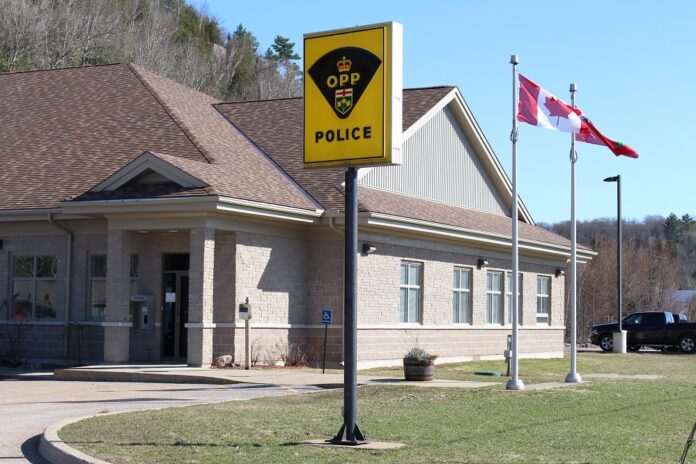
On Monday (Sept. 25) OPP say there was an increased police presence in the area of Gelert Road in Minden Hills as a result of a search for a wanted person.

At approximately 1 p.m., members of the Haliburton Highlands Ontario Provincial Police (OPP) attended a residence on Gelert Road to locate and arrest a wanted person. However, the person fled into a wooded area.

As a precaution, members of the OPP Emergency Response Team (ERT), Canine Unit, Aviation Services and Tactics and Rescue Unit (TRU) were dispatched to the area to assist in the search. The person was not located. OPP continue to investigate. There is no risk to public safety.

Anyone who may have information that may assist with this investigation are asked to contact Haliburton Highlands OPP at 705-286-1431 or toll-free at 1-888-310-1122. You can also provide information anonymously by contacting Kawartha Haliburton Crime Stoppers at 1-800-222-TIPS (8477) or online at https://www.khcrimestoppers.com.

Chamber awards to celebrate business

0

County residents have just a few days left to get their nominations in for the 2023 Haliburton Highlands Chamber of Commerce community and business achievement awards.

The event is being held Oct. 20 at Eagle View Wedding and Event Centre, at Sir Sam’s Ski/Ride, and will bring a collection of the Highlands’ finest entrepreneurial minds together to celebrate the biggest success stories of the year in business.

There will be 12 premiere awards dished out this year, recognizing: business achievement; top entrepreneur; best businesswoman; not-for-profit; industry and trades; tourism and hospitality; innovation and creativity; customer service – employee; customer service – business; best new business; and Highlander of the Year.

Chamber spokesperson Kirstley Dams said she has received 52 nominations to date. The submission deadline is Sept. 30.

“The Haliburton Highlands Chamber of Commerce takes great pride in delivering this annual event. Although glory is not the reason that the nominees get into small business ownership, it certainly feels nice when we can recognize and appreciate all the hard workers in our County,” Dams said. “We encourage everyone to nominate a business or community member they feel goes above and beyond.”

Asked what people should consider when making a nomination, Dams added, “don’t complicate it. We all know someone, or some place, that seems to always offer the best service, or always lead their industry. Find a category of the 12 available and give them a nomination.”

She said she was particularly looking for nominations in the tourism and hospitality, young professional, industry and trades, and innovation and creativity categories.

“When submitting your nominations try to be as detailed as possible – our judges are completely unbiased, which means they are relying solely on the information you provide to make their decision,” Dams said.

Liz Danielsen will also be presenting her ‘Warden’s Award’, which has historically been awarded to those deemed to be exemplary citizens/organizations who go above and beyond for our County, Dams said. Local non-profit Point in Time was named the winner of last year’s award.

Dams said she’s looking forward to a great evening. Tickets went on sale Sept. 18.

“This achievement gala is the only Haliburton business awards [we have] and one of the few occasions where our business community can get a little fancy and gather to network and share their stories. We’re really excited,” Dams said.

The event will kick off with a 4 p.m. cocktail hour and complimentary chairlift rides. Dinner and awards ceremony will begin at 7 p.m. For more information, to make a nomination, or book a ticket, visit haliburtonchamber.com/gala.

HHHSF in ‘quiet phase’ of CT fundraising

0

Haliburton Highlands Health Services Foundation executive director, Melanie Klodt Wong, said she and her board are currently in the “quiet phase” of a campaign to raise millions of dollars for a CT scanner and CT mammography unit for HHHS.

The Ministry of Health has approved the machines but does not provide funding for them. Haliburton Highlands Health Services (HHHS) interim president and CEO, Veronica Nelson, said she wants them in place by summer 2024.

Asked for a status report at the HHHSF AGM Sept. 21, Klodt Wong said, “we’re planning. We’re talking to folks who are interested in larger gifts.”

She said they know it is going to be a lot of money. “Even though we raised a million dollars last year, this is going to be a lot more than that. We need to make sure we have all our ducks in a row.”

She added that generally with these sorts of campaigns, the foundation will raise a certain amount “before the thermometer goes up.”

Pushed as to when they might launch a campaign, Klodt Wong said, “I think a good time would be when there’s a lot of people around.” She said it would not be before the holidays.

“The goal is to get to a certain amount, so however long it takes to get there, that’s when we’re going to look to have that launch.”

Responding to a suggestion that might be “aggressive” to have funding in place for the spring, Klodt Wong said it was. “But we’re hopeful. We want to support that (timeline) and we’re acting as quickly as we can to get funds. Anyone out there who is interested in supporting health care in a big way in this County, we want to talk to you.”

Last fiscal year

Klodt Wong said in the 2022-23 fiscal year, they’d had 1,934 donors, averaging $509 per gift, had retained 27 per cent fewer donors; but saw 437 new donors give $290,000.

She said the number of active donors is down from the previous fiscal year but closer to the historic average. She added the pandemic and economy had affected donations.

“We’ve seen less donors, especially at the lower levels. However, those who are giving, are giving more,” she said.

As a result, she said overall donations were up approximately $400,000. She added their goal is to bring inactive donors back and retain more donors as they move forward.

She said they were able to transfer $284,279 to HHHS for things such as a long-term care nurse call bell system, a blood bank fridge, emergency stretchers, park benches and gardens and replacing the engine on a community support services’ (CSS) van. They also transferred $50,000 to CSS to subsidize its meals-on-wheels and medically-required transportation programs. Another $12,506 went into the education assistance program.

Some of the highlights included the Matt Duchene Charity Golf Classic golf tournament returning in 2022 after a twoyear hiatus, and raising more than $200,000 for “smart” IV pumps. The annual radiothon raised more than $31,000. The winter holiday campaign garnered nearly $275,000. The 50-50 lottery and the collectible bear puzzle, Mosely Moose, Haliburton cottage pack and reopening of the Haliburton gift shop all helped the effort, Klodt Wong said, as well as volunteers.

Klodt Wong said she is always impressed and grateful for “the generousity and care that comes from this community.”

‘Telling stories weaves net of solidarity’

0

After a hastily-organized Take Back the Night event in Minden Sept. 21, organizers are planning to be back bigger next year in what they hope to make an annual event.

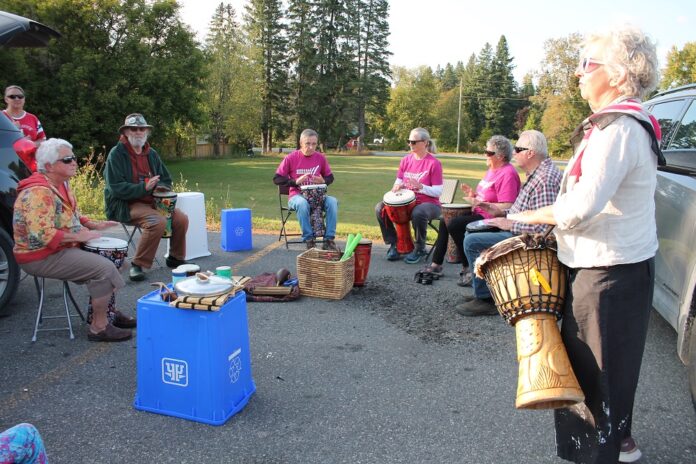
With Rails End Gallery drummers in attendance, the YWCA Peterborough Haliburton gathered people on the grass outside Canadian Tire before leading them on a march on the river walk.

Director of philanthropy, Tina Thornton, thanked Haliburton County-based organizers and attendees.

“Thank you so much all of you. This started off as just an idea about a week ago and we managed to pull together, and I couldn’t be more excited. I am looking forward to hopefully having Minden as an annual event.”

She read an address from executive director, Kim Dolan, who was at another event on the night.

“We gather in solidarity knowing that our collective presence honours the experiences of women-identified people and girl children who’ve experienced gender-based violence in our streets, workplaces, institutions, and homes for too long,” Dolan said.

“Despite our efforts, since the 1970s, gender-based violence is affecting more women, happening more often, and becoming more violent. This means that more women are afraid, more women are being harmed, and more harm is happening. The threat of violence silences us, but not tonight.”

Dolan added that gender-based violence does not discriminate, for perpetrators or women, no matter their gender identity, sexual orientation, race, ethnicity, health, abilities, social and geographical location.

“The power of women telling one another their stories of violence and sexual assault weaves a net of resilience, defiance, outrage and hope. The telling of our stories speaks truth to power. The telling of our stories shines a light on misogyny, colonialism, racism, transphobia and societal and institutional systems that perpetrate violence. Telling our stories weaves a powerful net of solidarity.”

Respiratory season around corner: HKPR

0

The health unit is readying itself for respiratory season, medical officer of health, Dr. Natalie Bocking, told a Haliburton, Kawartha, Pine Ridge (HKPR) board of health meeting Sept. 21.

She said the fall is an “incredibly” busy time for the health unit, and the media is now focusing on the fall respiratory season. She added the community wants to know what to expect and what the recommendations are.

“We’re preparing folks for what’s considered to be another atypical respiratory season,” Dr. Bocking said.

She said that means they are anticipating flu season to hit early, COVID-19, and other respiratory viruses to be somewhat higher than pre-pandemic levels.

As for readiness, Dr. Bocking said it’s about the health unit, long-term care homes, public education, vaccination, testing and treatment.

“We had a fairly intense influenza season last year, that happened earlier and peaked earlier, that had a number of implications for our health sector partners, emergency departments, hospitals as well as patients from the health unit,” Dr. Bocking said.

She added they take their cue from the southern hemisphere, which has already experienced a fall and winter 2023.

Australia and New Zealand saw “not quite as high” cases of influenza compared to last year, fewer deaths, but quite high hospital admissions, particularly among children up to the age of nine. She said the most at-risk are people 65 years old and older, and the very young.

As for COVID-19 locally, she said they’d had a long stretch of fewer hospital admissions. She is anticipating that will increase. She added the virus continues to mutate and evolve, with a couple of different variants that have mutated together. However, she said there are no new variants that have set them back. She said the variants remain contagious but do not cause more severe illness.

She suggested people keep an eye on things through reputable sources, such as the local health unit, Kingston public health unit and Public Health Ontario.

Dr. Bocking said in the past couple of weeks, they have been doing tabletop exercises with health sector partners, including in Haliburton County. They’re working with LTC homes. “Preparation for worse case scenarios should they arrive.”

They’re ramping up public education, reminding people to stay home if sick, and wear masks.

The health unit is also encouraging people to get both a flu and COVID vaccine (which can be given at the same time) and LTC and those over 65, an RSV (respiratory syncytial virus) shot.

Dr. Bocking said people in LTC homes and hospitals will be immunized first, followed by at-risk groups, and then the general public, likely in late October. Vaccines will be available in pharmacies. The health unit will have vaccine clinics and primary care professionals will also give jabs.

As for testing and treatment, the region’s top doc said PCR test kits are still available and there is a test locater on the provincial website. Rapid antigen tests are still available.

She also encouraged people to go to their new website at hkpr.on.ca.

Rallies demonstrate divide

0

A 1 Million March 4 Children event in Head Lake Park Sept. 20 quickly led to Minden Pride organizing a counter rally, as hundreds demonstrated their ideological differences in the Highlands.

The 1 Million March 4 Children was a series of protests in cities and towns across Canada.

Local spokeswoman, Valerie Jarvis, said they were uniting diverse backgrounds and faiths who, “share a resolute purpose: advocating for the elimination of the sexual orientation and gender identity curriculum, pronouns, gender ideology and mixed bathrooms in schools.”

She said as a symbol of their commitment, students were encouraged to participate in a nationwide school walkout on the day, although few did locally.

“Together, we stand united to safeguard the well-being and innocence of our children,” Jarvis said. She added their mission is to, “free children from the bondage of indoctrination. Breaking the system designed to sexualize our children.”

While the approximately 50, 1 Million March participants started at the welcome centre in the park, they eventually marched on the path towards Haliburton Highlands Secondary School.

The walkway was lined by LGBTQ+ supporters, who outnumbered them approximately three to one. One of the 1 Million March 4 Children brigade called out “God bless you.” The Pride-organized supporters answered with “educate, don’t discriminate.”

Pride chair Alan Guinan said, “I think the idea of removing queer ideology from the curriculum in high schools is a very dangerous proposition because it’s been proven that people who are within the queer spectrum have to have some sense of belonging. If you remove it from the education system, I don’t know where else they’re supposed to get it from.

“There’s this idea that there’s this sexualization of children, which is not what education is about, so from our perspective, we’re just here to say that there is a different viewpoint around education of children.”

Guinan added the opposition march seemed to be part of a growing anti-LGBTQ+ movement.

“We’re starting to feel as though there’s other people who have maybe a different agenda, an anti-LGBTQ+ agenda. We really want to ensure that our voices are heard.”

The Trillium Lakelands District School Board’s Carolynne Bull said TLDSB believes in safe and caring school communities.

“It is important that all students, including our youngest students, learn to respect each other’s individuality. Students and staff need to see themselves reflected in the language used in classrooms and in the school,” she said.

“At TLDSB, Positive Space is only one component of the equity and inclusive education strategy. Since 2009, TLDSB has been working on a number of inclusive education initiatives, including religious accommodation, Indigenous rights, sexual orientation, and socio-economic status, to promote a safe and caring school climate for all.”

She shared two pages from the TLDSB website relating the board’s “commitment to equity, inclusion, and well-being for all.”

Communal services key to housing crisis

0

Haliburton County CAO Mike Rutter believes communal water and sewer systems may be the missing piece to help leaders address the Highlands’ housing woes.

Representatives from Frontenac County explained the potential solution to County council Sept. 13. Staffers Joe Gallivan and Kelly Pender said the plan, which took around seven years to develop, has helped the municipality progress three housing projects they say will bring more than 200 units over the next few years.

Communal services are made up of shared drinking water and wastewater systems, servicing groups of residences and businesses clustered together. Currently, in Haliburton County, most new developments utilize municipal services, in Haliburton and Minden villages, or are on private systems.

“We will never have municipal water and sewer in Frontenac – it’s fiscally impossible for our four small municipalities to afford that kind of project. Just like in Haliburton, our settlement areas are small villages on relatively small lots,” Gallivan said. “Planners have to think 25, 50, 100 years ahead. It’s important we keep our villages sustainable long-term, and to do that we need to significantly add to our housing supply.

“We already knew we couldn’t keep doing what we were doing. We’ve been struggling to attract [investors] to Frontenac County,” he added.

Gallivan said the Ontario government updated its provincial policy statement in 2020, identifying communal servicing as the second most preferred system behind typical municipal services, and ahead of private wells and septics, for new developments.

How it works

Through the program, Frontenac staffers work with developers to identify buildable land. Because single communal systems can be installed at a fraction of the cost of individual units, and don’t take up nearly as much underground real estate, new subdivisions can be created quickly.

“One of the major benefits of this kind of a system in a rural setting is they are very scalable. The developer doesn’t have to build expensive infrastructure for 50 lots at the start of the process anymore – these new systems are almost like Lego blocks.

You can start with a system that can handle five, 10, or 15 lots, and expand on that over time,” he said.

There are environmental benefits too – rather than establishing multiple connections to an underground aquifer, communal systems require a single hook up. In terms of planning, Gallivan said communal services allow municipalities to fit more units on an individual lot – whether within high population areas, such as the villages, or more rural.

“We have situations in Frontenac where we have developments [proposed] in our formal settlement area boundaries around villages, and further away. They stand alone with no integration with existing subdivisions, but with the potential for more units, creating much-needed living spaces for people,” he said.

“There is no rental housing available in Frontenac, so this has been huge for us in helping to build our inventory,” he added, noting he saw no reason why Haliburton County couldn’t replicate the model.

“That’s the best thing about it – it’s very easily transferrable to any other jurisdiction in Ontario,” Gallivan added.

Once systems are installed, developers enter into an agreement with the municipality, stipulating the township will take care of any maintenance. In Frontenac, they are in the process of developing their own utility corporation to take care of any issues. He noted the failure rate of units is around three per cent, and that replacement parts are cheap and can usually be fitted by township staff.

Haliburton ‘fits’ model

Pender, Frontenac’s CAO, said the regional municipality hopes to have 10 new subdivisions, each with communal services, finished by 2033. He believes the benefits will be wide reaching. “This is the answer we’ve been looking for. Kingston is growing… we’re seeing pressures all over our community. We can’t continue developing on two acre lots. All our good lots are gone, the bad lots are difficult to build on, service, and maintain, so this opens up a lot of doors,” Pender said.

Echoing Gallivan, he said if communal systems can work in Frontenac County, they can work in the Highlands.

There probably aren’t two counties in eastern Ontario that are any more similar than Haliburton and Frontenac,” Pender said.

“So, if it fits well with us, I think it can fit well with you, too.”

Homeowners on the new lots in Frontenac will be charged monthly fees, expected to be around $125 a month, for water and wastewater services. “You’re in the same ballpark you’d be in if you needed to pay for new systems and amortize that over 20, 25 years,” Pender added.

Rutter said the most important facet of communal systems is how attractive they make potential build sites to developers.

“Lack of municipal water and wastewater really limits the intensity of development and increases the operating costs for developers… if implemented, this will make development in Haliburton County much more attractive,” he said.

“This could be one way we reduce the barriers that exist when developing housing. Municipalities are generally not developers. We can, however, stimulate the development of housing by allowing cost-effective servicing opportunities like this, reviewing land use approval processes to make it easier to do business in Haliburton County, and ensuring we use servicing systems that effectively protect the natural environment that we treasure. This model seems to check all those boxes.”

Warden Liz Danielsen said she found the presentation “really exciting.

“This offers some food for thought on how we can meet the challenges of housing here, particularly in places like Highlands East and Algonquin Highlands where we don’t have any servicing at all,” she said.

Rutter said he would be circling back to County council before the end of the year to see if there is any desire to pursue the concept.

AH to consider waste options for Hawk Lake

0

Algonquin Highlands council has committed to taking a deep dive into waste management options for Hawk Lake, two years after shuttering a landfill in the area.

The Hawk Lake waste disposal site was closed at the end of its life in 2021. No new landfill options were announced at the time, with the township opting instead to streamline services at other sites in Dorset, Oxtongue Lake, Maple Lake, and Pine Springs.

That proved a controversial decision. Many residents protested the closure, with council reconsidering its position last winter. During 2023 budget deliberations, council directed staff to investigate options to bring waste management services back to the Hawk Lake community.

At a Sept. 21 meeting, Melissa Murray, the township’s environmental manager, tabled five possibilities for council to consider. She said Peterborough-based consulting firm Cambium Inc. had assisted with the project.

“We’ve gone through a two-stage evaluation process and are looking at all options,” Murray said, noting the estimated start-up costs to establish a new service range from $100,000 to $515,000, with annual operating costs between $40,000 and $110,000. She said all five options could be brought online in the next two to four years.

To determine the appropriate scale of service delivery options, Murray and Heather Dzurko, representing Cambium, looked at past trends at the old Hawk Lake landfill, noting that, in 2019, the last year of statistics before the COVID-19 pandemic, 18 per cent of total waste site traffic township-wide was recorded at Hawk Lake. The pair said, based on previous numbers, around 600 residences would benefit from a renewed service during the summer, with around 230 residences utilizing it during the off-season.

From 2015 to 2021, an average of 11,235 vehicles accessed the Hawk Lake waste disposal site annually. In 2019, almost 16,000 bags of garbage were collected at the site.

The first option, Murray noted, is to open a transfer station at the old Hawk Lake dump location. Bins would be placed to store garbage and recycling until it could be transferred off-site. This proved to be the most expensive option, with design and construction estimated at $500,000, and annual running costs of $60,000.

A second possibility is to develop a stationary collection program. This would see the township purchase a waste collection truck, or contract out the work, to pick up garbage and recycling at specific locations on designated days and times. Costs would vary depending on what council wanted, estimated between $100,000 and $200,000.

Other options included contracting a local business to host containers for the collection of materials, estimated to cost between $50,000 and $100,000 to set up, and $50,000 annually; look for possible community-based sites where bins could be placed in central areas and managed by a cottage association or other like-minded entity, at an estimated running cost of $100,000 to $200,000 per year; or stick with the status quo and make no enhancements to service.

Mayor Liz Danielsen said she felt uneasy designating authority to a community group to collect materials, seemingly ruling out Option 4. Coun. Julia Shortreed said she would be worried about the longevity of a community-led effort.

“Let’s say everything goes gung-ho at the start – great. Then after a couple of years nobody wants to do it, then what?” she asked. Murray admitted there were “several challenges” with that model.

Council spent the most time discussing Option 2, involving stationary vehicles. Danielsen wondered how solid the numbers outlined in the report were, with Dzurko saying they should be treated as estimates only, with an RFP required should council wish to proceed.

Murray noted the District of Muskoka had some success launching a lakeside collection model recently, which offers seasonal and year-round locations for residents to dispose of waste. Danielsen said she’d like to see a breakdown of costs between seasonal and year-round options in Algonquin Highlands.

“We’re not going to make a decision on this today – this is something that would go to projects and priorities [later this year] and be balanced against the other things we have to do,” Danielsen said.

She asked if staff could reach out to Muskoka to see if a representative would be willing to share details about its new program, while also encouraging residents to reach out and state their preferred option.

“This is going to continue on for some time until we land on a solution that, hopefully, will work for everyone,” she added.