
Home Blog Page 148

Mountain bike racer juggles work and play

0

Haliburton County mountain bike racer Nick Emsley had a big 2023 – winning the Canadian Rockies 24 Hour race and starting his own business; Fix it Nick.

Emsley finished second in the 2022 version of the gruelling Alberta race, saying “it was a close race, a tough one.”

So, he was determined to return this past summer to the world-renowned Canmore Nordic Centre.

“The race was exceptionally good… truthfully, I couldn’t have asked for a much better race,” he said of the win.

He was naturally pleased as, “with 24-hour races, you never really know. You can go in as prepared as you want but you never know. I mean it’s 24 hours. How do you prepare?”

For example, he said riders can train for six to eight hour stretches but never actually train for 24 hours straight.

“So, it’s hard to prepare yourself for that 24-hour period, but overall, physically, mentally, you’re all ready to go,” Emsley said.

In the 24-hour solo open men under 40 category, the local completed 21 laps in 23:14:14.2, beating out Magnus Stenlund, who did 20 laps.

“He was a great competitor, we were really neck and neck,” Emsley said of Stenlund. “He kept me really going and we were playing a little cat and mouse for awhile there. But I took the lead in the start and kept a consistent pace at the front. And he kept trying to catch me. Couldn’t have asked for a better 24-hour race. Everything worked out great. My mental picture, physical picture, everything was good.”

He said it is challenging trying to get nutrients right in a 24-hour race. He estimates he burns 700 calories an hour in the first eight hours of an endurance race. Then, muscles deteriorate, requiring less. Near hour 20, he might be burning 500 an hour. But he did burn about 15,000 in 24 hours, “which is a lot.”

He said while riding, he tries to consume about half of what he burns. The challenge is riders cannot take on a lot of solid foods as it takes energy to digest. So, there are a lot of smoothies and “foods that won’t make you sick. Which is hard,” Emsley said.

And while riding, there were only three spots he could actually eat food. “You have to consume around 400-500 calories in three bites. It’s hard to get the right foods. It’s a big challenge but this year everything worked out well.”

It was Emsley’s fourth 24-hour race win in his career.

After that, he did an eight-hour at Harwood Ski and Bike near Orillia. But as it was just a month after the 24 Hour, and he said his deep tissue muscle was not healed from Alberta, he finished fourth.

As for this year, Emsley said he had already registered for the Canadian Rockies 24. It’s July 27-28. He is undecided about Albion Hills since it is only a month prior to the Alberta race. He is planning some eight-hour events.

Fix it Nick

As a person who “likes to do his own thing,” with a “design fabrication mind” and being into construction and maintenance, Emsley started Fix it Nick in April 2023.

“I know there’s a little lacking in the handyman industry right now. All of the contractors, or most of them, have been doing bigger work.”

He said in his first year, he was not expecting anything big but knew it would be hard. “In the spring, I hit my max of 87 hours a week,” he said, which was why he did not train and race as much last year.

It went from not expecting much to a lot of phone calls, Emsley said. It expanded faster than he thought it would. He said he’s tripled what he originally envisaged in one year. “I’m expanding even more this year. So, it’s really good.”

At just 24 years of age, Emsley still wants to race and said he can do so once his business is firmly established.

“It’s been something I’ve been doing for 13 years, having put all of this effort in.”

Highland Storm strike Silver-Stick

0

The Highland Storm U13 Rep team have returned victorious from the Jan. 21 International Silver Stick Championships in Forest, Ontario.

Team manager Cynthia Hutchinson said the team went 4-0 in the preliminary round against four other regional champions, from Columbus, Ohio, Dresden, West Niagara and Frontenac.

In the finals, the Storm were up against the scrappy Ice Dogs from Arran-Elderslie.

Hutchinson said the Storm made use of their speed and passing to create space and generate goals from Travis Rowe (2), Chase Kerr and Henry Neilson to secure a 4-0 win behind the shutout goaltending of Blake Hutchinson.

Strong defensive support from Levi Rowe, Hudson Meyer and Tyler Hughes kept Frontenac at bay. At the same time, forwards Lyla Degeer, Cruize Neave, Hawksley Dobbins, Linus Gervais, Jaxon Hurd, and Brycen Harrison were all over the ice with incredible forechecking and back-checking, generating chances. Marshall Heasman was again at the ready if needed in goal as the Storm brought home the title, Hutchinson said.

For head coach Scott Neilson, this finishes what he started last year after a narrow loss in the semi-finals. Supported by assistant coaches James Reilly, Shawn Walker, trainer Marcus Rowe, and team manager, Hutchinson, the U13 team was well prepared, organized and motivated.

“For the kids, the banners hanging in Minden and Haliburton will represent memories that will last a lifetime,” Hutchinson said.

‘Ray days’ priceless for canoe builders

0

Kim Switzer and partner, Brad Archer, are enjoying what they are calling ‘Ray days’ – working with legendary canoe and paddle builder, Ray Kettlewell.

For the past year, the partners have been travelling to Kettlewell’s shop near Kinmount to learn how to build cedar canoes.

In a large shed, heated by a wood stove, and filled with tools, Switzer and Archer lean over a canoe-in-the making, steaming cedar ribs to curve them around a form, and then tacking them down with specialized nails.

Kettlewell looks on, occasionally offering a word of advice, but mostly letting the couple do the work themselves.

Kettlewell knows a thing or two about the trade. He’s been involved with canoeing and wood most of his life.

Prior to 1970, he worked in the hardwood lumber industry; logging and managing a sawmill and dry kiln in southwestern Ontario.

Much of his spare time was spent paddling, though, on his own and guiding groups of adults and children on canoe trips. Kettlewell earned a canoe instructor’s certificate in 1973 and 15 years of marathon canoe racing earned him a canoe full of trophies.

He began making paddles in 1970 to supply himself with the kind of paddles he wanted. He had access to the best hardwood and years of knowledge of wood. Since 1977, making paddles had been Kettlewell’s full-time occupation until retirement. After having purchased a 130-year-old Chestnut form canoe from New Brunswick, his focus shifted to canoe building and he points to the 20th canoe he’s built up on a rack. He reckons it takes 200 hours to build one by hand.

At 89, going on 90, it’s time to pass on his knowledge. So, when Switzer came calling last fall, and the two shared a connection over all things canoeing, it made sense for Kettlewell to take her under his wing.

Switzer tells the story of how she learned about, and wanted to buy, a famous Ray Kettlewell paddle but she couldn’t lay her hands on one. When she learned the inventor lived just down the road, she called and was invited to come to the shop.

Deep passion

“We talked for over two hours, about the passions that light us up, like the feeling of being one with your canoe. Only a select few share that real deep passion for paddling and being in a wooden canoe. And then I saw he was building these boats. I came looking for a paddle but then it was like, wait a minute, what’s this? I said I want to learn how to build these. I want to be involved in this. I want to know how to do this. And the next thing I knew, I’m down here building and this has been an amazing journey, so many skills, so many lessons to be learned. And I really hope to carry this on.”

Kettlewell is equally pleased since, “there’s nobody really passing this on that I know of. I know some other builders, but they’re not passing it on because probably they can’t find anybody to do it. It’s a dying industry because everybody thinks fibreglass does the job. With cedar, hand-built canoes, you’ve got to have many, many skills.”

Looking at Switzer and Archer planking the canoe, Kettlewell adds, “they’re interested. I don’t know whether they’re interested enough to make a career out of it, but at least there’s knowledge being spread.”

Switzer has a yellow canoe that she saved from the landfill, however, she said the canoe has in many ways saved her life, helping her to heal from a myriad of losses.

“So, this is also going to help me keep my yellow boat alive, which is a big part of who I am. Learning how to build boats and hopefully passing on these skills and knowledge to others. I want to keep doing this. I want to build a boat with my son, Memphis, because he’s got that passion. And he’s been able to come down here. Ray has welcomed him into the shop and he’s been weaving seats and tacking planks, too. If we don’t have people that want to teach and pass on these skills, it’s going to die.”

Switzer adds no one has ever wanted to teach her woodworking, but Kettlewell has been “amazing” and pushed her beyond her comfort zone. For example, using power tools and doing things she’s never done before. It’s given her confidence.

“I’m just in awe of this whole experience. It’s lit me up in so many ways.”

Archer had a shop and carpentry skills so the two make a good team. He says it has been an interesting experience, sharing how his family owned the Matabanick Cottage Resort on Boshkung Lake, with its large boathouse. “My grandfather used to build boats, and did a lot of work on canoes. I don’t know if they actually made any canoes or not, but I know they made cedar-strip row boats and dippy boats.”

Switzer can’t wait to get the canoe in the water, even if there is some ice. She finds solo paddling slow, calming and steady. It brings her peace and joy.

Switzer adds her ‘Ray days’ may be unpaid, but they are priceless.

“This isn’t something that we would put a value on. And I think that was one of the questions that Ray asked me. What would you value this at… the information, the knowledge, the skills, the craftsmanship, the time, the energy? All of that is priceless.”

Student film sheds light on adapting to Highlands

0

As a recent Haliburton School of Art + Design graduate, international student Erica Olavario said she wants to help pave the way for other overseas arrivals to the Highlands.

Olavario, who grew up in the Phillipines, completed the year-long integrated design course at the Haliburton campus in December. As a part of her program, she produced an 18-minute documentary highlighting her time in the Highlands, showcasing the highs and the lows of adapting to life in a rural community in a foreign country. The movie was featured at the San Diego Filipino Film Festival in October.

“I was having a hard time adapting to the new culture… I battled homesickness, anxiety and depression. My film tackles all those issues, while revolving around the four seasons in Haliburton and how they have been like a parallel to how my life has been changing,” Olavario said.

Titled Ugnayan, which translates to connection in Filipino, the movie begins with a backdrop of snow – winter in the Highlands. Growing up in a tropical country, this was Olavario’s first time living in, and adapting to, extreme cold. She talks about being away from home and having to adjust to a new way of living without any real support system.

After starting her studies, Olavario said her community began to grow. She made friends with classmates and connected with mentors such as Barr Gilmore, HSAD’s integrated design professor.

“I was learning to be OK, to be self-sufficient, to be more connected with myself. My time in Haliburton, although difficult, taught me to be brave. It showed me how strong I am, and how much I love making new experiences,” Olavario said.

The film features picturesque stills from around the HSAD campus, the space Olavario was renting, and various spots in Haliburton village. The idea, she said, was to show everything the Highlands had to offer.

“My aim was to extend a hand of understanding and validation to those who share similar experiences. Leaving home and adapting to a new culture is a profound journey, often marked by a range of emotions. The film captures that, offering a personal perspective on this transformative voyage… I wanted to show people that things do get better, they get easier,” she said.

She added, “this project has been an opportunity for growth, empathy and healing. By sharing, I hope to foster a sense of community and connection. Ugnayan is a testament to the power of storytelling to bridge gaps, create understanding, and validate the shared experiences of our lives.”

She hopes to continue showing the documentary to others, recently submitting it for consideration in several 2024 film festivals.

Olavario noted her biggest challenges, aside from acclimatization, was a lack of transit options and housing. Sometimes, she said, she would be waiting at the school for over an hour before finding a ride home. She said having a bus service connecting HSAD to Haliburton village would be a big deal for students. The County has recently supported a transit pilot, with a bus running from Haliburton to Minden and hitting key areas in both communities – with HSAD identified as a potential stop.

She also believes a new 47-unit student housing facility, which broke ground last month, will help students, particularly those from overseas, settle better.

By the time summer came around, Olavario said she was settled. She had found a rhythm between studying, exploring her new community, and maintaining contact with her family and friends.

She has relocated to Toronto as she attempts to pursue a career in the arts, though Olavario said she will always look back fondly on her time in Haliburton County.

“I call it my home now – I have friends there who have become almost like family. I love the community I had in Haliburton. People were very supportive and giving,” she said. “It was tough for me to start, but I’ll have very positive memories of Haliburton for the rest of my life.”

Rowden lived ‘long, happy life’

0

Summer afternoons on his dock overlooking Twelve Mile Lake will never be the same for Haliburton resident Gary Rowden, who lost his dad, Harold, last week.

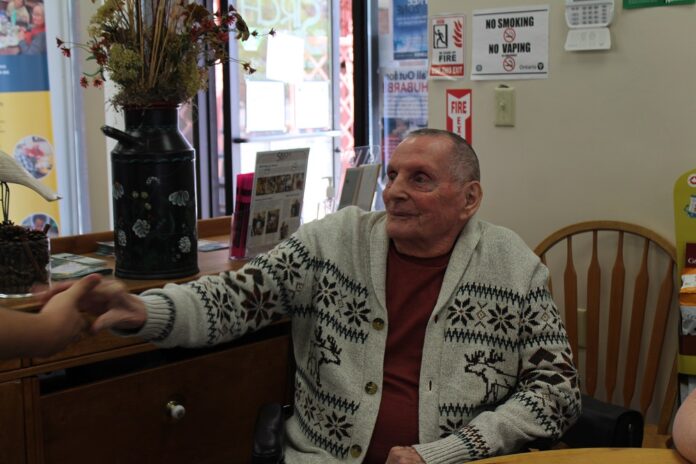
One of the County’s last remaining Second World War veterans, Harold ‘Rowdy’ Rowden passed away Jan. 14, just three months shy of his 100th birthday. The veteran had spent the past three years living at the Gardens of Haliburton retirement residence after a long life that involved a lengthy tour of Europe with the Canadian Armed Forces as a teenager and stints living in the Highlands, Toronto, and on both the west and east coasts.

“Dad always liked to keep busy. He worked and travelled around a lot, especially once he and my mom split and he left Haliburton County,” Gary said.

His return in 2020, just prior to the COVID19 pandemic, was a big deal for the entire Rowden family, Gary said. Its patriarch was home.

Some of the best memories he has of his dad were made in the years since. Gary recalls how every weekend his dad would join him at the cottage for a catchup – and a beer.

“We’d have some laughs out there – he had his license until last year, so he would drive himself over and stay for a while. He always made sure to only have one beer so he could drive himself back to Haliburton,” Gary said. “For the last year or so, my sister [Gail] and I would take it in turns to pick him up and take him out for a drive, or to do something, a couple times a week. He always liked us doing that.”

Rowden was fiercely proud of his military service, Gary said. Serving with the 3rd Division of the 13th Field Regiment during the Second World War, ‘Rowdy’ was there the day members of the Canadian military went where no Allied soldier had gone before, pushing the Nazis out of their beachfront strongholds, and sending them into retreat.

Harold was 15 when he signed up for the war effort. He spent years training at various sites across Canada and the UK, though was in Portsmouth, England on that fateful day, June 6, 1944. The Normandy landings, particularly the Canadian affront on Juno Beach, have long been considered the catalyst for the Allies’ eventual victory.

Rowden shared his story with The Highlander for a piece in the lead up to Remembrance Day in 2021. He told how, as a dispatch rider, it was his job to collect messages from one command point and deliver them to another. It was dangerous work – his orders were often top secret.

After emerging from the wreckage of Juno Beach, Rowden saved lives while treating wounds during a fight with the Nazis in a small French town, Courseulles-sur-Mer, and saw action in the Battle for Caen. He was injured during intense enemy shelling in Caen, sent to the UK to recover and discharged once the war was won.

Once back in Canada, he met and married Nellie Miscio. He moved to Haliburton and took a job at Carnarvon Lumber, where he worked for years while he and Nellie raised their nine children. After they split, Rowden moved to the city, where he spent years working as a mechanic and, later, a truck driver. He retired to Orillia in 1990, living there for almost three decades.

After moving to the Highlands, Rowden became a member of the Haliburton Legion. Its president, Mike Waller, said ‘Rowdy’ was always in good spirits when visiting the branch.

“He was very forthcoming, always made time to chat. He was very generous that way,” Waller said. “He was a fun guy. He had some good stories – he’d always have people laughing when he came in.”

Waller said Rowden would visit the legion once a week. While he didn’t like to talk about his experiences during the war, ‘Rowdy’ was a central figure at the Haliburton Remembrance Day services the past four years.

“He always made himself available for things like that. Remembrance Day was a big deal for him. He didn’t like it when you made a big deal of him though – I remember former president Don Pitman saying to him, ‘you’re a real hero’ and ‘Rowdy’ would reply ‘no, the only heroes are the boys we left behind’,” Waller said. “He was very humble about his service.”

Gary said he’d miss seeing and spending time with his dad, but noted he has many lessons to remember him by.

“He always used to say to me ‘if a man’s word is no good, then he’s no good’. Those are good words to live by, it’s basically how he lived his life. Just be true to your word and be honest – those are the main things I learned from him,” Gary said. “I’ll miss him, but he lived a long, happy life.”

Per Rowden’s wishes, there will be no visitation or funeral service. Donations can be made to the Orillia or Haliburton legions in his honour.

Better public toilets one MH budget ask

0

The public and councillors received an overview of the draft Minden Hills budget Jan. 18 – with a starting point of a 9.41 per cent tax levy increase over 2023.

Factoring in assessment growth, it equates to a 7.81 per cent hike, CAO Cynthia Fletcher and treasurer Greg Bedard told council.

A little over a third (35 per cent) would go to wages and benefits; 33 per cent for materials, supplies and operating costs; 12 per cent for policing; nine per cent for contribution to other funds, such as cemetery and capital; six per cent for debt servicing and five per cent to reserves.

Fletcher said the capital budget includes investments to improve roads, public safety, regulatory compliance and accessibility.

“Council, staff and the public spend a great deal of time and consideration in developing a budget that provides necessary services to residents, businesses and visitors,” she added.

Bedard said the typical single-family home in Minden Hills has an assessed value of $209,000. This property would see a $68.56 increase if the draft went unchanged. The typical seasonal recreational dwelling has an assessed value of $316,000 and would see a $103.66 increase. The impact on $100,000 of residential assessment is $32.81.

Property owners contribute 72 per cent of the cost of running Minden Hills, while grants are 15 per cent, penalties, interest and other revenues seven per cent and six per cent in user fees.

Bedard said government grants had dropped this year by about $60,000. It’s anticipated tipping fees, building bylaw and planning department fees will be less, while recreation centre revenues should increase.

He said inflation and supply chain issues are impacting the budget. For example, he’s seeking 4.8 per cent more for fuel costs, and additional financing is needed for vehicles, utilities and insurance.

Staff are proposing a new ditching program. Bedard said, “many township roads do not have adequate ditches, and this hinders water from draining properly. The lack of proper ditching results in washouts, poor driving surfaces, and increased operational costs to repair.” The proposed drainage program will focus on improving ditches and water drainage, with a specific focus on roads identified for resurfacing in the following calendar year.

The costs associated with operating landfills and transfer stations have increased. Policing costs are up as well.

The draft calls for transferring $867,460 to reserves. Debt servicing costs are headed north, projected to increase to $1.2 million in 2025.

Bedard said the township is looking to use just shy of $1.2m in reserves, $2.255m in loans; about $383,00 in grants and $859,500 in taxation.

Staff are further proposing a two per cent water rate increase and three per cent wastewater hike.

The biggest ticket items are $1.5 million for the construction of the Scotch Line transfer station and nearly $1.4 million for road resurfacing. Council will resume budget talks in February and hopes to finalize the document March 5.

Public input

Only three people spoke at the public meeting.

Jim and Bernie Davis talked about the need for better public washrooms.

“There continues to be a problem with the lack of facilities for the public in our community,” Jim said. “I am here hoping that the township can find some funding to improve our public washrooms, especially as we are an aging population and it is becoming more and more of an issue.” However, he said it would benefit young families, too, and keep people downtown.

Bernie said they could look to Bracebridge as an example.

Mayor Bob Carter said public washroom companies present new concepts and ideas at the ROMA and AMO conferences.

“I would agree with you that there is something that needs to be done.”

Bill Blakes said he believes there is a problem with the township’s water billing system. He claims readings are being taken eight to 14 days before the beginning of the billing cycle, and sometimes four to eight days after. “That meant during the summer… we were getting billed for an extra 14 to 15 days, which we already paid for in the last bill, and which we would pay for in the next bill.” He said the issue has been going on for years.

Carter said, “I know this has been a problem for some time that I’ve been on council and it’s something that we have to do better with and we will.”

Ingram: ‘what does tourism look like?’

0

There’s a familiar face in former County CAO Mike Rutter’s office, as Angelica Ingram takes over as the Highlands’ new tourism manager.

Many would know Ingram as a reporter with the Haliburton Echo and Minden Times until 2018. She went on to work for SIRCH and the Haliburton BIA while raising her two young girls with husband, Chad.

Now that the kids are in school, Ingram said it was the perfect time to return to full-time work, and she couldn’t pass up applying for the tourism job when she saw it advertised.

Born and raised in Richmond Hill, Ingram got her first taste of cottage country working as a summer student for a newspaper in Muskoka.

“I loved it. There were a lot of feel-good stories about small town living and tourism. It was a great job.”

She returned to the city, found a corporate gig, but was not happy. Then the Echo and Times job was posted. She got a reporting position in the fall of 2009, thinking she’d spend a year, pad her resume, and move on.

“That was 14 years ago,” Ingram says with a laugh.

She said in Richmond Hill, she could not name 20 people she knew. However, “within a year or two of living in Haliburton, I had a community. That really kept me in the area. People knew their neighbours. People looked out for each other.”

SIRCH allowed Ingram to hone her marketing skills and get a handle on the clientele serviced by the agency. The BIA fulfilled her interest in economic development and downtown beautification.

Some have questioned her experience for a tourism manager, but Ingram said, “you could have a very qualified individual, but you can’t make them know or fall in love with the area. If you don’t have a passion for the area, it’s really hard to market it.

“How do you get people to come up for experiences or book accommodations or go to restaurants if you yourself are not enthusiastic about the restaurants or the accommodations or experiences up here?”

She added she told her interviewers, “you can teach me things, but you can’t teach me where you can find the best food, the best lunch spot, or things like that.”

Ingram added it is the landscape that is the major drawcard to the County, which is why protecting the local climate is paramount.

“That’s why environmental groups are important because we need to keep all of that protected and intact and as pristine as possible because (otherwise) people aren’t going to want to come up here.”

Ingram feels blessed to have followed in the footsteps of, first, Amanda Virtanen, and then Tracie Bertrand. She already has a blueprint for the job. She has Thom Lambert and Eric Casper to draw on.

“There’s been some really great work done in the last 10 years,” she says of branding, social media, websites, and collaboration.

She will continue to work towards making the County a year-round destination, not just a summer one, pointing out how the Hike Haliburton winter festival is growing, and they will continue to endeavour to get more shoulder season visitors.

She said she and Lambert are discussing marketing the area as a place to rejuvenate. “There’s some really neat stuff happening and I think that’s another area that we could pursue and expand.

“I think I’m coming into the role at a really great time. I just want to build on a lot of what Amanda and Tracie have begun. I don’t need to reinvent the wheel. We’ll look to other areas to see what they are doing well.”

She said the key is pivoting, a lesson learned from COVID.

She noted climate change is bringing changed winter conditions and providers cannot always rely on tourism opportunities of the past.

“Stakeholders have to get involved because their livelihood can’t just be based on a six-week season.”

Ingram said her department is asking, “what does tourism look like? Does it look like a wellness, holistic, retreat type of thing? I think that’s something that’s definitely going to be top of mind for the next couple of years.”

They are also discussing sustainability. “Does this area want more visitors or does it want someone who comes and stays longer? We have to think about all that. What’s our long-term goal?

She added she also brings a “young family, kid perspective” to the job.

“There are so many great events for young kids and for families, but what’s missing and what more do we need? What can we promote more?”

Townships, County receive provincial windfall

0

Municipalities across Haliburton County are splitting just over $1.1 million in provincial money from the Ontario Community Infrastructure Fund.

Haliburton-Kawartha Lakes-Brock MPP Laurie Scott announced Dec. 11 the taxpayer money is to help renew and rehabilitate critical infrastructure across the Highlands.

“Together, we are building a foundation for a prosperous future by fostering economic growth and creating more jobs within the region by improving roads, bridges, water and wastewater systems,” Scott said.

The County of Haliburton received around 40 per cent of the funds, taking in $455,416. CAO Greg Dyke said the money will be used to offset the cost of repairing and upgrading bridges and large culverts. He noted the upper-tier council was in the process of identifying specific projects the funds will be allocated to via the 2024 capital budget.

Dysart et al will receive $288,155, Minden Hills $163,996, and Algonquin Highlands and Highlands East each $100,000. The CAOs of each township noted the money will be allocated for projects during 2024 budget deliberations.

OCIF provides funding for local infrastructure projects in communities with less than 100,000 residents, as well as all rural and northern communities. Funding allocations are based on a formula that considers the different needs and economic conditions of each community, Scott said.

In 2024, the government is allocating approximately $400 million in OCIF funds to 425 communities. Scott noted communities may accumulate funds for up to five years to address larger infrastructure projects

Decision on health unit merger looming

0

Dr. Natalie Bocking, chief medical officer of health with the Haliburton, Kawartha, Pine Ridge district health unit, said a decision over a potential amalgamation with Peterborough Public Health will be made in the next six weeks.

Speaking at a HKPR board meeting Jan. 18, Bocking said a draft report by consultant, Tony Yu and his firm Sense & Nous, will be presented to a joint board of health working group next week. Presentations will then be made to the HKPR board Feb. 5 and to the PPH board Feb. 6.

Local board of health members will discuss further at a Feb. 15 meeting, which will include officials from the Ministry of Health, Bocking said.

“We have scheduled a series of meetings that will hopefully bring the board to a point where it can make a decision by the end of February,” Bocking said, noting the province is accepting business cases for voluntary amalgamations until April 2.

Last August, the Ford government said it would provide funding to health units that want to merge as part of a provincial approach to clarify roles and responsibilities of public health. This follows a 2019 move to download more costs of public health care delivery to municipalities – with the province lowering its funding contribution from 75 per cent to 70 per cent.

Bocking said the consultants recently completed HKPR staff consultation, providing local feedback on any possible amalgamation. Several concerns were outlined, she said, including a fear relationships between public health and the community would get watered down with a larger organization.

There was also concern expressed about the leadership of a new, larger health unit, given Bocking and Thomas Piggott, PPH medical officer of health, are relatively new to their roles. Bocking joined HKPR in April 2021, with Piggott taking on his role in December 2021.

“[Comments received] suggests there has been a considerably positive culture shift at the respective organizations,” Bocking said, noting staff didn’t want to see any regression on that front.

Staff also asked questions about job security, what implications amalgamation would have on existing collective bargaining agreements, how additional work travel due to having a larger coverage zone would be handled, and what would happen if the boards decided against coming together.

Bocking said there has been considerable consultation with Curve Lake and Hiawatha First Nations, which have agreements for public health delivery with PPH, on how any amalgamation may impact them.

“We’ve had good discussions. What came through to me is the importance of not losing local connections in any merger… what works in urban Peterborough may not work in Haliburton County,” Bocking said.

Yu noted his team has put together a merger feasibility report that identifies how amalgamation will impact HKPR across all departments. The report also considers potential benefits of the merger.

“Based on our experience… any merger is possible, it just depends on how much effort you’re willing to invest, how much pain you’re willing to go through to see this through,” Yu said. “As a board of health, you need to think about not only the costs, but what are the possibilities that can be brought forward.”

Bocking said while a decision will likely be made by the end of next month, any merger is likely to be a long process.

“Once our board makes a decision, it has to go to the Ministry of Health for approval. That’s not going to happen right away. Even after we put a business case together, there will be an air of uncertainty because we don’t know 100 per cent if they’ll approve it,” she said, explaining there are no timeframes in place.

Cec Ryall, who represents Haliburton County on the board, asked how big a merged board of HKPR and PPH representatives would be. HKPR currently has seven representatives, while PPH has 13.

“Will every community, every Indigenous group be represented? If it becomes 20 people, how will that work? No decision is going to be made with a board that size,” Ryall said. “Haliburton County is one of the smallest municipalities (in HKPR). How are we going to be protected (to ensure we have a voice).”

Bocking said the makeup of a combined board would be discussed should both health units agree to a merger.

‘Tis the season

Bocking provided an update on the 2023/24 respiratory season, noting numbers are down this year and more in line with pre-pandemic levels.

She said there have been 44 COVID outbreaks in HKPR, resulting in 28 hospital admissions and 17 deaths. There has also been 111 confirmed cases of influenza, resulting in seven hospital admissions.

“While we’re not seeing waves of COVID the same way we did before, we’re still seeing illness associated with COVID,” Bocking said. “There’s a desire from all of us to pretend it’s behind us. It’s not… the new normal is COVID is part of the mix of respiratory viruses in our communities.”

HKPR chief medical officer of health Dr. Natalie Bocking said a decision on local health unit amalgamation.

Dysart reduces farmers market ask

0

Dysart et al council has reduced its financial ask from the Haliburton farmers market to return to Head Lake Park, although market officials remain unconvinced.

At a Jan. 23 meeting, mayor Murray Fearrey said he and his council want to maintain a farmers market in the village, but are adamant the Haliburton County Farmers Market Association (HCFMA) should pay if they want it back in Head Lake Park.

The event was held at the downtown park for 11 years before being moved to nearby Rotary Beach Park last season.

Brian Nash, of the HCFMA board, said the relocation was not well received, by vendors or the public. Attendance was down approximately 30 per cent while some merchants opted not to move.

The association has stated it will not return to Rotary Beach this season, previously telling The Highlander there likely won’t be a market in Haliburton unless it’s returned to Head Lake Park. Dysart’s latest offer is for the HCFMA to pay approximately $4,200 to run the upcoming season at the site, based on having 40 vendors for 21 events.

Fearrey said, “we have arrived at $5 per [vendor] for each market event. So, if in May you have 12 vendors, that would cost $60 to run. If it’s July and you have 40 vendors, that would be $200. If there’s bad weather, or you decide not to run a market, there wouldn’t be [any charge]. That’s a substantial difference financially to what we proposed before.”

Farmers remain unconvinced

In December, the mayor suggested charging the association $1,000 for each market during the “busy” summer months – July, August and September – with a $700 fee applied for any other month, for a total cost of around $15,000. That was then lowered to a flat rate $1,000 per month to run events in July, August and September, and $700 in May, June and October, totaling $5,100.

“We have a lot of money to spend on the park. Nobody is trying to take advantage of the farmers,” Fearrey said, noting township staff often had to carry out repairs at the park after market events.

In a letter to council, the association replied, “we take exception to your suggestion the market causes such extensive damage… to justify a $5,100 (now $4,200) annual damage fee… while we are aware of the odd tire track on very rainy days, or perhaps damage to sprinklers, we have no knowledge of any ‘significant’ damage we have ever caused.”

Nash said the board has offered, in the past, to reimburse the municipality for any landscaping work, but claims they were told the issues “were an easy fix” by parks and recreation staff.

Nash said the board has asked the township for records highlighting any major damages. The Highlander has made a similar request, though no evidence has been provided.

HCFMA board member Angel Taylor said the association does not have the money and would have to download on market vendors. She estimated it would represent a more than 25 per cent increase. It was noted merchants pay $400 per season – not the $300 previously quoted. An increase would bring that to $505.

Nash said an email will be going out to existing vendors this week to see if they would return under the proposed conditions.

“This is likely to drive away some of our smaller agricultural vendors. Farmers Market of Ontario requirements state to be designated as a farmers market you need to have half plus one of your vendors agricultural. Our numbers are pretty borderline… if we lose three vendors, our numbers will likely fall below that requirement and we wouldn’t be able to have a market anyway,” Nash said.

He maintained he doesn’t feel the association should have to pay, pointing to events such as the boat races, or Art in the Park, which are not charged.

Fearrey previously stated council will consider implementing fees for other events on a case-by-case basis. He noted many of the organizations that use the park make other contributions to the community, such as the boat races donating annually to Haliburton Highlands Health Services.

Nash said the farmers market also gives back. “We bring 15,000 people to town. We also provide financial support to good causes – we’ve given about $5,000 to Places for People over the years.

“It seems they just want to get money to use that site. OK, I get that, but let’s be honest about it. It’s not really about damages, because we don’t have any evidence of damages. This seems totally discretionary. It seems like there’s [an agenda] against us.”

Nash said the board will likely have an answer by next week as to whether vendors are willing to absorb the cost. If not, they will be going back to council. Fearrey indicated the township was open to further negotiation.

“If you shed light on something that changes our mind, we may change our mind… we can have another discussion,” Fearrey said.