Home Blog Page 389

Left to Tell – Part 11: Lost equipment

0

By Mabel Brannigan

The train left Haliburton at 5 a.m. and if you were going to Toronto, you had to be on it.

On this particular morning, I was returning to Western Canada after a furlough.

When I got on, I saw Maurice, an old school chum. He told me it was his last leave and the boys had given him a party and put him on the train. Knowing the kind of party it had been, I asked “where is your gun and duffle bag?”

“I don’t know, I’ve lost everything,”

“Well, you stay in your seat, and I’ll look from them,” I said. I came back with the gun and duffle bag. I said, “don’t lose this again. You know what will happen to you if you show up with no equipment.”

He was to stay overnight in Toronto at his sister Lilly’s before catching a train for Halifax. I think he must have had a bottle on the way to Toronto. When we arrived, I could see he was in no condition to be left alone. I looked for a pay phone to call Lilly to come for him. Then I took his gun and put it in a locker and put the key in his pocket, along with a note. I had to catch my train or I would be in big trouble if I missed it. No excuses.

Apparently, next morning Lilly asked Maurice, “don’t you have luggage?”

“I have lost it.”

She scolded him and said, “well, give me your pants and I’ll press them.”

That’s when she found my note. Well, she got him in to get his equipment and on the train to Halifax. He said, “oh yeah, I remember Mabel taking my gun and duffel bag.”

I never saw Maurice until after the war. The Township of Stanhope held a Veterans Day at Matabanick Inn. Maurice and I were there. It was good to see the others. But it was hard to celebrate victory when we were saddened by our comrades who had died, five of our chums from Maple Lake.

Every Remembrance Day at the Legion, Maurice told this story. When he couldn’t go anymore, I phoned him on Remembrance Day, and he laughed and reminded me of losing his gun, and what would have happened to him if I hadn’t been there. When he died, the Minden Legion was open, and I attended his funeral.

Do you have any war stories of your relatives from Haliburton County? If so, please share them with us at mabelhewitt@ icloud.com.

Arena costs creeping towards $13 million

0

The new arena and community centre in Minden will have a refurbished canteen as councillors continue to slowly make decisions about so-called value-added-items at the $12.7-million facility that is now nearing completion.

During a special council meeting Sept. 17, they gave the green light to four new additions: signage, lobby furniture, fitness room access control and refurbishment of the canteen.

CAO Trisha McKibbin had 19 items in a detailed report. A number of them were removed, such as cleaning supplies and equipment, as they would classify as normal township operating costs. Others were shifted to the fundraising committee, in hopes they can get some community donations.

As for an eating option in the new facility, Coun. Pam Sayne said she was in “total support” of having a canteen, whether the township eventually runs it or a third-party contractor does.

Coun. Jean Neville was in agreement, saying decision-making around the arena’s add-ons had dragged on too long. She said they needed a canteen regardless of who runs it. “Without a canteen, it doesn’t work for me.”

Deputy Mayor Lisa Schell also spoke in favour and the council direction was noted.

McKibbin said she had sought out quotes and estimated the work at $40,000.

As for lobby furniture, Neville added, “we’ve got to get the place furnished.” McKibbin has estimated a price tag of $14,000.

Coun. Bob Carter noted they would need fitness room access control as soon as equipment was installed, especially during a pandemic. He said once they get the equipment in, it needs to be protected and they don’t want unauthorized people in the room. That will cost the township about a further $7,000.

Signage was also approved at an upset limit of about $14,000.

Early on in discussions, some councillors, such as Carter and Jennifer Hughey, said they would want more details before voting on whether to say yes or no to some items.

“We have to understand what we’re agreeing to with all these things because money is money,” Carter said.

Hughey added, “I’m not comfortable voting on anything with numbers that are questionable or potentially incorrect.”

She suggested they make decisions on what they could to be productive on the day.

McKibbin said council also had to provide direction on where the money would come from.

Mayor Brent Devolin suggested from surplus or reserves.

Sayne said, “we look at some of the great ways that we’ve seen other places raise money and get community involvement, such as the youth hub … I think if we can rely on some of that local support these numbers would stay down much lower so we try to do these locally as well.”

Coun. Hughey, who is the council liaison on the fundraising committee, expressed some frustration saying the committee had not been able to meet yet due to COVID-19 restrictions and the township’s inability to provide a venue for electronic committee meetings.

Carter was adamant the money should come from reserves, not the surplus. “Everything else that’s part of this building should be assimilated as part of the building and we don’t go into the surplus. The surplus we have, and we have to decide what to do with it, I just don’t want to think it’s a pot, a piggybank we can go and spend that money. If this is legitimately part of the project it should be accounted for as part of the project so we know what the total cost of this is.”

Coun. Neville questioned debenturing, due to low borrowing interest rates. “This amount of money is not going to be significant in the very big picture,” she said.

However, Devolin said they would have to research what items on the list can be debentured.

The original budget for the project was $12,494,570. An additional $250,000 was approved by council in December 2019, increasing the budget to $12,744,570. McKibbin said contractors’ MBC have advised that, based on completed tenders and items that remain outstanding, a project surplus is unlikely. The list of value-added items, if all funded by the township, [of which some will come from Ontario Trillium Founation grants of $150,000] would have added another $518,793. However, council has so far approved just $75,000 of that. A follow-up report will come back to council.

Minden to get $6.8 million affordable housing development

0

Minden is getting 30 new affordable housing rental units thanks to a public-private partnership between a long-time cottager and the Kawartha Lakes-Haliburton Housing Corporation.

Corporation CEO, Hope Lee made a presentation to Minden Hills council’s Sept. 24 meeting. The private landowner is Bill Switzer, who did not appear during the Zoom meeting. Tim Welch, of Welch and Associates, joined Lee. They are the development consultant assisting with the project.

Lee said KLH’s newest development plan in Minden “is a particularly exciting project for KLH Housing as it will become our first public-private partnership.”

She added that KLH and Switzer, of F.W. Gwillim, hope it becomes a model for other housing in Haliburton County.

The units will be in 15, two-bedroom, duplexes. They are going on a vacant parcel of land on the west side of Highway 35 at County Road 21, between Rotary Park and the Minden Legion overlooking the Gull River. Lee said the accessible units will be approximately 800-square-feet. Each will have parking out front.

“So, this project will nestle nicely into the area with the Gull River as a boundary. The area provides a number of amenities, including Rotary Park and the grocery store.”

“The townhouses will provide 30 units towards the affordable housing targets,” she said. The Coaliton has set a goal of creating 750 new units in a 10-year-period.

Ten of the units will be at 80 per cent of affordable rent, and 20 at 100 per cent. According to this year’s affordable rents, 80 per cent is $980, and 100 per cent $1200-a-month with all utilities included.

Hope added they would be approaching the County of Haliburton “looking for rent supplements to make some of the units even more affordable for those with the lowest income.”

All in, she said the capital cost of the development is $6.8M

“It’s important to highlight the significant contribution of Mr. Switzer towards this project,” she said. “Without his support, including the land, this project would not be possible or considered. A long-time seasonal resident of the County, Mr. Switzer has owned this parcel of land for many years. This project is not only his dream for the land but his way to give back to this community.”

She said Switzer would be involved in the development of the project, but it would then be transferred to the corporation, which will become the owner and operator.

She said they had secured funding from the Canada Mortgage and Housing Corporation and would be applying for co-investment funding from the CMHC.

She asked for the township’s planning help, including official plan amendment, rezoning, donation of a road allowance, site plan approvals, relief from fees and charges and waiving of securities. Council unanimously consented.

“While we realize this property wasn’t necessarily considered in the past for residential development, we hope that you will agree with us that it is possible and will meet a significant need,” Lee said.

She said official plan and rezoning paperwork is with the township and they’ve completed topographical and geotechnical studies to confirm suitability of where they are placing the units on the site. They are just waiting on a traffic study.

If all goes according to plan, construction would begin in April 2021 and people move in, in the spring of 2022.

Coun. Bob Carter, who’s on the housing task force, said they’d been involved since 2018 and, “we’re really excited to see it come to fruition.” He said he’d spoken to some of the neighbours, and other groups within the municipality, and, “for the most part, right across the whole township, people are excited about this project.”

Coun. Pam Sayne, who is also on the housing task force, said she likes the fact it’s mixed income development.

Mayor Brent Devolin said the public-private partnership model “is potentially an answer to some of the challenges” that the County has had with affordable housing residential development in the past.

Coun. Ron Nesbitt added, “Minden deserves this and needs this.”

Haliburton Legion decorates veterans’ graves

0
Retired OPP Const. Val Jarvis carried a flag as part of a colour party for the Haliburton Legion’s Decoration Day ceremony Sept. 21. Photo by Joseph Quigley.

The Royal Canadian Legion Branch 129 Haliburton honoured the sacrifices of local veterans despite the pandemic with its second annual Veterans Decoration Day service Sept. 21.

Members of the legion, the Haliburton Legion’s Ladies Auxiliary and the Haliburton and District Lions Club attended the St. Anthony Cemetery and Evergreen Cemetery to place crosses at the graves of veterans. The pandemic meant that members of the public, including veterans’ families and high school students who placed the crosses previously, could not attend.

Public relations officer Linda Heeps said she would have liked to have the public involved.

“We couldn’t have the public, which is saddening because many family members put their own (crosses),” Heeps said. “We have to live within the rules.”

Attendees laid approximately 180 crosses, which will remain in place until Sept. 27. A small service was held, featuring a colour party and prayers by Reverend Garry Swagerman.

Heeps said it was important to recognize veterans’ sacrifices despite the pandemic.

“I can’t even imaging going to war. I couldn’t even imagine how awful it is,” she said. “If we can honour them once a year, it’s not too much to ask.”

Remembrance Day events cancelled

The pandemic is also hitting legions’ Remembrance Day ceremonies, with Haliburton legion president Paul Sisson announcing there will be no local event by order of Ontario Command. Instead, the legion will have a service with a small number of members laying wreaths at the cenotaph on behalf of people who request them.

“I don’t think that the veterans are getting the recognition that they deserve by not having people attending the ceremony,” Sisson said. “COVID-19, it certainly has made a lot of changes in lifestyle.”

The order applies to all legions across the province, though small services will happen. The Royal Canadian Legion is also doing a Facebook Live stream of the national Remembrance Day ceremony.

“There’s no way we can fit it in with COVID. We might have tried to put together a plan being a small community, but it came down from Dominion Command,” Heeps said. “It’s sad because it’s a real highlight of our community.”

Part 10: Prisoner of War

0
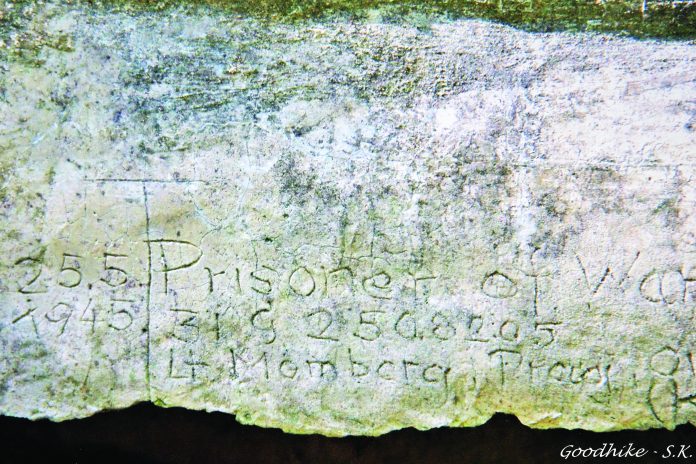
A note from a prisoner of war in the Second World War. Flickr.

By Mabel Brannigan

Merrill Bailey was one of the prisoners of war from Haliburton and this is in Merrill’s own words.

“I joined the RCAF in December, 1940, and my first billet was Manning Pool, The Coliseum Building in the CNE grounds. My next stop was in Kingston on thence back to Toronto to the Eglington Hunt Club buildings on Avenue Road. From there, I was transferred to Malton Airport (now Pearson International Airport) and began my flying training on Tiger Moths with my cousin as instructor. As I was being trained as a bomber pilot, I was sent to Brantford on twin-engine Ansons. It was there that I obtained my wings as a pilot in August 1941.

In the same month, I married Muriel Johnston, and thence overseas, arriving in England on Sept. 1. After training at Wellesbourne, Warwickshire on Wellington bombers, I transferred to Water Beach, converting to four-engine Stirling bombers. From there, I was sent to Oakington (near Cambridge) No. 7 Squadron, a Royal Air Force unit. There, we began our night bombing operations over enemy territory. After several operations, about 19, on July 1, 1942, our luck ran out. We were caught in searchlights over the target with a steady stream of anti-aircraft fire directed our way. Taking frantic evasive action, I managed to escape the target area, although we had taken several hits. One engine was out of commission and the hydraulic system controlling the guns was also a casualty.

Crossing the coast, we sustained another burst of fire. Suspecting a German night fighter, I dived beneath the clouds and proceeded over the North Sea at a low level.

The engineer then reported the gauges indicated a fire and that we were running out of fuel in the wing and that had been hit. The situation was getting desperate when we flew over a German flak ship. They opened fire on us and we crashed into the sea. Two gunners and I survived and the other five crew members were killed. The crew of the flack ship picked the three of us up and we were prisoners of war in Silesea in eastern Germany near the Polish and Czech borders. This area now belongs to Poland.

This camp held thousands of prisoners and many more thousands were away from camp on work parties. Our flying suits and boots were confiscated to be put to use on the Russian front. We were issued wooden clogs, mine being about four sizes too big having to be tied on to keep from falling off. There were 200 in our end with broken window glass, making it cold in the winter. Breakfast was non-existent. Lunch was a few small potatoes. Supper was a hunk of coarse brown bread with the consistency of sawdust. Fortunately, we received a Red Cross food parcel occasionally which we shared. For some time, we were kept in handcuffs. Fleas were our constant companions. And bed buds. We fared better than the Japanese prisoners of war.

From this location in January, 1945, and hearing the guns booming in the distance, the Germans started us on a 600-mile march to keep us from falling into the hands of Russians. Some of us tried to escape. The Nazi sergeant pulled his pistol but just motioned to join the column.

We made our way to England and to New York with Americans. I was too sick to celebrate V.E. Day. I caught a train to Montreal and was hospitalized. My wife came to see me. After my recovery, I rejoined my father in the lumber business at Eagle Lake.”

Bad internet creates ‘countless lost economic opportunities’

0
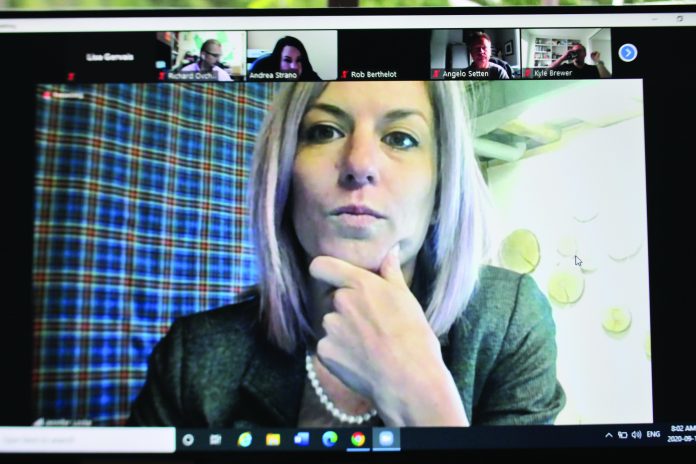
Executive director Jennifer Locke and The Haliburton Highlands Chamber of Commerce held its 59th annual AGM via Zoom Sept. 15. Photo by Lisa Gervais.

The Haliburton Highlands Chamber of Commerce “is in a good position although the future is uncertain,” executive director Jennifer Locke told the organization’s 59th annual AGM Sept. 15.

She added the positivity comes despite COVID-19 due to “savvy and adaptable entrepreneurs that make up our membership, and make up our community …”

While the AGM covered business for the 2019-2020 year, much of it before the pandemic, Locke and board president Andrea Strano referenced the health crisis throughout the meeting. “The story is what happened at the end of this term, with COVID-19 and what opportunities presented themselves,” Locke said. She added she’s constantly asking how she can best serve members and the new board will be coming together in a few weeks for its inaugural meeting, and rolling out new activities.

She encouraged members to do three micro-surveys via the Ontario Chamber of Commerce to outline their issues. In Haliburton County, she said she’s hearing, “cellular and internet infrastructure continues to be a stumbling block and has presented new challenges during COVID-19. Our system is being bogged down with loads we’ve never seen before with remote learning and working and we have multiple generations of families being affected now and countless lost economic opportunities.”

Strano said she’d witnessed acts of kindness, strength, resilience and unity during these unprecedented times and said the power of human connection and networking has never been more obvious.

She said this year, they’ll be opening new virtual channels of promotion and community building for their membership, and supporting the implementation of technology in the workplace.

“It will be a busy year and we remain committed to strengthening business and community by supporting, advocating and serving the community, and like Jennifer said, we are stronger together.”

Locke said economic recovery will come here on the backs of small business.

“The reality is, in Halburton County, if you don’t work directly or indirectly for government you likely work for a small business or enterprise. Make no mistake, small business and small enterprises [are] the economic drivers that will get our community back on its feet.”

During general business, the board bid farewell to departing members Bram Lebo, Amanda Virtanen and Stefan Bjelis and welcomed Melissa Valentini, Mark Bell and Simon Payn. Returning members are Strano, Greg Hebert, Patrick Louch, Joe Cox, Lisa Tompkins, Rob Berthelot, Emily Keller and Jennifer Morrow.


Firefighters on scene south of Carnarvon

0

BREAKING NEWS: Emergency crews are on site at a structure fire at JC Powersports Marine along Highway 35, just south of Carnarvon. There is a lot of smoke in the area but no visible flames. We will update the story Sept. 23.

Boundless revving up engines for takeoff

0
The main character, Betty. Photo by Samantha Falco

Kate Campbell’s 10-year odyssey to bring the story of Second World War female pilots to the big screen is about to land.

The short film version of Boundless is nearing completion and Campbell, from Haliburton, is in the process of shopping it out to film festivals around the world.

It’s one step in a much larger project to eventually produce a miniseries, Campbell told The Highlander in an interview. “We’ll start submitting to festivals this week, though we still may be tweaking sound and finishing the titles and credits until the end of September,” she said.

It will then begin its festival tour wherever it is accepted. Most festivals are now online due to COVID.

“It would have been nice to have had a proper in-person premiere, which we will still have when it’s safe to do so, but I’m embracing online because it’s time for the piece to get out into the world now, and because it also has the potential to be seen by more people through festivals online.” Campbell said they’ll use it as a pitch for the larger version of the project.

It’s been more than a decade of interviewing, travelling, writing and researching to get to this stage, Campbell said.

Being from from Haliburton, it was important for her to include the County in this production. Tammy Rea is one of the producers and Anabelle Craig, Joey Varga and Hannah Sadlier helped on set. The Haliburton County Folk Society and Nick Russell assisted with the soundtrack [see next week’s Highlander] and there’s been financial support from the Haliburton County Development Corporation and the Haliburton Legion.

Campbell said she’s very excited to share the film and everyone’s hard work with the world, and ready for the next Boundless adventure.

The project was inspired by her grandmother, Betty Greply (nee Ward), who became a pilot to conquer her fear of heights in the 1950s at Buttonville Airport behind her husband’s back. She

was a member of the Ninety-Nines Flying Organization, which began in 1929, and where Amelia Earhart was a president.

Dini Petty plays the older version of the lead character, Betty. The Canadian broadcast icon was the first woman in the world to pilot a helicopter while broadcasting over the radio at the age of 23.

“My grandmother and Dini flew out of Buttonville at the same time in the late 60s and early 70s,” Campbell, who is a student pilot and member of the Ninety-Nines, added.

Between 1942 and 1944, more than 1,000 female pilots flew a collective 60 million miles in service in a specialized training program to free the male pilots for battle. The program was based out of Sweetwater, Texas and was headed by famed aviatrix Jaquiline Cochran.

“As the war was ending, the women were abruptly disbanded, denied military status, shamed for taking the jobs of men returning from war, and were forced to pay their own way home,” Campbell said.

“It’s a really important untold story that was not in our history books, so being able to share this education is significant.”

Pandemic rocks Wilberforce Curling Club plans

0
The Wilberforce Curling Club has cancelled its season due to COVID-19. File photo.

The Wilberforce Curling Club has cancelled its season due to the pandemic.

In a letter to members Sept. 11, club president Gord Fitch wrote about the decision to call off their 2020/21 season entirely, the first local club to do so.

Fitch said the executive met earlier this month and decided they could not proceed given the difficulties caused by the pandemic.

“After an extensive and exhaustive debate about the potential risks and liabilities we face as a club, it was overwhelmingly decided that we can not move forward successfully and responsibly with curling this year,” Fitch said in the letter.

Curling clubs across the province have grappled with whether to proceed this season with restrictions. The neighbouring Halliburton Curling Club and Minden Curling Club both put it to membership votes, with Haliburton deciding to go ahead and Minden deciding to cancel its season for now, with plans to re-evaluate in December.

The Wilberforce club uses a municipal facility and Fitch said between regulations, limited membership dues and increased costs, the season would be severely hampered.

Other concerns included social distancing restrictions, limited social interaction and the possibility of closing mid-season due to an infection.

“As an elected executive, it is our responsibility to look out for the best interest of our membership and the financial success of our non-profit curling club,” Fitch said.

Fitch added the club would help co-ordinate, but not sponsor, some winter events to help keep people active and in shape for next season.

Fundraiser goes ahead

Meanwhile, the club and the Wilberforce FUNRaising Group are partnering to go ahead with an annual birthday calendar fundraiser to help both of their suffering coffers.

The groups are selling the custom calendars which highlight people’s birthdays, with the proceeds split between the two.

FUNraising Group member Kathy Rogers said the pandemic has curtailed their usual fundraisers, but this was one they felt they could still do. She added though the curling club is not running, they will still need funding.

“Our people are hurting too much, we need to do this,” Rogers said. “They can’t hold curling at all – it’s going to be building the club back up again.”

The calendars are $10 each and available by contacting 705-448-1285 or 705-935- 0098.

“It’s good community fun,” Rogers said. “And all the proceeds go back into the community.”

Beloved pastor remembered

0
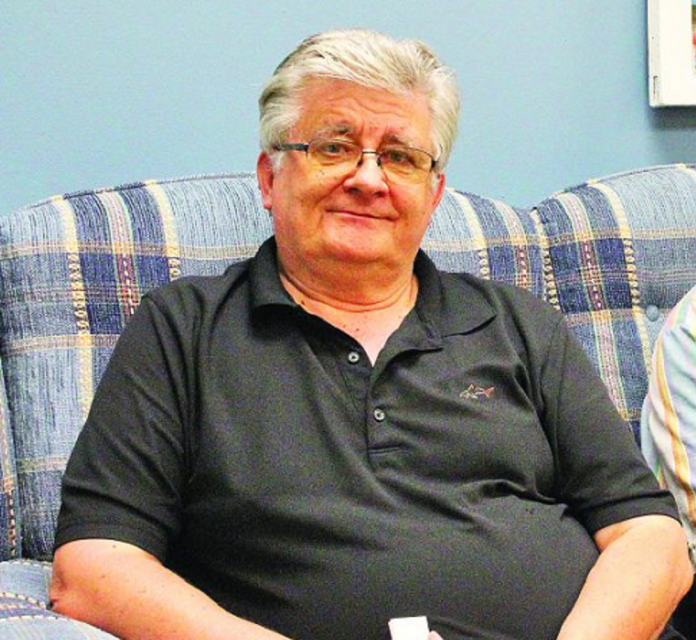
Lighthouse Pentecostal Church pastor Doug Ross was mourned by his community after passing away at the age of 65. Photo submitted.

Several days before he passed, Haliburton’s Lighthouse Pentecostal Church pastor Doug Ross was doing what he loved: sharing the word of God.

Though the pandemic meant he had to do it from a basement via live stream, he continued to reach out to his community, and they watched. His wife, Kim Ross, said he often attracted more than 100 viewers, with people tuning in from outside Haliburton.

“I’m a preacher that preaches about the love of Jesus Christ,” Ross said in his final sermon. “Sometimes people accuse me of preaching about that too much, but can you preach about the love of Christ too much? I don’t think you can.”

Ross’s family and community are mourning his loss after he died July 29 at the age of 65. The long-time pastor, businessman and school board trustee is survived by four children, 10 grandchildren and three greatgrandchildren.

Kim Ross described him as a very outgoing person who touched the lives of many people.

“Had a fantastic sense of humour. I think pretty much anywhere he went, he would just kind of brighten up,” Ross said.

Ross said her husband grew up poor, raised by a single mother. During his last sermon, the pastor described himself as a lost, “nasty person” in his youth.

“All I could think of was survival,” Ross said. “I said ‘God, there must be more to life than this. If that’s what life is really like, it’s really not worth living.’ Within a matter of two days, God sent somebody to talk to me about him and share Jesus Christ with me. Within less than a week, I gave my heart to Jesus Christ.”

That person was a pastor, Kim Ross said, who convinced the then 18-yearold to come to church, where he was moved. She said they met at a camp near his home in New Brunswick soon afterward and started a whirlwind romance.

They originally met in August and were married by February of next year as teenagers.

“We only knew each other a short time,” she said. “But we knew we wanted to spend the rest of our life together.”

The two started a family in Ontario. While Doug Ross began working as a pastor in Oshawa, he soon started selling cars. They moved to Whitby and after going through a difficult financial crunch, they got into the food business.

The family began selling peanut brittle made with an old family recipe. A successful Christmas season run at Zellers got them a recurring business. It would become Granny Williams, a confectionery manufacturing business that would go for 30 years, operating at many Zellers locations.

They also opened a café in downtown Oshawa, which Ross said was an important hotspot in the city. While selling cars, her husband also struck a friendship with famed Toronto Maple Leaf Eddie Shack. That eventually led to him owning two restaurants under the Eddie Shack’s Donuts and Snacks brand.

She said Shack would often invite Ross to hang out with other Leafs alumni at the famed Hot Stove Lounge and when pictures for autographs would go around, Shack insisted Ross sign it.

“People always wondered who this guy is,” Ross said. “There was a lot of laughs with Eddie Shack.”

Ross was also civically engaged, acting as a trustee for 12 years with the Durham District School Board. One of his colleagues, Patty Bowman, described his dedication to his constituents during Ross’s celebration of life Aug. 7. She also recounted his efforts in working through the implementation of Canada’s first modified school-year system, balancing out holidays throughout the year.

“He was tenacious about sitting down across the room … trying to figure out where we could find our common ground and he would never give up,” Bowman said. “Because when we agreed, everything shifted and moved in our communities and we saw it happen.”

His passion for pastorship remained central in his life. Kim Ross described his evangelist-style that moved a lot of people.

“He had such a love for people, and he has so much patience with people,” Ross said. “He had so much energy for life. He loved God with all his heart.”

But his health suffered with a stroke and though he survived, she said it was a difficult, year-long recovery. They chose a slower life after that, moving to Fenelon Falls and eventually Haliburton to take on pastorship at the Lighthouse Pentecostal Church in 2012.

He volunteered for various boards and the local Rotary Club. Kim Ross said he has touched the lives of so many people, with hundreds of messages flooding in recent days about all the good he did.

“It’s been a fascinating life,” Ross said. “He didn’t actually just live 64 years, he lived 80 years or more because of the amount of living that he did.”

Despite everything the pastor achieved, in his last sermon, he downplayed it compared to what was most important to him.

“I don’t think I’ve done a lot of great things in life. I’ve had some small accomplishments,” Ross said. “The most precious thing that I have in my life is that Jesus Christ loved me.”