Home Blog Page 387

Authorities investigate fatal Highlands East fire

0
The Office of the Fire Marshal investigated a fatal fire in Highlands East Oct. 15 and 16.

The Office of the Fire Marshal (OFM) is investigating a fatal home fire in Highlands East on Glamor Lake Road Oct. 15.

Haliburton Highlands OPP, the Highlands East Fire Department and Haliburton County Paramedic Services responded to the scene around 4:40 a.m. After firefighters put out the blaze, the OFM attended and fire investigations supervisor Richard Derstroff said they recovered one deceased victim from the debris later in the day.

The OFM was on scene again Oct. 16 and the cause of the blaze is still under investigation, Derstroff said.

“There was a lot of damage and a lot of information to go through,” Derstroff said. “The entire structure was into the basement, was into the foundation.”

Derstroff said three family members did make it out of the fire, but there were some injuries. He said the OFM has not had the opportunity to interview them yet.

He said OPP and the Highlands East Fire Department are co-ordinating on the case but could not provide an estimate for how long the investigation might take.

A post-mortem investigation of the victim is scheduled for Monday.

The Highlander will update this story as more information is made available.
              

Minden and Dysart volunteers knock down fire

0

No one was hurt when a cottage caught fire in Minden Hills Oct. 15.

Minden Hills fire Chief Nelson Johnson said his department responded at 4:38 p.m., arriving at a single family detached cottage on Curtiss Road in about eight minutes.  

“With four firefighters arriving with the initial group, we deployed two hose lines to contain the fire,” Johnson said.

He said the resident of the cottage was on scene, discovered the fire and reported the situation, including that there was no one in the building. 

He said his department quickly controlled the fire with the initial team while the second arriving team set up a portable pump from the lake to provide water to the fire engine.

Other firefighters started to arrive and there were 10 volunteers from Minden Hills. Johnson said they called for assistance from Dysart, so there were more than 20 volunteer firefighters to assist.

The fire was controlled by 6 p.m. and extinguished by 7 p.m. with the fire department off scene by 7.30 p.m.

 “I would like to thank the volunteers that responded to assist with the control of the structure fire. Everyone was a great help and the teamwork displayed allowed us to have the fire under control in a short time,” Johnson said.

“We also would like to thank Dysart et al fire department with their assistance during this incident. They provided a valuable service and we greatly appreciate having the resources available when needed. “

School board says bus rides not guaranteed

0
A lack of school bus drivers is putting pressure on the TLDSB. File photo.

By Kirk Winter

The Trillium Lakelands District School Board created a social media firestorm Oct. 1 by posting a message on Facebook about bus transportation for the remainder of the 2020-2021 school year.

“Due to the current shortage of qualified school bus drivers, any day we could be without a driver for your child’s bus route,” the message reads. “It is important to make alternate transportation arrangements to get your child to and from school in the event of a cancellation.”

Hundreds of outraged parents responded, detailing circumstances of families with no car or no car at home during school hours; of shift workers who would not be available for unscheduled pickups; or children who might try to walk significant distances rather than wait for parents, potentially putting themselves in danger.

The posting comes after public statements by communications officer, Sinead Fegan, and superintendent of business, Tim Ellis, who had speculated about a shortage of school bus drivers and what impact it might have on the transportation system in mid-September.

As early as 2016, Unifor, which represents most of the unionized bus drivers in Ontario, went on record calling the way school boards procure transportation as “deeply flawed” and “a race to the bottom.”

Unifor argues that the request for proposals process leads to constant instability and contract flipping as school bus companies try to outbid each other. This has led to a precarious industry offering few rewards for drivers and little stability for parents, they say.

The pandemic has only worsened the working conditions for drivers as they are now expected to sanitize buses between runs. Unifor says that pay as “miserly” as $60 a day, with no pay for professional activity days or school holidays, is not nearly enough for often elderly drivers to risk exposure to the COVID-19 virus on a daily basis.

Local parents and drivers have also taken to social media to voice their concerns about buses travelling at pre-pandemic capacities.

“Our buses are loaded as they normally would be prior to COVID-19,” Fegan told The Highlander via e-mail.

Debbie Montgomery, president of Unifor Local 4268 and a bus driver for more than three decades said, “The Ontario government has also failed to make driver retention bonus cheques available to qualified school bus drivers from 2019. The payment is given to drivers with near perfect attendance as a payout of $1,000 for the period of September 2019 through December 2019 with payment due March 2020,” she said.

“The next payment period which ran from January 2020 thru to June 2020 was interrupted when schools closed in March. The program administrators have not communicated to the drivers if they will receive pay for either of these periods,” Montgomery said.

Unifor said many drivers rely on the Driver Retention Program to help make ends meet. Without those twice a year bonus payments, they say more drivers have left the industry, contributing to the shortage of school bus drivers, only made worse by the onset of a pandemic.

HCDC celebrates business success amidst pandemic

0
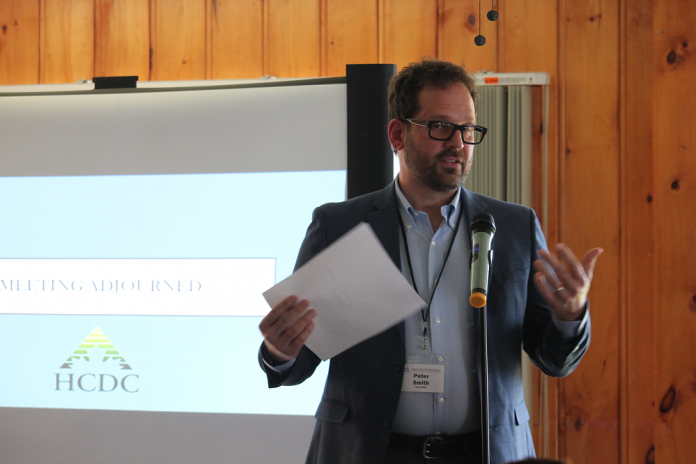
Board chair Peter Smith pictured at the 2019 AGM. File photo.

The Haliburton County Development Corporation (HCDC) reflected on its successes and the helping hand they gave businesses amidst the pandemic at its 35th annual general meeting Oct. 7.

The organization met via Zoom and highlighted all the support provided to businesses this year, including $932,500 through its COVID loans program and $994,889 distributed through the federal Regional Relief and Recovery Fund (RRRF). It also spotlighted its more usual assistance for the year ending March 31, including $55,000 through its Local Initiatives Program and two new businesses launched via its incubator.

Chair Peter Smith expressed his gratitude to his board, staff, and organizational partners including all levels of government.

“Despite COVID perhaps being an opportunity … where we don’t feel we’re in the driver’s seat, I remember people getting together with a single focus and just working together,” Smith said. “We owe a great deal of thanks to everyone who has participated, small and large.”

The corporation has continued to support businesses throughout the pandemic, with more to come. It will distribute another $560,000 through the second round of the RRRF.

Tim Degeer of auditor Dawson Gray said the organization’s annual audit was seamless, even with COVID-19.

“Want to congratulate your organization on an outstanding year and thank you for acting swiftly when the pandemic did strike,” he said. “It’s certainly something that’s noted and appreciated in the community.”

Program and operations co-ordinator Autumn Wilson highlighted the Haliburton Guitar Studio for the organization’s success story. The business owned by Nick Russell started at HCDC’s business incubator in 2018, starting part-time and going fulltime in a year. Wilson said the studio now has 30 students and has kept going in the pandemic, offering additional online services. The Community Futures Network of Canada also selected it as Ontario’s success story for its annual report.

“Nick and his business have become a staple in our community and an incredible story of hard work, resilience, authenticity and kindness,” Wilson said.

Warden Liz Danielsen attended and offered congratulations to HCDC.

“Your assistance to local business and not-for-profit organizations is unparalleled and does so much to help the economy here in the Highlands, particularly during these challenging times,” Danielsen said. “It is my hope that the County will move ahead in the near future with an economic development portfolio.”

“I do want to thank, at this time, the staff for their continued professionalism,” Smith said. “This has made this entire experience a positive one.”

Highlands real estate booms during pandemic

0

By Lisa Gervais

As a second wave of COVID-19 hits urban Ontario, Haliburton County’s real estate industry continues to boom with buyers wanting space outside of cities.

It’s a trend that has seen realtors reporting record summers with indications the fall will be just as brisk.

“It was a pretty slow start to the year but as the months progressed, the real estate market in Haliburton became busier and busier,” said Linda Baumgartner, broker of record with RE/MAX Professionals North. “It has been the busiest summer I have experienced in the 32 years I’ve been in the business.”

Anthony vanLieshout, broker of record with Royal LePage Lakes of Haliburton, added that in his 35 years, “this is as good as it’s got from a seller’s perspective.”

Hilary Morrin, salesperson with EXP Realty Brokerage, added she’s having an “excellent 2020.” Seeing a marked increase in buyers looking for property in The Highlands, from vacant lots, to businesses, to homes, condos and cottages.

The three said they’ve had huge numbers coming to showings and multiple offers above asking price and market value.

vanLieshout said in the case of cottages, a lot of people have said they love the idea of owning one, but it’s a lot of work and commitment so some have opted not to buy in the past.

“All of a sudden, they’re saying ‘geez, it would be nice to have a place to get away from the city, a place to escape and just feel safe and secure in a smaller community. I think people are into protection mode,” he said of 2020.

Morrin added people are not spending money on travel, so she’s seen an increase in the timeline to purchase a second property and be able to spend time with family at a cottage and in the lake right now.

“More and more people want out of the city,” Baumgartner agreed. “There is a huge sense of urgency and the consumers are demanding immediate responses. They want to find a cottage and they want it yesterday.”

The challenges have been a dearth of stock, since it’s in such demand, and the rigorous cleaning having to be done at open houses, the three said.

“I generally carry a large inventory but with the high buyer demand they are selling off the shelf,” Baumgartner said.

She added the new protocols to protect themselves and clients have changed the way they deal with clients. 

“We spend a good portion of our time when showing a property disinfecting and making sure we leave the houses and cottages as we found them. Before COVID, we focussed 100 per cent of our time engaging with our clients.”

All three said another trend is that buyers are looking for reliable internet so that they can work from the cottage.

vanLieshoust said he now puts internet download and upload speeds on his listings. Morrin added that both cell phone coverage and internet speed and service are a huge criteria for buyers.

vanLieshoust said the only comparable boom was in 2000-2007. He said eventually the market will stabilize.

“After every boom there is usually a bust or a correction in the market,” Baumgartner said. “The bubble has to burst at some point. We are seeing many properties selling for well over asking price and well over market value. Some of these purchasers may have to sell for unfortunate reasons in the not to distant future, such as health or finances. The question we as realtors ask is ‘are we going to be able to sell their homes and cottages for what they paid for it’?”

Morrin said the bust or correction won’t be coming any time soon.

“With the second wave of COVID, I predict we will see more of the same reaction. People not travelling and therefore investing those dollars in a second property. People are seeking space.”

Health Unit offers Thanksgiving advice

0

With the Thanksgiving holiday almost here, area residents are being reminded to serve up COVID-19 safety with the usual fall festive fare. 

The Haliburton, Kawartha, Pine Ridge District Health Unit is encouraging everyone to reduce the spread of COVID-19 during the holiday long weekend. This includes staying close to home as much as possible and ideally only marking Thanksgiving with those in your immediate household. 

“Thanksgiving is traditionally the time to celebrate the fall harvest and gather with family, friends and loved ones,” says Dr. Lynn Noseworthy, Medical Officer of Health with the HKPR District Health Unit. “This year, we ask people to be mindful of COVID-19 and celebrate Thanksgiving differently to reduce the spread of the virus. We’re now in the second wave and with cases of COVID-19 rising across Ontario, it’s essential we do our part to protect the health of our community.” 

Local residents are encouraged to connect with family and friends either virtually or outdoors over Thanksgiving. Connecting by phone, social media or video conferencing can still allow people to get together – albeit remotely. If an in-person visit with family or friends is planned for Thanksgiving, it’s best to hold festivities outdoors staying within gathering limits and keeping a two-metre (six-foot) physical distance from others. Face coverings should also be worn. If any participants feel sick, they should stay home and not visit anyone. 

“While we realize this year’s Thanksgiving may not be what we’re used to, these precautions are necessary to help reduce everyone’s risk of COVID-19,” Dr. Noseworthy said.

If students are coming home from college or university for Thanksgiving, the Health Unit urges extra precautions. It’s important for students who are back home to practise proper hand hygiene, wear a face covering indoors and keep at least two metres distance, especially while eating or drinking. If they are feeling sick, students should not return home for Thanksgiving. 

People should also consider COVID-19 prevention tips when serving and preparing food. It’s recommended that food be plated individually by someone who is symptom-free and knowledgeable in safe food handling. Do not share food and beverages buffet or family style.  

“Thanksgiving is a time to appreciate what we have, so let’s celebrate smartly and safely as we do our best to flatten the COVID-19 curve,” Dr. Noseworthy said. 

County refocuses on guiding rail trail

0
The County has started a new rail trail roundtable to guide the development of the rail trail. Photo by Joseph Quigley.

The County of Haliburton is taking a closer look at the Rail Trail and its future development.

A new roundtable committee made up of councillors held its first formal meeting Sept. 11 to discuss the 2004 Rail Trail Master Plan and update its goals and guiding principles. Chaired by Coun. Carol Moffatt, the group went through the plan, reviewed how well the County has progressed with it and what to do next.

She also recounted an informal meeting held in July to set up the new roundtable.

“This is a big project and I think we agreed we’re going to take it chunk-bychunk, bite-by-bite,” Moffatt said.

The group went through different parts of the original plan, discussing whether they were still relevant or had been achieved. They agreed that several objectives, such as addressing the needs of all trail-users and promoting sustainable trail design, construction, and use, had not been met. Other principles in the plan, such as staging areas and washroom and picnic facilities, also have yet to come to fruition.

“We all fully acknowledge there’s an awful lot of work to be done,” Moffatt said. “The work to be done in achieving any number of these things is tied directly to finances. If we don’t have the money for it, we can’t do it.”

But members added that they have made strides in developing the rail trail and meeting many of the objectives, even if there is still work to do.

“All of these objectives should always be ongoing. They’re fluid,” deputy warden Andrea Roberts said. “Look how far we’ve come, because I think there’s a big difference between 2020 and 2004.”

Although the roundtable considered much of the plan still relevant, some parts were shifted or removed based on redundancy. The committee noted the plan will have to be updated to reflect the changes of the day, such as the significant rise in cycling.

“To achieve this trail’s potential, that’s what it should be about,” Roberts said.

The group also discussed partnerships. The Friends of the Rail Trail (FoRT) has received grant funding through the Haliburton County Development Corporation to hire a consultant, Jane McCulloch, to develop the trail as a linear park. FoRT provided a video presentation to County council Aug. 26.

Warden Liz Danielsen said they should have McCulloch present to the roundtable in the future to ensure alignment.

“I’d hate to find out in say March that we’ve gone in completely different directions,” Danielsen said.

“This is a person who has far more experience than any of us, so absolutely,” Moffatt replied but added they should ensure municipal direction is understood. “There are municipal reasons for doing some of the things we do, which directs some of the language in the document. We can’t be everything to everybody.”

Drag and Spruce Lakes continue war on Eurasian Milfoil

0
Jim Miners stands next to a sign at Drag Lake warning people of locations with Eurasian Water Milfoil in 2020. Photo by Joseph Quigley.

The Drag and Spruce Lake Property Owners’ Association (DSLPOA) is pulling out all the stops in its fight against Eurasian Water Milfoil, raising more than $32,000 to combat the invasive species.

After years of effort, the association launched a new project this summer to tackle Eurasian Water Milfoil (EWM), an underwater plant that has plagued lakes across the province. To combat it, the association has partnered with Trent University to use biodegradable, coconut fibre matting to suppress its growth. It has hired a specialized dive company to install the mats, costing thousands of dollars.

It was a long process for the association, which first confirmed the species at its lake in 2017 and worked to get a permit this year from the Ministry of Natural Resources and Forestry to install the mats. DSLPOA working group member Jim Miners said he is pleased with how the project has gone so far, though added there is a lot of work to do.

“There’s no easy solution. There’s no onetime application and we’re done. It has the potential to become an ongoing project,” Miners said.

The plant competes with native species and its decomposition can reduce oxygen levels in lakes, harming fish, Miners said. An outbreak can deflate property values by five to 10 per cent over time, he added. Miners said the plant has spread to four locations in Drag Lake, likely by boating.

“If you don’t take some steps, some way to control the growth of this species, it really is invasive and it really will take over an area,” Miners said.

The organization installed matting this year on a trial basis, covering one-third of a large bed at Harris Beach. The matting is supposed to help starve the plant of resources, though Miners said there is a concern the plant could adapt and grow over the matting. Besides that, the association has also launched a public awareness campaign, spreading information and putting signs up.

Lake steward Bert Bicknell said that has gone well, with celebrity decorators Colin and Justin getting involved with an Instagram post.

“Cottagers have been actively engaged and supportive of the program and have identified additional sites of concern where EWM outbreaks may be occurring,” Bicknell said.

The plant has not spread far in Haliburton County, Miners said.

The project this year must wrap up by Oct. 1, the limit of the ministry permit. After that, the association will strategically plan for its approach next year. Although they have raised more than $32,000, they hope to reach $50,000 to carry on the fight.

“For me to call it successful, I need to believe that we have enough people,” Miners said. “So that we can, together, take on the challenges controlling Eurasian Water Milfoil.”

Local group pushing for better long-term care

0
A new advocacy group is pushing for improvements to long-term care. File photo.

Locals are banding together to push for improvements to Ontario’s long-term care system and call for that care to be under the Canada Health Act.

The Haliburton-CKL Long-Term Care Coalition is a new public group made up of people from across both Haliburton and Kawartha Lakes. It formally announced itself Sept. 24 and seeks to address the deficiencies in long-term care made apparent by COVID-19.

Member Bonnie Roe said they feel bringing it into the Canada Health Act will help address those issues.

“There’s a real issue around the quality of care,” Roe said. “With COVID, it stretched staff, working hours, training. I think it’s just stretched people too thin.”

The coalition is also calling for an end to private, for-profit nursing home companies and a change in long-term care culture to become more resident-centred and rights-based. Roe said they have established contacts in other organizations, like the Ontario Health Coalition, with similar objectives. She said the group is getting a positive response.

“It affects everyone,” she said. “This issue is not new.”

Long-term care in the province came under scrutiny when the military, called in to assist amidst the pandemic, reported terrible conditions at some private long-term care homes. That prompted the province to launch an independent commission.

“Every publicly funded dollar and every dollar paid by the residents of long-term care should go to their care, not to profit corporate entities and their shareholders,” Haliburton member Brigitte Gebauer said in a press release.

Kawartha Lakes member and former federal NDP candidate Mike Perry said they have ambitious goals but there is a great need.

“We need to help our seniors, front-line workers, and families,” Perry said. “To build things back better, as any of us may need long-term care ourselves one day.”

The group is planning its first event in Haliburton Oct. 8, in solidarity with a day of action organized by the Ontario Health Coalition to call for long-term care improvements. Anyone interested in the group is encouraged to contact Roe at 705- 286-2414 or hckllongtermcarecoalition@gmail.com.

Roe said improved standards could help local care providers and prevent situations such as the roof leaks at the Highland Wood Long-Term Care Home in February 2019.

“We feel that the regulations, if they were under the Canada Health Act, would be for all long-term care facilities,” Roe said. “Hopefully, that would help prevent the issues.”

County responds to shoreline bylaw concerns

0
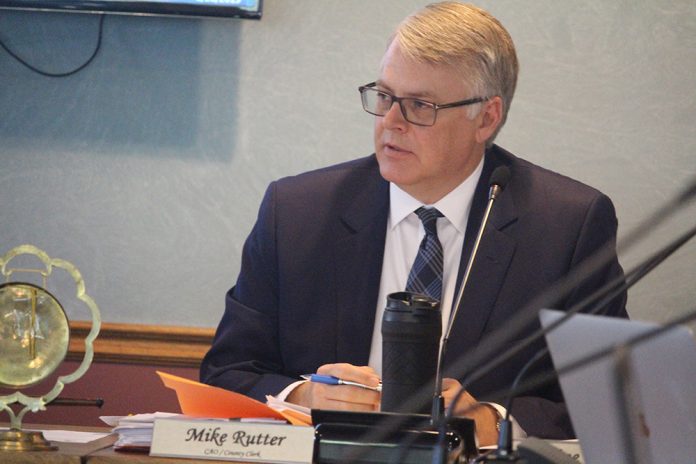
County CAO Mike Rutter directly addressed a letter about the bylaw. File photo.

The County of Haliburton sought to correct the record and respond to accusations of an “underhanded” step in its shoreline bylaw process Sept. 23.

CAO Mike Rutter reported to council about a widely circulated letter from landscaper Michele Bromley, which The Highlander also published as a letter to the editor Sept. 17.

The letter responded to the County committee of the whole meeting doing an in-depth review of the draft shoreline protection bylaw Sept. 9, which Bromley said occurred without enough prior public notice. She also alleged the County modified the agenda after it was first sent, to add the report about the bylaw’s content, which she said “occurred underhandedly.”

“The public is constantly asked to trust the councillors and the process, but that’s hard to do when things like this happen. This feels sneaky,” Bromley said.

Rutter did not name Bromley but reported about an online public feedback process on the first bylaw draft, with further feedback opportunities to come. He also said the allegation that the agenda was modified is untrue and there was a proper notice for the item on the committee agenda two days in advance, per legislated timeline.

“This isn’t something I normally do,” Rutter said. “But I really felt since a lot of the facts were not correct in the letter, and some of the facts were widely distributed, I think it was important to clarify.”

Rutter said staff also sent an additional email to 157 individuals and organizations about the meeting in advance. They filled that list with those who had previously written to the County about the subject.

“Thank you for bringing this,” Coun. Brent Devolin said. “We live in Trumpian times and sometimes it’s important to correct the record.”

Bromley declined an interview request on the matter.

Special meeting coming

Director of planning, Charlsey White, brought an updated bylaw to council based on feedback from the committee of the whole meeting. But with some council questions needing ministry response, they agreed to hold off and have a special meeting later to go through the bylaw in detail again.

White also defended the 30-metre protected shoreline zone the bylaw proposes, which Coun. Patrick Kennedy challenged at the Sept. 15 meeting. She noted the science behind that and how provincial policy already recommends that 30-metre setback as a minimum.

Deputy warden Andrea Roberts said although there has been criticism about the bylaw, her emails have also been overwhelmed by messages supporting it.

“There’s going to be a lot of support for this going forward,” she said.