Birders around Minden faced stormy weather and mild temperatures during a record-setting Christmas bird count. More field observers than ever, 32, scanned the skies, trees and waterways for winged creatures on Dec. 18 in a search area north of Minden. Along with those watching backyard bird feeders, 4,238 different birds were counted. The 20-year average sits at 4,282. Organizer Ed Poropat reported 51 species were recorded, up from the average of 45. Snow, which began to fall mid-morning, made it difficult to find birds due to decreased visibility and poor driving conditions.
That meant many birds passed on backyard feeders in favour of seed crops in the shelter of the forest. “Once again in 2021, most feeder watchers lamented the lack of birds on count day,” Poropat said.
He added bumper seed crops from spruces, tamaracks, hemlocks and yellow birches were a big draw for hungry finches. Some field observers noted “this was the best winter finch year they could remember.”
Birders spotted 867 Common Redpolls, 354 American Goldfinches, and smaller numbers of Pine Siskins and Purple Finches. Open water meant it was challenging for participants to spot spread out birds on lakes within the search area.
However, astute observers found four Common loons, 54 Common Goldeneye ducks, 51 Hooded Merganser ducks, and 28 Common Merganser ducks.
Five Red-breasted Mergansers were spotted on Canning Lake, and six Buffleheads near Minden. Poropat said birders documented a record number of 16 Ring-billed Gills, along with 33 Herring Gulls. Some birds commonly hunted, such as Wild Turkey and Ruffed Grouse, likely found shelter throughout the storm, making them harder to spot.
Observers spotted 107 and 11 respectively. Other birds showed up in decreased numbers, for example, 632 Black-capped Chickadees marked a decline from previous years.
Poropat said Ontario-wide monitoring could help determine if the population is declining. Rare finds “As always, one of the interesting aspects of Christmas counts is the discovery and/ or documentation of uncommon or rare species,” Poropat said.
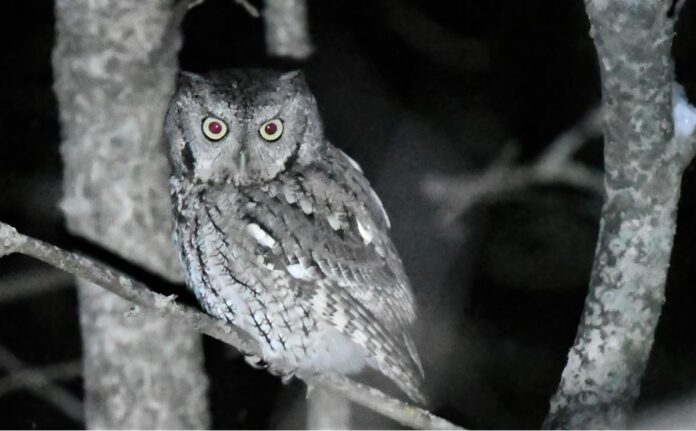
An Eastern Screech Owl might be this year’s celebrity. It was the 109th new species discovered in the 55 years of the count. It is a “rare, prized find anywhere on the Canadian Shield,” Poropat said. “Despite its name, Eastern Screech Owls do not normally screech and instead make a distinctive whinny-like whistle or quiet trill.”
This year, observers also spotted a single male Black-backed Woodpecker near Kinmount, and a Canada Jay was found near Dena Lake.
A pair of Red-bellied Woodpeckers visited feeding stations near Minden Lake and two rare Cedar Waxwings were found. Two White-throated Sparrows and a single female Northern Cardinal made an appearance too.
Poropat thanked volunteers for participating in the count. “Our collective efforts help contribute to knowledge of avian populations and conservation across the continent.”
The Haliburton County Huskies dropped a 2-1 decision to the Toronto Jr. A Canadiens Jan. 2, two days before the OJHL announced it’s suspending all operations until Jan. 26.
Commissioner Marty Savoy said Jan. 4 that all games will be postponed for the next three weeks in light of Ontario’s return to lockdown. He said the OJHL has developed a plan that will allow the league to complete a full regular season and playoff schedule this year.
Huskies head coach and general manager Ryan Ramsay isn’t happy about the suspension. Some “elite level” amateur sports leagues such as the OHL and Ontario Junior Lacrosse League have been given the green light to continue; Ramsay said he sees no reason why the same rules shouldn’t apply to the OJHL.
“I have 18 out of 22 players that have been drafted to the OHL, and three or four of them that have played in the league. Then we have other high-end players like Oliver Tarr, Patrick Saini and Isaac Sooklal who were offered contracts, but have decided to go [the NCAA] route. I’d say that’s pretty elite level competition,” Ramsay said.
The Huskies had a scheduled game against the Caledon Admirals called off over the holidays after the GTA team experienced a COVID-19 outbreak.
Sunday’s loss to the Canadiens was the Huskies’ first matchup in almost two weeks. Now, Ramsay’s players will be forced to take another break.
“It’s frustrating. I just feel for the players. They listen to the government and get their vaccine, their boosters and everything else and they still get screwed in the end,” Ramsay said. “There’s such a short window for junior hockey. These guys have already missed so much time. They’re getting the short end of the stick here, for sure.”
Controversial call ends Huskies’ run
It hasn’t been a good week for the team, which found their defeat to the Canadiens a tough pill to swallow. Playing in front of a reduced crowd at S.G. Nesbitt Memorial Arena, the Huskies gave a good account of themselves, dominating much of the game.
Even without star goaltender Christian Cicigoi, top forward Christian Stevens and defencemen Sooklal and Will Gourgouvelis, missing through illness and injury, the Huskies controlled the play through the first two periods, generating several good scoring chances. It wasn’t a surprise when Tarr finally gave the blue and white a lead 9:02 into the second period, capitalizing on a bad turnover from the Canadiens.
The lead held up until midway through the third period, when Matthew Wilde scored on the powerplay. He sent a gorgeous shot up over Huskies’ netminder Christian Linton’s glove, with the puck hammering the post on its way into the net.
Christian Catalano added a quickfire second two minutes later, firing past a helpless Linton after a two-on-none breakaway.
“I think we started to run out of gas a little bit in the third period. A lot of our players had only really skated once in almost two weeks, so some mistakes started to creep in,” Ramsay said.
Ramsay called a time out. It seemed to work when, with 21 seconds left on the clock, the Huskies appeared to tie the game.
A scramble in front of the Canadiens’ goal ended with Tarr jamming the puck past a prone Shelby Warren. Referee Dylan Rodgers waved off the goal, believing the Canadiens’ net to have come loose before the puck crossed the line. Ramsay was livid.
“When he (the ref) went to put the net on again it was already in place. He didn’t have to push it back on, because it never came off. It’s a [bad] call,” Ramsay said. “That would have tied the game and then maybe we would have gotten at least a point, if not two out of it. Again, very frustrating.”
The Huskies don’t have a game until Jan. 26, when they’re slated to face the Mississagua Chargers on the road.
Their next home game is scheduled for Jan. 28, against the North York Rangers.
December showcased the Highlands’ giving mentality.
Our editorial schedule was peppered with community food drives, toy collections, gift-giving and countless other events hosted and attended by people who want to help. At the 4Cs food bank, one donor even spent more than $900 on food donations.
Those donations helped feed Highlanders. But it’s unlikely donations made during the Christmas season will keep bellies full for long. A study by three Canadian universities estimates food costs will rise a further five to seven per cent in 2022, and inflation is surging to levels not seen for nearly 20 years.
Dr. Valerie Tarasuk, who has spent decades researching food insecurity, argues that the federal and provincial governments miss the mark if they think food banks are a solution for food insecurity and food drives an effective method to end it.
Jamie Schmale, Laurie Scott or Justin Trudeau (and nearly every elected official) advocate for food drives, food banks and the volunteers who staff them. We applaud Scott’s support of the hardworking volunteers, Schmale’s questions in parliament and his research into the rising cost of living.
However, Tarasuk, and other research groups and food bank workers say one cause is clear: people in Ontario aren’t making enough money.
Schmale’s Conservative Party has been a staunch opponent of basic income initiatives, which Tarasuk said could be a valuable step in the right direction; Scott’s provincial party has approved a minimum wage that sits nearly $5 below what’s needed to support a family of four in the County.
When people with full-time jobs (as over 60 per cent of Ontario’s food bank clients have) cannot afford to feed themselves, or those living with disabilities must choose between rent or dinner, our politicians need to recognize their food drives, grants, and congratulatory social media posts seem like slapping a Band-aid on an injury that requires emergency surgery.
To say Haliburton County is facing difficulties now seems like an understatement.
We are a spread-out community, with a minuscule rental stock, sky-high energy prices, and an aging population that will soon rely on services provided by a younger demographic who may struggle to afford to live here.
It’s our job as a community newspaper to unpack that big ball of challenges and make it understandable. To do that, we need your stories.
While I understand the difficulty in discussing these hard topics, we need the voices of those directly impacted.
You see, the hard part of this argument is convincing the powers to be that the ‘hidden’ homeless, hungry and poor truly exist in the Highlands.
We urge you to share your experiences, to help us change the narrative about the issues of homelessness, hunger and poverty in the County
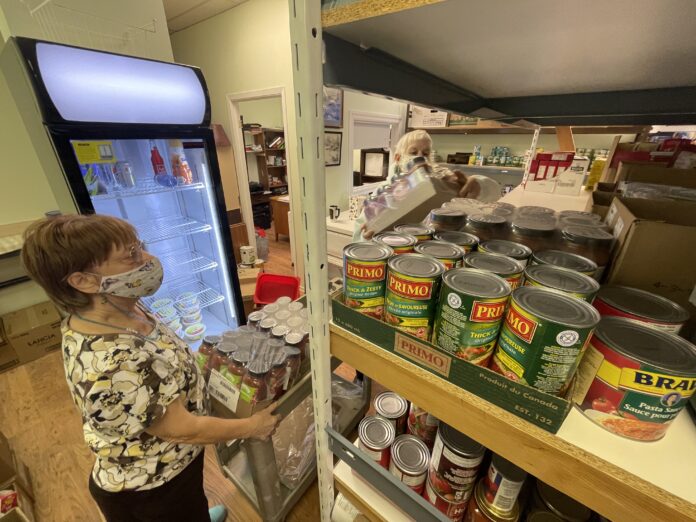
Haliburton 4Cs food bank manger Judy MacDuff organizes donations with a volunteer.
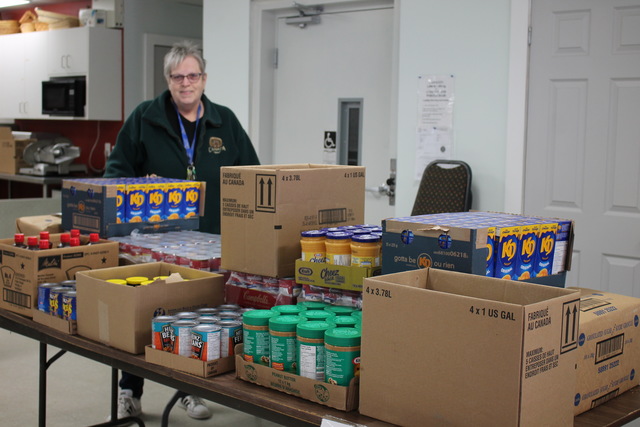
“A bag, or a bag and a half and you’re at $50,” said Joanne Barnes. She’s talking about a trip to the grocery store; a lot of Highlanders are experiencing the same thing these days, with inflation hitting an 18-year high. Barnes knows all too well how rising food prices affect residents. She manages the Minden Community Food Centre.
She said this year has further exposed how prevalent food insecurity is in the County. “I said all along in the beginning of October we were going to see people lined up out the door. That’s what has happened.”
Food banks across Haliburton County are reporting high usage and changing demographics; those who work in the field are calling for urgent action to address the crisis.
Tina Jackson, executive director of the Central Food Network in Highlands East, said there’s been a year-on-year increase in food bank use.
Now, you’ve got a whole new set of people who have never been in this situation before.
Joanne Barnes
She said the food bank assisted 318 people in 2018, 394 in 2019, and 525 in 2020. “We just can’t sustain this significant increase, year after year,” she said, adding the food bank needs “urgent” support to maintain current service levels due to soaring food costs.
Barnes said the end of COVID-19 supports means some clients haven’t budgeted for taxes, or don’t qualify for income supports. “Now, you’ve got a whole new set of people who have never been in this situation before,” she said, mentioning a family who had been sleeping in a tent after losing their home. “What we’re seeing now is desperation.”
Jackson said Haliburton’s tourism and hospitality sector, hit hard by shutdowns and restrictions the last two years, is also an industry where many jobs pay minimum wage or just above. “It had a greater impact on low-income workers,” she said.
In Haliburton County, that means “we have a huge portion of our economy and residents connected with that.” Judy MacDuff of the 4Cs food bank said she’s seen an increase in younger people seeking help at their York Street location in Haliburton. Last estimates put Haliburton’s lowincome population at just over 17 per cent, compared with 12.3 per cent Ontario-wide.
Yet all three food banks try to address more than just food needs; Feed Ontario estimates 90 per cent of food banks in the province offer other vital services such as help dealing with energy bills.
Jackson also runs Heat Bank Haliburton County, which in 2020 alone assisted 276 people, supplying firewood, providing energy kits or helping unlock energy benefits. More than 47 per cent of residents in Haliburton County pay more than 10 per cent of their income on heating costs.
“The majority of the households we’re working with are struggling to cover hydro and heating bills because of a lack of income,” Jackson said. “There’s overlap there.”
For Dr. Valerie Tarasuk of PROOF, a University of Toronto interdisciplinary study group focusing on Canadian food insecurity, that overlap suggests food banks aren’t a long-term solution for hungry Highlanders.
“By the time someone doesn’t have enough money to buy food there are other things missing besides food,” she said. Systemic solutions “We can absorb ourselves with activities of collecting food, Tarasuk said, referring to festive fundraisers Canada-wide.
“It sounds like we’re doing a gigantic thing. But it’s so out of sync with the scale of the problem.” While food banks can offset grocery bills and meet emergency needs, Tarasuk hasn’t found evidence suggesting food banks can move households out of food insecurity. Instead, she points to studies that show basic income, for example, or a minimum wage which more accurately reflects living costs, target the source.
PROOF also states that programs such as the Canada Child Benefit have helped reduce instances of severe food insecurity.
For those working on the ground like Jackson, it’s difficult to balance a desire for long-term solutions with the increased number of visits. “I think it’s really difficult to get public buy-in and political buy-in when the answer isn’t immediate,” said Jackson. “The answer to addressing poverty is not going to be an instant solution.”
MPP Laurie Scott said her government has invested in food support programs across the Highlands, noting multiple provincial grants that have funded SIRCH training programs or food banks. “We’ve invested in a lot of that to help these communities,” Scott said.
Feed Ontario’s 2021 hunger report states that Ontario’s social assistance programs, ODSP and OW, totaling $8,796 and $14,028 a year, are “significantly below the level needed for a standard of living that is adequate for the health and well-being of the recipient and their family.”
The 2016 census reports Haliburton County’s unemployment rate at 9.6 per cent, 2.2 percentage points higher than the province’s.
Barnes and Jackson see many who are employed seeking food bank services. “A wage has to be higher than what it is, to be able to sustain a person, $14 or $15 an hour doesn’t cover it,” Barnes said.
Scott said raising the minimum wage could discourage job opportunities. “There’s a very fine balance between supporting employees or the fact they’ll close up shop or stop expanding,” she said. Scott added there are many openings for positions in industries, like construction, that pay well.
MP Jamie Schmale raised concerns over inflation and the cost of living during a session of Parliament in December.
However, in the four years leading up to the COVID-19 pandemic, the percentage of those with jobs accessing Ontario food banks grew by 44 per cent. PROOF claims that 65 per cent of those going to food banks report salaries and earnings as the main source of income: “Simply having a job is not enough; low-waged jobs and precarious work means people in the workforce often don’t have enough income to be food-secure,” states PROOF’s website.
In an address to parliament Dec. 16, MP Jamie Schmale said the Liberal government’s newly-passed aid package represents government spending that drives inflation, “making the savings of many in the working-class worth less.”
He said living costs are rising “because the government has thrown all this money up into the atmosphere, and refuses to change course.” While Jackson and Barnes acknowledge politics, inflation and systematic changes all play a role in the Highlands, they and their volunteers are focused on those needing urgent help.
“We need more political buy-in to address the deep systemic changes we need to address these things, but we certainly still need investments in the non-profits that are doing the grassroots work,” Jackson said. “People still need to be fed, people still need warmth while these things are happening.”
Ontario has added new COVID-19 restrictions in the face of rapidly rising case counts.
During a Jan. 3 press conference, Premier Doug Ford said medical advisors predict the highly transmissible Omicron variant could overwhelm hospitals, with some expecting more than 100,000 cases a day.
That could potentially mean more than 1,000 new hospital admissions per day.
While some studies show the variant is less severe, the sheer number of infections could still mean hospitals could be “thousands of beds short in the coming weeks,” Ford said.
“We need to slow [COVID-19] down in order to deliver shots,” Ford said.
Starting Jan. 5, here’s what will change:
All restaurants will move to take-out only.
All publicly-funded and private schools will move to remote learning starting Jan. 5 until at least Jan. 17.
Workplaces with employees able to operate remotely must do so.
All retail establishments (including malls) will run at 50 per cent capacity.
Organized public events and private gatherings are limited to five people indoors and 10 people outdoors.
All indoor sports facilities and gyms must temporarily close, including the Minden Arena.
Ontario hospitals will pause all non-emergent and non-urgent surgeries and procedures.
Museums, such as the Minden Hills Cultural Centre and Haliburton County Museum, will close.
Restricting alcohol sales after 10 p.m. and alcohol consumption at a business after 11 p.m.
Public libraries will be limited to 50 per cent capacity.
Personal care services are to be limited to 50 per cent capacity.
The rules will be in place until at least Jan. 17.
SUB: Business supports
In a press release, the Ontario government announced an expansion of the new Ontario Business Costs Rebate Program.
Some businesses required to close or limit capacity can apply for rebates on energy and property tax bills.
“Eligible businesses required to reduce capacity to 50 per cent, such as smaller retail stores, will receive a rebate payment equivalent to 50 per cent of their costs, while businesses required to close for indoor activities, such as restaurants and gyms, will receive a rebate payment equivalent to 100 per cent of their costs,” states the press release.
Applications for the program are slated to open later in January.
A Minden restaurant has consented to an Order of the Superior Court of Justice to close after failing to comply with a Section 22 order issued by the local Medical Officer of Health.
According to the HKPR district health unit in a Dec. 30 media release, on Dec. 14, they served the owner/operator of Minden’s 50s Diner with a Section 22 Order.
They said the Section 22 Order was issued under the Health Protection and Promotion Act which governs the prevention of the spread of disease and the promotion and protection of the health of the people of Ontario.
The Order required the owner to comply with all provincial measures for restaurants required by the Reopening Ontario Act, and associated regulations, or to close the premises, the release said.
“The Section 22 order came after HKPR staff received multiple complaints about the restaurant not following provincial COVID-19 regulations. Health Unit staff visited the site multiple times to provide information and education to the owner before progressing to further enforcement measures,” the health unit said.
It added that on Dec. 23, a Superior Court judge made an order with the consent of the parties, that the restaurant remain closed until further order of the court.
“Because patrons are not always fully masked while in a food premise, the province’s Reopening Ontario Act requires that restaurants take additional actions to prevent spread of COVID-19,” said medical officer of health, Dr. Natalie Bocking.
“By not complying with provincial regulations for indoor masking and proof of vaccination, operators put their staff and customers at risk.”
She said the health unit is grateful to the many operators in the region who continue to work with HKPR in meeting the provincial requirements and helping to prevent the spread of COVID-19.
When sitting down to write this week’s editorial, I pondered an opinion piece on a number of the stories we were working on.
Unfortunately, there appeared no way to avoid COVID-19 and the fifth – sigh – yes, fifth wave of the pandemic starring the Omicron virus.
I’ll leave you to read the news coverage.
Quite frankly, while as a newspaper we have to cover this continuing story, we, like most of you, are sick and tired of it.
Laying on the chiropractor’s table this week, Jason asked me what I thought. I told him I didn’t want to talk about it. I wondered if we’d erred badly collectively. Should we have allowed herd immunity to run its course and avoid the seemingly endless parade of vaccine boosters that may mark our futures. Flu shot? Check? Pneumonia shot? Check? Shingles vax? Check? Booster? Booster? Booster? Check. Check. Check.
And now, some of us are scrambling to figure out whether those Chrismas plans are on. If they are, what do we have to do to ensure everyone is safe? Others are rethinking that winter getaway. Our physical and mental healths are taking a hit on a week when we saw the least bit of daylight for the entire year.
I lit an outside bonfire on the solstice, a sort of middle finger to winter. And, I think it’s time we did the same with COVID. So, with this rawness, let’s talk about our feelings and coping.
I’d like to present my personal list of 10 ways I am trying to stay positive during winter’s icy grip and COVID’s continuing presence.
– Finding inspiration. I’m reading two books at the moment. The Namesake by Jhumpa Lahiri, which brings me back to my Indian soul home. I’ve also just cracked The Golden Spruce. I’ve learned more about trees in the first 26 pages than I have learned in my lifetime. Find a documentary. Find a podcast.
– I’m practicing gratitude. Every day I am thankful for where I live; the cottage roads I walk down; and the peace and tranquility in front of my living-room fire. What are you grateful for?
– Seek out the positive people in your life. If some family members or friends are spiralling into negativity, choose to not go down that road with them.
– While you might not be able to physically escape, find things that tap into your inner child or provide joy. For me, it’s colouring, playing in the snow, a long, hot bath.
– Smile and say hello. Yup, I’ve got a mask on. But when you smile, people can see it in your eyes. Even while out walking, I’ll smile at drivers. Nine times out of 10, they smile back.
– Reach out. I chat with strangers and I am connecting more with loved ones via text, messenger, phone calls, emails and Zoom.
– Exercise. That’s a big one for me. My daily walks keep me sane.
– Focusing on my four walls. I’m renovating. Again. This time, I’m in the laundry room. That fresh coat of paint makes me smile.
-Take time to breathe. Maybe it’s a cup of tea. Find that ritual that allows you to stop for five minute intervals.
– This might sound ironic, since I am a newspaper editor, but set limits on how much news you’re consuming or monitoring Facebook and other feeds so you don’t go down that rabbit hole.
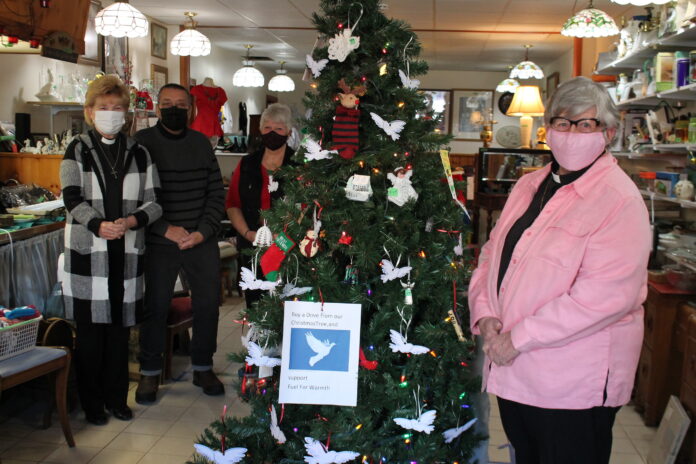
Rev. Canon Joan Cavanagh-Clark, Joe Bertin, Wendy Connelly and Deacon Martha Waind at Bountiful Blessings.
Bargain hunters now have two shops in Minden affiliated with The Anglican Parish of Minden, Kinmount and Maple Lake.
The thrift store at St. Paul’s Anglican Church, at 19 Invergordon Ave., is slated to re-open on Monday, Jan. 3. It has been closed since Aug. 28 for renovations to double in size, said Reverand Canon Joan Cavanagh-Clark.
“There’s such a huge need in the community that we had to expand,” Rev. Joan said of the thrift shop.
Deacon Martha Waind said they opened the thrift shop in 2014. It started up stairs in the church but they outgrew that space in a matter of months.
They stipulated it will remain as a thrift shop, with no items priced at more than $8.
“The thrift shop is to meet a need in the community because you know the stats on poverty in this community,” Rev. Joan said. “There’s no public transportation. We try
to shop locally but it’s very limited so a second-hand shop was really needed.
“They have a lovely one in Haliburton but they don’t have enough transportation to get there so the first year we were open at the thrift shop I was almost in tears because a mother said to me ‘this is the first time my kids in Grade 3 and 1 have had indoor shoes for school because I can’t afford both’. So, it’s been a huge need in the community.”
Rev. Joan added that other than their operating costs, every cent they make is given back to the community or some other non-profit they support. One of those is the Bishop McAllister Anglican Church School in Africa, an orphanage for kids who have lost their parents to AIDS. She said it costs $450 a year per child. Closer to home, they support Places for People, the Minden Community Food Centre, have put braces on kids’ teeth and paid emergency dental bills. They often provide thrift store items for free when there is a need, such as clients of the women’s shelter in the County.
Bountiful Blessings
The other shop is Bountiful Blessings, located at 105 Bobcaygeon Rd. in the downtown.
It opened in September 2020 but has been disrupted by COVID-19. However, it’s again operating Monday to Saturday from 10 a.m. to 4 p.m.
The original plans have changed, according to Waind. She said that with the thrift shop closed, “this turned into something it wasn’t intended to be. We just kept getting donations and donations and donations and we had no place else to put them so our purpose for this became a second-hand store, which wasn’t the real reason for opening.”
Rev. Joan said the original vision – and one they are still working towards – is a gathering place with classes.
“We can’t do an awful lot about the homelessness but perhaps we can provide
a place to come during the day because the homeless people I work with have nothing to do all day except walk and go to Tim Hortons if they have the money to do that.”
She said the plan is for a community venture, since there is no seniors’ centre for example. It will be free or by donation and involve the community identifying its needs and people stepping up to gift their time and expertise.
“So far, we have someone willing to do art classes, teach sign language, budgeting, Christians against poverty.” They’re also planning to bring in computers for those who experience internet connectivity issues and to help people fill out forms, such as CPP, EI, etc.
But for now, as a second-hand store, with perhaps better-quality goods than the thrift store, Waind said, “we’ve had really good reception.
Haliburton County Huskies forward Oliver Tarr didn’t have to think twice when asked to relocate to the Highlands last summer.
The 19-year-old forward spent a great deal of time in the area throughout his childhood, with his family having a cottage on Little Hawk Lake, north of Carnarvon. When he learned the Whitby Fury would be moving, he was excited by the prospect of representing a place he refers to as his home away from home.
Tarr is enjoying a career year in the blue and white, putting up a staggering 43 points in 28 OJHL games. He’s one of the leaders on a Huskies outfit that look primed to challenge for championship honours come spring.
It’s exactly the sort of situation Tarr imagined himself in when he was growing up. Always more of a smaller, skilled player, the Huskies’ number nine got his start playing minor hockey for the Uxbridge Stars in the late 2000s.
He honed his skills on a backyard rink his dad built every winter, spending countless hours trying to replicate plays thought up by former Detroit Red Wings centre Pavel Datsyuk and current Pittsburgh Penguin Sidney Crosby.
Tarr represented the Central Ontario Wolves and Whitby Wildcats in AAA before making the jump to junior.
He cracked the Fury as a 17-year-old in 2019-20, taking on a role in the team’s top
six. Last year, with most players stuck on the sidelines, Tarr headed east to represent the Miramichi Timberwolves in the Maritimes Jr. A Hockey League, putting up 21 points in 24 games.
That Atlantic experience served as the springboard for this season’s offensive explosion, he said.
“I feel like I took my game to a whole other level. I had an unbelievably fun time, grew into my body a little more and found myself more comfortable with the pressure of putting up points and being an offensive driver at junior level,” Tarr said.
He worked hard over the summer getting into peak physical condition. Before committing to the Huskies, he took part in a Peterborough Petes training camp. He did enough to earn a contract with the OHL outfit, who saw potential in him as a mid- level scorer.
While he was appreciative of the offer, Tarr has always known what his next path was going to be.
“NCAA has been the dream for as long as I can remember,” Tarr said. “When I was 12 or 13, my hockey team went on a trip to Michigan State. I was blown away by the facilities, and we’re seeing more players excelling at college hockey and then turning pro.”
He held talks with several Division 1 schools, making a committment to Canisius College Dec. 21. He plans to begin at the Buffalo school in September.
Now home over the holidays, Tarr said he’s looking forward to the second half of the season, where he expects the Huskies to lay down a marker and show the rest of the league what they’re capable of.
“We’re finally healthy. We’ve struggled with injuries all season, and have had to play short lots of nights. Since having
guys back, we’ve won six straight and are playing some really good hockey,” Tarr said. “I think we’re going to have a really successful season. I don’t see anybody getting in our way. When you look at the locker room and the guys we have, a championship has to be the end goal.”
The Haliburton County Huskies extended their winning run to six games this past weekend, with impressive home-ice performances against the Toronto Jr. Canadiens and Cobourg Cougars.
On Dec. 17, the Huskies welcomed OJHL South Division powerhouse Canadiens to the S.G. Nesbitt Memorial Arena.
The hometown team got off to the best possible start, with forward Lucas Stevenson opening the scoring just a minute in after being set up by line-mate Oliver Tarr. Payton Schaly bagged a second at 3:47 of the opening period, before Bryce Richardson added a third at 14:55.
The Canadiens hit back through Liam Fedak at 17:46, the one blot on an otherwise excellent first period for the Huskies.
Christian Stevens scored a fourth mid- way through the second, giving the dogs an ultimately unassailable lead. The Canadiens rallied in the third, potting a couple of goals, including one in the final minute of play with their net empty, but Huskies goaltender Christian Cicigoi stood tall, making several key stops right at the death to seal a 4-3 victory.
It was a familiar sight the next night as the Huskies and Cougars went to battle for the eighth time this season. The dogs held a 4-2-1 record over their rivals heading into the game. The opening period went by without much action, with both teams a little slow growing into the game.
A hard-hitting opening to the second period played into the Huskies hands as they took control, but a sucker-punch by Cobourg’s George Krotiris at 6:42 gave the Cougars a lead to hang on to.
The Huskies pushed, but found an immovable object in the Cougars’ goal. Justin Easter made 38 saves across the opening two periods, to the frustration of 335 fans in attendance. The third period was following the same pattern, but then forward Schaly sprang to life. He picked up the puck on the blue line, danced past a pair of Cougars defencemen and lifted a shot over Easter’s reach to tie the game.
It was Schaly’s fourth goal in as many games since opening his account for the Huskies Dec. 10 against the Lindsay Muskies.
That tally changed the mood inside the arena, and just a few minutes later the Huskies found themselves ahead. Tarr picked up a puck from Pat Saini and skated in one-on-one with the goaltender, beating him over the shoulder at 17:19 to give the Huskies the lead.
“I had a lot of opportunities tonight, and maybe could have capitalized a bit early, but at the end of the day when the game’s on the line, I like my chances with the puck on my stick,” Tarr said. “It was a great moment, the boys were excited, the fans too… a nice way for us to finish heading into the break.”
Saini potted an empty-netter at 18:58 to secure the win.
Head coach Ryan Ramsay was in good spirits after the game having watched his team, albeit temporarily, climb to the top of the league’s East Division standings.
“That was playoff hockey tonight, and that’s what we’re good at,” Ramsay said. “This group is special. They’re resistant, relentless and just work non-stop each and every night. It doesn’t matter if we’re down by two or three, this group doesn’t stop. They find ways to win.
More than 50 fans lined up outside the home dressing room following Saturday’s game, as the Huskies held an autograph session. All players participated.
The team has a week off over the holidays, with their next game scheduled for Dec. 29 on the road in Mississauga. The Huskies will be back in action in Minden on Dec. 31, with a 2 p.m. tilt against the Caledon Admirals.