
Home Blog Page 291

Council defers decision on firefighter pay

0

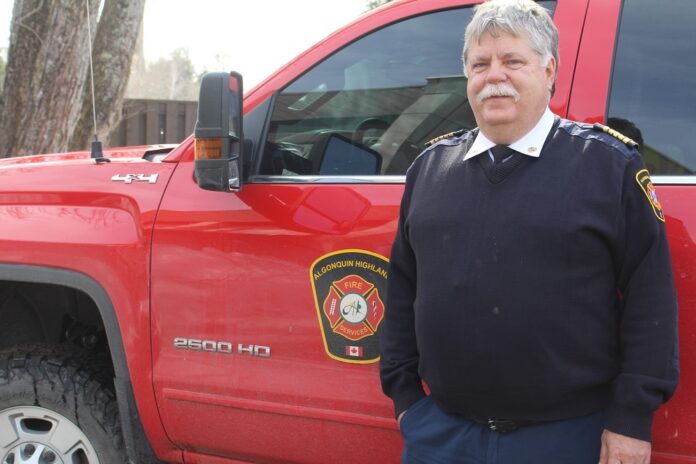
Algonquin Highlands fire chief Mike French proposed new firefighter renumeration rates to council Feb. 3, calling for an increase in pay for experienced members and a decrease for new recruits.

Currently, all volunteer firefighters in Algonquin Highlands make $20.51 per hour. This is the highest rate in Haliburton County, French noted. In his report to council, he proposed increases to members holding down the positions of acting captain (up to $22.01), captain ($23.51) and district chief ($25.01), while recommending untrained new recruits be bumped down to $16 per hour.

French also asked that firefighters be paid a minimum of two hours’ pay for each callout.

The changes would represent an increase of $9,294.50 in the fire department’s budget in 2022.

Deputy Mayor Liz Danielsen wasn’t a fan of the proposal. She said she wouldn’t support a pay decrease for new recruits, and called on Algonquin Highlands to be “local leaders” in establishing fair pay for volunteer firefighters.

“I’ve suffered two house fires in my life and have firsthand experience of how much our firefighters do for us. At risk of upsetting the budget applecart, I have an issue with a reduction here,” Danielsen said. “In the city, firefighters get paid almost $50 per hour. I understand all firefighters have to maintain the same level of training, that’s a big spread for me.

“I’d like to see us be leaders and do more beyond what is being recommended here,” she added.

CAO Angie Bird noted firefighters have typically received a cost-of-living increase from the municipality, after being asked by Danielsen. French’s proposal would see that annual review maintained.

Given the request to change the minimum callout pay, Bird asked that council defer making a final decision until she’s able to calculate how much that would cost, and how big of an implication it would have on the 2022 budget. The issue will be coming back later next month.

Legion and rinks get provincial money

0

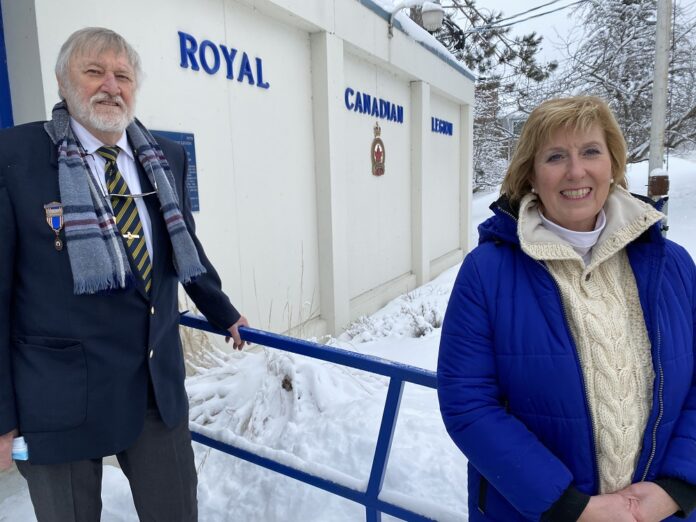
MPP Laurie Scott was in Haliburton Feb. 3 to announce more than $260,000 in provincial funding for two local organizations.

The Haliburton Legion will be receiving $104,100 to help cover several facility upgrades, while Dysart et al township is getting $162,000 to renovate two outdoor rinks into multi-purpose courts for hockey, pickleball and basketball.

The money is being filtered into Haliburton through Ontario’s Community Building Fund. In total, the program is supporting 186 municipalities, Indigenous communities and non-profit tourism, culture, sport and recreation organizations experiencing significant pressures due to COVID-19. Scott noted around $105 million is to be invested through the fund this year.

“This funding will help address much-needed upgrades and repairs so community members can continue to enjoy outdoor sports facilities and the services our local Legion offers,” Scott said.

Legion president Don Pitman said the money would be used to replace windows ($17,000), purchase a new outdoor digital sign ($17,000), upgrade the building’s water filtration system ($2,000) and its heating and air conditioning system ($65,000).

The big-ticket heating and A/C item was “an absolute must” according to Pitman, who received a $6,000 hydro bill in December due to the current system failing and the back-up, electric powered system kicking in.

Dysart CAO Tamara Wilbee said the money Dysart is receiving will be used at the Harcourt and West Guilford outdoor rinks to upgrade the surface, fencing, and lighting at the pads.

Minden, County receive money too

Scott said two projects brought forward by the County of Haliburton and Minden Hills township would receive approximately $180,000 in funding through the Municipal Modernization Program.

The County will receive $101,760 for its paramedic service master plan, while Minden Hills is getting $81,357 for HR information system modernization.

“For some time now, Haliburton has been experiencing substantially increased call volumes, pressures associated with transfers for diagnostics, as well as managing the new community paramedicine program. Given the changing atmosphere we have found the need to carefully study our management structure, assess our existing bases and determine where additional resources will be required,” said County warden Liz Danielsen. “Haliburton has seen considerable growth, and we need to carve out the best path to move forward and continue to offer exemplary service to our residents.”

The Ontario government is distributing $28 million to 322 small and rural municipalities through the first batch of 2022 MMP funding.

Funding for agriculture

Around $1 million will be made available to various agricultural and horticultural societies across Ontario in the coming weeks, as the province looks to assist organizations still impacted by the pandemic.

Base support funding of $1,000 will be issued to all eligible societies to support their continued incorporation and upcoming activities, with new “hardship funding” available to those that have been most impacted. Applications will be assessed based on gate revenues for 2019. Successful applicants will be able to use the money to offset operating losses, liabilities and fixed overhead costs related to land and buildings.

Money will be distributed to eligible societies before March 31, according to Lisa Thompson, minister of agriculture, food and rural affairs.  

Dysart waste study results ‘encouraging’

0

The first of a four-part waste composition study in Dysart et al found that each municipal household averages 641 kilograms of garbage and recycling per year, and that 29.16 per cent of all waste is successfully diverted from landfills and recycled.

Environmental manager John Watson provided his report to council Feb. 8. The municipality contracted AET Group to carry out the study, with the first stage taking place at the Haliburton landfill Jan. 12 to 14. There, staff collected garbage and recycling from 65 residences, representing 609 waste generation days.

Looking at the data, Watson said 69.36 per cent of all plastic recycling collected was considered acceptable, with 25.98 per cent classified as garbage, 9.75 per cent being non-acceptable plastics such as film and large pails, and 5.16 per cent deemed to be “other waste,” namely clothes hangers, wood and meat pads.

More encouraging, 85.42 per cent of all paper recycling collected was deemed acceptable. “Most people are recycling their papers correctly,” Watson noted. Around 9.35 per cent of items placed in paper recycling was classed as garbage and 5.22 per cent as recycling that should have been placed in with plastics.

Watson said that 90 per cent of all garbage collected ended up in the right place, with 5.85 per cent of items belonging in plastic recycling and 4.13 per cent in paper recycling.

Misplaced garbage and recycling costs Dysart thousands of dollars annually, Watson said. While he was encouraged by the numbers reported through this first event, he told council it was important the township continues to promote proper recycling and sorting habits.

“When you look at this report, I think we’re doing a heck of a good job,” said deputy mayor Pat Kennedy.

Ministry investigating

Jeff Iles, Dysart’s director of planning and land information, said several provincial and federal ministries are actively investigating wetlands along Gelert Road after a local property owner’s desire to develop the land caused uproar in the community last month.

Several environmental activists sounded the alarm, as reported in the Jan. 27 edition of The Highlander, after a piece of the wetland was filled early in the new year. The issue came to council Jan. 25, with officials directing staff to get further information on what was going on at the site.

Fisheries and Oceans Canada reported they intend to assess the site in the spring, when water levels are high, to determine if there has been any evidence of loss of fish habitat due to the filling. Ontario’s Ministry of Environment, Conservation and Parks say they have consulted with the landowner, who has voluntarily agreed to stop filling at the site until a habitat assessment is completed and reviewed.

While the township does not currently have any bylaws in place preventing this kind of thing from happening again in the future, Iles said it’s always a good idea to first reach out to municipal officials to receive a second opinion before proceeding with any significant project on your property.

“We are a good starting point and can provide direction to the appropriate approval authority,” Iles said.

Highlands East morphing into Muskoka: CBO

0

Highlands East chief building official Laurie Devolin said what happened in Muskoka a decade ago now appears to be happening in Highlands East when it comes to building activity.

She made the comment when presenting a 10-year building activity report to a Feb. 8 council meeting.

Her annual comparisons and statistics indicated that while there were not substantial jumps in the number of permits issued from 2012-2021, the construction values increased considerably.

For example, 174 permits were issued in 2012, worth a little over $10.4 million. In 2021, there were 216 permits, with a construction value of just under $43 million.

Coun. Cec Ryall noticed the nuance. “The actual number of permits that are being issued, although it’s higher, it’s not that much higher so I’m going to assume for the sake of argument that the value of the properties is what’s driving the numbers,” he asked Devolin.

She said there were a lot more dwellings, including permanent dwellings and cottages, as well as some significant additions.

“It seems that what happened in Muskoka a decade ago, everything is moving in this direction,” she said.

“So, there’s a lot of planning for people taking down old cottages and building new ones, people wanting to move here for retirement, making cottages into their permanent dwellings, so lots of work required to do that.”

She noted COVID-19 had driven up material costs but it was also a case of higher-end construction.

“The little 700 sq. ft. house and 400 sq. ft. cottage just isn’t the norm anymore. We have significantly increased the value of what’s being constructed in Highlands East, so that drives the construction value up.”

Ryall then asked Devolin if she foresaw any challenges with service delivery.

Record-breaking building activity around County

She said in 2021, her department was taxed around the volume of work that came in, but they have good systems in place.

“I don’t foresee there being any issues with service delivery at this point, we’ll see how it goes along, as it gets busier in summer,” she said.

In the report, Devolin also indicated that building inspections were fairly even over the 10-year period. It was about the same for zoning compliance letters and total building infractions and files resolved.

When it comes to septic permits, between 2014-2021, there was a marked increase. In 2014, there were 68 permits issued, while in 2021 it was 123. The number of inspections climbed to 255 last year, from 71 in 2015.

So far in 2022, she said there’s been lots of permit applications for building and septics. They’ve already issued two building permits and “have a few in the wings.”

She noted the construction value is also considerably higher, already at just under $2 million for the new year, compared to just over $27,000 this time last year.

“It looks like it’s going to be another busy year for us.”

A bit of a boom

Meanwhile, Dysart’s chief building official also provided an update to his council at a Feb. 8 meeting.

Karl Korpela said 2021 was a record-breaking year for development in the township, with 607 building permits being issued throughout the year and new construction values soaring to more than $98 million.

Korpela said those numbers had much to do with the number of new seasonal residences being built on area lakes in the past 12 months.

“People are building substantially larger cottages. Before, we would usually see one or two monster cottages go up in a year, this year there’s been a lot of them,” Korpela said. “People are spending money here in Dysart, and that’s not a bad thing.”

Volunteers needed to bring memories to life

0

A new SIRCH program is pairing local listeners with storytelling seniors living with dementia.

The Memories to Life program aims to collect the experiences of those who have early-stage dementia and package them in a scrapbook. Once the disease progresses, it can be a point of connection with loved ones.

“It’s really about listening to people’s stories of their lives,” said SIRCH executive director Gena Robertson.

Volunteers train for a few days with SIRCH and are equipped with scrapbooking know-how as well as training on dementia and SIRCH best practices.

Then, they’ll visit seniors to gather memories. They’ll help collect newspaper clippings, photos and more based on the person’s experiences.

“In one person’s book: he was a pilot in a war, the volunteer had done research on the plane,” Robertson said. “There can be pictures of families and friends and pets and whatever.”

Jan Saugh, an activation coordinator hired by SIRCH to run the program, said volunteers must only “have a love of seniors, be able to listen and engage, and want to tell their story.”

Compiling memories and experiences into a physical collection of items often unearths recollections in those with dementia.

“It’s to spark recognition for the client, help them remember their accomplishments,” she said.

It’s also for loved ones.

“Families can use the book for conversation pieces for family and friends, and it’s a treasured memory they’ll have forever.”

The upcoming Memories to Life program is funded by a donor who wished to remain anonymous, however Robertson said past experience shows how impactful it can be.

Over a decade ago, volunteers were able to come together with the people who told their stories and share what they created.

Robertson saw how much it meant to elderly residents to have their lives celebrated.

“I remember one man tearing up, saying before he’d done this project, he really didn’t feel like he’d done anything of value in his life,” Robertson said. “This made him realize how much he had.”

To register as a volunteer or sign up as a participant to have your story told, contact SIRCH before the middle of February at 705-457-1742.

Ice drivers slide back into Minden

0

After a two-year hiatus, racers will soon be sliding around an icy Minden Fairgrounds.

The annual Canadian Automobile Sport Club Ice Racing series was recently green-flagged by the Township of Minden Hills, who voted to allow the use of the fairgrounds.

They’re aiming to begin racing Feb. 5 and 6, with five weekends of racing planned.

“I got the impression everybody on council was eager for us to go forward with this,” said CASC ice racing director Brad Elkins.

During ice races, competitors drive cars outfitted with snow tires or spiked tires around a closed circuit. It requires precise handling and speed control.

Elkins has raced on ice on and off since 1978. He said he enjoys the camaraderie between competitors.

“It’s a chance to get outside and do stuff in the winter time,” he said.

Andy Rickard, president of the Kin Club of Minden, said racers are “extremely keen to go racing.”

Rickard and other Kin Club members create the racetrack. It’s built on layers of ice lined by tall snowbanks, twisting and turning much like an asphalt race track.

Last year the race was cancelled in the midst of COVID-19 restrictions, and Rickard said the return to racing also means a tourism boost for Minden. Drivers often eat at local restaurants and some stay overnight. “It brings a lot of money into the community,” he said.

The race is one of two annual Kin Club events. During COVID, Rickard said both events have been a “complete loss.” The Kin Club is already prepping this year’s track and building up the snowbanks that line the course.

“It’s very welcome, both for the financial good of the club and for the health of the ice race series,” he said.

Driving school returns

The IRL Car Control driving school will resume its training programs at the fairgrounds with COVID safety measures in place.

Council voted to allow the school to resume using the fairgrounds for its training courses. As of press time, the school will be limited to corporate training programs. The majority of current clients, said president and chief instructor Ian Law, are provincial or federal public servants.

Arts Centre Foundation casts
first corporate sponsorship

0

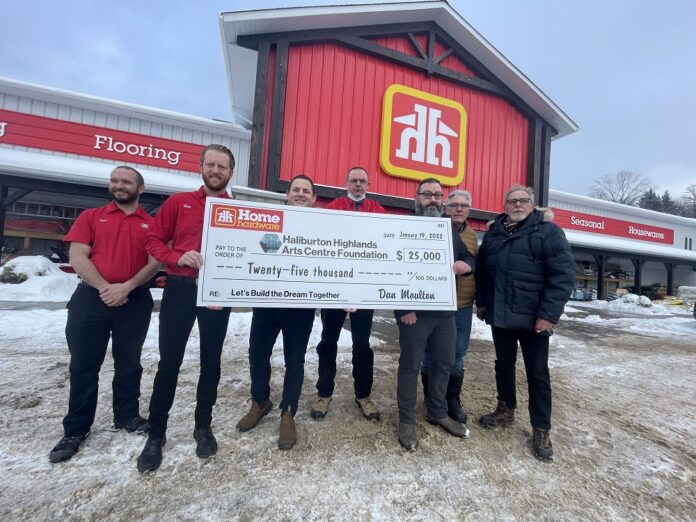
Haliburton County’s Home Hardwares are helping build a Highlands arts hub.

The Home Hardware Building Centre of Haliburton and Minden has donated $25,000 to the Haliburton Highlands Art Centre Foundation (HHACF), becoming the foundation’s first corporate sponsor.

“We are very pleased and committed to supporting the HHACF in its mission to build and operate a world-class performing arts centre in Haliburton County,” said dealerowners Dan and Emily Moulton in a press release.

“We believe strongly in the economic impact that this project will bring to our region, and we would like to encourage all local companies and individuals to pledge their support in the coming year.”

The money will help fund follow-up steps to an ongoing feasibility study that will lay out the what, where and how of a large-scale performing arts centre in Haliburton County.

Nationally-acclaimed theatre consultants Janis A. Barlow & Associates are conducting the study, expected to be published by Spring 2022.

“Word of the foundation is spreading, but in these early stages, it’s donations like this that take our fundraising campaign to the next level,” said foundation president Dan Manley. “We hope that fellow business owners share in Dan and Emily’s economic vision for the Haliburton Highlands.”

Benoir Lake resort community breaks ground

0

Work is underway on the Nomi Resort Club, a 51-unit recreational community on Benoir Lake, near Elephant Lake.

Dysart et al mayor Andrea Roberts, deputy mayor Pat Kennedy and Coun. Tammy Donaldson attended a ground-breaking ceremony Jan. 27.

“I think this has been a long-time coming. It’s always been talked about,” said COO of Nomi Resort, Susan Elizabeth (Elise) Blouin, who’s directed multiple development projects with international firm Sieta and Pikes.

The project will be an addition to the existing Nomi resort. Buyers purchase a turn-key home near a stretch of private waterfront. Residences can be rented to Nomi guest members during seasons they are away.

The first 15 homes are expected to be completed this summer, along with a spa, gym, food emporium, Nespresso lounge and outdoor sports facilities.

Blouin said it’s a marker of Nomi’s dedication to crafting a destination, which might boost local tourism, too. “That transcends into Haliburton,” she said. “We spend a lot of time marketing Haliburton, we put so much effort into that.”

She said many buyers so far have been between 38 to 45-years-old, reflecting a younger generation eager to invest in rural tourism.

“They’re looking at this for their own sense of wellness,” Blouin said.

Construction on the private residences is expected to stretch into 2023, with plans for further buildings on the 850-acre property underway.

Bringing a little Italy to the streets of Dorset

0

Owner Mike Hinbest and employee Shelbie Schumacher adopt a Vanna White pose as they show off Robinsons Café and Gelato’s main attraction – a Faema espresso and cappuccino machine, ‘stile di vita italiana’ that cost about as much as a new car.

And, why not? It’s the heart and soul of the latest offering from Robinsons, which includes a general store with food, hardware, clothing and gifts, and a marina up the road.

It opened Jan. 11. As of Jan. 14, they had pastries. They have their regular coffee from Muskoka Roastery as well as the espresso machine for roasting beans. There are cold drinks, including Italian sodas. They will have gelato soon and will be adding breakfast sandwiches.

In discussing the $40,000 espresso machine, Hinbest said, “to get the best coffee, the Italians do it best. That is an imported machine. We had an old Italian guy come up and get it all set up for us. It does make extremely good coffee. Once you have one, you’re like ‘this is better than home. I understand’.”

He said they thought the café and gelato shop was a great idea since Dorset is “the in-between” of larger centres such as Minden, Haliburton, Huntsville and Bracebridge. Also, customers asked for it. “Where’s the coffee? So, we thought let’s get some coffee for them because this is the lifeblood of everybody in their town.

“There are some little coffee shops around and they do a great job as well. What we were looking to do for people is to bring them in. A coffee shop is not just about selling coffee. We had a customer come in who was 80 years old and this was his birthday present from his daughter. She brought him in to get a cup of coffee. Those are the stories of why we actually do this. It is a lot of community involvement, getting people out, a nice warm drink just soothes the soul on a cold day.”

The space used to be the hardware store’s old garage with a concrete floor and walls. They spent six months renovating throughout the pandemic. Hinbest said they went with a custom look that will last forever.

On a cold winter’s day, he is asked to envision what it will look like inside and outside the shop in May when seasonal residents and visitors return.

He laughed and said, “I’m a little scared.” He added it will be a learning curve to understand the traffic flow. However, they always hire a lot of students for the busy summer season. He anticipates they will have lineups, but they’ll also have a mobile app so people can order ahead and not stand in line.

The Hinbests’ ethos remains, “stick with tradition, bring in new pieces that people are looking for and get ready to ramp up for the busy season.”

Robinsons Café and Gelato is at 1064 Main St. Dorset. They are open seven days a week, 7 a.m. to 4 p.m. although they might adjust hours going forward.

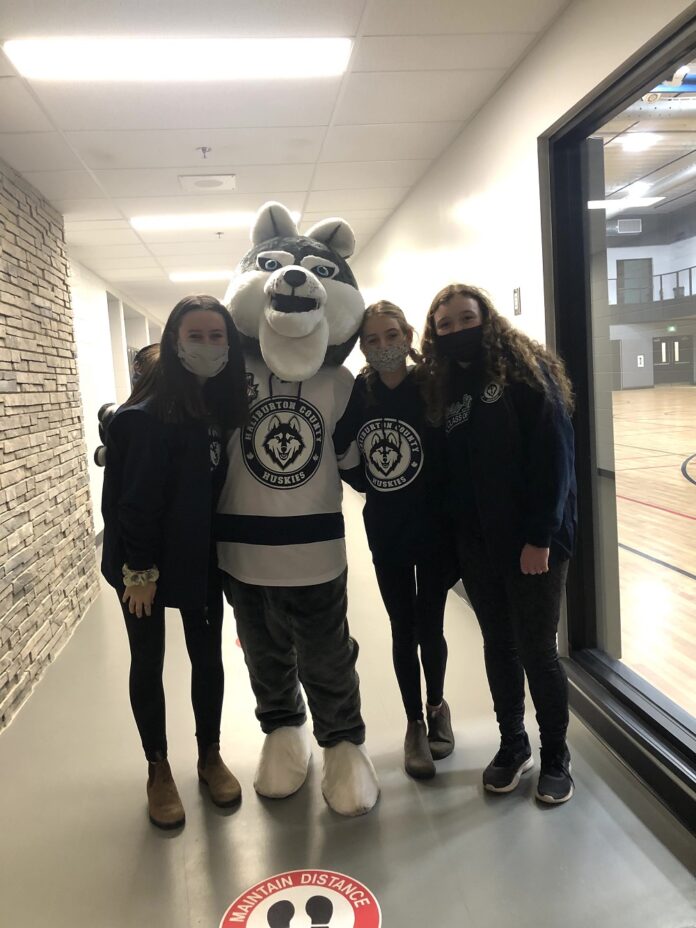
Volunteers help Huskies through first year

0

With Jr. A hockey set to resume at S.G. Nesbitt Memorial Arena this weekend, a group of 15 area residents are chomping at the bit to get back to work.

Each home game, the Huskies has its own mini-army of volunteers pulling together to cover a wide-range of responsibilities, including running security, manning the concession stand and even livestreaming games.

Klara Oyler was one of the first community members to offer her services last summer. Once it was announced the franchise would be moving to Haliburton County, ownership needed someone with computer skills to put together sponsorship packages and lay out all the paperwork for contract agreements. After doing a similar job with the Haliburton Highlands Health Services Foundation for several years, Oyler said it seemed a good fit.

“A friend of mine was heavily involved with fundraising, and I’ve known Paul Wilson (Huskies owner) for a long time. I started out very informally last summer helping out here and there, and it was great,” Oyler said. “It’s a brand-new organization, and I think it’s important that the community get involved.”

Hannah Sharp, a Grade 9 student at Haliburton Highlands Secondary School, originally signed up to help as a way of completing the volunteer hours she needs to graduate. Helping to sell team merchandise, enforcing COVID-19 protocols and serving people at concession, Sharp said she’s really enjoyed the experience thus far.

Even though she completed her hours during the opening half of the season, Sharp said she plans to stick around and continue helping.

“I really like interacting with the fans and seeing people happy, and it’s cool that I get to watch the games,” Sharp said. “It’s great to see how many people come out to support the team. The arena is always really busy on game days.

“This has been a really cool thing for the community,” she added.

When Mac Monk-Cray learned Haliburton County would be getting a new hockey franchise, he reached out right away to see how he could help. A recent graduate of Brock University’s sports management program, he was eager to learn anything he could regarding operations of a junior hockey franchise.

His primary responsibilities this season have been putting up the advertising signs along the glass in the arena, and running the live stream of games for HockeyTV.

“They’ve actually allowed me to do a lot of really cool things. Right away, they’ve welcomed me in and really made me feel like I’m part of a team. We’re kind of like a big family,” Monk-Cray said.

He said it’s been incredible to watch the Huskies’ evolution this season, going from playoff hopefuls to genuine championship contenders.

“You always heard about the usual OJHL beasts like Wellington and Trenton, but Haliburton has more than competed with them this season. It’s been so much fun being a part of this journey,” he said.

Oyler said she’s excited to head back to the rink Feb. 5. Now forming part of the ticketing team, she’s looking forward to greeting some familiar faces.

“I’m just itching to get back. It’s been great for me socially, being able to get out and see people again. You generate real connections,” she said. “I know all the regulars by now. There was a funny situation before the break when a gentleman came through with his wife, he reached into his pocket and panicked. ‘It was my job to get the tickets off the kitchen counter, and I forgot them,’ he said. I told him don’t worry about it, I know who you are, and that you’ve got season tickets.

“Those are the kind of things you can do in a small town like ours. I feel like, during a difficult time with the pandemic, the Huskies have really brought our community together,” she added.