
It was exactly a decade ago when Otter Lake cottager, Lisa Lauter, started to suffer from immense fatigue, brain fog and sudden bouts of nausea that she believed were symptoms of living a busy life as a full-time nurse and mom to three preteen boys.
Not thinking or knowing there was anything seriously wrong, Lauter soldiered on until, one day in the summer of 2017, she suffered a rare tonic-clonic seizure on the dock of her Dorset property.
“That changed everything,” Lauter said, noting she became obsessed with finding out what was going on. Testing was done in Huntsville and Barrie before Lauter returned to her then-home in Houston, Texas searching for more answers. She got a formal diagnosis of autoimmune encephalitis in February 2018.
The Mayo Clinic describes the affliction as a group of conditions that causes swelling in the brain. This usually happens because the immune system mistakenly attacks brain cells. Other symptoms include memory loss and changes in thinking and behaviour.
The scary thing about autoimmune encephalitis, Lauter said, is that experts don’t know what causes it. For some, it can be triggered by certain cancers or infections, or medicines for others. People with an existing autoimmune disease or a family history of them may be more likely to contract it.
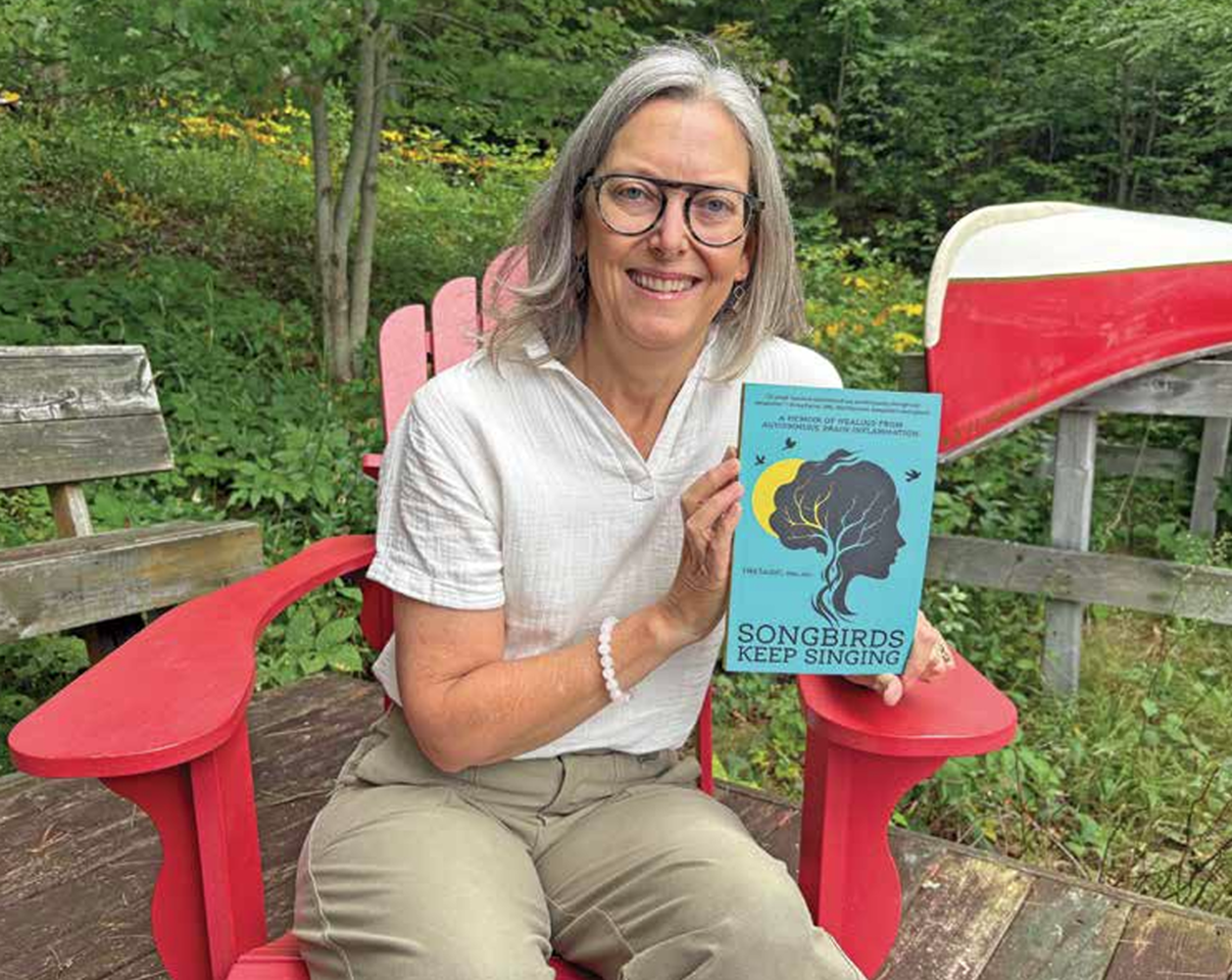
Such was the information overload Lauter put herself through following her diagnosis, she now considers herself a rare patient-expert hybrid. She has written a book, Songbirgs Keep Singing: A Memoir of Healing from Autoimmune Brain Inflammation, outlining her journey through diagnosis and recovery. It was published in July.
“It was very hard for me to navigate the system and find out what I needed in terms of treatment and what I could do. That was a big motivator for me to write the book – to raise awareness,” Lauter said. “I think there’s a lot in my book and my story that could be helpful to other people facing chronic illness.”
The book took her about four years to write and isn’t like your typical guide, Lauter said.
“I’m very careful not to be prescriptive, because every case is so individual. What I tried to do was write it in a way that gives people ideas of what they can ask for, advocate for, different strategies they could consider adopting for their overall health, things they could ask their doctor. I’m also just very real about my story and the obstacles I faced,” she said.
For example, feeling a strange numbness and tingling sensation around her forehead and under her eyes, sleeping up to 20 hours on her bad days, and losing cognitive function.
It was a long road to recover for Lauter – one that continues now. Since her 2018 diagnosis, Lauter said she’s completed rehabilitative, physical, occupational, aquatic, vision and vestibular therapies, while also changing her diet and adopting a more positive mindset. It was a strenuous first 18 months, but the results, she said, have been spectacular.
“As I write about in the book, I never thought I wouldn’t get better. Just having a strong determination to do everything you can to recover, I think, is half the battle,” Lauter said.
Now living in Nelson, British Columbia for most of the year, Lauter said she still spends summers in the Highlands – only recently returning home. She launched the book in an event at the Dwight Public Library Aug. 25.
Learn more about Lauter’s story at www.lisalauter.com. Her book can be ordered online at Indigo.ca or in-person at Cedar Canoe Books in Huntsville and Bracebridge.