
The Land Between’s Leora Berman has always harboured dreams of running an incubation program big enough to regenerate the Highlands’ turtle population. Now, she’s one step closer to achieving her goal.
The local charity, founded by Berman in 2007, was awarded a $196,000 grant by the Ontario Trillium Foundation last week, with the money to establish a new Turtle Guardians nursery in Gooderham. Berman said she hopes to have the site up and running by June 2027.
“This is a reason to celebrate and a major milestone for the organization,” Berman said, noting the endowment is The Land Between’s first capital grant. “Our goal is to be on par with Scales Nature Park. They’re the largest incubation centre in Canada… we’re at the point now where, if we don’t do something soon, our kids will not grow up with turtles.”
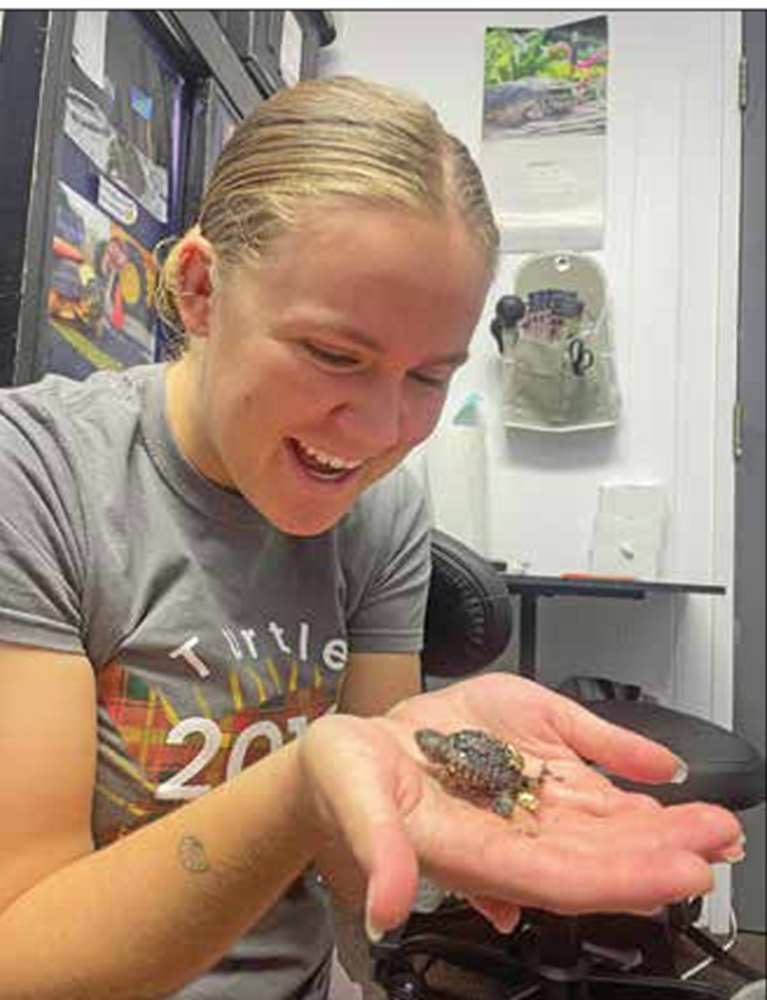
Berman said staff and volunteers respond to calls from the public about turtles on roads, or in dangerous situations. Because turtle eggs are so vulnerable, they’re taken back to Turtle Guardians’ facility in Haliburton village, where they’re cared for and nurtured for 10 days before being released back into the wild.
This year, the facility took in almost 14,000 eggs from approximately 500 nest sites across the County. They have to maintain a 97 per cent success rate in hatchling survival to maintain their incubator permit. Berman said they’ve always hit that benchmark, but survival in the wild is slim.
Charity hopes to raise another $400,000
“We balance the odds from 1 in 1,400 eggs reaching adulthood [left alone in nature], but it’s 1 in 250 if we excavate nests and incubate,” Berman said. “So, even after all our efforts this year, we have 300 turtles reaching adulthood, we’re seeing an average of 1,000 dead turtles every year… so we’re not even coming close to replacing the dead ones.”
Since 2016, Turtle Guardians has been patrolling roads across Haliburton County, Peterborough, Kawartha Lakes and Hastings Highlands, tracking data for rescues, injuries and fatalities. Berman said some areas are seeing losses of up to 40 per cent in turtle populations.
Because Turtle Guardians has only been able to care for hatchlings for up to 10 days before releasing them, Berman said they return to dangerous locations on the side of roads, where they’re prone to be hit by cars if they wander, or picked off by other animals.
To go along with funding for the new facility, Berman said she’s also secured an extension to the amount of time hatchlings can be under Turtle Guardians’ care, now up to two years.
“Now, we’re going to try to boost the turtle population ourselves. If we grow them for one or two years, the hatchlings are that much bigger when they’re released. They won’t be targeted by frogs or fish, and will be difficult for herons to take, so we’re cutting at least half the threats to them right away,” she said.
She’s aiming to take in 20,000 hatchlings next year, though hopes to grow to 30,000 when fully operational. Her upside limit is 50,000.
The 1,500 sq. ft. facility will basically be a turtle farm, Berman said. It will need to be bio-secure to keep new diseases away, with heated flooring required to maintain temperatures.
While thankful for the grant, Berman said she’s around $400,000 short of funding the project. That will cover construction, infrastructure and equipment costs, while also establishing an endowment fund for emergencies. Anyone interested in donating can contact info@turtleguardians.ca.
Once built, Berman said she’ll also be on the lookout for more volunteers to help run the space.
“I want this to be a community project. We want people named on the permits, out excavating nests, helping to raise the turtles and, eventually, release them. That way it becomes sustainable. It becomes a Haliburton project forever – that’s kind of my dream,” she said.
Twins update
Conjoined twin snapping turtles, Bert and Ernie, have beaten the odds thus far, Berman said. Recovered from Eagle Lake in August, the pair were still at Turtle Guardians’ home base in Haliburton as of Tuesday (Oct 6).
“They’re still doing well. I don’t think they’ll make it much longer, but they are still going,” Berman said.
The mini snappers were born with two heads but only one shell and body, a condition known as bicephaly. Conjoined twins occur once in every 100,000 cases among turtle hatchlings.
Berman said the pair would soon be shipped off to Simcoe County, where they’ll be cared for at another rehab centre.