

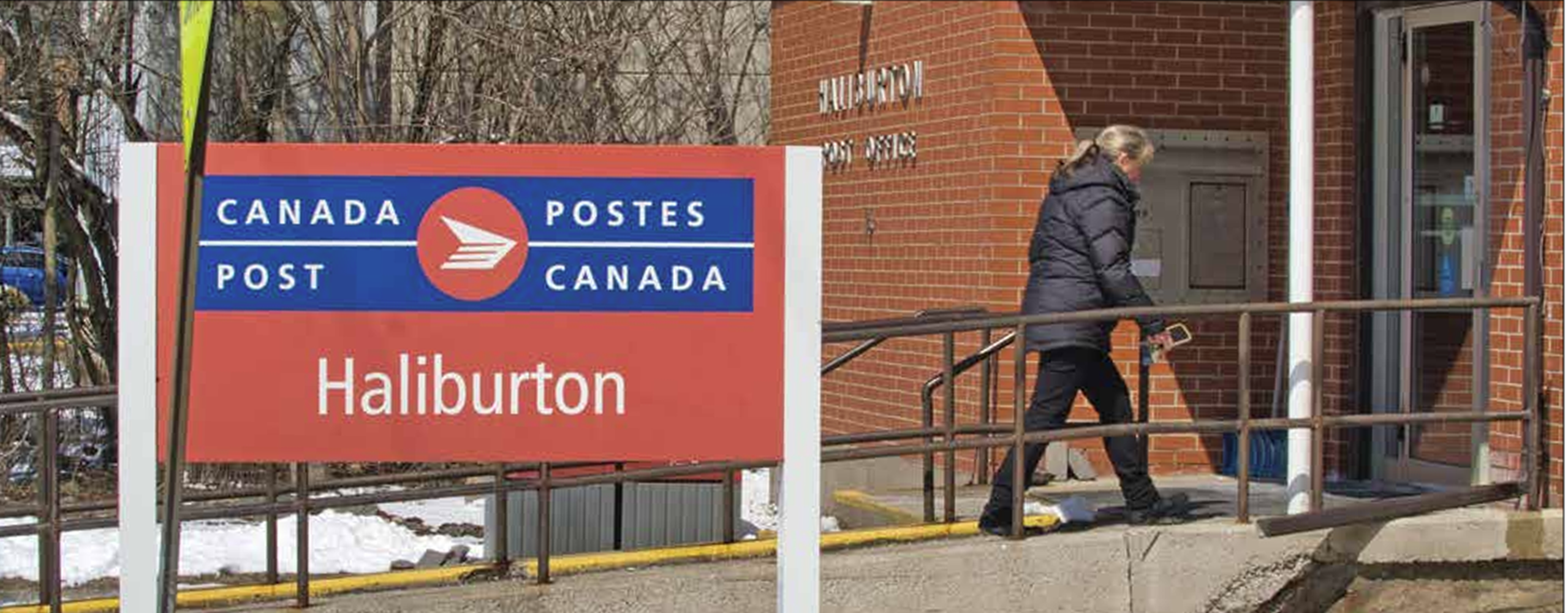
By Adam Frisk Local Journalism Initiative Reporter
It appears that Canada Post is moving forward with its restructuring plan, which includes several proposed cost-saving measures, including the end of door-to-door mail delivery and the possibility of post office closures.
Last week, the Crown corporation announced that it is moving forward with the transformation plan, as directed by the federal government last year, which includes the transition to community mailboxes. While the latest announcement doesn’t directly affect the Minden, Haliburton and Wilberforce areas, since they don’t have letter carriers, it opens the door to the potential of having postal outlets shuttered, the union said.
“We continue to work closely with the government on the details of our proposed transformation plan. At the same time, given the government’s direction to begin taking initial steps, we are reaching out to our bargaining agents to consult on our approach to several proposed changes,” Canada Post said in a March 30 statement to The Highlander. “These proposed changes include converting the remaining addresses that still receive delivery at the door to community mailboxes and modernizing our retail network.”
The announcement comes as the Canadian Union of Postal Workers (CUPW) is in the middle of a ratification vote. Local union president Kelly Lawr blasted last week’s announcement, calling it a “complete s***show.”
“It’s absolutely ridiculous,” she said.
Lawr said that the government has had Canada Post’s proposed changes for about four months, only to end up releasing it now during the ratification process.
Canada Post said it would be working with the federal government “delivery standards for letter mail, which will require amendments to the Canadian Postal Service Charter.”
“Canada Post has reached an important turning point,” the Crown corporation said. “Our transformation will strengthen the postal service, allow us to be a better partner for businesses, and help us meet our dual mandate of delivering for all Canadians in a way that is financially self-sustainable.”
The proposed transformation also opens the door to the closure of rural, small-scale, postal outlets. Lawr pointed at Kinmount and Burnt River as high-risk locations that could be shuttered. She said that because both of these locations operate with only one route, they would be “top of the list” for closure, forcing residents to travel further to access postal services.
“It’s not, in the company’s eyes, worthwhile for them to keep it open for one route,” Lawr said.
While much of Haliburton County already utilizes roadside delivery, community mailboxes, and P.O. boxes, Lindsay still maintains urban letter carriers. These positions are now directly in the crosshairs as Canada Post pivots to community mailboxes.
The local union president questioned the financial logic behind the transition, pointing to the costs of manufacturing community mailboxes, scouting safe locations, and providing vehicles for previous walking routes, which might offset any projected savings. Prod:
“How much are you actually saving by doing this?” Lawr said. “It’s like they’re intentionally driving it into the ground. It’s unbelievable.”
The union president went on to voice her concerns for seniors and those with mobility issues, noting that while Canada Post offers the delivery accommodation program for those unable to reach a community mailbox, getting into the program is a bureaucratic nightmare.
“From the feedback [users] have given me… it is extremely difficult. It was a lot of back and forth, doctors’ notes. It just felt like pulling teeth trying to get onto this program,” Lawr said. “And that’s if you even have a family doctor in this area.
“I don’t think the corporation realizes how much of a lifeline we actually are,” she added.
The postal service said once the initial consultations with bargaining agents were completed, they will begin “engaging municipal officials.”
“We’re committed to moving forward in a thoughtful way that prioritizes service for all Canadians while protecting access to vital postal services in rural, remote and Indigenous communities.”