
By Adam Frisk Local Journalism Initiative Reporter
The Haliburton tourism industry is ushering in a new era by welcoming the formation of an industry-led Municipal Services Corporation (MSC).
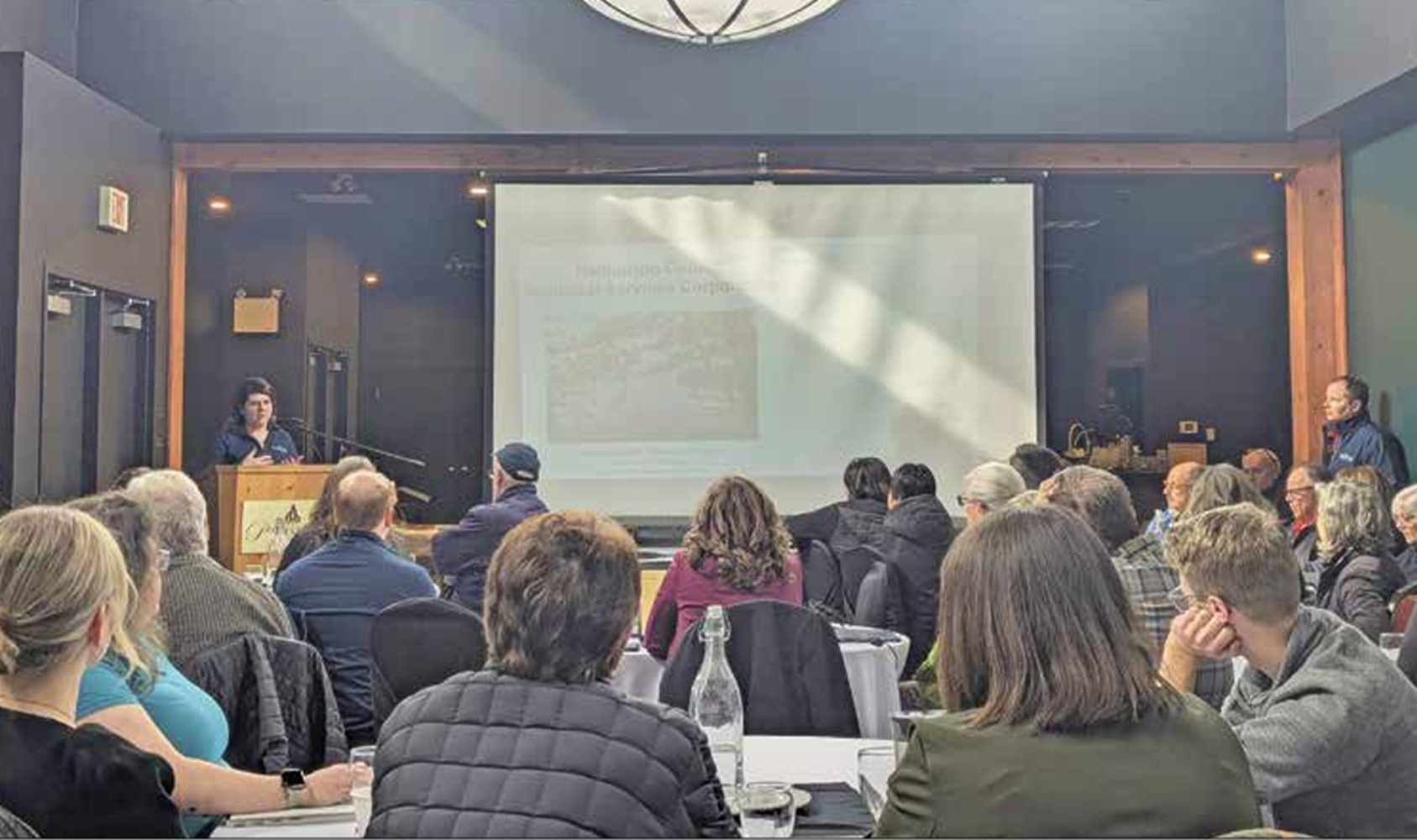
During a tourism stakeholders meeting that was hosted at the Pinestone Resort and Conference Centre on April 2, the County of Haliburton said it is restructuring how it handles tourism by moving toward a more collaborative, stakeholder-led model. The move comes after the County begins to see the revenue generated from the Municipal Accommodation Tax (MAT) on short-term rentals.
Angelica Ingram, manager of tourism for the County, explained that the shift wasn’t just about tax dollars, but about rebuilding a connection with business owners that had been lost in recent years. She explained, following the seminar, that for nearly a decade, various tourism groups existed in the Highlands, but the most recent iteration disbanded in 2022.
“The two people who were leading it were just too busy, and they couldn’t continue, and nobody really took on the reins,”
Ingram said. Ingram said that since she stepped into her role at the end of 2023, businesses have been vocal about wanting to reconnect.
“I listened… I said I need a little bit of time to just get my feet wet,” she said. “Then in 2025, I started to have conversations with people: ‘let’s try to get this thing going again.’”
And thus a tourism stakeholder session was held. The informal stakeholder group will be supported by the County, the Haliburton County Development Corporation (HCDC), and the Chamber of Commerce. While not a formal committee of council, Ingram explained that the information gathered at these meetings will directly impact her department’s choices.
“This is a really great opportunity for me to hear what people are saying, how they’re feeling… You can send out emails, you can do online surveys, but the engagement isn’t always there,” the County representative said. “This is the kind of engagement I love.”
For many others in the room, the meeting was a welcome reunion.
“I used to religiously go to all the meetings previous to COVID,” Tegan Legge, general manager of tourism and recreation at Haliburton Forest, said. “Meetings like this are really important so that we can gather and see what’s going on and see who’s still in the room. There are operators in this room that I didn’t even know were still in the County.”
So how does the MSC work? Under provincial law, 50 per cent of MAT revenue must go to an entity responsible for tourism marketing and development. Since the tax took effect on October 1, 2024, the County has begun tracking its impact.
“The first year we’ve seen about $85,000,” Ingram said, adding that three townships are collecting, and one is still in the implementation phase. “I think $100,000 is a better picture going forward of what we could see.”
And where will the money go? The County said that the spending power would lie with MSC’s seven-member board, which would be made up of four council reps and three public members.
“The decision won’t be mine or Scott’s (Scott Ovell, director of economic development); it will be the MSC that gets to make that decision,” Ingram explained.
A “wish list” of projects for the MSC has already taken shape with wayfinding, signage, and rail trail enhancements. There’s also a plan to shift marketing behaviour from individual business competition toward an entire regional brand identity.
While the MSC focuses on marketing and signage, operators like Legge suggest that the County look at some of the barriers in the industry to keep Haliburton competitive.
“Tourism aside, but the County in general, if they can help with public transportation and cutting red tape for accommodators… that’s really beneficial,” Legge said. “Things like my canopy tour, I can’t fill it if I don’t have enough accommodations in the area for people to stay in.”
The stakeholder said that a successful tourism industry requires support for the workforce.
“It’s not just about staff housing. It’s also about daycare. It’s about being able to support those young families that are going to be working in our industry,” Legge said. “Housekeeping, servers, front office. That is probably even more important sometimes.”
The consensus in the room following the two-hour session was that Haliburton’s tourism industry will be stronger with a collaborative, not a solo, mission.
“People always think they’re in competition with one another. They’re not,” Ingram said. “Their best success comes from working together.”