

By Adam Frisk Local Journalism Initiative Reporter
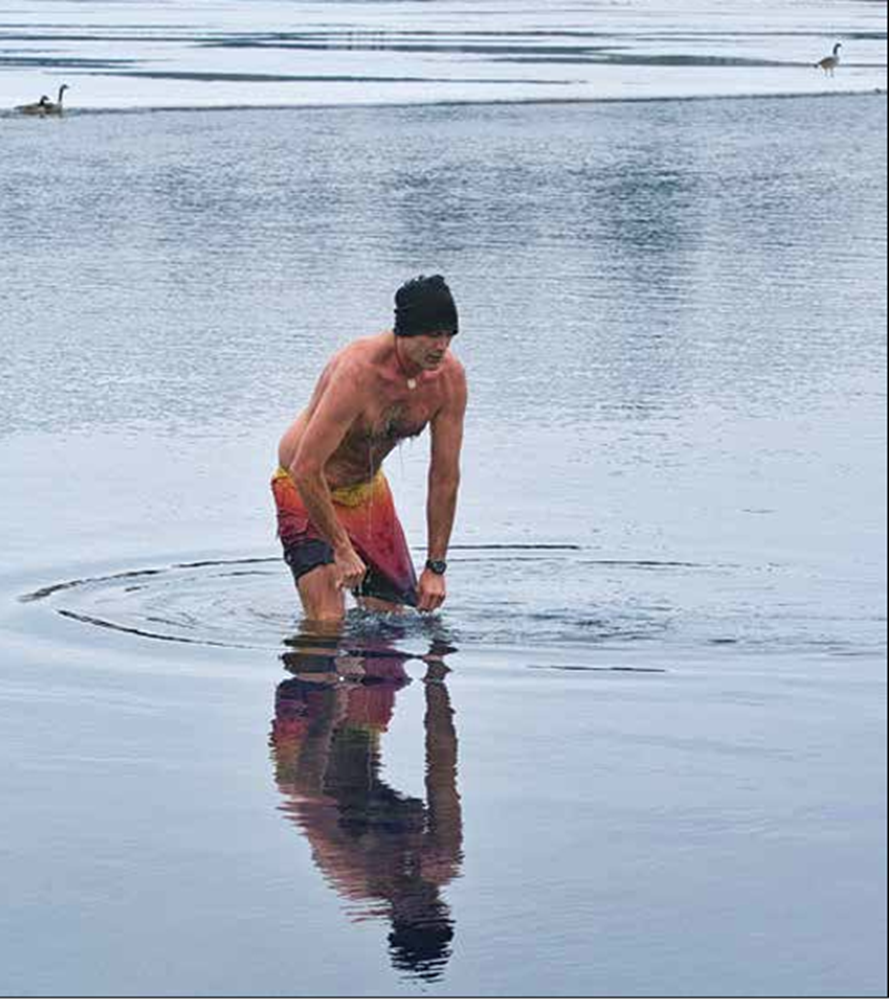
On a crisp spring morning, dog walkers are usually seen at Head Lake Park bundled up while taking Fido for a stroll past the frozen beach. But for Jon Dunsmore, the sub-zero temperature and partially frozen lake were just what he needed.
Dressed in his swimsuit, a toque, and a towel hanging off his shoulder, Dunsmore walked the path past the dog park, dropped his beach towel on the rocks, and walked straight into Head Lake.
Dunsmore, who was visiting his mother, a lifelong local, explained to The Highlander that he wasn’t going to let a change in geography break a disciplined habit: a daily polar dip.
“I try to do it every day,” he said. “And I just wanted to keep the streak going.” A resident of British Columbia’s Haida Gwaii, Dunsmore plunges into the Pacific waters every single day in a ritual that isn’t about the thrill, but more about the mental edge.
“It’s not something I enjoy doing,” he admitted after emerging from the icy water of Head Lake. “But to force myself into the water every day is a great element to bring into my life. If I do this every day, everything else seems a little easier.”
Dunsmore said the practice helps boost both his physical and mental health, and that self-discipline was the primary driver. Despite the honking geese that joined the B.C. native in the frigid waters, Dunsmore said his internal dialogue goes silent while he focuses on just one thing. Breathing.
“When I first go into the water, you kind of have that sensation of a loss of breath,” he explained. “I really try to control that, focus on my breathing, and just do some real deep breaths while I’m in there… just silence the mind.”
According to several Canadian studies, frequent plunges into icy water can provide several health benefits, including increased metabolism and reduced inflammation. However, according to the Heart and Stroke Foundation of Canada, exposure to sudden cold can spike heart rate and blood pressure, which can be dangerous for those who may have heart conditions. People should consult their family doctor before trying the practice, and never take a plunge alone.
As for Dunsmore, back in Haida Gwaii, the ocean temperatures typically hover between 5 C and 10 C, but he found the freshwater of Haliburton to have a bit of a “bite” to it.
“It’s colder than back home, definitely,” he said. “I’ve never taken the temperature of the water [in Haida Gwaii], but it doesn’t have that same bite as it does here.”