

Last week’s virtual panel hosted by Environment Haliburton! – dissecting the negatives of incineration – brought forward as a possible solution to the County’s waste management woes – was the first concerted effort by the community to learn more about the controversial process.
It came just months after County council committed to investigating incineration, largely at the behest of Dysart et al deputy mayor Walt McKechnie, who has spent much of this term advocating for it.
It took Dr. Paul Connett, a retired environmental chemistry professor and one of North America’s leading speakers on waste management solutions, about two minutes to convince me an incinerator is likely never coming to Haliburton County.
For one, the cost is wildly prohibitive. We heard how the Durham-York plant located in Clarington cost $295 million to build in 2016 and carries an annual operating bill north of $16 million. Connett estimated a similar facility could cost between $400 and $500 million if built today.
Granted, that’s a much bigger facility than we would need in the Highlands. The Durham-York plant processes about 140,000 tonnes of waste per year. Our four townships combined generate about a quarter of that amount. Maybe.
McKechnie said he wants to see a made-in-Haliburton County solution. He doesn’t believe there’s any need to pursue a facility as large as the one serving Durham-York, calling for something smaller. He said there are many examples of small-scale commercial incinerators operating around the world. He has said others could shop their waste here, too.
According to John Watson, Dysart’s environmental manager, there are limits to what can be done with municipal systems. He noted the plant in Durham-York is one of the smallest incinerators Cavanta, the company that runs it, operates in North America. Speaking at a council meeting in May, Watson didn’t think an incinerator was viable.
Even if it was decided the County could get a cost-effective burner, where would it go? For a community renowned for its natural beauty, dropping an oversized furnace here, even in some far-flung corner, would likely do more damage than it’s worth, certainly from a tourism perspective. And NIMBYism will raise its ugly head, too.
McKechnie is right, though, when he says something needs to be done. The biggest landfill in Dysart, the Haliburton site, is already at end-of-life having been capped in 2020. The Maple Lake landfill in Algonquin Highlands has about 45 years of life left, while the Scotch Line facility in Minden Hills has a remaining lifespan of about 11 years.
Soon, most of our major landfill sites will have transitioned to a transfer station. While it’s not a great use of money spending hundreds of thousands of dollars shipping garbage elsewhere, as McKechnie claims, we don’t have any other choice right now.
With a resource as invaluable as U-Links Centre for Community-Based Research on our doorstep, perhaps there’s an opportunity to engage with the bright minds from Trent University and Fleming College to help us forge a new path.
Connett’s suggestion of establishing a zero-waste strategy in the Highlands, while noble, is more of the same pie-in-the-sky thinking that I just can’t see happening. At least not yet. Maybe people will be more amenable in another 30, 40 or 50 years, when our landfill space really dwindles. Or our townships are more open-minded to wide scale organic recycling and composting.
I’m glad these conversations are happening – incineration is likely to be one of the hot-button issues leading into the 2026 municipal elections. It’s important to know where people stand.
It’s equally important that groups like EH! continue to bring experts like Connett in to discuss the issue. But it’s important to be balanced.
Next, I’d like to hear from someone who can talk to the benefits of incineration. There must be a reason places like Durham Region and York, as well as Edmonton – which recently committed to building a new $300 million, 150,000-tonne-per-year incinerator – are doing this.
With inflation driving up costs for people all over the country, nobody is lining up to burn money. Maybe incineration is the key, maybe not – a lot more discussion and local research needs to take place before we can say for sure.
Incineration a hot topic
For the love of animals

David Hyland was naturally surprised earlier this week when a peacock showed up on his property just down the road from Furnace Falls.
The animal lover took the bird under his wing so to speak, offering it sanctuary and food.
He had some ideas of how the peafowl may have come to the Hwy. 503 area, but had no proof. It was a bit of a mystery.
Not sure whom to call, he reached out to The Highlander. We are far from bird or animal experts, but we do know animal welfare charities in the area.
Naturally, we thought of Woodlands Wildlife Sanctuary. However, they are licensed to rescue wild animals. From everything David was saying, and from what I could see when I visited the bird on his property, this peacock was tame. It appeared to be a domesticated animal. As such, WWS could not take it in.
They suggested some other avenues and David was left with a list of phone contacts.
Peacocks are allowed on agricultural properties in Ontario, but cannot be kept as pets. David conjectured this one may have been stolen and maybe plucked for its feathers.
Again, while no bird expert, I began to do some research. I discovered peacocks can molt, between February and August, so this bird may have dropped its feathers naturally.
But the real mystery was where had it come from? Were there any agricultural properties in the Furnace Falls area missing a peacock? There were Airbnbs in the area. Had someone brought it from elsewhere?
When we get animal-related calls in this area, it is sometimes difficult to figure out whom to contact. The local organizations, such as WWS and The Land Between-Turtle Guardians, are pretty responsive. We’re a long way away from the nearest OSPCA. Provincial ministries are not nearly as reactive as they once were. It can leave people such as David somewhat in the lurch.
We are also hearing from local animal welfare advocates that they have been beseeched since COVID-19’s winding down.
During the pandemic and lockdowns, people thought it would be a great idea to get a dog, cat, rabbit, guinea pig, snake, rat, you name it, for a pet to keep them company. Now, they’re dumping these animals at alarming rates.
A CBC report from last July documented how more people were surrendering their pets and animal shelters were pleading for help. It is a trend that is continuing. Organizations said people having to return to work, and the rising cost of living, were contributing to a crisis. A shortage of vets may also be causing issues. As a result, sadly, some have simply dumped their pets. Meanwhile, fosters are down, donations are down, and adoptions are down.
It’s tougher in rural areas. In places such as Toronto, for example, the Toronto Humane Society has an urgent care system. Owners experiencing a crisis or financial hardship can apply to the program, and their pet will be temporarily put in a foster home until the owner can take the pet back. They also have pet food banks.
But I digress. What we’d really like is for anyone local who may be missing a peacock to get in touch and we’ll connect them with David. If any animal welfare groups can help out, we’re also eager to make the connection.
New marina owner plans resort
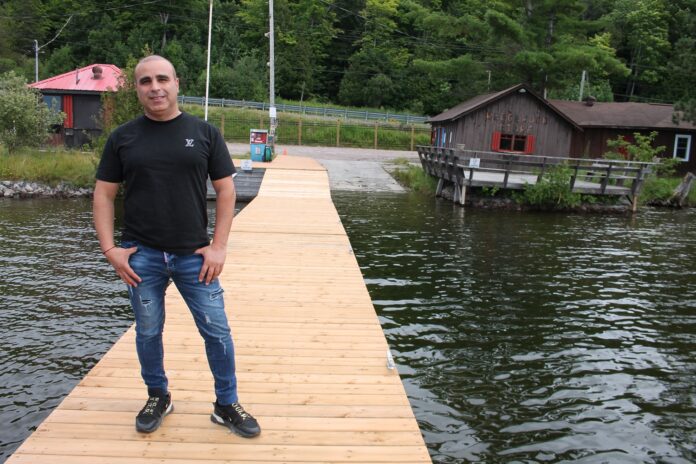
The new owner of the former Wedgewood Marina on 12 Mile Lake is planning to build a small resort on the property.
Ronen Ifraimov said he was driving through Haliburton County for the first time when he noticed the property up for sale. A developer and builder from the Greater Toronto Area, it caught his eye.
“I was meeting a few colleagues up north for a retirement home project, and on the way back I saw this land for sale, and the moment I saw it, I had a vision.”
He noted the buildings and property were run down and thought, “what a shame, such a beautiful lake, such a beautiful area.” He contacted his realtor, and was soon in negotiations with the former owners. The sale was recently completed.
One of the first things he has done is purchase the boat launch as part of the sale. He said it will remain open to the public. He has already put in a new docking system, valued at $120,000. Ifraimov added he plans to replace the gas tank and pump to offer fuel to boaters. He emphasized the new entity will not be a marina, but he has purchased insurance to cover the launch and will offer gas. As for other marina services, he is happy to speak with potential operators who can independently offer boaters launch, servicing, winterizing, transport and storage options.
Public boat launch will be retained
Ifraimov said he initially had no intention of getting involved in boat launching, but after reading newspaper articles in The Highlander, documenting how residents along the lake chain would be impacted by the loss of their launch, he changed his mind. Though insurance is costing “an arm and a leg” since they are not a marina, Ifraimov said he wanted to get off on the right foot with neighbours.
“It’s going to be my second home, it’s going to be my resort, my kids’ resort, I want to take care of it like my own.
“I obviously had a concern because no one could launch their boats. I didn’t want to be the guy that’s taking over a property where I ruin it for everybody,” he added.
He is allowing the public to use the launch for free this summer and autumn. Some boats are also using the slips free of charge. He will have to charge next year but said rates would be reasonable. “Even if I charged $100, which I won’t, it will not cover my insurance. It’s basically public service.”
Small resort
He has also spent $150,000 on fencing. Overall, Ifraimov said they are looking to invest $6-8 million into a small resort.
He does not yet have architectural plans, but is envisioning a two-storey motel, a large cottage for families to rent on the hill, smaller, two-storey timber chalets closer to the water, and an Italian restaurant. He’ll also have housing for his family and out-of-town tradespeople. However, he said they will try to use local workers when they can. He thinks it will take six-to-eight months to get plans and then it will be a year or two until construction, depending on how things proceed with the Township of Minden Hills.
Ifraimov, originally from Israel and coming to Canada at the age of nine, runs Perfectly Built, owns a company called Art Farms in the Ontario Food Terminal and is also at the helm of Deluxe Produce, all in the GTA. He said his firm is currently building 62 homes in Dundalk, and is about to start construction on a retirement home in Walkerton.
On 12 Mile, he said he would eventually be tearing down all of the existing structures and building anew. Until then, he said they’ll have the launch and gas, and likely keep the barbecue shack open.
He said it is a personal – as well as a business – investment. “Because where we start, we continue. We will eventually want to build other things; whatever the County is looking for.
“I’m going to come here a lot. This town is going to be part of my family. it’s something we would want to take care of dearly from our heart and build relationships with everybody. We want to make sure it turns out perfect.”
He encouraged anyone with questions to call him at 416-825-4827.
Children’s Aid Society cuts ‘complex and sad’
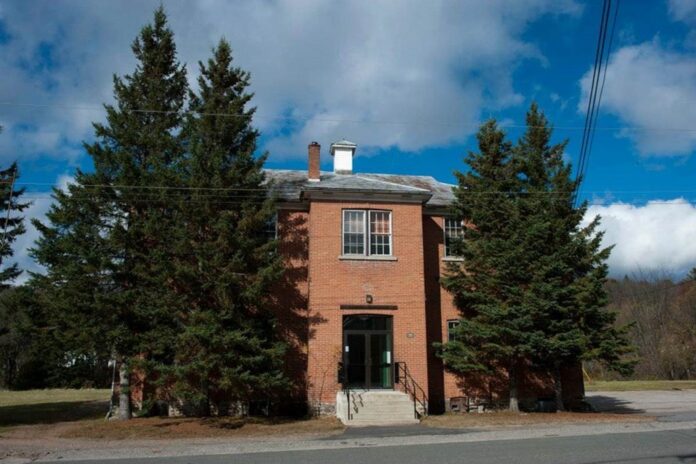
The Kawartha-Haliburton Children’s Aid Society (KHCAS) has announced plans to shutter its branch at 73 Victoria St. in Haliburton next year, and drop one full-time staff member, although the agency says it will continue to offer its services across the County.
Jennifer McLauchlan, executive director of the KHCAS, said, “from the community perspective, what they’re not going to see is a physical presence. Although we are committed to working with our community service partners in the Haliburton and Minden area to find an alternative location, that we could partner and work out of another space while we get our financial situation back in order. Then we can reconsider whether or not there is a physical office required.”
The one full-time lay-off will reduce the number from three full-time, two-part time and a shared manager with Lindsay and will occur between now and March 31, 2025. The office is slated to close April 1, 2025.
The KHCAS is currently working with approximately 30 families in Haliburton. Head office is in Peterborough with another branch in Lindsay. McLauchlan said most of the outreach work is done in client family homes, or within the community. They have remote work agreements with staff as a result of COVID and most employees work from home, with access to the office.
Overall, 24 full-time equivalent positions, affecting 25 people, will be eliminated across the three locations.
As for local layoffs, McLauchlan said, “the concern is with fewer staff doing the same amount of work, staff will be impacted by having more of the same work to do. What we’re looking at doing internally is working with the staff in terms of ‘how do we deliver the same level of service’?”
County demands meeting with province
Ruby Taylor is OPSEU local 334 president, which represents impacted workers. She said the union is concerned about not having a presence in Haliburton County. She added with the loss of one worker “our worry is for the safety of the children and the work that we do with families in that community with less people.” She said they were already understaffed, even before the cuts, so it impacts remaining workers
Operating in deficit
KHCAS said the reason for the measures is the society has been in a deficit position the last two years. The Ministry of Children, Community and Social Services does not allow that. It’s forced a deficit management plan.
The KHCAS attributed the deficit to years of funding reductions, increased costs, increased complexity of need, and the lack of services required by legislation within the funding allocation.
McLauchlan elaborated waitlists are growing and they don’t have enough foster families, paying them $50a-day, so are having to use outside paid resources, largely for-profit, and licensed by the ministry, which can cost between $400 and up to $2,600a-day. Part of the plan is to boost the number of foster families.
It is looking to cut $7.6 million out of a $22 million budget.
KHCAS board chair Sandra Robinson said decisions, “were not made lightly, especially related to reducing staff. We know the leadership team and staff are firmly committed to delivering quality services to children, youth and families and they will work together to maintain these services to ensure child safety and well-being.”
McLauchlan added, “this is a very difficult time for our staff. The priority moving forward will be to focus on how we deliver services, and to work with community service providers to strengthen services that support children, youth and families, while supporting our staff through the transition.”
KHCAS is not alone in facing financial challenges in delivering mandated services. Over half of child welfare agencies in the province were projecting deficits at the end of last fiscal year.
“The Ontario child welfare sector needs sustainable, stable funding to ensure agencies can deliver high-quality, traumainformed, culturally-relevant care. They also need an updated funding formula that truly prioritizes early intervention, prevention, and continued connections to kin, community and culture,” the KHCAS said.
They added, “the Ontario government needs to make targeted investments to strengthen social infrastructure in communities across the province so that human and community services organizations and providers can deliver vital support to children, youth and families at the right time, close to home.”
Point in Time and County respond
Marg Cox is the executive director of Point in Time Centre for Children, Youth and Parents, based out of Haliburton.
She said the KHCAS situation is “very complex and sad. We certainly understand the agency is mandated to drastically cut costs and still provide essential service, however there needs to be some changes to allow for cost-effective investments that will increase local placements, like reimbursement for kinship care, and higher rates of remuneration for foster parents overseen by the agency.”
She added Point is Time is committed to collaborating with KHCAS, “to ensure we’re doing everything we can so Haliburton children and families receive the support and service they require.”
County of Haliburton representative to Point in Time, Jennifer Dailloux, raised the issue at a July 24 council meeting. “This is pretty serious stuff. It will have important and unforeseen consequences for our children and also for our local service providers, such as Point in Time,” she said.
Dailloux added Point in Time is monitoring the situation and, “anticipating a potential uptick in crisis calls if the Children’s Aid Society is not able to offer the same level of service to families in crisis as it has up to now. It’s really big news.”
Council passed a resolution to inform Premier Doug Ford about the “harmful cuts” that will have an “extreme negative impact.” They have also demanded a meeting with Ford, minister Michael Parsa, and MPP Laurie Scott.
Fearrey: flag talk about policy not Pride
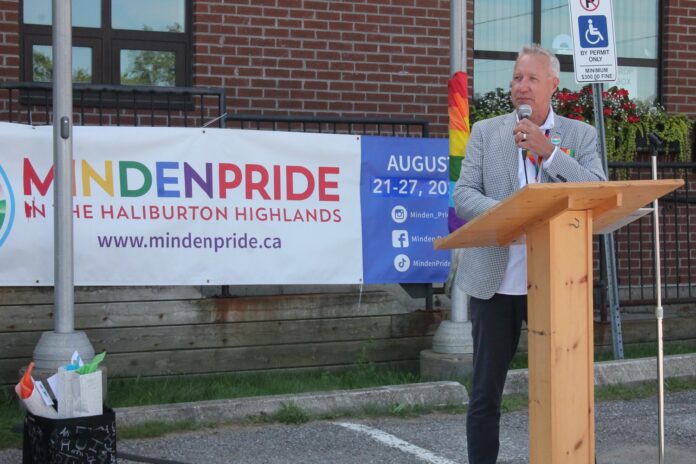
Dysart et al mayor Murray Fearrey said a recent decision not to fly the Pride flag at town hall, or participate in a Pride-themed community poster initiative, is more about establishing fair policy than taking shots at the LGBTQ+ community.
Speaking at a July 23 Dysart council meeting, Fearrey took exception to an invitation from the Haliburton BIA to take part in a ‘Show Your Pride’ decorating contest Aug. 1 to 9. The contest was organized by Minden Pride in advance of its upcoming Pride Week celebration Aug. 19 to 25.
Allan Guinan, Minden Pride chair, said the contest is designed to generate hype for this month’s festivities and help bring the community together. He said numerous organizations and businesses across the County would be participating, including some Highland Street merchants.
Fearrey said he had no problem supporting Minden Pride or the LGBTQ+ community but felt decorating a public space was a bridge too far.
“Town hall is for everybody. We don’t need to decorate the office. It’s an historic building. Why would we want to decorate it? We have to draw the line somewhere,” Fearrey told The Highlander following the meeting.
The mayor said he wanted to see Dysart establish a policy to cover these kinds of requests, which he also wants to extend to flag flying. He proposed a one-day limit for promotion on municipal property.
Speaking at the meeting, Fearrey said, “I don’t want flags up for weeks at the landfills, arena, or anywhere else (the township owns). You can have your day like anyone else, that’s just my opinion.
“It’s not going against what’s going on… in terms of flags, we run the flag up the pole for Remembrance Day, which is the people that made this country. I don’t think we should have any more than one day for any other flags. That’s not necessary,” Fearrey added. “What happens if we get a bunch of other requests from other special interest groups? What if the Palestinians came out to the community and said, ‘we want to fly a flag and have a special day’.”
Fearrey likened the situation to the recent controversy over different groups using Head Lake Park to host community events. The township implemented a new bylaw earlier this summer mandating organizers of any for-profit or revenue-generating event pay a fee to rent space in the park.
Coun. Pat Casey agreed a consistent policy is needed, saying he didn’t believe any group should be allowed to display prominent promotional materials on municipal property for weeks on end. “I have no bias one way or another… but it’s public space. This is something we’ll have to chat about, because how do you qualify who can fly the flag up a pole,” Casey said. Fearrey said he hoped to discuss a new bylaw at Dysart’s next meeting Aug. 27,
Minden Pride responds
Guinan expressed confusion and disappointment over the discussion, and said he was upset by what he perceived as Fearrey’s comparison between the Pride and Palestinian flags.
The Palestine flag is being used by people protesting the country’s conflict with Israel over the Gaza Strip, which dates back to the 19th century.
“I don’t believe there was a request for the council to decorate and there certainly was not a request for the council to raise the Pride flag,” Guinan said. “It was disappointing to hear terms like ‘special interest groups’… being compared to a group of Palestine supporters, I found that a ittle offensive.”
Brandon Nimigon, chair of the Haliburton BIA, said they received a request from Minden Pride last month to promote the poster contest, which it emailed out to members. Since the township is a member, it received the email.
Guinan confirmed the Pride flag will be erected at Minden Hills township office Aug. 19. He said Minden has a long history of supporting Minden Pride.
“Nine years ago, when we started to mobilize… Minden embraced us,” Guinan said, noting the group first approached Dysart about flying a flag, but were turned down. “That’s why we’re called Minden Pride, because they supported us when [Dysart] didn’t.”
A mixed bag as farmers markets hit mid-summer

As Haliburton County hits the dog days of summer, it’s been a mixed farmers market season, says Janine Papadopoulos, the Haliburton County Farmers Market Association (HCFMA) manager.
She said the return to Head Lake Park – albeit with a new fee to utilize the space – has been good. The HCFMA is absorbing the charge levied by Dysart et al township on behalf of its vendors.
“Dysart has changed their whole use-of-park policy, and now there is a fee for anybody who uses the park, except for not-for-profit organizations. So, we weren’t the only ones, but we were the first to instigate that,” she said.
Papadopoulos added, with a concern about wear and tear on the park, particularly when it is wet, “we have moved our vendors in locations that, if the ground is really, really wet, we’ve got them all situated in places that aren’t as wet. So, that’s why we’re not all in a row. We’re kind of spread out, and it’s worked out great.”
She added, “we’re totally thankful that we’re back in Head Lake Park as opposed to Rotary Park. One of our vendors sent me her numbers for the first five markets and she was up over 100 per cent of what she did the first five markets over in Rotary Park. So, the location is really important to our vendors.”
Asked to compare the market performance to when they were last in Head Lake Park, Papadopoulos said number of visitors, and revenue, is down.
She said it may have to do with the changed hours, going from 10 a.m. to 2 p.m., as opposed to noon to 4 p.m., but thinks it is also a reflection of the high cost-of-living.
Minden, meanwhile, which features a farmers and artisans market on Saturdays from 10 a.m. to 2 p.m. is “a great, going concern,” Papadopoulos said.
“Everybody loves the Minden market because there’s the advantage of having an artisan market run by the cultural centre. It means we can open up for more food-type vendors.” To be a farmers market, they need to be 51 per cent agricultural and 49 per cent other. Having the artisan market allows for more flexibility.
“Plus, it’s Saturdays. People come in to go shopping, and then they go back to their cottages,” the market manager said.
Meanwhile, the HCFMA has shuttered the Abbey Gardens market, which began there last year on Fridays. Papadopoulos said they simply were not getting the customers to warrant vendors attending. “It was costing them more money to be there than money they brought in.”
She added they could say it is because Haliburton Highlands Brewing is no longer at Abbey Gardens. “But the real reason is, we just didn’t have enough customers to support a third market.”
She said she will be surveying market vendors about what they want for 2025.
“Where do we want to go? What do we want to do? And let it be their decision. Now, economically, it doesn’t make sense to have three markets in Haliburton County.
“People aren’t spending as much and things are expensive. You buy your strawberries, that’s $8. To support local is great, but you have to also be able to afford to support local.
“I want input from our vendors so that we can create a market that serves them, and also serves our public.”
Papadopoulos added, “I’m just thankful we have two thriving markets for Tuesday and Saturday, thankful we’re back in Head Lake Park. People are loving that we’re back there. Our vendors are loving that we’re back there. Minden, we’ve got some great new vendors there that people are loving. It’s all good.”
Finding handmade heaven in Haliburton
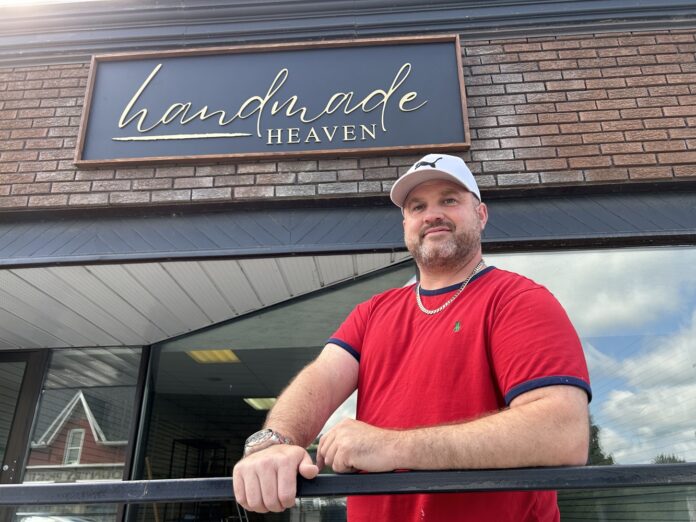
Highlanders now have another prime space to showcase their home-crafted goods, with Handmade Heaven the latest addition to Haliburton’s downtown business community.
The new store fills the space left by Halco’s The Source, which closed in the spring. After launching Handmade Heaven in early 2023, Sam Milne said he’s excited to set up shop in Haliburton. It will be his sixth location, joining stores in Peterborough, Barrie, Oakville, Markham, and Toronto.
“I really like the vibe of the community – it’s still got that small town feel. I love that there are still old-school family stores like Glecoff’s. It’s a busy, diverse downtown” Milne said.
A “modern” take on the community marketplace model, Handmade Heaven provides hobbyists and up-and-coming entrepreneurs space to promote and sell their goods. Milne said there will be items from approximately 100 makers at the new store, with half of those local.
Some of the County-based offerings include: Lynx 87, which specializes in woodworking, custom cabinets and home décor; Rowan and Oak natural soaps and candles; Encapsulated Love roses and forever bears; and Wee Lamb Collection.
Milne has spent weeks renovating the space – a mural representing “the rolling hills of Haliburton” greets people as they enter, while the walls are jam-packed with shelving featuring an array of products.
There are three price points for partners, Milne said, ranging from $130 to $260 per month. A five-tier “entry” unit that will be located in the centre of the store, an eightfoot by two-foot wall unit, and eight-foot by three-foot wall unit. Rent is due monthly, with makers retaining 100 per cent of sales. Vendors are responsible for managing inventory and setting up their space.
Products that prove popular will have the chance to be featured at other Handmade Heaven locations, Milne said.
Now living full-time at his family cottage on Catchacoma Lake, about 60 kilometres south of Haliburton, Milne said he’s embraced rural living. Setting up in Haliburton has taken him back to his childhood – he visited the community frequently as a kid and loved getting ice cream downtown before walking around Head Lake Park.
He stumbled upon the town again last spring while taking his son to Algonquin Park.
“The memories all came flooding back. But Haliburton has changed, this is a really busy place now in the summer. It’s hard even crossing the road some days, but that’s exciting as a small business owner – there are thousands of visitors during the summer, often from far away. It felt like the perfect opportunity, having this space where people can shop for cool things made locally that they won’t be able to find anywhere else,” Milne said.
He hopes to become a hub for the arts scene and encourages any small business owner wanting to reach a wider audience to connect.
“This is about building community – in some of my other locations, owners come together, share ideals, collaborate sometimes. It provides unique opportunities,” he said. “My aim is for people to do so well that they keep increasing their space, growing, and see where that takes them. Down the road, maybe it leads to them going out on their own – that’s what Handmade Heaven is all about.”
A grand opening was held July 27, with Milne saying the store was abuzz for much of the day.
For more information, visit handmadeheaven.ca/haliburton.
Minden Collision passes to next generation
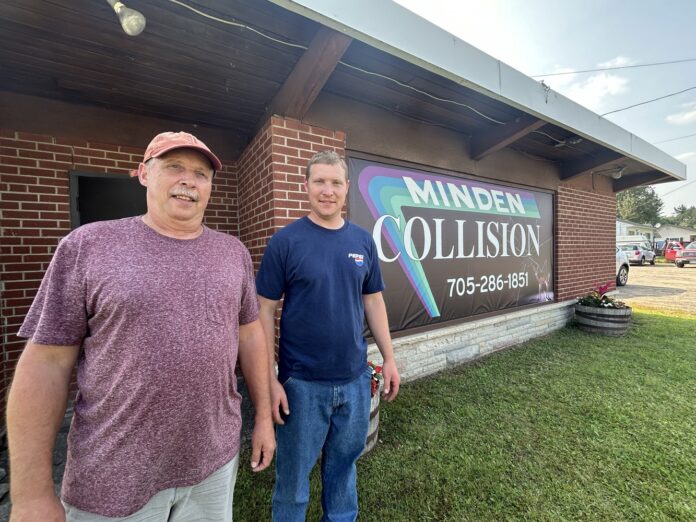
Instead of turning into the parking lot on the corner of Bobcaygeon and Deep Bay roads in Minden each weekday morning, Jim Carrell will have to get used to simply driving by, albeit with a smile on his face.
Carrell retired from Minden Collision July 26 after spending more than 40 years working at the community’s longest-tenured body shop – the past 24 as owner.
He’s passing the business onto his son, Jeff, who will be the third generation of Carrells to run the business. Jim’s dad, Bill, first opened Minden Collision in 1976.
“He worked there and owned the shop for 24 years before he retired – it felt kind of fitting that I’d do the same,” Jim told The Highlander while surrounded by friends and family at a surprise retirement party last week.
When his parents decided to up sticks from Brooklin, ON and head north, Jim admits he was a little apprehensive. Leaving behind friends and potential career opportunities in the GTA, Jim completed his Grade 12 at Haliburton Highlands Secondary School before joining his dad at the family business. Reflecting years later, he said it was the best decision they ever made.
“This is a great community – it’s home. There’s no other place we’d rather be,” Jim said.
For years, Minden Collision was the only place to get your car fixed after a fender bender. Looking back, Jim said there have been some memorable stories.
“There was the day a lady phoned my dad and said a tree had hit her Bronco – we laughed at that one,” he said.
On another occasion, a friend called one morning to say his wife had been in an accident and totalled one side of her vehicle. He needed Jim to perform a quick fix.
“I just remember him being so mad, ‘I don’t know what she did, I think she swerved for a bird or something’. One whole side of the car was destroyed from colliding with a guardrail, but we got it fixed,” Jim said. “He comes in the next day to pick it up and had to clarify his story – his wife was driving down the highway with her windows down and a great big crow flew into the car and was flapping its wings trying to get out. She couldn’t see where she was going, so put it against the guardrail and slammed the breaks to avoid swerving into traffic.”
Jim’s mom, Elizabeth, told how her son always made sure to eat lunch at the shop – whether with his dad when he was younger, with his many employees over the years, and, more recently, with Jeff.
“He has always been big on community, on getting to know the people he worked with. You always knew where to find Jim at noon on workdays,” she said.
Rob Randles, a mechanic and windshield specialist at Precision Auto, said he’s worked with Jim a lot over the past 10 years. “He’d call me up to come and cut glass out of a car after a wreck, I’d usually see him at east once a week. We’ve always had a great relationship,” said Randles. “In 10 years, I never caught Jim on a bad day. He’s always so positive and has time for anyone.”
Now he’s retired, Jim plans to spend lots of time fishing on his new boat during the summer and ripping up the track at the Minden Ice Races in the winter.
Jeff, who has worked with his dad since 2018, said he isn’t planning any major changes at the shop. He thinks it’s “pretty neat” to be the third generation of Carrells to run the business.
“I’m just excited and proud to carry on their legacy,” Jeff said.
A toe-tappin’, roof-raisin’ salute

If you can’t make it to Nashville to see the Grand Ole Opry, Leisa Way is bringing the Opry to Haliburton County.
The Canadian concert producer and songstress is presenting Opry Gold as part of the Highlands Summer Festival Aug. 4 to 8. The show features the Wayward Wind Band, which consists of award-winning Canadian musicians, including Bruce Ley, a pianist and the musical arranger, who has played piano for The Tommy Hunter Show and The Ronnie Prophet Show. There will be five performances.
Brant Garratt, a lead vocalist and guitarist with a passion for acoustic guitar, said he’s excited to come to the Highlands to play Opry Gold because of the proximity to nature.
“My family used to own a cottage on Miskwabi Lake. I spent a lot of time there during the summers, and it fostered my love of nature, and of canoeing, camping,” Garratt said.
He added, “I love the theatre there, the festival theatre, and it’s just a great meeting of two things that I love. It’s kind of a dream, like getting to go up to Haliburton to play music for a week, like come on. I’m probably bringing my canoe, that’s for sure.”
He can’t wait for audiences to hear the ripping guitar solos, not by him, but by the other guitar player, Jack Gaughan. “I know there’s just a lot of cool musical showcases of all different performers in the show, like our fiddle player, Alex George, incredible fiddle player. Just everybody gets their own feature, and it’s always a lot of fun.”
Garratt grew up listening to country music and credits his mom, who grew up in Newfoundland, for that. “I was exposed to people like Shania Twain, Garth Brooks, Brooks & Dunn, that kind of stuff. My parents are listening to that, I’m just saying they’re really into Gordon Lightfoot. I grew up listening to those genres,” said Garratt.
On being part of the group, Garratt said, “it’s been a great opportunity for me. And really, it’s been a dream come true to be part of a group like this, it’s an actual professional working band, and especially under somebody like Leisa.”
Opry Gold is a toe-tappin’, roofraisin’ salute to the greatest music in the history of country music. It’s a vibrant celebration featuring a rich mixture of classic Grand Ole Opry masters and the next generation of breakthrough country artists. The show highlights all the amazing artists that have played the Opry stage over the years and tells the stories about their connections.
Garratt will be singing in a four-part harmony, detailing he’ll be doing a lot of singing. Garratt says he’s done other shows where it’s been a three-part harmony, but never a four-part harmony.
“It’s really nice to be able to blend voices like that, because it’s not really something that happens a lot in normal bands. You have a nice two-part, two voices, but have four harmonies, it’s pretty cool.”
Great nights of live music ahead
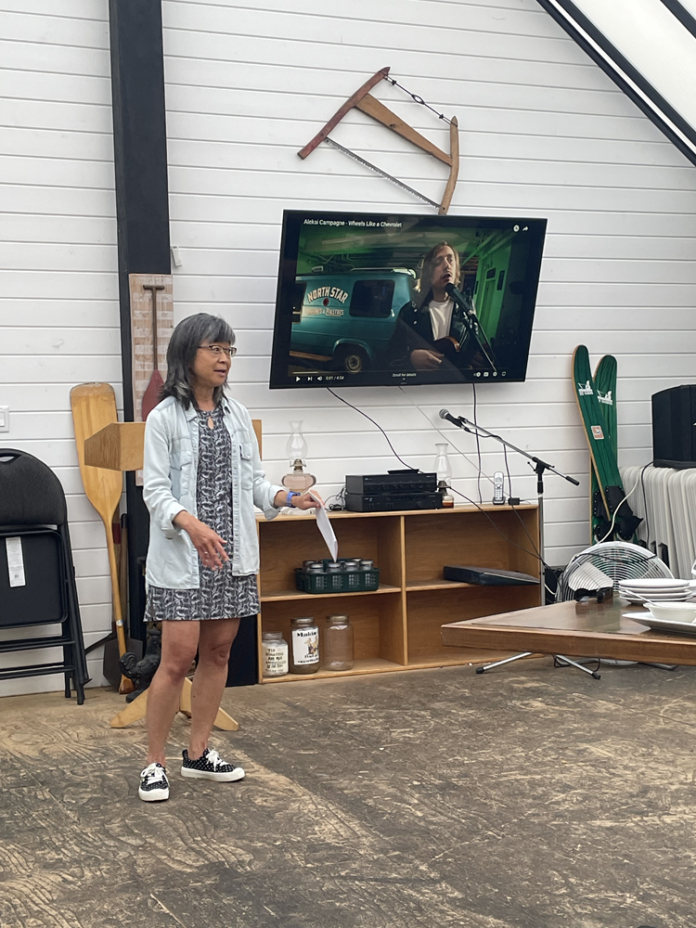
The Haliburton County Folk Society recently announced its 2024-25 lineup of artists during a concert series reveal party.
The event was held at the Dominion Hotel in Minden for members, musicians and folk enthusiasts. A limited number of passes will be sold for the series, which consists of five live shows.
“This is the first time in five years we have programmed a full series, and we are really excited about our line-up, which includes Juno and Canadian Folk Music Award winners and Polaris Music Prize and Maple Blues Award nominees,” said artistic director Sue Shikaze. “We pride ourselves in bringing top Canadian talent to the Haliburton Highlands. I think people know that Folk Society shows are a great night of live music, representing a broad range of genres.”
The event introduced attendees to the artists that are booked for the concert series through YouTube video performances of their works.
The series opens Sept.14 with Garnetta Cromwell and DaGroovmasters, a blues band that delivers high-energy shows to “bring joy to all,” according to a press release from the Folk Society.
Aleksi Campagne, a bilingual singer, songwriter and fiddle player, will be performing on Oct. 18. Campagne was named Penguin Eggs and Roots Music Canada’s New Discovery of the Year. He combines his voice, violin and loopingeffect pedals to wow audiences. Campagne received a Canadian Folk Music Award this year for French Songwriter of the Year.
On Feb. 1, 2025, Terra Lightfoot will return to the Haliburton Highlands with her trio. “Their energy and charisma on-stage creates musical magic”, the press release said. Lightfoot’s latest album, Healing Power, was recently long-listed for the prestigious 2024 Polaris Music Prize.
From Northern Alberta, Celeigh Cardinal, a soul-folk singer, will be taking the stage with her band on April 19, 2025. Celeigh has a confident voice, owns the stage and captivates audiences. She can also blend humour and vulnerability into her performances and her songwriting has been described as both impactful and sublime.
Barbra Lica is a Juno-nominated vocalist and singer-songwriter whose music blends jazz, country, and folk influences. Lica and her band will be performing on May 31, 2025 to wrap up the series. She is described as sunny, upbeat and refreshing.