
Home Blog Page 474

CUPE support staff threaten strike

0
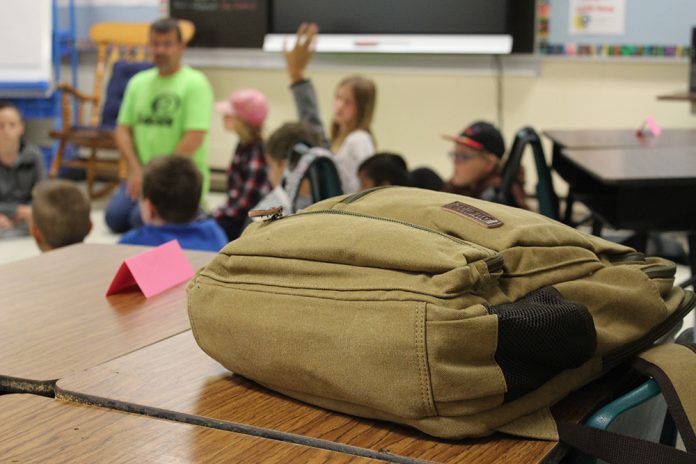
File photo.

Schools are bracing for possible closures and cancelling community permits as support staff across the province threaten a strike which could begin Oct. 7.

The Canadian Union of Public Employees (CUPE) announced a strike would begin if no deal was reached with the province by then. This has prompted Trillium Lakelands District School Board (TLDSB) to cancel all permits for community use of its schools after Oct. 4.

Local CUPE 997 president William Campbell said his members are fully supportive of the action. They voted overwhelmingly to support the strike mandate Sept. 7, with 98.8 per cent of custodial maintenance and 97.4 per cent clerical, technical and educational assistants (EAs) in favour.

“With the concessions that the Ford government is proposing, and the school boards are supporting, our members can’t continue under those,” Campbell said. “The Ford government cuts are going to make it very difficult to attract good quality people to those positions going forward.”

He further said EAs are subject to a lot of physical attacks from children and are not compensated well enough.

Provincial funding cuts and declining enrolment prompted TLDSB in June to lay off the full-time equivalent of 54 support staff positions, including four EA’s in Haliburton County.

TLDSB said in a release Oct. 3 it is assessing the potential impact of a strike on school operations. The board indicated closures are a possibility and urged families to prepare.

The health and safety of our students is our priority. We want our school communities to be aware that this strike action by CUPE may result in school closures,” the release said. “Families are strongly encouraged to begin making alternate childcare arrangements prior to this potential strike beginning on Monday, October 7.”

In a press conference Oct. 2, Minister of Education Stephen Lecce said the province is open and available to work towards a deal.

“Historically, a lot of these circumstances have pled out to create that pressured environment and I understand that,” Lecce said. “I don’t think we have, we collectively, have done all our due diligence to get a deal through that table.”

The strike notice escalates CUPE’s current work-to-rule, which began Sept. 30. That limited what duties could be carried out by support staff, such as custodians not cleaning hallways and offices.

Campbell said CUPE is willing to continue negotiations and he hopes the strike action brings both sides back to the table.

“Nobody wants to go on strike,” Campbell said. “I think this is the time to do it because I don’t think we have a choice.

“We’re all hoping for a fair collective agreement and if we get that, I think this whole situation can be avoided.”

Library board mulls axing Highlands East branch

0
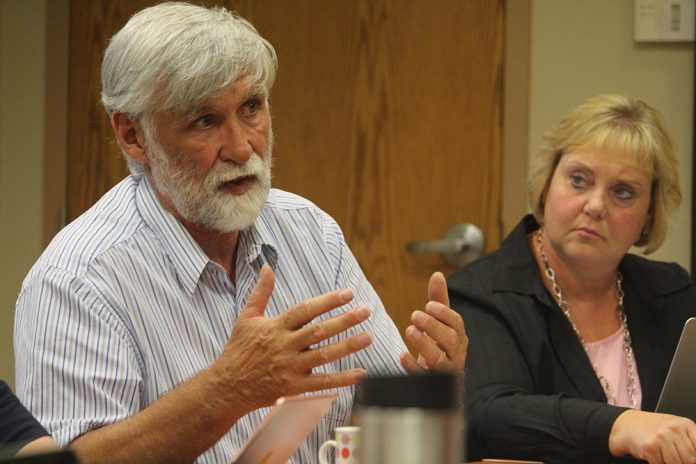
County Coun. Cec Ryall speaks at a Haliburton County Library board meeting Sept. 25. Photo by Joseph Quigley.

The Haliburton County Library Board plans to discuss closing a Highlands East branch as it navigates increased budget pressures and saving interlibrary loans.

The board brought up the measure during a budget-focused board meeting Sept. 25. Staff presented a 2020 draft budget with a tentative increase of $84,371 from 2019, driven largely by a $51,921 employee wages and benefits as well as rising costs for interlibrary loans.

With that, Coun. Carol Moffatt brought up the possibility of closing one of Highlands East’s four library branches as a cost-saving measure.

“This conversation has been raised over and over and over again over many years,” Moffatt said. “That has to be part of the conversation is consolidation of services into fewer locations.

“This is not the removal of services; this is about the realignment of services in a way that works for everybody.”

Highlands East has four library branches, located in Cardiff, Gooderham, Highland Grove and Wilberforce. In comparison, Dysart et al and Minden each have one, while Algonquin Highlands has a branch in Stanhope plus a library depot in Dorset.

Coun. Cec Ryall, the only Highlands East representative on the board, said the municipality would be open to conversation, but it is not something that could happen quickly. He added the municipality would have to consider the social aspect of libraries in addition to book supply.

“What does the library mean to the people we represent, and that’s the challenge that sits with us right now,” Ryall said. “How can we make sure that, at the end of the day, the service meets the demand of the people?”

Library CEO Bessie Sullivan said the employee wage and benefits budget increase, about six per cent more than last year, is estimated based on the cost of living adjustment and periodic increases negotiated by the union of county employees. Although the library workers are not unionized, those negotiations tend to drive wage increases for them.

No motion came forward regarding Highlands East branches but the board indicated it would continue discussing this idea at a later date.

Wants to preserve interlibrary loans

The board also discussed the cost pressures it faces this year. The interlibrary loan service, which allows users to borrow books from outside libraries, was a focal point of the meeting.

The province cut the service this year, removing couriers and requiring libraries to send books using Canada Post.

Librarian Bessie Sullivan said that represents an increase in shipping costs. To return to 2018 levels for the service, the library is budgeting an extra $15,000 for 2020. Depending on the county budget, the board talked about additional limits on the number of books provided through the service.

“It’s an important program I would like to see us continue,” Warden Liz Danielsen said. “We will need to gauge the overall picture. See where we’re at and we might need to make some adjustments.”

Board vice-chair Reuben Maughan said cutting services is concerning to him.

“We’re kicking the dog too. Services have been cut from the province so now there’s more responsibility for the county, now we’re talking about turning county spaces over to municipalities,” Maughan said. “I don’t want to get into that too. It would have been more efficient for interlibrary loans to continue as it was, rather than pass that cost to somebody else.”

County sets goal to build 750 rentals

0
The Kawartha Lakes-Haliburton Housing Corporation recently completed the development of 12 new affordable rental units. Photo by Joseph Quigley.

The County of Haliburton is aiming to create 750 new affordable rental units within the municipality over the next 10 years.

County council formally adopted the target during its Sept. 25 meeting. The City of Kawartha Lakes housing services manager Hope Lee brought the targets forward as part of a new 10-year Housing and Homelessness Plan. Lee said demand remains high, with the city and county experiencing low vacancy rates and private developers prioritizing building homes geared for ownership.

But Lee said setting housing targets at higher levels would help.

“It will significantly increase the number of units that are being developed,” Lee said. “But it will also help us to meet the demands that are out there.” L

ee said the target would take continued support from all three levels of government, as well as from partners like the Kawartha Lakes Haliburton Housing Corporation, which projects to build 150 of the new units.

Private sector partners will also need to contribute, she said.

“Sometimes, it’s not clear to some of those partners what affordable housing means.”

CAO Mike Rutter said that understanding could come with more work communication with developers.

“We need to show them we can actually make a business case (for affordable housing),” Rutter said. “Be able to make face-to-face contact.”

Within the 750-unit target, 270 would be geared to low-income renters, with a gross annual household income of $21,000 or less. About 200 units would be geared to middle-income renters, with income from $21,000-$36,600. Another 280 units would be supportive units with extra features for elderly, disabled and/or other vulnerable people.

Under the targets, the City of Kawartha Lakes would also produce 2,000 new affordable rental units within its borders. Coun. Andrea Roberts said the targets appear daunting.

“I look at those targets and I don’t know how we’re going to achieve them,” she said.

Coun. Cec Ryall said although the targets are hard to reach, the county stands to improve by pursuing them.

“If we achieve 80 per cent of any of those targets, we’re 80 per cent better than we are today,” Ryall said. “I’m not as worried about the achieving of the targets themselves as by the process we use to get there.”


Candidate profiles: New Democratic Party – Barbara Doyle

0
Haliburton-Kawartha Lakes-Brock NDP candidate Barbara Doyle. Photo submitted.

Haliburton-Kawartha Lakes-Brock NDP candidate Barbara Doyle said her desire to run for office came out of personal experience with a system she believes is broken.

“We have programs that don’t work or don’t work well enough. We have justice issues. Going through it, the only way to effect change on a real level is to be on the inside,” Doyle said. “I realized I needed to step up and work towards becoming a member of Parliament.”

The treasurer for the Olde Gaol Museum in Lindsay has also spent time as a social advocate. She co-chaired a coalition against a local hospital merger and worked on a committee to improve domestic violence services.

As a survivor of domestic violence, Doyle said she has gone through the gaps in the justice system, particularly around family law.

“That’s one of the things that really brought me to wanting to be in government,” Doyle said. “The family law system is incredibly broken in this country. “This is my history. I’m not ashamed of it. I was a victim but I’m not a victim anymore. I’ve come through the other side.”

She added criticism for the Liberal government’s family law update getting stuck in the senate in the last months of its term.

Doyle has a college education in legal studies. She joined the NDP because it closely aligned with her values and belief in programs like national pharamacare, a guaranteed basic income and a plan to build 500,000 affordable housing units over the next decade.

“It’s not about the have or the have nots,” Doyle said. “Everybody should have.”

Doyle said health care, in particular, is very important to her and she believes public health care should extend to include dental, vision, hearing and mental.

“We know this works. We know when people get access to their medications, it actually saves money and health care costs,” Doyle said. “Health care should encompass the entire body, head to toe.”

Despite running in a longtime Conservative stronghold, Doyle said she is confident about her chances as she feels voters are disappointed in both their provincial and federal representatives.

“A lot of broken trust in this riding. A lot of things that have gone unanswered,” Doyle said. “I’m getting incredible feedback on the ground, at doors and events. People are really supporting us.”

You will not see any NDP lawn signs in Haliburton-Kawartha Lakes-Brock. That’s because Doyle has decided not to use them, citing environmental concerns given signs are single-use and end up in landfills. Doyle said both her and her party are passionate about addressing climate change and she wanted to set a good example.

“I have to stand by what I’m talking about,” Doyle said. “It is advertising how I will be in government. I will do what I will say I do.”

The NDP has remained a distant third in polling so far but Doyle said she remains confident in her party’s chances. She added Canada has been stuck in a cycle between Liberal and Conservative governments.

“The NDP sometimes gets left out a little bit,” Doyle said. “But NDP is a viable choice. We have a platform that works … I’m actually very proud to stand with the NDP.”

Hanging up the keys after 35 years on the road

0
Coach driver Wilbert Tindale was greeted with a bus full of balloons for his final trip before retiring Sept. 10. Photo by Joseph Quigley.

Wilbert Tindale has transported thousands of Haliburtonians throughout his 35 years driving coach buses.

As he prepared for one last ride before retirement Sept. 10, he was greeted with a surprise bus full of balloons. Friends and co-workers celebrated his career outside the XTR gas station in Haliburton village. About 30 of those years were spent driving people from Haliburton, most recently as part of the Can-ar Coach Service.

Tindale said even after all the time spent on the road, he still likes the ride.

“I still enjoy driving. It’s great. The freedom, my own boss,” Tindale said. “I’m going to miss driving with all the people. But I got another chapter to go.”

His oft-driven route sees him travel from Haliburton to Minden, Lindsay, Port Perry, Oshawa before finally arriving in Toronto and driving back. Throughout his driving days, Tindale said he tries to treat everybody with the same friendliness.

“I’ll say where are you going today and I hope you have a great day.”

Frank Brookes has worked alongside Tindale for 20 of those years, alternating with him on the Haliburton route. Although another driver is set to replace Tindale, Brookes said it is hard seeing him retire.

“Bill’s a good guy. He’s very loyal to the company. He’s good with the passengers, he’s been good for the business,” Brookes said. “It’s going to be sad to see him go after all those years and I know he will be missed by many of our passengers.”

Barbara Schofield has ridden the coach buses from Haliburton since 1971, many driven by Tindale.

“Nice, pleasant guy and he’s very helpful,” Schofield said. “It (the bus) goes to the little towns but that serves a lot of people.”

XTR owner Greg Tibbitts organized the celebration and said he wanted to honour the man who he’s worked beside for 26 years.

“He’s a nice guy and he’s funny. We have a lot of laughs in the morning,” Tibbitts said. “I just wish him all the best. I hope he enjoys his retirement.”

Tindale said he looks forward to opening a new chapter in his life and plans to travel to visit his kids in Alberta now that he is retiring. But as he prepared to embark from the XTR gas station for his final trip, he said he’ll miss interacting with all the passengers he picks up on every trip.

“Sometimes, you feel like a bartender. They open up and tell me their life story,” Tindale said. “It’s kind of neat.”

New HHSS program helping students “Read Up”

0
The Rotary Club of Haliburton donated $4,000 to support Haliburton Highlands Secondary School literacy initiatives Sept. 17. Left to right: Doug Ross, Andrew Hodgson, Jim Joseph, Brian Nash, David Zilstra, teacher Rebeka Borgdorff, Kevin DesRoches, Heather Phillips and Ted Brandon. Photo by Joseph Quigley.

Haliburton Highlands Secondary School is introducing a new program for bringing students up to speed in their reading.

The school has started a new course called “Read Up” this year as part of a schoolwide initiative to improve reading. The program tailors material to students who are reading at lower grade levels and are identified as needing more one-on-one support.

Head of English Rebeka Borgdorff said it is unfair to expect students to meet a certain bar if they have not been equipped to do that.

“As teachers, we’re not here to just fill a bucket with knowledge. We’re here to see students actually engage and be as successful,” Borgdorff said. “It just really prompted us, burdened us to change what we’re doing in order to meet our students, to engage and meet them where they’re at.

“As soon as we do that, it’s a gamechanger.”

Borgdorff said the school is responding to trends it sees with student reading. The school has trended downward more steeply in Grade 10 literacy test results compared to the board and province, with a 60 per cent success rate in 2017-18, 24 per cent less than five years ago.

She said although students have fared well in writing, reading has proven more of an issue. Societal trends toward technology are part of the reason, Borgdorff said.

“We like texting and short forms and emojis and such and we’re losing a lot of the quality of our language.”

Over the past two years, the school’s English department has also implemented a program called LLI, Levelled Literacy Intervention. Originally in elementary schools, the program sees some English courses have students reading from different texts, tailored toward individual reading levels.

“Although it was suitable for measuring the gaps and suitable for understanding the levels of our students, the content itself was rather uncomfortable for our students, in the sense it felt juvenile,” Borgdorff said.

The school has sought more materials to help improve both the LLI and the new Read Up course, with the Rotary Club of Haliburton answering the call. The group donated $4,000 to support the literacy initiatives Sept. 17.

Member Andrew Hodgson said the group was happy to work with HHSS to help students.

“If you’ve got that little bit more confidence, little bit more self-esteem, that takes us all a long, long, long way,” Hodgson said.

It is too early to know how well the Read Up course will work, Borgdorff said. But if it succeeds, she said it might be a concept employed in other grades and schools in the years to come.

She described seeing her 11 students in the course read a passage aloud to the class at their reading level.

“These were students who would generally completely say, ‘I am not doing an oral presentation ever’,” Borgdorff said. “It nearly brought tears in my eyes. It was beautiful. “Just that ability to feel like, ‘I can do this.’ That’s the goal of this whole course.”

Women light way against gender violence

0
Participants march through Haliburton village for Take Back the Night Sept. 19, Photo by Joseph Quigley.

The people of Haliburton protested gendered violence and lit their way through the darkness with the annual Take Back the Night event Sept. 19.

Dozens of people gathered in Haliburton in solidarity with those across the region to speak out against sexual and domestic violence. They marched through the streets of Haliburton village by candlelight, accompanied by Haliburton Highlanders Pipes and Drums.

YWCA Peterborough Haliburton clinical therapist Denise Morton-Sayles told the crowd they are all a part of ending that violence.

“Many of us are here tonight who have lost and are on a journey to reclaim ourselves due to being victims of gendered violence and we need to continue to march and we need to continue to be a voice for change,” she said.

Morton-Sayles cited local stats. The YWCA in Minden has seen a 30 per cent increase in the number of women seeking services between 2018 and 2019. Over the same time, 38 per cent more women are accessing YWCA’s Haliburton Emergency Rural SafeSpace.

“It could tell us that people know how to reach out,” she said. “But also the numbers of violence are not dwindling. Violence against women is not diminishing the way we want.”

Jean Coates said she has attended Take Back the Night for years with her mother and children.

“Both me and my mother have had abusive relationships and we just feel it’s good to support and make sure it’s well known there is help out there,” Coates said.

“It’s a great cause,” attendee Lorraine Evans said. “It’s not only for survivors today but also for future survivors.”

The Kawartha Sexual Assault Centre, Fleming College and partner organizations organized the evening. Clinical counsellor Diana Primavesi said she was pleased by how it went.

“We had a great turnout from people in the local community,” she said.

Primavesi said Take Back the Night, which began in the 1970s, remains important to help those working to address gender-based violence.

“As someone who is a survivor and works in the field, it is helpful to be in solidarity with others who care about this issue,” she said. “It can be very isolating. So, I think that, for me, the biggest thing about Take Back the Night is for us to come together and raise up our voices to be heard.”

New faces add to The Studio Tour palette

0

Nothing says ‘autumn’ in Haliburton County quite like The Studio Tour.

As the iconic event enters its 32rd year, organizers have rebranded and launched a new logo.

Also for 2019, there will be seven new artists and some non-resident guest artists for the first time – all offering a variety of mediums and techniques.

The tour goes the first two weekends in October.

Chair Cathy Taylor said the thinking behind the repositioning as The Studio Tour-Haliburton Highlands (formerly known as the Haliburton County Studio Tour) “is that of all the tours across the province … it’s “The” tour that visitors don’t want to miss.

“We’ve worked through the repositioning and rebranding process with our tour members and the County of Haliburton’s tourism department over the past several months,” Taylor said.

“Crystal Image Studio brought our vision to life and we feel we have a fresh, reinvigorated logo to enter into our 32nd year. The pictorial logo is the loon design by Peter Hood.

“In addition to the rebrand, we’ve also launched a sponsorship program for the first time ever,” Taylor said.

The Studio Tour members thanked the Haliburton County Development Corporation for their financial support of the rebranding initiative.

“For more than 30 years, The Studio Tour – Haliburton Highlands has drawn an eclectic group of visitors each year,” Taylor said. “Thousands of guests – residents, cottagers and tourists alike – have experienced the entire Haliburton Highlands region visiting the artist studios along the tour.”

This year, there are a total of 40 artists opening the doors of 25 studios. It is a self-guided driving tour that promises beautiful fall colours; a chance to watch artists and artisans create; and shop.

Taylor said that each year, The Studio Tour – Haliburton Highlands generates an average of $1.75 million for the local economy, benefitting the entire region.

“The Tour is proud to contribute to such a vibrant arts and culture scene in #MyHaliburtonHighlands,” she said.

For more, see the studiotour.ca .

Dysart mayor right about roads

0

It’s a common scene in council chambers across the county. From about May to October every year, irate cottagers make delegations to councils demanding one thing or another.

They are quick to remind elected officials they pay hefty waterfront taxes, and have invested millions of dollars in the area. I think we would all acknowledge the importance of cottagers to our local economy.

However, sometimes the tone of these delegates is a bit troubling. Take for example the folks from Redkenn Road who jammed Dysart et al’s council chambers earlier this week.

They came armed with a petition requesting their road be hard-surfaced after the municipality made it a gravel road last year.

They said they represented 60 owners along a 1.2 km stretch of road along Redstone Lake. They were angered after having had a paved road for 30 years.

They said it affected their quality of life, with one spokesperson saying the pain is real.

They pointed out a neighbouring road was paved in 2017. They broached the have and have not argument.

Not to be unsympathetic, but we need to put these concerns into context. A quality of life issue is a decades-long boil advisory for drinking water in a northern Indigenous community. The difference between a paved and gravel road is hardly a have versus have not argument.

Having your road go to gravel, from paved, is annoying, irksome even. It means you have to slow down for fear of rocks hitting your windshield and fishtailing. But if you slow down, it should ease the wear on your vehicle. Sure, you might have to wash your vehicle more often because of the dust. You’ll have to slow down for safety reasons too. But is it really life-altering?

Not only did the delegation ask for paving, they wanted it before winter.

Not many cottagers are around every winter for budget talks at council. They should be. They would hear how councils grapple with decisions around roads when they have a finite amount of tax dollars coming in. The Redkenn folks would have learned that Dysart et al has to take care of not only their 1.2 km of road, but an additional 303.3 km across the township, some 280 km of hard-topped and 24.5 of gravel. Each and every person on each and every one of those roads wants better.

On top of that, the public works department is levelling out gravelled roads, ditching, cleaning out culverts, mowing and brushing, controlling dust, repairing shoulders, maintaining bridges and catch basin, street sweeping and providing traffic control.

At budget time, townships such as Dysart et al have to triage the worst of the roads and put those to the top of their roads needs list. The decision is often made around public safety.

Mayor Andrea Roberts was completely right in telling the delegation she and her council have to consider the entire municipality, not just the squeaky wheel.

“It’s many, many, many other roads we have to take into consideration,” she said.

So, with all due respect to the 100 people who signed a petition, and to those who spoke out at Dysart council, things have changed. Our townships now do comprehensive roads studies to figure out what roads need to be done and in what order. They’re not about to change plans just because a few angry people show up at the council chambers. And that’s the way it should be.

Community rallies for climate

0
Protestors gather outside Haliburton Highlands Secondary School for a climate change protest Sept. 20. Photo by Joseph Quigley.

Environmentalists gathered outside Haliburton Highlands Secondary School to support a worldwide rally for climate change action Sept. 20.

Approximately 60 people attended the local protest done in solidarity with youth-led events around the world, with students striking from school. The local strikes are a continuation of protests last spring. The Sept. 20 event attracted more students than previous but more than half the contingent were adults.

Organizer and HHSS student Jurgen Shantz said it remains important for youth to send a message.

“If nothing’s done then life will be a lot worse for a lot of people,” Shantz said. “I don’t want that to happen.”

Shantz struggled to attract peers for his spring strike outside the Dysart et al municipal office, where only a few high school students attended. About 20 HHSS students participated this time according to organizers.

“It’s better but not incredibly better,” Shantz said, adding he hopes to do a longer promotional campaign leading into the next event.

Grade 10 student Nick Phippen said many peers he spoke with did not feel like their protest could make a difference.

“Sadly, most of the kids I was talking to thought that ‘no one’s going to listen if we go out,’” Phippen said. “I’m out here to prove the point that us young generation, it is important and it is important for us to stand here and let people know and politicians know that climate change is happening.”

The protests were originally inspired by Swedish student Greta Thunberg, who has gained international acclaim for striking from school to protest inaction on climate change.

Haliburton School of Art and Design also joined the local demonstration.

“It’s hard to ignore the fate of our planet,” ceramics student Hasmita Alimchandani said. “It’s really important for more people to really lean in and show their support, especially young people.”

Bonnie Roe has regularly attended the protests started by Shantz. She said many adults have joined because they recognize how serious climate change is.

“Maybe a demonstration doesn’t change anything at the moment but it brings awareness to the issue and awareness is what we need,” Roe said. We need people to get on board.”

Shantz commented on the upcoming federal election.

“Vote for people that will help climate change action.”