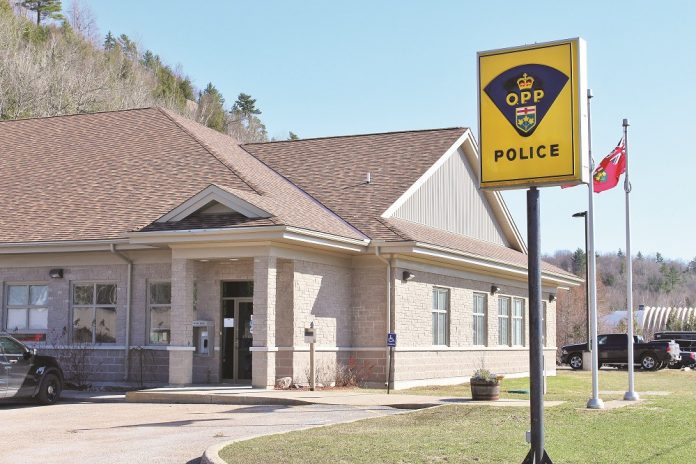
Haliburton Highlands OPP is investigating a Dec. 9 armed robbery at the Highland Pharmacy.
In a press release Dec. 10, police said they received information about two unknown masked suspects entering a business on Highland Street with a firearm. They responded at approximately 6 p.m.
“The suspects demanded and received narcotics, then fled the scene. The employees were not injured,” the press release said.
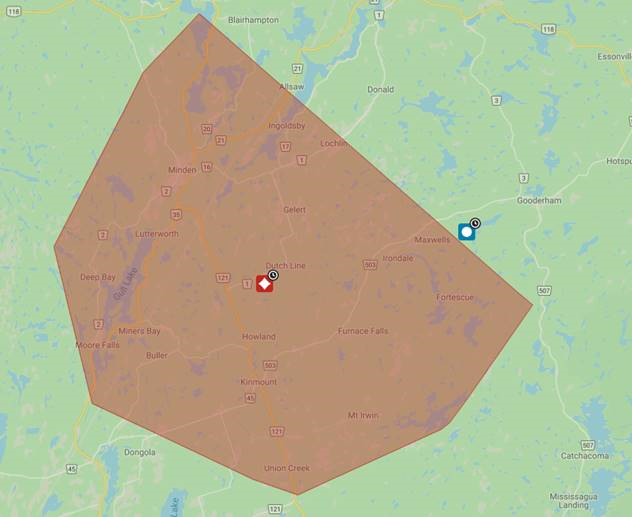
The OPP Tactics and Rescue Unit (TRU), Canine, Emergency Response Unit (ERT) and Forensic Identification Services (FIS) were called to assist, police said. OPP central communications tweeted around 7 p.m that a large police presence was conducting an investigation in the Haliburton to Tory Hill area and asked residents stay inside. The presence cleared within the hour.
Police established a perimeter around the pharmacy shortly after 6 p.m., closing off the area, with at least three police cars on scene.
The press release said the incident is still under investigation and more information will be released when it is available.
Investigators are encouraging anyone with information regarding the incident or the suspects’ identity to contact the Haliburton Highlands Detachment at 705-286-1431 or toll-free at 1-888-310-1122. If you wish to remain anonymous, please contact Crime Stoppers at 1-800-222-TIPS (8477).
Police investigate armed robbery of pharmacy
Chamber calls for County economic focus
The Haliburton Highlands Chamber of Commerce is welcoming the prospect of the County taking on economic development.
The County services delivery review unveiled Nov. 25 recommended the municipality hire an economic development officer. Consultant StrategyCorp, estimated the position would cost $200,000 including $80,000 in salary, $24,000 in employee overhead and $96,000 in service expenses.
Haliburton Highlands Chamber of Commerce board president, Andrea Strano, said she is optimistic about the recommendation, adding it is something needed in the County.
“There’s a really good opportunity here for forward-thinking and forward planning,” Strano said. “We can’t always keep having the same group of 10 people in the community getting together in a bunch of groups and then talking about it, kind of like hamsters on wheels. We need to have more planning and more doing.”
Economic development is presently handled at the lower-tier level, with townships taking different approaches. StrategyCorp held a workshop about economic development with stakeholders including the chamber, Haliburton Village BIA, Algonquin Gateway Business Association and the Highlands East Economic Development Committee. The report found stakeholders wanted increased government support and coordination at the County level.
“It was a really productive process,” chamber executive director, Jennifer Locke, said. “The timing of this conversation is really key, especially with COVID.”
The report said economic development must be distinct from tourism, which already has a County position. Locke said the success of that has motivated a desire for an economic development staff.
“Easier … than having these piecemeal, silo-based activities at the lower levels,” Locke said. “The stakeholders and the business community, they are behind a centralized role.”
She added expanding the scope of the economy beyond its seasonal nature is important.
“Come winter, everybody’s on vacation. That’s the root of that,” Locke said. “There’s kind of a recognition it creates these cycles that are perhaps not ideal for our entire community … Perhaps other opportunities that would allow for a more year-round economy, diversified economy. As we’ve noted through COVID, tourism can be precious in ways that we don’t expect.”
The report said there is a community need for more economic development, citing the County’s below-average income and above-average unemployment rate (13.1 per cent in August 2020, compared to 10.6 per cent for the province). The report notes the position would likely lead to increased revenues but does not estimate that figure.
It added with provincial and federal economic programs likely coming due to the pandemic, this can take advantage of them. It recommends implementing the position starting in 2021.
There is an opportunity cost to lacking economic development, according to the report. Locke said she has received calls from businesses interested in coming to the area, but the lack of centralized resources is a difficult hurdle. She further said economic development also needs to consider environmental and social aspects, also known as a triple-bottom-line approach.
“It cannot just be about dollars and cents. It needs to be about the community, environment, everything because there are risks when we d
Ministry investigates blast
The Ministry of the Environment, Conservation and Parks (MECP) is looking into a blast Dec. 2 in Algonquin Highlands that reportedly damaged some homes and had some residents thinking there’d been an earthquake.
Residents experienced a large rumbling about 2 p.m.
MECP spokesman, Chris Johnston, said Dec. 4 there was a blast at the Francis Thomas Contracting (FTC) quarry on Highway 35 in the township. He said it wasn’t FTC that blasted but subcontractors, Fowler Construction and Austin Powder. Ltd.
He said the blast exceeded the ministry’s applicable noise limits.
“The blasting company reported the incident to the ministry,” Johnston said.
“Members of the public also contacted the ministry reporting property damage. The ministry is working to ensure the quarry owner and its contractors take appropriate action to address the public’s concerns and to ensure similar incidents do not occur in the future.”
Johnston said the ministry is working to determine the cause of the blasting noise limit exceedance and address public concerns. He said it is too early to determine the results of the ministry’s review and assessment of the incident.
“We are requiring that the company conduct inspections of the reported damage to determine what steps are necessary to restore the property. The ministry will monitor the progress of these inspections and ensure that the parties involved take appropriate action.”
Algonquin Highlands Mayor Carol Moffatt posted to her Facebook page shortly after the blast.
She said she made some quick calls and was advised the blast occurred in the aggregate pit on North Shore Road.
“Although notifying the broader community is not required under the Act, Francis Thomas Contracting has historically notified the township and we, in turn, put out public notice. It doesn’t appear there was any notification today [Nov. 2],” she said.
She said after speaking with Francis Thomas Contracting and Fowler Construction, “we will be seeking better and more appropriate notification going forward.”
Resident Cheryl Richman wrote on the mayor’s Facebook page, “I have someone coming to check on my home as I am concerned about structural damage due to the violent shaking caused the shockwaves from the blast. There should be limits on the strength of dynamite being used near residences.”
Elaine Smith added, “we are directly across from North Shore Road, on Beech Lake. We thought the earth had moved.”
Province increases COVID restrictions in district

The provincial government announced today the Haliburton, Kawartha, Pine Ridge (HKPR) District Health Unit will be moving from Green-Prevent to Yellow-Protect under the provincial COVID-19 Response Framework.
The change will be effective Dec. 7. The change brings with it enhanced enforcement, fines and education to limit spread. The health unit will apply more measures in higher-risk settings.
HKPR medical officer of health Dr. Lynn Noseworthy said in a press release the change is not surprising.
“We are seeing more COVID-19 activity in our region,” Noseworthy said. “The new measures in the Yellow level are not much different than what we currently have in place but will enhance our ability to slow the spread of COVID-19 in our communities.”
There is currently only one confirmed active case in Haliburton, but cases have spiked elsewhere in the district, with 23 cases active in Northumberland and seven in Kawartha Lakes.
According to the health unit, key changes under the new restrictions include:
- Restaurants/bars must close at midnight.
- Alcohol can no longer be sold or served after 11 pm.
- A limit of six people can be seated at one table in restaurants
- Eateries and other select businesses must keep contact information for all patrons who dine in. Currently, restaurants only had to collect contact information for one person in the party.
- Gyms and fitness clubs must increase spacing between patrons to 3 metres (from 2 metres) in areas with weights or exercise equipment, as well as in exercise/fitness classes.
- The volume of music in stores and businesses must be low enough so a normal conversation is possible, and shouting is not required.
- Most businesses must now complete a COVID-19 safety plan and make it available upon request.
“Local businesses and organizations have done an excellent job following the public health measures designed to protect our residents,” Noseworthy said. “It’s important we continue to work together with our business community to ensure a smooth transition to the new restrictions coming into effect under the Yellow level.”
The local health unit will stay in Yellow for a minimum of 28 days.
“We all need to continue doing our part so we can quickly get back to Green,” Noseworthy said.
Collaboration could save towns $1.18M

Councillors from local townships met Nov. 25 to digest a massive services delivery review with 12 recommendations for more collaboration that could save upwards of $1.18 million annually.
Toronto-based consultant, StrategyCorp., presented 12 initiatives for more intermunicipal partnerships. Their report follows months of work and more than 100 interviews/workshops with councillors and staff. The firm said between operational efficiencies, productivity gains, and $74,000 in more revenue, the implemented strategies could provide that $1.18 million.
StrategyCorp principal, John Matheson, said they did not approach the job like auditors but to work alongside staff. He said there is a clear willingness on the part of municipalities for more collaboration.
“We’re not saying we found great big problems with waste here,” Matheson said. “We’re saying we were invited to come work with the team, to try and find better ways of doing things and not surprisingly, you spend this kind of effort, that we found some.”
The recommendations do not directly address the idea of amalgamation, which was never in the terms of reference for the review. Instead, it tackles where municipalities could improve services with different levels of co-operation, including places where services could be integrated to one provider – whether the County, a special body or a lead municipality.
Matheson praised the council for being open-minded about possible improvements and being willing to do a review, as well as creating a safe space for staff to consider different ideas.
“What you’ve really done is wiped away a lot of the historical stresses that come out of the air about forced amalgamation. Where people are worried about hanging onto their right to continue providing governance for fear of being stripped away from them by a provincial government,” Matheson said. “There’s lots of different ways to achieve things to the benefit of better public administration, better value for money.”
Councillors spent four hours delving into the report and questioning each of its recommendation sections. Coun. Bob Carter of Minden Hills questioned the fire service recommendations only extending to joint training, noting common issues across the municipalities such as succession planning, increased demand and escalating costs.
“It seems to me the process for determining what was looked at was not only a quantitative process but a qualitative assessment,” Carter said.
Matheson said that is accurate, adding their recommendations focused on improvements that could achieve more for fewer or similar dollars, rather than improvements that could be more costly. He added they decided on the subjects of deeper dives after their estimate of what was most worthwhile after the first phase of the process.
“It’s not that theoretically, you couldn’t do more,” Matheson said. “We would just evaluate those opportunities as being a little less ripe in the light of the state of readiness of the organizations.”
Next steps
The review recommends implementation over several years, but divides recommendations into short, medium, and long-term. It suggests addressing some things, such as communications, economic development and collaborative procurement starting in 2021.
The review recommends the County begin implementation of other initiatives like planning, building, septic and bylaw in 2022. Warden Liz Danielsen said the review should be a standing item on the County committee of the whole. She added a special meeting should be called in January or early February to start working through it and the proposed timelines.
“We’ve got a lot to absorb and lots to talk about,” Danielsen said. “We need to start thinking about how we’re going to move forward.”
Coun. Carol Moffatt said some of the ideas in the report are not new, such as the County having an economic development position.
“To me, it seems like some of the reason why some of this collaboration isn’t already happening will be the same reasons why some of it doesn’t move ahead going forward,” she said. “We all sitting around this table today need to really, genuinely understand – that whether and how any of this moves forward depends on the will of each and all of us to conceive something for the greater good. For the benefit of the community.”
The Highlander will detail more aspects of the 138-page report in the coming weeks.

Significant changes recommended
• Roads, bridges, and drainage: Implement capital bundling, allowing contractors to secure multiple projects at once. Formalize joint planning of road maintenance.
• Fire services: Integrate fire training and explore a joint-training facility.
• Waste management: Approve a working group to standardize waste management processes across the County and/or do a Countywide review of landfills and transfer stations.
• Building, septic, bylaw: Explore either shared service agreements or integrate services.
• Planning: Create one, central official plan with secondary plans below it. Standardize more of the planning processes across the townships. Create a new County-level planning position to assist.
• Economic development: Create a new economic development staff position.
• Collaborative procurement: Approve a new staff position for the process and approve a new shared-service agreement.
• Integrated digital strategy: Integrate long-term IT planning and municipal IT investment decisions.
• Co-ordination of legal services: Hire a county-level in-house municipal barrister and solicitor and approve a shared service agreement for it.
• Human resources co-ordination: Explore the benefits of a centralizing human resource information system. Pool benefits together and create shared-service agreements for key HR functions.
• Communications: Approve a new central communications position, which would also include grant writing.
• Co-ordination: Create a new implementation committee of County council to promote effective collaboration between local municipalities.
Dysart slow on promise of change
Change was in the air when Dysart et al’s new council was sworn-in Dec. 3, 2018.
Andrea Roberts became the municipality’s first new mayor in nearly 40 years, unseating Murray Fearrey. She was joined by three new council members: John Smith, Larry Clarke and deputy mayor Patrick Kennedy, and three incumbents. People wanted change and things to be run differently.
Two years on, the dramatic shake-up does not feel like it has necessarily manifested. Though council is setting up for a different vision of tomorrow, progress has felt slow, made worse by the pandemic.
To date, this term of council has been unable to buck the generally slow machinations of municipalities. There have not been any major things such as the Minden arena. It took the municipality one year to produce a final list of big ideas for the term: a recreation master plan, improving housing with a task force, a parks management plan, enhancing lake and shoreline health, a long-term Dysart master plan and digitizing more municipal services.
None of these are sexy, other than perhaps the intent to have a shovel-ready plan for a new recreation complex. In addition, there is nothing imminent. Though forethought is important, the list made clear the reality of this term: it was for set-up, in hopes of bringing big things in the future. A year later, in the face of a pandemic, it feels uncertain whether even these plans can come to fruition within two more years.
It is worth noting the conflict that has also been a key aspect of this council, primarily from Smith. The freshman has pushed hard for more radical, faster change and gotten a lot of pushback. Some of his ideas were intriguing, such as a more robust roads budget that has made a bit of headway. Other ideas, such as cutting funding to the museum and art gallery, have been unpopular.
Regardless, his butting heads with council, often over new ideas and slowmoving procedures, has made the progress of this council feel slow: Both because the conversation gets bogged down and because it has made it feel like this is not a table that’s open to anything dramatically new or different.
There have also been issues where the municipality has been slow to react to an obvious need for change. Short-term rentals are a pressing issue. An economic development committee seemed poised to take it on at the start of term, but council let it dissolve into nothingness. Two years on, there has been basically no progress on the file, with council only recently indicating it wants to act.
But with all that said, this council has had positive developments: the Head Lake Park master plan; the roads needs study; and the recent services review. It’s also had a good response to the pandemic. It’s been at the forefront of bringing more things online and is the only area council keeping livestreamed meetings up permanently. It’s passed noteworthy bylaws, leading the charge on fireworks limitations, and a major planning bylaw overhaul.
Despite some good, measured work, the public can be impatient. Come 2022, we will see whether voters believe in the vision this council is putting forward, or if their patience will run thin.
COVID and Christmas
By Dr. Nell Thomas
COVID-19 is not the gift you want to give or receive this Christmas.
Humans are adaptable creatures. Good thing, because a basic evolutionary principle is that without adaptation, a species will perish. It should be pretty simple to make a few changes from your traditional approach to the holidays. This is only one year, for heaven’s sake. Here are some guidelines and suggestions to keep you and your family safe.
High risk holiday activities to avoid:
• attending large gatherings with people from outside your household;
• going to crowded parades, community events, parties;
• shopping in crowded stores.
Recommended low or no-risk alternatives:
• shop online and have delivered;
• make the holidays about you and your immediate family, splurge on fancy treats for an intimate group, choose exactly the things you want to eat;
• find virtual substitutes for family holiday traditions, like Zoom or Skype cooking and meal-time;
• pick recipes to make “virtually together” and compare/compete for best finished product;
• select friends or neighbours to do secret Santa gift exchange and drop off presents in mailboxes, on front porches, or choose delivery if far away;
• form a virtual group to make gifts or food for those in need (contact the Food Bank, The Legion, Rotary, SIRCH, YWCA to find ways to share your gifts);
• order dinners from local restaurants (they need the support);
• divide up dinner menus with neighbours and safely deliver COVID dishes to each other to complete the meal plan.
Reduce risk if visiting:
If you are determined to visit individual family or friends, then do so with masks and with distancing, in large spaces, outdoors, and with testing done as close to the event time as possible, although a negative test is no guarantee because the test can fail to show the virus even when you are infected.
Travel in your own vehicle and avoid airports and train stations, if possible. Avoid crowds and choose places with good ventilation. Keep air circulating. Open windows. Wear a suitable mask properly at all times. Wash/alcohol your hands every time you to return to your vehicle. Wash/alcohol at gas stations, after you touch anything outside your vehicle. Avoid restaurants and indoor establishments, and if you don’t pack food from home then observe caution at fast food venues (food itself is not likely to have virus in/on it but the containers are higher risk).
Using masks, remaining touch-free and six feet apart at all times will reduce risk, but the only way to stop risk entirely is to stay home in your core family unit “bubble.” In other words, the only way to completely reduce risk of infection is to remain separated.
The New York Times asked readers what their Christmas plans were. My favorite is this one from a clever fellow in New York.
“Skipping it. No risk, no harm, no one gets sick, no one dies, no one grieves. Better apart than under. I respect and love my family enough to remain apart so that we are able to enjoy many more years of celebrations.” – Paul Marber, New York.
The government of Canada is advising no non-essential travel. There are sobering thoughts such as penalties if you are found in violation of Canada’s Quarantine Act or if you or someone chooses to break mandatory isolation.
Penalties can include six months in prison and/or $750,000 in fines. If you violate mandatory quarantine or isolation and your actions result in death or serious bodily harm to another person, fines can be $1 million and imprisonment up to three years or both.
Council fights for wetlands protection

Highlands East council joined the chorus of voices calling for the province to halt its plans to significantly change conservation authorities.
Council passed a resolution Dec. 1 asking the province to repeal the section in the upcoming Budget Measures Act (Bill 229) which governs the changes. If passed, it would allow the Minister of Environment, Conservation and Parks to make permitting and appeals decisions and add more layers to the appeals process.
The Highlands East resolution – which the Crowe Valley Conservation Authority (CVCA) is providing to all its member municipalities – said the changes hinder the Conservation Authority’s role in regulating development and creating more “red tape” and costs for authorities.
“It allows the province to go against recommendations that the conservation authority makes regarding development,” said Coun. Suzanne Partridge, who serves on the CVCA board on behalf of the municipality. “Could have serious implications on our wetlands and increase flooding potential throughout the province.”
The Highlander reached the Ministry of Environment, Conservation and Parks for comment but did not receive a response before press time.
The changes are receiving criticism from conservation authorities across the province.
CVCA general manager, Tim Pidduck, said authorities are already willing to work with developers. He added since 2017 when the CVCA started keeping track, they have only had eight board hearings and one denial amongst 917 processed permits.
“We’re not here to get in the way of development, but we just want to make sure it’s the right development in the right location,” he said.
Pidduck said the changes also complicate the process by adding more and different avenues of appeal, versus the more linear process that exists now.
The province consulted with authorities and the public for the past year and a half about changes. Pidduck said it was a good opportunity to address concerns – such as the inherent funding inequities with rural residents paying more per person for their authorities.
But he added it feels as though the province ignored a lot of the consultation, based on the changes.
“It’s almost like we never participated, or the province and ministry staff weren’t particularly listening,” Pidduck said.
Highlands East’s resolution asks the province to continue to work with authorities to find “workable solutions to reduce red tape and create conditions for growth.”
“Come to a good compromise or conclusion on how to proceed,” Partridge said. “It’s just the one section that has really, serious long-term implications to all our municipalities.”
Where’s the long-term vision?
It was during the first week of December 2018 that Algonquin Highlands, Dysart et al, Highlands East and Minden Hills held inaugural meetings of their newly-elected 2018-2022 councils. As such, it seemed appropriate to look back at what was said, and promised, to see how councils are tracking as they reach their mid-way points.
You’ll see those mid-term reports in today’s Highlander, following these opinion pages. We’ve also done a recap of County council.
Without a doubt, each of our councils has been hampered somewhat by COVID-19. They could never have planned for the bulk of their second years in office to be sideswiped by a global pandemic. It has delayed a number of things on all of their to-do lists. A perfect example is the County of Haliburton’s shoreline preservation bylaw. Best case scenario is it may be in place for the spring. They had hoped to have it operational as of this past summer.
Looking back on the Dec. 5, 2018 Highlander, it is interesting to note that only one council spoke about “a long-term vision” for its municipality. That was Algonquin Highlands Mayor Carol Moffatt. Perhaps one of our biggest criticisms of not just these councils – but all Haliburton County-based councils for years – is the lack of long-term vision and the strategic planning and execution that goes with that vision.
In relationships, and in private businesses, we often sit down over coffee and paper and pen and ask ourselves ‘where do we want to be in five years, 10 years, 20 years and beyond?’ We don’t see enough of these types of discussions in our council chambers.
Of late, for example, we are hearing that our County is changing. We are seeing small, family-owned cottages giving way to large waterfront dwellings by people leaving the GTA due to COVID. Our councils are reacting, in some cases increasing the footprints for structures while also allowing decreases for the tiny homes set.
We are slowly seeing public policy aimed at protecting our lakes. There is talk of making sure all of this development doesn’t harm our trees and lakes. However, the big picture discussions are lacking.
Our councillors need to be visioning about what the County and its townships want to look like in the future. There are a number of challenges this County is facing. While seasonal residents and tourism are a major backbone of our economy, there remains a need to diversify. What type of industries or businesses do we hope to attract?
We keep hearing about better broadband and cell coverage, yet many of us still experience pitifully poor service. Some of the promised changes could take five years. What are we supposed to do in the interim?
Some of the other big-ticket items that need to be hashed out include our lack of affordable housing. While there have been a few developments in recent years, it isn’t enough. We also have a growing senior population that is demanding more and better services. In a community that struggles to have a walk-in clinic, that is another major issue moving forward. It’s great the County has hired someone to work on physician recruitment and retention but more must be done.
At the moment, it feels like our governments are mostly reactionary, little boats bobbing around on the waves, doing their best to keep afloat. Instead, they should be charting a very clear direction, bringing the right people on board, and then sailing full steam ahead.
Raising funds box-by-box to keep youth strong
Haliburton Highlands Youth Unlimited (HHYU) is hosting a 1-100 fundraiser “to maintain their programs and to serve the youth in the area,” the organization said in a recent press release.
One hundred boxes, with amounts valuing from $1 to $100, are available to raise funds in support of the ministry.
“Box by box, you will be helping to maintain programs for the young people throughout Haliburton Highlands and also help them to reach their fundraising goal of $5,050.00,” Ian McIntosh, satellite director of HHYU, said.
The 1-100 fundraiser began Nov. 22 and will end Dec. 13. McIntosh said people have the ability to donate online from home or via their cell phones. There is no limit to how many boxes people can choose except if that box has already been claimed by another donor.
“Not only will you be helping to provide youth with safe and healthy programming, you will also be creating opportunities for youth to be mentored and cared for,” McIntosh said.
McIntosh said HHYU has been working one-on-one with students. Under COVID protocols and regulations, he said they have been able to take students out to lunch or for a coffee and guide them through life’s difficulties and changes. He said they often make contact at the Haliburton Junction Skate Park.
He added that HHYU is offering a new program to teach and develop youth to become more creative musically. In October, they began online music lessons for ages eight to 18. Each lesson is 45 minutes, comprising 30 minutes of music instruction and 15 minutes of life lessons and positive conversation. Music lessons are available for drums, guitar and piano, and offered for eight consecutive weeks.
HHYU is also supporting junior youth (Grades 6-8) and senior youth (Grades 9-12) operating out of Lakeside Baptist Church in Haliburton.
See the fundraiser page: givingbox. ca/f/4400 For more information on HHYU, visit: youthunlimitedkaw.com/ haliburtonhighlands/ or contact McIntosh at 905-429-8389, ian@youthunlimitedkaw. com or on Facebook and Instagram.