

Home Blog Page 35

Tourism department says ‘quite a good summer’

0

While they have no statistics yet, the County of Haliburton’s tourism department says it was “quite a good summer” for industry businesses and operators.

Manager of tourism, Angelica Ingram, gave her third quarter report to councillors last Wednesday.

She told them her department had done a lot of marketing in 2025, especially in the spring and summer.

“A lot of the data we were seeing was showing there were some real shifts in travel this year with the political climate …there was a lot of appetite and desire for Canadians to stay in Canada and from other travellers from other
countries looking at Canada as a new option for travel, so we wanted to take advantage of that.”

Without getting into specifics, she was referencing how some Canadians, and residents of other countries, are
avoiding travelling to the U.S. under president Donald Trump.

“We did a lot of marketing to Canadians, to some new markets, and we’re starting to see some results of that.
We think it was quite a good summer in terms of business and travellers to the area. We don’t have hard data yet, but anecdotally we have heard some very good things from a lot of our tourism businesses and operators and we’re
hoping this continues throughout the fall and winter and into next year,” Ingram said.

She added they had more hits on the My Haliburton Highlands website. In July, the website reached 36,200
views, and in August, 35,300, an increase of 31.5 per cent over the same months last year.

While the growth was partly driven by the integration of the Hike Haliburton Festival into the site, which generated
more than 3,100 page views, Ingram said that, even without the addition, traffic rose by 19.2 per cent.

“Google Analytics shows 18,000 active users in August, with 17,000 of those being new visitors.”

The most visited pages highlight what attracts visitors to the region, with the Home page, What’s Happening, Hike
Haliburton, Hiking Trails, and Live Entertainment leading in views.

“Traffic sources also show that the site is reaching beyond the County, with the majority of users coming from organic Google searches (12,000 sessions), followed by direct visits (7,600), County of Haliburton referrals (1,000), and social media (Facebook referrals at 451).

“These results confirm that the website is performing as a central tourism tool, both engaging new audiences
and directing them to key seasonal experiences in the Haliburton Highlands.”

Looking ahead to 2026, staff are already working on furthering the marketing strategy by creating a campaign that promotes shoulder season tourism, as well as looking at ways to improve the functionality of the website.

Ingram added they are working with a lot of different partners into next year, including hosting some workshops with the Haliburton County Development Corporation, and some cross promotion with different cultural institutions in the area, on some new ideas for next year.

The manager of tourism told council her department was also “really thrilled with how our fall Hike Haliburton
Festival, Sept. 18-21, went. We were able to grow the festival with a grant we got and through some additional
planning and organizing that Eric (Casper) and I and the team did.” They got a $25,000 grant from the federal government. She said they had more than 1,870 participants, in 44 guided hikes. Further, more than 85 volunteers leant a hand.

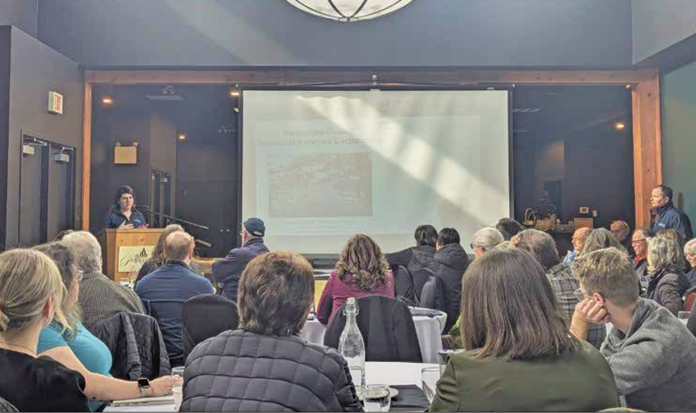
Another highlight was the annual business summit Sept. 23, for which Ingram reported, “we had a good turnout of
speakers and participants and we got some good feedback on how we can evolve that event going forward next year
and we’re hoping to continue that as well.” She noted 40 people attended.

Granite Shores comes back to council

0

Highlands East residents, and organizations such as the Paudash Lake Conservation Association (PLCA) and the Crowe Valley Conservation Authority, have reiterated their concerns about the Granite Shores development on Centre Lake – even though the proponent has made more changes to its original plans.

Highlands East held a public meeting Oct. 7 on a proposed official plan and zoning bylaw amendment.

Municipal planner Chris Jones said Granite Shores wants to build a subdivision on 115 hectares of the 431 hectares owned. The land abuts a 200-foot Crown Reserve, with the first 66-feet an original shore road allowance established prior to the reserve.

The shoreline has been arguably the most contentious issue to date. Highlands East council did not support the disposition of the Crown Reserve in 2021. It also voted not to close and convey an unopened road allowance in 2024.

Jones said the revised plan calls for 18 lots, and two island lots, for detached dwellings; 13 backlots for detached
dwellings; four open space blocks; a block for commercial use on Hwy. 118 and a common private road.

He said the policy exemption being sought, in part, “would acknowledge public ownership of the Crown Reserve and shore road allowance, and the right for the public to continue passive recreational use of the shoreline.” The rezoning would be to open space for recreation, and shoreline residential. Further, natural features and
recommended buffers would be used for environmental protection.

Ritee Haider, a planner at Arcadis, said they had heard concerns since 2021 about loss of public land, impact on the
environment, the scale of the development, appropriate servicing and health impacts. She said they had made changes, with more refinement to come. For example, they removed a wellness centre and 60 hotel suites.

She said they are now looking at up to 33 seasonal cottages, with the Crown Reserve and shore road allowance not included. “It’s still accessible to the public …” She said the cottages would be pushed back from the shoreline, have their own septic and wells, and there would be public hiking trails and lake access. She added they would have commercial development and a condo road would be maintained by a condo corporation. She said technical studies found the plan “was environmentally feasible” provided mitigation measures were followed, such as setbacks from wetlands and minimal tree removal. She added they believe the lake has enough capacity and found no significant highway traffic impacts.

“Centre Lake will continue to be used as it is today, whether it be for boating, fishing, kayaking or paddleboarding, That will not change.” She further said they would provide an additional and safer public boat launch and campers would not see the cottages.

“In our opinion, the revised proposal conforms to the relevant planning documents, it supports tourism while
protecting significant natural features on the property, conforms to the County of Haliburton official plan, and meets the intent of the Township of Highlands East’s official plan.”

Deputy mayor Cec Ryall asked, “is there any way to restrict access from those cottages to the lake directly or will they be able to put trails and boats in?”

The proponent said lots would be adjacent to Crown Land, which is open to the public, including cottagers. However, there would be minimal tree removal for trails and no docks.

Ryall responded, “If someone was to go deeper into that 200-foot with development, how are we going to ensure that gets resolved, if not stopped?” A number of people spoke out against the project, and a petition was tabled.

PLCA concerns

Mike Thomas of the Paudash Lake Conservation Association touched on most of the concerns.

“While the new application does not contain the 60-unit condo resort building or the 200 ft. wide Centre Lake Crown
shoreline reserve, we continue to have concerns about the future implications of the development as well as its current impact,” he said.

He suggested Highlands East or the County assume ownership or management of the reserve from the MNRF to maintain public lake access, or support a First Nation doing so.

People are also worried that another developer has applied to purchase the public Crown reserve on the other side of the lake to build 35-40 cottage lots.

The PLCA wants to ensure the public can still camp; they’d like fencing between the private lots and public reserve, with gates to access the shoreline; they feel the proponent is overstating economic benefits; uncertainty over the use of the unopened municipal road allowance; the type of ownership and seasonal use of the cottages is unclear; the impact on municipal infrastructure; radon gas; and the need to monitor lake health.

Neither Highlands East council or the County of Haliburton has made a decision on the file.

No help yet for rec ratepayers

0

Algonquin Highlands council has opted against offering township residents a discount on parks, recreation and trails
user and rental fees for now, though will be approaching Lake of Bays about contributing funds towards the operation of the Dorset Rec Centre.

At an Oct. 2 meeting, parks, recreation and trails manager Chris Card brought forward a recommendation that the township apply a 20 per cent discount to local ratepayers for facility rentals, recreational programming, water trails use, and entry to the Dorset Tower.

He estimated the move would cost the township around $6,800. Factoring in 1.9 per cent inflation, he suggested the township could recoup the money by upping its trails fees 2.3 per cent, canoe rentals 11 per cent for 16-foot boats and 16 per cent for 17-foot boats, Dorset Tower entry by 2.91 per cent, and all recreation programming 8.28 per
cent.

Card said ratepayers accounted for two per cent of all trails sales, which includes rates for camping, equipment rentals and ski passes; five per cent of all visits to the Dorset Tower; five per cent of facility rentals; and 30 per cent of all recreational programming.

Mayor Liz Danielsen said, “I think this is too much for too little,” noting she didn’t support the plan. Deputy mayor Jennifer Dailloux suggested that, since Algonquin Highlands residents had paid for these facilities and services through their property taxes, that they should be given a break. Coun. Sabrina Richards agreed.

Danielsen said she and CAO, Angie Bird, will meet with Lake of Bays administration to see if they’d be willing to contribute to the facility’s running costs.

Danielsen, Barry and coun. Julia Shortreed opted against applying the discount, though talks continued on how the township could cut costs. It was noted Algonquin Highlands manages trail systems in Minden Hills and Lake of Bays, with Richards suggesting those municipalities pay their way.

Card was asked how much events lik the Dorset Snowball cost to run – he said he would bring a report on the event’s revenues and expenses to a future meeting. He will also bring back another suggestion to implement a ratepayer discount for programming at the Dorset Rec Centre only.

Fire department ‘in pretty good shape’

0

Consultants, the Loomex Group, presented a fire master plan to Minden Hills council Sept. 25 with just eight recommendations. It also contains 24 other initiatives.

The first was that fire chief, Don Kruger, work with members to develop a recruitment and retention program designed to recognize volunteer firefighters.

The second was developing a firefighter health and wellness program, including for mental health.

Third, Loomex suggested the fire chief investigate the possibility of developing a training facility in Minden Hills for
practical training. Now, they go to Algonquin Highlands.

Next, it was recommended council provide financial support to the firefighters to maintain their DZ driver’s licences to drive fire department vehicles.

Loomex said Kruger should continue to monitor department response and “focus on whether the fire department needs to increase its staffing levels, particularly during regular business hours, weekends, and holidays.”

It also encouraged council to continue to properly fund the department for upkeep of the new fire hall.

Another recommendation is that Minden Hills should do a water supply study for the non-hydrant-protected area of the community.

“The study should aim to determine whether it is feasible to install dry hydrants in those locations. The study should also identify the best locations for dry hydrants in the township,” the consultant said.

In addition, councillors were told they should continue to use the budgeting process to provide the department with
funding it needs to replace fire apparatus and fire service equipment that has reached its life expectancy.

Coun. Pam Sayne said the report was very informative. She liked the recommendation about licences in particular, noting the cost of a DZ licence is very expensive. She also asked what a dry hydrant is. The consultant said it is a pipe put deep into a body of water so it does not freeze and remains in place to be accessed by pumper trucks.

Coun. Tammy McKelvey queried whether they ask for dry hydrants now for large developments. Kruger said they can ask for cisterns to be installed.

Mayor Bob Carter asked about the need for a training facility.

“Did we consider the fact we have four departments in Haliburton County that have mutual aid plans instead of Minden Hills developing this; that one be developed that is shared.”

Kruger said there is a facility in Algonquin

Highlands used for new recruits. Butfor weekly training, it’s “quite a drive to get there.” It means they cannot respond quickly if there is a call in the community while they are away. He added it would allow them to do more live fire training.

Carter also wanted to know how realistic it was for rural fire departments to do the work suggested in the recommendations and initiatives, such as formalizing handshake agreements about mutual aid. The consultant agreed “the administrative side of it is a nightmare, especially when it’s a one or two person show that’s doing it.”

He added it is not uncommon for Loomex to recommend 30, 40 or 50 things, but Minden Hills’ fire department “is in pretty good shape comparatively … you really need to support that and build it up.”

CAO Cynthia Fletcher asked council to receive the report as information only.

“Every one of these recommendations would almost be mini business cases. If we were to bring them to council, they need to be fleshed out with much more detail.”

She added they may partner with other townships on some recommendations and initiatives and would report back quarterly.

Taking a chance to try something new

0

When Highlands Opera Studio (HOS) put out a call for stories based on life in Haliburton County, it piqued Marcia
Mandel’s interest.

She had tales of Highlands experiences, from being a Hike Haliburton leader, to a sound bath practitioner, and a newspaper columnist.

She applied and was chosen as one of the four creators of short operas that will be staged Oct. 18 at the Northern Lights Performing Arts Pavilion in Haliburton.

‘Let’s Make an Opera’ is a grassroots production designed to encourage participation in local theatre.

Mandel said her script, or libretto in opera speak, is about a single mother turning 50 who is looking for something different. She sees an ad in the paper for Hike Haliburton leaders and offers a walk called Crane Lake Cleanse, also the name of the opera. With only 20 minutes to tell the tale, it starts in her kitchen with her son, then quickly shifts
to the start of the hike. She is met with people who have come because other hikes have filled, or wives have forced husbands. And, it’s raining.

“Somehow, even with all of that, I was able to keep myself grounded and take these people on my hike, and it all comes from that,” Mandel says, adding the sound bath element is also woven into the opera. She plays guitar and other instruments.

Learning at Ryerson University years ago that she could write, and having studied screenwriting, the musician said it all came together with this project.

HOS co-artistic director Valerie Kuinka said this Saturday night is a culmination of a “daring” new year-long project, which was supported through a $97,400 grant from the Ontario Trillium Foundation.

“We wanted to encourage people who were not familiar with opera to dispel the preconceptions and take a chance to
try something new,” Kuinka said. “All opera is, is stories supported by music and theatre. So, we brought the entire process of creating an opera front and centre to people in Haliburton County.”

Earlier this year, Kuinka gathered stories from the public that feature the Highlands, whether from people who live here or were born here.

Workshops began in April, focusing on background. Each piece is about 20 minutes long and boasts its own dedicated team. Regular meetings were held virtually through spring and summer, with a second workshop in August – with all components coming together for a series of rehearsals.

Kuinka said the idea was to create a heartwarming production for the community, from the community. After
its ‘pay what you can’ singing programs, Kuinka sees this as another way of giving back – and allowing people to peek behind the curtain.

“This is about the people of Haliburton County owning their story. Opera does not have to be professional singers in a big theatre with a full orchestra in a major city. In fact, it’s much more exciting creatively working with smaller operas – this is what we would like to share at home in Haliburton,” she said.

The other operas are: Two Shots at the Working Beaver (written by Veronica Beynon, with Bill Gliddon the composer
and musical director); Desmond and Lois (by Meghan Mardus with Melissa Stephens and Lauren Margison) and Women at the End of the Line (by Janet Trull, with Richard Charles, Stephens and Kuinka).

Tickets for the 7:30 to 10 p.m. performance are available through the HOS website.

Film festival shares stories of overcoming adversity

0

Those Other Movies has announced this year’s Haliburton International Film Festival (HIFF) lineup for Nov. 7-9 at the
Northern Lights Performing Arts Pavilion in Haliburton, as well as Highlands Cinemas in Kinmount.

Spokesperson Tammy Rea said after watching more than 50 films at the Toronto International Film Festival
and Sudbury’s Cinefest, the committee is excited about the bill coming to Haliburton County.

“The films in this year’s lineup tell epic tales and small stories about overcoming adversity and persevering against all odds, with jazz scores flowing through many of our films. Many of the films find ways to make us laugh even while portraying challenges,” Rea said.

She added they will be showing seven films; opening the festival with Guillermo del Toro’s Frankenstein at the iconic
Highlands Cinemas.

“We are excited about a local connection to this film that we’ll be announcing closer to show time. All other films on Saturday and Sunday will be shown at the Northern Lights Performing Arts Pavillion, four movies on Saturday and two on Sunday,” Rea added.

Here is the lineup:

• Friday, Nov. 7 at Highlands Cinemas 2 and 7 p.m. Frankenstein with special guests.

  • Saturday, Nov. 8 at the Northern Lights Performing Arts Pavillion: 10 a.m. Little Lorraine; 1 p.m. Once Upon My
    Mother; 3:30 p.m. DJ Ahmet; 7:30 p.m. Youngblood with special guests.
  • • Sunday, Nov. 9 at the Northern Lights Performing Arts Pavillion: 10 a.m. There’s Still Tomorrow and 1 p.m. Köln 75.

Rea said Oscar-winning director del Toro adapts Mary Shelley’s classic tale of Victor Frankenstein, a brilliant but
egotistical scientist who brings a creature to life in a monstrous experiment that ultimately leads to the undoing of both the creator and his tragic creation. “This multi-layered story has a Haliburton connection,” she teased.

She said Little Lorraine is about the aftermath of a mine disaster in a small North Atlantic seaside town.

Once Upon My Mother tells the story of a woman whose baby is born with a clubfoot in 1963.

DJ Ahmet is about a 15-year-old boy from a remote Yuruk village in northern Macedonia. His mute brother finds solace in music while navigating grief over their mother and a controlling father.

Youngblood follows Dean Youngblood, a hockey prodigy who joins the Hamilton Bulldogs and has to deal with toxic
behavior during his journey to the National Hockey League draft. It’s a remake with a different approach from the 1986 film of the same name.

There’s Still Tomorrow is set in post-war Rome, where a working-class woman dreams of a better future for herself and her daughter while facing abuse at the hands of her domineering husband.

Finally, Köln 75 follows 18-year-old Vera Brandes as she defies her conservative parents to organize a Keith Jarrett concert in Cologne, Germany in 1975.


Rea added they have a new projector and audio system for this year’s festival toimprove the viewing experience. Weekend VIP passes are $65 ($60 for season’s pass holders) and are available at https://www. thoseothermovies.com/ or cash at the door. Tickets for individual films are $10 at the door. Single tickets for Frankenstein will be sold in advance – available through committee members, or online from their website.

Making connections

0

The Haliburton County Folk Society (HCFS) recently announced they will be receiving a grant from the Ontario Arts
Council to support some of their live music events in 2025-26.

Shawn Chamberlin, co-chair of HCFS said, “we are thrilled about this recent grant from the Ontario Arts Council. One
of the primary objectives of the HCFS is to expand the circle between artists and our audiences, thereby enhancing the overall audience experience and increasing their exposure to artists they might not otherwise encounter. This OAC grant will be a significant asset in achieving this goal.”

Funds from the grant will be used to offer artist workshops in conjunction with the HCFS’ 2025-26 concert series and enable hiring of out-of-province artists for the annual Winter Folk Camp in 2026.

“The Ontario Arts Council has invested over $5,000 in the Haliburton County Folk Society, through the Ontario Arts Presenters Project, to help connect artists with rural audiences,” said Laurie Scott, MPP for Haliburton–Kawartha Lakes–Brock. “This funding will strengthen the society’s capacity to deliver accessible, affordable, and engaging music events, including the celebration of the 15th edition of Winter Folk Camp; an inspiring weekend of music,
mentorship, and community.”

The HCFS has been bringing live music to the Haliburton Highlands since 1996. The concert series lineup includes artists from a range of genres that have blues, folk, Celtic, roots and country influences. Artists on the schedule are Sandra Bouza, Mimi O’Bonsawin, Union Duke, Minor Gold and Jessica Pearson and the East Wind.

Series passes are available online. Winter Folk Camp will take place at YMCA Camp Wanakita March 6-9, 2026. For more information on all HCFS events, visit www. haliburtonfolk.com.

Halls Island Artist Residencyreimagining its future

0

After seven years of welcoming artists of all disciplines to Koshlong Lake, the Halls Island Artist Residency hosted
its final residency guests in September, a spokesperson for the Fraser-Hughes family – which own the island – said.

The residency, located at an off-grid island, “has inspired artists from as far away as upstate New York, British
Columbia, and Newfoundland, as well as Haliburton County artists,” the spokesperson added.

Since 2019, more than 100 painters, photographers, sculptors, novelists, poets, actors, songwriters and musicians
discovered inspiration as they engaged with nature and pursued their creative endeavours in the beautiful setting.

Halls Island is privately-owned by the Fraser-Hughes family, whose generosity provided the residency, accommodations, and island access for the chosen artists. The family said it was enormously grateful for the support of the Haliburton County Community Cooperative and the volunteers who served on the management committee.

“In 2018, we were joined in a vision by the Haliburton County Community Cooperative and several local volunteers
to build a program that inspired artists from all over Canada and elsewhere to visit a peaceful refuge on Koshlong
Lake. Word quickly spread and each year more and more creative people, duos and groups applied to become part of the Halls Island experience. These artists became alumni of the special and inspiring space that the island offered,” the spokesperson said.

“We are now going to take a pause and consult with our former artists in residence and consider reimagining the
future of this magical place. It has been an honour and privilege to work with our partners and provide an exceptional experience for so many worthy and creative Friends of Halls Island.”

They went on to thank Abbey Gardens, Haliburton County Museum, Haliburton County Public Library, the Arts Council Haliburton Highlands, Haliburton County Development Corporation, TD Ready Fund, Haliburton County Folk Society, YMCA Camp Wanakita, Koshlong Lake supporters, and the volunteer management committee and artist selection committee members.

‘It’s been a fun ride’

0

Although Dr. Norm Bottum has retired from family practice as of Sept. 30, Haliburton County residents will continue to see his familiar face for some time to come.

Bottum is transitioning to part-time work, doing sports medicine and being involved with the Metabolic Syndrome Program at the Haliburton Highlands Family Health Team. It helps patients with Metabolic Syndrome and Type 2 diabetes. In addition, Bottum will continue to put in shifts as a coroner. You’ll see him at community events too, such as last week’s advance care planning information day at the Haliburton Legion.

“My plan is to work two weeks on, and two weeks off, and see where I can fit in. I’m not planning to pick anything up, and hopefully will be slowing down,” he said in an Oct. 6 interview with The Highlander.

Dr. Mario Lupu is taking on Bottum’s patients. “He’s been working out beautifully so far,” the retiring GP said.

Bottum has been trying to scale back for years. At the age of 55, he gave up doing emergency medicine. At 60, he was looking to cut back further but didn’t get a chance due to other doctors retiring.

He noted physician recruitment is difficult, but lauded the County’s involvement along with former physician recruiter Cheryl Kennedy and today’s Wendy Welch for bringing doctors onboard.

Bottum shares the story of how he and his wife did a road trip in winter to some County cottage hotspots, but there was something about Haliburton that caught their attention.

“Haliburton was a little bit smaller than what I was interested in, to be honest,” he recalled. He noted there was no operating room, and he enjoyed assisting in the ER. There was no recreation centre. But there were positives, such as working closely with a smaller group of colleagues.

“We said ‘let’s give it a whirl and see how it works out’.”

There were some tough times, such as being on-call one in four nights, and having to staff the emergency room overnight and still show up for regular patients the next morning – with little to no additional pay. In larger centres, there would have been more staff to share the work.

When he started, mind you, there were six family doctors in Haliburton and six in Minden. Now, there are nine. That excludes strictly emergency department doctors.

“We did both for 25 years. We looked after the show. If there was an issue at the hospital and staffing, we figured out a way to cover it, no Health Force Ontario doctors or supports.”

Bottum reminisced on the many changes, from the time of being part of St. Joseph’s Hospital in Peterborough to the formation of the Haliburton Highlands Health Services, for which he led medical staff through the transition. He became the first chief of staff of the new entity. It was a busy time with fundraising and construction and a new
board of directors. “A lot of energy and passion.”

He notes the medical advances as well, such as cardiac care that allows people to return to work a week after a heart attack, and being able to reverse Type 2 diabetes. When he started, it was all about clinical skills, with limited diagnostic equipment, tests and drugs.

“I wish I knew then what I know now. If I had some of those tools, information, tests, and drugs how much better I would have been able to care for my patients. It would have been amazing.”

Asked for highs, lows or surreal, Bottum said SARS and then COVID were game changers. “Just the length of time it went on for. It was exhausting, and the surge afterwards when people became more comfortable coming back into the office.”

He thanks his wife, Janet, and family for putting up with everything that comes with family and emergency medicine; missed hockey games, speeches and other activities. He thanked the hundreds of “incredible” staff he has worked with over the years.

“So many wonderful, smart, dedicated people. It’s all part of the culture of Haliburton County. Maybe that’s why we
stuck it out.

“It’s been a fun ride.”

Two decades of soaking in learning

0

On Oct. 7-8, more than 800 Grade 4-6 students, with their teachers and parent volunteers, gathered at the Kinark Outdoor Centre to take part in the 20th annual Haliburton-Muskoka-Kawartha Children’s Water Festival (HMKCWF).

Students engaged in hands-on fun at 37 activity-based learning stations set up across the site. Elementary schools from across the Trillium Lakelands District School Board and families of local homeschoolers were involved.

HMKCWF coordinator Kara Mitchell said more than 100 volunteers helped children explore the vital connections between water health, ecosystems, and personal and community well-being through motivational experiences.

The festival, a flagship program of the Haliburton-based charity FEEL (Friends of Ecological and Environmental Learning),is organized in partnership with U-Links Centre for Community-Based Research and Kinark. Significant volunteer support came from high school students in the Kawartha Youth Leadership in Sustainability (YLS)
program and Trent University students from the School of the Environment.

This year, 12 community partners including the Turtle Guardians, Kawartha Conservation, the Muskoka Watershed
Council and the Algonquin Highlands Fire Service enriched the programming through hands-on activities. Mitchell said, “students soaked in messages on water conservation, technology, protection and science and came to understand that their attitudes towards water matters and their actions can and will make a difference.”

With a milestone celebrated this year, many of the 90 parent volunteers said they were inspired through their initial
attendance as school children.

Mitchell added through the waterheroes. ca website, students can continue their water stewardship journey. Running until the end of April, students can enter the ‘big splash’ contest by sending in water friendly actions they pledge to do in the year ahead. Donated prizes will be awarded to individuals, classes and schools making inspiring positive impacts on local water systems through their actions.

Mitchell said the festival was possible thanks to support from a diversity of individual donors, local businesses and
service clubs. She added, “FEEL invites local businesses, organizations and individuals to consider donating at any
level to keep our impactful programming flowing.”

The festival will also recognize volunteerswith an event Nov. 1, noon to 3 p.m., at the Highland Hills United Church in Minden.

Mitchell said, “we’ll be acknowledging all supporters, including our groundwater volunteers and donors; those who have been consistent supporters for the past decade.” She said anyone curious about volunteering is welcome to attend.

FEEL says it is committed to advancing public awareness and appreciation of ecosystems through education. HMKCWF is their flagship program. Since the festival began in 2005, more than 16,000 children have benefited.

More information can be found at hmkchildrenswaterfestival@gmail.com, or www.ecoenvirolearn.org, hmkwaterfestival.ca or www.waterheroes.ca