
Home Blog Page 333

High school pioneers equity and inclusion

0

By Kirk Winter

Students and staff at Haliburton Highlands Secondary School (HHSS) are at the forefront of the new school board initiative for equity and inclusion, its principal and vice principal told a May 25 school board meeting.

Chris Boulay and Jennifer Mills said whether it is learning more about First Nations culture or understanding the value of being a global citizen, HHSS is taking steps to make students aware of equity and to create a climate of equality for all at their school.

Some examples are ensuring a diversity in language department resources, Indigenous topics being embedded into course content, including smudging ceremonies, and students being offered a senior level Equity and Social Justice course in the 2021-2022 school year.

Boulay and Mills outlined the Justice Equity Diversity Inclusion Initiative at the school. It’s better known by its acronym of JEDI.

“We began this initiative last spring,” Boulay said. “We wanted to bring equity, inclusion and justice to the forefront of our classrooms. Our work around these issues is not done. We want to have conversations about big issues with our kids present.”

“We want to be focusing on global citizenship and ensure that kids are aware of each other and what is going on in their community,” Boulay added. “We want to create positive change in a non-judgemental way.”

What began as a learning opportunity for staff has now been shared with students to hopefully create positive change in the world by increasing awareness and acting to reduce factors that impinge on equal opportunities for everyone regardless of gender, race, class, ability, religion, sexual orientation, identity or circumstance.

“JEDI also hopes to create and foster a positive school environment,” Boulay said, “where each person’s unique set of ideas, beliefs and skills are valued and represented.”

Mills added, “We wanted to look at how we can make change looking at issues like privilege. Our journey is just beginning. About half the students in the building engaged with the program and generally the feedback has been very positive.”

Mills admitted that some student feedback was negative, suggesting the program is “too political” and that because of Haliburton’s isolation, its content isn’t necessarily impactful on students’ lives.”

But Mills said, “We need to open up people’s minds to different points of view.”

Chief trustee Bruce Reain called JEDI “a great project and it was good to see kids so involved in it.”

Student trustee Kaylee Kelly added her support, calling JEDI at HHSS “absolutely inspiring” and complimented the school on the amount of time it has put into discussing important questions such as the ones JEDI is addressing.

School board celebrating Pride

The Trillium Lakelands District School Board (TLDSB) is recognizing Pride Month.

Superintendent Jennifer Johnson told the May 25 school board meeting that as part of ongoing work by the TLDSB Equity and Inclusion Task Force, they’re committed to supporting the Two-Spirit, Lesbian, Gay, Bi-Sexual, Transgender, Queer, Intersex, Asexual, Plus community and their allies, so all people feel safe, welcome, included and respected.

Johnson said the board would like to ensure that all of its schools are a positive space for all students.

A recent review by school administrators suggested that most schools are ready to support the 2SLGBTQIA+ community and some are ready “to go deeper and continue cultural competency learning for staff, students and community.”

Pride Month is being recognized with the Pride flag flying from June 1 at the education centres in Muskoka and Lindsay, Johnson said.

She added that positive space documents and website pages have been updated and ready for promotion to staff, students and the school community.

Teachers are being supported with curriculum connections and resources to further imbed 2SLGBTQIA+ perspectives into classroom instruction.

The month will culminate with the progress Pride flag being raised at all TLDSB schools from June 21 to June 30.

Johnson said the rainbow colours of the Pride flag have long been a symbol of hope and peace and “raising the flag will visibly highlight the continued commitment to ensure equity, dignity, well-being, diversity and inclusion of the 2SLGBTQIA+ community in TLDSB.”
Folk society zooms from coast to coast

0

Rural internet speeds and COVID-19 didn’t dampen The Haliburton County Folk Society’s first pay-per-view zoom concert.

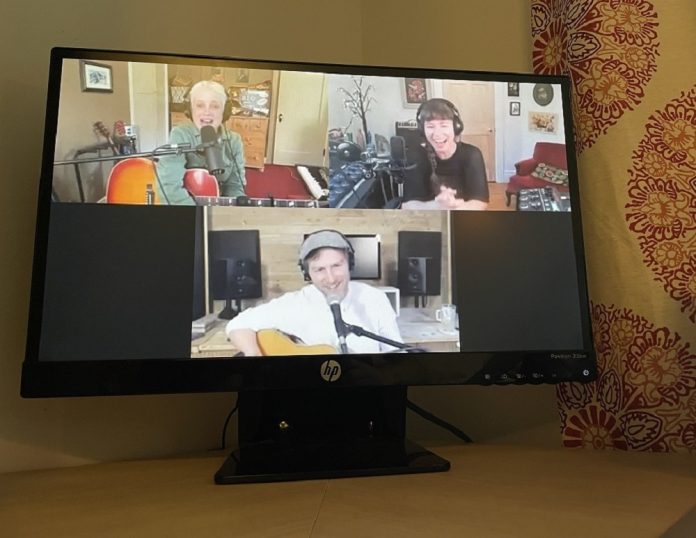
“Because music doesn’t happen as often as it should these days, I thought I’d start off with something fun,” Halifax-based musician Ian Sherwood said as he began his performance June 5.

Sherwood strummed, sang and chatted with Coco Love Alcorn and Helen Austin in the Folk Society’s “Music from Coast to Coast” Zoom concert.

Concert organizer Don Gage said he and the society were pleased with how the show went.

“It was fantastic,” Gage said. “We’ve experimented with using local artists and doing Zoom shows over the last year – this is the first time we’ve done a ticketed event.”

Organizing a concert reliant on fast internet is no easy feat in the Highlands: high-speed internet is only available in select locations.

Gage, who had an appointment in London, was able to host the show remotely.

So far, the society has been spreading out around the County to prep and produce live shows.

“You have to have good internet for live music,” Gage said.

All three musicians sung songs from their own libraries, also leading singalongs such as Coco Love Alcorn’s song, “This world is for everyone.”

The singer conducted viewers as they sang on their own Zoom screens.

Eighty people chimed in from across the County and beyond – typing messages to each other while the stream took place.

“There was some back and forth between the audience and the performer too,” Gage said.

He said the feedback from viewers was “unbelievably positive.”

Afterwards, many left excited comments on the group’s Facebook page.

The Folk Society tried out a couple of live shows before this cross-Canada event.

To work around internet speed issues, volunteers usually set up in three locations: The Dominion Hotel in Minden, Haliburton Village’s Rails End Gallery and the HCDC office in Haliburton Village. From their, they can help musicians produce their live streamed shows.

For Music from Coast to Coast, however, each musician was in their own home studios.

While Gage said everyone in the society hopes they can move to in-person shows soon, their positive experience producing the weekend’s concert means that a virtual music option for live concerts is likely here to stay.

“As we gradually move out of COVID, many people are still going to be reluctant to go to live shows,” Gage said.

The society’s next showcase features local musicians Kate Hall, Just Jodi and Virginia de Carle on Saturday June 12.

Registration is available on the society’s website, haliburtonfolk.com.

Choosing creative solitude: artist residency to reopen

0

While the easing of COVID-19 restrictions means many are excited to gather again, it also will allow artists, musicians and actors to seek isolation at the re-opened Halls Island Artist Residency.

Artists who had residencies cancelled in 2020 will have the chance to dive into their art form on the scenic island on Koshlong Lake.

“Halls Island Artist Residency is an amazing opportunity for artists to come to Haliburton, be inspired by its beauty and add to the rich fabric of our local community,” said Don Gage, co-chair of Halls Island residency in a press release.

“We’re excited by what our resident artists will do this summer.”

The residency is set to see its first guest on June 12, with the Haliburton County Development Corporation’s Local Initiatives Program helping to fund the reopening.

In 2019, a wide range of accomplished creatives spent time at the island: 2021’s guests are no different.

New York Times best-selling writer Cathy Marie Buchanan, R&B singer Sandra Bouza, playwright Beverley Cooper and more are set to attend.

While in-person programming is cancelled to comply with COVID-19 regulations, virtual programs will be announced throughout the summer.

So far, residency guests will be invited to partake in a video project: Escape to Halls Island. In a six-minute video, they’ll be encouraged to explore themes of creativity – however that looks for each person.

In November, the Haliburton Arts Council will host a premiere of the compiled videos.

In the past, residency guests have hosted readings, writing workshops and invited the public to participate in video projects.

Despite that programming shift due to the pandemic, solitude, quiet and space to create are key parts of the residency which has been operating on the private island since 2019.

“We’ve all been forced into isolation throughout the year,” said Joan Duhaime, Halls Island arts administrator. “But I think these artists are looking for that anyways for their creative process.”

“It also offers them a different location,” said Duhaime. “Isolation from their daily grind – isolation from [their] house.”

For artists looking for off-grid space to create next year, the residency will be accepting applications for the summer of 2022 starting in November.

You can find out more at hallsisland.ca

Art meets expression at gallery launch

0

Whether on childhood trips to his family’s cottage, or painting en plein air around the County as a seasoned artist, Byron Hodgins often found inspiration in the Highlands.

“Every time you go up, you leave a bit of yourself there,” said Hodgins, who now lives in Ottawa.

This summer, he’s opening a new permanent gallery in the sprawling main floor of Haliburton village’s Lucas House.

The rotating exhibition will showcase work from accomplished contemporary painters from across the province.

“I really want artists to come up and experience Haliburton, and bring their work up, and see their work in that context,” Hodgins said.

The gallery is owned by Simon Payn and Bram Lebo. Payn is publisher of The Highlander.

After coordinating with Lebo and Payn, Hodgins curated a test show in 2020. His work weaves his own psyche between Haliburton County’s lakes, rivers, forest tracts and settlements.

“I’m painting a meeting point between myself and the landscape,” he said.

Now, he’s inviting four other initial artists to show their work alongside his throughout 2021.

Margaret Glew, Julie Himel, Scott Sawtell and Shannon Dickie will hang their paintings in the rooms and hallways of the Victorian-era building across from the A.J. LaRue Arena.

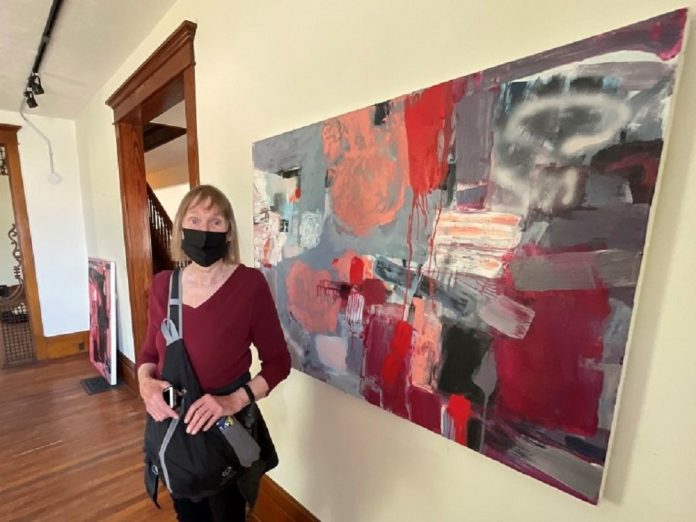
“I liked what Byron was doing – in putting a gallery of contemporary and abstract work in a place that hasn’t had that before,” Glew said.

Glew is a widely-celebrated textile, painting and sculpture artist. Her work has been featured in more than 20 solo exhibitions and been shown in galleries from Kelowna to New York City.

The Corner Gallery offers contemporary artists an unusual space to show their work, Glew said.

“I like the contrast between the old and the contemporary – the grilled work, the places for candles; it’s a beautiful room.”

Hodgins said he’s excited for people to experience strikingly modern paintings in a building with such history.

“Most galleries are a bit of a white cube – you just see the art only,” he said. Lucas House, a downtown landmark, is a meandering collection of rooms and corridors not typically associated with vibrant contemporary paintings.

“This space is a bit different. You hear the creaky floors – you see the wood molding. You know, this room was a dining room at one time, you know that that room was the proprietor’s office,” said Hodgins.

Lucas House is also home to The Highlander and Lebo Law.

Glew’s show, Slow Time, is set to open June 12. Throughout the summer, Hodgins said each artist might even be able to do an artist talk through Zoom.

Himel, Sawtell, Dickie and Hodgins will display shows throughout the summer and fall.

While each brings a different style and subject matter to the gallery – Dickie’s work deals with blurred memories and dreamy scenes, for example – they all celebrate and reflect the craft of painting.

“These are painter’s painters,” Hodgins said. “These are artists who are really positive about painting,”

Hodgins said that the Corner Gallery plans to grow and develop organically – engaging with the community through contemporary art.

“Potentially it will open up to have deeper conversations with the community and its history, and where it could be going,” he said.

Lebo said, “Haliburton is an arts community and deserves more art galleries. Lucas House is so beautiful, it needs to be open to the public and we thought this was the best way to honour its history and add to the value of Haliburton as a destination.”

To stay up to date about the gallery’s opening dates, and learn more about the artists visit cornergallery.ca.

Retirees get chance to tour new suites by lake

0

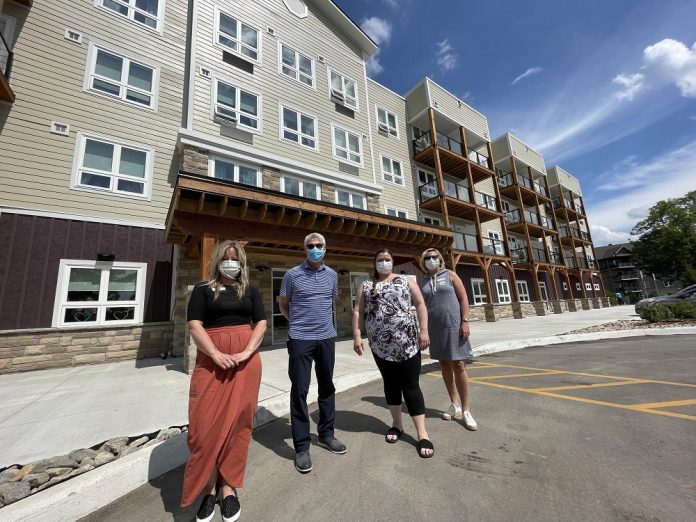
While a ribbon-cutting or grand opening celebration is on hold, the Gardens of Haliburton retirement residence is open for business.

Since COVID-19 restrictions have begun easing, retirees can now tour the games rooms, medical facilities and check out the view from a suite overlooking Head Lake.

The building’s first residents began moving in on May 1.

Phil McKenzie, company partner, said he heard many residents were excited to find out assisted living was available in the County.

“So many people who wanted the levels of care that we provide,” McKenzie said. “They were so happy to be coming back to Haliburton.”

Thirty-one suites are reserved out of 70 available units, which range from one bedroom hotel-style rooms to larger multiroom suites. Since last August, Patti Lou Robinson, director of community relations, has been heading up a showroom in downtown Haliburton Village.

“Now that the restrictions have been lifted, we’re now able to actually take people on tours,” Robinson said. “There’s still some restrictions: only two people at a time, you must wear a mask.”

Unlike rules during the worst part of the province’s third wave, the length of a quarantine period for new residents depends on their vaccination status. After a set amount of time and negative COVID-19 test, they’ll be able to mingle with other residents with safety protocols in place.

“People that were afraid to come in and be quarantined, are changing their thoughts,” Robinson said. “More and more people are interested in coming to see the suites and reserve them.”

She also said many people she’s spoken to have been drawn to the residence’s flexible living styles.

“There is the ability to have services provided for you, for different levels of care one might need,” Robinson said.

The entire ground floor of the building is made up of common spaces for residents: a large dining area complements two spaces residents can reserve for special dinners or family functions.

Once restrictions ease, more and more amenities will be available to residents: a gym, hair salon, and a small bus service to nearby towns and attractions, for example.

“There’s always something going on – it’s more like choosing ‘what am I going to do? rather than ‘is there anything to do?’” Robinson said.

Dysart et al Mayor Andrea Roberts hasn’t visited yet but said she’s excited that the residence is bringing more people – and jobs – to the County.

“There’s lots of well-paying jobs with something like this,” Roberts said. “It’s a great asset to our town and County.”

The Gardens of Haliburton currently employs more than 20 people. Phase two of construction, a multi-storey addition attaching to the end of the main building, will begin once the current suites are nearly filled. McKenzie estimates with that addition, the residence will provide more than 50 full-time positions.

For more on the Gardens of Haliburton, and current employment openings, visit gardensofhaliburton.ca

County recognized for talking up recycling

0

The Municipalities of Dysart et al, Algonquin Highlands, Highlands East, Minden Hills and the County of Haliburton brought home the hardware at the Municipal Waste Association’s 2021 promotion and education awards June 2.

Dysart et al environmental manager, John Watson, said Dysart et al received a Gold Print Tool Award for its children’s activity book Let’s Protect the Environment Together. The book was available for pickup during the fall of 2020, and is also available for download at dysartetal.ca/ waste. The other award winners in the category were Dufferin County (silver), and City of Barrie (bronze).

The judging committee said, “By targeting a specific audience, this activity book was fun and creative, and demonstrated that small municipalities can implement effective promotion and education.”

Dysart, Algonquin Highlands, Highlands East, Minden Hills, and the County of Haliburton, in partnership with the Haliburton County Public Library, also won a silver Social Media and Online Strategy Award for their fall 2020 Waste Reduction Week in Canada social media campaign. The other award winners in this category were Region of Waterloo (gold), and City of Toronto (bronze).

On the Haliburton municipalities’ submission, judges said, “The partnership between four small municipalities, the County and library, helped effectively deliver consistent and clear waste diversion messaging to residents.”

The Municipal Waste Association is an incorporated not-for-profit organization formed in 1987 by Ontario municipal waste management professionals to facilitate the sharing of municipal waste reduction and recycling information and experience.

Its annual awards recognize outstanding achievements by Ontario municipalities for the use of effective waste minimization and diversion communication efforts.

Schmale on Kamloops: status quo not working

0

When Haliburton-Kawartha Lakes-Brock MP Jamie Schmale first heard that the remains of 215 children, some as young as three, had been found buried outside a residential school in Kamloops, BC, he reacted as a father.

“It makes you sick,” he said in a June 4 interview.

As the Shadow Minister for CrownIndigenous Relations, Schmale added, “It’s something that has profoundly lasting and damaging impact on Indigenous culture, heritage and language. The legacy of residential schools is a shame.”

In a wide-sweeping interview, Schmale said the fact the last residential school was closed in 1996 means it is not something that happened in a faraway time. “The effects are still having ramifications on the survivors today, on the people that are very much around today.”

Schmale said he has been the lead of the file for the Official Opposition Conservatives. He has been working closely with leader Erin O’Toole and his office, committees, and speaking with Indigenous People, “reaching out and talking with them and trying to develop a fast forward.”

It began with work June 1 and is continuing.

He stressed that the Conservatives “felt this wasn’t an opportunity to politicize something,” but rather making “helpful suggestions. Not placing blame or anything like that because we know the failures are on governments of all stripes going right back,” Schmale said.

His party has asked for the government to develop a plan for Truth and Reconciliation (TRC) calls for actions 71-76, dealing with missing children and burial information by July 1. They also want funding for investigations at all former residential schools in Canada where unmarked graves may exist. Thirdly, ensuring the proper resources are allocated to communities to commemorate and honour the individuals discovered through the investigations and an education plan for Canadians of all ages to understand what happened.

He said any plan going forward must be Indigenous-led, with Ottawa providing assistance.

“Some believe they are gravesites, some crime scenes. Both are true. Some are saying leave it, some are saying let’s get closure … it has to be Indigenous-led not Ottawa-led.”

The local MP said he is having emotional talks with Indigenous Peoples following the gruesome discovery.

He said a lot were not surprised by the finding but were by the number. He said many tell stories of classmates having gone missing and never coming back.

“Most of it is listening, trying to understand the pain they were and have been feeling.”

He thinks this is just the beginning.

Backing Charlie Angus’ call for reform

Schmale said his party plans to vote in favour of NDP Charlie Angus’ motion on the issue, with a vote expected the week of June 7.

As of June 3, they are calling on the Liberals to: end their legal battle against the First Nations children and accept the findings of the Human Rights Tribunal; end their legal battle against the St. Anne’s survivors; push for the adoption of the TRC calls to action particularly calls 71-76; provide survivors and their families the support for dealing with the trauma; and table within 10 days the steps they have taken to end their legal battles.

Schmale said, “We need to deal with this. We need to take action. We know what needs to be done. We need to listen to what the people on the ground are telling us and how we should proceed and then do it.”

The local MP said it’s clear governments have failed for centuries and this is “an opportunity to perhaps think differently on the situation. The status quo is not working so how do we proceed with reconciliation in a more meaningful way? And that includes financial and economic reconciliation too.”

For example, he said there remains equality issues. Some Indigenous police services do not have the same powers and resources as other police forces in the same province. He said the officers know the communities, people, families, and how to deal with situations differently but don’t have the same powers to deal with those situations and that must change.

He said many First Nations people don’t have the ability to acquire property, sell land, have self-governance and the resources to do that.

Referencing years-long boil water advisories, Schmale said in “today’s day and age, how the heck is this still happening?” In some cases, he said it is because a local has not been trained to service a water treatment plant.

“The mechanism of the way government and the bureaucratic structure works, it’s failing, and until we fix that, I think no matter who’s in power, this will be a problem. The fact it’s taken us 150 yearsplus and we’re still failing – at what point do we say the status quo isn’t working? We need to change the way we’re operating. And a lot of that can be done with Indigenous-led.”

“No matter where you were in Canada, when news of what happened in Kamloops came out, I think it affected everyone, Indigenous, non-Indigenous, it didn’t matter. When you hear about a mass gravesite of 215 children, some as young as three, I think a whole country mourns.”

Haliburton honours 215 lost Indigenous children

0

By Sam Gillett & Lisa Gervais

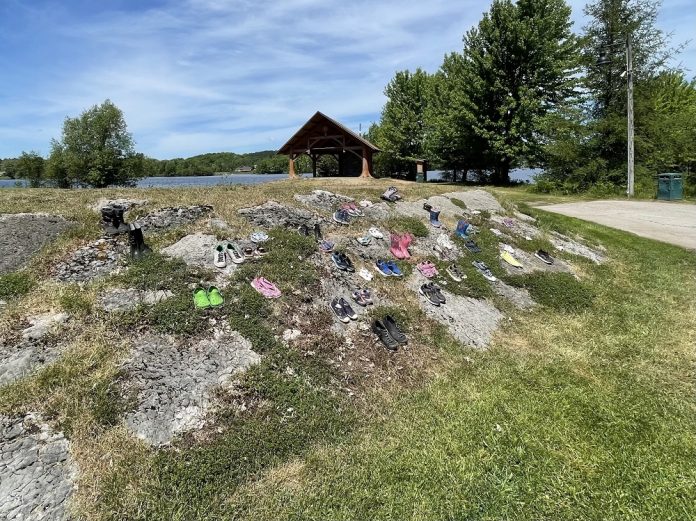
More than 40 pairs of children’s shoes dot the rocks by Haliburton’s waterfront.

They were laid in memory of the 215 children whose graves were uncovered at the site of a former residential school in Kamloops, BC.

Ashley Wilson posted on Facebook after she and her family placed shoes on the rocks. By the next day, many others had come to put footwear and pay their respects.

After seeing the cross-Canada call from Indigenous people and organizations, she thought it was important to bring that to Haliburton County.

“It’s something that I have personally myself paid attention to and tried to educate others [about],” Wilson said.

“When I saw it, it was devastating and disgusting, and sad.”

“We sometimes are a bit sheltered to what is going on across the country. I think it’s really important people are aware of the ongoing trauma that Indigenous people face because of residential schools.”

Val Balaski, who has ties to Haliburton County, is Indigenous.

“My heart is broken. I mourn the loss of these dear souls who never did anything but be born First Nations, Inuit or Metis,” she told The Highlander.

“The families that never knew what happened to their babies. I can’t imagine the pain. I pray with this discovery more of the residential school ‘concentration camps’ will reveal more little ones that need to go home to the Creator. May they rest in peace.”

In 2015, the Truth and Reconciliation Commission of Canada (TRC) determined that Canada’s forced assimilation of 150,000 Indigenous peoples between the 1870s and 1990s amounted to cultural genocide.

“It’s not ancient history – the last residential school in Canada closed very recently,” said Kate Butler, director of the Haliburton Highlands Museum. “It’s a big issue.”

Butler said the museum is committed to educating and informing non-Indigenous people around Haliburton County about the history of their country.

“Always remember the story of Haliburton County doesn’t go back 150 years – this land has a history that goes back so much further,” she said.

For people looking to find out more about residential schools, Butler said museums are a great place to turn.

“We’re looking for ways all the time to better tell the story of Indigenous settlement. It’s something that needs to be ongoing, for people to seek out those sources, and continue to learn, and continue to connect with Indigenous voices and to listen to what’s being said. If people want to talk about it, connect with us.”

A nationwide Indian Residential School Crisis Line is available for former students and others affected. To access emotional and crisis referral services, call the 24-hour national crisis line: 1-866-925-4419.

Step one will last 21 days

0

Other highlights of the reopening plan mean:

• Outdoor social gatherings and organized public events with up to 10 people;

• Non-essential retail permitted at 15 per cent capacity, with no restrictions on the goods that can be sold;

• Essential and other select retail permitted at 25 per cent capacity, with no restrictions on the goods that can be sold;

• Outdoor fitness classes, outdoor groups in personal training and outdoor individual/team sport training to be permitted with up to 10 people;

• Day camps for children permitted to operate in a manner consistent with the safety guidelines for COVID-19 produced by the Office of the Chief Medical Officer of Health;

• Overnight camping at campgrounds and campsites, including Ontario Parks, and short-term rentals; • Concert venues, theatres and cinemas may open outdoors for rehearsing or performing a recorded or broadcasted concert, artistic event, theatrical performance or other performance with no more than 10 performers; • Outdoor attractions such as zoos, landmarks, historic sites, botanical gardens with capacity and other restrictions.

• Indoor religious services, rites and ceremonies, including wedding and funeral services limited to 15 per cent capacity.

The province said it is entering step one based on the provincewide vaccination rate and continuing improvements in key public health and health system indicators, such as provincial case rate decreases and numbers of patients in ICU dropping.

“Thanks to the ongoing success of Team Ontario’s vaccine rollout and the ongoing improvements in public health trends, we are able to enter step one of the roadmap and begin to safely and cautiously lift restrictions,” Premier Doug Ford said on June 7.

He said the only reason they’re able to do so is because of the “enormous sacrifices” made by individuals, families and communities across Ontario.

“As we begin to enjoy the benefits of the first step in our roadmap like meeting friends on a patio or visiting your favourite local store, please do so safely by continuing to follow all public health guidelines,” he urged.

The province will remain in step one for at least 21 days.

Businesses gearing up for reopening … again

0

Like many Haliburton County businesses, the Mill Pond Restaurant in Carnarvon is gearing up for even more customers June 11 as they will be allowed to offer outdoor dining to go along with take-out service.

The province announced June 7 that it is entering step one of its roadmap to reopen plan as of 12:01 a.m. Friday.

It means restaurants such as the Mill Pond can now offer outdoor dining with up to four people per table, with exceptions for larger households.

The Highway 35 eatery had picnic tables last summer but owner Brad Archer said they are planning better for this year to be able to cope with take-out and table service “because last time it was a little bit chaotic. Just trying to keep up in the kitchen.”

With take-out and 12 picnic tables, Julie Brittain said it will be “all hands on deck.”

They are encouraging people to call ahead to book outside tables and place orders and to be patient.

But the two are encouraged by the latest development and what it means for not only their establishment but businesses across the Highlands.

“I think they left it long enough this time, hopefully, that it’s going to be alright,” Archer said. “And they’re doing it really gradually, too, allowing four people at a table to begin with.”

Brittain added, “the numbers today (June 8) are the lowest since last September so it’s looking positive.”