

Home Blog Page 186

Researchers put Minden under the microscope

0

If you live in Minden, chances are you’ve seen Dionne Pohler and Leticia Chapman around town.

Pohler, a University of Saskatchewan faculty member, and Chapman, a PhD student from the University of Alberta, have been chatting up locals for a research project on rural Canadians.

Pohler explained they’ve been inspired by the work of Katherine J. Cramer, the author of The Politics of Resentment: Rural Consciousness in Wisconisn and the Rise of Scott Walker. She delved into why Democratic Wisconsin turned Republican in 2016, and the mood of rural and smalltown America.

Cramer’s work focuses on the way people in the U.S. make sense of politics and their place in it. But. instead of relying on polls and surveys, she dropped in on informal gatherings, such as coffee shops, and gas stations, to listen in on what people were saying.

Pohler said as a result, Cramer, “had probably the most compelling explanation for what had happened, and what people were upset about because she was actually coming and talking to people in rural communities.”

She added when it comes to social science research, academics tend to live in cities, which means, “we’re doing research that doesn’t get a sense of what happens outside of the large urban areas. Canada’s urbanizing and a lot of the research is survey-based or opinion research, polling, and that kind of thing. You don’t really get a feel for how people make sense of issues, what they care about, why they care about it, and how they make sense of issues together in groups.”

Pohler got a grant from the Social Sciences and Humanities Research Council to study rural Canadians, and Chapman is her research assistant. Pohler’s collaborator is Clark Banack, the director of the Alberts Centre for Sustainable Communities.

“We’re starting to spend two weeks in every rural community we visit and try and get a sense of the place and the people. What do they care about? How do they make sense of issues? Why do they care about the issues they care about?”

She said they come without an agenda, and just see what presents in a community. In this instance, it’s the closure of the Minden ER.

They’ve picked up on the seasonal nature of the County, too, as well as a movement towards self-sufficiency and homesteading.

“I think people in urban centres, or in general, think rural communities are not diverse, thriving places, and you show up in them and you’re like, ‘wow, they are’,” Pohler said.

Other observations they’ve made is that people might have different opinions but generally get along.

When they are done their research, Pohler said it may turn into a book. They will definitely publish academic papers, but would like their findings to be more accessible to the general public, including the communities they are visiting.

Pohler said it’s been eye-opening since most of her research is statistics and datadriven. “I have to say there’s something interesting about just letting people tell you why they think and believe the things they do in their own words.”

Chapman added, “when we’re debriefing after we’ve talked to somebody, is people in small communities don’t necessarily expect other people to be totally coherent. You can have this opinion, and you can have that opinion, and it doesn’t matter what’s kind of related to that. Sort of a bit of pragmatic tolerance.

“When I decided to go back to university and start a PhD, I wanted to write about rural communities because I wanted to research them and find a way to talk about this in a different way because what I was seeing was really complex and interesting. Basically, people finding ways to get along with each other. I’ve always seen rural life in small communities being much more socially complex.”

Pohler added, “maybe we don’t have as many competing values as we think when it comes down to it. It’s about relationships. You care about interacting with somebody and you don’t walk away because it’s a difficult conversation.”

Dionne Pohler and Leticia Chapman conducted research in Minden.

Gold medalist appearing at Home Show

0

Canadian curler Mark Ideson is the living embodiment of grit, hard work, and determination.

A little more than 16 years removed from a major helicopter crash that almost killed him, Ideson reflects on his second chance at life in a recent interview with The Highlander. While he is confined to a wheelchair, diagnosed with quadriplegia after breaking 29 bones in the February 2007 accident – including shattering his legs and pelvis and breaking his neck in two places – Ideson has spent every day since chasing his dreams and living his best life as one of the country’s top Paralympic athletes.

He’ll be at the Haliburton Curling Club Saturday as the featured guest at the 44th annual Haliburton Home and Cottage show.

After cracking Team Canada in 2013, Ideson won mixed team gold at the 2014 Sochi Paralympic Games, following up with bronze medals in Pyeongchang in 2018 and Beijing in 2022.

“I was just lost after the accident, looking for something I could sink my teeth into. I spent months in rehab, but it wasn’t until watching the documentary Murderball about full-contact wheelchair rugby that I started to come out the other side,” Ideson said.

While that endeavour didn’t last, largely because he was competing against amputees and paraplegics with full use of their upper body, it gave Ideson the drive he needed to find success elsewhere.

He remembers watching the 2010 Paralympic Games in Vancouver, specifically following the journey of Jon Montgomery, who won gold in the men’s skeleton event.

“I remember thinking he was a superhero. It was so inspiring and really pushed me to find something I could excel at to get to the world stage,” Ideson said.

He started curling later that year. There was a learning curve, but given he’d played as an able-bodied adult he picked things up quickly. After a year of continuous improvement, he attended a Team Canada curling camp in Grimsby, ON in 2011. That put him on the national program’s radar and, after sticking with it, he was named to the mixed squad ahead of the 2013 World Championships in Sochi, where he won a gold medal.

The trick was repeated 12 months later, when Ideson appeared in three games en-route to claiming Paralympic gold.

“It was very emotional, because not a lot of great things had happened to me after my accident. There was a lot of heartache and tears, so to have that moment was just incredible. It was the single greatest honour of my life, being up there on the podium and hearing the national anthem blaring. But there was also a sense of unfinished business,” Ideson said. “I didn’t get to play in the gold medal game, so I left hungry for more. I made it my mission to make the starting lineup ahead of the next games.”

He did just that, serving as skip in Pyeongchang, South Korea. He led his team to nine wins out of 11 in round robin play, setting up a semi-final showdown with China. Canada lost a close 4-3 game to the eventual gold medal winners, securing a podium finish with a 5-3 victory over the host nation in the bronze medal game.

Ideson was back for another crack at Beijing in 2022. Canada snuck into the semifinals as the fourth seed after going 7-3 in round robin. They came face-to-face once again with the Chinese, who prevailed with a 9-5 win. Canada would go on to claim a second straight Paralympic bronze after Ideson and his team bested Slovakia 8-3 for the bronze.

“I consider myself very fortunate to have come as far as I have. My biggest takeaway of the last 15 or so years, and what I tell people who are recovering from different things – when one door closes, another one opens,” Ideson said. “I loved my job. I loved flying helicopters. But when that door closed suddenly, I was able to find a new opportunity to pursue.”

He competed in the 2023 World Championships in Richmond, British Columbia in March, where his team came away with silver after being bested by, you guessed it, China in the final.

“We definitely have a bit of a rivalry going on. They’re an incredible team,” Ideson said. “I’m busy now trying to keep myself in shape and focusing on the 2026 Paralympics in Italy. Appearing in four straight games would be something really special to me.”

Ideson is looking forward to coming to Haliburton, sharing his story, and giving people a chance to see his collection of medals. His appearance was arranged by his brother, Joel, who lives in the area.

“It’s not every day you get to see a Paralympic gold medal up close and in-person. I’m excited to do this. Hearing that it’s a fundraiser for the local curling club, this is a great opportunity to give back to the sport that has given me so much,” he said.

Ideson noted he’ll also be bringing a signed Team Canada jersey that he’ll be raffling off.

He’ll be at the Haliburton Curling Club booth from 11 a.m. to 2 p.m.

Award-winning musician returns to Haliburton

0

At the Royal Canadian Legion Branch 129 in Haliburton June 3, there’s an opportunity to glean some insight into song writing from award-winning singer-songwriter Rob Lutes from 1-2:30 p.m.

Then, at 7:30 p.m., the artist takes to the stage for a concert with long-time friend, and collaborator, Ron MacDonald.

“I have only played solo in Haliburton, but this time I’m bringing my guitar player with me. I have played with him for more than 25 years. He is a phenomenal player, and it is interesting what we do together, so I am bringing something slightly new this time,” Lutes said.

When asked about playing smaller places, such as Haliburton, Lutes added, “when I am invited back to a place like Haliburton it’s a no-brainer. It’s a beautiful town, I know people there, and it is always very receptive and fun.”

Getting into the music business was anything but planned, according to Lutes. He said he heard a lot of acoustic music growing up and, “it was more organic then planned.” The next logical step was to start writing songs, which he did well. “They were popular, people liked them around the province (Quebec) and I had the kind of boost of ‘ok you can do this,’ and then I just kept doing it.”

The term “roots” is how he describes his music because, “…we are drawing from the same well, blues, country, singer-songwriter, folk, Americana. You are picking little bits of different styles, and they are so similar. You have a lot of choices.”

Lutes has eight albums, numerous nominations and two awards from the CFMA (Canadian Folk Music Awards) for contemporary singer of the year in 2018 and 2022. He is noted for his style of guitar picking, and his unique songwriting ability. La Presse, a French-language digital newspaper in Montreal, said, “Rob Lutes confirms his place among the most important songwriters of his generation.”

The most recent album, Come Around, was recorded during COVID and came together using the internet and other digital technology. Lutes explained how he laid down his tracks and hired people across the country: a singer from Toronto, a bassist in Edmonton, a couple of people in Montreal, who all recorded in their own studio.

“I played my guitar and sang, then sent the song to one person, they put what they did down on it, then back to us, we mixed it and sent it to the next person. It was like getting out the crayons and colouring in the picture with everyone’s different work.”

The future of contemporary folk/blues music is good, according to Lutes. “There are new people doing it, and they are doing it well. As part of this multi-segmented music, folk has endured and continues to produce really good things. There is pop-infused folk, it is kind of pop, but it’s got a folk influence and brings more people to the genre. There is an interest in the authenticity of folk, and blues. The blues is durable, there is something about that music, it is culturally relevant, always.”

For more information and tickets for the workshop and concert go to haliburtonfolk.com.

Fearrey ‘sympathetic’ over ER

0

Dysart et al mayor Murray Fearrey has broken his silence on Haliburton Highlands Health Services (HHHS) decision to shutter the Minden emergency department effective June 1, calling it a “major loss” to the County.

The mayor told The Highlander he isn’t happy about the looming closure.

“I think they provided a good service [in Minden]. They may have made a decision based on what they think the facts are, but they haven’t communicated that very well,” Fearrey said. “I don’t think they had a longrange plan in place, they didn’t seem to know how they were going to transition so quickly.”

HHHS president and CEO Carolyn Plummer, and board chair David O’Brien, announced the decision April 20, saying that all emergency and in-patient services would be consolidated at the Haliburton hospital ahead of the busy summer tourism season.

Plummer said the move was related to the organization’s staffing crisis, with a shortage of nurses and physicians leading to more than 20 ‘close calls’ over the past year where one or both emergency departments faced temporary closures.

A more detailed plan was rolled out to the public May 16, highlighting enhancements that have been made, or are coming, to the Haliburton hospital. The number of treatment spaces in the emergency department is increasing from nine to 14 or 15, a new trauma bed is being added, while seating and space in the waiting area has been nearly doubled. An additional 15 parking spaces have been added outside.

While Plummer said there will be more staff working to cover the anticipated increased volume of patients, Fearrey has his reservations.

“If staffing was a concern before, I have to think that’s going to be a concern again… they’ve said they’re going to have extra nurses available and two doctors instead of one at the busy times – maybe it’ll all be OK, but I have some concerns,” Fearrey said.

“For a lot of people in our County, this is going to mean an increased travel time for emergency services. Nobody can think that’s a good thing.

“I’m very sympathetic to people in Minden and the surrounding area. If they don’t do something to take the pressure off, like opening a walk-in clinic, I think there’s going to be problems,” he added.

NDP leader calls on province to act

0

Ontario NDP Leader Marit Stiles labelled the closing of the Minden ER “outrageous” May 25, while calling on premier Doug Ford and health minister Sylvia Jones to reverse the decision to close it June 1.

Speaking in downtown Minden, Stiles dismissed Ford, Jones and MPP Laurie Scott’s claims the decision is a local one – made by the Haliburton Highlands Health Services board and management.

“The buck stops with the provincial government when it comes to health care. They have the power to do something. And if this ED is closing, you can be darn sure that the minister of health had to sign off on that. I think we need to hold them to account and hold them responsible and we need to shame them.

“It is their responsibility to ensure this stays open. Ford and Jones have the tools and the resources to do the right thing and cancel this decision immediately. They can listen to the voices of the community, advocates, health care professionals, and so many others who have been unequivocal that this is worth saving, that the right thing to do is worth doing,” she added.

Speaking in the town’s Village Green, Stiles said it is not normal for a local ED to close and leave rural communities without timely access to health care; for the minister of health to abdicate responsibility; and for a premier to ignore community voices.

She also panned HHHS and its board.

“This is really extraordinary, to, out of nowhere, with no consultation with the community, no consultation with emergency services, such as paramedics, and police and firefighters and ORNG ambulance, to just go ahead and announce, a-month-and-a-half out, that they were going to close the emergency department. It’s outrageous and the only thing probably more outrageous than that is the fact that the local MPP, Laurie Scott, Ford, and Jones have refused to show any responsibility or to take action and stand with these folks.”

She said the NDP were listening and standing with the Minden community. A petition to stop the closure has garnered 24,000 signatures.

“We are working together to save this emergency room and save rural emergency rooms across the province,” the official opposition leader added.

Residents descended on the green with signs and told Stiles their stories. Business owners are worried about people not coming to, or leaving, the community. Others said they would not have moved to the area with aging relatives had they known this was coming.

She noted the June 1 closure comes “when cottage-goers are arriving, when parents will be dropping off their children to nearby summer camps, and when local residents will be out and about enjoying the summer weather. They’re going to be needing reassurance that timely, nearby, emergency room services will be there for them – if emergencies strike.”

“I am incredibly inspired by the people of Minden, but they shouldn’t have to fight for basic medical services in their community like this. They shouldn’t have to be raising money to mount a legal challenge when their premier could just listen.”

Stiles added she’s concerned about the direction Ontario is heading in terms of health care.

“Some people will say we’ve spent too much money on health care. I can’t see it.

“We have a health care crisis across this province because we have a government that actually fails to spend the money they were allocated on health care.

“The health crisis we are seeing today was created. It is chaos and the government is using this as an excuse to bring in privatization, private clinics. That’s going to be their answer,” she said.

“The vultures are circling over the community of Minden. We cannot afford to sit back and stand by and let this happen. What happens in Minden is what’s going to happen across this province if we’re not careful.”

As for the closure coming in a staunch Conservative riding, long held by Scott, Stiles said, “the government really takes communities like Minden for granted – they’ve done that for too long.”

Dysart to consider changes to suites

0

Dysart et al council has initiated a review of its bylaws covering secondary housing units, with mayor Murray Fearrey saying it’s time for the township to “loosen up” its rules and regulations.

The file was discussed at a May 23 meeting, following a presentation from Haliburton resident Gary Burtch. He asked council why, with the community suffering from a lack of housing, the municipality wasn’t doing more to bring much-needed additional units online.

“This is something that needs looking at… the lack of housing is impacting everyone in this community,” Burtch said, feeling secondary units form part of the answer.

Planner, Jeff Iles, said secondary dwellings are permitted in Dysart, pointing to duplexes, semi-detached homes, and basement apartments. Other structures, such as garden suites, are considered on a case-by-case basis, and only on properties in Haliburton village hooked up to the town’s sewer line.

Burtch feels that allowance needs to be extended further.

“I think people should be allowed to put a secondary residence on a property if it’s large enough. It could be for an aging parent, a kid who wants [more independence], or a working professional looking for somewhere to live,” Burtch said.

He accepts that new units can’t be created on waterfront lots but said there are plenty of properties across Dysart that could be ripe for this sort of development.

“I’m thinking something small, between 800 and 1,200 sq. ft.,” he said, adding that he thinks these units should be allowed to have their own septic and well systems installed, and not tap into the main property’s lines. Iles noted this wouldn’t be allowed under existing policy

Discussions around secondary units have been rife in recent months. Last November, the Ontario government passed Bill 23, the More Homes Built Faster Act. One of many sweeping changes to the province’s housing rules was extending the number of units allowed on a single residential lot to three.

While this rule doesn’t apply to Dysart, given it only extends to communities with town-supplied water and sewer, Iles said the message from Queen’s Park has been clear.

“There is support for this kind of thing. It seems to be the trend things are going in,” Iles said.

He further informed council any potential change to allow more secondary units to be developed would require amendments to Dysart’s official plan and zoning bylaw.

Fearrey said he could get behind the idea but wanted clarity on a few issues. He feels it’s important that any additional units be owned and operated by the primary landowner, while reiterating units won’t be considered on waterfront properties. He also asked what the township can do to stop people applying for a new secondary unit and then shopping them as short-term rentals.

“If we’re going to do this, it’s because we want to increase the supply of rental units, or units for seniors. That has to be the main focus,” the mayor said.

Coun. Pat Casey said he wouldn’t be opposed to stretching the boundaries even further and having the bylaw cover potential full-time living spaces above garages or workshops. Right now, those spaces are designated as private cabins, according to Iles, and aren’t permitted to serve as a permanent dwelling area.

Fearrey said he expects an amended bylaw to be brought back to council for further discussion on June 13 or 27.

“We will pursue this… I think it’s the right and necessary thing to do,” he said.

Advisory group needed for climate change

0

Citing significant flooding in 2013, 2016, 2017 and 2019, as well as a major winter storm in April 2018, “the County of Haliburton is experiencing the impacts of climate change,” Korey McKay told County council May 24.

McKay, the County’s climate change coordinator, unveiled her draft community climate action plan at last week’s meeting, encouraging an advisory group to be reestablished to help in its implementation.

Leading into her report, McKay said the climate impacts include more extreme precipitation events with longer dry spells in between and more extreme heat and intense storms.

She added future climate projections indicate these will become more frequent and intense over the coming decades. She added it’s damaging infrastructure in the County and public health. “Municipalities are on the front lines of responding, including the financial impacts. Municipalities also influence about half of Canada’s greenhouse gas emissions.”

McKay said Haliburton County emits approximately 300,000 tonnes of carbon dioxide equivalent annually. This is largely a result of driving and heating and powering our homes and buildings.

“Adapting to more variable and extreme weather, protecting our natural assets, and reducing greenhouse gas emissions will improve community health and wellbeing, generate local job opportunities, decrease local energy costs and avoid long-term costs from damage from climate impacts down the road,” she said.

McKay began her work at the County in 2019, with a three-phased climate change planning process. Phase one was corporate mitigation to reduce greenhouse gas emissions in buildings, vehicles, landfills, sewer and water, and streetlights. The County and the four townships measured their emissions and set targets.

Phase two was corporate adaptation, to reduce the impacts of climate change. They looked at vulnerability and risk assessments.

This third stage involves “creating a longterm strategic roadmap to reduce greenhouse gas emissions, build climate resilience to more extreme and variable weather and protect our natural assets across the County,” McKay said.

McKay said the latest plan has six strategies to achieve a 25 per cent reduction in emissions by 2030 and reach net zero by 2050. They include:

• Shift from personal vehicles. Implement a public transportation system. County council has investigated public transit over the last number of years but been unable to deliver. Increased opportunities for ride sharing and carpooling. Active transportation, which requires more housing in the villages so people can get around easier on bicycles, for example.

• Switch to zero emission vehicles. Getting people to stop idling; educating on zero emission vehicles; and getting more electric vehicle charging stations.

• Retrofitting homes, cottages and other buildings. Promoting existing funding options; looking at a voluntary local home energy efficiency program; support a local Energiesprong approach (supporting markets for energy transition, pushing forward the development of energy positive materials); bulk purchasing; and advocating for a decarbonized electricity grid.

• Encouraging low carbon, new development, such as through a voluntary green development standard; reviewing building permit fees and requirements with a sustainability lens; and advocating for a stronger Ontario Building Code.

• The acceleration of local production of low carbon energy, such as through a local energy cooperative; and providing renewable and low carbon energy sources.

• Protecting the County’s natural assets, for example, a lake stewardship program at the property level; support of initiatives for food security; and protecting wildlife corridors and education.

McKay said her report emanated from talking to the community climate action plan advisory group, surveys, and meeting with external organizations.

“Staff are proposing to council that the (group) is reformed as an implementation group, as a mechanism for ongoing collaboration across the community,” McKay said.

“This plan aims to reduce our local greenhouse gas emissions from the broader community and better prepare for, and adapt to, a changing climate. The success of this plan will require action from residents, visitors, and local businesses and organizations, in addition to municipal, provincial and federal governments.”

See the full plan on the Haliburton of County agenda for May 24, 2023.

Highlanders vote against health care privatization

0

Haliburton County residents overwhelmingly voted against health care privatization during May 26-27 polling at 30 stations across the Highlands.

A total of 5,396 people voted ‘no’ in the local Ontario Health Coalition (OHC) ballot, while only 108 were in favour.

Across Ontario, the numbers were 376,223 against privatization and 6,083 for.

Bonnie Roe, of the Haliburton Highlands LTC Coalition, said, “30 locations across the County. Cannot thank them enough and the more than 80-plus dedicated volunteers who were so committed to get out the message to our community about the referendum, and to enable citizens to voice their opinion about privatization.”

She noted with a 24 per cent voter turnout, it was more than some local elections have garnered.

“Your numbers are huge given your population,” the OHC’s Natalie Mehra said.

The current health care system in Ontario ensures that every resident, regardless of income or status, has access to free healthcare through their health care card. However, privatization would mean that the elite would be able to pay for their healthcare and the less privileged will not.

Grass Lake proposal taken to Ontario tribunal

0

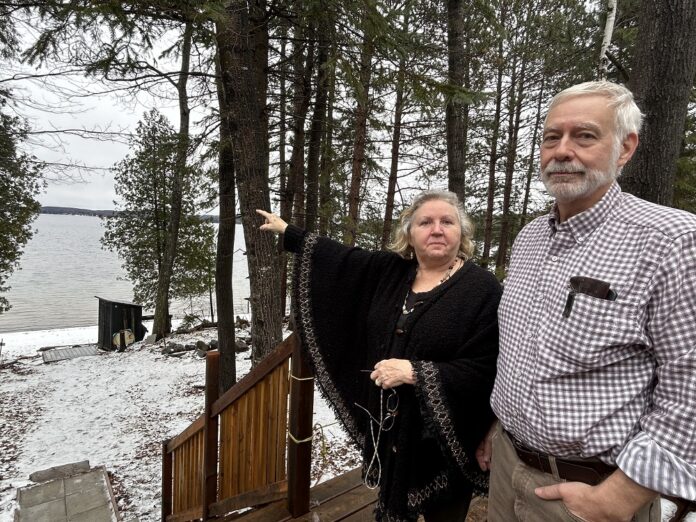
Waterfront property owner Catherine Swift is “shooting her last shot” after filing an appeal with the Ontario Land Tribunal (OLT) last week, protesting a proposed 88-unit development slated for land near Grass Lake in Haliburton.

The proposal, brought forward by developer Paul Wilson and his company Harburn Holdings in 2019, would see approximately 2.5 hectares of land along Peninsula Road repurposed into four lots each housing multistorey apartment and condo buildings, with one unit featuring a commercial component.

Dysart et al’s previous council expressed support for the project in September 2022, while County council ratified an amendment to its official plan in April, paving the way for the development to proceed.

Swift is a member of the Friends of Grass Lake advocacy group, which opposes the build. Speaking to The Highlander, she said the OLT is her final hope.

“I don’t feel the environmental issues presented throughout this process have been adequately considered. I want to present this information to an unbiased third party that can look at everything we’re laying out fairly and objectively,” Swift said.

She has retained Toronto-based environmental lawyer David Donnelly to argue the case.

The primary concern, Swift said, is the development will “drastically and permanently” impact water quality and animal habitats, including for the endangered Blanding’s turtle. She contends that a wetland area abutting the parcel Wilson wants to develop will be ruined if the build proceeds.

“Wetlands are almost like an added layer of protection for bodies of water – they help to filter junk out, but also provide habitats to all kinds of critters,” Swift said. “This proposed location is virtually right on top of a wetland area… it could destroy that wetland.”

Wilson has committed to keeping a 30-metre buffer between the wetland and any development. Environmental impact, wetland site assessment and hydrogeological studies have been completed, peer-reviewed and endorsed by Dysart staff.

Swift contends the project should be seen as a non-starter considering Grass Lake is already deemed to be over its recreational capacity.

“Dysart’s own plans show Grass Lake is 170 per cent over capacity. By adding another 88 units to the waterfront, that would take it to more than 300 per cent over capacity. This is a small, shallow lake. It’s vulnerable. Adding a development of this size is going to wreck this lake,” she said.

Swift said the implications of the build are already being seen – one couple has sold their property and moved. Swift said she’s considering selling too.

“I’ve been here for 20 years… I love this place. I have a real connection here, history too – my parents honeymooned at the old Deer Lodge. That’s only about a 10-minute boat ride from my place,” she said. “It would break my heart to leave but knowing what’s going to happen to the lake [if development proceeds], it’s something I’m considering for sure.”

She’s worried too about the precedent the project would set, potentially paving the way for other high-density development on the water.

Given the stated timelines at OLT – it’s estimated a hearing will be scheduled within four to eight months – Wilson expressed disappointment the issue will likely carry over into the new year.

“I started this process four years ago and still don’t have an answer. It’s unfortunate it takes so long to bring these things to fruition – we’re in dire need of housing in this community right now,” Wilson said.

Swift believes she has a 50/50 shot of success at the OLT.

“I know this isn’t a slam dunk. We feel these issues are real and deserving of further consideration. If the answer [from OLT] is the same, then OK. But I know if I don’t keep fighting, I’d regret it forever,” she said.

Editor’s note: A statement attributed to Harburn Holdings’ lawyer, Tony Usher, claiming the four lots along Peninsula Road aren’t considered waterfront lots has been removed. The lots in question are classified as waterfront.

Controversial one-stop ER opens in County

0

With last-ditch efforts now exhausted to postpone or reverse the Minden ER closure, the Haliburton Highlands Health Services (HHHS) consolidated County ER services in Haliburton June 1.

Dr. Norm Bottum, acting chief of staff for HHHS, said, “we are all deeply committed to delivering high quality and safe care to our community. And, as we have always done, we will do everything in our power to ensure that all those in need of emergency care in Haliburton County can get it.”

He reiterated the decision to close the Minden ER, and consolidate services in Haliburton as of today, “has been an incredibly difficult decision for our leadership that was made after many years of searching for solutions that would stabilize and protect emergency services in the County over the long term.”

Dr. Bottum added, “our goal is to ensure our community has a stable and safe emergency care system that you can all count on. This means having an emergency department that is open and able to provide quality services – each and every time someone shows up in an emergency department.

“The safety of our community has been impacted by the multiple, unpredictable, last-minute closures faced by HHHS over the past number of years. We are committed to reducing this risk by consolidating services in one location that can provide consistent service to our community and those seeking care.”

Bottum: reduced risk of closures

Dr. Bottum said they had been working closely with EMS, which had assured them the community is supported by access to 911. “Local paramedics are a critical part of our emergency care system. We encourage you to call 911 when you experience a medical emergency, knowing that care begins immediately, while you are en route to the HHHS emergency department.”

Revised ambulance coverage

The Haliburton County Paramedic Service has revealed its new boundaries as of now.

Director Tim Waite said that in the south, the borders will be Hwy. 35 at Monck Road (Norland), and County Road 121 at County Road 49 (the turn off to Bobcaygeon). Patients north of those boundaries will be transported to Haliburton, and patients south to Lindsay.

They are Hwy. 35 and Sherbourne Road to the north, and Black River Road to the west. Anyone south or east will be taken to Haliburton, and west to Bracebridge or Huntsville.

Waite said they had an extra ambulance from midnight May 31. “We’re going to keep it over at the Minden emergency department as often as we can, unless it gets assigned for a high priority call that it’s closest to, and it will be there until nine in the morning, with a second ambulance coming in at nine in the morning to go until nine at night on June 1. We have a similar thing on June 2, 3 and 4, a day shift of 9 a.m. to 9 p.m.,” Waite said.

When it comes to patient transfers, the chief said having a single site, “is probably going to be very advantageous for us because now the physicians are all at one site. They’re able to better prioritize which patient needs to go first, allowing us to keep more balanced 911 coverage.”

He said in the past, the two sites did not communicate. “Now, they will understand better there’s so many ambulances we have, and this is how many we can send out of the area at a time and they can better prioritize that.”

Injunction not possible

Jayson Schwarz of Schwarz Law Partners told The Highlander May 29 he’d been advised by litigator Mark Ross that no judge would grant an injunction of judicial review against the closure.

“First, the hospital is not a standalone hospital, Minden Hills and Haliburton are one hospital together, with two separate campuses. In other words, it is like a business doing an internal consolidation and there is no legislation or case law that would support an injunction.”

Secondly, he said with the decision, the Minden ER doctors have taken jobs elsewhere and it would be impossible to restaff for the summer.

“This means we are down, but not out. We certainly have nowhere to go for June 1, but we may have a case for relief to force the reopening for the fall,” he said.

As for money, he said they’d collected $85,000 and have kept records. He urged people to cancel e-transfers.

He added, “we now need to consider if we wish to push forward.” He reiterated there may be a case under the Canada Health Act; they could challenge HHHS; or simply refund donations.

“This is heart-breaking for all of us.”

Patrick Porzuczek, who led the citizens’ fight against the closure, said he isn’t convinced by Dr. Bottum or HHHS assurances.

“They are winging it and gambling with our lives. This isn’t Texas hold’em or a casino.

“What they did to the legacy and hard work of David Fiddler and his brother Doug and son Dennis (Minden ER doctors) is a huge kick. These doctors and the care they offered … the high regard for our community and the extra services they provided outside the scope of an ED will never be forgotten.”

He further pledged to fight on. “I’m not stopping after June 1. My words and message will become stronger.”

Minden Hills mayor Bob Carter said, “we have asked, we have pleaded, we have begged HHHS to reconsider what we think is a bad decision. But they have refused.

“The question becomes ‘what’s next?’ … our council needs to support the people to do all that we can to try to come to a better resolution.”

June doctor schedule almost filled

CEO Carolyn Plummer told The Highlander May 31, “as of June 1, many temporary changes have been made to spaces in the Haliburton ED to accommodate the additional patient volumes that are expected.”

She added, “this is providing the team with the time they need to finalize the spaces on a more permanent basis in coming weeks, which could not be done until they were able to start moving equipment out of the Minden ED.”

Spaces that didn’t require moving of equipment, such as parking lots, have been changed and signage will be erected by June 1.

In terms of staffing, she said the June physician schedule is now 98 per cent full and HHHS is confident the remaining two shifts will be filled.

“This puts us in a better position for June than in previous years, as it is not unusual for HHHS to have gaps in the following months’ schedule, even in summer. “ She said the July and August schedule is now being filled by local physicians first, before being posted to the Health Force One Emergency Department Locum Program for additional coverage.