Home Blog Page 392

College staying online for start of fall

0
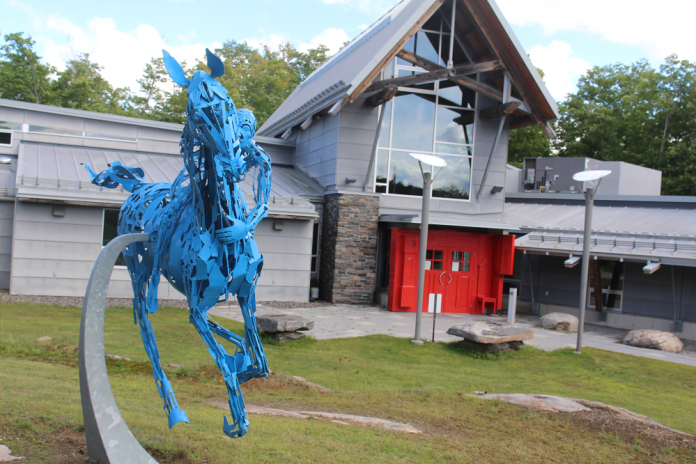
Haliburton School of Art + Design. Photo by Joseph Quigley.

The Haliburton School of Art + Design will go without students in its halls this month as it runs only three courses this semester – all starting entirely online.

Fleming College has decided to begin with online-only learning across all of its campuses, including Haliburton, due to COVID-19. The school plans to return to some in-person learning in November depending on the course of the pandemic.

Fleming College president Maureen Adamson said the Haliburton campus has been the hardest hit by the format, given how experiential it is. She stressed safety when asked about the online-only decision and how it contrasts to grade schools returning to in-person learning.

“Every decision we’re making is based on safety,” Adamson said. “If we can’t set up a classroom that’s appropriately socially distanced, then we won’t run it because the worst thing that could possibly happen for Fleming is to have to shut down again. It’s an extraordinary challenge.”

Like all schools, Fleming closed its doors in March at the onset of the pandemic, switching to online delivery and cancelling its dozens of weeklong summer courses. Many post-secondary schools are taking a similar approach this fall, going to primarily remote delivery, with some allowing blended courses with limited in-person instruction.

Fleming has had to cut down on its 12 full-time Haliburton programs for this semester, as well as other weeklong courses. This semester, the college will deliver its drawing and painting certificate program, as well as its integrated design and digital and creative design diploma programs, with each running between 12 and 20 students.

“The faculty has retained all of the learning outcomes but converted to a digital format,” Adamson said.

The decline in courses has hit enrolment. Across all its campuses, Adamson said domestic enrollment is down 30 per cent and international is closer to 40. That has led to layoffs as well, though Adamson said they have tried to keep as many people employed as possible and they hope layoffs are temporary.

The decline in college students is concerning to some in the Haliburton community.

Landlord Nicola Jowett has offered rooms to students in Haliburton for 12 years but finds several of them empty this September without a student population.

“Frustrated. We’re all in this together and it’s a very difficult situation. Some schools are going back, some places are not,” Jowett said, adding she is considering moving away from offering student housing. “It does put me in a precarious situation.”

Adamson said the college is doing everything it can to support students through the semester ahead.

“We know students, parents, everybody’s nervous and anxious,” Adamson said. “Fleming College has really pulled out all the stops to make all students – new and returning – comfortable, and most importantly, safe.”

Runners stride from the hills of Haliburton to the streets of Boston

0
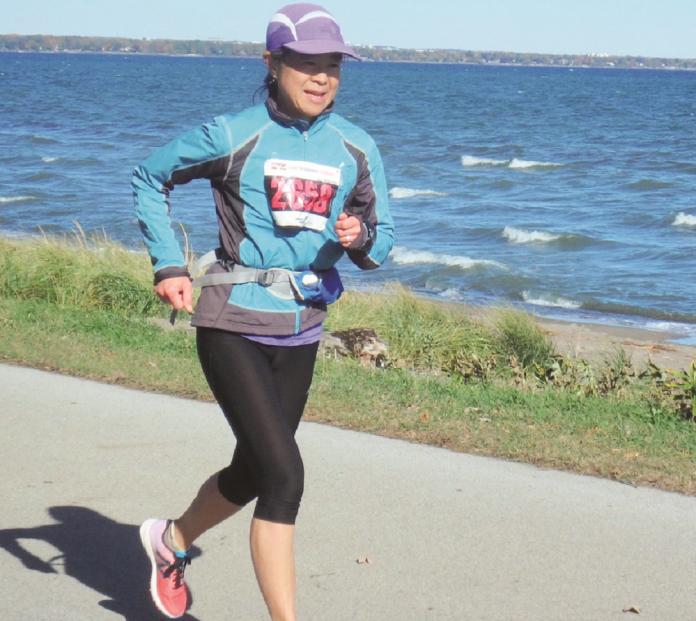
Sue Shikaze is about to run her fourth Boston Marathon. Photo submitted.

Duncan Farthing-Nichol is about to run the Boston Marathon – in Haliburton.

When organizers of the iconic footrace were forced to cancel this year’s event due to COVID-19, they instead offered qualifiers an option of running a marathon in a place of their choosing.

Farthing-Nichol chose a 42.195 km route in his adopted home of Haliburton. He’ll run it Sept. 12.

The 31-year-old said he wasn’t surprised by the Boston cancellation.

“It was mid-March and it looked as if the world might not last much longer,” he said.

The marathon was originally scheduled for April 20. It was rescheduled to Sept. 14 before being called off entirely.

“I couldn’t grieve too much over it. And, to tell the whole truth, I was a little relieved because the delay meant I could take a break from my training regime,” Farthing-Nichol said.

He is back at it now, though. He runs four times a week. Monday is a steady eight or nine-kilometre run, Wednesday is hill repeats (run fast up the hill and slowly down, five or six times), Friday is kilometre repeats (run a kilometre fast, stop and rest a minute or two, then do it again), Saturday is a long run, up to 32 kilometres.

While naturally disappointed he’s not headed to arguably the most famous marathon in the world, Farthing-Nichol said he loves the virtual option.

“Even if I’d prefer Boston, I’d much rather run at home than shelve the whole thing and try again another year. Plus, this way, no travel, no worries, finish at your front door, couldn’t be easier. And the race organizers have done a wonderful job making sure we’ve the things we need to make it special – a custom audio track for the race, a website to design your own finish line, a medal in the mail.”

Farthing-Nichol qualified for Boston during the 2019 Ottawa Marathon. He ran track and cross-country in high school and started again a few years ago “because I can’t press a bench to save my life and being a skinny dude at the gym is no fun.”

He decided to run his first marathon because he was planning to run a halfmarathon and then thought, “in for a penny, in for a pound.”

This marathon will be his third. He has chosen a route that begins and ends at his girlfriend Jessica Slade’s house.

“I tried to avoid the highways, taking quiet, picturesque roads like Wigamog and Caribou instead. I may have erred in choosing the brutal hills of Pine and Harburn for my next-to-last stretch, but it’s too late now and maybe I’ll catch a second wind on the decline. I find the stretch near Fleming College among the most relaxed in Haliburton; I thought it’d work its pleasing magic as I make my way home.”

He ran his last marathon in 2:56:14. He doesn’t think he’ll make that same time due to the hills but thinks he’ll clock 3:15 and hopefully faster.

He said he loves running in the Highlands.

“People around here are lovely. Twice now I’ve gotten lost and needed to make a phone call (I don’t carry my phone while running), and neither time was it difficult to flag down a stranger to help me out.”

Sue Shikaze to run fourth time

Meanwhile, Sue Shikaze is planning to run her fourth Boston Marathon at home Sept. 12.

She ran in 2004, 2008 and 2015, each time in a different age group since they go in five-year increments.

“I made it a goal to run in another consecutive age group (55-59) in 2020,” she said.

She qualified at the Hamilton Marathon in 2018, receiving confirmation in September, 2019 that she was in for 2020.

Initially, when it was announced the Boston race had been shelved but she could run at home, she said she wasn’t all that keen.

“Training for and running a marathon is hard enough when it’s a big event, never mind running one alone. But I finally did register. It is only open to runners who were scheduled to run in April 2020, and instead of thinking of it as just a solo marathon, I reframed it to this being the Boston Marathon in 2020. It’s a unique experience.”

She said more than 17,000 people have registered worldwide.

“It has actually been more motivating than I thought it would be, and good to have an event and goal to be training for. I haven’t done quite as much mileage as I normally would for a marathon, but I’ve definitely been consistent and done some long runs that make me pretty confident that I’ll be able to finish in a reasonable time,” Shikaze said.

With Boston organizers bringing the marathon to the world, Shikaze said there is an app that all runners have access to, which has printable start and finish lines, signs for each town, sounds of cheering crowds and tracking, as well as the leaderboard. There’s also a medal, T-shirt and program.

She’ll start at 8 a.m. from her place on Gelert Road (south of Donald), to Lochlin Church Rd., Tom Bolton Rd, Kash Road and back home. It’s about 15.5 miles. She’ll do the remaining distance out and back on the rail trail towards Haliburton. She anticipates it will take about 4.5 hours and said, “spectators welcome!”

New retail development proposed for Haliburton

0
The site plan for a new retail development in Haliburton. Photo via Dysart et al

Dysart et al council got its first look at the site plan for a massive new retail development in Haliburton but are getting pushback on the municipal securities requirements.

The municipal committee of the whole reviewed a proposed development at 10 Hops Dr., along County Road 21, featuring a 10,000-square-foot retail store, a restaurant with a drive-thru and a gas bar. The tenants of the buildings are undetermined.

But the developer, Toronto-based Marnac Management Corp., is disputing the cost of securities to be held by the municipality. The municipality is requiring $201,390 based on work-cost estimates, while the developer is estimating $153,597. Council received the report for information, with the developers scheduled to make their case at the Sept. 26 council meeting.

“There’s probably some room to negotiate here,” Deputy Mayor Patrick Kennedy said. Mayor Andrea Roberts said there is the possibility to adjust the percentages on securities, considering how significant a development this is for the community. “We know development on that property will be good for our community,” Roberts said. “We have to weigh that out.”

But Coun. Larry Clarke said they should defer to staff.

“We have to be consistent,” Clarke said.

“There’s a precedent that’s established. We have to be professional in how we address this.”

Drive-thru questioned

The municipality has several requirements for the development, such as compatibility with local landscaping and compliance with the official plan.

Coun. John Smith asked about requiring the removal of the drive-thru, concerned about the environmental impact of idling cars.

“There will certainly be many people who will be upset at the thought of a drive- thru restaurant,” Smith said. “Many other communities have already placed a limit on them because of the impact in terms of greenhouse gases.”

Roberts said the municipality has previously refused a drive-thru development due to proximity to a residential area.

Senior planner Kris Orsan said there is nothing in the official plan for limiting drive-thrus, but it is something that could be considered.

Coun. Walt McKechnie did not agree with cutting it out entirely.

“I don’t think I’m the only guy who has a car that shuts down when sitting on a red light,” he said. “Are we really discussing not being open for fast-food restaurants for drive-thru? This is 2020, isn’t it?”

Major roadworks planned for 118

0

People advised to remove docks

The Ministry of Transportation (MTO) is advising people who live on Highway 118 between Carnarvon and Haliburton to remove docks and related structures in advance of planned roadworks.

Project manager Judith Baldasaro confirmed the deadline for removal is Sept. 15.

She said that would allow the ministry enough time to prepare the area for utility relocation work. 

The MTO is planning a rehabilitation of the highway, from Highway 35 east to 0.7 km west of Haliburton County Road 21, a stretch of 23.4 km.

According to a letter sent to affected residents, dated Aug. 31, the MTO said AECOM is finalizing a detail design study. It said improvements will include: slope stabilization works at Head Lake; highway resurfacing; culvert repair and replacement; drainage improvements; treatment of frost heaves and distortion areas; guiderail replacement or adjustment and intersection improvements at Kennisis Lake Road. The slope stabilization works involve placement of rock fill along the highway embankment.

“This project is being undertaken to improve the pavement condition, ride quality, safety and operational characteristics of Highway 118,” Baldasaro said.

She said utility relocation is scheduled to begin in October with construction scheduled to begin in 2021, pending funding, clearances and approvals.

As for owners removing docks and other infrastructure, she said, any “remaining after Sept. 15 will be removed and disposed of by the ministry to ensure the utility relocation work is not delayed. The ministry will not be reinstating the docks and related structures.”

Anyone seeking more information can contact Baldasaro at 705-497-6936 or Judith.Baldasaro@ontario.ca

Harp in the Dark – chapter 7: Heartbeat

0

By Hope Thompson

“You cannot see him,” the nurse said to Detective Harry Harp and Constable Terry Becker. “He’s having tests.”

After driving to the Golden Villa Retirement Centre to see Stanley Barley, they had discovered that the old man had been admitted to hospital earlier in the day. Harp asked the nurse how long they would have to wait.

“Take a seat,” she said wearily.

The two men sat down in the waiting area and Becker flipped open a fishing magazine. Harp leaned back and let his thoughts drift to Brigitte Cave, the librarian he’d met two days earlier. He couldn’t get her out of his mind. And then he wondered if that was how Rand felt about Irene Barley.

But did it happen that way? Did Stanley Barley catch Rand Carlyle with his wife and then murder him in a jealous rage?

Goofy music interrupted his thoughts. Across from him, a boy played an electronic device, thumbs jabbing frantically. Next to the boy sat a white-haired man whose leg was in a cast, and in the corner, two men sat close together, both looking at their phones and talking quietly. Harp considered their neat hair and fitted clothes and the lines in his forehead deepened. Then he remembered the numerology project—begun by the original detective on the case, George Maclem. The gender tally for the night of the murder was 12 men and 10 women. If everyone paired up, two men would be left out. Suddenly, an unmistakable feeling of clarity filled Harp’s mind.

“I have it!” he said.

“Listen,” Becker whispered.

The hospital’s public address system crackled through the air: “Repeat: Adam Barley to reception.”

Harp and Becker rushed to the nurse’s station and she looked up at them suspiciously. “So, which one of you officers is Adam Barley?”

Harp said, “Neither. We just want to talk to him.”

“First the father, now, the son.” The nurse rolled her eyes. “Make up your minds.”

Suddenly, Harp remembered his revelation and turned to Becker. But at the same moment, a door opened behind where the constable was standing. It was the door to the men’s room and a man stepped out. He was tall and thin with white-blond hair. He walked around the two detectives.

“I’m Adam Barley,” he said to the nurse.

She looked up. “Doctor wants to see you but he’s just this minute been called into Emergency.” She nodded over his shoulder. “And these gentlemen here….”

Adam turned to find Harp holding out his police ID card.

“Mr. Barley?” The detective introduced himself and Becker. “Could we have a word?”

Harp directed him to a private alcove away from the main waiting area.

“What’s this about?” Adam Barley said with undisguised nervousness.

Harp said, “We’re investigating the murder of Rand Carlyle.”

Barley nodded, eyes on the floor, fingers twitching.

“When did you last see your father?” Harp said.

Barley looked surprised. “Years ago. We’re not that close.”

“Why? What happened?” Becker said.

Barley shrugged, “Life, I don’t know.”

The constable frowned.

“Mr. Barley, tell us about August 1970,” Harp said.

“I worked at Pines End. My parents got me the job. And I hated it.”

“What was so bad about it?” Becker said.

“I was 16 and I had to wait on guests my own age. It was humiliating.”

“What about Rand Carlyle?” Harp said.

“What about him?”

Becker said, “We know you took him fishing. You must have been friendly with him.”

“My job was to do what people asked—get towels, drinks, take them fishing, whatever.”

Harp was silent for a moment. “What do you do for a living, Mr. Barley?”

“I’m an accountant. Why?”

“You’re married?” Harp said.

“No,” Barley said. “I live alone. Now, if you’ll excuse me, I have just driven six hours and I’d like to see my father.”

 “And we have a murder to solve.” Harp faced him. “What were you doing on the night of August 1, 1970?”

Barley scowled. “I don’t remember. Probably fetching drinks for people! It was Simcoe Day. There was a bonfire, I remember that.”

“Did you see Rand?”

“No!” Barley cried then took a breath and spoke calmly. “I don’t remember.”

To Harp, the man was somehow incomplete as if something had stunted his growth. The detective wondered if it was the truth. “Mr. Barley,” Harp said. “I believe you knew Rand Carlyle extremely well. In fact, I believe you knew him—intimately.”

Becker’s eyes shot open.

Barley launched from his seat. “I am not going to sit here being accused of—indecency!” He turned to leave but Becker was on his feet blocking his exit.

“We just want the truth, Mr. Barley.” Becker gently touched Barley’s elbow. “Please?”

Barley stared at the young constable’s hand then sat down.

“Look, I knew Mr. Carlyle. And I liked him—though certainly not as you suggested.” He ran his hand over his face. “He was a lot nicer to me than those kids. He was kind.” The man looked up. His face was filled with confused emotion. “He didn’t deserve to die!”

Harp’s eyes glinted. “But his killer thought differently. His killer was filled with so much ferocious hate that he drove an ice pick into Randolph Carlyle’s back.”

Barley winced.

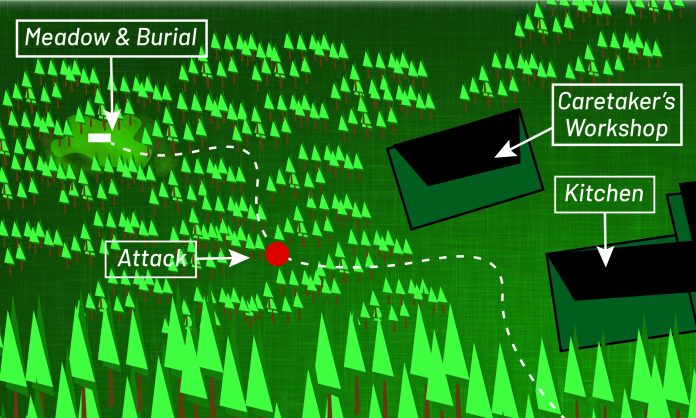
“Then buried his body in an old fridge in a little meadow in the woods.”

Adam Barley’s face softened as if remembering something long forgotten.

“I believe your father saw you and Rand together and that drove him to kill—.”

Barley leapt to his feet. “NO!”

Just then, the nurse rushed towards them. “Mr. Barley? Come with me.” She waved at him. “Your father’s taken a turn.”

A few minutes later, Adam Barley stood beside his father’s hospital bed. A breathing mask covered Stanley Barley’s face and tubes and wires crisscrossed his body. Adam looked down at him and thought about what the detective had said.

Tears stinging his eyes, Adam squeezed his father’s hand as the heartbeat monitor pulsed erratically.

August 1, 1970 – 4 PM

Adam Barley was well aware that guests would be asking for drinks and that the hateful Cat Wilson would be whistling for him and that he had to collect wood for the bonfire and do a million other things. But he didn’t care because, he, Adam Barley, was in love.

Turn at the boulder then over the fallen tree and up the slope. He knew the way to the little meadow by heart. He also knew that Rand was already there because he could smell his cologne.

Pushing aside bushes, he stepped into the sunlit meadow where Rand lay waiting.

Adam joined him and they stared up at the sky. Except for the sounds of insects and rustling leaves the forest was silent. Then a twig snapped.

“What was that?” Adam whispered, eyes wide.

Rand pulled him close. “That’s the sound of my heart beating crazily for you.”

At the edge of the meadow, a woman peered through the bushes. Her face was twisted by horror at the sight of what Randolph Carlyle was doing to her boy—her dear sweet boy.

Irene Barley’s eyes narrowed as she realized what she had to do.

Harp in the Dark – chapter 6: Prejudice

0

By Hope Thompson

After their interview with 90-year-old Stan Barley, the former caretaker of Pines End, Detective Harry Harp and Constable Terry Becker stopped in at the local café. The two men sat huddled in a corner booth staring down mugs of coffee.

Becker peeled the wrapping off a muffin and took a bite.

“What do you make of Stan Barley?” Harp said.

“He’s grumpy.” Becker pulled a serviette from the dispenser on the table and wiped his fingers. “But that could just be old age talking.”

“Or guilt.” Harp took a sip of coffee. “I’m pretty sure he knows more than he’s saying.” The detective wrapped his fingers around his coffee mug. “Remember what Crystal Corrigan said about antiques?”

Becker nodded. “Sure. They were all over Pines End—even in the kitchen. Muir was so stingy, stuff wasn’t updated and a lot of the antiques were still in use, like the old fridges. So?”

Harp raised a finger. “Crystal didn’t remember the ice pick but it could have been part of the antiques lying around. Look—let’s say it was. Then Stan had the means. And very likely the opportunity.”

Becker nodded. “But what about motive?”

Ten minutes later, the two men were back at their office in the Spruce County Police Department. On a white board, Becker had written the names of all guests and staff and next to each name was a note. “Deceased” was written beside most names.

Fingers clattering over his keyboard, Becker leaned back grinning.

“Thank god for online obituaries!” The constable said.

Harp’s desk was covered in the scrawled pages of his ongoing numerology project. He looked up, blinking.

“Just found Trudy Carlyle’s obituary. She died four years ago. Predeceased by her husband and daughters, Emily and Lily.” Becker jumped up and added the information beside their names.

“Everyone who was an adult at the time of the murder is deceased—except for Stan.” Becker sat down and started typing again. “And I’ve tracked down the teenage guests—just waiting on the Moort twins and Adam Barley to get back….”

Harp squinted at the white board, not listening.

“Is—something the matter?” Becker said.

Trance like, the detective picked up a marker and drew lines between names. Becker grimaced as Harp destroyed his neat list.

“I get it,” Harp said. “I get the numbers thing!” He frantically drew lines between Mr. and Mrs. Muir, the lodge owners, between the Carlyle’s, between Cat Wilson and Brett Penzler. The detective spun around.

“Matchmaking!”

“Huh?” Becker said, walking over.

“If we eliminate the Wilson baby, there are 12 males and 10 females. With the most obvious pairings, the Penzler and Moort dads are left out.”

“Left out of what?” Becker scratched his head.

“Of romance! Remember what Brigitte said? People go on vacation for a lot of reasons and romance is one of them.”

Becker’s eyes narrowed. “You think it was a crime of passion?”

“What if Stan’s wife, Irene, was having an affair with Rand Carlyle? And Stan found out….” Harp gestured a plunging motion. “And killed Rand.”

“Solid motive,” Becker said.

Harp flipped through the original case papers. “Says here, Maclem found empty booze bottles on the lawn. It was concluded that Rand was drunk, stumbled into the water and drowned. But I don’t think Maclem believed that.”

Becker nodded. “Doesn’t the file say Rand was keyed up? Excited? The man was looking for love. Maybe he walked into the woods to find Irene Barley.”

Becker put his fingers together like the preacher in ‘Night Of The Hunter’. “But instead, he found hate. I mean, in the form of death.”

Harp’s eyes flashed. “Stan could easily have spied on the party at the fire pit and when he saw Rand leave, all he had to do was follow him. And Rand was stabbed in the back.” The detective sat down. “This wasn’t a confrontation. This was the swift elimination of a problem.”

Just then Harp’s phone buzzed and he answered it. The detective looked momentarily confused then thanked the caller and hung up.

He shrugged. “Cat Wilson’s back.”

“And the cat came back….” Becker said, grinning.

A couple of minutes later, the two men sat down across from the tanned retiree.  

Harp smiled. “What can we do for you today, Ms. Wilson?”

“Call me Cat,” she said brusquely. “Now I want to add to my earlier statement thingy. Just to be completely honest.” She shifted in her chair. “There was a kid called ‘dogsbody’. I don’t know his name, anyway, my sister and I were, well, rather cruel to him.” She threw her head back. “Nothing criminal. Just mean. As kids can be.”

Harp’s forehead creased. “Why?”

Cat was silent. “He was a local kid and we were from the city and we just, well, we felt superior.” She smiled widely. “Of course, I’ve changed, I mean, I live here. I love Spruce County!”

Becker’s eyes narrowed. “His name is Albert Barley.”

“Oh,” Cat said quietly. “Oh, of course! His mother and father worked there.”

Harp leaned forward. “Do you remember seeing Rand Carlyle with either of them?”

Cat shook her head. “I just remember the father—a big man. Gruff.” She shivered.

A few minutes later, the interview ended and the two men sat alone in the meeting room.

“Interesting,” Harp said.

“Prejudice is interesting?” Becker pointed at the door Cat Wilson had just exited through.

Harp said, “No. But think of Stan. He discovers Rand Carlyle with his wife. And Rand is from the city! Rand could have had that same superior attitude.”

Becker looked out the window. “Stan would have hated him even more.”

“Let’s talk to him.” Harp stood up. “And this time, let’s get the truth.”

August 1, 1970 – 10:00 PM

As the fire died down, people drifted into the lodge. Before Rand Carlyle joined the flow, he cast a look over his shoulder at his wife, Trudy. She was deep in conversation with Mrs. Wilson, the flames casting an orange glow over both women’s faces.

Perfect, thought Rand with a sly smile.

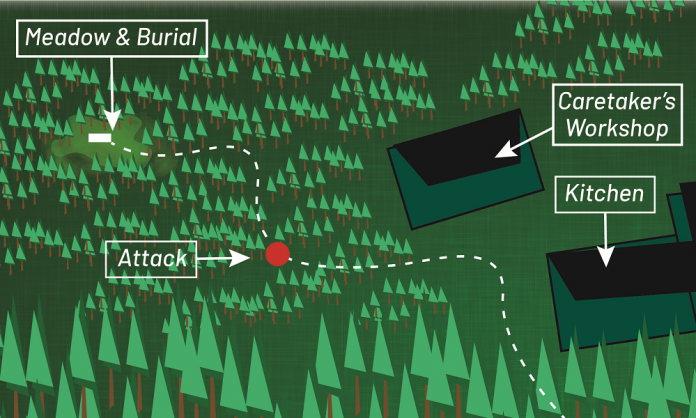
As other guests crossed the terrace and entered the lodge, Rand stepped to the left and disappeared into the darkness. The route through the woods to the little meadow was familiar, even in the dark. He’d made the same trip once already that day and many times during the week, ever since the first meeting, the first moments of connection. Yes, it was dangerous but the danger just made the whole enterprise more exciting. He turned at the little building and stepped into the forest as a woodland chorus played around him—a croak and a buzz here, a rustle there. Then another sound: quick footsteps. Rand smiled and started to turn—when sharp metal sunk into his back and searing pain made him freeze. He stumbled forward grabbing at the air, then collapsed on the forest floor. Filling with blood, his throat constricted and he gasped, breathing in the damp scent of moss and pine bark and his mind began to close and as it did, he held on to one image—the face of love—until that, too, was gone.

Still Standing headed Minden’s way

0

CBCs Still Standing is planning to film in Minden the week of Sept. 20, and then present a pandemic-revised live comedy show at the fairgrounds later in the week.

Minden Hills staff and councillors discussed the visit during their committee of the whole meeting Sept. 10.

While the national broadcaster first pitched the idea at a June 18 meeting, and planned to film in July, it was delayed due to COVID-19.

They approached the township again recently about kickstarting the project.

CAO Trisha McKibbin said, “They have reached out to us and we’re seeking some direction and comfort from council, specifically regarding the comedy show portion.”

Still Standing is one of CBC television’s flagship shows, now filming its seventh season. Hosted by Canadian actor and comedian Jonny Harris, it explores the challenges facing small communities across Canada and celebrates their people.

McKibbin said CBC is recommending the comedy show portion be a closed event, and not open to the general public. She said they would limit numbers to 100 as per provincial government guidelines for outdoor gatherings. They’re recommending that only people filmed and their families be invited and it would be outdoors in the bandshell area of the fairgrounds. Each participant will be seated within their family bubble; six feet from another bubble; masks required; no lineups; and hand sanitizer provided.

“This is the first filming taking place in COVID-19 of Still Standing and certainly in my conversations, they want to protect their crew and they want to protect the public as well,” McKibbin said.

She said the township’s emergency control group has questioned whether 100 people is too many and if there could be a drive-in element.

Deputy mayor Lisa Schell said she spoke with story producer, Shayla Howell, “and I felt very confident that they were in control and had a good plan put in place and they definitely were willing to work with the municipality.”

“I know I go to the grocery store and I’m in a building where there’s way more than 100 people there, so I don’t see how, being at the fairgrounds, separating 100 people, will be an issue,” she said.

Coun. Jennifer Hughey said there are other areas in Ontario doing similar things and Ontario’s 100-person limit for outdoor gatherings is lower than Montreal, for example, which allows 250.

“It’s really at people’s comfort level as well as how we would like to protect our staff,” she said.

Coun. Hughey said she had accepted a job as a fixer for the show. She said it is a paid position but she would donate the money to the Minden Community Food Centre.

Coun. Ron Nesbitt suggested a drive-in format given recent rainy weather in the township.

Coun. Pam Sayne said she’s excited about the event and thinks it’s great that it’s proceeding. However, she said the emergency control group had denied other events, so pandemic decision-making needed to be reviewed in future.

She also wondered if the general public could not access the show via Zoom.

McKibbin said the emergency control group has said no to events in the past, a month to six weeks ago, and that has been part of the discussion as, “we don’t want to feel we’re being selective in saying yes to one group and no to another.”

Coun. Bob Carter said he’s fine with 100 people and not lowering the number since, “if we are within the rules and the guidelines and we are practicing all the necessary precautions, I’m in favour of allowing this to go forward.”

Coun. Jean Neville added, “I think it’s great that we proceed and it sounds as though CBC has done a great deal of extensive research and planning and it might be an innovative concept to do a combination of the family pod and a drive-in and that would accommodate the 100 maximum. I’m in agreement with it going forward.”

OPP investigating fatal collision on Highway 118

0
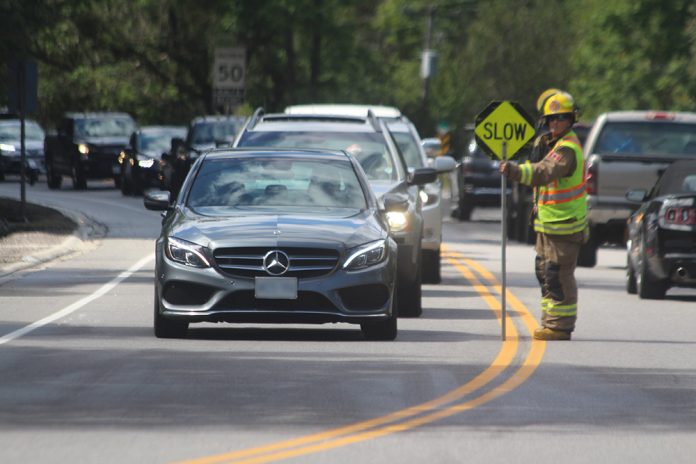
Emergency crews manage traffic on Highway 118 Sept. 4. Police announced Sept. 10 there was a fatal collision between a dump truck and a pedestrian that afternoon. Photo by Joseph Quigley.

Haliburton Highlands OPP announced they are investigating a fatal collision invovling a dump truck and a pedestrian Sept. 4.

Emergency responded to the single-vehicle collision around 12:50 p.m. on the Highway within Dysart et al. The pedestrian, a 59-year-old from Haliburton, was transported to hospital and pronounced deceased, according to police.

“OPP Technical Traffic Collision Investigators (TTCI) attended the scene to assist the investigation,” police said. “No foul play is suspected.”

Police closed down a section of Highway 118, between Kennaway Road and Glamorgan Road, throughout the afternoon Sept. 4, diverting and slowing traffic.

More to come.

Harp in the Dark Chapter 7: Heartbeat

0

By Hope Thompson

“You cannot see him,” the nurse said to Detective Harry Harp and Constable Terry Becker. “He’s having tests.”

After driving to the Golden Villa Retirement Centre to see Stanley Barley, they had discovered that the old man had been admitted to hospital earlier in the day. Harp asked the nurse how long they would have to wait.

“Take a seat,” she said wearily.

The two men sat down in the waiting area and Becker flipped open a fishing magazine. Harp leaned back and let his thoughts drift to Brigitte Cave, the librarian he’d met two days earlier. He couldn’t get her out of his mind. And then he wondered if that was how Rand felt about Irene Barley.

But did it happen that way? Did Stanley Barley catch Rand Carlyle with his wife and then murder him in a jealous rage?

Goofy music interrupted his thoughts. Across from him, a boy played an electronic device, thumbs jabbing frantically. Next to the boy sat a whitehaired man whose leg was in a cast, and in the corner, two men sat close together, both looking at their phones and talking quietly. Harp considered their neat hair and fitted clothes and the lines in his forehead deepened. Then he remembered the numerology project—begun by the original detective on the case, George Maclem. The gender tally for the night of the murder was 12 men and 10 women. If everyone paired up, two men would be left out. Suddenly, an unmistakable feeling of clarity filled Harp’s mind.

“I have it!” he said.

“Listen,” Becker whispered. The hospital’s public address system crackled through the air: “Repeat: Adam Barley to reception.”

Harp and Becker rushed to the nurse’s station and she looked up at them suspiciously. “So, which one of you officers is Adam Barley?”

Harp said, “Neither. We just want to talk to him.” “First the father, now, the son.” The nurse rolled her eyes. “Make up your minds.”

Suddenly, Harp remembered his revelation and turned to Becker. But at the same moment, a door opened behind where the constable was standing. It was the door to the men’s room and a man stepped out. He was tall and thin with white-blond hair. He walked around the two detectives.

“I’m Adam Barley,” he said to the nurse.

She looked up. “Doctor wants to see you but he’s just this minute been called into Emergency.” She nodded over his shoulder. “And these gentlemen here….”

Adam turned to find Harp holding out his police ID card.

“Mr. Barley?” The detective introduced himself and Becker. “Could we have a word?”

Harp directed him to a private alcove away from the main waiting area.

“What’s this about?” Adam Barley said with undisguised nervousness.

Harp said, “We’re investigating the murder of Rand Carlyle.”

Barley nodded, eyes on the floor, fingers twitching.

“When did you last see your father?” Harp said.

Barley looked surprised. “Years ago. We’re not that close.”

“Why? What happened?” Becker said.

Barley shrugged, “Life, I don’t know.”

The constable frowned.

“Mr. Barley, tell us about August 1970,” Harp said.

“I worked at Pines End. My parents got me the job. And I hated it.”

“What was so bad about it?” Becker said. “I was 16 and I had to wait on guests my own age. It was humiliating.”

“What about Rand Carlyle?” Harp said. “What about him?”

Becker said, “We know you took him fishing. You must have been friendly with him.”

“My job was to do what people asked— get towels, drinks, take them fishing, whatever.”

Harp was silent for a moment. “What do you do for a living, Mr. Barley?”

“I’m an accountant. Why?”

“You’re married?” Harp said.

“No,” Barley said. “I live alone. Now, if you’ll excuse me, I have just driven six hours and I’d like to see my father.”

“And we have a murder to solve.” Harp faced him. “What were you doing on the night of August 1, 1970?”

Barley scowled. “I don’t remember. Probably fetching drinks for people! It was Simcoe Day. There was a bonfire, I remember that.”

“Did you see Rand?”

“No!” Barley cried then took a breath and spoke calmly. “I don’t remember.”

To Harp, the man was somehow incomplete as if something had stunted his growth. The detective wondered if it was the truth. “Mr. Barley,” Harp said. “I believe you knew Rand Carlyle extremely well. In fact, I believe you knew him— intimately.”

Becker’s eyes shot open.

Barley launched from his seat. “I am not going to sit here being accused of— indecency!” He turned to leave but Becker was on his feet blocking his exit.

“We just want the truth, Mr. Barley.” Becker gently touched Barley’s elbow. “Please?”

Barley stared at the young constable’s hand then sat down.

“Look, I knew Mr. Carlyle. And I liked him—though certainly not as you suggested.” He ran his hand over his face. “He was a lot nicer to me than those kids. He was kind.” The man looked up. His face was filled with confused emotion. “He didn’t deserve to die!”

Harp’s eyes glinted. “But his killer thought differently. His killer was filled with so much ferocious hate that he drove an ice pick into Randolph Carlyle’s back.”

Barley winced.

“Then buried his body in an old fridge in a little meadow in the woods.”

Adam Barley’s face softened as if remembering something long forgotten.

“I believe your father saw you and Rand together and that drove him to kill—.”

Barley leapt to his feet. “NO!”

Just then, the nurse rushed towards them. “Mr. Barley? Come with me.” She waved at him. “Your father’s taken a turn.”

A few minutes later, Adam Barley stood beside his father’s hospital bed. A breathing mask covered Stanley Barley’s face and tubes and wires crisscrossed his body. Adam looked down at him and thought about what the detective had said.

Tears stinging his eyes, Adam squeezed his father’s hand as the heartbeat monitor pulsed erratically.

August 1, 1970 – 4 PM

Adam Barley was well aware that guests would be asking for drinks and that the hateful Cat Wilson would be whistling for him and that he had to collect wood for the bonfire and do a million other things. But he didn’t care because, he, Adam Barley, was in love.

Turn at the boulder then over the fallen tree and up the slope. He knew the way to the little meadow by heart. He also knew that Rand was already there because he could smell his cologne.

Pushing aside bushes, he stepped into the sunlit meadow where Rand lay waiting.

Adam joined him and they stared up at the sky. Except for the sounds of insects and rustling leaves the forest was silent. Then a twig snapped.

“What was that?” Adam whispered, eyes wide.

Rand pulled him close. “That’s the sound of my heart beating crazily for you.”

At the edge of the meadow, a woman peered through the bushes. Her face was twisted by horror at the sight of what Randolph Carlyle was doing to her boy— her dear sweet boy.

Irene Barley’s eyes narrowed as she realized what she had to do.

Left to Tell Part 8: Closer to home

0
Flikr.

By Mabel Brannigan

At home in Haliburton County, the Saturday night thrill was hockey by radio with Foster Hewitt, telling the whole country ‘he shoots, he scores.’ Well, the Toronto Exhibition Park had become a military camp, the Royal Winter Fair had closed, and many hockey players had enlisted, including the famous Boston Kraut line of Bobby Bauer, Woody Dumart and Milt Schmidt. But national hockey continued, and transcripts were sent to the troops overseas.

Hardly anyone locked their doors in Haliburton County at night.

While war ravaged towns and cities on one side of the ocean, we were not immune to fire at home as the east side of Minden’s main street was tragically destroyed by fire in the spring of 1942.

Earl Hewitt and Pat McKay, reaching main street, saw Percy Brintnell, the baker, coming down a ladder in his underwear.

“Where is Ina and Barb?” asked Earl. Ina is getting her purse and Barb has gone to Hartles, he told Earl. Earl brought Percy a pair of pants and everyone started a bucket brigade from the river. Minden had no fire protection. A few had pumpers, the kind that could be laid in the river.

As the flames raced towards the telephone office, threatening to cut off all communications, Earl phoned a friend, Charlie Lamb, mayor of Lindsay. And in 55 minutes the fire department was here. Without this help, all of Minden may have burned.

Mark Snell is also credited with hanging sheets of 12-foot steel roofing from the eaves of Moss Kellett’s Dominion Hotel for saving the west side. Brintnells were the first to rebuild and the Haliburton County Echo relocated in the village of Haliburton.

Most people concluded that the fire was caused by an explosion in the bakers shop, but Earl had his own theory. At 4 a.m., on May 15, 1942, the day of the fire, Earl was awakened by a dog barking at the transport building. A car drove away from the building followed by a loud bang on main street.

Just prior to this tragedy, fires had been set in Gelert and Donald. Needless to say, Earl was convinced for the rest of his life that Minden’s fire was deliberately set.